Heat Transfer Enhancement of Nanofluid in Natural Convection of an Enclosure Heated
from Below
In Cheol Bang, Eung Soo Kim, Soon Heung Chang
Dept. of Nuclear & Quantum Engineering, KAIST, Daejeon, Republic of Korea Tel: +82-42-869-3856, Fax: +82-42-869-3810, E-mail: [email protected]
1. Introduction
The general strategy for improving the safety of nuclear power plant and its economics is to accomplish power uprates while securing sufficient thermal-hydraulic margin. In order to succeed this strategy, there have been a lot of efforts in increasing the margin through the enhancement of heat transfer capability in coolants. However, despite their efforts, only about 10 ~ 15 % increase of the thermal margin is possible by using the best art known well up to now with installation of mechanical engineering devices such as mixing vane or button to generating the swirl flow and turbulent mixing.
The limit of the capability of the best technique has made a lot of engineers to be frustrated to do the power uprates. Nevertheless, fortunately a new innovative idea is being proposed in heat transfer community as an engineering colloidal fluid to basically change the original properties of the coolant. The fluid began to be called by Choi[1] as a nanofluid which is a mixture of solid nanoparticles and liquid.
So many researchers expressed a lot of interests in its capability. Their focuses are limited in investigations of thermal conductivity enhancement. All thermal engineers usually have learned the importance of natural convection with the convective motion driven by buoyancy in a thermal system design. Its understanding is central to investigate on flowing characteristics of the nanofluids. In particular, natural convection in enclosure has considerable interest of many engineers due to the characteristics of the motion derived by the interaction of a difference in density driven by thermal gradient with a gravitational field. And also, the natural convection is significantly important in an accident of loss of pumping capability in nuclear power plant and a safety analysis. Therefore, the purpose of this paper is to investigate the basic natural convection characteristics of nanofluids for which yet a lot of understanding is necessary. For this, a commercial CFD code, Fluent is used.
2. Natural convection (Benard Cells) and heat transfer Characteristics of nanofluid
In enclosures heated from below, the imposed temperature difference must exceed a finite critical value before starting fluid motion and convective heat transfer occurs. As the temperature gradient exceed a critical value, the condition for the onset of convection is expressed by the critical Rayleigh number [2]
Ra ≥ 1708 (1)
Where Ra g Tβ( H T HC) 3
αν
−
= .
Immediately above Ra =1708, the flow consists of counterrotating two-dimensional rolls like Fig. 1. The flow pattern is commonly called as Benard cells or Benard convection. The heat transfer effect of the cellular flow is to augment the net heat transfer rate [2]. Generally, the correlations of heat transfer for natural
circulation have a type of Nu=ARaB.
Cellular flow pattern
Heater (Hot) Cooled
g
Fig. 1. Horizontal fluid layer heated from below [2,3]
2.1 Cellular flow pattern in Water
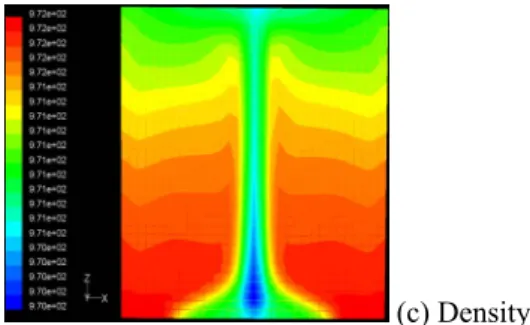
We simulated the Benard cells by using Fluent code. The fig. 2 shows the results displaying the buoyancy-driven motion by density differences caused by temperature gradient. The enclosure has a size of 160 x
8 x 165 (xyz direction) mm3 and a heater of 4x100 mm2
in bottom. 50 kW/m2 heat flux is assumed.
(a) Velocity
(b) Temperature
Transactions of the Korean Nuclear Society Autumn Meeting Busan, Korea, October 27-28, 2005
(c) Density Fig. 2. Field contours in Water
2.2 Cellular flow pattern in Nanofluid
The simulation for alumina (Al2O3) nanofluid by
assuming that alumina nanoparticles are well dispersed in water as a base fluid was also performed as shown in Fig. 3. The particle concentration can be considered uniform throughout the enclosure and the effective properties of the nanofluid as a mixture can be evaluated using following classical formula [5].
The density expression for a solution of liquid-solid is like
(1
)
f v p v
ρ ρ
=
−
φ
+
ρ φ
. (1)This equation can easily derive the next relation for heat capacity [6].
(1
)
p f pf v p pp v
c
c
c
ρ
=
ρ
−
φ
+
ρ
φ
(2)The thermal conductivity of the solution can be easily calculated through a simplified Hamilton and Crosser model without considering the temperature effect as the following equation.
/
f1
vk k
≈ +
n
φ
(3). The following equation may be applied in the prediction of viscosity of nano-fluids [4].
(1 2.5 )
f v
µ µ
=
+
φ
(4)The change of the surface tension of water could be negligible.
(a) Velocity
(b) Temperature
(c) Density
Fig. 3. Field Contours in 0.5 vol. % Al2O3 nanofluid
2.3 Heat transfer enhancement of nanofluid
From the simulation results, nanofluid could enhance the heat transfer from the heater to the liquid. This is corresponding to the general relationship[3] like
nf nf f f h k f h k ⎛ ⎞ = ⎜⎜ ⎟⎟ ⎝ ⎠ . (5) 0.02 0.04 0.06 0.08 0.10 0.12 0.14 168 170 172 174 176 178 180 182 184 186 Su rf a ce H eat T ran sf er C o ef fici ent ( W /m 2K) Location -x (m) Water 0.5% alumina nanofluid 0.02 0.04 0.06 0.08 0.10 0.12 0.14 374.6 374.8 375.0 375.2 375.4 375.6 375.8 376.0 376.2 376.4 376.6 376.8 Water 0.5% alumina nanofluid H eat er Sur face T em per at ur e ( K ) Location -x (m)
Fig. 3. Comparison of heat transfer coefficient and heater surface temperature between nanofluid & water
REFERENCES
[1] S. Lee, U.S. Choi, S. Li, J.A. Eastman, Measuring thermal conductivity of fluids containing oxide nanoparticles, ASME J. Heat Transfer 121, 280–289, 1999.
[2] A. Bejan, Convection Heat Transfer," 3rd ed., John Wiley & Sons, 2004.
[3] J. Kim, Y.T. Kang, C.K. Choi, Analysis of convective instability and heat transfer characteristics of nanofluids, Physics of Fluids, 16, no7, 2395-2401, 2004
[4] H.C. Brinkman, The Viscosity of concentrated suspen-sions and solutions, J. Chemistry Physics 20 ,571–581, 1952. [5] I.C. Bang, S.H. Chang, Boiling heat transfer performance and phenomena of Al2O3–water nano-fluids from a plain surface in a pool, Int. J Heat and Mass Transfer, Vol. 48, Issue 12, 2407-2419, 2005.
![Fig. 1. Horizontal fluid layer heated from below [2,3]](https://thumb-ap.123doks.com/thumbv2/123dokinfo/4969981.52799/1.892.555.722.436.556/fig-horizontal-fluid-layer-heated.webp)