INTRODUCTION
Post-traumatic stress disorder (PTSD) is a chronic and dis-abling disorder, characterized by specific symptoms that de-velop following exposure to trauma where the person’s response involves intense fear, helplessness or horror (1). Nowadays, PTSD is not merely a disease confined to an individual patient, but a suffering which makes social impacts and requires nati-onal structured system preparing for disaster, especially in highly industrialized countries.
Since PTSD was first introduced in the Diagnostic and Sta-tistical Manual of Mental Disorders, third edition (DSM-III) (2), a number of interviewer-administered scales have been devel-oped for the assessment of symptoms of PTSD. These
struc-tured interview-based measures of PTSD include the Struc-tured Clinical Interview for DSM-III-R (SCID) (3), the Clini-cian Administered PTSD Scale (CAPS) (4), the PTSD Inter-view (5), Structured InterInter-view for PTSD (SIP) (6), Short PTSD rating inventory (SPRINT) (7), and the Posttraumatic Stress Scale (8). And some self-rating assessment tools such as David-son Trauma Scale (DTS) (9), Impact of event scale-revised (IES-R) (10) are also have been developed and used widely. All of these scales show good psychometric reliability and validity and are comprehensive in assessing the core symp-toms of PTSD. Among these, CAPS, a most comprehensive and psychometrically sound interview-based measurement is only one standardized in Korea (11). However, CAPS has a major limitation that it takes more than one hour and not 26
Won Kim, Daeho Kim*,
Ho-Jun Seo�, Sang-Yeol Lee�,
Seung-Ho Ryu�, Jung-Bum Kim‖,
Moon Yong Chung¶, Young Jin Koo**,
Seong Gon Ryu��, Eui Jung Kim��,
Tae-Suk Kim�, Hyun-Kook Lim�,
Jong-Min Woo, Jeong-Ho Chae�, and
Disaster Psychiatry Committee in Korean Academy of Anxiety Disorders
Department of Psychiatry and Stress Research Institute, Seoul Paik Hospital, Inje University, Seoul; Department of Psychiatry*, Hanyang University Guri Hospital, Guri; Department of Psychiatry�
, College of Medicine, The Catholic University of Korea, Seoul; Department of Psychiatry�
, Wonkwang University Hospital, Wonkwang University, Iksan; Department of Psychiatry�
, Konkuk University Hospital, Konkuk University, Seoul; Department of Psychiatry‖, Dongsan Medical Center,
Keimyoung University, Daegu; Department of Psychiatry¶, Seoul Veterans Hospital, Seoul; Department
of Psychiatry**, Eulji General Hospital, Eulji University, Daejeon; Department of Psychiatry��
, Kangdong Sacred Heart Hospital, Hallym University, Seoul; Department of Psychiatry��
, School of Medicine, Ewha Womans University, Seoul, Korea
Address for correspondence Jeong-Ho Chae, M.D.
Department of Psychiatry, St. Mary’s Hospital, The Catholic University of Korea, College of Medicine, 62 Yoido-dong, Youngdeungpo-gu, Seoul 150-713, Korea Tel : +82.2-3779-2019, Fax : +82.2-780-6577 E-mail : [email protected]
DOI: 10.3346/jkms.2009.24.1.26
Psychometric Validation of the Korean Version of Structured Interview
for Post-traumatic Stress Disorder (K-SIP)
For diagnosis and management of post-traumatic stress disorder (PTSD), the easily administered assessment tool is essential. Structured Interview for PTSD (SIP) is a validated, 17-item, simple measurement being used widely. We aimed to devel-op the Korean version of SIP (K-SIP) and investigated its psychometric prdevel-operties. Ninety-three subjects with PTSD, 73 subjects with mood disorder or anxiety disor-der as a psychiatric control group, and 88 subjects as a healthy control group were enrolled in this study. All subjects completed psychometric assessments that includ-ed the K-SIP, the Korean versions of the Clinician-Administerinclud-ed PTSD Scale (CAPS) and other assessment tools. The K-SIP presented good internal consistency (Cron-bach’sα=0.92) and test-retest reliability (r=0.87). K-SIP showed strong correlations with CAPS (r=0.72). Among three groups including PTSD patients, psychiatric con-trols, and normal concon-trols, there were significant differences in the K-SIP total score. The potential cut-off total score of K-SIP was 20 with highest diagnostic efficiency (91.9%). At this point, the sensitivity and specificity were 95.5% and 88.4%, respec-tively. Our result showed that K-SIP had good reliability and validity. We expect that K-SIP will be used as a simple but structured instrument for assessment of PTSD.
Key Words : Post-Traumatic; Stress Disorder; Validation Studies
Received : 22 October 2007 Accepted : 14 April 2008
easily applicable for clinical practice or emergent situation such as disaster. Therefore, we need the more practical instru-ment for screening, diagnosing, and assessing treatinstru-ment effect in relative short time, SIP is one of the adequate measures for that purpose.
SIP was first developed by Davidson et al. (12) in 1989 with reference to DSM-III criteria and modified several time for assessment of diagnosis, treatment effect, and symptom severity (13). This scale comprises 17 items reflective of the DSM-IV criteria for PTSD. So this can be readily adminis-tered for diagnosis according to DSM-IV in about 20 min. Cronbach’s α, a measure of internal consistency, was 0.80, and correlation with other measures of PTSD, depression, and anxiety were also high (6).
In this study, we aimed to develop and validate the Kore-an version of SIP (K-SIP). First, we performed the trKore-ansla- transla-tion of SIP into Korean language while maintaining its basic structure. And we figured out the validity and reliability of K-SIP for testing the usefulness in Korean patients.
MATERIALS AND METHODS
Subjects
Total of 254 subjects were recruited from 18 medical institu-tions in all states and territories of Korea, from January 2006 until December 2006. Among those are 93 subjects with PTSD, 73 subjects with mood disorder or anxiety disorder as a psychiatric control group, and 88 subjects as a healthy control group. All of the subjects were between 18 and 65 yr of age. PTSD and other psychiatric disorders were diag-nosed by the MINI International Neuropsychiatric Interview using the criteria of the DSM-IV (14, 15). The diagnoses of subjects in the psychiatric control included major depressive disorder (N=54), panic disorder (N=7), generalized anxiety disorder (N=12). There were no significant difference in mean age and gender among PTSD group, psychiatric control group and healthy control group.
Each of the healthy controls demonstrated that they did not have a lifetime history of psychiatric and medical disor-ders in a semi-structured interview. Each of the subjects pro-vided informed consents for their participation in this study after the procedure had been fully explained and the institu-tional review board approved this study.
Procedures and assessment instruments
First of all, the SIP was translated in Korean by two psy-chiatrists and one psychologist, and any English phrases that were difficult to understand were translated into Korean after consulting a Korean professor of English literature. Then, the Korean SIP was back-translated by a person bilingual in English and Korean, to validate the translation, and the
back-translated version was reviewed. After obtaining permission from the original author of the translated version, we estab-lished the final Korean translation version of the SIP (K-SIP). The Korean version of CAPS was used to assess the conver-gent validity of the K-SIP. The CAPS is a comprehensive, psychometrically sound, structured clinical interview designed to assess adults for the seventeen symptoms of PTSD outlined in the DSM-IV along with five associated features (guilt, dis-sociation, derealization, depersonalization, and reduction in awareness of surroundings). It consisted of 1 and CAPS-2, which were designed to assess the current or lifetime PTSD status and PTSD symptoms experienced during the previous week, respectively. The Korean version of CAPS has excellent internal consistency, with Cronbach’s α-coefficient of 0.95 (11). In this study, we only used the CAPS-2 in which the assessment period corresponded to that of K-SIP.
The Beck Depression Inventory (BDI) and the Spielberg-er State Trait Anxiety Inventory (STAI) was also pSpielberg-erformed to assess the correlations of peripheral or related aspects of PTSD and K-SIP. The BDI, a 21-item self-administered ques-tionnaire, was developed to assess the severity of subjective depressive symptoms, and the STAI, which is a self-report-ing questionnaire, was designed to evaluate the severity of the anxiety symptoms and is composed of 20 questions for anxiety and 20 questions for trait anxiety (16, 17). The Kore-an version of the BDI demonstrated good psychometric prop-erties, and its internal consistency coefficient was reported to be 0.85 (18). The Korean version of STAI has previously been shown to exhibit excellent psychometric properties, and its internal consistency has been reported as having a Cron-bach’s α-coefficient of 0.91 (19).
The raters in this study were experienced board-certificat-ed psychiatrists who participatboard-certificat-ed in formal consensus meet-ings concerning the use of the K-SIP and the Korean version of CAPS. The consensus meetings consisted of observing the administration of the evaluations by an experienced supervi-sory psychiatrist and videotaped administrations featuring standard PTSD patients. The inter-rater reliability values of the K-SIP and the Korean version of CAPS were high, with intra-class correlation coefficients of 0.85 and 0.76, respec-tively.
Statistical analyses
Group comparisons were performed using the analysis of variance (ANOVA) and
χ
2analyses to compare thequanti-tative and categorical variables, respectively. Internal consis-tency was assessed using Cronbach’s α. Test-retest reliability was calculated by means of the intraclass correlation coeffi-cient (ICC). The inter-rater reliability was also analyzed on the basis of ICC. The concurrent validity between the K-SIP and other measures were evaluated using Pearson correlation coefficients. ANOVA and Tukey’s post hoc test were applied to identify the between-group difference by the severity
mea-sured by the K-SIP. The factorial validity of the K-SIP was examined using an unrotated principal components factor analysis in the PTSD patients. The sensitivity, specificity, predictive values, and diagnostic efficiency were calculated according to the standard formulae. We analyzed a receiver operating characteristic (ROC) curve to obtain the optimal cut-off score to detect PTSD in all subjects. All statistical analyses were conducted using SPSS for Windows, version 10.0.
RESULTS
Demographics and clinical characteristics
The mean ages of the PTSD, psychiatric control, and nor-mal control group were 44.9 (SD=15.7), 44.6 (SD=14.6), and 43.0 (SD=13.2) years, respectively. The numbers of males in the three groups were 48 (51.6%), 28 (37.5%), and 50 (56.8%), respectively. No significant differences were found for age (F=1.303, p=0.274) or gender ratio (
χ
2=5.677, p=0.059) between the three groups. There was no significant difference in marital status, although a significant difference in economic status was found among the three groups (
χ
2=10.480, p=0.033).
The mean duration of symptoms in the PTSD group was 5.4 (SD=10.9; range=0.1-52.0) yr. The worst traumas expe-rienced in the PTSD group were serious accidents, such as automobile or man-made disasters (N=54, 58.1%), assault (N=11, 11.8%), combat experience (N=7, 7.5%), impris-onment (N=4, 4.3%), sexual abuse (N=3, 3.2%), disease (N=2, 2.2%), and witnessing an accident (N=1, 1.1%).
Reliability
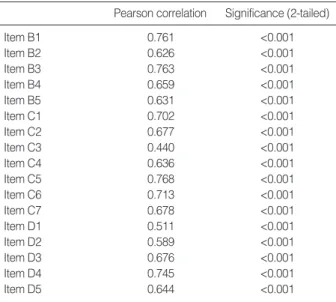
Cronbach’s αwas used to evaluate the internal consisten-cy of the K-SIP in 93 PTSD patients. The coefficient was 0.92 at baseline for the 17 items in K-SIP. Based on the cri-terion of 0.30 as an acceptable corrected item-total correla-tion (20), all 17 items performed adequately (range=0.45-0.76). (Table 1)
The test-retest reliability was examined by comparing the baseline K-SIP score with a K-SIP assessment performed 2 weeks later. The PTSD patients only included those who claimed that there was no change in their PTSD symptoms and agreed to a second K-SIP assessment. Among the 93 PTSD patients, 42 subjects were recruited for the evalua-tion of the test-retest reliability. The test-retest reliability was determined to be 0.87 (p<0.001).
Validity
The total scores±standard error (SE) of K-SIP in the PTSD group, the psychiatric controls and normal controls were 39.82±1.34, 15.73±2.32, and 2.44±4.21, respectively. These values significantly varied by ANOVA (overall F= 186.14, p<0.001). The Tukey’s post-hoc test showed that there were significant differences among the three groups. These results showed a good construct validity of the K-SIP. For validity to assess the core symptoms of PTSD, concur-rent validity of K-SIP was assessed by comparison with CAPS. Total K-SIP score was highly correlated with weekly CAPS score (r=0.72, p<0.001; N=48). Concurrent validity was also assessed being compared to other measures that address periph-eral or related aspects of PTSD. The total K-SIP score was correlated with BDI (r=0.61, p<0.001; N=82), the state anx-iety of STAI (r=0.28, p=0.010; N=84), and trait anxanx-iety of STAI (r=0.40, p<0.001; N=85). Thus, the correlation of K-SIP was strong with CAPS, and relatively weak with STAI, and intermediate with BDI (Table 2).
The explorative factor analysis with varimax rotation on the items of the K-SIP for 93 subjects from PTSD group showed that there were three factors that explained 61.71% of the total variance. Factor I accounted for 43.57% of the Pearson correlation Significance (2-tailed)
Item B1 0.761 <0.001 Item B2 0.626 <0.001 Item B3 0.763 <0.001 Item B4 0.659 <0.001 Item B5 0.631 <0.001 Item C1 0.702 <0.001 Item C2 0.677 <0.001 Item C3 0.440 <0.001 Item C4 0.636 <0.001 Item C5 0.768 <0.001 Item C6 0.713 <0.001 Item C7 0.678 <0.001 Item D1 0.511 <0.001 Item D2 0.589 <0.001 Item D3 0.676 <0.001 Item D4 0.745 <0.001 Item D5 0.644 <0.001
Table 1. The correlation between scores of each item and total score of K-SIP (Structured Interview for PTSD-Korean version)
*p<0.05 level of significance; �
p<0.001 level of significance.
K-SIP, Structured Interview for PTSD-Korean version; CAPS, Clinicians Administered PTSD Scale; BDI, Beck Depression Inventory; STAI-S, State-Trait Anxiety Inventory-state anxiety subscale; STAI-T, State-Trait Anxiety Inventory-trait anxiety subscale.
K-SIP CAPS BDI STAI-S
CAPS 0.72� BDI 0.61� 0.31* STAI-S 0.28* 0.24 0.30� STAI-T 0.40� 0.23 0.56� 0.58�
Table 2. Pearson’s correlations among K-SIP, CAPS, BDI, and STAI in the PTSD patients
variance (eigenvalue, 7.41) and was interpreted as numbness and depression, with loadings for each item ranging from 0.58 to 0.78. Factor II accounted for 10.63% of the variance (eigenvalue, 1.81) loaded on avoidance and distress at expo-sure to reminder of events. Factor III (eigenvalue, 1.28) loaded on hyperarousal (Table 3).
ROC analysis
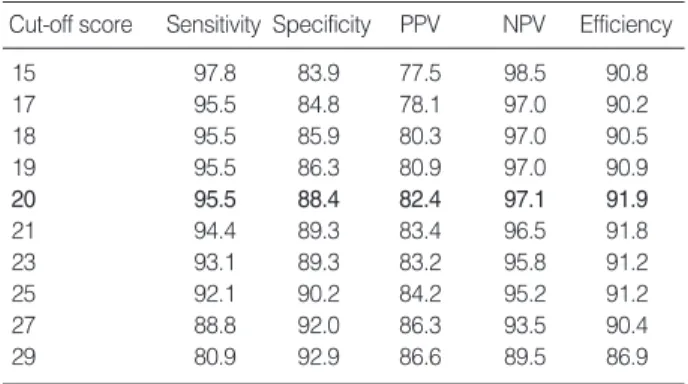
An ROC analysis was conducted to obtain the cut-off score on the K-SIP for the diagnosis of PTSD. The sensitivity, speci-ficity, predictive values, and diagnostic efficiency were calcu-lated for every possible K-SIP cut-off score. Table 4 shows ten different threshold scores and their corresponding sensi-tivity, specificity, positive and negative predictive values, and diagnostic efficiency. The highest diagnostic efficiency was found at a total score of 20, where the sensitivity and speci-ficity were 95.5% and 88.4%, respectively.
The area under the ROC curve (AUC) is an overall index of the accuracy of the discrimination provided by the K-SIP. The AUC ranges from 0 to 1, with an AUC above 0.85 gen-erally considered to be an indication of good diagnostic ability (21). The AUC of the K-SIP is 0.94 and its standard error is 0.019 (p<0.001). This AUC value confirmed the excellent diagnostic ability of the K-SIP.
DISCUSSION
We developed The Korean version of SIP, and test the reli-ability and validity in the Korean population. The original version of SIP was developed as one of several interview-based measures of PTSD for assessment of diagnosis, treatment effect, and symptoms severity (13). The SIP consists of 17 items according to the DSM-IV criteria for PTSD, supple-mented by two measures of survival and behavioral guilt, which represent holdovers from the DSM-III criteria and which are felt to the phenomenologically important when present because they may have some bearing on treatment management and outcome (22). Each item is rated on a 0-4 scale and represents a composite of frequency, severity, and functional impairment. There is a maximum total score of 68 for the DSM-IV symptoms without guilt.
In our results, we found out that K-SIP presented good reliability and validity. Internal consistency of K-SIP
indi-cated a Cronbach’s αof 0.92 and this coefficient was within the optimal range considering that an ideal value of αshould be between 0.70 and 0.90 (23). And this is consistent with the Cronbach’s αof 0.80 in the original SIP (6). The test-retest reliability of K-SIP was determined to be 0.87 in the Pear-son correlation and also consistent with 0.89 of the original SIP (6). The test-retest interval in this study was two weeks. In clinical settings, longer test-retest intervals mean greater possibilities of symptom changes. Most of the PTSD subjects assessed in this study were chronic types whose mean dura-tion of symptoms was 4.9 yr, and all of the subjects claimed that there were no changes in their symptoms. However, some subjects refused to enter the retest due to painful experiences with individual stressors. Consequently, 42 PTSD subjects (45.2%) were enrolled in the test-retest study. The result of the test-retest reliability was quite good. Thus, we can con-clude that the K-SIP showed good reliability as compared with the original SIP.
In order to assess the concurrent validity, we compared the K-SIP total score with the weekly CAPS total score. The CAPS is widely used for the diagnosis of PTSD and is often considered the gold standard for the assessment of PTSD (24). The K-SIP and CAPS demonstrated a strong correlation in our results (r=0.72), which was comparable to that of origi-nal SIP (r=0.67) from the Davidson group who developed the scale (6). Thus, K-SIP as well as the original SIP might be more ideal for use in routine clinical or research assessments of PTSD considering that they performed similarly to the CAPS and took less time to administer than the CAPS. The correlation between K-SIP and other measures such as BDI and STAI was also significant. PTSD is easily comorbid with depressive and anxiety disorder, and PTSD symptoms are very often presented with depressive symptoms and anxiety. So, this correlation is not surprising. However, the correla-tion with other measures is weaker than that with CAPS, which shows that K-SIP is more useful and specific scale for PTSD.
The best diagnostic efficiency was 91.9% when the cut-Extraction Method: Principal Component Analysis.
Component Eigenvalues % of Variance Cumulative %
Factor I 7.406 43.567 43.567
Factor II 1.807 10.628 54.195
Factor III 1.278 7.519 61.714
Table 3. The explorative factor analysis with varimax rotation on the items of the K-SIP for 93 subjects from PTSD group
Cut-off score Sensitivity Specificity PPV NPV Efficiency
15 97.8 83.9 77.5 98.5 90.8 17 95.5 84.8 78.1 97.0 90.2 18 95.5 85.9 80.3 97.0 90.5 19 95.5 86.3 80.9 97.0 90.9 20 95.5 88.4 82.4 97.1 91.9 21 94.4 89.3 83.4 96.5 91.8 23 93.1 89.3 83.2 95.8 91.2 25 92.1 90.2 84.2 95.2 91.2 27 88.8 92.0 86.3 93.5 90.4 29 80.9 92.9 86.6 89.5 86.9
Table 4. Sensitivity, specificity, predictive values, and diagnos-tic efficiency of the K-SIP for ten possible cut-off scores
Data represent ‘percentage’.
off score of the K-SIP was 20 in this study, and this is simi-lar with the original SIP (6). Sensitivity and specificity was very good as 95.5% and 88.4% when using 20 as the cut-off score. The determination of the optimal cut-off point for the diag-nosis of a disorder of concern is an invaluable process in the validation study. However, the best cut-off point to achieve optimal sensitivity and specificity may have considerable variances from one clinical setting to another (25). The dif-ferences in the standard to define a case, the particular dis-orders included in the cases, the timing of the interview rel-ative to the administration of the screening, the prevalence and severity of the disorder in the studied population and socioepidemiological variables such as age, gender, and edu-cation could be included as possible sources of variation in the threshold (26). There were also some variations between different cultures and even between different institutes with-in the same culture (27). Therefore, the optimal cut-off powith-int of the scale may not be fixed in accordance with various sit-uations.
The findings of this study have the following limitations. The sample sizes of the individual events were relatively small, thus making it difficult to draw any definite conclusions. In addition, most of the healthy controls and non-PTSD patients did not experience the traumatic event that was strictly met by DSM-IV diagnostic criterion A for PTSD. Instead, they recollected the most distressing traumatic event past one year and interviewed with a rater.
In conclusion, our findings demonstrate that the K-SIP had good psychometric properties and can be used as a reli-able, valid, and timesaving tool to diagnose and assess PTSD. Further studies are needed to fully evaluate the K-SIP, includ-ing researches applyinclud-ing it to the general population and in a primary medical setting where the prevalence of PTSD is relatively low.
ACKNOWLEDGMENTS
This study was supported by a grant of the Korean Acade-my of Anxiety Disorders, Korean Neuropsychiatric Associa-tion, and Korean Health 21 R & D Project, Ministry of Health and Welfare (A060273), and the Specific Research Program (M10644000013-06N4400-01310), Ministry of Science & Technology, Republic of Korea.
REFERENCES
1. American Psychiatric Association. Diagnostic and statistical manu-al of mentmanu-al disorders, 4rd ed. Washington DC: American Psychi-atric Association, 1994.
2. American Psychiatric Association. Diagnostic and statistical manu-al of mentmanu-al disorders, 3rd ed. Washington DC: American Psychi-atric Association, 1980.
3. Spitzer RL, Williams JB, Gibbon M, First MB. Structured clinical interview for DSM-III-R (SCID). New York: Biometric Research Department, State Psychiatric Institute, New York, 1990.
4. Blake DD, Weathers FW, Nagy LM, Kaloupek DG, Gusman FD, Charney DS, Keane TM. The development of a clinician-adminis-tered PTSD scale. J Traum Stress 1995; 8: 75-90.
5. Watson CG, Juba MP, Manifold V, Kucula T, Anderson PE. The PTSD interview: rationale descriptions, reliability, and concurrent validity of a DSM-III based technique. J Clin Psychol 1991; 47: 179-88.
6. Davidson JR, Malik MA, Travers J. The structured interview for PTSD (SIP): psychometric validation for DSM-IV criteria. Depress Anxiety 1997; 5: 127-9.
7. Conner KM, Davidson JR. SPRINT: a brief global assessment of post-traumatic stress disorder. Int Clin Psychopharmacol 2001; 16: 279-84.
8. Foa EB, Tolin DF. Comparison of PTSD symptom scale interview version and the clinician-administered PTSD scale. J Trauma Stress 2000; 13: 181-91.
9. Davidson JR, Book SW, Colket JT, Tupler LA, Roth S, David D, Hertzberg M, Mellman T, Beckham JC, Smith RD, Davison RM, Katz R, Feldman ME. Assessment of a new self-rating scale for post-traumatic stress disorder. Psychol Med 1997; 27: 153-60. 10. Horowitz M, Wilner N, Alvarez W. Impact of Event Scale: a
mea-sure of subjective stress. Psychosom Med 1979; 41: 209-18. 11. Lee BY, Kim Y, Yi SM, Eun HJ, Kim DI, Kim JY. A reliability
and validity study of a clinician-administered PTSD scale. J Korean Neuropsychiatr Assoc 1999; 38: 514-22.
12. Davidson J, Smith RD, Kudler H. Validity and reliability of the DSM-III criteria for posttraumatic stress disorder. Experience with a structured interview. J Nerv Ment Dis 1989; 177: 336-41. 13. Solomon SD, Keane TM, Newman E, Kaloupek DG. Choosing
self-report measures and structured interviews. In: Carlson EB eds. Trau-ma Research Methodology. Lutherville, MD: Sidran. 1996; 56-71. 14. Sheehan DV, Lecruiber Y, Sheehan KH, Amorim P, Janavs J, Weiller
E, Hergueta T, Baker R, Dunbar GC. The MINI international neu-ropsychiatric interview (MINI): the development and validation of a structured interview for DSM-IV and ICD-10. J Clin Psychiatry 1998; 59 (Suppl 20): 22-33.
15. Yoo SW, Kim YS, Noh JS, Oh KS, Kim CH, Nam KK, Chae JH, Lee GC, Jeon SI, Min KJ, Oh DJ, Joo EJ, Park HJ, Choi YH, Kim SJ. Validity of Korean Version of the MINI international neuropsy-chiatric interview. Anxiety Mood 2006; 2: 50-5.
16. Beck AT, Steer RA. BDI, Beck depression inventory. San Antonio, TX: Psychological Corp, 1987.
17. Spielberger CD, Gorsuch RL. State-trait anxiety inventory. Palo Alto, CA: Consulting Psychologists Press, 1983.
18. Rhee MK, Lee YH, Park SH, Sohn CH, Chung YJ, Hong SK, Lee BK, Chang P, Yoon AR. A standardization study of Beck depression inventory I; Korean version (K-BDI): reliability and factor analysis. Korean J Psychopathol 1995; 4: 77-95.
19. Hahn DW, Lee CH, Chon KK. Korean adaptation of Spielberger’s STAI (K-STAI). Korean J Health Psychol 1996; 1: 1-14.
McGraw-Hill, 1994.
21. Metz CE. Basic principles of ROC analysis. Semin Nucl Med 1978; 8: 283-98.
22. Davidson JR, Kudler HS, Saunders WB, Erickson L, Smith RD, Stein RM, Lipper S, Hammett EB, Mahorney SL, Cavenar JO Jr. Pre-dicting response to amitriptyline in posttraumatic stress disorder. Am J Psychiatry 1993; 150: 1024-9.
23. Nunnally JC. Introduction to Psychological Measurement. New York: McGraw-Hill, NY, 1978.
24. Weathers FW, Keane TM, Davidson JR. Clinician-administered PTSD
scale: a review of the first ten years of research. Depress Anxiety 2001; 13: 132-56.
25. Chen CH, Shen WW, Tan HK, Chou JY, Lu ML. The validation study and application of stratum-specific likelihood ratios in the Chi-nese version of SPAN. Compr Psychiatry 2003; 44: 78-81. 26. Furukawa T, Goldberg DP, Rabe-Hesketh S, Ustun TB.
Stratum-spe-cific likelihood ratios of two versions of the general health question-naire. Psycho Med 2001; 31: 519-29.
27. Goldberg DP, Oldehinkel T, Ormel J. Why GHQ threshold varies from one place to another. Psychol Med 1998; 28: 915-21.