R E S E A R C H A R T I C L E
Open Access
Looking into the life of
technology-dependent children and their caregivers in
Korea: lifting the burden of too many
responsibilities
Yu Hyeon Choi
1, Min Sun Kim
1*, Cho Hee Kim
2, In Gyu Song
3, June Dong Park
1, Dong In Suh
1and
Hyung-Ik Shin
4Abstract
Background: The number of technology-dependent children (TDC) is increasing in South Korea, but available healthcare services after their discharge are poor. This study aimed to examine how TDC and caregivers live at home and identify their difficulties and needs regarding home care with few services to support them.
Methods: This cross-sectional study was conducted in a tertiary hospital for children in South Korea. A self-reported questionnaire was completed by primary caregivers of TDC who were younger than 19 years and had been dependent on medical devices for more than 3 months. Technologies included home mechanical ventilation, oxygen supplementation, suction equipment, enteral feeding tube, and home total parenteral nutrition. Patterns of healthcare use and home care of TDC and caregivers’ perception toward child were assessed.
Results: A total of 74 primary caregivers of TDC completed a self-reported questionnaire. About 60% children were aged under 5 years. There were 31.1% children who required both respiratory and nutritional support. On average, caregivers took care of a child for 14.4 (±6.1) hours, slept for 5.6 (±1.6) hours, and spent 2.4 h per day on personal activities. Children used hospital services for 41.3 (±45.6) days in 6 months, and most (78.1%) were transported through private car/ambulance. Participants (75.6%) reported taking more than an hour to get to the hospital. More than 80% of caregivers responded that child care is physically very burdensome. The only statistically significant relationships was between economic status and financial burden (p = 0.026).
Conclusions: Caregivers of TDC reported having significant time pressure regarding childcare-related tasks, insufficient time for personal activities, and inefficient hospital use because of inadequate medical services to support them in South Korea. Thus, it is necessary to support caregivers and develop a home care model based on current medical environment.
Keywords: Healthcare, Home care, Medical equipment, Home mechanical ventilation, Care burden, Cross-sectional study
© The Author(s). 2020 Open Access This article is licensed under a Creative Commons Attribution 4.0 International License, which permits use, sharing, adaptation, distribution and reproduction in any medium or format, as long as you give appropriate credit to the original author(s) and the source, provide a link to the Creative Commons licence, and indicate if changes were made. The images or other third party material in this article are included in the article's Creative Commons licence, unless indicated otherwise in a credit line to the material. If material is not included in the article's Creative Commons licence and your intended use is not permitted by statutory regulation or exceeds the permitted use, you will need to obtain permission directly from the copyright holder. To view a copy of this licence, visithttp://creativecommons.org/licenses/by/4.0/. The Creative Commons Public Domain Dedication waiver (http://creativecommons.org/publicdomain/zero/1.0/) applies to the data made available in this article, unless otherwise stated in a credit line to the data.
* Correspondence:[email protected]
1Department of Pediatrics, Seoul National University Hospital, Seoul National
University College of Medicine, 101 Daehak-ro, Jongno-gu, Seoul 03080, South Korea
Background
With the advances in pediatric critical care and technology, number of children who require some form of techno-logical assistance to compensate for impairment in vital function is increasing [1, 2]. These technology-dependent children (TDC) require an extensive range of healthcare services including preventive, specialty, emergent, and acute care services [1]. Recently, most TDC have main-tained their medical care at home rather than in a hospital and this care usually goes on for a prolonged period after their acute treatments in inpatient facilities [3]. Hence, there is a growing demand for changes in healthcare services to improve care coordination with continuity, familiarity, accessibility, partnership, and early crisis recog-nition even at home [4]. In addition, it is suggested that someone responsible for these patients should be assigned to integrate community- and tertiary hospital-based ser-vices on behalf of the caregiver to ultimately relieve the caregivers’ burden.
Treatment outcomes of serious illnesses in children, such as survival in pediatric cancer, congenital heart disease, or prematurity in South Korea has significantly improved compared to that in other developed countries [5, 6]. As a result, the number of children who are temporarily or permanently dependent on technology is increasing. According to the national data in 2016, the prevalence of children with home mechanical ventilation (HMV) in South Korea is estimated at 4.4 per 100,000 for those aged under 19 years, which is similar to other countries [7]. In addition, it is suggested that the num-ber of patients using HMV has increased by about three-fold from 2016 to 2018 [7]. Nevertheless, healthcare ser-vices for home care of TDC are poor in South Korea— there are no primary care physicians (PCPs) in the healthcare system [8], and no community- or home-based medical service for TDC and their families. Al-though there is an activity assistance service for the dis-abled, this service only provides non-medical support and is only available for those older than 6 years of age.
Thus, our hospital planned to develop a service for TDC after going back home, based on their needs as well as their caregiver’s. Until now, several studies have reported on the lives of TDC and their families, but most of these have been performed in areas where various healthcare services are already available. Therefore, we aimed to investigate the medical care environment at the homes of TDC with few healthcare service to support them, such as how to provide medical care at home, how to use hospital services, and what difficulties they have. Methods
Setting, design, and participants
This cross-sectional study was conducted at the Seoul National University Children’s Hospital, which is a tertiary
hospital for children, located in Seoul with 350 beds, including 24 designated beds for the pediatric intensive care unit. It is one of the few hospitals providing special-ized medical service for pediatric patients in Korea; thus TDC are highly concentrated in this hospital regardless of where they live.
For eligibility, participants should have been primary caregivers of TDC. For this study, TDC was defined as patients younger than 19 years (0–18 years) with special-ized medical equipment to support their lives, including HMV, oxygen supplementation, suction equipment, enteral feeding tube (nasogastric tube or gastrostomy tube, among others), or home parenteral nutrition [2]. The exclusion criteria were: not being a primary caregiver of TDC and if the care recipient was 19 years of age or older or had been dependent on medical devices for less than 3 months. The minimum duration of technology-dependency was adopted to ensure reasonable caregiving experience at home.
Before constructing a questionnaire, preliminary inter-views with 12 primary caregivers of TDC were conducted to understand a primary caregiver’s experience regarding caregiving activities, intensity of care burdens, difficulties, and unmet needs. Once the questionnaire was developed, it was reviewed and revised by 15 multidisciplinary specialists: three pediatric intensivists, two neonatologists, three pediatric rehabilitation specialists, a pediatric pul-monologist, a gastroenterologist, a pediatric hematology/ oncology specialist, two nurse unit managers, a clinical nutritionist, and a pharmacist. Lastly, the questionnaire was pilot tested and revised prior to being administered in this study.
The final version of the questionnaire (see Additional file1) consisted of four sections: general characteristics (patients’ and caregivers’ age, sex, residence, type of insurance, finan-cial status of family, educational level of caregiver, family types, and type and duration of technology-dependency; 13 items); the caregivers’ perception of their child’s medical condition and healthcare use (physical and psychological condition, physical ability, hospital admission, outpatient clinic visit with time spent, usage of emergency services, healthcare expenditure, and communication; 10 items); pat-terns of home care (detailed time spent on care, ways to get medical advice, caregiver burden, and difficulties; 21 items). The questions in this self-reported questionnaire were either categorical or used a 7-point Likert scale. In this question-naire, health-related expenditures included hospital fee, fee for medication, medical equipment and supplies, transporta-tion costs, nursing fee, rehabilitatransporta-tion, or any kind of therapy.
Data collection
Data were collected from January 3 to February 14, 2019 using convenience and purposive sampling strategy. Trained researchers randomly approached and screened
the eligibility of caregivers while they are waiting for their child’s outpatient appointments. After providing information about the study and obtaining their written informed consent, a total of 74 caregivers participated and completed the questionnaire. They took approxi-mately 20 min on average to respond to the whole questionnaire.
Statistical analysis
Data were analyzed using descriptive statistics and presented through mean and standard deviations, while frequencies and percentages were used in case of categorical variables. We used univariate binary logistic regressions to examine the association of care burden with demographic (child’s age, child’s sex, residential area, child’s insurance type, family types, caregiver’s per-ceived financial status of the family, and caregiver’s level of education) and clinical (primary diagnosis, physical capacity, level and duration of technology-dependency) variables. Those that were statistically significant in uni-variate analysis were then included in the multiple logis-tic regression to examine their associations with care burden. Care burden or difficulties were dichotomized by combining responses of 5, 6, and 7 (Very much) into the considerable category, and others into a not consid-erable category, using the median score to differentiate “considerable” and “not considerable” [9]. All analyses were performed using IBM SPSS Statistics version 20 (IBM Company, Chicago, IL, USA), and the level of significance was defined asp < 0.05.
Results
General and clinical characteristics
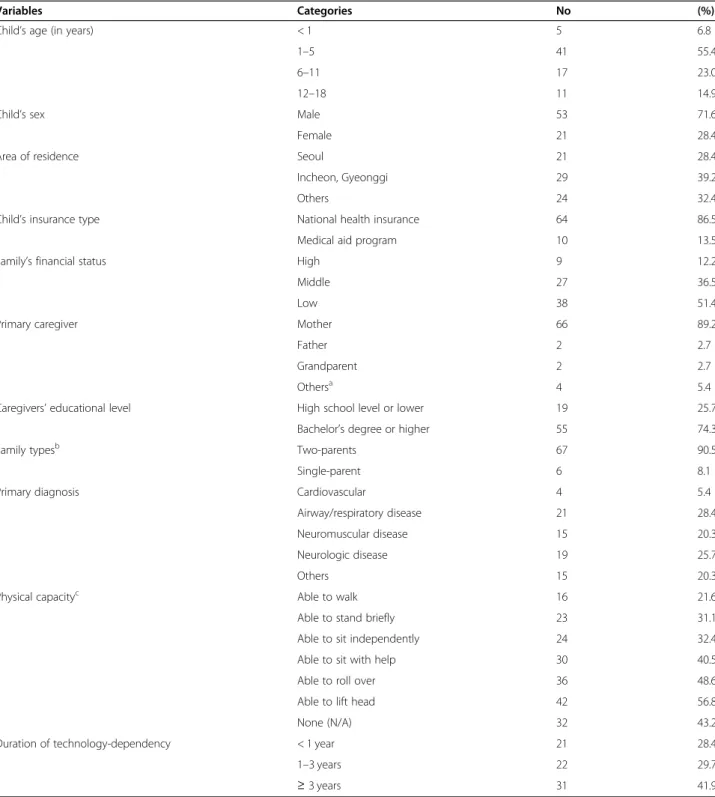
A total of 74 TDC and their respective caregivers were included in the study (Table 1). The mean age of the children was 5.7 (± 5.2) years, with 46 patients (62.2%) aged 5 years and below. Fifty patients (67.6%) lived in Seoul and its surrounding cities (Incheon and Gyeonggi). Airway and respiratory diseases were the most common primary diagnosis, followed by neurological diseases. There were 16 (21.6%) and 24 (32.4%) patients who could walk and sit without help, respectively. About 70% of patients had been receiving technology aid for more than 1 year. Mothers were the most common primary caregivers (89.2%).
As shown in Table 2, all TDC used more than one medical device. Regarding type of respiratory support device, a tracheostomy tube and a HMV were used by 42 (56.8%) and 36 (48.7%) patients, respectively. A total of 36 patients (48.6%) required a nasogastric tube or a gastrostomy tube, and five needed an intravenous pump for parenteral nutrition. Additionally, the number of children requiring both respiratory and nutritional de-vices was 41 (55.4%).
Patterns of medical care at home
The TDC slept an average of 10.8 (± 3.5) hours and re-ceived medical or physical care for 6.9 h each day (Fig.1). Caregivers spent most of their time on childcare-related tasks, including medical care for 14.4 (± 6.1) hours a day. With regard to the remaining time, 5.6 (± 1.6) hours were spent on sleep, and only 2.4 h per day were spent on personal activities, such as resting and hobbies.
The specific daily childrelated tasks by the care-givers and their corresponding frequency per day are as follows: suctioning (17.7 times/day), position change (6.8 times/day), feeding via nasogastric or gastrostomy tube (6.4 times/day), rehabilitation (3.8 times/day), disinfec-tion or cleaning of medical instrument (2.4 times/day), and administration of medication (1.8 times/day).
Patterns of healthcare utilization
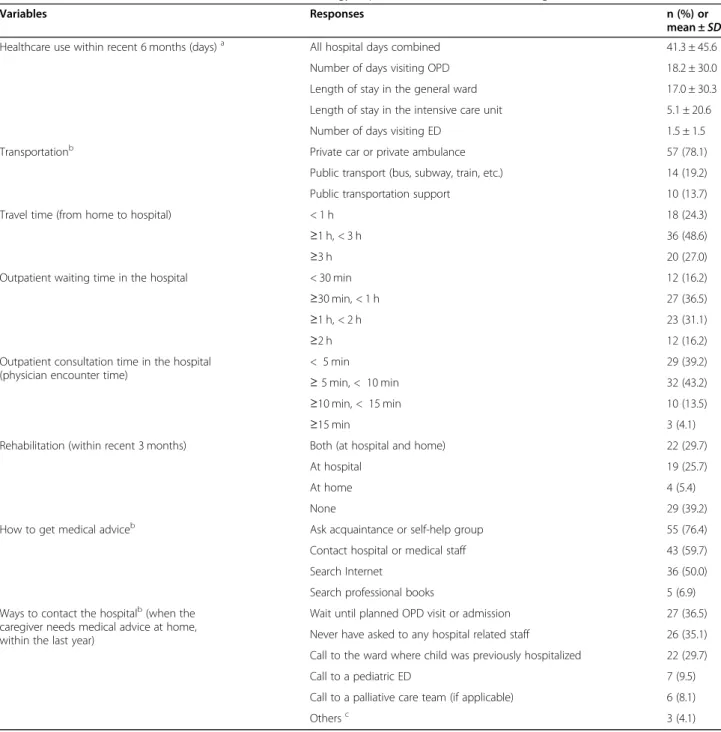
TDC used hospital services for an average of 41.3 (± 45.6) days in the last 6 months (Table 3). About 80% used a private car or a privately paid ambulance to access the hospital. Among the participants, 75.6% reported that it took more than an hour to get to the hospital and nearly half of all patients had to wait in the hospital for more than an hour again to consult with the physician. The actual consultation time was less than 10 min in 82.4% of cases, and only 4.1% said they spent over 15 min with a physician. Additionally, the order of preference for the way in which caregivers got medical advice was as follows: ask acquaintances or self-help group, 76.4%; contact hospital or medical staff, 59.7%; and search internet, 50.0%. Even when contacting the hospital, 36.5% had to wait until their outpatient appointment.
Care burden and difficulties perceived by caregivers
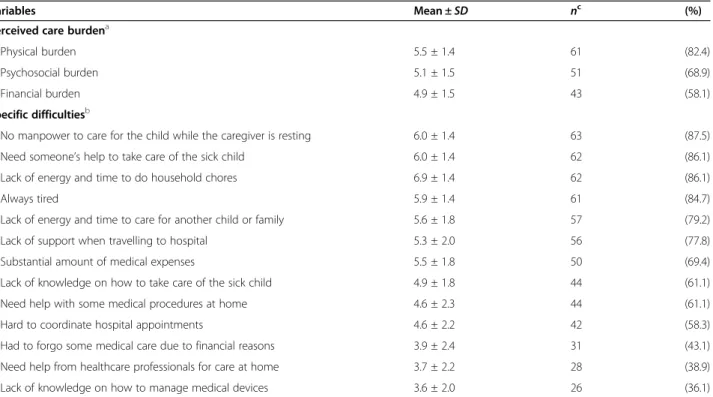
The vast majority (82.4%) of caregivers in this study reported physical burden, followed by psychological and financial burdens (Table 4). Regarding specific difficul-ties, 87.5% of caregivers reported that they had no one to take care of the child while resting and 86.1% said they needed someone’s help to take care of the sick child. Caregivers also mentioned that they lack the en-ergy and time for household chores or to take care of other family members. More than three-fourths of par-ticipants indicated traveling to the hospital and having to pay for medical expenses to care for the child as rea-sons for their difficulties. In addition, caregivers said that they did not know how to take care of TDC or that they needed help with the procedures at home.
Factors affecting the level of perceived care burden
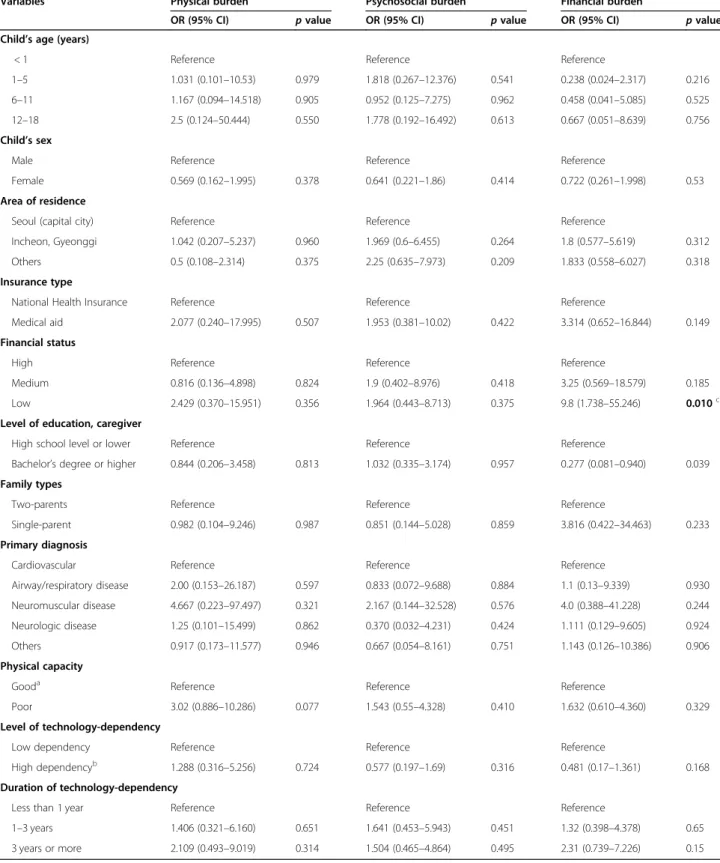
There were no statistically significant relationships be-tween any variable, including child’s age, residential area, financial status, level of education, family types, level of
technology dependence, and level of perceived burden, except that between economic status and economic burden in multivariate analysis (OR 7.414, CI 1.275– 43.116, p = 0.026) (Table 5).
Discussion
In this study, the majority of the caregivers described their experiences of spending a considerable time on childcare, with insufficient private time and frequent
Table 1 General and clinical characteristics of technological-dependent children and their caregivers (n = 74)
Variables Categories No (%)
Child’s age (in years) < 1 5 6.8
1–5 41 55.4
6–11 17 23.0
12–18 11 14.9
Child’s sex Male 53 71.6
Female 21 28.4
Area of residence Seoul 21 28.4
Incheon, Gyeonggi 29 39.2
Others 24 32.4
Child’s insurance type National health insurance 64 86.5
Medical aid program 10 13.5
Family’s financial status High 9 12.2
Middle 27 36.5
Low 38 51.4
Primary caregiver Mother 66 89.2
Father 2 2.7
Grandparent 2 2.7
Othersa 4 5.4
Caregivers’ educational level High school level or lower 19 25.7
Bachelor’s degree or higher 55 74.3
Family typesb Two-parents 67 90.5
Single-parent 6 8.1
Primary diagnosis Cardiovascular 4 5.4
Airway/respiratory disease 21 28.4
Neuromuscular disease 15 20.3
Neurologic disease 19 25.7
Others 15 20.3
Physical capacityc Able to walk 16 21.6
Able to stand briefly 23 31.1
Able to sit independently 24 32.4
Able to sit with help 30 40.5
Able to roll over 36 48.6
Able to lift head 42 56.8
None (N/A) 32 43.2
Duration of technology-dependency < 1 year 21 28.4
1–3 years 22 29.7
≥ 3 years 31 41.9
a“Others” included an activity assistant service for persons with disabilities, a neighbor, a day care center for persons with disabilities, and a teacher at a special school
b
One caregiver did not respond c
long-distance hospital usage with short consultation time in the outpatient clinic. Thus, the caregivers suf-fered from various physical, psychological, and financial burdens. We focused on TDC, who have more complex medical conditions, and found that caregivers’ burdens were not related to the severity of the child’s condition. To the best of our knowledge, this is the first study that specifically quantified the childcare-related tasks of TDC caregivers, daily activity patterns of both the child and the caregiver, and TDC’s utilization patterns of the healthcare system, such as transportation, with few community- or hospital-based medical home services to support them.
Caregivers of children with medical complexities per-form a variety of activities that are usually conducted by different professionals in a hospital, such as those per-formed by nurses and consulting physicians, as well as parenting for a limited time [10]. McCann et al. reported that caregivers spend approximately 63 to 726 min per
day doing all these care activities [11]. In this study, with a narrower population of TDC, parents spent more than half of the day on childcare-related tasks, which led to absolute lack of personal time. Additionally, given the number of specific daily care-related tasks presented in this study, we estimated that one or more essential tasks were performed every hour. Consequently, activities other than caring of children, including sleep, are ex-pected to be usually fragmented and scattered without continuity throughout the day. As reported by previous studies, these activities eventually affect family function-ing or reduce social activities, resultfunction-ing in the caregivers’ social isolation [3,12].
TDC utilize a tertiary hospital service, including out-patient clinics, intensive care unit, and emergency departments, with a high frequency [13,14]. The results of this study are consistent with that of previous reports; however, we found that our participants used hospitals more inefficiently. Many children in this study lived in
Table 2 Type of support device for technology-dependent children
Respiratory support
Nutrition support O2 onlya Tracheostomy without ventilator Non-Invasive Ventilator Tracheostomy and ventilator Total
Oral feeding,n (%) 5 (6.8) 12 (16.2) 7 (9.5) 9 (12.2) 33 (44.6)
Enteral feeding,n (%) 13 (17.6) 3 (4.1) 2 (2.7) 18 (24.3) 36 (48.6)
Parenteral feeding,n (%) 5 (6.8) 0 (0.0) 0 (0.0) 0 (0.0) 5 (6.8)
Total,n (%) 23 (31.1) 15 (20.3) 9 (12.2) 27 (36.5) 74 (100.0)
a
included patients who received non-invasively oxygen without tracheostomy or home mechanical ventilation
Fig. 1 Daily activity patterns for technology-dependent children and their caregivers. Data are presented as“mean ± standard deviation”. Each circle means 24 h a day. Examples of each activity are as follows: taking care of child includes any activity provided by caregivers to their technology-dependent child (supervision as well as medical and physical care, etc); household chores (vacuuming, doing the laundry, taking care of other family members, etc.); private time and rest (watching TV, surfing the internet, playing games, reading, etc.); social activities (going to school, meeting friends, working, etc.); receiving medical care (taking medicine, suctioning, changing tracheostomy tube, etc.); receiving physical care (bathing, eating, dressing, etc.)
areas that are more than an hour away from the hospital by car. Moreover, they had to come to an outpatient clinic at least once a month to see a doctor for less than 10 min on average. We believe that this inefficiency in hospital use led to the several consequences reported in this study. First, when health related problems occur during medical care at home, caregivers usually seek medical advice mainly from non-medical sources such as
other caregivers and the internet. In case of seeking advice from medical practitioners, they were more likely to wait for a scheduled appointment rather than immedi-ately contact a medical staff. This can cause management errors related to the treatment of TDC that prevent them from receiving it in a timely and adequate manner [15]. Second, TDC repeat long-distance travels with essential medical devices, which can eventually exhaust caregivers
Table 3 Patterns of healthcare services utilization for technology-dependent children and their caregivers
Variables Responses n (%) or
mean ±SD Healthcare use within recent 6 months (days)a All hospital days combined 41.3 ± 45.6
Number of days visiting OPD 18.2 ± 30.0
Length of stay in the general ward 17.0 ± 30.3
Length of stay in the intensive care unit 5.1 ± 20.6
Number of days visiting ED 1.5 ± 1.5
Transportationb Private car or private ambulance 57 (78.1)
Public transport (bus, subway, train, etc.) 14 (19.2)
Public transportation support 10 (13.7)
Travel time (from home to hospital) < 1 h 18 (24.3)
≥1 h, < 3 h 36 (48.6)
≥3 h 20 (27.0)
Outpatient waiting time in the hospital < 30 min 12 (16.2)
≥30 min, < 1 h 27 (36.5)
≥1 h, < 2 h 23 (31.1)
≥2 h 12 (16.2)
Outpatient consultation time in the hospital (physician encounter time)
< 5 min 29 (39.2)
≥ 5 min, < 10 min 32 (43.2)
≥10 min, < 15 min 10 (13.5)
≥15 min 3 (4.1)
Rehabilitation (within recent 3 months) Both (at hospital and home) 22 (29.7)
At hospital 19 (25.7)
At home 4 (5.4)
None 29 (39.2)
How to get medical adviceb Ask acquaintance or self-help group 55 (76.4)
Contact hospital or medical staff 43 (59.7)
Search Internet 36 (50.0)
Search professional books 5 (6.9)
Ways to contact the hospitalb(when the
caregiver needs medical advice at home, within the last year)
Wait until planned OPD visit or admission 27 (36.5) Never have asked to any hospital related staff 26 (35.1) Call to the ward where child was previously hospitalized 22 (29.7)
Call to a pediatric ED 7 (9.5)
Call to a palliative care team (if applicable) 6 (8.1)
Othersc 3 (4.1)
SD standard deviation, OPD outpatient department, ED emergency department a
Of the 74 participants, seven responses were excluded, leaving a total of 67 responses for healthcare use analysis. Reasons for exclusion included 2 missing values and 5 responses exceeding 180-day within 6 months
b
There were multiple responses
and add more negative outcomes related to care burden [16]. Third, considering that the primary means of trans-portation was a private car or an ambulance, which are not covered under the national insurance in Korea, it is possible that frequent hospital visits are burdens on household finances.
Among the several obstacles for parents of children with serious illnesses, physical exhaustion has emerged as the major hurdle in our study. Notably, the top 5 spe-cific difficulties described by caregivers were also associ-ated with physical burdens. Interestingly, our results showed no statistically significant relationship between caregivers’ burdens and the medical conditions or gen-eral characteristics of children. However, one Japanese study involving children with special healthcare needs, including TDC, showed that tracheostomy with home ventilators for older groups of children and older sib-lings for younger groups of children increased caregiver burden [17]. It is presumed that this inconsistent result is owing to the difference in patients’ characteristics. TDC, included in this study, presented a higher medical complexity and lower functional status, with more than half below 5 years; hence, they had more needs that care-givers need to attend to [11]. Thus, since the burdens of TDC caregivers are already considerable, they might be significantly more affected by their caring environment
rather than by demographic or medical conditions. This result support that home care environment with lack of healthcare system to support TDC leads to higher inten-sity parents-led care, which ultimately increase care-giver’s burdens.
Therefore, appropriate services should be developed to relieve caregivers’ burdens at home and deliver continu-ous and coordinated medical services for TDC. The American Academy of Pediatrics recommends that the PCPs of a community should be matched with children during the transition period between care at the hospital and care at home [18]; however, there are no PCPs in the South Korea healthcare system [8]. Furthermore, tertiary hospitals are responsible not only for specialist care related to diseases among TDC, but also to their routine, emergency, and critical care. Thus, compared to most developed countries where the primary physician system of a community is well established, other countries, where such a system is insufficient, need an alternative.
Recently, hospital-based comprehensive care program are steadily increasing in children with complex condi-tions who are closely connected with tertiary care centers [4, 19]. This model can be particularly helpful for TDC who frequently require discussions with mul-tiple subspecialties owing to their complex issues. As a result, through reorganizing the current care system that
Table 4 Levels of care burden and specific difficulties perceived by caregivers
Variables Mean ±SD nc (%)
Perceived care burdena
Physical burden 5.5 ± 1.4 61 (82.4)
Psychosocial burden 5.1 ± 1.5 51 (68.9)
Financial burden 4.9 ± 1.5 43 (58.1)
Specific difficultiesb
No manpower to care for the child while the caregiver is resting 6.0 ± 1.4 63 (87.5)
Need someone’s help to take care of the sick child 6.0 ± 1.4 62 (86.1)
Lack of energy and time to do household chores 6.9 ± 1.4 62 (86.1)
Always tired 5.9 ± 1.4 61 (84.7)
Lack of energy and time to care for another child or family 5.6 ± 1.8 57 (79.2)
Lack of support when travelling to hospital 5.3 ± 2.0 56 (77.8)
Substantial amount of medical expenses 5.5 ± 1.8 50 (69.4)
Lack of knowledge on how to take care of the sick child 4.9 ± 1.8 44 (61.1)
Need help with some medical procedures at home 4.6 ± 2.3 44 (61.1)
Hard to coordinate hospital appointments 4.6 ± 2.2 42 (58.3)
Had to forgo some medical care due to financial reasons 3.9 ± 2.4 31 (43.1)
Need help from healthcare professionals for care at home 3.7 ± 2.2 28 (38.9)
Lack of knowledge on how to manage medical devices 3.6 ± 2.0 26 (36.1)
SD standard deviation a
Perceived level of care burden and difficulties were measured on a 7-point Likert scale ranging from 1 (not at all) to 7 (very much) b
The list below was derived from interviews conducted before constructing the questionnaire c
Burden and difficulties were dichotomized by combining responses of 5, 6, and 7 (very much) into considerable (burden or difficulty) category, and others into a not considerable category
Table 5 Factors affecting level of perceived care burden (n = 74)
Variables Physical burden Psychosocial burden Financial burden
OR (95% CI) p value OR (95% CI) p value OR (95% CI) p value
Child’s age (years)
< 1 Reference Reference Reference
1–5 1.031 (0.101–10.53) 0.979 1.818 (0.267–12.376) 0.541 0.238 (0.024–2.317) 0.216 6–11 1.167 (0.094–14.518) 0.905 0.952 (0.125–7.275) 0.962 0.458 (0.041–5.085) 0.525 12–18 2.5 (0.124–50.444) 0.550 1.778 (0.192–16.492) 0.613 0.667 (0.051–8.639) 0.756 Child’s sex
Male Reference Reference Reference
Female 0.569 (0.162–1.995) 0.378 0.641 (0.221–1.86) 0.414 0.722 (0.261–1.998) 0.53 Area of residence
Seoul (capital city) Reference Reference Reference
Incheon, Gyeonggi 1.042 (0.207–5.237) 0.960 1.969 (0.6–6.455) 0.264 1.8 (0.577–5.619) 0.312 Others 0.5 (0.108–2.314) 0.375 2.25 (0.635–7.973) 0.209 1.833 (0.558–6.027) 0.318 Insurance type
National Health Insurance Reference Reference Reference
Medical aid 2.077 (0.240–17.995) 0.507 1.953 (0.381–10.02) 0.422 3.314 (0.652–16.844) 0.149 Financial status
High Reference Reference Reference
Medium 0.816 (0.136–4.898) 0.824 1.9 (0.402–8.976) 0.418 3.25 (0.569–18.579) 0.185 Low 2.429 (0.370–15.951) 0.356 1.964 (0.443–8.713) 0.375 9.8 (1.738–55.246) 0.010c
Level of education, caregiver
High school level or lower Reference Reference Reference
Bachelor’s degree or higher 0.844 (0.206–3.458) 0.813 1.032 (0.335–3.174) 0.957 0.277 (0.081–0.940) 0.039 Family types
Two-parents Reference Reference Reference
Single-parent 0.982 (0.104–9.246) 0.987 0.851 (0.144–5.028) 0.859 3.816 (0.422–34.463) 0.233 Primary diagnosis
Cardiovascular Reference Reference Reference
Airway/respiratory disease 2.00 (0.153–26.187) 0.597 0.833 (0.072–9.688) 0.884 1.1 (0.13–9.339) 0.930 Neuromuscular disease 4.667 (0.223–97.497) 0.321 2.167 (0.144–32.528) 0.576 4.0 (0.388–41.228) 0.244 Neurologic disease 1.25 (0.101–15.499) 0.862 0.370 (0.032–4.231) 0.424 1.111 (0.129–9.605) 0.924 Others 0.917 (0.173–11.577) 0.946 0.667 (0.054–8.161) 0.751 1.143 (0.126–10.386) 0.906 Physical capacity
Gooda Reference Reference Reference
Poor 3.02 (0.886–10.286) 0.077 1.543 (0.55–4.328) 0.410 1.632 (0.610–4.360) 0.329 Level of technology-dependency
Low dependency Reference Reference Reference
High dependencyb 1.288 (0.316–5.256) 0.724 0.577 (0.197–1.69) 0.316 0.481 (0.17–1.361) 0.168 Duration of technology-dependency
Less than 1 year Reference Reference Reference
1–3 years 1.406 (0.321–6.160) 0.651 1.641 (0.453–5.943) 0.451 1.32 (0.398–4.378) 0.65 3 years or more 2.109 (0.493–9.019) 0.314 1.504 (0.465–4.864) 0.495 2.31 (0.739–7.226) 0.15 OR odds ratio, CI confidence interval
aGood physical capacity includes patients who are able to walk, stand briefly or sit independently b
High technology-dependency indicates patients with both enteral nutrition support (ex. nasogastric tube, gastrostomy tube, etc.) and respiratory support (tracheostomy and/or home mechanical ventilator)
is centered on a tertiary hospital, it is expected to pro-duce positive outcomes, such as efficient hospital usage and appropriate medical care at home. However, this care model requires substantial financial, structural, and staff resources in a tertiary hospital [4]. Additionally, because multiple teams are involved, there is a risk of diffusion of responsibility, given the ambiguous patient ownership and lack of integration with community-based services. In a recent study, the accessibility of services were improved and caregiver’s satisfaction were increased through the designated care coordinator in a tertiary hospital, such as complex care team [20]. Never-theless, in our study, since caregivers mainly experienced daily absolute“overwork” associated with caring for their child, enrollment in a certain model of care for TDC could be insufficient to relieve parents’ burdens or im-prove their quality of life [21]. Thus, additional systems that free them from“home,” such as respite facilities or programs, should be considered. Consequently, depend-ing on the resources in a hospital and community, it is ultimately necessary to modify the services in accord-ance with the perspective of the caregivers in detail, and not the medical staff, as has been done in our study.
This study has some limitations. First, it was conducted in a single institution and had a small sample, which limits the representation and generalization of the findings. How-ever, since the chosen research institute is, currently, one of the major tertiary hospitals located in the capital of South Korea, it can be said that the findings offer an aver-age understanding of the specificities of TDC’s care envir-onment. Nevertheless, we believe that future studies need to work with bigger samples and include more institutions. Second, this study used a cross-sectional design with a self-reported questionnaire that was completed by the TDC’s main caregivers; thus, recall bias may have affected their responses, and consequently, our findings. Third, because of the limitations of using a self-reported questionnaire, we could not collect information regarding co-morbidities of TDC. Thus, unlike previous studies, the accompanying diseases, except for the main diagnoses, could be underesti-mated in this study. Fourth, because participants were selected from outpatients, as per the inclusion criteria, selection bias could have also impaired our results. We believe that future studies must provide other types of reports for questionnaires, and sample selection should be randomized to allow generalization of the findings.
Conclusions
Lack of home care support causes significant burdens for TDC caregivers as well as inefficient hospital usage and occasional inappropriate medical care at home. Our study suggests that TDC require comprehensive care services, which should be modified based on the limited resources and needs of caregivers.
Supplementary information
The online version contains supplementary material available athttps://doi. org/10.1186/s12887-020-02388-z.
Additional file 1. Questionnaire in English. (PDF 254 kb)
Abbreviations
HMV:Home mechanical ventilation; PCPs: Primary care physicians; TDC: Technology-dependent children
Acknowledgments None.
Authors’ contributions
YHC designed the study, drafted the initial manuscript, and revised the manuscript. MSK designed the study, collected data, and reviewed the manuscript. CHK designed the study, performed the statistical analysis, drafted the manuscript, and reviewed the manuscript. IGS conceptualized the study, interpretation of data, and critically reviewed the manuscript. JDP, DIS, and HIS contributed to the study design, patient recruitment, and critical review. All authors have read and approved the manuscript as submitted. Funding
This study supported by a grant from the Health Insurance Review & Assessment Service. The funders had no role in the study design, data collection and analysis, data interpretation, writing the manuscript, and publication.
Availability of data and materials
Data supporting the results are available from the corresponding author upon request.
Ethics approval and consent to participate
The work described has been carried out in accordance with The Code of Ethics of the World Medical Association (Declaration of Helsinki) for experiments involving humans. The institutional review board of the Seoul National University Hospital approved this study (No. 1812–103-995). Written informed consent was obtained from a parent or legal guardian.
Consent for publication Not applicable. Competing interests
The authors declare no conflicts of interest. Author details
1
Department of Pediatrics, Seoul National University Hospital, Seoul National University College of Medicine, 101 Daehak-ro, Jongno-gu, Seoul 03080, South Korea.2Seoul National University College of Nursing, Seoul, South Korea.3Department of Pediatrics, Severance Children’s Hospital, Yonsei
University College of Medicine, Seoul, South Korea.4Department of Rehabilitation Medicine, Seoul National University Hospital, Seoul National University College of Medicine, Seoul, South Korea.
Received: 26 June 2020 Accepted: 14 October 2020
References
1. Cohen E, Kuo DZ, Agrawal R, Berry JG, Bhagat SK, Simon TD, et al. Children with medical complexity: an emerging population for clinical and research initiatives. Pediatrics. 2011;127(3):529–38.
2. Spratling R. Defining technology dependence in children and adolescents. West J Nurs Res. 2015;37(5):634–51.
3. Wang K-WK, Barnard A. Caregivers' experiences at home with a ventilator-dependent child. Qual Health Res. 2008;18(4):501–8.
4. Pordes E, Gordon J, Sanders LM, Cohen E. Models of care delivery for children with medical complexity. Pediatrics. 2018;141(Suppl 3):S212–s23. 5. Park HJ, Moon EK, Yoon JY, Oh CM, Jung KW, Park BK, et al. Incidence and
6. Hahn W-H, Chang J-Y, Chang YS, Shim KS, Bae C-W. Recent trends in neonatal mortality in very low birth weight Korean infants: in comparison with Japan and the USA. J Korean Med Sci. 2011;26(4):467–73.
7. Park M, Jang H, Sol IS, Kim SY, Kim YS, Kim YH, et al. Pediatric home mechanical ventilation in Korea: the present situation and future strategy. J Korean Med Sci. 2019;34(42):e268.
8. Lee JY, Eun SJ, Ock M, Kim HJ, Lee HJ, Son WS, et al. General internists' perspectives regarding primary care and currently related issues in Korea. J Korean Med Sci. 2015;30(5):523–32.
9. Harrison JK, Chadwick M, Scales M. The relationship between cross-cultural adjustment and the personality variables of self-efficacy and self-monitoring. Int J Intercult Relat. 1996;20(2):167–88.
10. Kirk S, Glendinning C, Callery P. Parent or nurse? The experience of being the parent of a technology-dependent child. J Adv Nurs. 2005;51:456–64. 11. McCann D, Bull R, Winzenberg T. The daily patterns of time use for parents
of children with complex needs: a systematic review. J Child Health Care. 2012;16(1):26–52.
12. Toly VB, Musil CM, Carl JC. Families with children who are technology dependent: normalization and family functioning. West J Nurs Res. 2012; 34(1):52–71.
13. Newacheck PW, Inkelas M, Kim SE. Health services use and health care expenditures for children with disabilities. Pediatrics. 2004;114(1):79–85. 14. Cohen E, Berry JG, Camacho X, Anderson G, Wodchis W, Guttmann A.
Patterns and costs of health care use of children with medical complexity. Pediatrics. 2012;130(6):e1463–70.
15. Alfred S, Christina S, Carol C, Mike G. The potential for errors in children with special health care needs. Acad Emerg Med. 2000;7:1330–3. 16. Caicedo C. Families with special needs children: family health, functioning,
and care burden. J Am Psychiatr Nurses Assoc. 2014;20(6):398–407. 17. Yotani N, Ishiguro A, Sakai H, Ohfuji S, Fukushima W, Hirota Y.
Factor-associated caregiver burden in medically complex patients with special health-care needs. Pediatr Int. 2014;56(5):742–7.
18. Elias ER, Murphy NA. Council on children with disabilities. Home care of children and youth with complex health care needs and technology dependencies. Pediatrics. 2012;129(5):996–1005.
19. Cohen E, Jovcevska V, Kuo DZ, Mahant S. Hospital-based comprehensive care programs for children with special health care needs: a systematic review. Arch Pediatr Adolesc Med. 2011;165(6):554–61.
20. D'Aprano A, Gibb S, Riess S, Cooper M, Mountford N, Meehan E. Important components of a programme for children with medical complexity: an Australian perspective. Child Care Health Dev. 2020;46(1):90–103. 21. Kuo DZ, Robbins JM, Lyle RE, Barrett KW, Burns KH, Casey PH.
Parent-reported outcomes of comprehensive care for children with medical complexity. Fam Syst Health. 2013;31(2):132–41.
Publisher’s Note
Springer Nature remains neutral with regard to jurisdictional claims in published maps and institutional affiliations.