Exploiting Biological Nitrogen in Organic Grassland Farming
A.S. LaidlawAgri-Food and Biosciences Institute, Crossnacreevy, Belfast, Northern Ireland, UK BT6 9SH [email protected]
Abstract
The paper outlines farming systems, including organic, in the UK, and provides a context for the use of biological nitrogen (N) from legumes, especially clovers, and manure in organic grassland systems. As N is dynamic within organic ruminant/grassland systems its pathway is described, including its loss and resultant environmental impact. Improvements in the predictability of response to biological N, its role in reducing the carbon footprint of ruminant products and potential to improve its efficiency are discussed.
Introduction
Whether the crop is rice in a paddy field or temperate grassland in an intensive dairy production farm, the most limiting nutrient is likely to be nitrogen (N). In conventional farming sources of N can be inorganic N applied as manufactured fertiliser or ‘biological N’ from biological nitrogen fixation, or recycled N in manures (excreta deposited directly during grazing or collected from housed animals) and unharvested vegetation. Atmospheric deposition, particularly in industrial regions is also an input of N to agricultural soils. Mineralised N from soil organic N reserves also needs to be taken into account when considering the total potential sources of N available for crop growth. However, as inorganic N cannot be an input to organic farming, biological N assumes greater significance.
With increasing understanding of the interaction between farming and the environment, the adverse role of nitrogenous compounds from farming on water (waterways and underground water supply) and the air has become more apparent. This awareness of the potential problems created by excessive use of inputs in agricultural production has heightened consumer interest in farming methods such as organic farming and has had an impact on consumer behaviour.
This paper will consider the potential role that biological nitrogen can play in grassland farming, especially in temperate organic farming such as in the UK. However, irrespective of the production system or climatic zone, the same N-transforming processes are involved. So the relevance of the contents of the paper can extend to all crop production systems.
To provide a context for the processes described in the paper, a brief description of agriculture in the UK is covered, including a few facts about organic farming in the country. Thereafter the two main sources of biological N are considered i.e. biologically fixed N and manures. The likely fate of N from biological sources is described, and the impact of ‘lost’ N on the environment is considered, as are methods to minimise losses and increase efficiency in N use.
Farming in the UK
In the UK 18.8 Mha of agricultural land, 4.7 M ha are crops, 1.3 M ha are grassland less than 5 years old while 6.1 M ha comprises grass more than 5 years old. So grass is the most widely grown
‘crop’ in the country. This is reflected in the number of farms in the country in which ruminant production is the main enterprise: 167 K are dairy, beef or sheep farms while there are 45K pig and poultry farms and 74K are arable crop farms. (www.defra.gov.uk/statistics/foodfarm/landuselivestock/ junesurvey/)
The climate of the country is determined by its latitude and its proximity to the Atlantic Ocean. So it tends to be cool temperate. The growing season extends from less than 210 days in the hills and northern regions to over 300 days per year in parts of the west. Low rainfall particularly in the east of the country can limit growth in the summer. However, the grass-growing regions tend to be in the wetter west.
About 4% of UK’s agricultural land is certified as ‘organic’, the great majority of it being grassland. There are 10 organic certification authorities most of which are regional but the two largest are the Soil Association and Organic Farmers and Growers which are national. (www.defra.gov.uk/evidence/ statistics/foodfarm/enviro/organics/index.htm)
Organic forage-based ruminant production
As in all organic systems, organic ruminant production necessitates that no manufactured inorganic fertilisers, pesticides or veterinary medicines are used, high standards of animal welfare are maintained and farming operations enhance wild life, and the environment generally. Inputs must be organically grown or, depending on the certification authority, comprise at least a prescribed minimum proportion of the input. In summary, the farming system must be sustainable.
In grassland farming, as in all crop production systems in the UK, the most limiting nutrient is usually nitrogen (N). In intensive grassland farming systems this is overcome by applying inorganic nitrogenous fertilizer (ammonium nitrate, urea, ammonium sulphate etc.). Manure returned directly by the grazing animal and from housed animals supplements the supply of nitrogen. Of course, in organic systems as inorganic N is limiting more reliance needs to be placed on the application and efficient use of manures. However as nitrogen is cycled in a farming system some of it is lost and so it has to be replenished. Legumes are the principal means by which N can be introduced into the system, fixing N due to their association with the soil borne bacteria of the Rhizobium genus.
The most important temperate forage legumes in the world are alfalfa (Medicago sativa) and white clover (Trifolium repens). As alfalfa requires light free draining soils and as soils in the grass and forage growing regions of the UK tend to be heavy clay soils in areas with quite high rainfall white clover rather than alfalfa is the main forage legume grown on organic grassland farms. Red clover (Trifolium repens) is grown as a forage legume crop for silage on many organic farms. Although, like alfalfa, it has a preference for light soils it is less strict in that requirement.
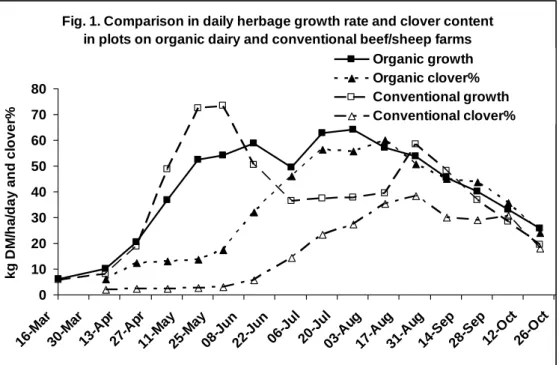
An example of seasonal production of grass/white clover grassland on organic dairy and conventional beef/sheep farms in Northern Ireland is presented in Fig.1
Fig. 1. Comparison in daily herbage growth rate and clover content in plots on organic dairy and conventional beef/sheep farms
0 10 20 30 40 50 60 70 80 16-M ar 30-M ar 13-A pr 27-A pr 11-M ay 25-M ay 08-J un 22-J un 06-J ul 20-J ul 03-A ug 17-A ug 31-A ug 14-S ep 28-S ep 12-O ct 26-O ct k g D M /h a /d a y a n d c lo v e r% Organic growth Organic clover% Conventional growth Conventional clover%
As the conventional farms can apply inorganic N fertiliser, growth tends to be higher on these farms in spring as grass with inorganic nitrogen commences growth after winter sooner than grass/clover. The breeds of animals on organic farms are not always those used in conventional farms. Dairy cows and beef cattle may be from breeds which are adapted to lower input conditions or may be strains of conventional breeds which are suited to forage rather than high input concentrate-based production e.g. New Zealand type rather than American-type Holstein dairy cows.
As organically grown concentrates are expensive compared to those conventionally produce, it is important that organic grassland farms maximise the benefits of their forage. Fortunately, forage legumes tend to have higher nutritive value than their grass counterparts and so, if properly managed, the requirement for concentrates and cereals can be less than on a conventional grassland farm to produce the same output.
Nitrogen fixation from temperate forages
The infection of roots of legumes by rhizobia, results in production of nodules which are the site of fixation of atmospheric nitrogen (N2). This input of N is essential in grass-based organic systems as
it addresses at least some of the shortfall in available N. In addition to N in the produce which is an output from the farm, shortfall is due to losses of N to the air as gases (ammonia, N2 and oxides of
N), to drainage water (nitrates) and to temporarily unavailable N pools in the soil or vegetation (in organic matter or immobilized).
Measured N2 fixation rates vary widely, some of the variation due to the amount of legume in the
herbage, the environmental conditions or the method of measurement. Forage legumes under UK farm conditions yield about 6 t DM ha-1 for white clover, 9 t DM ha-1 for red clover and 10 t DM ha
-1
for alfalfa (Wilkins and Jones 2000). Forage legume growth is more sensitive to environmental conditions than temperate grasses and so their yields are more variable. Also there is the added complexity of white clover growing with grass and the variability caused by the interaction between
the two components. The nitrogen content of white clover is usually about 35 g kg-1 DM while alfalfa is slightly lower at 32 and red clover lower again at about 29 g kg-1 DM.
To overcome the problem of different amounts of legume in the herbage, the fixation rate can be expressed as kg N t-1 DM of legume herbage. Despite this standardisation, estimates can vary widely. For example a survey of the literature shows a range of 23 to 46 kg N t-1 DM of white clover harvested. The range from studies on red clover is from 24 to 36 kg N t-1 DM harvested. The range is even greater when N2 fixed is related to total white clover biomass (including roots) i.e. 23
to 112 kg N t-1 DM total white clover plant (summarised in Frame et al. 1998).
Fate of N in legumes
N transfer within grassland
Nitrogen in white clover in grass/white clover grassland will be used as an example as the presence of a companion grass provides another route for legume-N to follow. Nitrogen after fixation is either transported to the shoots or remains in the roots or shoot bases. Nitrogen is removed in the parts of the shoots which are grazed or harvested. It will, in turn, be returned in urine and faeces to the field while the animal is grazing or will be excreted indoors and then returned as manure, although some will be lost as described above).
Fixed nitrogen which is not destined for the harvestable shoots will be held within the roots and shoot bases until it is released to the surrounding soil. This may occur by decomposition, leakage of amino acids, amides etc from roots and nodules, grazing by soil fauna or transfer to hyphae of mycorrhiza. Nitrogen turnover, and so loss, in white clover roots is much faster than in grass roots (Laidlaw et al. 1996). The fixed nitrogen will be in a range of soil N pools ranging from the partially unavailable N in organic matter to the easily mineralised nitrogen in the less complex nitrogenous compounds by ammonification. It can then be transformed by nitrification to nitrate. Grass is usually able to take up mineral nitrogen rapidly, especially nitrate, and so it can take advantage of the mineral nitrogen. This increases its competitiveness towards white clover which reduces its growth rate and so its N2 fixation declines. The nitrogen which was originally fixed by
clover and is taken up by the companion grass is referred to as ‘transferred’ nitrogen.
The mineralised N in the process of being transferred also has an adverse effect on N2 fixation.
Increasing soil mineral N reduces N2 fixation rate. So a combination of faster growth rate of grass
able to make use of the increased N availability and reduced N2 fixation rate put the clover partner
in the combination at a disadvantage.
White clover usually has a higher N content than the accompanying grass, irrespectively of the system of management. However, application of N fertiliser may reduce N content in white clover, as seen in the comparison in Fig. 2 between N content in clover and grass in an organic and conventional system of management.
Fig. 2. Nitrogen content (mg g-1) in perennial ryegrass and white clover grown in mixture when receiving inorganic N or in
an organic system 0 10 20 30 40 50 60 70 18-A pr 02-M ay 16-M ay 30-M ay 13-J un 27-J un 11-J ul 25-J ul 08-A ug 22-A ug 05-S ep 19-S ep 03-O ct m g N g -1 Inorganic N W Cl Inorganic N Gr Organic W Cl Organic Gr
N uptake and leaching in following crops
Nitrogen in roots and herbage when a grass/legume crop is ploughed is potentially available for the following crop. This is the principle behind crop rotations and is widely used in organic farming. However this N is also prone to loss as availability increases rapidly. If the crop has not been sown immediately or is too young to take advantage of the high amount of readily available N it will mainly be lost by leaching. For example in a trial carried out in Denmark, ploughing 3 year old grass-clover grassland followed by a barley crop with no N fertilizer applied (equivalent to organic farming), over 180 kg NO3-N were leached whereas when undersown with perennial ryegrass,
leaching was reduced by more than three quarters indicating that the undersown perennial ryegrass was able to make use of the flush of mineralised nitrogen made available due to cultivation (Hansen
et al. 2007).
Every effort needs to be made to ensure that the high rate of mineralised N following ploughing a grass/clover sward is not lost in leaching. In a further trial in Denmark, a grass crop was ploughed, then sown with wheat, only a small proportion of the mineralised N was lost in leaching. In comparison, a grass/clover sward treated similarly, resulted in five times the amount of nitrate leached, although crop uptake of N was doubled Høgh-Jensen 1996). Inclusion of an undersown (catch) crop could have reduced this amount leached.
Nitrogen losses from grass/clover systems
Each stage in transfer of nitrogen presents an opportunity for loss (Ledgard et al. 2009). In some instances the loss has no harmful effects on the environment e.g. N2 emitted by denitrification.
However in many instances, the loss involves production of nitrate and gases containing nitrogen. Nitrates in water can cause nutrient enrichment (eutrophication) resulting in undesirable biological activity in the water. Also, nitrates are harmful to humans in drinking water (. So nitrates entering inland waterways or aquifers due to leaching from crop production should be avoided. While N2
poses no harm, other gases containing N are damaging to the environment, especially nitrous oxide, a potent greenhouse gas (GHG) about 300 times as strong as carbon dioxide, but ammonia and nitrous oxide also have an adverse effects on the environment by damaging to the ozone layer. As
already mentioned ploughing and cultivation induce a large pulse of mineralisation producing nitrates at a time when there is no significantly growing crop to take up the nitrate and so leaching of nitrates is likely. Other sources of loss are nitrous oxide from denitrifying urine either in manure or directly voided excreta by grazing animals (which can also result in production of nitrates due to nitrification of ammonia).
In a whole system study in England, comparing a dairy system either relying on N fertilizer or depending entirely on grass/white clover, loss of N as a proportion of input in each was similar for both systems except leaching which was slightly higher in the high N system (17% compared to 13% in the grass/clover system) (Jarvis et al. 1996). From a detailed comparison of leaching studies of grass/N and grass/white clover taken from the literature, the two systems leach approximately similar amounts of N for a given level of N input.
The loss of nitrogen as nitrous oxide has assumed increasing importance in recent years as its role as a greenhouse gas has become more clearly understood. Due to its potency, only a small amount of nitrous oxide need be emitted to have a large effect. Although estimates vary for the amount of nitrous oxide emitted from grassland generally, especially grazed grassland, there is evidence that N2 fixation produces very much less nitrous oxide than nitrogen fertilizer when at the same level of
input (Ledgard et al. 2009). These differences are detected when nitrous oxide emission is measured directly from the soil. However, excreta from animals feeding on the herbage, of course, will contribute similarly to that of grass. As grass/clover herbage usually has a higher content of N than grass, in some instances nitrous oxide would be expected to be higher in the grass/clover system. Nitrogen losses from faeces and urine
Ruminants retain 15 to 30% of the nitrogen they ingest. So 70 to 85% of N in ingested herbage is in excreta, 80% of which is in a highly available form in urine. As one deposition of urine can be equivalent to 1000 kg N ha-1 or more, the growing grass and clover cannot take up all of the N and so it is available to be transformed to ammonium and nitrate and potentially can be lost by leaching, denitrification or volatilization (Monaghan et al. 2007). Nitrogen in faeces is less readily available and so behaves equivalent to a very slow release fertilizer.
Mineral N resulting from mineralisation of N in excreta when deposited in a grazed grass/clover pasture will have an adverse effect on clover. Just as N that is made available by clover to soil has an adverse effect on N2 fixation, so too does N in excreta. This N which has passed through the
animal and excreted is another route for clover N to be transferred to grass. Irrespective of the route of transfer, in all instances this N from clover will have an adverse effect on N2 fixation and on
clover development in the vegetation (Ledgard et al. 2001). Management of the grassland needs to take this into account such as not allowing too long a regrowth interval between grazing periods. In organic systems, soil mineral N can be reduced by introducing a cutting cycle. Nitrogen is ‘mopped up’ by the growing grass and so less mineral N is available for leaching or other routes of N loss. Efficient use of N in manures
‘Average’ cattle slurry from housed animals in a UK system contains about 6% dry matter and 3 kg total N m-3. Farm yard manure (FYM) from housed cattle, however, is about 25% dry matter with about 6 kg N t-1 of which 10% is available if it has been stored or 15% if it is fresh. Pig FYM has a similar dry matter content but slightly higher total N (7 kg t-1) with about 15% available if stored and 25% if used fresh (DEFRA 2010).
Farm yard manure is more prevalent in organic than conventional farming systems as straw bedding is preferred in the former due to its higher animal welfare value. However, most of the manure produced in the UK is in the form of slurry and a major challenge is how to maximise the use of N in the slurry, considering the problems of loss of N from urine as discussed earlier.
The conventional method was to apply slurry by tanker and splash plate. This produced an aerosol effect as the slurry was projected through the air. Legislation has been introduced in Nitrate Vulnerable Zones, which are specific areas of the country where the total amount of N applied to crops is limited by law in order to reduce the amount of nitrate in waterways in the region. In those areas and, indeed in the Code of Good Agricultural Practice for all UK farms, the splash plate must be inverted, so the slurry is expelled towards the ground, resulting in less contact in the air. While this may increase efficiency of utilisation of N in slurry from about 15% to 25%, it is still a low rate. Developments in the technology of slurry application have included band spreading and trailing shoe application which deposits the slurry in bands or ‘ribbons’ on the surface of the ground. This increases utilisation of N to 35-45%. A further method is to inject the slurry into slits in the grassland into the soil. This can improve utilisation efficiency to about 70%.
In a recent trial in Northern Ireland in which a range of forages have been compared for their response to slurry nitrogen, the highest efficiency in slurry N usage was a mixture of grasses which included cocksfoot (Dactylic glomerata)and timothy (Phleum pratense) (Dale and Laidlaw 2011). The poorest response was red clover and perennial ryegrass (Lolium perenne) /white clover due to the N in slurry reducing nitrogen fixation. The slurry did, however, increase availability of potassium. In organic grassland systems in the UK potassium deficiency can be a major problem. Depending on the certification authority, a derogation may be granted for some forms of potassium fertiliser to be used.
Season and weather conditions also have an impact on slurry N use efficiency. Conditions which minimise the volatilization of ammonia increase this efficiency (Lalor and Schulte 2008). For example cool, moist, calm conditions will reduce volatilization and so more N is available for uptake by the crop. Decision support computer packages are available in many countries which help farmers plan their manure management. In conventional farms this includes integrating manure management with inorganic fertilizer management to produce whole farm nutrient management plans. So management of all nutrients, not just N, is taken into account.
Increasing predictability of response to biological N
A major criticism levelled at reliance on N that is either fixed or in manures is that it is less reliable than inorganic nitrogen. As all biological material is less uniform than manufactured products, that should not be surprising. However, as farmers may be concerned that crop yields will fall without use of inorganic fertiliser, they need to be given confidence that biological N will meet their needs. As mentioned earlier, a grass/white clover balance is difficult to maintain. Not only is the relationship between the two dependent on the inorganic status of the soil it is also influenced by management and weather (disease may also be involved in exceptional instances). In Northern Ireland a management support system has been running for a few years in which data are collected from monitor plots laid down on farmers’ fields throughout the Province and subject to standard management. The system is known as CloverCheck and was developed initially to be of specific help to organic farmers (Laidlaw et al. 2007). Information on growth and clover content from the plots is published every two weeks in the farming press and on websites. Prediction of performance of the plots over the following two weeks based on weather forecast data as inputs to a
mathematical model of grass/clover growth is also made. This information is intended to allow farmers to ‘benchmark’ their own grass/clover fields and to identify potential problems in advance of them becoming serious. It also helps farmers understand the limitation to grass/clover swards, such as the different growth patterns of the two components throughout the growing season i.e. they should not expect a constant clover content from early spring to late autumn.
The CloverCheck management aid programme has exposed a major problem in the prediction of growth and clover content in grass/clover swards in organic systems. The amount of soil mineral nitrogen (SMN) is difficult to predict as it varies widely from site to site. This difference is not consistent and its variability has a major impact on the growth rate of grass. In systems where N is supplied by inorganic fertilisers soil organic N is not so important as the inorganic N applied dilutes the impact of SMN. It can be approximately predicted from previous history. However, this is less easy in an organic system. An example of the effect that different levels of SMN can exert on grass growth in grass-clover swards is presented in Fig. 3.
Fig. 3. Growth rate of the grass component in grass/clover swards on 4 organic dairy farms in Northern Ireland (showing
impact of different SMN levels)
0 10 20 30 40 50 60 70 80 90 1 6 -M a r 3 0 -M a r 1 3 -A p r 2 7 -A p r 1 1 -M a y 2 5 -M a y 0 8 -J u n 2 2 -J u n 0 6 -J u l 2 0 -J u l 0 3 -A u g 1 7 -A u g 3 1 -A u g 1 4 -Se p 2 8 -Se p 1 2 -O c t Farm 1 Farm 2 Farm 3 Farm 4 Mean
Finding a way of predicting the contribution of SMN in organic systems remains a challenge. Impact of source of N on carbon footprint of farm produce
A major source of carbon expenditure in crop and animal production systems is manufacture of nitrogenous fertilisers (due to carbon dioxide emissions from fossil fuel combustion during their manufacture). As already described, nitrous oxide is emitted when N fertiliser is applied to soil. These sources of GHG have to be taken into account in calculating the carbon foot print of agricultural produce. In these calculations all direct and indirect emissions (i.e. GHG emitted during the manufacture of inputs to the system) have to be quantified. This is known as a Life Cycle Assessment (LCA) and the carbon footprint of produce can be determined from this calculation.
This approach has been used to calculate the carbon footprint of beef produced in a grass/N fertiliser/concentrate system and a grass/clover/concentrate system (Dawson et al., 2009). The carbon footprint of beef from the grass/white clover system was 19% less than that of the grass/N fertiliser system. The saving was due to 11% less indirect emissions as no N fertiliser was manufactured and 8% direct emissions less as no N fertiliser was applied.
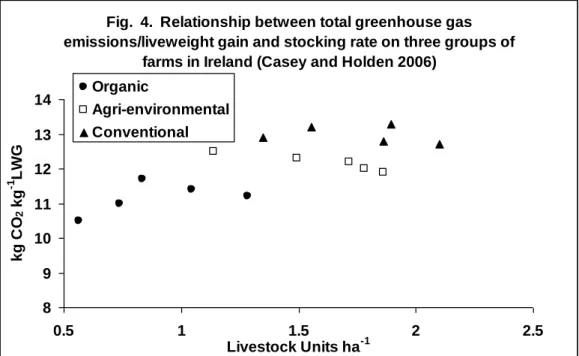
This method has been applied to compare the carbon footprint of beef production between suckler beef farms which are conventionally farmed in an agri-environment scheme or are organic in Ireland (Casey and Holden 2006). The carbon footprint of production of cattle (kg liveweight gain, LWG) from the conventional farm was 13.0 kg CO2 kg-1annum-1, compared to 12.2 and 11.1 kg
CO2 kg-1 LWG annum-1 for the agri-environment and organic farms, respectively. Differences
between the farms in their carbon footprint were directly related to their intensity of production (Fig. 4). It is interesting to note that total emissions of some of the agri-environmental scheme farms were as low as some organic farms.
Fig. 4. Relationship between total greenhouse gas emissions/liveweight gain and stocking rate on three groups of
farms in Ireland (Casey and Holden 2006)
8 9 10 11 12 13 14 0.5 1 1.5 2 2.5 Livestock Units ha-1 k g C O2 k g -1 L W G Organic Agri-environmental Conventional
Future potential to improve biological N efficiency .
Breeding
Selection and breeding of grasses which are more compatible with clovers has been a breeding objective in the major clover breeding institutions in the world (Woodfield and Clark 2009). Increasing understanding of the factors that cause grass to be aggressive towards clover will help find a more compatible combination. Some progress has been made in breeding for white clover which is less sensitive to high soil mineral nitrogen (Abberton et al. 2008). Also breeding crops specifically for low input systems will help balance emphasis to date on breeding for maximum productivity in response to high inputs. Suitability of forage grass varieties for low input grassland farming is an objective in the programmes of some international breeding companies (Stewart and Hayes 2010). Selection for, or genetic manipulation to produce, more effective rhizobia have not resulted in highly successful improvements in N fixing ability.
Diet
One of the problems in ruminant production is that the energy and protein ratio is not in balance in diets and so high amounts of ammonia build up in the rumen, resulting in N-rich urine production and low efficiency in use of ingested N. Increasing energy in diets can reduce the damaging effects of N in ruminant diets. In the UK some varieties of high sugar perennial ryegrasses have been bred and offer some prospect of more efficient N utilisation (Merry et al 2006). This has the potential to improve efficiency in utilisation of crude protein in the diet of the ruminant and also reduced loss of N in its excreta.
Manure management
Opportunities for the loss of manure N arise during storage and application. Covering slurry stores will reduce the loss of ammonia and nitrous oxide prior to spreading. Reference has already been made to the optimum conditions for application of slurry to reduce ammonia loss and to the types of forage that are most efficient in the use of slurry N. If phosphorus (P) and potassium (K) in the slurry is not required slurry should not be applied to a forage legume as it will reduce the contribution made by fixed N (Dale and Laidlaw, 2011). Separating the solid and liquid fractions in slurry provide an opportunity for slurry to be used more flexibly. The liquid fraction of mechanically separated slurry has an N content of about 3 kg N m-3 of which about one half is readily available compared with the solid fraction which has a content of about 4 kg N t-1 but only about one quarter of this is readily available.
Conclusions
No crop production system can be free from N loss. As shown earlier, loss even from a dairy production system in which no N fertiliser is applied still losses 40 to 50% of its nitrogen per annum. So, even for a sustainable production system, nitrogen will need to be replenished annually to maintain production. In organic production systems, unless a source of organic material from outside the system is readily and dependably available there will always be a requirement for biologically fixed N as an important input.
The following are reasons for developing increased reliance on biological N:
Increasing cost and availability of fossil energy for manufacture of inorganic N fertilisers,
More stringent legislation to minimise total N input to reduce damaging effects on the environment and
Consumer concern about the use of manufactured chemicals in food production and the size of carbon footprint of food products.
Due to the complexity of the system of production of biological N and the variability of the source, lack of predictability is often cited as a reason for avoiding reliance on it. Predictability in production and in efficiency of use of biological N by
increasing understanding of the system of production of biological N so that output can be quantified,
development of easier, but accurate, methods of measuring availability of biological N for crop growth so that monitoring is made easy and
using the information in combination with decision support systems to help the farmers rely on, and manage, biological N.
References
Abberton, M.T., Marchall, A.H., Humphreys, M.W., Macduff, J.H., Collins, R.P. and Marley, C.L. (2008) Genetic improvements of forage species to reduce the environmental impact of temperate livestock grazing systems. Advances in Agronomy, 98, 311-355.
Casey, J. and Holden, N.M. (2006) Greenhouse gas emissions from conventional, agri-environmental scheme and organic Irish beef suckler-beef units. Journal of Environmental
Quality, 35, 231-239.
Dale, A.J. and Laidlaw, A.S. (2011) Low input forages for ruminant production systems. End of
Project Report to Agrisearch, June 2011.
Dawson, L., Wood, V., Yan, T., Watson, C. and Laughlin, R. (2009) Greenhouse gas emissions from and carbon footprint of beef production systems. In: From Beef Production to
Consumption – A Seminar for Specialists. Proceedings of an Agrisearch Seminar at
AFBI-Hillsborough, October 2009, 83-121.
DEFRA (2010) Fertiliser Manual (RB209). 8th edition. Department of Environment, Food and Rural Affairs: London.
Frame, J., Charlton, J.F.L. and Laidlaw, A.S. (1998) Temperate Forage Legumes. CAB International: Wallingford.
Hansen, J.P., Eriksen, J. and Vinther, F.P. (2007) Catch crop strategy and nitrate leaching following grazed grass-clover. Soil Use and Management, 23, 348-358.
Høgh Jensen, H. (1996) Nitrogen recovery after clover/ryegrass leys. In: Legumes in Sustainable
Farming Systems. Younie, D. British Grassland Society, pp. 130-132
Jarvis, S.C., Wilkins, R.J. and Pain, B.F. (1996) Opportunities for reducing the environmental impact of dairy farming managements: a systems approach. Grass and Forage Science, 51, 21-31.
Laidlaw, A.S., Christie, P. and Lee, H.W. (1996) effect of white clover cultivar on apparent transfer of nitrogen from clover to grass and estimation of relative turnover rates of nitrogen in roots. Plant and Soil, 179, 243-253.
Laidlaw, A.S., Moore, N. and Dale, A.J. (2007) Monitoring and modelling growth in a proposed management support system for grass-white clover swards. In: Making Science Work on the
Farm. Holden, N.M. et al. (Editors) Agmet, Dublin, pp. 83-88.
Lalor, S.T.J. and Schulte, R.P.O. (2008) Low-ammonia-emission application methods can increase the opportunity for application of cattle slurry to grassland in spring in Ireland. Grass and
Forage Science, 63, 531-544.
Ledgard, S.L. (2001) Nitrogen cycling in low input legume-based agriculture. Plant and Soil, 228, 43-59.
Ledgard, S.L., Schils, R., Erikson, J. and Luo, J. (2009) Environmental impacts of grazed clover/grass pastures. Irish Journal of Agricultural and Food Research, 48, 209-226.
Monaghan, R.M., Hedley, M.J., Di, H.J., McDowell, R.W., Cameron, K.C. and Ledgard, S.L. (2007) Nutrient management in New Zealand pastures- recent developments and future issues. New Zealand Journal of Agricultural Research, 50, 181-201.
Stewart, A. and Hayes, R. (2010) Ryegrass breeding- balancing trait priorities. In: Grasses for the
Future. Teagasc and Department of Agriculture, Fisheries and Food, 53-68.
Wilkins, R.J. and Jones, R. (2000) Alternative home-grown protein sources for ruminants in the United Kingdom. Animal Feed Science and Technology, 85, 23-32.
Woodfield, D.R. and Clark, D.A. (2009) Do forage legumes have a role to play in modern dairy farming systems? Irish Journal of Agricultural and Food Research, 48, 137-147.