자폐 스펙트럼 장애 아동의 섭식 문제를 위한 부모교육의 효과: 체계적 고찰 39
Ⅰ. 서 론
식사 시간은 가족과 함께하는 중요한 시간이다. 아동 은 식사 시간을 통해 가족의 정체성과 안정성을 만들어 나가며, 언어발달 및 사회적 기술을 발달시킨다(Murphy, Zlomke, VanOrmer, & Swingle, 2020). 자폐 스펙트 럼 장애 아동은 일상생활의 여러 영역에서 어려움을 가 지는데, 그중 식사 시간 동안 아동이 보이는 식사 습관의 어려움은 가정 내 갈등을 유발한다(Williams, Dalrymple, & Neal, 2000). 문제행동으로 인해 부모의 스트레스가 증가하고, 식사시간에 대한 만족도가 감소한다(Ausderau & Juarez, 2013). 자폐 스펙트럼 장애 아동의 46∼89%가 섭식 문제와 식습관에 어려움을 가진다고 추정한다(Bandini et al., 2010; Curtin et al., 2015). 자폐 스펙트럼 장애 아동의 부모들은 아동이 자리에 앉아 있는 것을 거부하거나 음 대한감각통합치료학회지 제18권 3호
The Journal of Korean Academy of Sensory Integration 2020 Vol. 18. No. 3 http://dx.doi.org/10.18064/JKASI.2020.18.3.39
자폐 스펙트럼 장애 아동의 섭식 문제를 위한 부모교육의 효과: 체계적 고찰
최연우*, 김경미** *동서대학교 작업치료학과 초빙교수, 인제대학교 대학원 재활과학과 박사수료생 **인제대학교 보건의료융합대학 작업치료학과 교수국문초록
목적 : 본 연구는 자폐 스펙트럼 아동의 섭식 문제에 대한 부모교육의 효과를 알아보고자 체계적 고찰을 실 시하였다.연구방법 : 2000년 1월부터 2019년 5월까지 게재된 논문을 대상으로, Cochrane library, Embase, Ovid, Pubmed 데이터베이스를 이용하여 검색하였다. 총 6개의 논문을 최종 선택하여 연구의 근거 수준에 따 라 질적 분석을 실시하였고, PICO(Patient, Intervention, Comparison, Outcome) 에 따라 정리하였다. 결과 : 최종 선정된 논문 중 4편이 근거 수준 1이고, 나머지는 근거 수준 3으로 나타났다. 부모교육의 기반 이 되는 중재 접근법 중 행동치료가 기반이 되는 논문이 3편으로 가장 많았으며, 모두 근거 수준 1에 해 당하였다. 결론 : 본 연구는 섭식 문제를 가진 자폐 스펙트럼 아동의 가정에 도움을 주는 다양한 방법의 부모교육을 알아봄으로써 임상에서 적용할 수 있는 부모교육의 방향을 모색하는 데 의의가 있다. 주제어 : 부모교육, 섭식문제, 자폐 스펙트럼 장애, 체계적 고찰 교신저자: 김경미([email protected]) 접수일: 2020.11.15. ∥심사일: 2020.12.01. ∥게재확정일: 2020.12.24.
40 대한감각통합치료학회지 Vol. 18, No. 3, 2020
식을 게워내는 등의 행동을 할 뿐만 아니라 아동이 음식 을 선택하고, 음식을 받아들이는 것에 대해 매우 제한적 이라고 보고 하였고, 그로 인해 다양한 영양소를 골고루 섭취하는 데 어려움이 있다고 하였다(Cermak, Curtin, & Bandini, 2010; Schreck, Williams, & Smith, 2004). 이런 섭식의 문제가 오랜 기간 지속되면 영양실조, 발달 지연 등 아동의 성장과 발달에 해로운 영향을 미친다 (Sharp, Jaquess, Morton, & Herzinger, 2010).
자폐 스펙트럼 장애 아동의 부모들은 식사 시간에 보 이는 문제점들을 해결하기 위해 다양한 전략을 모색한 다. 식탁 의자에 앉기, 식사 시간 동안 움직이지 않기, 다양한 음식 먹기, 새로운 음식 시도하기 등을 위해 다양 한 방법을 시도하지만, 성공하기는 쉽지 않다(Suarez, Atchison, & Lagerwey, 2014). 아동이 식사 시간에 참 여하기 위해서는 구강 운동, 감각 처리, 사회 행동적 기 술과 같은 다양한 필수적인 요소들이 필요하고, 섭식 문제 를 해결하기 위해서는 아동이 가지고 있는 이러한 요소 들에 대한 정확히 이해해야 하지만(Miyajima, Tateyama, Hirao, Nakaoka, & Higaki, 2014; Roley et al., 2008), 부모가 모든 요인에 있어 정확히 파악하고 전략을 모색 하기란 어렵다. 특히 자폐 스펙트럼 장애 아동의 부모는 아동의 섭식 문제와 식습관에 관련하여 더 많은 이해가 요구되는데, 부모가 자폐스펙트럼 장애 아동의 섭식 문 제와 식습관과 관련된 요인에 대한 이해가 부족하고 자 녀 양육 방법에 어려움을 가지면 부모의 스트레스가 가 중되고 가정 분위기도 우울하게 되며, 결국 아동과 가족 모두에게 부정적인 영향을 미친다(Tanner et al., 2015). 부모가 아동에게 미치는 영향은 강력하다. 부모는 아 동과 정서적 유대관계를 맺고, 아동의 성장과 발달을 돕 는다. 태어나면서부터 아이의 영양 섭취는 부모에게 의 존하며, 부모의 식습관과 영양에 대한 지식은 지속해서 영향을 주기 때문에 아동의 식습관 형성에 있어 부모는 중요한 요인 중 하나이다(Balantekin, 2019). 부모교육 은 부모로서 해야 할 역할을 원활히 수행하기 위한 정보 와 지침을 마련하는 모든 형태의 활동이자 부모의 역할 수행 변화에 영향을 미치기 위한 교육적 기법을 사용하 는 활동이다(Brim, 1959; Roberston, 1984). 식습관 관 련 부모교육은 부모가 아동에 대해 이해하고, 부모가 치 료자로서 역할을 함으로써 치료를 자연스럽게 일상으로 연결해 치료의 효과를 일반화시킬 수 있다(Dempster,
Burdo-Hartman, Halpin, & Williams, 2016). 또한 부 모에게 효과적인 양육법을 학습할 기회를 제공함으로 부 모와 아동과의 관계에도 긍정적인 영향을 미치며, 부모 의 스트레스도 경감시킨다. 자폐 스펙트럼 장애 아동이 가지는 다양한 문제에 도 움을 주기 위해 부모교육이 이루어지고 있고, 부모교육 의 효과에 대한 체계적 고찰과 메타분석 연구 결과 부모 의 스트레스를 감소시키고, 자폐 아동의 문제를 감소시 키는데 효과가 입증되었다(Kirkpatrick, Louw, & Leader, 2019; Rutherford et al., 2019; Trembath et al., 2019). 따라서 최근의 논문들을 통해 자폐 스펙트럼 장 애 아동의 섭식 문제에 관한 접근으로 부모교육에 대한 필요성을 제시하기 위해 자폐 스펙트럼 장애 아동의 섭 식 중재에 대한 부모교육의 효과를 체계적으로 검토하고 분석하고자 한다. 또한 이를 통해 중재에 관한 정보를 수 집하고 근거를 제시함으로 섭식 문제를 가진 자폐 스펙 트럼 장애 아동의 부모교육에 도움을 주고자 한다.
Ⅱ. 연구 방법
1. 논문검색 및 자료수집
본 연구는 2000년 1월부터 2019년 5월까지 게재된 연 구를 대상으로 하였다. 문헌검색을 위한 데이터베이스로 Cochrane library, Embase, Ovid, Pubmed를 사용하 였다. 검색용어는 자폐아동에 대해 “autism spectrum disorder, autism, autistic, Asperger, pervasive developmental disorder”으로, 섭식 문제에 대해 “feeding problem, feeding difficulties, feeding behavior, mealtime behavior problem, food selectivity, picky eater, eating habits problem”으로, 부모교육에 대해 “parent education, parent training, parent participation,strategies, intervention, treatment, approach, program”
으로 하였다. 분석연구의 선정기준과 배제기준은 다음과 같다.
1) 포함기준
자폐 스펙트럼 장애 아동의 섭식 문제를 위한 부모교육의 효과: 체계적 고찰 41 연구
(2) 섭식 문제에 관한 부모교육/부모훈련을 1회기 이상 한 연구
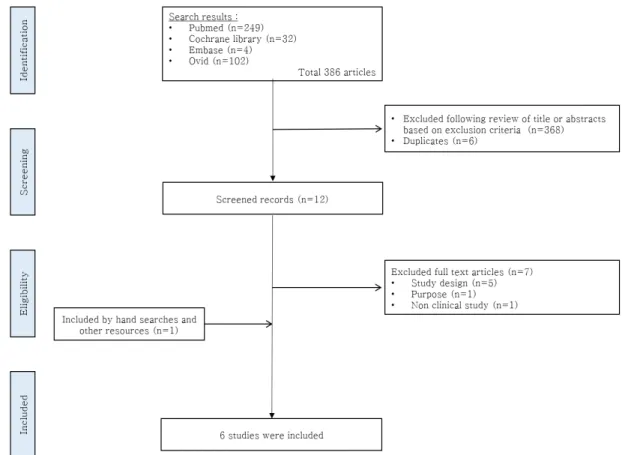
(3) RCT(randomized controlled trials)연구, 유사 실험 연구 2) 배제기준 (1) 성인이나 동물을 대상으로 한 연구 (2) 약물 중재를 포함한 연구 (3) 단일사례연구, 고찰 및 학위 논문, 보고서 이와 같은 기준으로 검색한 결과 일차적으로 386편의 논문이 검색되었다. 검색된 연구는 제1 저자가 제목 및 초록을 검토하여 문헌을 선별하였고, 386편의 논문 중 중복되거나 포함기준, 배제기준에 따라 374편의 논문을 제외하였다. 논문을 선정하는 과정 중 의문이 드는 논문 에 대해서는 2명의 연구자가 의견을 나누어 결정하였다. 총 12편의 논문의 전문을 확인하여 논문의 배제기준에 따라 7편을 제외하였고, 수집된 논문의 참고문헌을 검토 하여 선정기준에 부합한 1편의 논문을 포함하여 최종적 으로 6편의 논문을 선정하였다. 자료수집 절차는 다음과 같다(Figure 1).
2. 연구의 근거 수준
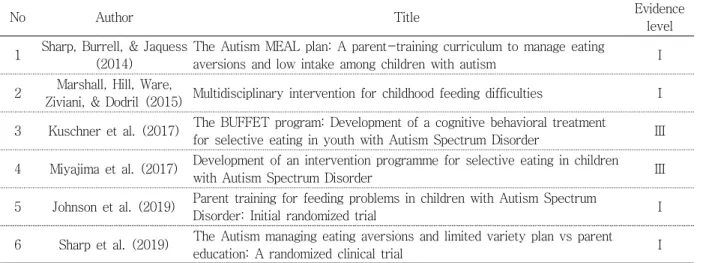
본 연구에서 선정된 논문의 근거 수준을 평가하기 위 해 Arbesman, Scheer와 Lieberman (2008)이 개발한 질적 근거 수준 분석 모델을 사용하였다(Table 1).3. 논문의 질적 분석
최종적으로 선별된 연구 중 RCT 연구는 PED(Physiotherapy Evidence Database)ro scale을 사용하여 문헌의 질을 평가하였다(Table 2). PEDro scale은 총 11개의 항목으 로 구성되며, 각 항목에 대해 1점씩 배점한다. 1번 항목을 제외하고 2번에서 11번 항목의 합을 총점으로 한다(Tooth,
No Author Title Evidence level 1 Sharp, Burrell, & Jaquess
(2014)
The Autism MEAL plan: A parent-training curriculum to manage eating
aversions and low intake among children with autism Ⅰ 2 Marshall, Hill, Ware,
Ziviani, & Dodril (2015) Multidisciplinary intervention for childhood feeding difficulties Ⅰ 3 Kuschner et al. (2017) The BUFFET program: Development of a cognitive behavioral treatment
for selective eating in youth with Autism Spectrum Disorder Ⅲ 4 Miyajima et al. (2017) Development of an intervention programme for selective eating in children
with Autism Spectrum Disorder Ⅲ
5 Johnson et al. (2019) Parent training for feeding problems in children with Autism Spectrum
Disorder: Initial randomized trial Ⅰ 6 Sharp et al. (2019) The Autism managing eating aversions and limited variety plan vs parent
education: A randomized clinical trial Ⅰ Table 1. Level of quality among each study
No Author Item Total Quality
1 2 3 4 5 6 7 8 9 10 11
1 Sharp, Burrell, & Jaquess
(2014) Y Y Y Y N N N N N Y Y 5 Fair
2 Marshall, Hill, Ware,
Ziviani, & Dodril (2015) Y Y Y Y N N N Y Y Y Y 7 Good 3 Johnson et al. (2019) Y Y Y Y Y N Y Y Y Y N 8 Good 4 Sharp et al. (2019) Y Y Y Y N N Y Y N Y Y 7 Good Table 2. Physiotherapy evidence database scale for researches
Item 1: Eligibility criteria were specified (not scored). Item 2: Subjects were randomly allocated.
Item 3: Allocation was concealed.
Item 4: The groups were similar at baseline regarding the most important prognostic indicators. Item 5: There was blinding of all subjects.
Item 6: There was blinding of all therapists who administered the therapy.
Item 7: There was blinding of all assessors who measured at least one key outcome.
Item 8: Measures of at least one key outcome were obtained from more than 85% of the subjects initially allocated to groups. Item 9: Data for at least one key outcome was analyzed by “intention to treat”.
Item 10: The results of between-group statistical comparisons were reported for at least one key outcome. Item 11: The study provided both point measures and measures of variability for at least one key outcome.
No Author Item
1 2 3 4 5 6 7 8 Total
5 Kuschner et al. (2017) 2 2 0 2 0 2 1 0 9
6 Miyajima et al. (2017) 2 2 2 2 0 2 1 0 11
Table 3. Methodological index of non-randomized studies for researches
Item 1: A clearly stated aim
Item 2: Inclusion of consecutive patients Item 3: Prospective collection of data
Item 4: Endpoints appropriate to the aim of the study Item 5: Unbiased assessment of the study endpoint
Item 6: Follow-up period appropriate to the aim of the study Item 7: Loss to follow up less than 5%
Item 8: Prospective calculation of the study size
자폐 스펙트럼 장애 아동의 섭식 문제를 위한 부모교육의 효과: 체 계적 고 찰 43 No A rt ic le Ev id en ce le ve l P ar ti ci pa nts In te rv en ti on O utc om e E G C G E G C G M ea sur em ent R es ul ts 1S ha rp , B ur re ll, & Ja qu es s (2014) Ⅰ N =1 0 A ge( m on) M ( SD ) 70. 8 (20. 5) M: F = 8 :2 N =9 A ge(m on) M ( SD ) 64. 8( 16 .9 ) M: F = 7 :2 T he aut is m M E A L p lan b eha vi or al i nt er vent io n b eha vi or m an agem en t st ra tegi es spec if ic i nt er vent io n -st rat eg ie s fo r pro m ot in g sel f-fee di ng 8 se ss io n, 6 0 m in /se ssi on H and out s no n fe ed in g re la te d to pi cs w it h lim it ed beha vi or al c ont ent F ea sib ilit y o ut co m e - S R S so ci al v al id it y an d pa rent p er ce pt io n of im pr ov em en t E ff icac y o ut co m e PSI -sho rt f or m - B A MB I FPI F ea sib ilit y at te nd an ce (8 3 % ) hi gh d egr ee o f so ci al v al id it y pa rent p er ce pt io n of ef fe ct iven es s E ff icac y o ut co m e E G s how ed si gni fi ca nt r educ ti on pa rent in g st re ss (P S I: F (1 ,1 6 ) = 7. 6, p = . 01) no s ig ni fi ca nt c hanges det ec te d fe edi ng b eha vi or s (B A M B I to ta l sco re : F =0 .0 7 , p = .0 7 ; B A M B I lim it ed va ri et y : F =0 .3 6 , p = .3 6 ; B A M B I fo od r efu sa l : F = 0 .46, p = . 4 6 , B A M B I aut is m f ea tur es : F = .34, p = .5 7 ; F P I sel ec ti vi ty sco re : F = 1 .7 , p =. 2 1 ) 2 M arsh al l, H ill, W ar e, Z iv ia ni, & Do dr il (2015) ⅠA S D , N =3 3 NM C, N =3 5 O per ant cond it io ni ng b eha vi or al i nt er vent ion; top-dow n pr om pt -and re w ard t he ra py pa re nt t ra in in g pr og ra m f ocus ed on fe ed in g sk ills , be ha vi or , an d nu tr it io n 1 0 se ss io n S y st em at ic des en si ti za ti on b eha vi or al i nt er vent ion; bo tt om -up m odel in g and pl ay-ba se d ther apy pa re nt t ra in ing pro gram fo cu se d on f eed in g sk ills , be ha vi or , an d nu tr it io n 1 0 se ssi on In te rv ent ion im pa ct 3 -day w ei ghe d food di ar y f ood list s BPFA S T o com pa re out com e f ee di ng d if fi cu lt ie s w ei ght , hei ght , B M I EC BI PSI -sho rt f or m In te rv ent ion im pa ct 2 i nte rv en ti on w as g re at er in cr ea se s in t he t ot al n um ber o f fo ods c onsum ed (a dj us ted m ea n di ff er ence 3 .3 f oods, 9 5 % C I 6. 8 0. 1, P = 0 .06) T o com pa re out com e f ee di ng d if fi cu lt ie s no s ig ni fi ca nt di ff er ences i n out com e m ea su re s bet w ee n the O C and S y sD i nt er ve nt io n gr oups N =3 6 Ag e M ( SD ) 5. 1 (1. 3) N =3 2 Ag e M ( SD ) 5. 1( 1 .3 ) Tabl e 4. Char act er is tics of ana ly zed studi es
44 대 한감각통합치료학회지 V ol . 18 , N o. 3 , 20 20 No A rt ic le E vi denc e le vel P ar tic ip an ts In te rv en tio n O ut co m e E G C G E G C G M ea sur em ent R es ul ts 3 Joh ns on et a l. (2019) Ⅰ N =2 1 A ge(y r) M ( SD ) 5. 1( 1 .3 ) M: F = 1 9 :3 N =2 1 A ge(yr) M ( SD ) 5. 1( 1. 3) M :F = 21: 0 Pa re nt t ra in in g pr og ra m b eha vi or al i nt er vent io n i nt egra te d beha vi or al st ra te gi es ada pt ive feed in g sk ills (u si ng u te ns ils a nd pr epa ri ng a si m pl e m ea l) n ut rit io na l gu id an ce 1 1 se ssi on , 60 -90 m in/ se ss ion no in te rv en tio n F ea si bilit y PSQ T reat m en t F id el it y C hec kl is t C hi ld F ee di ng O ut com es - BAM B I-R - AYC E - CGI -I C hi ld B eha vi or O ut com es - ABC - HS Q Pa re nt o ut co m es PSI Sh or t Fo rm PSO C - CGS Q F ea sib ilit y at te nd an ce (8 5 % )/ pa re nt sat is fact io n hi gh t rea tm ent f id el it y hi gh (9 7 % t he ra pis t in te gr it y ; 9 4 % p ar ent a dher en ce ) E G s how ed si gni fi ca nt ly gr ea te r reduc ti ons f ee di ng out com e( B A M B I-R ; T wa ld = -2 .7 9 ; p = . 0 0 3 *; A YC E; T wa ld = -3 .5 8 ; p = .0 0 1 *) D is rupt iv e beha vi or out com es dec re as ed, no s igni fi ca nt (A B C ; T wa ld = 0 .2 9; p = .77, HS Q ; T wa ld = -0. 75; p = .46) P ar en t out co m es im pr ov ed, no si gni fi ca nt (P S I; T wa ld = -1. 40 ; p = . 17 , C G S Q ; T wa ld = 1 .5 1 ; P = . 14, P S O C ; T wa ld = 1 .1 7 ; P =. 2 5 ) 4S ha rp et a l. (2019) Ⅰ N =1 9 A ge(m on) M ( SD ) 58. 3( 14 .6 ) M: F = 1 6 :3 N =1 9 A ge(m on) M ( SD ) 59. 1( 13. 4) M :F = 16: 3 T he aut is m M E A L pl an m ult id is ci plin ar y in te rven ti on(be ha vi ora l & nut ri ti ona l) n ut rit io n ed uc at io n s tr at egi es t o st ru ct ur e m ea ls a nd ex pa nd t he ch ild ’s di et be gi nn ing w ith s es si on 5, in co rp or at ed pa rent -chi ld pr act ic e( last 3 0 m in ) 1 3 s es si on(1 0 c or e & 3 boos te r ses si on), 9 0 -m in /s essi on Pa re nt e du ca ti on pr ogra m in fo rm at io n about a ut is m w it hou t gu id an ce o n nu tr it io n, m eal s tr uc tu re , or d ie t chi ld ren w er e not in vo lv ed 1 0 se ssi on , 9 0 -m in /s essi on F ea si bilit y a tt enda nce P are nt sat is fact io n Q uest ion na ir e E ff icacy - CGI -I - BAM B I F ea sib ilit y at te nd an ce : E G 8 7 % , C G 6 7 % P are nt sat is fact io n E G 84% (5 .66/ 6. 0) E ff icac y C G I-I: E G 47. 4% , C G 5 .3 % ( P <. 05) E G s how ed si gni fi ca nt ly l ow er B A M B I to ta l sc or e( p = .01) E G s how ed si gni fi ca nt ly c ons um ed gr am s( p = .01) Tabl e 4. Char act er is tics of ana ly zed studi es (C on t.)
자폐 스펙트럼 장애 아동의 섭식 문제를 위한 부모교육의 효과: 체 계적 고 찰 45 N o A rt ic le Ev id en ce le ve l P ar ti ci pa nt s In te rv ent io n O ut co m e E G CG EG C G M ea su re m en t Re su lt s 5 K usch ne r et a l. (2017 ) Ⅲ N =1 1 Ag e 8-11ye ar s M: F = 1 1 :0 -T he B U F F E T P ro gr am C B T pr in ci pl e pa re nt -al one , ch ild -al one, ch ild -pa ren t dy ad s ec ti on c op ing s tr at egi es f or a nxi et y and st re ss , the conc ept s of F ood F oe an d F ood F ri en d T hou ght s, st ra te gi es f or f le x ib ilit y 1 4 se ss io n, 9 0 m in /se ssi on -T re at m en t acce pt ab ilit y s es si on a tt en da nc e i nd ivi dua l se ss ion ra ti ng s T re at m en t sat is fact io n - C S Q T re at m en t ac ce pt ab ilit y hi gh at tendanc e (9 1 % ) p ar en t & c hild re n sh ow ed v ar ia bilit y in th ei r perc ept ions of how h el pf ul e ac h se ssi on T re at m en t sat is fact io n C S Q : hi gh to ta l sc or e 3 0. 5(2 7 -3 5 ) 6 M iy aj im a et a l. (2017 ) Ⅲ N =2 3 A ge(m on) M ( SD ) 52. 83( 12 .1 0 ) M: F = 1 8 :5 -Int er ve nt io n pr ogra m m e ba se on P er so n E nvi ronm ent O cc upa ti ona l m od el t o im pr ove se le ct ive ea ti ng a nd at ti tu de s at m ea l ti m e 2 se ss io n, 4 0 m in /se ssi on -T he ch an ge to p ar en ta l atti tu de degr ee o f di ff ic ul ty ex per ience : V A S se lf -ef fi cacy : S A P S t he nu m ber o f re co mme nd at io ns T he cha nge t o chi ld' s eat in g pa tte rn t he nu m ber o f foods (c hi ld chos e to e at ) t he pa re nt 's s ub je ct iv e vi ew T he cha ng e to pa rent al a tt it ude V A S s cor e si gn if ic an tl y dec rea se d(1 7 .8 7 poi nt , p < .001 ) S A P S s co re s ig ni fi ca nt ly i nc re as ed (5 .3 5 poi nt , p = .018) si gn if ican tl y i ncre ase i n th e nu m be r of re co m m enda ti ons ( p < .0 1) T he c han ge t o ch ild' s ea ti ng p at te rn t he n um ber o f foods it em s si gn if ican tl y in cre ase d( 4 .3 5 , p = .004) t he num be r of una cc ept ed fo od s it em s si gn if ican tl y d ec re as ed (2 .7 3 , p < .001) t he pa rent 's s ubj ec ti ve vi ew s ho w ed a si gn if ican t de cre as e( p < .001) Ta ble 4. C haracteristics o f ana lyzed s tudi es (Cont .) * A B C : A be rr ant B eh av io r C hec kl is t / A S D : aut is m spec tr um d is or der / A Y C E : A bout Y our C hi ld ’s E at ing / B A M B I-R : the B ri ef A ut is m M ea lt im e B ehavi or In ve nt or y -R ev ise d / B M I: B od y M ass In de x / B P F A S : B eh av io ral P ed iat ri cs F eed ing A sses sm en t S ca le / C B T : C og ni ti ve B eha vi or al T re at m en t / C G : C on tr ol G rou p / C G I-I: C lin ical G lo bal I m pr essi on -Im pr ovem ent scal e / C G S Q : C ar egi ve r S tra in Q ue st io nna ir e/ C S Q : C lient S at is fa ct ion Q ue st io nna ir e / E C B I: E y ber g C hi ld B eha vi or In ven to ry / E G : E x per im en ta l gr ou p / F P I: F ood Pr ef er ence In ven to ry / H S Q : H om e S it ua ti ons Q uest ion na ir e / N M C : N onm ed ic al ly C om pl ex C hi ld ren / PS I: P ar en ti ng S tr es s In dex / P S O C : T he P ar en ti ng S ens e of C om pet enc e / P S Q : T he P ar ent S at is fa ct ion Q uest ion na ir e/ S A P S : th e S el f-ef fi cacy A ss essm en t fo r Pa re nt s of C hi ld re n w it h S el ec ti ve E at ing Sc al e / SR S : S oci al R esponsi ven es s S ca le / V A S : V is ual A na log ue Sc al e
46 대한감각통합치료학회지 Vol. 18, No. 3, 2020
McCluskey, Hoffmann, McKenna, & Lovarini, 2005). 9-10점은 아주 높은 질적 수준, 6-8점은 높은 질적 수 준, 4-5점은 중등도 질적 수준, 3점 이하는 낮은 질적 수준으로 분류한다. 유사 실험 연구는 MINORS(Methodological Index of Non-Randomized Studies)를 사용하여 문헌의 질을 평 가하였다(Table 3). MINORS는 비교집단이 있거나 없는 유사 실험 연구를 평가할 수 있는 도구로, 본 연구의 대 상논문이 비교집단이 없는 유사 실험 연구이므로 8개의 문항만 평가하였다. 각 평가항목에 따라 ‘0점(not reported), 1점(reported but inadequate), 2점(reported and adequate)’으로 총 16점 만점으로 평가한다(Slim et al., 2003).
4. 분석 방법
본 연구에서는 Patient, Intervention, Comparison, Outcome(PICO) 형식에 따라 근거 수준별로 기술하였다 (Table 4).
Ⅲ. 연구 결과
1. 부모교육
부모교육의 기반이 되는 중재접근법에는 행동치료(행 동수정, behavior therapy), 인지행동치료(cognitive behavioral treatment; CBT), 다학제적 중재 (multidisciplinary intervention)와 PEO(Person Environment Occupational) model이 있다. 행동치료 가 기반이 되는 논문이 3편(50%)으로 가장 많았으며, 인 지행동치료, 다학제적 중재, PEO model이 기반이 되는 논문은 각 1편(16.67%)이었다.
2. 연구 근거의 질적 수준에 따른 부모교육의
효과
1) 근거 수준 Ⅰ의 부모교육 효과 부모교육 프로그램에 대한 부모들의 만족도는 높게 나 타났으며, 부모의 인식개선에도 효과적으로 나타났다 (Johnson et al., 2019; Sharp, Burrell, & Jaquess, 2014; Sharp et al., 2019). 전체 4개의 연구 중 3개의 연구에서 부모교육 전후로 부모의 스트레스 정도를 측정 한 결과(Johnson et al., 2019; Sharp, Burrell, & Jaquess, 2014; Sharp et al., 2019), 모두 부모의 스트 레스 지수가 낮아졌다고 보고하였고, 3개의 연구 중 1개 의 연구에서만 통계적으로 유의한 차이를 보였다(Sharp, Burrell, & Jaquess, 2014).부모교육 프로그램을 통해 아동에게 나타난 변화는 전 체 4개의 연구 중 2개의 연구에서 통계적으로 유의한 차 이를 나타내었다. 아동이 선호하는 음식만 선택해서 먹 는 행동이 감소하고, 음식을 거부하는 행동이 감소하면 서 새로운 음식–과일, 채소, 다양한 곡물을 섭취하려는 시도들이 증가하였다(Johnson et al., 2019; Sharp et al., 2019). 또 이전에 거부했던 음식의 섭취량이 유의하 게 증가하였다(Sharp et al., 2019).
2) 근거 수준 Ⅲ의 부모교육 효과
부모교육 프로그램에 대한 부모의 만족도는 높게 나타 났으며(Kuschner et al., 2017; Miyajima et al., 2017), 부모의 자폐 스펙트럼 장애 아동에 대한 인식변 화에 도움이 되었다(Miyajima et al., 2017). 부모교육 프로그램을 통해 아동은 섭취하는 음식의 종류가 증가하 였고, 거부하는 음식의 종류가 감소하였고, 이는 부모가 주관적으로 판단하기에도 음식 섭취에 대한 불균형이 감 소하였다(Miyajima et al., 2017).
Ⅳ. 고찰
본 연구는 자폐 스펙트럼 장애 아동의 섭식 문제에 접 근하는 데 있어 부모교육에 대한 필요성을 제시하기 위 해 자폐 스펙트럼 장애 아동의 섭식 중재에 대한 부모교 육의 효과를 체계적으로 검토하고 분석하여 임상 현장의 적용을 위한 기초자료를 제시하고자 하였다. 이를 위해 2000년 1월부터 2019년 5월까지 국외 학술지에 게재된 6편의 연구를 분석하였다. 대상 연구의 근거 수준이 높을수록 비뚤림(bias)을 최자폐 스펙트럼 장애 아동의 섭식 문제를 위한 부모교육의 효과: 체계적 고찰 47 소화하기 때문에, 결과를 도출하는 과정과 해석과정에서
오류가 발생하거나 왜곡될 가능성이 작다. 근거 수준이 높은 무작위대조군 연구(Randomized Controlled Trial; RCT)는 비뚤림(bias)을 최소화하는 연구 디자인이기 때 문에, 중재 효과를 비교하기 위한 가장 신뢰할만한 방법 이다. 따라서 본 연구에서는 대상연구에서 분석한 연구 결과의 근거 수준을 높이기 위해 단일사례연구, 고찰 및 학위 논문, 보고서는 제외하였다. 대상 논문의 근거 수준 은 수준 1의 무작위 임상 실험 연구가 66.7%, 수준 3의 단일집단 무작위 실험 연구가 33.3%를 차지하였다. 대 상 논문의 근거 수준 1에 대한 질적 수준은 PEDro scale 을 이용하여 평가하였고, 75%가 높은 질적 수준을, 25% 가 중등도의 질적 수준을 나타내었다. 대상 논문의 근거 수준 3에 대한 질적 수준은 MINORS를 사용하여 문헌의 질을 평가하였다. 본 연구에서 부모교육의 기반이 된 중재 접근법 중 가 장 높은 빈도를 차지하는 것은 행동치료이다. 행동치료 는 아동의 부적절한 문제행동의 빈도와 강도를 감소시키 고, 부모의 양육효능감 증가 및 부정적인 감정을 감소시 킨다는 점에서 1940년대부터 현재까지 자폐 스펙트럼 장애 아동의 사회적 의사소통 문제, 문제행동, 적응기술, 수면 문제 등 다양한 영역에서 많이 사용되고 있다 (Aman et al., 2009; Bearss et al., 2015; Johnson et al., 2013; Scahill et al., 2016). 이는 섭식 문제를 가 진 아동에게 사용하는 치료에 대한 근거를 제시하기 위 해 체계적 고찰을 한 Gosa, Carden, Jack., Threadgill과 Sidlovsky(2017)의 연구에서도 가장 많이 사용되고 있 는 중재 접근법으로 나타났다. 본 연구의 행동치료와 행동치료를 포함한 다학제적 중 재가 기반이 되었던 부모교육은 일반적으로 자폐 스펙트 럼 장애 아동의 식사 시간에 보이는 문제행동에 관한 전 략, 스스로 먹는 방법, 새로운 음식을 소개하는 방법 등 으로 구성되었다. 치료사가 개별적으로 부모와 상담하 고, 아동의 모습을 직접 관찰하거나 동영상을 통해 관찰 한 후 아동의 식사 시간에 보이는 문제행동을 정의하였 다. 이를 해결하기 위해 부모교육에서는 부모에게 사용 할 수 있는 전략과 기술을 제시하고 다양한 방법으로 실 습을 할 수 있게 하였다. 부모교육에서 알려준 행동전략 의 기초가 되는 기법에 차이를 보였지만, 모두 부모교육 후에는 가정에서 시행할 수 있는 과제를 주었다. 다음 회 기 부모교육에서 과제에 대한 피드백을 제공하였으며, 아동의 긍정적인 행동을 일반화하여 유지할 수 있도록 도왔다. 또한 회기별로 제공된 부모 교육 자료에는 치료 의 기본적 원리, 행동전략에 관한 내용뿐만 아니라 영양 에 관한 내용도 포함하였다(Johnson et al., 2019; Marshall, Hill, Ware, Ziviani, & Dodril, 2015; Sharp, Burrell, & Jaquess, 2019; Sharp et al., 2014).
Miyajima 등(2017)의 연구에서 제시된 부모교육은 PEO model을 기반으로 아동의 구강 운동, 감각, 인지적 요인에 따라 다른 중재를 제공해야 한다는 것을 교육한 점에서 다른 연구들과 차별성을 나타내었다. 자폐 스펙 트럼 장애 아동이 가진 섭식 문제는 다양한 요인으로 인 해 발생하기 때문에 섭식 문제와 관련된 다양한 요인들 을 이해하는 것 또한 중요하다고 강조하였다. 부모교육 에서 구강, 감각, 인지적 요인과 관련된 음식 선호도를 평가하고, 각 요인에 따른 접근방법을 제시하였으며, 섭 식 활동을 지지하기 위한 기본적인 태도/환경조성에 대 해 교육하였다. 이를테면 구강 운동 요인으로 잘 씹지 못 한다면 작게 잘라주고, 감각적 요인으로 샌드위치같이 다양한 맛이 느껴지는 것을 좋아하지 않는다면 빵, 채소, 달걀을 따로 제공해주고, 인지적 요인으로 처음 먹어보 는 음식을 싫어한다면 음식을 만드는 과정에 함께 참여 하여 음식이 만들어지는 과정을 보도록 하는 등의 접근 법을 소개하였다. 그리고 2개월 간 요인에 따른 접근방 법에 대해 개별적으로 피드백을 제공하였고, 이후에 부 모들이 시도했던 요인과 접근방법에 대해 서로 이야기를 나누는 것으로 부모교육이 진행되었다. Kuschner 등(2017)의 연구는 인지행동치료를 기반으 로 한 부모교육프로그램을 소개하였다. 일반적으로 인지 행동치료는 인지-정서-행동 패턴을 변화시키는 데 초점 을 둔다(Benjamin et al., 2011). Kuschner 등(2017)은 인지행동치료 전략이 새로운 음식을 접하거나 선호하지 않는 음식을 먹을 때 자폐 스펙트럼 장애 아동의 불안함, 사고에 대한 대처기술을 발달시키고 적응적인 행동할 수 있도록 돕는다고 하였다. 부모교육의 첫 6세션까지는 심 리교육에 중점을 두고 진행되었다는 점에서 다른 연구의 부모 교육과 차이를 보인다. 자폐 스펙트럼 장애 아동의 음식에 관한 생각과 스트레스, 그로 인해 유발되는 불안 과정을 설명하였고, 불안을 느끼는 과정에서 부모의 역 할에 관한 토론과 불안을 유연하게 다루기 위한 전략을
48 대한감각통합치료학회지 Vol. 18, No. 3, 2020 교육하였다. 이후 세션부터는 목표를 정하고, 단계적으 로 음식에 대한 노출을 실행하는 것으로 이루어졌다. 사 용된 개념을 반복하고, 일반화하기 위해 회기마다 가정 에서 시행할 수 있는 과제를 제공하였다. 자폐 스펙트럼 장애 아동 부모의 양육효능감 증가와 양육 스트레스 감소 및 삶의 질 향상을 위해 자폐 스펙트 럼 장애 아동이 가진 다양한 문제를 중심으로 부모교육 이 이루어지며, 여러 연구에서 그 효과성을 검증한다. 자 폐 스펙트럼 장애 아동의 파괴적 행동을 감소하기 위해 부모교육을 한 무작위대조군(RCT) 연구를 체계적 고찰 및 메타분석 한 연구에서 자폐 스펙트럼 장애 아동의 파 괴적 행동에 대한 부모교육이 효과가 있는 것으로 나타 났다(SMD -0.59[95% CI (-0.88, -0.30); p < 0.001]) (Postorino et al., 2017). 또한 자폐 스펙트럼 장애 아 동의 수면 문제 개선을 위한 부모교육의 효과를 체계적 고찰 연구에서도 전체 11개의 연구에서 9개의 연구에서 부모교육이 자폐 스펙트럼 아동의 잠자는 시간과 수면 행동 문제를 개선하는데 효과적이었다(Kirkpatrick, Louw, & Leader, 2019). 반면 6살 이전의 자폐 스펙트 럼 장애 아동의 증상의 심각도 완화, 사회화, 의사소통-언어, 인지능력 향상을 위해 부모교육을 시행한 연구를 메타 분석한 연구에서는 적은 중재 효과를 보였다. 이러 한 결과는 연구의 질적 수준과 양적 수준에 따른 차이도 있지만, 부모교육 시행 방법의 차이에 의해서도 나타날 수 있다. 따라서, 부모교육 시행에 있어 핵심 기능에 초 점을 두어 부모교육을 시행하는 것이 더 효과적이라고 볼 수 있다(Nevill, Lecavalier, & Stratis, 2018).
부모교육에 대한 참석률과 만족도는 대부분의 연구에 서 80% 이상 나타났는데, Sharp 등(2019)의 연구에서 부모와 아이가 함께 참여한 그룹과 부모만 참여한 그룹 의 참석률을 비교해 본 결과 부모와 아이가 함께 참여한 그룹의 참석률이 20% 더 높게 나타났다. 또한 자폐 스펙 트럼 장애 아동의 섭식에 대한 긍정적인 반응도 부모와 아이가 함께 참여한 그룹에서 더 높게 나타났다. 부모에 게 자폐 아동 섭식에 관한 정보만 전달하는 부모교육보 다 부모와 아이가 함께 참여하여 교육받은 내용을 실습 하거나 가정에서 할 수 있는 과제를 제시하고 피드백을 받아 가정에서 일반화할 수 있는 부모교육이 섭식 문제 를 가진 자폐 스펙트럼 장애 아동의 부모들에게 도움이 되었다. 이는 자폐 스펙트럼 장애 아동의 행동 문제를 해 결하기 위해 유용한 정보만을 제공해주는 부모 교육과 아이의 문제행동을 줄이기 위한 기술 습득 및 적용하기 를 연습한 부모교육을 비교한 무작위대조군(RCT) 연구 에서도 아동의 문제행동 감소에 있어 기술 습득 및 적용 하기를 연습한 부모교육이 더 효과적이었다고 나타났다 (Bearss et al., 2015). 또한 발달장애 아동의 부모를 대 상으로 이론을 중심으로 한 부모 교육과 실습을 중심으 로 한 부모교육의 효과성을 비교한 연구에서 실습을 중 심으로 부모교육을 받은 집단이 이론을 중심으로 부모교 육을 받은 집단보다 자연스럽게 배운 내용을 적용할 수 있으며, 일반화시킬 수 있었다(Shin & Chung, 2014).
본 연구에서 분석한 논문의 수가 적다. 그로 인해 메 타분석을 하지 못하여 통계적으로 중재의 효과를 확인하 는 데 어려움이 있다. 섭식과 관련된 문제의 개입에 있어 구강 운동 중재, 감각 기반 중재, 행동 기반 중재, 제약 기반 개입, 두 가지 이상의 방법을 함께 사용하는 혼합중 재를 사용할 수 있으나(Gosa, Carden, Jacks, Threadgill, & Sidlovsky, 2017), 본 연구를 통해 나온 결과는 행동 기반 중재가 주를 이루고 있다. 부모교육은 섭식 문제로 어려움을 겪는 많은 자폐 스펙트럼 장애 아동과 가정에 도움을 준다. 작업치료 영역은 다양한 접근으로 자폐 스 펙트럼 아동의 섭식 문제에 도움을 줄 수 있다. 치료 시 간뿐만 아니라 자폐 스펙트럼 장애 아동의 모든 일상에 서 도움을 제공하기 위한 부모교육의 방향을 모색할 필 요가 있다.
Ⅴ. 결론
본 연구는 자폐 스펙트럼 아동의 섭식 문제에 접근하 는 데 있어 부모교육에 대한 근거를 제시하고자 6편의 연구를 중심으로 체계적 고찰을 시행하였다. 본 연구의 결과, 행동치료(행동수정, behavior therapy), 인지행동 치료(Cognitive Behavioral Treatment; CBT), 다학제적 중재(multidisciplinary intervention)와 PEO(Person Environment Occupational) model을 근거로 부모교육 이 시행되었으며, 행동치료를 기반으로 둔 부모교육이 가장 많았다. 부모교육의 참석률과 만족도는 80% 이상 나타났으며, 부모교육을 통해 부모의 자폐 스펙트럼 아 동에 대한 인식이 변화되었다. 그리고 부모교육을 통해자폐 스펙트럼 장애 아동의 섭식 문제를 위한 부모교육의 효과: 체계적 고찰 49 자폐 스펙트럼 아동에게 나타난 변화는 식사 시간에 보
이는 문제행동이 줄어들었으며, 선호하는 음식과 거부하 는 음식과의 불균형이 감소하였다(Johnson et al., 2019; Miyajima et al., 2017; Sharp et al., 2019). 질 적 수준이 높은 연구를 통해 섭식 문제를 해결하기 위한 다양한 방법의 부모 교육과 효과를 확인할 수 있었으며, 자폐 스펙트럼 아동의 섭식 문제로 어려움을 겪는 가정 에 도움을 주는 부모교육의 필요성을 제시하며, 작업치 료 영역에서 자폐 스펙트럼 아동의 섭식 문제에 대한 부 모교육의 방향을 모색하는 데 있어 의의가 있다.
참고 문헌
Aman, M. G., McDougle, C. J., Scahill, L., Handen, B., Arnold, L. E., Johnson, C., et al. (2009). Medication and parent training in children with pervasive developmental disorders and serious behavior problems: Results from a randomized clinical trial. Journal of American Academy of Child and Adolescent Psychiatry, 48, 1143–1154. Arbesman, M., Scheer, J., & Lieberman, D. (2008).
Using AOTA's Critically Appraised Topic(CAT) and Critically Appraised Paper(CAP) series to
link evidence to practice. OT Practice, 13(5),
18-22.
Ausderau, K., & Juarez, M. (2013). The impact of autism spectrum disorders and eating challenges
on family mealtimes. ICAN: Infant, Child, &
Adolescent Nutrition, 5(5), 315-323.
Balantekin, K. N. (2019). The influence of parental dieting behavior on child dieting behavior and weight status. Current Obesity Reports, 8(2), 137-144.
Bandini, L. G., Anderson, S. E., Curtin, C., Cermak, S., Evans, E. W., Scampini, R., et al. (2010). Food selectivity in children with autism spectrum disorders and typically developing children. Journal of Pediatrics, 157(2), 259-264. Bearss, K., Johnson, C., Smith, T., Lecavalier, L.,
Swiezy, N., Aman, M., et al. (2015). Effect of parent training vs parent education on behavioral problems in children with autism spectrum disorder: A randomized clinical trial. Journal of the American Medical Association, 313, 1524– 1533.
Benjamin, C. L., Puleo, C. M., Settipani, C. A., Brodman, D. M., Edmunds, J. M., Cummings, C. M., et al. (2011). History of cognitive-behavioral therapy in youth. Child and Adolescent Psychiatric Clinics, 20(2), 179-189.
Brim, O. G. (1959). Education for child rearing. New York: Russell Sage Foundation.
Cermak, S. A., Curtin, C., & Bandini, L. G. (2010). Food selectivity and sensory sensitivity in children with autism spectrum disorders. Journal of the American Dietetic Association, 110(2), 238-246.
Curtin, C., Hubbard, K., Anderson, S. E., Mick, E., Must, A., & Bandini, L. G. (2015). Food selectivity, mealtime behavior problems, spousal stress, and family food choices in children with and without autism spectrum disorder. Journal of Autism and Developmental Disorders, 45(10), 3308-3315.
Dempster, R., Burdo-Hartman, W., Halpin, E., & Williams, C. (2016). Estimated cost-effectiveness of intensive interdisciplinary behavioral treatment for increasing oral intake in children with feeding
difficulties. Journal of Pediatric Psychology,
41(8), 857-866.
Gosa, M. M., Carden, H. T., Jacks, C. C., Threadgill, A. Y., & Sidlovsky, T. C. (2017). Evidence to support treatment options for children with swallowing and feeding disorders: A systematic
review. Journal of Pediatric Rehabilitation
Medicine, 10(2), 107-136.
Johnson, C. R., Brown, K., Hyman, S. L., Brooks, M. M., Aponte, C., Levato, L., et al. (2019). Parent training for feeding problems in children with
50 대한감각통합치료학회지 Vol. 18, No. 3, 2020
autism spectrum disorder: Initial randomized
trial. Journal of Pediatric Psychology, 44(2),
164-175.
Johnson, C. R., Turner, K. S., Foldes, E., Brooks, M. M., Kronk, R., & Wiggs, L. (2013). Behavioral parent training to address sleep disturbances in young children with autism spectrum disorder: A pilot trial. Sleep Medicine, 14, 995–1004. Kirkpatrick, B., Louw, J. S., & Leader, G. (2019).
Efficacy of parent training incorporated in behavioral sleep interventions for children with autism spectrum disorder and/or intellectual disabilities: A systematic review. Sleep Medicine, 53, 141-152.
Kuschner, E. S., Morton, H. E., Maddox, B. B., De Marchena, A., Anthony, L. G., & Reaven, J. (2017). The BUFFET program: Development of a cognitive behavioral treatment for selective eating in youth with autism spectrum disorder. Clinical Child and Family Psychology Review, 20(4), 403-421.
Marshall, J., Hill, R. J., Ware, R. S., Ziviani, J., & Dodrill, P. (2015). Multidisciplinary intervention
for childhood feeding difficulties. Journal of
Pediatric Gastroenterology and Nutrition, 60(5), 680-687.
Miyajima, A., Tateyama, K., Fuji, S., Nakaoka, K., Hirao, K., & Higaki, K. (2017). Development of an intervention programme for selective eating in children with autism spectrum disorder. Hong Kong Journal of Occupational Therapy, 30(1), 22-32.
Miyajima, A., Tateyama, K., Hirao, K., Nakaoka, K., & Higaki, K. (2014). An exploratory study on the factors of food preferences and approaches for selective eating in children with autism spectrum disorder(ASD). Japanese Occupational Therapy Research, 33(2), 124-136.
Murphy, J., Zlomke, K., Van Ormer, J., & Swingle, H. (2020). Impact of disruptive behavior in
childhood feeding difficulties. Journal of
Clinical Psychology in Medical Settings, 27(2), 406-415.
Nevill, R. E., Lecavalier, L., & Stratis, E. A. (2018). Meta-analysis of parent-mediated interventions for young children with autism spectrum disorder. Autism, 22(2), 84-98.
Postorino, V., Sharp, W. G., McCracken, C. E., Bearss, K., Burrell, T. L., Evans, A. N., & Scahill, L. (2017). A systematic review and meta-analysis of parent training for disruptive behavior in children with autism spectrum disorder. Clinical Child and Family Psychology Review, 20(4), 391-402.
Roberston, S. E. (1984). Parent education: Current
status. Canadian Journal of Counselling and
Psychotherapy, 18(3), 100-105.
Roley, S. S., Barrows, C. J., Susan Brownrigg, L., Sava, D. I., Vibeke Talley, L., Kristi Voelkerding, B., et al. (2008). Occupational therapy practice framework: Domain & process 2nd edition. American Journal of Occupational Therapy, 62(6), 625-683.
Rutherford, M., Singh-Roy, A., Rush, R., McCartney, D., O'Hare, A., & Forsyth, K. (2019). Parent focused interventions for older children or adults with ASD and parent wellbeing outcomes: A systematic review with meta-analysis. Research in Autism Spectrum Disorders, 68, 101450. Scahill, L., Bearss, K., Lecavalier, L., Smith, T.,
Swiezy, N., Aman, M., et al. (2016). Effect of parent training on adaptive behavior in children with autism spectrum disorder and disruptive behavior: Results of a randomized trial. Journal of the American Academy of Child and Adolescent Psychiatry, 55, 602–609.
Schreck, K. A., Williams, K., & Smith, A. F. (2004). A comparison of eating behaviors between children with and without autism. Journal of Autism and Developmental Disorders, 34(4),
자폐 스펙트럼 장애 아동의 섭식 문제를 위한 부모교육의 효과: 체계적 고찰 51 433-438.
Sharp, W. G., Burrell, T. L., & Jaquess, D. L. (2014). The autism MEAL plan: A parent-training curriculum to manage eating aversions and low
intake among children with autism. Autism,
18(6), 712-722.
Sharp, W. G., Burrell, T. L., Berry, R. C., Stubbs, K. H., McCracken, C. E., Gillespie, S. E., & Scahill, L. (2019). The autism managing eating aversions and limited variety plan vs parent education: A randomized clinical trial. Journal of Pediatrics, 211, 185-192.
Sharp, W. G., Jaquess, D. L., Morton, J. F., & Herzinger, C. V. (2010). Pediatric feeding disorders: A quantitative synthesis of treatment outcomes. Clinical Child and Family Psychology Review, 13(4), 348-365.
Shin, H. Y., & Chung, K. M. (2014). Effects of behavioral parent training for parents of children with developmental disabilities: Comparison of theory-based training and practice-based training. Korean Journal of Clinical Psychology, 233(2), 221-242.
Slim, K., Nini, E., Forestier, D., Kwiatkowski, F., Panis, Y., & Chipponi, J. (2003). Methodological index for non‐randomized studies (MINORS): Development and validation of a new instrument. ANZ Journal of Surgery, 73(9), 712-716. Suarez, M. A., Atchison, B. J., & Lagerwey, M. (2014).
Phenomenological examination of the mealtime experience for mothers of children with autism
and food selectivity. American Journal of
Occupational Therapy, 68(1), 102-107.
Tanner, K., Case-Smith, J., Nahikian-Nelms, M., Ratliff-Schaub, K., Spees, C., & Darragh, A. R. (2015). Behavioral and physiological factors associated with selective eating in children with autism spectrum disorder. American Journal of Occupational Therapy, 69(6), 6906180030p1-8. Tooth, L., McCluskey, A., Hoffmann, T., McKenna,
K., & Lovarini, M. (2005). Appraising the quality of randomized controlled trials: Inter-rater reliability for the OT seeker evidence database. Journal of Evaluation in Clinical Practice, 11(6), 547-555.
Trembath, D., Gurm, M., Scheerer, N. E., Trevisan, D. A., Paynter, J., Bohadana, G., et al. (2019). Systematic review of factors that may influence the outcomes and generalizability of parent‐ mediated interventions for young children with
autism spectrum disorder. Autism Research,
12(9), 1304-1321.
Williams, P. G., Dalrymple, N., & Neal, J. (2000). Eating habits of children with autism. Pediatric Nursing, 26(3), 259-264.
52 대한감각통합치료학회지 Vol. 18, No. 3, 2020
Abstract
The Effect of Parent Education on Feeding Problems in Children With
Autism Spectrum Disorder: A Systematic Review
Choi Yeon-Woo*, M.S., O.T., Kim Kyeong-Mi**, Ph.D., O.T.
*Dept. of Occupational Therapy, Dongseo University, Dept. of Rehabilitation Science, Graduate School
of Inje University
**Dept. of Occupational Therapy, College of Health and Medical Affairs, Inje University
Objective : The purpose of this study was to investigate the effect of parent education on feeding problems in children with autism spectrum disorder.
Method : Articles published between 2000 and May 2019 were identified through a database search of Cochrane Library, Embase, Ovid-Medline, and PubMed as well as through additional manual searches. A total of six articles were selected and qualitatively analyzed according to the level of evidence of the study and arranged according to PICO (Patient, Intervention, Comparison, Outcome).
Results : Six articles were used for the data analysis; four articles were at evidence level 1 and two articles were at evidence level 3. Behavioral therapy was the most common interventional approach to parent education, and all of the articles based on behavioral therapy had evidence level 1. Conclusion : This study examines the various ways of parenting to help families with autism spectrum
children with feeding problems in order to find directions for parent education that can be applied in clinical practice.