광자결정(光子結晶)에서 전자기파의 비대칭적 주파수 배가(倍加)
Nonreciprocal frequency doubling of electromagnetic waves in
photonic crystals
Sangbum Kim1, Kihong Kim1, Hanjo Lim2, and F. Rotermund1,
1
Division of Energy Systems Research, Ajou University, Suwon 442-749, Korea
2Department of Electrical Engineering, Ajou University, Suwon 443-749, Korea
E-mail: [email protected]
We study a one-dimensional photonic crystal (PC) that generates a second harmonic (SH) field from a fundamental field (FF) and provides unidirectional propagation(1,2) of the SH signal. The
PC consists of two substructures, the left substructure creating an SH signal and the right
substructure blocking the FF field while permitting the passage of SH field.(3) The left structure is built with an elementary cell consisting of four sublayers whose thicknesses are varied to achieve doubly-resonant SHG by controlling the band structure.(4,5) The right substructure is a usual quarter-wave (QW) stack providing Bragg reflection.(6)
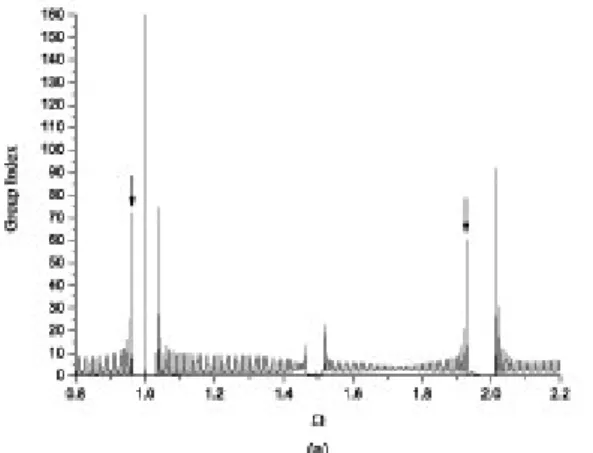
Figure 1 summarizes two characteristics of the PC necessary for nonreciprocal frequency doubling calculated using the so-called invariant imbedding method.(7, 8) We used a shooting method to solve the coupled wave equation for FF and SH fields.(9, 10) The more the FF field is blocked from transmission, the more energy is transferred to the SH field and we obtain higher SH conversion efficiencies than in the photonic crystals without QW cells. Thus we achieved an enhanced second harmonic generation as well as the unidirectional transmission of the SH signal.
Fig. 1. (a) Density of modes and (b) transmission spectrum of the photonic crystal vs normalized frequency. The FF field and the SH fields are tuned at the lower edges of the band gaps, while the transmittance for FF is greatly suppressed.
REFERENCES
1. M. Scalora, J. P. Dowling, C. M. Bowden, and M. J. Bloemer, “The photonic band edge optical diode,” J. Appl. Phys. 76, 2023-2026 (1994).
2. M. D. Tocci, M. J. Bloemer, M. Scalora, J. P. Dowling, and C. M. Bowden, “Thin-film nonlinear optical diode,” Appl. Phys. Lett. 66, 2324-2326 (1995).
3. V. V. Konotop and V. Kuzmiak, “Nonreciprocal frequency doubler of electromagnetic waves based on a photonic crystal,” Phys. Rev. B 66, 235208 (2002).
4. S. Kim, K. Kim, F. Rotermund and H. Lim, “Computational design of one-dimensional nonlinear photonic crystals with material dispersion for efficient second-harmonic generation,” Opt. Express, submitted .
5. G. T. Kiehne, A. E. Kryukov, and J. B. Ketterson, “ A numerical study of optical second-harmonic generation in a one-dimensional photonic structure,” Appl. Phys. Lett. 75, 1676-1678 (1999).
6. J. M. Bendickson, J. P. Dowling, and M. Scalora,`”Analytic expressions for the electromagnetic mode density in finite, one-dimensional, photonic band-gap structures,” Phys. Rev. E 53, 4107-4121 (1996).
7. K. Kim, H. Lim, and D.-H. Lee, “Invariant imbedding equations for electromagnetic waves in stratified magnetic media: applications to one-dimensional photonic crystals,” J. Korean Phys. Soc. 39, L956-L960 (2001).
8. K. Kim, D. K. Phung, F. Rotermund and H. Lim, “Propagation of electromagnetic waves in stratified media with nonlinearity in both dielectric and magnetic responses,” Opt. Express 16, 1150-1164 (2008).
9. M. Midrio, “Shooting technique for the computation of plane-wave reflection and transmission through one-dimensional nonlinear inhomogeneous dielectric structures,” J. Opt. Soc. Am. B 18, 1866-1871 (2001).
10. M. Midrio, L. Socci, and M. Romagnoli, “Frequency conversion in one-dimensional stratified media with quadratic nonlinearity,” J. Opt. Soc. Am. B 19, 83-88 (2002).