Print ISSN: 2288-4637 / Online ISSN 2288-4645 doi:10.13106/jafeb.2021.vol8.no6.0661
Determinants of Corporate Cash Holdings Among Asia’s Emerging and
Frontier Markets: Empirical Evidence from Non-Financial Sector
Tanveer BAGH1, Muhammad Asif KHAN2, Natanya MEYER3, Rashid SADIQ4, Sebastian KOT5
Received: February 20, 2021 Revised: April 20, 2021 Accepted: May 15, 2021
Abstract
The determinants of Corporate Cash Holdings (CCH) have been a deep-seated debate among institutions and scholars over the last couple of years. Therefore, this paper aims to investigate the determinants of CCH among emerging and frontier markets (Bangladesh, China, India, Pakistan). Due to endogeneity, the generalized methods of moments (GMM) methodology was applied to capture the impacts of different variables, including profitability, firm size, financial leverage growth opportunity, dividend payout, and the business cycle on CCH. The result shows that the firm’s size positively enhances CCH in emerging and frontier markets. Growth opportunity is negatively influenced by CCH in the case of Bangladeshi firms while a positive driver in emerging markets. The business cycle has a negative bearing on CCH across Pakistan, India, and Bangladeshi firms while positive and significant in Chinese firms. Financial leverage and dividend payout were positive determinants of CCH in Chinese firms, while they appear negative for Pakistan, India and Bangladeshi firms. Finally, profitability has a positive and significant impact on CCH in frontier and emerging markets. The study contributes to the incumbent determinants of CCH literature by introducing a fresh outlook and offering policy insights helpful in emerging and frontier markets perspectives.
Keywords: Corporate Cash Holdings, Emerging Markets, Growth Opportunity, Firm Size, Financial Leverage JEL Classification Code: G32, E22, E32
Orr, 1966; Suryadi et al., 2021; Aziz et al., 2021). The value and enormity of cash cannot be watered down as cash provides financial freedom to firms by enabling them to independently take financial decisions without external interference (Boubaker et al., 2015; Al-Najjar & Clark, 2017). According to Khuong et al. (2019) and Oláh et al. (2019), cash is regarded as one of the riskier liquid assets, and an increase in cash flow can assist in better decision-making practices. Regarding this, Siddiqua et al. (2019) argue that the trade-off, pecking order and cash flow theory typically elucidate the pattern of CCH. Considerable research studies have been conducted into the determinants of CCH; nevertheless, the past literature reveals a magnitude of concepts that has room for further exploration. According to An et al. (2013), firms should maintain an appropriate liquid position to avoid costly external financing for operational and investment needs.
Interestingly, Błach et al. (2014) state that cash management policies have become essential research in recent years. If the organizations cannot maintain their liquidity position correctly, they may face bankruptcy even if they are profitable. In addition, Gill and Shah (2012) mention that the liquid assets available to finance positive net present value projects or available to distribute among
1 First Author. Faculty of Management Sciences, Riphah International
University Islamabad, Pakistan. Email: [email protected]
2 Assistant Professor, Department of Commerce, Faculty of
Management Sciences, University of Kotli AJ&K, Pakistan. Email: [email protected]
3 Corresponding Author. Associate Professor, DHET-NRF SARChI
Entrepreneurship Education, Department of Business Management, University of Johannesburg, South Africa [Postal Address: University Roads, Auckland Park, Johannesburg, 2092, South Africa]
Email: [email protected]
4 Faculty of Management Sciences, Riphah International University
Islamabad, Pakistan. Email: [email protected]
5 Associate Professor, [1] Management Faculty, Częstochowa
University of Technology, Poland [2] DHET-NRF SARChI Entrepreneurship Education, Department of Business Management, University of Johannesburg, South Africa.
Email: [email protected] © Copyright: The Author(s)
This is an Open Access article distributed under the terms of the Creative Commons Attribution Non-Commercial License (https://creativecommons.org/licenses/by-nc/4.0/) which permits unrestricted non-commercial use, distribution, and reproduction in any medium, provided the original work is properly cited.
1. Introduction
Corporate Cash Holdings (CCH) behavior and other financial topics have reached unprecedented consideration in the contemporary finance literature field (Miller &
shareholders are considered cash holdings. Yulu (2018) and Elbadry (2018) mention that the importance of cash holding increased in recent years.
Linking with the above discussion of the broad theoretical orientation, Lie et al. (2018) and Islam et al. (2020) argue that the sensitivity of cash holdings varies in developed, emerging, and frontier markets as financial development may bring down the affectability of cash holdings considerably. Datta and Jia (2012) state that there are different cash holding trends in different countries. Existing research investigates determinants of CCH and confirms a mix of association of CCH and its determinants across the different markets. This study’s primary purpose is to examine the determinants of CCH in emerging and frontier markets. Thus, we concentrate on China, India, Pakistan and Bangladesh as representatives of respective markets by taking ten years’ data from 2010 to 2019 of 166 firms from these emerging and frontier markets. Due to the endogeneity problem, the generalized methods of moments (GMM) method is applied to capture the impacts of different variables like profitability (P), financial leverage (FL), growth opportunity (GO), dividend payout (DP), firm size (FS) and the business cycle (BC) on corporate cash holdings (CCH). This study has mainly been undertaken to give a fresh insight into determinants of corporate cash holdings among emerging and frontier markets. It may be articulated from the lack of background research on cash holdings in emerging and frontier markets.
This article contributes to the current literature in a few ways. Firstly, studies by Shah (2011), Haraguchi et al. (2017) and Mostafa and Klepper (2017) contributed by analyzing cash holdings determinants in a different kind of macroeconomic environment as to our study, which focuses on emerging markets (China, Pakistan, India) and a frontier market (Bangladesh). Our study’s countries are also characterized by high macroeconomic uncertainty, prompting the managers to hold more cash than would be optimally required. Since macroeconomic uncertainty increases volatility in the firm’s cash flows, managers are sensitive to such variations, leading to different cash holding behavior than under a stable macroeconomic environment. Secondly, evidence from emerging and frontier markets help us better understand the underlying effect of determinants of CCH.
Furthermore, it is essential to swiftly look at emerging and frontier markets as these markets tend to change quickly (Khan et al., 2020). The economy of Pakistan, China and Indian is treated as emerging economies of the world. Bangladesh is considered a frontier market. Bangladesh’s business hub is Dhaka Stock Exchange and the Chittagong Stock Exchange (Bates & Buckles, 2017). Qoyum et al. (2015) studied the relationship between business cycles and macroeconomics performance. The study revealed that money supply, interest rates, exchange rates, and stock
prices, among other determinants, fluctuate in south Asia and Asia-Pacific regions.
The remainder of the requisite article is ordered as follows: Section 2 delves into the literature review and construction of the hypotheses. Section 3 discusses the study’s methodology. Results are offered in Section 4 and end with the research article’s conclusion and upcoming studies in Section 5.
2. Literature Review
Corporate Cash Holdings (CCH) behavior has received unprecedented consideration in the contemporary finance literature field after Miller’s contribution twentyfiveand Modigliani and Miller’s preliminary work (1958). An et al. (2013) state that firms should maintain appropriate liquidity positions to avoid costly external financing for operational and investment needs. Interestingly, Błach et al.’s (2014) study on policies about cash management has become essential research in recent years. If the organizations cannot maintain their liquidity position correctly, they may face bankruptcy even if they are profitable. The related strand of literature confirms the importance of determinants of cash holdings. The first theory about cash holdings is the Trade-off theory presented by Miller and Orr (1966). According to Han and Qiu (2007), precautionary motives usually expect a problematic situation to generate funds for different investment purposes and operations purposes and hold high cash to secure them. The third motive is the speculative motive. Tax laws of the country also affect the firm’s decision about cash holding levels. Firms adopt their policies about cash holdings as per the tax laws that affect them (Gill & Biger, 2013).
2.1. Firm Size and Cash Holdings
According to the first theory, Trade-off theory, about the cash holdings, the organizations more significant in size can distribute external funds cost over large size and enjoy economies of scale. Conversely, Aftab et al. (2018) documented a positive association between firm size and cash holdings. This leads to our first hypothesis.
H1: Firm size (FS) significantly affects cash holdings (CCH) in emerging and frontier markets.
2.2. Financial Leverage and Cash Holdings
Abbadi and Abbadi (2013) demonstrated a negative relationship between financial leverage and liquid assets; a higher level of financial leverage reflects a higher risk level. Another study conducted on Croatian firms by Sarlija and Harc (2012) on European change economies affirmed
a negative relationship between liquidity and financial leverage. Gancherka (2018) observed different associations among the variables.
H2: Financial leverage (FL) significantly affects cash holdings (CCH) in emerging and frontier markets.
2.3. Growth Opportunities and Cash Holdings
Ullah et al.’s (2018) trade-off model state that the firms with higher growth opportunities and risky debt on their balance sheets are most likely to face the under-investment problem. Therefore, organizations with more significant growth opportunities (GO) have a strategy to accumulate extra cash to avoid a financially stressful situation. Contrary to this literature, we found numerous researchers who revealed an opposite relation between GO and CCH.
H3: Growth opportunity (GO) significantly affects cash holdings (CCH) in emerging and frontier markets.
2.4. Dividend Payments and Cash Holdings
From the Trade-off model view between cash holdings and dividend payments, a negative relationship exists. From this view, in the case of a liquidity shortage, dividend cuts can provide funds. Those organizations that are paying profits gather less cash than those that are paying earnings since profit slices are expected to be related to low expenses. Ullah et al. (2018) found a negative association between dividend payments and cash holdings. Singh and Misra (2019) and Julio and Yook (2012) found that dividend payments are adversely related to liquid corporate assets.
H4: Dividend payout (DP) significantly affects cash holdings (CCH) in emerging and frontier markets.
2.5. Profitability and Cash Holdings
Ullah et al. (2018) again found a negative association between profitability and cash holdings. Whereas Aftab et al. (2018) found adverse results significantly bearing on cash holdings and profitability.
H5: Profitability (P) significantly affects cash holding (CCH) emerging and frontier markets.
2.6. Business Cycle and Cash Holdings
Wang and Wang (2019) studied the relationship between the economic cycle and cash holdings rate using data from firms listed on the Schengen security exchange (period 2004 to 2015). They found a negative relationship between the economic cycle and CCH levels. Jebran’s (2019) research
investigated firms in Pakistan from 2004 to 2015 and divided them into three phases: pre-crisis, crisis, and post-crisis and found that financial crisis affects firms’ cash holdings.
H6: Business cycle (BC) significantly affects cash holdings (CCH) in emerging and frontier markets.
2.7. Conceptual Framework
The scholarly theoretical and empirical literature review reveals an inconclusive association among determinants of corporate cash holdings. It is stated in the literature that the effect of study variables varies from country to country and from sector to sector. Some researchers explored the determinants of corporate cash holdings from developing, emerging and developed countries separately, but not in a single study. Therefore, this study contributes to new knowledge as it assesses the determinants of corporate cash holdings among developed, emerging and frontier markets. Based on the previous review, the designed framework is portrayed in Figure 1.
3. Research Methodology
3.1. Research Design
This study utilized the GMM test to examine the relationship between the dependent (CCH) and independent variables (P, FL, GO, FS, DP and BC) using STATA 12. The purpose of using GMM was to overcome the endogeneity problem (Khan et al., 2020). Endogeneity may lead to parameters being biased and inconsistent (Roberts & Whited, 2011). This paper excludes non-financial sectors because they are grounded on unique accounting standards or benchmarks and have different capital structures.
There are two types of GMM, system and difference. The dependent variable is used as a lag variable on the right-hand side, so the model becomes dynamic, and the independent variables’ lag values are used as instruments.
3.2. Empirical Model Building and Estimation
In past investigations, many factors were explored to check their association with cash holdings by various
specialist research scholars of different nations worldwide. Affirming these researchers’ results, this study has analyzed a few factors by testing emerging and frontiers markets. The study research model is stated as follows.
CCHit = α + β1FS + β2P + β3GO + β4FL
+ β5DP + β6BC + εit
Where, CH: Cash Holdings of the firm; P: Return on assets (Profitability); FS: Firm Size; GO: Growth Opportunities; FL: Leverage; DP: dividend payout; BC: Business cycle ε: represents error. For this study, the data was collected through different data streams and official websites. For the emerging countries, Pakistan, India and Chinese firms were included using data from 2010 to 2019, and Bangladeshi firms used as part of the frontier market. From the Indian, Chinese and Pakistan markets, we have collected data from 42 firms per country and the Bangladesh market 40 firms.
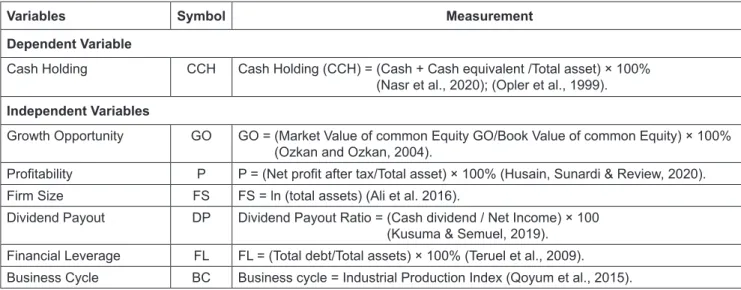
3.3. Variables Measurement
Cash Holdings (CCH) taken as dependent variable represents Cash + Cash equivalent divided by Total asset × 100%. This choice is in line with Nasr et al. (2020) and Opler et al. (1999). The dependent variables were selected as follows: Growth Opportunity (GO) is calculated as Market Value of common Equity GO divided by Book Value of common Equity × 100%, which is in line with Ozkan and Ozkan (2004). Profitability (P) = Net profit after tax divided by Total asset × 100%. We compute Firm Size (FS) = ln Total Assets (Ali et al., 2016).
Financial Leverage, (FL) = Total debt divided Total assets × 100% (Teruel et al., 2009). Business Cycle (BC) = Industrial Production Index (Qoyum et al., 2015) of Pakistan, India, Bangladesh and China. In Table 1, operational details are offered.
4. Empirical Results and Discussion
This section reports the descriptive statistics, variance inflation factor, GMM results, discussion, and hypothesis testing.
4.1. Baseline Results
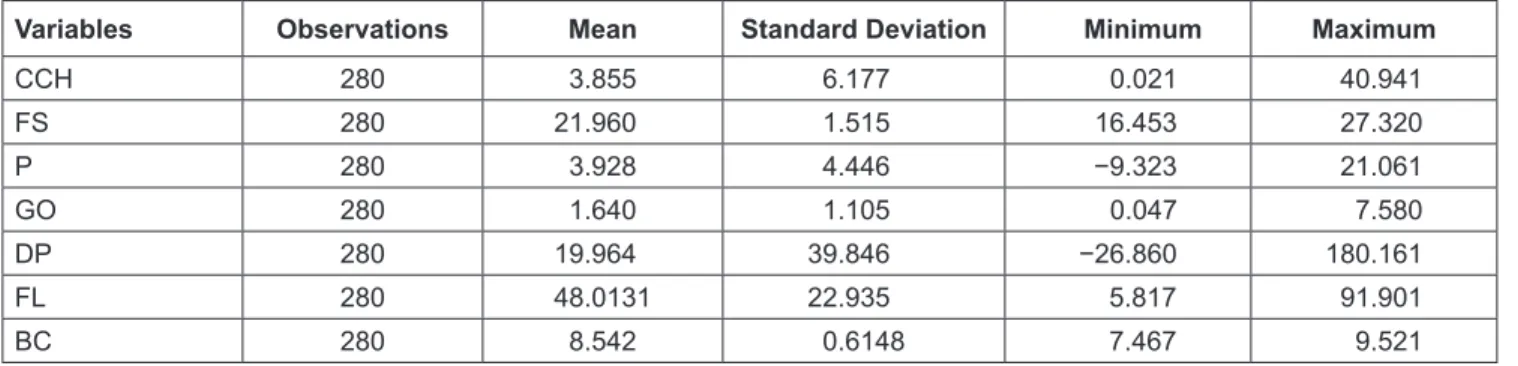
Tables 2, 3, 4, and 5 report descriptive statistics of the data’s basic pattern and behavior, i.e., mean, SD, minimum and maximum in all cases.
4.2. Correlation Results
The study shows that there is a significant association among variables in cases of emerging and frontier markets.
4.3. Variance Inflation Factor (VIF)
An important test of detecting multicollinearity is VIF (Gujarati, 2010). Before moving forward and applying GMM, we check the absence of multicollinearity. There should be no correlation between IVs and DV and the value of VIF presented in Appendix A, which are less than 5 in all cases. Hence, the results show that there is no multicollinearity problem.
Table 1: Operational Definition of Variables and Measurement
Variables Symbol Measurement
Dependent Variable
Cash Holding CCH Cash Holding (CCH) = (Cash + Cash equivalent /Total asset) × 100% (Nasr et al., 2020); (Opler et al., 1999).
Independent Variables
Growth Opportunity GO GO = (Market Value of common Equity GO/Book Value of common Equity) × 100% (Ozkan and Ozkan, 2004).
Profitability P P = (Net profit after tax/Total asset) × 100% (Husain, Sunardi & Review, 2020). Firm Size FS FS = ln (total assets) (Ali et al. 2016).
Dividend Payout DP Dividend Payout Ratio = (Cash dividend / Net Income) × 100 (Kusuma & Semuel, 2019).
Financial Leverage FL FL = (Total debt/Total assets) × 100% (Teruel et al., 2009). Business Cycle BC Business cycle = Industrial Production Index (Qoyum et al., 2015).
Table 2: Chinese Firms Descriptive Statistics
Variables Observations Mean Standard Deviation Minimum Maximum
CCH 301 9.555 7.509 0.020 38.940 FS 301 11.951 2.884 6.080 18.270 P 301 5.713 6.210 −34.570 37.250 GO 301 2.772 2.871 0.250 38.170 DP 301 25.243 25.72 −76.900 137.20 FL 301 53.527 13.476 16.500 84.630 BC 301 98.002 2.4613 93.230 101.020
Table 3: Pakistani Firms Descriptive Statistics
Variables Observations Mean Standard Deviation Minimum Maximum
CCH 328 8.490 10.371 0.020 48.721 FS 328 17.989 3.408 9.930 26.310 P 328 3.891 11.464 −57.170 54.110 GO 328 1.631 2.247 −2.561 28.823 DP 328 16.757 31.084 −103.380 230.794 FL 328 53.403 19.735 10.510 98.130 BC 328 4.3850 1.1324 3.000 6.807
Table 4: Indian Firms Descriptive Statistics
Variables Observations Mean Standard Deviation Minimum Maximum
CH 336 3.198 4.192 0.0100 29.790 FS 336 12.691 4.758 5.280 22.430 PROF 336 5.255 8.180 −37.750 50.231 GO 336 2.372 2.2023 −1.340 11.503 DP 336 18.520 27.257 −49.661 24.281 LEV 336 50.994 19.673 0.050 95.863 BC 336 99.986 7.137 91.871 110.951
Table 5: Bangladeshi Firms Descriptive Statistics
Variables Observations Mean Standard Deviation Minimum Maximum
CCH 280 3.855 6.177 0.021 40.941 FS 280 21.960 1.515 16.453 27.320 P 280 3.928 4.446 −9.323 21.061 GO 280 1.640 1.105 0.047 7.580 DP 280 19.964 39.846 −26.860 180.161 FL 280 48.0131 22.935 5.817 91.901 BC 280 8.542 0.6148 7.467 9.521
4.4. GMM Regression Results
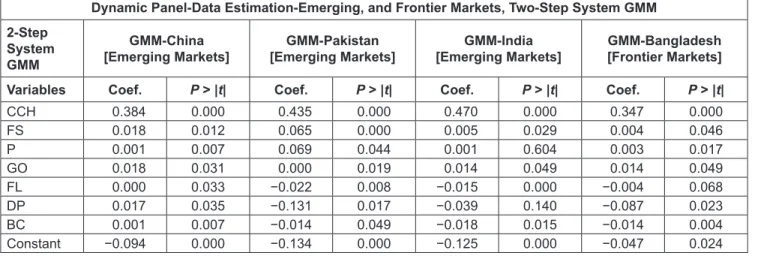
Referring to Table 6, results signify that financial leverage (FL) significantly impacts cash holdings. Profitability and CCH are positively related at the 5% level, and a 1% change in profitability will change the cash holdings by 0.047% in the case of Chinese firms. Firm size and cash holdings also have a positive and significant link in Chinese firms, and the result is significant at the 5% level. The results indicate that an increase of 1% in firm size is associated with an increase of 0.018% in Chinese firms. These results of firm size and cash holdings are consistent with the results of Bigelli and Sanchez-Vidal (2012). They also found that the variable growth opportunities significantly affect cash holdings in Chinese firms, where a 1% increase in GO results in an increase of 0.018% in firms’ cash holdings. This is in line with Khieu and Pyles (2012). While the dividend payout ratio has a significant relationship with cash holdings in China’s case, BC has little bearing on CCH.
In Pakistan and India, FL and CCH are negatively related. An increase of 1% in leverage resulted in a decrease of 0.022 in Pakistani firms’ cash holdings and 0.015 in Indian firms’ cash holdings. These results are consistent with Sarlija and Harc (2012). The profitability result is also positive and significant in Pakistan at the 5% level. Hence, a 1% increase in Pakistani firms’ cash holdings is 6.9% of the emerging Pakistani market. Thus, profitability plays a more critical role in Pakistan.
On the other hand, results show that profitability is insignificant with cash holdings in India’s emerging market. The result indicates that an increase of 1% in firm size is associated with a rise of 0.065% in Pakistani firms and by 0.0056% in Indian firms. A 1% rise in GO leads to an increase of 0.00046% in Pakistani firms’ cash holdings and 0.014% in Indian firms’ cash holdings. The variable business cycle has a negative and significant relation with cash holding in Pakistan and India, and the result is significant at the 5% level. The result indicates that an increase of 1% in the business cycle
is associated with a decrease of 0.014% in Pakistani firms’ cash holdings and 0.018% in Indian firms. Wang (2019) found a negative connection between the monetary cycle and cash holdings. The results further indicate that DP negatively and significantly affects cash holdings in Pakistan’s case, and in India’s emerging market, it is insignificant. Hence, the findings suggest that a 1% rise in dividend payment results in a decrease of 13% in Pakistani firms. The FS and FL have positive and significant results in the case of a frontier market. Likewise, the firm’s size and profitability also show a significant positive liaison. Bangladeshi firms showed that a 1% increase in profitability would increase the cash holdings levels by 0.003%. These findings are supported in the study of Bigelli and Sánchez-Vidal (2012). The results also show that the variable growth opportunities negatively and significantly affect cash holding in Bangladesh. A 1% increase in GO results in a decrease of 0.06% of Bangladeshi firms’ cash holdings; this result was also found by Bigelli and Vidal (2012). The results further indicate that dividend payout negatively and significantly affects cash holdings in Bangladesh. Hence, the findings suggested that a 1% rise in dividend payment results in a decrease of 8.7% in Bangladeshi firms and supported the previous studies by Julio and Yook (2012). The variable business cycle has a negative and significant relation with cash holdings in Bangladesh, and the result is significant at the 5% level. The result also indicates that an increase of 1% in the business cycle is associated with a decrease of 0.014% in Bangladeshi firms. Wang (2019) discovered a negative connection between the monetary cycle and cash holdings.
4.5. Diagnostic Test
To check the instrument’s validity, the study employed the Hansen test where the null hypothesis is that instruments and error term is correlated. Further, to check whether there is autocorrelation, the study uses the Arellano–Bond
Table 6: GMM Results-Emerging and Frontier Markets
Dynamic Panel-Data Estimation-Emerging, and Frontier Markets, Two-Step System GMM 2-Step
System GMM
GMM-China
[Emerging Markets] [Emerging Markets]GMM-Pakistan [Emerging Markets]GMM-India [Frontier Markets]GMM-Bangladesh Variables Coef. P > |t| Coef. P > |t| Coef. P > |t| Coef. P > |t|
CCH 0.384 0.000 0.435 0.000 0.470 0.000 0.347 0.000 FS 0.018 0.012 0.065 0.000 0.005 0.029 0.004 0.046 P 0.001 0.007 0.069 0.044 0.001 0.604 0.003 0.017 GO 0.018 0.031 0.000 0.019 0.014 0.049 0.014 0.049 FL 0.000 0.033 −0.022 0.008 −0.015 0.000 −0.004 0.068 DP 0.017 0.035 −0.131 0.017 −0.039 0.140 −0.087 0.023 BC 0.001 0.007 −0.014 0.049 −0.018 0.015 −0.014 0.004 Constant −0.094 0.000 −0.134 0.000 −0.125 0.000 −0.047 0.024
test (see Table 7), which shows that the p-value is greater than 5%; hence the null hypothesis cannot be rejected. Thus, there is no autocorrelation in the dataset. The speed of adjustment towards China’s target cash holdings is 62%, for Pakistan 57%, for India 53%, and for Bangladesh 66%.
4.6. Comparative Analysis of Emerging and Frontier Markets
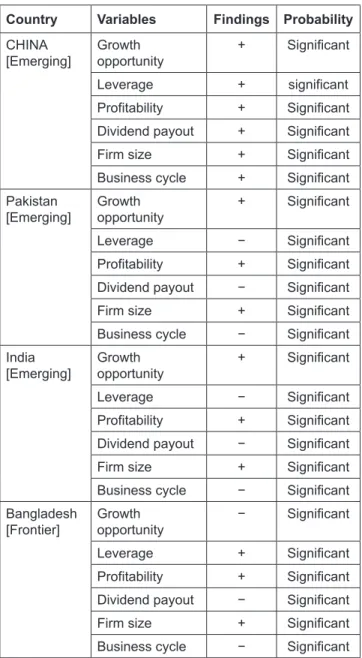
The relationship between financial leverage and cash holding found significant in the market of Chinese markets (see Table 8). On the other side, it was found negatively significant
in the emerging market of Pakistan, India and frontier markets. Profitability shows the insignificant relationship in India’s emerging market and is positively significant in our study’s rest markets. The dividend payout ratio also shows a significant relationship with cash holding in the case of china and a significant negative relationship in the other markets of our study. Firm size is positively significant in emerging and frontier markets of this study. Else than these, firms greater in size could gather more cash. GO has a considerable impact in cases of emerging and frontier market. BC has a negative bearing in the case of Pakistani, Indian and Bangladeshi firms while significant in Chinese firms (see Tables 9 and 10).
Table 7: Diagnostic Test Arellano-Bond Test for AR (1) in First Differences-(China) Arellano-Bond Test for AR (2) in First Differences-(Pakistan)
Sargan Test of Overid.
Restrictions-India Restrictions-BangladeshHansen Test of Overid.
z = −7.710 Pr > z = 0.000 Pr > z = 0.983z = 0.020 χ 2 (94 = 124.030 Prob > χ2 = 0.021 χ 2 (94) = 109.781 Prob > χ2 = 0.027 z = −4.120 Pr > z = 0.000 Pr > z = 0.655z = 0.450 χ 2 (39) = 39.270 Prob > χ2 = 0.045 χ 2 (39) = 38.770 Prob > χ2 = 0.030 z = −5.470 Pr > z = 0.000 Pr > z = 0.748z = −0.320 χ 2 (85) = 128.750 Prob > χ2 = 0.002 χ 2 (85) = 81.510 Prob > χ2 =0.087 z = −3.280 Pr > z = 0.001 Pr > z = 0.421z = −0.810 χ 2 (48) = 47.790 Prob > χ2 = 0.031 χ 2 (48) = 47.790 Prob > χ2 = 0.031
Table 8: System GMM Regression Results [Comparative Representation]
Variables Model-1CHINA Model-2PAK Model-3IND Model-4BAN
CCH (−1)s 0.3842** (0.010) 0.435** (0.030) 0.470** (0.012) 0.347** (0.022) FL 0.001*** (0.003) −0.022*** (0.008) −0.015*** (0.000) −0.004** (0.068) P 0.001** (0.047) 0.069** (0.044) 0.003** (0.604) 0.003** (0.017) DP 0.017** (0.005) −0.131** (0.017) −0.039** (0.010) −0.087** (0.023) FS 0.0183** (0.012) 0.065*** (0.000) 0.005** (0.029) 0.004** (0.046) BC 0.001** (0.687) −0.014** (0.049) −0.018** (0.015) −0.014*** (0.004) GO 0.010** (0.031) 0.004** (0.019) 0.014** (0.049) −0.061** (0.048) Constant −0.094*** (0.000) −0.134*** (0.000) −0.125*** (0.000) −0.0471*** (0.024) Observations 301 328 336 280 No. of Instruments 48 52 56 49 AR (1) −7.71 −4.12 −5.47 −3.28 P-value (0.000) (0.000) (0.000) (0.001) AR (2) 0.02 0.45 −0.32 −0.81 P-value (0.983) (0.655) (0.748) (0.421) Hansen test 109.78*** 38.77*** 81.51*** 47.79*** P-value (0.027) (0.080) (0.087) (0.081)
Differ. in Hansen test 13.09 11.36 8.79 9.70
P-value (0.834) (0.252) (0.964) (0.376)
F-significance (0.000) (0.000) (0.000) (0.000)
Table 9: Summary Results across Frontier and Emerging Markets
Country Variables Findings Probability CHINA
[Emerging] Growth opportunity + Significant
Leverage + significant
Profitability + Significant Dividend payout + Significant
Firm size + Significant
Business cycle + Significant Pakistan
[Emerging] Growth opportunity + Significant
Leverage − Significant
Profitability + Significant Dividend payout − Significant
Firm size + Significant
Business cycle − Significant India
[Emerging] Growth opportunity + Significant
Leverage − Significant
Profitability + Significant Dividend payout − Significant
Firm size + Significant
Business cycle − Significant Bangladesh
[Frontier] Growth opportunity − Significant
Leverage + Significant
Profitability + Significant Dividend payout − Significant
Firm size + Significant
Business cycle − Significant Table 10: Hypothesis Testing
Hypotheses Statements Results
H1 Firm size significantly affects cash holdings in emerging and frontier markets. Accepted H2 Financial leverage significantly affects cash holdings in emerging and frontier markets. Accepted H3 Growth opportunity significantly affects cash holdings in emerging and frontier markets. Accepted H4 Dividend payout significantly affects cash holdings in emerging and frontier markets. Accepted H5 Profitability significantly affects cash holdings in emerging and frontier markets. Accepted H6 Business cycles significantly affect cash holdings in emerging and frontier markets. Accepted
5. Conclusion
This paper was meant to investigate the determinants of corporate cash holdings among emerging and frontier markets. Ten years’ data from 2010 to 2019 of 166 firms were analyzed. Owing to endogeneity, the generalized methods of moments (GMM) methodology was applied to capture the impacts of different variables, including profitability, firm size, financial leverage, growth opportunity, dividend payout, and the business cycle on CCH. The result shows that firm size has a positive and significant impact on emerging and frontier markets. Growth opportunity has a negative and significant effect in Bangladeshi firms while positive and significant in emerging market firms. The business cycle has a negative and significant bearing in Pakistan, India and Bangladeshi firms while positive and significant in Chinese firms. Financial leverage and dividend payout are significant in Chinese firms while negative and significant signals Pakistan, India and Bangladeshi firms. Profitability has a positive and significant effect in the case of frontier and emerging markets on corporate cash holdings.
The study contributes to the incumbent determinants of cash holdings literature by introducing a fresh outlook and offering policy insights helpful in emerging and frontier market perspectives. This study’s results can be significant for firms to have a deeper understanding and appreciation of the role and the importance of the firm characteristics on the level of cash holdings. It can improve decision-makers knowledge, such as shareholders, managers, and investors, concerning what motivates firms to hold a certain level of cash holdings. It is finding the right balance between holding too much and less cash based on various factors.
Although many determinants of cash holdings have been investigated in this paper, many other factors influence the firm’s cash holdings level. Agency problems and corporate governance mechanisms (size and structure of the board of directors, shareholder protection and so forth) are internal characteristics that can impact how liquid assets are managed. For further research, it would be interesting to
investigate some macro-economic factors such as inflation, unemployment rate or capital market developments. This study’s results may not be generalized since small firms may have other factors influencing the cash holdings level. It may be interesting to look at small firms to see if the relationship holds. More than one frontier and emerging markets with extended years of data may be chosen in future research.
References
Abbadi, S. M., & Abbadi, R.T. (2013). The determinants of working capital requirements in Palestinian industrial corporations.
International Journal of Economics and Finance, 5(1), 65–75.
Aziz, T., Marwat, J., Zeeshan, A., Paracha, Y., & Al-Haddad, L. (2021). Do Islamic Stock Markets diversify the financial uncertainty risk? Evidence from Selected Islamic countries.
Journal of Asian Finance, Economics and Business, 8(3),
31–38. https://doi.org/10.13106/jafeb.2021.vol8.no3.0031 Al-Najjar, B., & Clark, E. (2017). Corporate governance and
cash holdings in MENA: Evidence from internal and external governance practices. Research in International Business and
Finance, 39, 1–12. https://www.sciencedirect.com/science/
article/pii/S0275531916301842
Aftab, U., Javid, A. Y., & Akhter, W. (2018). The Determinants of Cash Holdings around Different Regions of the World.
Business and Economic Review, 10(2), 151–181. http://www.
academia.edu/download/59472889/Cash_holdings20190531-91671-rf9ptd.pdf
An, M., Graham, J. R., & Harvey, C.R. (2013). The real effects of financial constraints: Evidence from a financial crisis. Journal
of Financial Economics, 97, 470–487.
Ali, S., Ullah, M., & Ullah, N. (2016). Determinants of Corporate Cash Holdings: A Case of Textile Sector in Pakistan. Available at SSRN 2728200.
Bates, M. O., & Buckles, T. A. (2017). An examination of market entry perspectives in emerging markets. International Journal
of Business and Economic Development, 5(3), 19–29.
Bigelli, M., & Sánchez-Vidal, J. (2012). Cash holdings in private firms. Journal of Banking & Finance, 36(1), 26–35.
Boubaker, S., Derouiche, I., & Nguyen, D. K. (2015). Does the board of directors affect cash holdings? A study of French listed firms. Journal of Management & Governance, 19(2), 341–370. Błach, A., Graham, J., Harvey, C., & Michaely, R. (2014). Pay-out
policy in the 21st century. Journal of Financial Economics, 77, 483–527.
Elbadry, G. (2018). Panel Data Inference in Finance: Least-Squares vs Fama-MacBeth. (Working Paper). USA: University of Maryland.
Gancherka, S., & Westerman, W. (2018). Financial and Institutional Determinants of Cash Holdings in the Oil and Gas Industry.
Journal of Corporate Finance Research, 12(3), 60–72.
Gujarati, D. N. (2010). Basic econometrics. Tata McGraw-Hill Education.
Gill, K. R., & Shah, Y. (2012). Long-term effects of a financial crisis: Evidence from cash holdings of East Asian firms. Journal
of Quantitative and Financial Analysis, 27(3), 617–641.
Gill, A. S., & Biger, N. (2013). The impact of corporate governance on working capital management efficiency of American manufacturing firms. Managerial Finance, 39(2), 116–132. https://doi.org/10.1108/03074351311293981
Han, S., & Qiu, J. (2007). Corporate precautionary cash holdings.
Journal of Corporate Finance, 13, 43–57. https://doi.
org/10.1016/j.jcorpfin.2006.05.002
Haraguchi, N., Cheng, C. F. C., & Smeets, E. (2017). The importance of manufacturing in economic development: Has this changed? World Development, 93, 293–315.
Husain, T., & Sunardi, N. (2020). Firm’s Value Prediction Based on Profitability Ratios and Dividend Policy. Finance & Economics
Review, 2(2), 13–26.
Iskandar-Datta, M., & Jia, Y. (2012). Valuation consequences of clawback provisions. The Accounting Review, 88(1), 171–198.
Islam, M. A., Khan, M. A., Popp, J., Sroka, W., & Oláh, J. (2020). Financial development and foreign direct investment—The moderating role of quality institutions. Sustainability, 12(9), 3556. https://doi.org/10.3390/su12093556
Jebran, K., Iqbal, A., Bhat, K. U., Khan, M. A., & Hayat, M. (2019). Determinants of corporate cash holdings in tranquil and turbulent period: evidence from an emerging economy.
Financial Innovation, 5(1), 1–12.
Julio, B., & Yook, Y. (2012). Political uncertainty and corporate investment cycles. The Journal of Finance, 67(1), 45–83. Khieu, H. D., & Pyles, M. K. (2012). The influence of a credit
rating change on corporate cash holdings and their marginal value. Financial Review, 47(2), 351–373.
Khan, M. A., Mate, D., Abdulahi, M. E., Sadaf, R., Khan, M. A., Popp, J., & Oláh, J. (2020). Do institutional quality, innovation and technologies promote financial market development.
European Journal of International Management (In Press),
https://doi.org/10.1504/EJIM.2020.10025994
Khan, M. A., Lulu, G., Khan, M. A., & Meyer, N. (2020). Effects of National Culture on Financial Sector Development: Evidence from Emerging and Developing Economies.
Borsa Istanbul Review. In Press, https://doi.org/10.1016/
j.bir.2021.02.003
Khuong, N. V., Ha, N. T. T., Minh, M. T., H. & Thu, P. A. (2019). Does corporate tax avoidance explain cash holdings? The case of Vietnam. Economics & Sociology, 12(2), 79–93.
Kusuma, O., & Semuel, H.J. (2019). The Effect of Company Performance on Dividend Policy in Manufacturing Companies.
Petra International Journal of Business Studies, 2(2), 87–95.
Lie, E., & Liu, Y. (2018). Corporate cash holdings and acquisitions.
Financial Management, 47(1), 159–173.
Miller, M. H., & Orr, D. (1966). A Model of the Demand for Money by Firms. The Quarterly. Journal of Economics, 80(3), 413–435.
Mostafa, R., & Klepper, S. (2017). Industrial development through tacit knowledge seeding: Evidence from the Bangladesh garment industry. Management Science, 64(2), 613–632. Modigliani, F., & Miller, M.H. (1958). The cost of capital,
corporation finance and the theory of investment. The American
Economic Review, 48(3), 261–297.
Miller, M. H., & Orr, D. (1966). A model of the demand for money by firms. The Quarterly Journal of Economics, 80(3), 413–435. Nasr, S., Lakhal, N., & Saad, I. B. (2020). Corporate social
responsibility and cash holdings: does board gender diversity matter? International Journal of Business Governance and
Ethics, 14(3), 250–270.
Oláh, J., Kovács, S., Virglerova, Z., Lakner, Z., Kovacova, M., & Popp, J. (2019). Analysis and comparison of economic and financial risk sources in SMEs of the Visegrad group and Serbia. Sustainability, 11(7), 1853, https://doi.org/10.3390/ su11071853
Ozkan, A., & Ozkan, N. (2004). Corporate cash holdings: an empirical investigation of UK companies. Journal of Banking
and Finance, 28(9), 2103–2134.
Opler, T., Pinkowitz, L., Stulz, R., & Williamson, R. (1999). The determinants and implications of corporate holdings of liquid assets. Journal of Financial Economics, 52, 3–46.
Qoyum, A., Miftahussurur, M., Matae, A. A., Yousuf, M., & Abdurrahman, A. (2015). Business Cycle and The Macroeconomics Performance: Evidence of Malaysia and Indonesia. Global Review of Islamic Economics and Business,
2(1), 045–068.
Sanchez, K., & Yurdagul, A. (2012). Does national culture affect international corporate cash holdings? Journal of Multinational
Financial Management, 19, 323–342.
Sarlija, N., & Harc, M. (2012). The impact of liquidity on the capital structure: a case study of Croatian firms. Business
Systems Research Journal, 3(1), 30–36.
Siddiqua, G.A., ur Rehman, A., & Hussain, S. (2019). Asymmetric targeting of corporate cash holdings and financial constraints in Pakistani firms. Journal of Asian Business and
Economic Studies, 26(1), 76–97. https://doi.org/10.1108/
JABES-07-2018-0056
Singh, K., & Misra, M. (2019). Financial determinants of cash holding levels: An analysis of Indian agricultural enterprises.
Agricultural Economics–Czech, 65(5), 240–248.
Shah, A. (2011). The corporate cash holdings: Determinants and implications. African Journal of Business Management, 5(34), 12939–12950.
Suryadi, S., Endri, E., & Yasid, M. (2021). Risk and return of Islamic and conventional indices on the Indonesian Stock Exchange.
Journal of Asian Finance, Economics and Business, 8(3),
23–30. https://doi.org/10.13106/jafeb.2021.vol8.no3.0023 García-Teruel, P. J., Martínez-Solano, P., & Sánchez-Ballesta, J. P.
(2009). Accruals quality and corporate cash holdings. Journal
of Accounting and Finance, 49(1), 95–115.
Ullah, S., Akhtar, P., & Zaefarian, G. (2018). Dealing with endogeneity bias: The generalized method of moments (GMM) for panel data. Industrial Marketing
Management (in Press). https://doi.org/10.1016/j.indmarman.
2017.11.010
Wang, Z., & Wang, Y. (2019). Ownership, Internal Capital Markets, and Cash Holdings. Emerging Markets Finance and Trade,
55(7), 1656–1668.
Yulu Ye, J. W. (2018). Robust analysis of linear Models. Statistical
Science, 19(4), 562– 570.
VIF Test for Emerging and Frontier Markets
Variables VIF (China Firms) VIF (Pakistani Firms) VIF (Indian Firms) VIF (Bangladeshi Firms)
VIF 1/VIF VIF 1/VIF VIF 1/VIF VIF 1/VIF
FS 1.04 0.962 1.02 0.976 1.09 0.913 1.21 0.824 P 1.13 0.884 1.29 0.776 1.49 0.671 1.29 0.774 GO 1.19 0.841 1.07 0.936 1.31 0.766 1.09 0.915 DP 1.01 0.990 1.18 0.850 1.09 0.914 1.13 0.881 FL 1.17 0.857 1.15 0.869 1.18 0.846 1.2 0.832 BC 1.03 0.975 1.04 0.964 1.14 0.874 1.02 0.983 Mean VIF 1.09 1.12 1.22 1.16

![Table 8: System GMM Regression Results [Comparative Representation]](https://thumb-ap.123doks.com/thumbv2/123dokinfo/4914441.41636/7.918.84.853.431.832/table-system-gmm-regression-results-comparative-representation.webp)