J Korean Acad Community Health Nurs (지역사회간호학회지) http://dx.doi.org/10.12799/jkachn.2016.27.4.410
The Effectiveness of a Cultural Competence Training Program for
Public Health Nurses using Intervention Mapping
Kim, Yune Kyong
1· Lee, Hyeonkyeong
2 1Department of Nursing, Masan University, Changwon2College of Nursing, Moi-Im Kim Nursing Research Institute, Yonsei University, Seoul, Korea
Purpose: This study evaluated the effects of a cultural competence training program for public health nurses (PHNs) using intervention mapping. Methods: An embedded mixed method design was used. Forty-one PHNs (experimental: 21, control: 20) and forty marriage migrant women (MMW) (20, in each group) who were provided nursing care by PHN participated in the study. The experimental group was provided with a four-week cultural competence program consisting of an eight hour offline and online course, e-mail newsletters and social networking services (BAND). Transcultural Self-efficacy (TSE) of the PHNs, client-nurse trust, and satisfaction with nursing care of MMW were measured. Ten PHNs in the experimental group were interviewed after the experimental study. Results: The ex-perimental group showed a significantly greater improvement in TSE, client-nurse trust, and satisfaction with nursing care than did the control group. Six themes emerged from qualitative data: (a) Recognizing cultural differences, (b) Being interested in the multicultural policy, (c) Trying to communicate in MMW’s own language, (d) Providing medical information using internet and smart phone, (e) Embracing culturally diverse people into society, and (f) Requiring ongoing cultural competence training. Conclusion: Cultural competence training enabled PHNs to provide culturally competent care and contribute to MMW’s health outcomes.
Key Words: Cultural competency, Public health nurses, Education
Corresponding author: Lee, Hyeonkyeong
College of Nursing, Yonsei University, 50-1 Yonsei-ro, Seodaemun-gu, Seoul 03722,, Korea. Tel: +82-2-2228-3373, Fax: +82-2-392-5440, E-mail: [email protected]
- This manuscript is a revision of the first author’s doctoral dissertation from Yonsei University. - This study was supported by the Moi-Im Kim Nursing Research Institute at Yonsei University fund.
Received: Aug 23, 2016 / Revised: Nov 10, 2016 / Accepted: Nov 14, 2016
This is an open access article distributed under the terms of the Creative Commons Attribution Non-Commercial License (http://creativecommons.org/licenses/ by-nc/3.0), which permits unrestricted non-commercial use, distribution, and reproduction in any medium, provided the original work is properly cited.
INTRODUCTION
Recently, the Korean society is rapidly increasing in num-ber of foreigners with different races, languages and nation-alities due to globalization, expansion of foreign labor force and international marriage. The number of foreigners re-siding in Korea reached about 1.9 million by 2015 compos-ing, reaching about 3.7% of the total population [1], sug-gesting that Korean society, which used to be a homoge-neous nation and mono-culturalism society, has been transformed into a multi- ethnic and multicultural society. Korea’s multicultural show policies have a different per-spective from those of the Western of countries with a long immigrant history, as the West have led immigrants to gradually be gradually socialized and integrated based upon equality. Policies driven by the Korean government
prioritize mainly encourage female marriage immigrants, who are the first settled immigrants, focusing on learning Korean language, childbirth and childcare in order to help them assimilate quickly in domestic families [2]. Commu-nity public health institutions such as public health centers and public health clinics have also provided health care services to marriage migrant women (MMW) and their fa-milies, mainly within this policy framework.
The multicultural phenomenon and policy of Korean society has increased the opportunities for nurses in the field to provide nursing services to multicultural benefi-ciaries, and emphasized the necessity of providing nurs-ing services considernurs-ing the diverse cultural background of foreign patients. Culture is a value, a belief, a norm and a way of life that is learned and shared, affecting the deci-sions and actions of members of society [3]. Therefore, the
cultural background of clients affects the interpretation of the individual’s health, illness perception and disease ex-perience, as well as health behavior, communication with-in the health care system, and healthcare service use pat-terns [4]. In particular, cultural and language barriers be-tween nurses and clients have negative effects on commu-nication and confidence formation, resulting in dissat-isfaction and non-compliance of nursing services, which is referred to as a limitation of achieving the health outcomes of multicultural groups [5]. Migrants residing in Korea have few opportunities to take advantage of healthcare services due to language barriers and lack of understand-ing of the healthcare system. They have also been treated unfairly because of health care professionals’ prejudices and discrimination against different cultures with the lack of knowledge and understanding of cultural diversity [6]. In fact, nurses in the field of practice have not been system-atically educated about cultural nursing care in past nurs-ing education courses, and they have been suffernurs-ing from language barriers while unable to understand the cultural needs of their clients [6,7].
In the United States and Canada, both with a longer multicultural history than Korea, national standards and guidelines for nursing and health care for culturally diver-se people have been well developed. They recommend that nurses in all practical areas require receiving contin-uous and regular education [8-10]. Therefore, in Korea, based on the cultural beliefs, behaviors and demands of the clients and the community, it is necessary to improve nursing and professional education so that nurses become culturally competent to perform safe and fair nursing based on evidence and client- and family-centered care [8,9].
Although cultural competence of domestic nurses is re-ported to be relatively low [11,12], the provision of traing programs to strengthen cultural competence is still in-sufficient. In a recent study on community nurses in Korea, more than 80% of visiting nurses and community health practitioners have provided nursing services to MMW. However, opportunities for participating in multicultural education were low for visiting nurses (22.0%) and com-munity health practitioners (14.3%) [12]. In addition, it has been pointed out that in home health care services, there is a lack of practical guidance for the provision of nursing care for MMW, along with insufficient standardized nurs-ing intervention trainnurs-ing for culturally diverse clients [12]. In the case of cultural education for community health practitioners, it is reported that the content is mainly fo-cused on cultural sensitivity, and education related to cul-tural knowledge and behavior, which is another compo-nent of cultural competence, has not been done [11].
Inter-vention studies on domestic cultural competence [13-16] are at an early stage and no intervention studies have been attempted on cultural competence programs for public health nurses that provide primary health care services in the community.
It is essential to enhance the cultural competence of public health nurses in order to improve the effects of sys-tematic health care services for culturally diverse clients and families and to promote health equity for them. Thus, this study verified the effectiveness of the cultural com-petence training program developed by reflecting multi-cultural phenomenon in the Korean community and the work of public health nurses.
The hypotheses for evaluating the effectiveness of the program are as follows.
Hypothesis 1. The public health nurses in the experi-mental group receiving the cultural competence train-ing program will have a higher TSE score than the control group.
Hypothesis 2. The culturally diverse clients receiving nursing care by public health nurses in the experi-mental group will have a higher client-nurse trust score than the control group.
Hypothesis 3. The culturally diverse clients receiving nursing care by public health nurses in the experi-mental group will have a higher nursing satisfaction score.
METHODS
1. Design
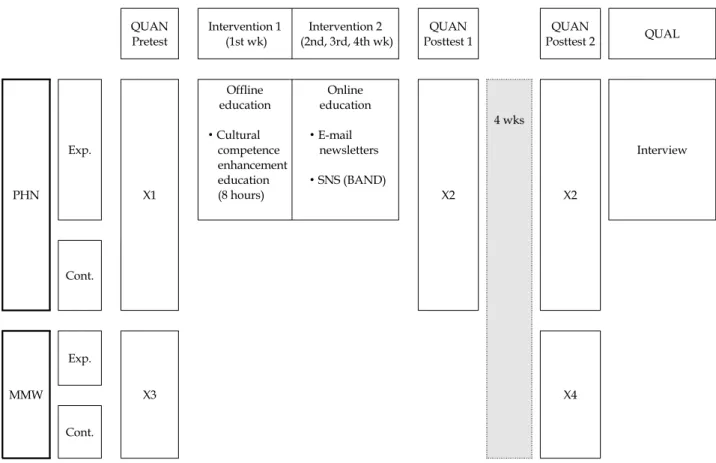
An embedded mixed method design was used [17] in which qualitative data is embedded within a major design of the non-equivalent control group pretest-posttest design (Figure 1). The outcomes of cultural competence training program for public health nurses were examined through the experimental method. The processes, such as how par-ticipants respond to the results were evaluated by obtain-ing detail views from participants additionally through qualitative data.
2. Participants and Settings
The participants of this study were public health nurses and culturally diverse clients who agreed to volunteer to participate in the study with an understanding of the pur-pose of this study. The inclusion criteria of the participants were public health nurses; (i) working in a public health center or a branch clinic of the public health center, (ii)
QUAN Pretest Intervention 1 (1st wk) Intervention 2 (2nd, 3rd, 4th wk) QUAN Posttest 1 QUAN Posttest 2 QUAL PHN Exp. X1 Offline education ∙ Cultural competence enhancement education (8 hours) Online education ∙ E-mail newsletters ∙ SNS (BAND) X2 4 wks X2 Interview Cont. MMW Exp. X3 X4 Cont.
QUAN=quantitative; QUAL=qualitative; PHN=public health nurses; MMW=marriage migrant women; Exp.=experimental group; Cont.=control group; X1=Sociodemographic characteristics, Characteristics of multicultural experience, Transcultural Self-Efficacy; X2=Transcultural Self-Efficacy; X3=Sociodemographic characteristics, Proficiency in Korean, Client-Nurse trust, Satisfaction with nursing care; X4=Client-Nurse trust, Satisfaction with nursing care.
Figure 1. Study design. never received cultural competence training, (iii) staying
abroad less than six months, and (iv) providing nursing services such as maternal health, vaccinations, and visit-ing health care to culturally diverse clients. MMW, who have two times more nursing services from nurse partic-ipants and are able to communicate in Korean or through interpretation services, were selected as culturally diverse clients.
Among the 20 public health centers in G province, 7 public health centers with more than 10,000 foreigners or more than 2.8% foreign population and high population density were selected with convenience sampling. During the course of the study, four public health centers were as-signed to the experimental group, and the remaining three public health centers were assigned to the control group to prevent diffusing of the treatment among the participants. The required sample size was determined by using G* Power software (v. 3.1.7.) with power=80%, ⍺=.05, effect size=.25, repeated measures=2 (clients) or 3 (nurses), and correlation between repeated measures=.50 [18]. A total of
28 public health nurse samples was required. For this study, a total of 44 nurse participants was recruited and as-signed 22 subjects per experimental group and control group, considering a 50% dropout rate due to the high ratio of non-regular workers. After the enrollment, one nurse in the experimental group was dropped due to the absence of education, and two nurses in the control group withdrew because of parental leave andjob termination. As a result, a total of 41 public health nurses participated in the study with 7% dropout rate (21 in the experimental group and 20 in the control group).
A total of 34 MMW was calculated for the study. As-suming a 60% dropout rate, a total of 56 MMW initially participated in this study, assigned 28 subjects per ex-perimental group and control group. A total of 16 client participants withdrew, resulting in 40 client participants with 29% dropout rate (20 in each group) due to no contact (9 women), receiving nursing services less than twice a month during the experimental period (4 women), and re-jection of data collection (3 women).
The qualitative data collection target were 10 nurse participants, who were selected among the experimental group of public health nurses after the second posttest, considering the TSE score, working departments and af-filiated public health centers.
3. Measurements
Cultural competence was measured by using a Korean version of Jeffreys’s [19] transcultural self-efficacy tool (TSET), which was modified by Kim [20]. TSET includes all of the three characteristics of a culturally competent nurse presented by the American Association of Colleges of Nursing (AACN), including cultural cognition (know-ledge), performance (skill), and affection (attitude) [9,21]. The Korean version of TSET has 83 items with three sub-scales: cognitive (25 items), practical (28 items), affective (30 items). The total score ranged from 83 to 830, meaning that high scores indicate high degree of transcultural self-efficacy (TSE). The reliability of the tool at the time of development was .99 for Cronbach’s ⍺, and Cronbach’s ⍺ was .98 for Kim’s [20] study. In this study, Cronbach’s ⍺ of TSET was .99, and Cronbach’s ⍺ of three subscales ranged from .98 to .99.
The public health nurses’ characteristics related to mul-ticultural experience are measured in total 7 items. Based on previous studies on cultural competence, experience of overseas stay, foreign language ability, participation in education regarding culturally diverse client care, and the frequency of providing nursing care to culturally diverse clients were measured as variables influencing cultural competence [11,12].
The client’s trust in nurse was measured by using the client-nurse trust scale, which Kim [22] modified from the client-physician trust scale developed by Kim et al. [23]. A panel of experts confirmed content validity. The client- nurse trust scale has 4 items, which are rated on a five- point Likert scale. High scores mean high degree of cli-ent’s trust in nurses. The Cronbach’s ⍺ of the client-physi-cian trust scale was .93 [23], the Cronbach’s ⍺ of the client- nurse trust scale was .84 in Kim’s study [22] and .75 in this study.
The satisfaction with nursing care was measured by us-ing the nursus-ing satisfaction scale, which Kim [22] modified from the satisfaction with medical care scale developed by Kim et al. [23]. A panel of experts confirmed content vali-dity. The nursing satisfaction scale has 4 items, which are rated on a five-point Likert scale. High scores indicate high degree of nursing satisfaction. The Cronbach’s ⍺ of the satisfaction with medical care scale was .96[23], the
Cron-bach’s ⍺ of the nursing satisfaction scale was .92 in Kim’s study [22] and .86 in present study.
4. Experimental Intervention
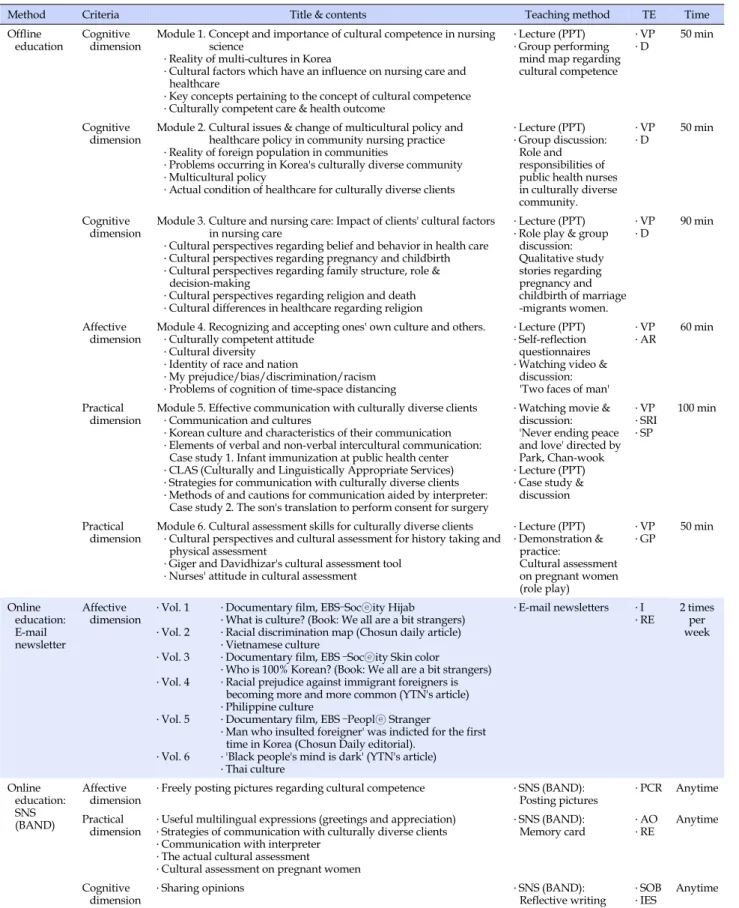
The experimental intervention provided to public health nurses is a cultural competence training program devel-oped for Korean public health nurses using Intervention Mapping [IM][24]. This is a systematically designed pro-gram based on psychosocial theory and evidence-based intervention strategies that influence the behavioral change based on the needs of the subjects. This program consists of an offline training course with 6 modules of 1 time 8 hours and online training of 3 weeks with two weekly email newsletters and BAND participation (Table 1). This study refers to the references and online sites introduced in the cultural competency toolkit of AACN [9] and the re-sults of a systematic review of the cultural competence programs [13-16,25-28] to select theory-based teaching methods and performance strategies, including program components. In addition, this study composed the con-tents by reviewing online education for the promotion of overseas cultural competence such as ‘Culturally Compe-tent Nursing Care: A Cornerstone of Caring’, of an online continuous education program with Minority Health De-partment of the US DeDe-partment of Health, and ‘Cultural Competence E-Learning Modules Series’ of Canadian Sick Children’s Hospital webpage.
The learning of culturally competent nursing is multi-dimensional process that is circulated in the order of cog-nitive (knowledge), affective (attitude) and practical (skill) dimension [19]. The offline education consisted of the fol-lowing six learning modules depending on this learning process was provided: (i) ‘concept of cultural compe-tence’ (module 1), ‘multicultural policy’ (module 2), and ‘culture and nursing care’ (module 3) on cultural know-ledge; (ii) ‘awareness and acceptance of other cultures’ (module 4) on cultural sensitivity and awareness; (iii) ‘effective communication skills’ (module 5) and ‘cultural assessment skills’ (module 6) on cultural skills. Only the experimental group was given experimental intervention, and the control group was not given education during the experiment, and this study provided the same program to the applicants in the control group after the experiment.
The offline education program developed for this study was approved by the Korea Nursing Association (KNA) as a continuing education course to RN (8 contact hours). The researcher took a continuing education provider course re-garding continuing education course operation by KNA. According to the continuing education guidelines, the
re-Table 1. Cultural Competence Training Program for Public Health Nurses
Method Criteria Title & contents Teaching method TE Time
Offline
education Cognitive dimension Module 1. Concept and importance of cultural competence in nursing science ․ Reality of multi-cultures in Korea
․ Cultural factors which have an influence on nursing care and healthcare
․ Key concepts pertaining to the concept of cultural competence ․ Culturally competent care & health outcome
․ Lecture (PPT) ․ Group performing
mind map regarding cultural competence
․ VP
․ D 50 min
Cognitive
dimension Module 2. Cultural issues & change of multicultural policy and healthcare policy in community nursing practice ․ Reality of foreign population in communities
․ Problems occurring in Korea's culturally diverse community ․ Multicultural policy
․ Actual condition of healthcare for culturally diverse clients
․ Lecture (PPT) ․ Group discussion:
Role and responsibilities of public health nurses in culturally diverse community.
․ VP
․ D 50 min
Cognitive
dimension Module 3. Culture and nursing care: Impact of clients' cultural factors in nursing care ․ Cultural perspectives regarding belief and behavior in health care ․ Cultural perspectives regarding pregnancy and childbirth ․ Cultural perspectives regarding family structure, role &
decision-making
․ Cultural perspectives regarding religion and death ․ Cultural differences in healthcare regarding religion
․ Lecture (PPT) ․ Role play & group
discussion: Qualitative study stories regarding pregnancy and childbirth of marriage -migrants women. ․ VP ․ D 90 min Affective
dimension Module 4. Recognizing and accepting ones' own culture and others.․ Culturally competent attitude ․ Cultural diversity
․ Identity of race and nation
․ My prejudice/bias/discrimination/racism ․ Problems of cognition of time-space distancing
․ Lecture (PPT) ․ Self-reflection questionnaires ․ Watching video &
discussion: 'Two faces of man'
․ VP
․ AR 60 min
Practical
dimension Module 5. Effective communication with culturally diverse clients․ Communication and cultures ․ Korean culture and characteristics of their communication ․ Elements of verbal and non-verbal intercultural communication:
Case study 1. Infant immunization at public health center ․ CLAS (Culturally and Linguistically Appropriate Services) ․ Strategies for communication with culturally diverse clients ․ Methods of and cautions for communication aided by interpreter:
Case study 2. The son's translation to perform consent for surgery
․ Watching movie & discussion: 'Never ending peace and love' directed by Park, Chan-wook ․ Lecture (PPT) ․ Case study &
discussion ․ VP ․ SRI ․ SP 100 min Practical
dimension Module 6. Cultural assessment skills for culturally diverse clients․ Cultural perspectives and cultural assessment for history taking and physical assessment
․ Giger and Davidhizar's cultural assessment tool ․ Nurses' attitude in cultural assessment
․ Lecture (PPT) ․ Demonstration & practice: Cultural assessment on pregnant women (role play) ․ VP ․ GP 50 min Online education: E-mail newsletter Affective dimension ․ Vol. 1 ․ Vol. 2 ․ Vol. 3 ․ Vol. 4 ․ Vol. 5 ․ Vol. 6
․ Documentary film, EBS–Socⓔity Hijab ․ What is culture? (Book: We all are a bit strangers) ․ Racial discrimination map (Chosun daily article) ․ Vietnamese culture
․ Documentary film, EBS –Socⓔity Skin color ․ Who is 100% Korean? (Book: We all are a bit strangers) ․ Racial prejudice against immigrant foreigners is
becoming more and more common (YTN's article) ․ Philippine culture
․ Documentary film, EBS –Peoplⓔ Stranger
․ Man who insulted foreigner' was indicted for the first time in Korea (Chosun Daily editorial).
․ 'Black people's mind is dark' (YTN's article) ․ Thai culture ․ E-mail newsletters ․ I ․ RE 2 times per week Online education: SNS (BAND) Affective
dimension ․ Freely posting pictures regarding cultural competence ․ Posting picturesSNS (BAND): ․ PCR Anytime Practical
dimension
․ Useful multilingual expressions (greetings and appreciation) ․ Strategies of communication with culturally diverse clients ․ Communication with interpreter
․ The actual cultural assessment
․ Cultural assessment on pregnant women
․ SNS (BAND): Memory card
․ AO
․ RE Anytime
Cognitive
dimension ․ Sharing opinions ․ Reflective writingSNS (BAND): ․ ․ SOBIES Anytime AO=advance organizers; AR=anticipated regret; D=discussion; GP=guided practice; I=individualization; IES=improving emotional states; PCR=provide contingent rewards; RE=repeated exposure; SOB=self-monitor of behavior; SP=shifting perspective; SRI=scenario-based risk information; TE=theoretical method; VP=verbal persuasion.
searcher and three professors in nursing department with experience in teaching or counseling MMW or foreign workers taught modules that correspond to their major field. Before the training, the researcher met each of the three in-structors, then explained and shared opinions about the contents of education, educational methods and learning environment and so on.
Twenty one nurse participants in the experimental group were divided into 15 and 6 participants according to their attendance schedule and received offline education along with other registered nurses who participated in the con-tinuing education. The offline training was conducted in small groups of 20 or less for 1 day (8 hours). After that, 2nd, 3rd, and 4th week online education were conducted to 21 nurse participants twice a week by email newsletters, allowing them to ensure continuous learning and reflec-tion of ‘awareness and acceptance of other cultures’ (mo-dule 4). In the ‘cultural competence room of health nurses’ created by the researcher using the BAND, which is a mo-bile community application, the nurse participants in the experimental group were invited by a Band URL via text before starting the offline education, and created a post in-cluding photos or newspaper articles and left comments about cultural competence in nursing after the offline edu-cation. They were able to share their thoughts and emo-tions and to stay connected with the instructors and collab-orate with each other. The memory cards were uploaded on the BAND to facilitate ‘cultural communication’(mod-ule 5) and ‘cultural assessment’(modcommunication’(mod-ule 6) in practice re-gardless of distance and time such as ‘strategy of commu-nication with culturally diverse clients’, ‘useful multilin-gual expressions (greetings and appreciation)’ and ‘cultu-ral assessment questionnaires’.
5. Procedures
Quantitative data collection was conducted from Feb-ruary 4, 2014 to April 17, 2014. In the case of public health nurses, pretest of the experimental group was conducted by the questionnaire under the guidance of the research assistant before the first offline education started. Posttest was conducted at the end of the 4th week (posttest 1) and 4weeks after the end of the program (posttest 2). The re-searchers distributed the questionnaire and collected it af-ter the subject completed it. In the control group as well, the researchers distributed the questionnaire and collec-ted it after the subject complecollec-ted it, and pretest and postt-est 1, 2 were conducted.
The pretest of MMW was conducted by researchers and trained research assistants either directly at home or at a
public health center before the pretest of public health nurses was started, and read aloud the contents of the questionnaire in Korean. The posttest of MMW was per-formed in the same way as the pretest at the posttest 2 stage of public health nurses. Vietnamese MMW who had difficulty in Korean language were surveyed with the help of volunteer interpreter at the public health center.
Qualitative data were collected from the individual in- depth interviews using semi-structured questionnaires within one month of the end of the posttest 2. The duration of the interview was about 40~60 minutes, and the whole process was recorded with the consent of nurse partici-pants. The main question was ‘What has changed since cultural competence education?’, and asked about changed personal thoughts and awareness after cultural competen-ce education, and cases to demonstrate their specific cultu-ral skills for cultucultu-rally competent care in practice.
6. Ethical Considerations
This study was granted the approval (IRB No. 2013- 0052-2) by the Bioethics Review Committee of Nursing College of Yonsei University. All research subjects who met the inclusion criteria were provided detailed infor-mation regarding the purpose and process of the study and signed the written informed consent form that is a vol-untary agreement to participate in research. The control group who did not receive the treatment was allowed to take the same program to those who want after the experi-ment. A small gift of gratitude was given to all research participants.
In order to ensure confidentiality and privacy of all the participants, a consent from the Vietnamese interpreter about the confidentiality of interpreted contents was re-ceived and nurse participants were not informed of the questionnaire contents associated with ‘client-nurse trust’ and ‘satisfaction with nursing care’ to prevent disadvan-tages from MMW’s response.
7. Data Analysis
1) Quantitative data analysisData analysis was carried out using IBM SPSS v. 20.0. To evaluate the baseline differences between the experimen-tal and control groups, the x2 test, Fisher’s exact test,
in-dependent t-test, and Mann-Whitney U test were used. Linear mixed models conducted for repeated measure-ments in order to verify the changes in TSE in public health nurses and satisfaction with nursing care perceived by MMW between pretest and posttests. The Mann-Whitney
U test was used to test the changes in client-nurse trust of MMW between pre- and post-test because the assumption of normality was not met by the Shapiro-Wilk test. 2) Qualitative data analysis
Qualitative data collected from individual depth in-terviews were analyzed using directed content analysis [29]. The researcher extracts meaningful words, sentences, and paragraphs by repeatedly reading through the tran-scripts written by the research assistant and categorizes the effects of the program into cognitive-affective-practi-cal dimensions, which are major components of cultural competence based on previous research results. The validi-ty of analyzed data was reviewed by qualitative research experts.
RESULTS
1. Participants’ Characteristics
1) Sociodemographic characteristics and multicultural experiences of public health nurses
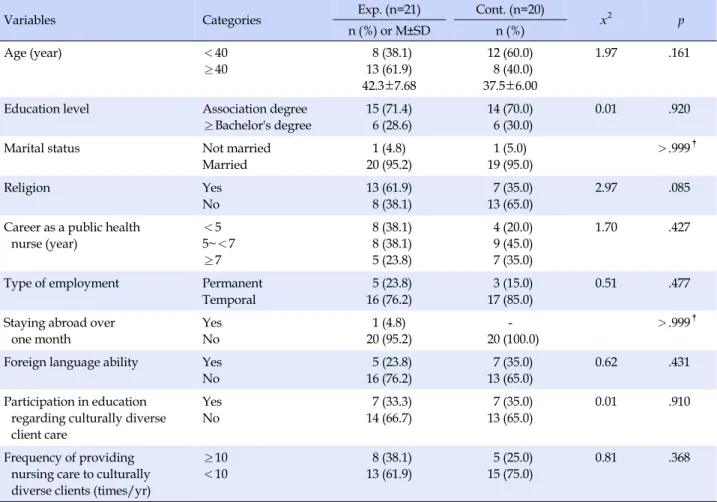
The mean age was 42.3±7.68 years in the experimental group and 37.5±6.00 years in the control group. The ma-jority of nurse participants had an associate degree (experi-mental group: 71.4%; control group: 70.0%). Most of nurse participants are married (experimental group: 95.2%; con-trol group: 95.0%) and those with religion were 61.9% in the experimental group and 35.0% in the control group. The majority has ‘5 years or more and less than 7 years’ work experience (experimental group: 38.1%; control group: 45.0%) and most of them are in temporary employment status (experimental group: 76.2%; control group: 85.0%). For the characteristics related to multicultural experience, most of nurse participants answered ‘no’ for the experience of staying abroad for more than one month (experiment-al group: 95.2%; control group: 100%) and responded ‘nothing’ for any communicable foreign languages (ex-perimental group: 76.2%; control group: 65.0%). In terms of education participation regarding culturally compe-tent care, ‘no experience’ was 66.7% in the experimental group and 65.0% in the control group. The frequency of providing nursing services to culturally diverse clients was for ‘less than 10 times a year’ 61.9% in the experi-mental group and 75.0% in the control group. There was no statistically significant difference between the experi-mental and the control group with regard to the baseline sociodemographic characteristics and multicultural experi-ences (Table 2).
2) Sociodemographic characteristics and proficiency in Korean language of MMW
As for the nationalities of the participants, ‘Vietnam’ was 55.0% in the experimental group and 55.0% in the con-trol group, which was the largest population, ‘the Philip-pines’ was 10.0% in the experimental group and 20.0% in the experimental group, and ‘China (ethnic Koreans from China)’ 5.0% in the experimental group and 15.0% in the control group. The mean age was 31.3±6.84 years in the experimental group and 30.3±5.95 years in the control group. And in terms of age, ‘26 years old or older and less than 31 years old’ was 50.0% in the experimental group and 35.0% in the control group, which is the largest pop-ulation, and ‘the case of 31 years old or older’ was 35.0% in the experimental group and 35% in the control group. In terms of education level, ‘high school graduation or more’ was 45.0% in the experimental group and 60.0% in the con-trol group, and ‘elementary school graduation’ was 30.0% in the experimental group and 20.0% in the control group. Most of MMW have children (experimental group: 95.0%; control group: 90.0%) and do not have an occupation (ex-perimental group: 90.0%; control group: 80.0%). The eco-nomic level was ‘bad’ in 70.0% of the experimental group and 40.0% of the control group, and medical insurance was held in 95.0% of the experimental group and 100% of the control group. The period of residence in Korea was ‘more than 5 years’ in 70.0% of the experimental group and 65.0% of the control group. The MMW answered ‘fair’ or ‘good’ for proficiency in Korean language were 70.0% of the ex-perimental group and 95.0% of the control group in speak-ing, 55.0% of the experimental group and 75.0% of the con-trol group in reading and 40.0% of the experimental group and 75.0% of the control group in writing. There was no statistically significant difference in baseline sociodemo-graphic characteristics and proficiency in Korean lan-guage between the two groups, confirming the homoge-neity between the two groups.
2. Homogeneity
There was no statistically significant difference in base-line TSE (t=-0.52, p=.604), client-nurse trust (Z=-1.52, p= .149) and satisfaction with nursing care (t=1.21, p=.233) between the experimental and the control group. The mean score for baseline these variables; TSE (experimental group: 5.79±1.50; control group: 6.00±1.09), client-nurse trust (experimental group: 3.85±0.42; control group: 4.01±0.46) and satisfaction with nursing care (experimental group: 3.69±0.66; control group: 3.98±0.83).
Table 2. Homogeneity Test of Sociodemographic Characteristics and Multicultural Experiences between Experimental and
Control Groups of Public Health Nurses (N=41)
Variables Categories Exp. (n=21) Cont. (n=20) x2 p
n (%) or M±SD n (%) Age (year) <40 ≥40 8 (38.1) 13 (61.9) 42.3±7.68 12 (60.0) 8 (40.0) 37.5±6.00 1.97 .161
Education level Association degree
≥Bachelor's degree 15 (71.4) 6 (28.6) 14 (70.0) 6 (30.0) 0.01 .920
Marital status Not married
Married 1 (4.8) 20 (95.2) 1 (5.0) 19 (95.0) >.999† Religion Yes No 13 (61.9) 8 (38.1) 7 (35.0) 13 (65.0) 2.97 .085
Career as a public health nurse (year) <5 5~<7 ≥7 8 (38.1) 8 (38.1) 5 (23.8) 4 (20.0) 9 (45.0) 7 (35.0) 1.70 .427
Type of employment Permanent
Temporal 5 (23.8) 16 (76.2) 3 (15.0) 17 (85.0) 0.51 .477
Staying abroad over one month Yes No 1 (4.8) 20 (95.2) 20 (100.0) >.999†
Foreign language ability Yes No 5 (23.8) 16 (76.2) 7 (35.0) 13 (65.0) 0.62 .431 Participation in education regarding culturally diverse client care Yes No 7 (33.3) 14 (66.7) 7 (35.0) 13 (65.0) 0.01 .910 Frequency of providing nursing care to culturally diverse clients (times/yr)
≥10 <10 8 (38.1) 13 (61.9) 5 (25.0) 15 (75.0) 0.81 .368
Exp.=experimental group; Cont.=control group; †
Fisher's exact test.
3. Transcultural self-efficacy
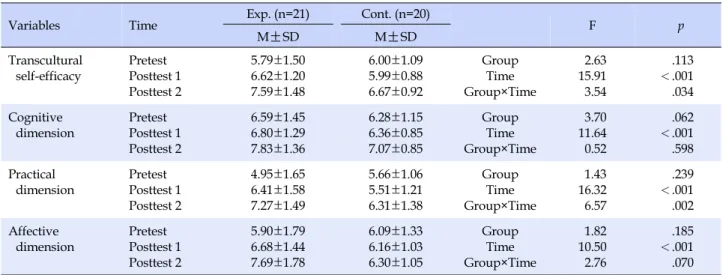
The results of the linear mixed models showed statisti-cally significant difference of interaction of time and group between the experimental and the control group in TSE (F=3.54, p=.034) and practical dimension (F=6.57, p=.002), while there was no significant difference in the cognitive di-mension (F=0.52, p=.598) and the affective didi-mension (F= 2.76, p=.070) (Table 3). Hypothesis 1 was supported.
4. Client-nurse Trust
From the results of Mann-Whitney U test, there was sta-tistically significant difference between the experimental and the control group in client-nurse trust (Z=-2.42, p= .018) (Table 4). Hypothesis 2 was supported.
5. Satisfaction with Nursing Care
The results of the linear mixed models showed
statisti-cally significant difference of between the experimental and control groups in terms of the changes in satisfaction with nursing care (F=9.22, p=.004)(Table 4). Hypothesis 3 was supported.
6. Changes Resulting from Cultural Competence
Training
As a result of analysis of qualitative data, 35 meaningful statements were extracted and based on this, six topic lists were derived.
1) Recognizing cultural differences (cognitive dimension) The respondents said that they came to learn about ‘cul-tural differences distinguished from my culture’ with re-gard to pregnancy and childbirth after participating in this study. They also stated that they try to recognize and me-diate the family conflicts and the problems of children in multicultural families due to cultural differences.
Table 3. Comparison of Transcultural Self-efficacy between Experimental and Control Groups of Public Health Nurses (N=41)
Variables Time Exp. (n=21) Cont. (n=20) F p
M
±
SD M±
SD Transcultural self-efficacy Pretest Posttest 1 Posttest 2 5.79±1.50 6.62±1.20 7.59±1.48 6.00±1.09 5.99±0.88 6.67±0.92 Group Time Group×Time 2.63 15.91 3.54 .113 <.001 .034 Cognitive dimension Pretest Posttest 1 Posttest 2 6.59±1.45 6.80±1.29 7.83±1.36 6.28±1.15 6.36±0.85 7.07±0.85 Group Time Group×Time 3.70 11.64 0.52 .062 <.001 .598 Practical dimension Pretest Posttest 1 Posttest 2 4.95±1.65 6.41±1.58 7.27±1.49 5.66±1.06 5.51±1.21 6.31±1.38 Group Time Group×Time 1.43 16.32 6.57 .239 <.001 .002 Affective dimension Pretest Posttest 1 Posttest 2 5.90±1.79 6.68±1.44 7.69±1.78 6.09±1.33 6.16±1.03 6.30±1.05 Group Time Group×Time 1.82 10.50 2.76 .185 <.001 .070 Exp.=experimental group; Cont.=control group.Table 4. Comparison of Client-Nurse Trust and Satisfaction with Nursing Care Perceived by Marriage Migrant Women between
Experimental and Control Groups (N=40)
Variables Time Exp. (n=20) Cont. (n=20) Z or F p
M
±
SD M±
SDClient-nurse trust Pretest Posttest 3.85±0.42 4.11±0.53 4.01±0.46 3.94±0.44 -2.42 .018 Satisfaction with nursing care Pretest Posttest 3.69±0.66 4.09±0.50 3.98±0.83 3.76±0.35 Group Time Group×Time 0.01 0.86 9.22 .910 .358 .004 Exp.=experimental group; Cont.=control group.
2) Being interested in the multicultural policy (cognitive dimension)
The interviewees recognized that Korean society has been turning into a multicultural society and stated that they became ‘interested in multicultural policies.’ They al-so expressed the need to expand support for the vulner-able populations.
3) Trying to communicate in MMW’s own language (practi-cal dimension)
The respondents stated that they used to explain to oth-er family memboth-ers excluding MMW who do not speak Korean fluently, however, after attending training course, tried to greet first with their mother tongue and to talk to them using translation apps or translation service. They also said that they sometimes felt an impulse to ask some-thing specifically. Especially, by utilizing application of cultural assessment tools, the point that they attempt to ac-tively ask specific questions for the cultural background and characteristics of the subject was what they felt as a big change.
4) Providing medical information using internet and smart phone (practical dimension)
The respondents utilized related internet web-sites and smartphone apps that they learned in the education to provide medical information to culturally diverse clients. Public health nurses also encouraged and cared for MMW to visit public health centers comfortably by themselves for the timely immunization of their children.
5) Embracing culturally diverse people into society (affec-tive dimension)
The respondents have expressed respect for people of other cultures and have developed a sense of accepting and embracing them as members of our society. They frankly expressed their ethnocentrism, stereotypes, and prejudice, which they had previously held in expressions such as ‘they are poor and are one step below us’, ‘others from for-eign countries’, ‘a person who can be ignored’. They stated that they were able to overcome the exclusiveness and hi-erarchical superiority of MMW through education and to regard them as an equal position. Also, public health nurses stated “MMW are considered to be ‘multicultural
persons’ but never have thought that Sarangi is the same”, which means that they became aware of discriminative ca-tegorization and double vision of culturally diverse people. 6) Requiring ongoing cultural competence training
After the program ended, nurse participants continued to search for materials such as movies and documentaries related to multicultural themes and to share information with people around them. In addition, they stressed that ‘cultural competence education is insufficient for one-time education’ and regular and continuous education is re-quired.
DISCUSSION
This study was attempted to identify the effects of cul-tural competence training program for public health nurses so that they could provide culturally competent nursing care taking into account the diverse cultural backgrounds and needs of culturally diverse clients residing in the com-munity. As a result, the cultural competence training pro-gram developed in this study was found to be effective in improving the TSE of public health nurses and the client- nurse trust and the satisfaction with nursing care of MMW.
This study applied an embedded mixed method design which is one of the mixing methods to verify the program effect. This is a research method that is used when qualita-tive data on research questions are additionally required on the basis of quantitative research. This study explores the response of the subjects to the experimental results and the long-term effects they experienced, and provides addi-tional explanations about the results of quantitative re-search [17]. In this study, there was no statistically signifi-cant change in cognitive and affective dimensions of TSE after experimental treatment in quantitative data analysis. However, knowledge and understanding of other cultures of public health nurses improved after the training in the structured interviews added after the experimental study. It was confirmed that they respect other cultures and em-brace MMW as members of our society, which was helpful in the limited interpretation of the study results. In assess-ing cultural attitudes, as it is difficult to accurately meas-ure changes in stereotypes or prejudices about particular ethnic groups or races, and there is a tendency to make so-cially favored responses, it is appropriate to measure us-ing structured interviews, which supports the argument of Betancourt et al. [5].
Like this, although the changes in the cognitive and af-fective dimension were observed in individual interviews, the contradictory result in the practical dimension only
was that unexpected results were obtained in the control group that did not provide the intervention and the TSE score increased. This is due to the incidence of measles in a high school in province G in 2013, and accordingly from February 2014, the research period, a free measles vacci-nation program was carried out for 10,000 MMW in the public health center in G province, which presumably is related to the promotion of medical care to multicultural families. And it may have influenced the results of the study as a contingent event that raised awareness and in-terest in the health of MMW.
The level of TSE of the public health nurses was 5.79± 1.50 in the experimental group and 6.00±1.09 in the con-trol group, which were almost at the middle level before the program intervention and the control group was slight-ly higher than the experimental group. The findings from the present study are slightly higher than those of Kim [20], who evaluated the TSE of hospital nurses (4.54±1.34) using the same tool. This is interpreted as a result of accu-mulating experience while providing services to cultur-ally diverse people in the community where the multi-cultural population ratio is higher. These results support the argument of Campinha-bacote [30], which emphasized that cultural contact directly interacting with other cul-tures is a key factor in achieving cultural competence. To explore the TSE according to cultural competence training program interventions, the experimental group had a ten-dency to increase immediately after the end of the pro-gram and it was maintained up to 4 weeks after finishing the program compared to the control group. This seems to supportJeffreys’ statement that cultural nursing self-effi-cacy is enhanced by formalized education and other edu-cational experiences [19], and that the effectiveness of cul-tural competence education lasts up to four weeks [25], the results of which are similar to those of the previous studies.
In the present study, the scores of the practical dimen-sion among the cognitive -practical-affective dimendimen-sions of each subcategory of TSE were the lowest in the pretest, but after the program intervention, cognitive and affective dimension showed no significant change of scores at each stage between the two groups, whereas in the practical di-mension, the experimental group showed significantly improved changes of scores at each stage compared to the control group. This can be interpreted as influences of composition and teaching methods of educational pro-gram contents. The cultural competence training propro-gram of this study was developed based on the IM framework [24], with a focus on the practical skills of public health nurses to perform culturally competent nursing in the practical field. This study used various methods of
edu-cator participatory teaching such as attempting to greet MMW with their mother tongue by using a memory card or using translation apps to increase the participants’ en-gagement with the conversation, and using educational materials to directly try out the cultural assessment and provide feedback, etc. In an overseas study on enhancing the cultural competence of nurses, it has been reported that the education program that applied the teaching method of participating in cultural activities and inter-viewing and evaluating using cultural assessment tools was effective in increasing cultural skills [26,27]. In this study, it was confirmed that the teaching and learning methods such as the contents of education, demonstration and role play focusing on the behavior change of the sub-jects are effective in attaining educational achievement.
This study is different from previous studies in that it measured the health outcomes of culturally diverse clients in addition to the effects of the cultural competence pro-gram provided to public health nurses. There is no study that measured the outcomes of the clients among the four studies that verified the effectiveness of the cultural com-petence program developed for domestic nurses and nurs-ing students [13-16], and Majumdar et al.’s [28] study was the only one in foreign literature. In practice, cultural com-petence of nurses is exerted through interaction with cul-turally diverse clients, and cultural competence of health care providers is ultimately aimed at improving health status and improving health equity of culturally diverse people. The evaluation by the perspectives of the clients receiving nursing care is the best way to check whether the culturally competent nursing is performed [21]. Therefore, as shown in the results of this study, the findings of im-proved health outcomes of MMW were from the fact that through the training, public health nurses increased con-fidence in the provision of culturally competent nursing, and performed it in practice, and also in the viewpoint of MMW, it could be interpreted and perceived as appro-priate nursing, leading to the MMW’s health outcomes. In other words, the contents of education were narrowed down to pregnant and childbirth, which is the main health problem of MMW, the first settlement migrants in Korea, and immunization of their children. It is believed that the fact that they were taught as simulated exercises in the form of discussion and role play by putting current cases frequently encountered in the public health center togeth-er with the education of ‘communication’ and ‘cultural as-sessment skills’ may have increased health nurses’ perfor-mance.
Cultural competence is an essential competence that all health care providers in health care institutions must have.
Cultural competence education and training should be in-cluded within the regular curriculum and it is necessary to provide systematic educational opportunities and resour-ces for the relevant health and medical practitioners at the relevant association and government dimension. In addi-tion, government-level support is essential including es-tablishment of interpreter support system, multi-lingual education materials and information display, etc. to streng-then institutional cultural competence, in order for do-mestic nurses working in various institutions to provide equally culturally competent nursing for culturally diverse clients. In order to systematize and sustain the promotion of cultural competence within the community system, in-formation and materials for strengthening cultural com-petence are shared by establishing partnerships between health clinics such as hospitals and clinics in the region as well as public health centers and free medical clinics, and training and education for health care providers are per-formed in mutual cooperation. At the same time, cultural awareness and sensitivity of community residents should be cultivated. All these efforts will ultimately contribute to ensuring the health rights of culturally diverse clients and ensuring their health equity.
CONCLUSION
This is the first study to verify the effectiveness of the cultural competence training program for public health nurses applying IM framework [24]. As a result of apply-ing an embedded mixed method design, TSE was im-proved in public health nurses after the training was re-ceived, and changes such as public health nurses ‘recogni-zing cultural differences’, ‘being interested in the multi-cultural policy’, and ‘embracing multi-culturally diverse people into society’ were identified. In addition, it was confirmed how public health nurses have performed culturally com-petent nursing such as ‘trying to communicate in MMW’s own language’ and ‘providing medical information using internet and smart phone’ within the community system. All these results improved the MMW’s perspectives of trust in nurses and satisfaction with nursing care, which ultimately contributed to the positive health outcomes.
This study has proven the validity of the cultural com-petence training program and has been able to dissem-inate and sustain education to public health nurses in oth-er areas as well. Future studies should include continuous cultural competence education by differentiating the level of education into basic and intensive courses. Although previous studies suggest that the cultural competence of health care professionals has a positive impact on health
outcomes in culturally diverse people, the results remain inconclusive and insufficient. To help address these in-sufficiencies, it is suggested that the target group of cultur-ally diverse clients should be specified as subjects with a specific disease or health problem and the effects of the program should be directly measured as health outcomes such as treatment compliance or health condition.
REFERENCES
1. Statistics Korea. Annual foreign residence status [Internet]. Daejeon: Statistics Korea. 2016 [cited 2016 August 19]. Avail-able from:
http://www.index.go.kr/potal/main/EachDtlPageDeta il.do?idx_cd=2756
2. Kim HM. We all leave home; living as a migrant in Korea. Paju: Dolbegae; 2014. 236 p.
3. Leininger M. Cultural care theory: A major contribution to ad-vance transcultural nursing knowledge and practices.Journal of Transcultural Nursing. 2002;13(3):189-192.
http://dx.doi.org/10.1177/10459602013003005
4. Andrews MM, BoyleJS. Transcultural concepts in nursing care. 6th ed. Philadelphia: Wolters Kluwer Health/Lippincott, Williams and Wilkins; 2012. 476 p.
5. BetancourtJR, Green AR, CarrilloJE, Ananeh-Firempong 2nd O. Defining cultural competence: A practical framework for addressing racial/ethnic disparities in health and health care. Public Health Reports. 2003;118(4):293-302.
6. Koh CK, Koh SK. Married female migrants’ experiences of health care services. TheJournal of Korean Academic Society of Nursing Education. 2009;15(1):89-99.
http://dx.doi.org/10.5977/JKASNE.2009.15.1.089
7. Kim SH, Kim KW, Bae KE. Experiences of nurses who provide childbirth care for women with multi-cultural background. Journal of Korean Public Health Nursing. 2014;28(1):87-101. http://dx.doi.org/10.5932/JKPHN.2014.28.1.87
8. Douglas MK, Rosenkoetter M, Pacquiao DF, Callister LC, Hattar-Pollara M, LauderdaleJ, et al. Guidelines for imple-menting culturally competent nursing care.Journal of Trans-cultural Nursing. 2014;25(2):109-121.
http://dx.doi.org/10.1177/1043659614520998
9. American Association of Colleges of Nursing. Tool kit of re-sources for cultural competent education for baccalaureate nurses [Internet]. Washington, DC: AACN. 2008 [cited 2016 September 30]. Available from:
http://www.aacn.nche.edu/education-resources/toolkit.pdf 10. Registered Nurses’ Association of Ontario. Embracing cultural
diversity in health care: Developing cultural competence [Internet]. Toronto: RNAO. 2007 [cited 2016 September 30]. Available from:
http://rnao.ca/sites/rnao-ca/files/Embracing_Cultural_Diver sity_in_Health_Care_-_Developing_Cultural_Competence.pdf 11. Lee EJ, Kim YK, Lee H. A study on the cultural competence of
community health practitioners.Journal of Korean Academy Community Health Nursing. 2012;23(2):179-188.
12. Yang SO, Kwon MS, Lee SH. The factors affecting cultural competency of visiting nurses and community health practi-tioners.Journal of Korean Academy Community Health Nurs-ing. 2012;23(3):286-295.
http://dx.doi.org/10.12799/jkachn.2012.23.3.286
13. Kim SH. Development of educational program for cultural competence in nursing for nursing students and its effects. The Journal of Korean Academic Society of Nursing Education. 2013;19(4):580-593.
http://dx.doi.org/10.5977/jkasne.2013.19.4.580
14. Peek EH, Park CS. Effects of a multicultural education pro-gram on the cultural competence, empathy and self-efficacy of nursing students.Journal of Korean Academy of Nursing. 2013; 43(5):690-696. http://dx.doi.org/10.4040/jkan.2013.43.5.690 15. Park MS, Kweon YR. Effects of a cultural competence
promo-tion program for multicultural maternity nursing care: Case- based small group learning.Journal of Korean Academy of Nursing. 2013;43(5):626-635.
http://dx.doi.org/10.4040/jkan.2013.43.5.626
16. Park M, Park E. Effect of cultural competence education for nurse. Multicultural education studies. 2013;6(2):115-133. 17. CreswellJW, Plano Clark VL. Designing and conducting mixed
methods research. 2nd ed. CA: Sage Publications; 2011. 488 p. 18. Faul F, Erdfelder E, Lang AG, Buchner A. G*Power 3: A flexible
statistical power analysis program for the social, behavioral, and biomedical science. Behavior Research Methods. 2007;39 (2):175-191.
19. Jeffreys MR. Teaching cultural competence in nursing and healthcare. 2nd ed. NY: Springer Publishing Company; 2010. 618 p.
20. Kim SH. Transcultural self-efficacy and educational needs for cultural competence in nursing of Korean nurses.Journal of Korean Academy of Nursing. 2013;43(1):102-113.
http://dx.doi.org/10.4040/jkan.2013.43.1.102
21. Shen Z. Cultural competence models and cultural competence assessment instruments in nursing a literature review.Journal of Transcultural Nursing. 2015;26(3):308-321.
http://dx.doi.org/10.1177/1043659614524790
22. Kim SH. Nurses’ communication, trust in nurses, and satisfac-tion of nursing service perceived by inpatients [master’s the-sis]. [Seoul]: Seoul University; 2013. 76 p.
23. Kim SW, Kim KH, Jang YH. The relationship between core service quality trust, value and satisfaction in medical service. Journal of Marketing Studies. 2009;17(1):115-140.
health promotion programs: An intervention mapping ap-proach. 3rd ed. San Francisco, CA:Jossey-Bass; 2011. 745 p. 25. Brathwaite AE. Evaluation of a cultural competence course.
Journal of Transcultural Nursing. 2005;16(4):361-369. http://dx.doi.org/10.1177/1043659605278941
26. Berlin A, Nilsson G, Tornkvist L. Cultural competence among swedish child health nurses after specific training: A random-ized trial. Nursing and Health Sciences. 2010;12(3):381-391. http://dx.doi.org/10.1111/j.1442-2018.2010.00542.x
27. HunterJL, Krantz S. Constructivism in cultural competence education.Journal of Nursing Education. 2010;49(4):207-214.
http://dx.doi.org/10.3928/01484834-20100115-06
28. Majumdar B, Browne G, RobertsJ, Carpio B. Effects of cultural sensitivity training on health care provider attitudes and patient outcomes.Journal of Nursing Scholarship. 2004;36(2):161-166. 29. Hsieh HF, Shannon SE. Three approaches to qualitative content
analysis. Qualitative Health Research. 2005;15(9):1277-1288. http://dx.doi.org/10.1177/1049732305276687
30. Campinha-BacoteJ. The process of cultural competence in the delivery of healthcare services: Thejourney continues. 5th ed. Cincinnati, OH: Transcultural C. A. R. E. Associates; 2007. 133 p.