ICCAS2005 June 2-5, KINTEX, Gyeonggi-Do, Korea
Networked Robots in the Informative Spaces
Bong Keun Kim, Kenichi Ohara, Kohtaro Ohba, Tamio Tanikawa, Shigeoki Hirai, and Kazuo Tanie Intelligent Systems Research Institute, AIST, Tsukuba, 305-8568 Japan
(Tel: +81-29-861-3494,; Fax: +81-29-861-3493; Email:[email protected])
Abstract: In this paper, the informative space is proposed to implant ubiquitous functions into physical spaces. We merge physical and virtual spaces through the space structurization using an RFID system, and solve the space localization and mapping problem for a robot to navigate through the distribution and synthesis of information and knowledge. To distribute knowledge flexibly and reliably to changing environment and also to develop a system which allows a robot to invoke and merge the distributed knowledge more freely, we employ a novel approach of knowledge management based on Web services. The proposed method is verified by building a physical space with two kinds of RFID tags and a virtual space with knowledge database based on Web services.
Keywords: Informative space, Networked robot, Ubiquitous functions, RFID tag, Web services 1. Introduction
Ubiquitous computing brought about the paradigm change that the robot technology transforms itself to the technology for everything which includes a robot and object. The appli-cation of a robot is moving up rapidly to the unstructured environment such as an office from the typical structured environment such as a factory. As a result, the house man-agement and the aged support service using an intelligent robot have become the most ideal robot technology which can be realized in the ubiquitous environment. But the real human living environment is too complicated to apply this ideal technology at once, and also there are still many diffi-cult problems for a robot to understand the identity of every object which exists in the real world. Hence, the research which allows robots to localize themselves, to recognize the environment, and to get information about the target ob-ject simultaneously by structurizing human daily living en-vironment and giving every object ubiquitous functions was emerged as a new issue of the recent robotics field. This technology aims to improve the intelligence of a robot and to realize the robot-human interface easily through the com-ponent based distributed computing service which supports the distribution and collection of knowledge and informa-tion based on wire/wireless network. Hence, it is essential in many applications to combine the information technol-ogy, which is for the creation of the ubiquitous environment by connecting every thing in physical spaces and merging virtual spaces, and the robot technology required in this en-vironment. Ubiquitous computing will enable a robot to access various applications and provide a robot with many intelligent functions.
In this paper, we discuss the space structurization, called in-formative spaces, which implants ubiquitous functions into the space and propose the knowledge distributed system for the intelligent interaction among a robot, environment, and object. In order for a robot to be able to perceive space and to recognize the identity of an object, an information medi-ator which transmits the information about an object and space to a robot is required because the real living space and objects have no computation, network ability and also they
can be changed as time passed. This kind of information me-diator should be implanted into space and an object, and also should save and transmit the specific information. An RFID tag has lately attracted considerable attention as the most proper mediator with this end in view [1–7]. Using radio fre-quency, an RFID tag can transmit its ID and information, which are used for a robot to perceive space and location, and also to access the information about an object. As a result, the structurization of space is actualized through bridging physical and virtual worlds by implanting an information mediator, RFID tag, into physical spaces. Hence, RFID can structurize space, implant ubiquitous functions into objects, and enable a robot to perceive space/location and to handle objects more naturally. In this paper, we build informative spaces using two kinds of RFID tags and Web services, and then show the effectiveness of the proposed method using a networked robot with ubiquitous functions.
In what follows, we first introduce the networked robot with ubiquitous functions. We then present details of our informa-tive spaces implementation based on Web services. Finally, we present experimental results illustrating the effectiveness of the proposed method based on RFID tags.
2. Networked Robots
The current robotics based on artificial intelligence and im-age processing technologies has reached the limit for ensur-ing robot workensur-ing in the everyday environment because di-verse objects make it extremely difficult to recognize the real world. But on the other hand, the ubiquitous computing which allows a thing of daily life intelligence and network ability is being realized. As a result, robot technologies are on the important turning point. It is because that the con-cept of ubiquitous robots which can work for a human being at any time, any place, connecting on the network and sen-sor net in the daily living space is being actualized. Thus, this section presents physical hyperlinks as a way to link the physical environment and objects with virtual Web re-sources, and then describes the ubiquitous functions control platform for the design and implementation of a networked robot system with ubiquitous functions.
Social Request House/Office Management The Aged Support ...
Robot & Unstructured Physical Space
? ? !
Knowledge & Information for Robots :
Wire/Wireless Web
Networked Robot with Ubiquitous Functions
IP Address for Objects & Spaces :
RFID Tag
World Wide Web & Virtual Space
Fig. 1. Physical hyperlinks for networked robots with ubiquitous functions.
2.1. Knowledge Distributed Robot System
Social requests such as house/office management and the aged support using a robot are being highly increased. In order to meet these requests, we need to develop a robot which can interact with common objects and physical spaces. But our daily spaces and objects have no computation and network access ability. As a solution to this problem, robot technologies based on an RFID tag have been published in succession. The newest research about the knowledge dis-tributed robot system is a good example [7–9]. This technol-ogy proposed the concept of ubiquitous functions of a robot in the knowledge distributed environment and the technol-ogy about the knowledge distribution itself. A series of in-formation and knowledge are separately saved to an object and database in advance and the distributed information and knowledge are integrated through an RFID tag when a new event is invoked. Each RFID tag has a native network ad-dress, which enables a robot to access the object information through network. As a result, this scheme allows a robot to recognize objects and to perceive spaces more easily, and also allows the manufacturers to save the burden of programming. Figure 1 shows the whole architecture of knowledge dis-tributed robot system. As shown in this figure, the envi-ronment can be structurized by physical hyperlinks from the physical spaces to virtual resources on the Web [10]. Human beings imagined that an intelligent robot which can keep house will be a high-tech product with mobility, the ability to grasp the situation, and very complex machinery. But, it is unnecessary to make an expensive and big robot house-keeper if the artificial intelligence and sensing ability can be distributed to surrounding environments.
2.2. Ubiquitous Functions Control Platform
Controlling an autonomous robot entails specifying how a robot is to react to perceptual input in order to accomplish a given goal. One of these specializations’ key challenges is the creation of an autonomous robot that performs everyday activity in real world environments over extended periods of time. Everyday activity requires such a robot to accomplish complex routine jobs in changing environments where they face familiar but often not completely known situations. To ensure continuing utility, robots must manage their mission and execute them flexibly and reliably. Hence, there are two major issues that must be adequately addressed to develop a versatile and successful autonomous robot system. One, a robot should be able to perceive spaces. And two, a robot should be able to identify objects scattered in the human everyday environments more naturally and to understand their built-in features based on the interaction with them. The information infrastructure that settled down in human daily life through the advancement of computer and network technologies is providing the social environment that allows a robot to interact with objects and to access new informa-tion at any time, any place. In this ubiquitous environment, a robot will grow as the advanced shape of a personal com-puter system, learn knowledge and information, and provide many applications which have various cultural, social, and educational contents.
A networked robot will have greater sensory capabilities, more intelligence, higher levels of manual dexterity, and ad-equate mobility compared with human beings. Hence, in order to control networked robots and to realize various ap-plications, it is essential to develop a ubiquitous functions
KNOW
Object DB Space DB
Logical function Physical data Absolute location Relative location
(a)Knowledge oriented Web.
Knowledge based manipulation
Behavior Generation Engine BGML Parser Learning Expert knowledge Logical decision Inference Engine Feedback Engine
Logical & physical priority
Logical & physical feedback Knowledge warehouse update
Behavior planning
Behavior Pattern Generator
(b)Behavior generation engine. Fig. 2. Ubiquitous functions control platform.
control platform (UFCP) which enables a robot to perceive spaces, to interact with objects, and to learn about them in the everyday environment through networks.
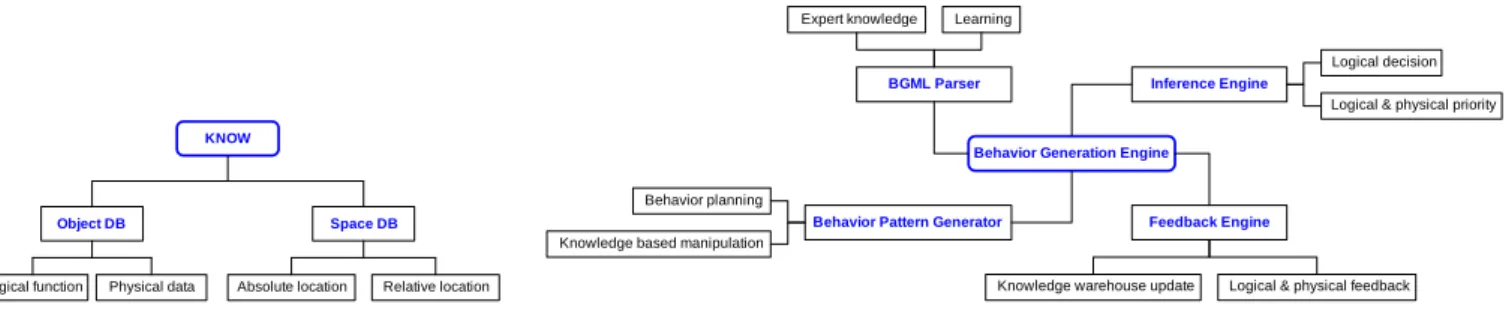
To meet the requisite of ubiquitous functions for a networked robot system, the proposed UFCP consists of Knowledge Oriented Web (KNOW) and Behavior Generation Engine (BGE). KNOW is a kind of database system, which has the environment information as well as object knowledge. And BGE is the main control unit of UFCP, which uses the environment information to perceive spaces and the object knowledge to identify them and learns about their tangible and intangible features, and also generates intelligent behav-ior pattern through inference and feedback. Figure 2 shows the structure of KNOW and BGE, respectively.
3. Informative Spaces
Now we continue with a discussion of the knowledge distri-bution method for physical spaces in detail. In this section, thus we first present our method for attaching information to spaces, and we then discuss the methods used for accessing information attached to spaces.
3.1. Physical Hyperlinks
The typical utilization of robots in the structured environ-ment such as a factory has moved up to the unstructured environment such as home and office. Hence, the space struc-turization for bridging physical space and virtual space us-ing virtual annotations or physical hyperlinks is prerequisite to the networked robot with ubiquitous functions. If ev-ery object in the daily environment could inform a robot of their position, it would be not so hard for a robot to move to the target position with the optimum path and to com-plete the given mission. The work ability of a robot makes a rapid progress in the ubiquitous residential environment which communicates with surrounding objects. This means that robots can understand the surrounding condition ac-tively and manage their duty by themselves. As a result, in order for a robot to evolve into not a passive machine slave but an agent which can complete the given mission autonomously, it is essential to build the ubiquitous envi-ronment above all else.
In order for a robot to navigate, a robot must build a map of its environment and then localize using this map. If the relative locations and the map information about the envi-ronment are given to a robot in real time, then this problem is fairly straightforward to solve. This means that if the
Active RFID Tag
(a)Active RFID tag.
Passive RFID Tag
(b)Passive RFID tags.
Fig. 3. Informative space based on RFID tags.
information of real space is stored in the virtual space and a networked robot can find the relative locations and the map information about the environment accessing directly the virtual space, then the localization problem can be eas-ily solved. This approach, called informative spaces, relieves a robot of many burdensome tasks involved in localization, path planning, and navigation by providing a simple, physi-cal hyperlink to the information.
The system for informative spaces stores information and knowledge in the network and associates IP address to infor-mation and knowledge with the physical spaces. By linking the physical and virtual spaces, robots can easily perceive the environment and localize their position.
One location of physical spaces is fixed by the relative dis-tance from the absolute location, and robots also can localize
their exact position using these absolute location information and relative information. Thus a virtual space system needs two kinds of databases which store the absolute location in-formation and the relative location inin-formation, respectively. Robots access each database using RFID tags which are dif-ferent in style. Figure 3 shows a example of the proposed informative space that employs RFID tags. A robot can ac-cess the absolute location information about the room using an active RFID tag and the relative location information about one location in this room using passive RFID tags. Actually, the present style building is very functionally de-signed. Especially, a library and art museum are easy to structurize because of the clearness of the use. The inside structure of these buildings is well known and there are clear differences of the use in each floor and each room. And also because database systems of books and works of art are al-ready builded up, these buildings are the most suitable place for the informative space of networked robots. Hence these kinds of buildings which can be easily structurized are the target applications of this paper.
3.2. Web Services for virtual spaces
Everyday activity requires a robot to accomplish complex routine jobs in changing environments where they face fa-miliar but often not completely known situations. To ensure continuing utility, a robot must manage the missions and execute them flexibly and reliably. Hence, we need a sys-tem which links physical and virtual spaces organically, and manages this efficiently. For this, we propose Web services based on the recent Internet technologies like XML, SOAP, WSDL, UDDI. A Web service is a software interface that de-scribes a collection of operations that can be accessed over the network through standardized XML messaging. It uses protocols based on the XML language to describe an op-eration to execute or data to exchange with another Web service. A group of Web services interacting together in this manner defines a particular Web service application in a ser-vice oriented architecture (SOA).
Web services use XML that can describe any and all data in a truly platform-independent manner for exchange across systems, thus moving towards loosely-coupled applications. Furthermore, Web services can function on a more abstract level that can reevaluate, modify or handle data types dy-namically on demand. So, on a technical level, Web services can handle data much easier and allow software to commu-nicate more freely. At the most recent step, Web services have moved towards the concept of XML-defined interfaces and communications, finally uniting any kind of application with another, as well as providing the freedom to change and evolve over time, as long as they are designed to the appropriate interface. The versatility of XML is what makes Web services different from previous generation component technologies. It allows the separation of grammatical struc-ture (syntax) and the grammatical meaning (semantics), and how that is processed and understood by each service and the environment it exists in. So now, objects can be defined as services, communicating with other services in XML-defined grammar, whereby each service then translates and analyzes
DB Access Integration Client Robot with BGE Database Server Web Server Object DB Space DB Data Tier Business Tier Client Robot System
Behavior/Display
Behavior generated from the BGML-based data
BGML delivered to other applications or objects for further processing
Data Delivery, Manipulation
BGML(XML & OWL) exchanged over HTTP, manipulated via the DOM
Data Integration
XML & OWL emitted or generated from multiple sources H T T P S O A P House Keeper with BGE H T T P S O A P B GM L Pa rse r XML OWL BGML Web Services
Fig. 4. KNOW framework with Web services.
the message according to its local implementation and envi-ronment. Thus a networked application can truly be com-posed of multiple entities of various makes and designs as long as they conform to the rules defined by their service oriented architecture.
3.3. KNOW for Informative Spaces
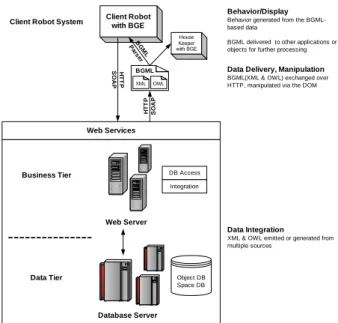
Figure 4 shows a generic architecture for Web services in the KNOW framework. The architecture of Web services is di-vided into two logical tiers. Furthest from the client robot system is the data tier, which stores information required by the Web service. Above the data tier is the business tier, which implements the business logic of the Web service. It is often subdivided into three parts: the data access, the
busi-ness facade, and the busibusi-ness logic. The data access presents
a logical view of the physical data to the business facade and the business logic. The data access isolates business logic from changes to the underlying data stores and ensures the integrity of the data. The business facade provides a simple interface that maps directly to operations exposed by the Web services. The business facade uses services provided by the business logic.
In the proposed UFCP framework, an application is con-structed from multiple peer Web services that work together to provide data and services for the application. Figure 5 shows the whole system interface of the UFCP for the knowl-edge distributed robot system. As in this figure, KNOW includes application specific Web services, object data spe-cific Web services, and space spespe-cific Web services, which work together through HTTP/SOAP. Application specific Web services provide application logic which a robot needs to manipulate the target object properly. Object data spe-cific Web services provide physical data for the manipulation of the target object. Space specific Web services provide the absolute and relative location information about the space.
Management System Robot Agent Vision Agent Tag Agent Web Servers Application Object Data <<TCP/IP>> <<TCP/IP>> <<TCP/IP>> <<HTTP/SOAP>> <<HTTP/SOAP>> <<HTTP/SOAP>> Space <<HTTP/SOAP>>
Fig. 5. UFCP architecture.
Fig. 6. Networked robot in the informative space.
4. Experiments
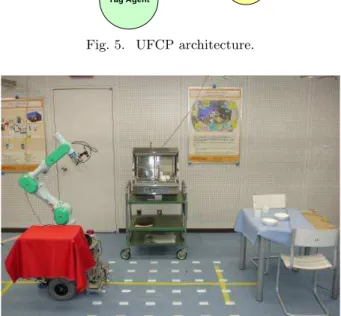
We have implemented an RFID tag based system embody-ing the concept of the informative spaces. Figure 6 shows the experimental test bed for the networked robot with ubiqui-tous functions in the informative space. This robot system is composed of a tag agent for localization and object recogni-tion, a vision agent for object localizarecogni-tion, a robot agent for object handling, Web servers for applications, object data, space information, and a management system for the control of the whole system.
To link the physical space and virtual space, we implemented physical hyperlinks using two kinds of RFID tags. Figure 7 (a) shows the active type of RFID tag, called ubiquitous
func-tions activate module (UFAM), which is used to access the
Web services for the absolute location information of the test place [6]. Hence the networked robot can download the map of the test room using this RFID tag. Table 1 shows the specifications of this module. Figure 7 (b) shows the passive type of RFID tags implanted under the floor and tag reader equipped under the bottom of the networked robot. This RFID system is used for the relative location information of the test place. Every tag was implanted at 25cm intervals in the floor for the reasonable localization and their ID and relative location data were stored into the space specific Web services. As a result, the networked robot can localize
us-(a)Ubiquitous functions activate module (active).
(b)RFID tag and reader (passive).
Fig. 7. Two kinds of RFID tags for the informative space. Table 1. Specification of the UFAM.
CPU PIC16F627A
Clock 4MHz
Trans./Recept. IC TA32305FN
Baud rate(TX/RX) 9600bps
I/O Device Switch, LED
Free I/O port I/O(5bit)
Battery 3V(Button Type)
ing the map of the test room and the location information relative to this map.
If the mission is to clean off the dining table shown in Fig. 6, the sequence of information management controlled by the networked robot is described as follows:
1. The user orders the task of cleaning the table to the net-worked robot.
2. The active tag system of the networked robot communi-cates with the active tag system of the informative space and the passive tag system reads the current information of the floor tags.
3. The active tag offers ID, URL, and user information of the test room and the passive tags offer ID, URL, and user information of the relative location.
4. The networked robot retrieves necessary knowledge from the data source provided by Web services.
Fig. 8. Localization of the networked robot.
5. The networked robot localizes the current position and composes the path to navigate to the target position. 6. The networked robot navigates to the target position and compensates the path following error continuously using the information from the informative space.
7. If the networked robot arrives at the target position, the robot carries out the given task.
Figure 8 shows the trace of the networked robot when this mission was given. In this figure, the nine red circles means that the RFID tags around the robot are activated by the tag reader. In this manner, the networked robot can localize and navigate to the target position.
5. Conclusion
We have proposed the physical hyperlinks based on RFID tags as a way to link the physical environment and objects with virtual Web resources. In order to relieve a robot of many burdensome tasks involved in localization, path planning, and navigation, we have proposed the informative space and actually built the informative space which con-sists of the physical space based on the active type of RFID tag called ubiquitous functions activate module (UFAM) and passive type of RFID tags, and the virtual space based on Web services which provide application, object data, and space specific services. Through the experiment in this space, we have shown the feasibility that a networked robot with ubiquitous functions can evolve into an autonomous agent in the proposed informative space.
References
[1] R. Want, K. P. Fishkin, A. Gujar, and B. L. Harrison, “Bridging physical and virtual worlds with electronic tags,” Proc. CHI99 , pp. 370–377, 1999.
[2] J. Bohn and F. Mattern, “Super-distributed RFID tag infrastructure,” Proc. 2nd European Symp. Ambient
In-telligence, 2004.
[3] N. Y. Chong, H. Hongu, M. Miyazaki, K. Takemura, K. Ohara, K. Ohba, S. Hirai, and K. Tanie, “Robots on self-organizing knowledge networks,” Proc. 2004 IEEE
Int. Conf. Robot. Automat., pp. 3494–3499, 2004.
[4] D. H¨ahnel, W. Burgard, D. Fox, K. Fishkin, and M. Philipose, “Mapping and localization with RFID tech-nology,” Proc. 2004 IEEE Int. Conf. Robot. Automat., pp. 1015–1020, 2004.
[5] M. Perkowitz, M. Philipose, K. Fishkin, and D. J. Pat-terson, “Mining models of human activities from the web,” Proc. 2004 Int. Conference on World Wide Web, 2004.
[6] K. Ohara, K. Ohba, B. K. Kim, S. Hirai, and K. Tanie, “Application on ubiquitous functions for human life,”
Proc. SSR2005 , 2005.
[7] B. K. Kim, M. Miyazaki, K. Ohba, S. Hirai, and K. Tanie, “Web services based robot control platform for ubiquitous functions,” Proc. 2005 IEEE Int. Conf.
Robot. Automat., 2005.
[8] N. Y. Chong, H. Hongu, K. Ohba, S. Hirai, and K. Tanie, “A distributed knowledge network for real world robot applications,” Proc. 2004 IEEE/RSJ Int. Conf.
Intelligent Robots and Systems, pp. 187–192, 2004.
[9] B. K. Kim, K. Ohba, S. Hirai, and K. Tanie, “Web ser-vices and ubiquitous control platform for the knowledge distributed robot system,” Proc. IROS2004 Workshop
- Network Robot System, pp. 31–36, 2004.
[10] T. Kindberg, “Implementing physical hyperlinks using ubiquitous,” Proc. Proc. 2002 Int. Conference on World