Babel
in
business:
The
language
barrier
and
its
solutions
in
the
HQ-subsidiary
relationship
§
Anne-Wil
Harzing
a,*
,
Kathrin
Ko¨ster
b,1,
Ulrike
Magner
c,2a
DepartmentofManagement&Marketing,UniversityofMelbourne,Parkville3010,Australia
bDepartmentofBusinessAdministrationII,HeilbronnUniversity,Max-Planck-Str.39,74081Heilbronn,Germany c
DepartmentofPsychology,EducationalandDevelopmentalPsychology,UniversityofFreiburg,Engelbergerstr.41,79106Freiburg,Germany
1. Introduction
The notion that cultural differences are a barrier to doing businessabroadisnowcommonlyaccepted(Adler&Gundersen, 2008;Hofstede, 1980and 2001). Thiscommonplaceacceptance mighthaveblindedresearchersandpractitionerstoamorebasic country-relatedcharacteristicwiththesameimpact:differencesin national languages (Harzing, 2003). Multinational companies (MNCs)aremultilingual(Luo&Shenkar,2006).EveryMNC will needtofindawaytodealwiththelanguagebarriersitencounters whenexpandingintocountriesthatdonotshareitshomecountry language. It is therefore surprising that language diversity has attractedsolittleattentioninthefieldofinternationalmanagement andbusiness.Thisisallthemoreremarkableasresearchintotherole oflanguageinorganizationsiswellestablished;especiallyincritical managementstudies(see,e.g.,Tietze,Cohen,&Musson,2003).
Scholarshavedescribedtheproblemofmanagingbusinesses acrosstheinternationallanguagebarrieras‘‘theforgottenfactor’’ (Marschan, Welch, & Welch, 1997), ‘‘the management orphan’’
(Verrept, 2000) and ‘‘the most neglected field in management’’ (Reeves & Wright, 1996). Although a recent special issue of International Studies in Management & Organization (2005) provided a major step forward,there is still much we do not knowabouttheroleoflanguageinMNCs.AsMaclean(2006,p. 1377)aptlyindicates ‘‘Companiesdealwithlanguage issuesevery day,theycope,theworldcontinuestoturn.Howtheydoso,however, remainslargelyabsentfromtheliterature.’’
Thisarticledealswiththelanguagebarrieranditssolutionsinthe relationshipbetweentheMNC’scorporateheadquarters(HQs)and its subsidiaries.Tothe bestof ourknowledge,thereis no prior researchthathassystematicallyinvestigatedtheextent towhich languageformsabarrierbetweenHQsanditssubsidiaries.Further, althoughFeelyandHarzing(2003)suggested a largenumberof solutionstothelanguagebarrier,wearenotawareofanyempirical studiesthatshowwhichsolutionsareusedinpractice.Inthisarticle, wepresentempiricalevidencefromeightMNCcorporateHQsin GermanyandJapanandtheirsubsidiariesinJapanandGermany, lookingatboththelanguagebarrieranditsvarioussolutions.
Inadditiontostudyingatopicthathasreceivedscantattention inthepast,ourstudycomplementspreviousresearchbyincluding amuchlargernumberofcompanies.Studieslookingattheroleof languageinHQ-subsidiaryrelationshipshavetypicallyfocusedon asmallnumberofcompanies.Infact,mostofthesestudieswere in-depth case studies of a single MNC. Although this research methodisideally suitedtocharteranasyetunexploredareaof research, it is less suitable as a vehicle to generalise on the importanceofcertainphenomenaorsolutionsinawidersetting. Our studyincludedthecorporateHQsandsubsidiariesof eight
ARTICLE INFO
Articlehistory:
Availableonline19August2010 Keywords: Languagebarrier Multinationals Communication HQ-subsidiaryrelationships Japan Germany ABSTRACT
UsinginterviewdatafrommanagersineightGermanandJapanesecorporateHQsandtheirsubsidiaries
inJapanorGermany,weprovidethefirstlarge-scaleempiricalanalysisofthelanguagebarrierandits
solutions.Wefoundthatlanguageisanimportantbarrier,slowingdownandincreasingthecostof
decision-making.Ourresearchsuggeststwelvedifferentsolutions,rangingfrominformalday-to-day
solutionssuchaschangingcommunicationpatternsandcode-switching,tomorestructuralsolutions
suchaslanguagetrainingandacommoncorporatelanguage.Weconfirmandextendpreviousresearch
and conclude that futureresearch should moreexplicitly consider thedifferent configurations of
languageskillsforHQandsubsidiarymanagers.
ß2010ElsevierInc.Allrightsreserved.
§
ThisresearchwassupportedunderAustralianResearchCouncil’sDiscovery Projectsfundingscheme(projectDP0555977).Theviews expressedhereinare thoseoftheauthorsandarenot necessarilythoseoftheAustralianResearch Council.
*Correspondingauthor.Tel.:+61383443724;fax:+61393494293. E-mailaddresses:[email protected](A.-W.Harzing), [email protected](K.Ko¨ster),[email protected](U.Magner).
1
Tel:+497131504340;fax:+497131252470.
2
Tel:+497612039445;fax:+497612033100.
ContentslistsavailableatScienceDirect
Journal
of
World
Business
j ourn a lhom e pa g e :ww w . e l se v i e r. c om / l oca t e / j w b
1090-9516/$–seefrontmatterß2010ElsevierInc.Allrightsreserved. doi:10.1016/j.jwb.2010.07.005
differentMNCs.Althoughthisisstillarelativelysmallsample,it
does give us some scope to generalise beyond the possible
idiosyncraticresultsofasinglecompany.
Finally,ourresearchprovidesanovelcontributionbyfocusingon twocountriesthathavenotbeenextensivelystudiedinthiscontext: GermanyandJapan.Previousstudiesfocusedonlanguage interac-tionsthatincludedonenativeEnglishspeakingparty(e.g.Harzing& Feely,2008;Lauring,2008;SanAntonio,1987;Wright,Kumagai,& Bonney,2001)ordealtwiththeoverseasoperationsofFinnishor Danishcompanies(Andersen&Rasmussen,2004;Lauring,2008; Marschanetal.,1997;Marschan-Piekkari,Welch,&Welch,1999a, b).Weareonlyawareofthreestudiesthatcoveredotherlanguages (Blazejewski, 2006; Fredriksson, Barner-Rasmussen, & Piekkari, 2006;Gimenez,2002).Gimenez(2002)dealtwithcommunication betweenasubsidiaryinArgentinaandaHQbasedinaEuropean country,whereEnglish-languagefluencywasmuchhigherthanin Argentina.The lack of understanding on the part of HQ of the problemsthatthiswouldcreatewasthemajorcontributingfactorto
the breakdown in communication between the two offices.
Blazejewski(2006)showedhowtheintroductionofEnglishasa corporatelanguageinaGermanMNCresultedinconflictbetween juniorandseniorJapanesemanagers,becausetheformerhadbetter Englishlanguage skills thanthe latter. Thiseffectively gave the juniormanagersbetteraccesstodecision-makingandmorepower thantheirseniors.Fredrikssonetal.(2006)discussdiscrepancies betweencompanypolicy andemployeepractices withregardto languageuse.Althoughbothstudiesprovideinterestinginsights, theyfocusedonasingleMNCandasinglelanguagebarriersolution (commoncorporatelanguage)only.
Inourstudy,wedealwithtwonationalitiesthatarenon-native speakersofEnglish, neitherofwhich havethe excellentEnglish language skills typicallypossessed byScandinavianmanagers. In fact, JapanesearecitedashavingthelowestaverageTOEICscoreinthe worldandJapanranks180outof189countriestakingtheTOEFLtest (Yoshihara,Okabe,&Sawaki,2001).FortheScandinaviancompanies included in many previous studies, using their home-country languagein overseas expansions is not an option becausetheir languages are not widely spoken outside their home countries (Fredriksson et al., 2006). Even within Scandinavia, English is increasinglyusedasthelinguafranca(Louhiala-Salminen,Charles, &Kankaanranta,2005).Incontrast,GermanandJapanesearemore widelyspokenoutsidetherespectivehomecountries.Thereareover 2millionnon-JapanesepeoplestudyingJapanese(Yoshiharaetal., 2001).Hence,thisstudyallowsustoestablishwhetherthedynamics found in previous research would replicate in a very different languagesetting.
Intheremainderofthispaper,wewillfirstdiscussourresearch sampleandmethodsofdatacollectionandanalysis.Wewillthen report our results, integrating – where applicable – previous researchintheareawithourownfindings.Wewillstructureour findingsaccordingtothefollowingtworesearchquestions:
1.Is there a language barrier between corporate HQ and
subsidiaries located in countries with different national languagesandhowimportantisthislanguagebarrier? 2.Whatsolutionsareusedtoresolvethelanguagebarrier?
A discussion and conclusion section puts our findings in a broaderperspectiveandpresentssuggestionsforfurtherresearch.
2. Methodology
2.1. Researchsample
Given thelack ofprevious empiricalresearchin this area, a qualitative,interview-basedmethodwasconsidered tobemost
appropriate. Because of the difficulty of getting access to elite interviewees (Welch, Marschan-Piekkari,Penttinen,& Tahvanai-nen,2002),wehadtorelyonaconveniencesampleofcompanies thatwehadestablishedcontactswithonpreviousoccasions.Even so,oursampleincludescompaniesinarangeofindustries,and represents both large established MNCs and smaller recently internationalizedMNCs(seeTable1).Webelievethatourresults are unlikely to be biased by specific company characteristics. However, as 7 of the8 companies have their corporate HQ in Germany,ourresultscannot begeneralisedtocompaniesfrom othercountrieswithoutfurtherverification.
Atotalof44interviewswereconductedin2006withfourto seveninterviewsateachoftheeightcompanies.Thevastmajority oftheintervieweesweremanagers,whilstsevenwereemployees, usually engineers. Only five of the interviewees were female. SixteeninterviewswereconductedatthecorporateHQleveland 28interviewswereconductedatsubsidiarylevel.
Alloftheintervieweeshaddirectexperienceininteractionwith thesubsidiaryinJapan/Germany(inthecaseofHQmanagers)orin interactionwithcorporateHQ orHQexpatriates(inthecase of subsidiary managers). Twenty-four of the interviewees were Germannationals,sixteenwereJapanesenationalsandfourhad differentnationalities.Whereapplicableweanalysedourresults bothforthesampleasawhole,andseparatelyforthecorporateHQ and subsidiaries, the different nationalities (German, Japanese, other)aswellasfortheeightindividualcompanies.Inmostcases, however,there wereno majordifferences betweenthe various groupsintermsoftheimportanceofthelanguagebarrierandthe solutionsusedtoresolveit.Where differenceswereapparent–
usually between German and Japanese managers – these are
discussedinmoredetailinSection3. 2.2. Datacollectionprocedures
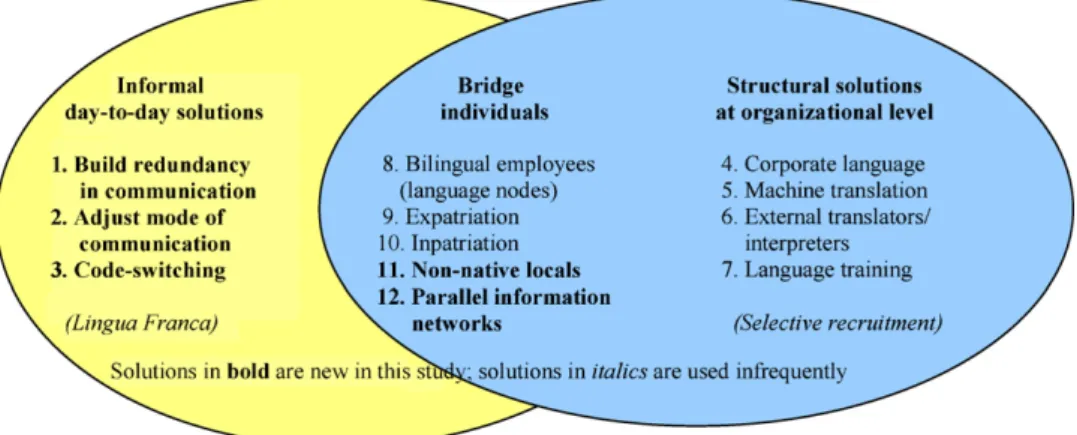
TheinterviewguidewasfirstproducedinEnglishbythefirst authorincollaborationwiththesecondauthorandthentranslated intoGermanandJapanesebythesecondauthor,whoisaGerman nativespeakerandfluentinJapaneseandEnglish.Questionsfor theJapaneseintervieweeswerephrasedslightlymoreindirectlyto accommodatetheless directnatureofcommunication inJapan (Hofstede,1980and2001).Thespecificquestionsthatwereasked forthetopicsdiscussedinthispaperwere:‘‘Whatdoyouthinkare themainissues,advantagesanddisadvantagesthatarisefromthe factthatpeopleinyourcompanyhavedifferentnativelanguages?’’ ‘‘Doyouthinkdifferencesinnationallanguagesformabarrierto communication between HQand subsidiaries?’’ [Generally,this wasaskedonlyafterthefirstmoreexploratoryquestion,soasto avoidleadingtheinterviewee]‘‘Whatkindsofsolutionsareusedto overcomeanylanguagebarriers?’’[onlyafterabarrierhadbeen identified],with further probing on individual solutions where necessary. In this we broadly followed the list of solutions as identifiedinFeelyandHarzing(2003)andreproducedinFig.1.The interviewer would let the interviewee expand on issues not
Table1
HQcompanydescriptives.
HQcompany Industry Size(#ofemployees)a German-A Automobile 270,000
German-B Automobilecomponents 13,000 German-C Automobilecomponents 270,000 Japan-A Semiconductor
manufacturingequipment
7700 German-D Semiconductors 13,000 German-E Electronics&IndustrialMachinery 400,000 German-F IndustrialMachinery 1800 German-G Pharmaceutical 30,000
a
coveredin theinterviewguidewhere appropriate.However, in principle each respondent was asked thesame questions. This semi-structured approach was consistent with our intent to empiricallyverifythesolutionsdevelopedbyFeelyandHarzing (2003,seeFig.1)andthefrequencyoftheiruse.
TheinterviewswereconductedbetweenlateJulyand Decem-ber2006andwerealldigitallyrecorded.Apartfromtwotelephone interviews, all interviews wereconducted in the interviewee’s officebythesecondauthor.Intervieweeswereofferedachoiceof interview languages. Mostmanagers wereinterviewed in their nativelanguage.Thisapproachwaspurposefullychosensoasto
allow a direct exchange of views without the use of an
intermediary.A secondadvantage of this approachis that it is easierto build rapportwhen interviewing in the interviewee’s native language (Welch & Marschan-Piekkari, 2006). Finally, authenticity,richness,andaccuracyofthedatacannormallybe expected to be higher when interviewing in the interviewee’s nativelanguage(Welch&Marschan-Piekkari,2006).
The data needed to be understood by all three authors.
Therefore,JapanesetranscriptsweretranslatedintoEnglishbya bilingualJapaneseresearchassistant,whohadalsotranscribedthe Japanese interviews.We considered thelossof dataquality by translatingfromJapanesetoEnglishas lesssignificantthanthe problemsassociatedwithinterviewinganexecutiveinalanguage thattheywerenotcomfortablewith(see,alsoVallaster,2000).The GermaninterviewswereanalysedinGerman,asthesecondand thirdauthorarenativeGermanspeakersandthefirstauthorhasa highleveloffluencyinGerman.However,interviewquoteshadto betranslatedfromGermantoEnglish.Thiswasdonebythesecond authorasshehadconductedtheinterviewsandalsohadthebest combinedlanguageskills.Ameaning-basedtranslationtechnique wasused(Marschan-Piekkari&Reis,2004),inwhichtheoriginal meaningoftheintervieweetakescentrestageandtranslationis conductedthroughparaphrasing and interpretation ratherthan mechanicaltranslation,whichmightleadtoaquotethatisstilted andawkwardtoread.
2.3. Dataanalysis
After transcription and translation, all interview transcripts were imported into NVIVO. Based on qualitative data analysis recommendations(Miles&Huberman,1994),theinterviewswere analysedthroughaprocessofdatareduction,display,conclusion
drawing, and verification. In the data reduction phase, a
hierarchical coding tree was created based on the interview
guidelines, covering main topics such as language barrier
solutions,misunderstandingandmiscommunication,andtherole oflanguage.Thesetopicswerethensubdividedintoforinstance individuallanguagebarriersolutions(asdiscussedinthispaper)or thedifferentcausesand consequencesofmisunderstanding and miscommunication.
Thehierarchicalcodingtreewasiterativelyadaptedduringthe codingprocess.Somemaincategoriesthathadnotbeeninitially anticipated,suchasculturaldifferencesandtypeof communica-tion,wereintroducedas soonasitbecameapparent thatthese topics were important in more than a couple of interviews. Subsequently, all previously coded interviews were reviewed againforinstancesofthesetopics.Codingwaspredominantlydone bythethirdauthor,aftercarefulinstructionbythefirstauthorand a coding reliabilitycheck for one of theinterviews. A detailed researchjournalwaskepttodocumentcodingchoicesandthefirst and third author discussed any problems encountered in the process.Afterthecodingprocesswasfinished,resultswere cross-checked bygoing through each interviewagain. In the display phaseaspreadsheetwascreatedforthemainthemesinthestudy withintervieweesintherowsandthekeyresultsineachcolumn. Subsequently,reportswerewrittenupforeachofthekeythemes wheretheresultsweresummarisedandrepresentativequotesfor eachthemeincluded.Thesewereusedasthebasisforwritingup articles.
Theconclusiondrawingandverificationphasewererelatively straightforward as the research questions could be answered ratherdirectlyintermsoftheexistenceofalanguagebarrierorthe extenttowhichsolutions tolanguagebarriersoccurred. Inthis
phase we also went back to our coding and systematically
reviewed codes that were not initially classified as language barriersolutions.Wethendiscoveredthatthemaintheme‘typeof
communication’ was most often discussed in the context of
overcomingthelanguagebarrier.Wealsodiscoveredthatsomeof thephenomenathatwereidentifiedinHarzingandFeely(2008)as factors that might reinforce language-based group boundaries (parallelinformationnetworksandcode-switching)wereinsome instancesusedtoovercomelanguagebarriers.Thesewereaddedto enrichtherepertoireoflanguagebarriersolutions.Giventhatthe totalnumberofsolutionstothelanguagebarrierthusidentified
was rather large, we subsequently searched for ways to
meaningfullyclassify themintoa smallernumberof categories withcommoncharacteristics.
After rereading thereports, we separated thesolutions into
the implementation of informal day-to-day changes in
communicationpatternsandstructuralsolutionsatorganizational level.Thefirstcategorycontainssolutionsthatindividual commu-nicationpartners havecomeupwithon aday-to-daybasis.The secondcategorycoversallformalratherthaninformalsolutions,and arestructurallyembeddedinthecompany.Athirdcategory,theuse ofbridgeindividuals,referstoindividualswithspecificlanguage skillsthatactasbridgesbetweenemployeeswithoutthenecessary languageskills.Thiscategoryhaselementsofboththefirstandthe secondcategory,asbridgeindividualscanbestructuralsolutions implementedbythecompanyorcangrowoutofinformalsolutions. However,giventhepredominanceofthisthemeintheinterviews, wefeltthiscategorywasimportantenoughtodiscussseparately. 3. Results
3.1. Theimportanceofthelanguagebarrier
Inresponsetothefirstresearchquestion,thevastmajorityof ourinterviewees(42outof44)indicatedthatalanguagebarrier wasindeedpresentintheinteractionbetweencorporateHQand subsidiary managers. In about one third of these cases, the interviewerhad specificallyreferred tolanguage asa potential barrier in one of her questions and hence the interviewee’s
response might have been influenced by this. However, this
generally only happened in pre-interview exchanges with the interviewee.In all the othercases interviewees mentioned the existenceofalanguagebarrierspontaneouslyinanothercontextor afterbroadprobingabouttheadvantages and disadvantagesof peoplespeakingdifferentnativelanguagesinthecompany.Itis alsoimportanttonotethattheissueoflanguageasabarrierwas oftennot just mentioned once in thesame interview,but was mentionedmultipletimesindifferentcontexts.Inall,therewere 151referencestolanguageasabarrierinthe44interviews.One representativeexample:
GermanmanagerincorporateHQofGerman-G[#15]:Well,
my former boss in Japan was also German. He gave clear
instructions to the Japanese.So he thoughtall wasagreed on. But,infacttheJapanesedidjusttheopposite.Afteroneortwoof theseexperiences,youtrytoswitchtoJapanesetomakesurethat allisunderstoodwell.Maybe,Englishwastoostraight,....ormy Englishwastooambiguous.
Morethanhalfoftheintervieweesindicatedthatitwasnotonly languagedifferencesthatcausedabarrierbetweenheadquarters andsubsidiaries,butalsoculturaldifferences;someindicatedthat intheirexperiencesitwasmainlyculturaldifferencesthatwere causing a barrier. In addition, just over a quarter of the interviewees felt that although a language barrier might be present,theyeitherdidnotfeelitwasverysignificantortheyhad resolveditthroughvariousmeans.Wewillcomebacktothisin moredetailwhenwediscusssolutionstothelanguagebarrier.
JapanesemanagerinJapanesesubsidiaryofGerman-G[#13]: UsuallynotmanypeopleontheJapanesesidearefluentinEnglish. So,Itrytoputbilingualconsultantsinbetween[inorder]notto makeitabarrier.So,Igiveafreedomtosayanything.Raiseyour hand,ifyoustarttospeakJapanese.Somebodywillautomatically translateittotherestofthepeople.Solanguagehasnotbecomea probleminourprojectteam.
Oneinfiveoftheintervieweessawtheexistenceofdifferent nationallanguagesin thecompanyasanadvantageratherthan only asa problem, mostoften listing a variety of perspectives relatedtodifferentlanguagesandcultures. Themostimportant
direct problem associated with the language barrier was that everythingtakesmoretimeandismorecostly.3Hence decision-makingwouldgenerallybeslower andlessefficientifdifferent languagesareinvolved.
Germanmanager in German subsidiaryof Japan-A [#18]:
Well, Ithink the biggest issue we have isreally [...] ‘‘time to market’’.Wealwayshavetoexplainingreatdetaileverythingwe do,thewholecontext,untilitisunderstood.Andthistakestime, [...],anawfullotoftime.
ThisechoesfindingsbyYoshiharaetal.(2001)4whoindicate that misunderstandings and delays in decision-making are the mostimportantcostsassociatedwiththelanguagebarrier.They reportinstances of decision-making in subsidiariesof Japanese companies coming to a complete standstill until the Japanese expatriatereturnsfromhisbusinesstriptoreadthe communica-tionsfromHQs,whicharenormallywritteninJapaneseonly.In fact, these authors report that in most of the companies they
studied, non-Japanese could not even figure out whom the
communicationwasaddressedtoaseventheaddressee’sname waswritteninJapanese.
Wefoundthatitisclearthatmostintervieweeswereacutely awareoflanguagedifferencesasabarrier.Thiswastobeexpected giventhefactthatGermanyandJapanhaveverydifferentnational languages,andthattheJapanesetendtohaveaverylowlevelof spokenskillsinEnglish.Moreinterestingly,however,companies havesolutionstoaddressthesechallenges,whichwewilldiscussin theremainderofthisarticle.
3.2. Solutionstothelanguagebarrier
FeelyandHarzing(2003)identifiedelevenpossiblesolutionsto thelanguagebarrier.Inourinterviews,wequeriedinterviewees aboutmostofthesesolutionsandintheprocessalsodiscovered severalnewsolutions.Wewilldiscussthemaccordingtothethree categories identified above: informal day-to-day changes in communication patterns, structural solutions at organizational levelandbridgeindividuals.
3.2.1. Informalday-to-daychangesincommunicationpatterns Three solutions were classified in this category: build in redundancyinthecommunicationexchange,adjustthemodeof communicationandcode-switching.
3.2.1.1. Buildinredundancyinthecommunicationexchange. Build-ing in redundancy is a relatively simple way to overcome the language barrier. It could mean asking your partner to repeat informationseveraltimes,checkingon understandingbyasking your partner to repeat the information you have just given, providingillustrativeexamples,andbuildinginfrequent summa-ries,especiallyinmeetings.
Two thirds of the interviewees mentioned they used this solution to the language barrier, making it the single most frequentlymentionedsolution,eventhoughitwasnotidentified by Feelyand Harzing (2003). There wasa difference, however, betweentheJapaneseintervieweesandtheintervieweeswitha Germanorothernationality.Oftheformergroup,onlyjustover
3
Therearemanymoreindirectconsequencesofthelanguagebarrier,suchas frustration,conflict,mistrust,resistance,declineinknowledgetransfer.However,a detaileddiscussionofthesegoesbeyondthescopeofthisarticle.
4
Wecoverthefindingsfromthisstudyinabitmoredetailthaniscustomary, becausetheoriginalJapanesebookwillnotbeaccessibleformanyreaders.The bookisbasedonthreesurveyswithwellover1000responsesintotalaswellas interviewsinmorethan50companies,bothJapaneseandforeign-owned.
half mentioned this as a solution, whilst in the latter group nearlythreequartersdidso.TheJapanesefeartolosefacemight havecontributedtothisdifference,althoughasthequoteshows,
someJapanese managershavemanaged toovercome thisfear
and have realised misunderstandings might have serious
consequences.
JapanesemanagerinJapanesesubsidiaryofGerman-E[#9]: Itdoesn’tmatterifIdon’tunderstandthejokesorthegreetings. However,if itseemsto beimportant,Iwould beafraid notto confirm.Iwouldsaysomethinglike‘‘thatmeansyouwantmetodo somethinglikethat’’andreconfirmmyunderstanding.[....]Idon’t want people to say, ‘‘you pretended to understand, when you didn’t.’’So,evenifIfeelabitreluctantaboutasking,Iwouldrather askagaintoconfirmmyunderstanding.
3.2.1.2. Adjustthemodeofcommunication. Asecondinformal day-to-daysolutiontothelanguagebarrieristoadjustthemodeof
communication. Although this was not a specific solution
mentioned by Feely and Harzing (2003), more than half of
theinterviewees talked about differentmodesof
communica-tion. Given that many communication exchanges occurred
betweenpartnerswhowerenotco-located,itisnotsurprising thatphoneandemailwerethemostdiscussedcommunication methods.
Overall,managershadapreferenceforemailoverphonecalls. Inthe23interviewsinwhich themode ofcommunicationwas discussed,13intervieweesindicatedtheypreferredemails,whilst theremaining10indicatedtheyhadnopreferenceorcombined different modes of communication. As Charles and Marschan-Piekkari(2002)foundoralcommunicationpresentsanadditional challengeoverwrittencommunicationbecauseofthedifferences in accents. Japanese managers were more likely than German managerstopreferemailcommunication,withtwothirdsofthe managerspreferringemailover phonecalls,whilstthiswasthe caseforonlyhalfoftheGermanmanagers.Themainreasonforthis was Japanese managers often had better written than spoken languageskillsandcouldwriteemailsattheirownpace.Moreover, they could enlist the help of someone to translate important communications.
Evenwithinthesamemode ofcommunication,adjustments weremadetoovercomethelanguagebarrier,particularlybythe Germaninterviewees. Ingeneral, Germanshad thetendencyto writelongunstructuredemailsandintheircommunicationwith Japanesemanagers.Theyquicklyrealisedthatthiswritingstyleled tomiscommunication.
Germanmanager in Germansubsidiary of Japan-A [#21]:
Well,Iwouldtrytofollowacertaintemplate,crystal clearand concise,bulletsonlywithclearnumbering.Thiskindof communi-cation ismuch easier to understand [by the Japanese]. At the beginning,Ihavetriedtocovereverythinginoneemail.Thatwasa mistake.Theemailsthatcontainedallkindofinformationtypically werenotanswered,oryougotanawfullotofquestionsback.Ihave stoppedsendingtheselongemails.Now,Iwriteshortones,only withthemostimportantdetails,althoughIknowthatnotallinfois covered.
Finally, seven of our interviewees indicated that language barriersweresmalleramongstengineersthanamongstmanagers. Engineerswereabletocommunicatelargelybyusingnumbersand drawings rather than words. This led to a smaller number of misunderstandings
3.2.1.3. Code-switching. A third informal solution was code-switching.Code-switchingispresentwhensecondlanguageusers reverttotalkingbetweenthemselvesintheirnativelanguage.In theliteratureonlanguageininternationalbusiness, code-switch-inghasgenerallybeenseenasanegativephenomenon,leadingto feelingsofirritation,discomfortandevenexclusionandsuspicion (Brannen,1994inBrannen&Salk,2000;Harzing&Feely,2008; Lauring,2008;SanAntonio,1987).
These feelings were certainly present amongst our intervie-wees.Code-switchingwasdiscussedin39ofthe44interviews.It wasseenasnegativebyjustover60%oftheinterviewees,whilst 44% oftheinterviewees considered itas mainlypositive (these
figures ad up to more than 100% as several interviewees
highlighted both positive and negative aspects). Both German andJapanesemanagersengagedincode-switching.However, in
contrast to most previous research, there were also many
interviewees who saw code-switching as positive or at least somethingoneshouldsimplyacceptasasolutiontothelanguage barrier.
GermanmanagerincorporateHQofGerman-C[#32]:They
discussabitinJapanese,andeventually,wecontinuethemeeting inEnglish.Patienceisimportant,justsittingthereandlisteningto theJapanese.Ofcourse,Idon’tunderstandanything,butforme, that’stheonlywaytodealwiththis.
Ourdataalsoshowedthattherewasarelationshipbetweenthe frequencyofuseofcode-switchingandtheextenttowhichiswas seenasnegative.Ifcode-switchingoccurredoccasionally,negative
and positive assessments were balanced. However, if
code-switching wasusedveryfrequently,then negativeassessments weremorefrequent.
3.2.2. Structuralsolutionsatorganizationallevel
Four solutions were classified in this category: adopting a common corporatelanguage,theuseoftranslators/interpreters, and the use of machine translation and provision of language training.
3.2.2.1. Commoncorporatelanguage. Oneofthe‘easiest’solutions toovercomethelanguagebarrieristoadoptacommoncorporate languageinwhichallofficialcommunicationsneedtotakeplace. Thisfacilitatesbothformal reportingbetweencorporate HQand subsidiaries and enhancesinformation communication between them.Itmightalsofosterasenseofbelongingtoaglobalfamily (Marschan-Piekkarietal.,1999a).In companieswith aHQinan Anglo-Saxoncountry,thecorporatelanguageisEnglishbydefault. ThisisalsothecaseinmostScandinavianmultinationalsastheir homecountrylanguagesarenotwidelyspokenoutsideScandinavia (Fredrikssonetal.,2006).Somewhatsurprisingly,giventhefactthat GermanandJapanesearelargerlanguageareasandaremorewidely spoken outside the respective home countries, English is also paramount as a corporate language. Many of the interviewees respondedtothisquestioninaverymatteroffactway.Allbutthree ofourintervieweesalsoindicatedthatEnglishwasusednexttothe locallanguageasadailylanguageintheircompany.Quiteanumber ofintervieweesdidsaythoughthatEnglishhadonlybeenformalised asacorporatelanguagerelativelyrecently.
GermanmanagerincorporateHQofGerman-G[#15]:Ithink ourcompanyadoptedEnglishasthe officialcorporatelanguage onlyseventoeightyearsago.That wasinthevaneof stronger internationalization.Backthen,theyhadnoticedthatpeoplehadto speak English,for instanceat certainevents. Otherwise,notall participantsunderstandwhat’sgoingon.
Onlytwooutofthe37intervieweesinGermanMNCsindicated thatGermanwasthecorporatelanguage,whilstoneindicatedthat acombinationofGermanandEnglishwasused.Weonlyhadone JapanesecorporateHQinoursample,buthereintervieweeseither indicatedthatthecorporatelanguagewasEnglishorthatthere was no official corporate language. Overall, a quarter of the interviewees indicated there was no corporate language, even
though a majority of interviewees for each company had
mentionedEnglishasthecorporatelanguage.Itisclearthatnot
everyone is aware of the official company language policy,
confirmingearlierfindings byFredrikssonet al. (2006)in their studyatSiemens.Finally,nearlyeverysingleintervieweeindicated that English language capabilities were very important for promotionwithinthecompany.Manyindicatedthatitplayeda role in recruitment as well, further reinforcing the current dominantroleofEnglishinourcompanies.
A small minority of interviewees indicated that there was selective,butpersistent,resistanceagainsttheadoptionofEnglish asacorporatelanguage.Oneintervieweehadfoundacreativeway ofdealingwiththis:
GermanmanagerinJapanesesubsidiaryofGerman-A[#2]
Interviewee: There are acouple of areas andfunctionswhere English as the official corporate language is still deliberately ignored...[andHQmanagerscommunicatewithusinGerman] Interviewer:Arethereanysanctions?
Interviewee:No,why?Ikeeptheballlowandjustdon’treactto theirrequests.Sometimes,Ievenencouragemystafftoreplyin Japanese.
3.2.2.2. Machinetranslation. Asolutionthatispracticalonlyfor written materials (though portable translation machines do exist for face-to-face interaction) is machine translation. Machinetranslationwasdiscussed in 25of the44interviews.
The overwhelming opinion was that it was useless beyond
gettingaverybasicunderstandingofthetopicofthetranslated materials.Morethanhalfof theintervieweesneveruseditfor thisreason,andanother30% did useitor hadused, orhad a communicationpartnerwhousedit,butfoundtheresultstobe dreadful:
GermanmanagerincorporateHQofGerman-C[#31]:Pretty useless.Well,ourJapanesecolleagueslikethem.AndthenIreceive theseemailsthatsoundkindofEnglish,butwhenIreadthemIcould laughmyheadoff.Youhardlycanguessthemeaning,justtotal nonsense.
3.2.2.3. Externaltranslatorsorinterpreters. Externaltranslatorsor interpreterswerementionedbywelloverhalfofourinterviewees as a way to negotiate the language barrier. Because of the substantialcostsinvolvedforprofessionaltranslatorsand inter-preters,theywereonlyusedtotranslatesignificantdocuments, suchascontracts and technicaldocumentation, and toprovide simultaneous interpretation at important board meetings or video-conferences. The problem with external translators or interpretersisthattheyareoftennotfamiliarwiththespecialist matter.Yoshiharaetal.(2001)reportonaDanishcompany–Novo NordiskPharmaceuticals–whoadoptedabestpracticeapproach tothis.Theyhavealongtermcontractwithadedicatedinterpreter whoattendsalltheirmonthlyboardmeetingsandhasdevelopeda high level of understanding of their business and specialist vocabulary.For important meetings,this wouldseem to bean idealsolution.
3.2.2.4. Language training. Finally, many companies consider language training as an important solution to overcome the languagebarrier.Morethan8outof10intervieweesindicatedthat languagetrainingwasofferedintheircompany.Thisveryhighuse oflanguagetrainingmightberelatedtothemoregeneraltendency
of Japanese and German companiestoprovide company-based
trainingincomparisontoAnglophonecompanies(Soskice,1993).
Yoshiharaetal.(2001)alsomakeveryfrequentreferencestothe strong commitment toprovide their staff withtraining among JapaneseandGermancompaniestheystudied.
In well over half of the companies that offered language training, this training was paid for by the company, although sometimesconditions–suchasacertaingradeaverageachieved– wereinstituted.Itwasmorefrequentthoughforlanguagetraining to take place in the manager’s own time, rather than in the company’stime,althoughinsomecompanies,languagetraining wasclearlygivenahighpriority:
GermanmanagerincorporateHQofGerman-A[#1]:Yes,I
thinkthattheJapanesesubsidiaryofferslanguagetrainingfornearly allemployees.Butattheheadquarters,itisonavoluntarybasis.Each employeewhoappliescangetEnglishtrainingfreeofcharge. 3.2.3. Bridgeindividuals
Bridgeindividualsarepopulartoovercomethelanguagebarrier. Generally,theseindividualsperformtheirbridgingfunctionaspart oftheirnormaljob;theyarenotspecificallyassignedtobridgethe languagebarrier,nordotheydevotethemajorityoftheirworking timetothisactivity.Bridgeindividualscantakeavarietyofroles. Herewediscussbilingualemployeesaslinkingpins,expatriatesand inpatriates,non-nativelocals,andparallelinformationnetworks. These categories are not mutually exclusive. Expatriates and inpatriates for instance can form part of a parallel information networkandsocanbilingualemployees.However,wefeltitwas importanttoconceptuallyseparatethesecategories.
3.2.3.1. Bilingual employees as linking-pins. The use of bilingual employeesaslinking-pinshasbeenidentifiedinthepriorliterature, wheretheywerecalled‘‘intermediaries’’(Marschan-Piekkarietal., 1999b) ‘‘language nodes’’ (Feely & Harzing, 2003; Marschan-Piekkarietal.,1999a),or‘‘translation machines’’(Vaara,Tienari, Piekkari,&Sa¨ntti,2005).Unfortunately,wedidnotsystematically address thistopicduringtheinterviews.Even so, a thirdofthe intervieweesexplicitlymentioned bilingualemployeesaslinking pinsasawaytocrossthelanguagebarrier.Manyoftheindividuals
involved spoke more than two languages and hence were
themselvesimportantcommunicationnodesinthecompany: JapanesemanagerinJapanesesubsidiaryofGerman-G[#13] Interviewer:Basicallyyou’dselectedthemduetotheirbilingual knowledgeskillsthatthey’refluentinJapaneseandEnglish? Interviewee: So,we call them bridge consultants. To make a bridgebetweentheITandthebusiness,andalsolanguagewise, EnglishandJapanese.
3.2.3.2. Expatriates. Expatriateshavebeenidentifiedasan impor-tantgroupofbridgeindividualsintheearlierliterature( Barner-Rasmussen& Bjo¨rkman, 2005; Feely& Harzing,2003; Harzing, 2001; Marschan-Piekkari et al., 1999b;Yoshihara et al., 2001).
Harzing (2001) conceptualises expatriates as bumblebees, who spreadthecorporateculture,andspiders,whoweave communi-cationnetworks.AsMarschan-Piekkarietal.(1999b)indicate,the role of expatriates as intermediaries has usually focused on culturalratherthanlanguageaspects.
Innearlyallourinterviews,wediscussedtheroleofexpatriates ingeneralterms,whilst31intervieweestalkedspecificallyabout thevariousrolesthatexpatriatesfulfil.Ofthese,nearlytwothirds mentionedimprovingcommunicationchannelsasthesinglemost importantfunctionof expatriatesinpractice,even thoughthey mightnot havebeenassigned specificallywiththis functionin mind.Expatriatesareaveryimportantwaytobridgethelanguage barrier:
3.2.3.3. Inpatriates. Although Feely and Harzing (2003) discuss inpatriates(subsidiarymanagerson a temporaryassignmentat HQ) as a solution to the language barrier, there is very little informationavailableabouttheimportanceofthisrole.Thisisnot surprisingas,afterdecadesofempiricalresearchonexpatriation, inpatriation as a phenomenon hasonly recently started to get empirical attention in the IHRM literature (Reiche, Kraimer, & Harzing,2009).
Inpatriation seemed to be quite common in our sample,
confirmingOddou, Gregersen,Black, and Derr’s (2001)findings thatEuropeanandU.S.MNCsinparticularwillcontinuetoincrease theirshareofinpatriatesinthefuture.Thetopicwasdiscussedin 38ofthe44interviews;onlyathirdoftheintervieweesindicated that they were not aware of inpatriation being used in their
company. Three reasons for inpatriation were seen as most
important, each being mentioned by about half of the inter-viewees:buildingrelationships,improvingcommunication chan-nelsandtechnicaltraining.Inpatriatesasbridgeindividualsbuild relationshipsandimprovecommunicationchannels:
ThirdcountrymanagerinJapanesesubsidiaryofGerman-E [#8]:Yes,youmeanpeoplefromJapantoGermany.Thisisexactly what this exchangeis about. Aperson from Japan working in GermanyisthecontactpersonfortheJapanese.Thisisexactlyhis function.Inparallel,thispersoncandevelophimselfbyimproving languagecapabilitiesorbuildinguppersonalnetworks.
3.2.3.4. Locallyhirednon-nativemanagers. Relatedtothe discus-sionof expatriatesandinpatriatesisanothercategoryofbridge individuals: locally hired non-native managers in Germany or JapanthatareJapaneseorGermannationals.Theseindividualsare alreadylivingintheothercountry,andhencearelocalhiresand notexpatriatesorinpatriates.Theirfamiliaritywithbothcultures andlanguagesmakesthemidealbridgeindividuals.Althoughthis solutionwasnotidentifiedbyFeelyandHarzing(2003),oneinfive intervieweesmentioneditspontaneously.
3.2.3.5. Parallel information networks. Parallel information net-workswereanimportantelementoftheworkdoneby Marschan-Piekkarietal.(1999b)intheFinnishMNCKoneElevators.Intheir work,thephenomenonofcommunicatingthroughintermediaries withtherequisitelanguageskillsratherthanthepersonincharge wascoined‘‘shadow organizationalstructures’’.Thisterm high-lights the potential negative impact of parallel information networks,alsoidentifiedbyFeelyandHarzing(2003),Peltokorpi (2007)andSanAntonio(1987).Justlikethephenomenonof code-switchingthatwediscussedearlier,parallelinformationnetworks canalsobeseensimplyasawaytoovercomethelanguagebarrier. Whenaskedwhethertheywouldcontactthepersonincharge orapersonwithwhomtheysharedthesamenativelanguage,our interviewees were approximately divided in half, with slightly moreindicating theywould contact a personwith whomthey sharedacommonnativelanguage.Giventhatinmostcasesthe question was asked fairly directly, and the politically correct answerwould probablybe‘thepersonincharge’,this indicates clearlyhowimportantparallelinformationnetworkswereforour interviewees.Thatsaid,manyofourintervieweesindicatedthat
theyusedthisbridgeindividualonlyasafirststeptofindoutbasic informationorestablishwhotocontactwiththeirquestion:
GermanmanagerinthecorporateHQofGerman-B[#38]
Interviewee:Youcontactpeoplewhoyouknowpersonally.That can be locals, or, as you said, expatriates, who channel the communication.Youalwayslookfortheeasiestway.InourBrazil operations, the Head of Research & Development is fluent in German. [...] Everybodycallshim becauseofall kindofissues. Sometimes,it’sonlytofindoutwhoisresponsibleoverthere.And heestablishestherightcontact.
4. Discussionandconclusion
Our results show that language was clearly seen as an
important barrier between corporate HQ and its subsidiaries, slowingdown business processesandincurringadditional cost. Ourintervieweeshadfoundalargerangeofsolutionstodealwith this barrier.Nearly all eleven solutions that Feely and Harzing (2003) suggested were implemented to someextent. The only exceptionsweretheuseofacontrolledlanguageandfunctional multilingualism. Thisis not entirelysurprising, as a controlled languageismostoftenusedinatechnicalcontextandfunctional multilingualismismore commonin asocial than ina business context(Feely&Harzing,2003).
Oftheotherninesolutions,theuseoflanguagetrainingandthe institutionofa corporatelanguage(English)were verycommon, whilst machinetranslation, externaltranslatorsand interpreters wereusedinfrequently.Theuseofthelinguafrancawasalsovery infrequent,whichisnotsurprisinggiventhatthisisonlyarealistic optionforAnglophonecompanies.Selectiverecruitmentwasnotyet
very common,but good command ofEnglish was seenas very
importantforpromotionbymostinterviewees.Finally,theuseof varioustypesofbridgeindividuals(languagenodes,inpatriatesand expatriates)wasalsofairlycommon,withanewcategory(locally hirednon-nativemanagers)comingupinourinterviewsaswell.
It is interesting to note that some solutions that were not identifiedbyFeelyand Harzing(2003)wereactuallythose that wereusedveryfrequently,suchasinformalday-to-daysolutions: ‘‘buildinredundancyinthecommunicationexchange’’and‘‘adjust themodeofcommunication’’werebroughtupbytheinterviewees and wereusedvery frequently.In addition,code-switchingand parallel information networks,which Feelyand Harzing (2003)
identified as factorsthat would reinforce language-basedgroup boundaries,werealsoseenasimportantsolutionstothelanguage barrierbyourinterviewees.
Buildingonourresults,wesuggestthatmanyofthestructural solutions, such as the institution of a corporate language and languagetraining,donotseemtobefullyeffective,atleastnotinthe shorter term. In spite of the existence of an official corporate languageandwidespreadlanguagesupportinallcompanies,bridge individualsandcode-switchingwerestillusedveryfrequently.We suggestthereisnogoldensolution:bothcompaniesandindividuals havetouse(andinmostcasesdouse)acombinationofsolutionsto resolvethelanguagebarrier.Wewouldargue,however,thatthe specificcombinationofsolutionsmightdifferacrossdifferenttypes of language interactions and that results from previous studies mighthavebeenboundbythespecificinteractionstheystudied. Thisobservationwaspromptedbyourfindingswithregardto code-switching,whichwediscussinmoredetail.
4.1. Implicationsfortheoryandsuggestionsforfutureresearch Inourstudy,code-switching–andtoalesserextentparallel informationnetworks–werenotseenasunanimously
problem-aticasinearlierstudies.Thisismostlikelycausedbythefactthat, inourstudy,thepartiesarenon-nativespeakersofEnglish.Hence, we suggest that code-switching is likely to be seen as mainly positiveinmultilingualgroupsinvolvingmanydifferentlanguages (see,also,Poncini,2003).Inanexchangewithonlytwolanguage parties,code-switchingisseenaslessnegativewhenneitherofthe communicationpartnerisanativeEnglishspeaker.Thisisbecause whenbothpartieshavetospeakanon-nativelanguage,theyare more tolerant of the difficulties that the other party might encounter.Moreover,nativeEnglish-languagespeakerstypically donotspeakanyforeignlanguages,andhencearelikelytofeel excludedassoonasanotherlanguagethanEnglishisused.
Thisleadsustothesuggestionthatwemayneedtoreconsider theroleoflanguageinHQrelationshipsintheorybuildinginthis area by focusing on different configurations of language skills betweenHQandsubsidiarymanagers.First,intheabsenceofa
shared language, direct communication between HQ and
subsidiariesisvirtuallyimpossible.Themainsolutionswouldbe tofindalternativecommunicationchannels(e.g.translators)inthe
short term and to implement focused language training or
selective recruitment to improve language skills in the longer term.Analternativeroutewouldbetotakeahands-offapproach and just let thesubsidiary operate independently. However, in mostindustries,synergiesandglobalstandardsplayanimportant role, and hence this option would only be possible in multi-domesticindustrieswherelocalizationisimportant.
Second,ifonepartyisanativeEnglishspeaker,theirEnglish languageskillsmightgivethemapositionofpower(Tietzeetal., 2003).WhenthesubsidiarythathasEnglishasitsnativelanguage theformalauthorityrelationshipmightbedistorted(Harzing& Feely, 2008). In addition, issues such as parallel information networksandcode-switchingmightbeseenashighlyproblematic bythenativeEnglishspeakersandcaneasilyleadtohighlevelof mistrust,negativeattributionsandpolarisedgroupidentities(see, e.g., Harzing & Feely, 2008; Lauring, 2008). We suggest that reversingthisprocessthroughaconcertedactiontocreatemore organization-basedidentitiesratherthanlanguage-based identi-tieswouldbethemainmanagerialchallenge.
Third,ifbothpartieshavesomefluencyineachother’slanguage or a shared language such English, the main language barrier problemmightbehowtodealwiththeinevitable misunderstand-ings and delays in order to ensure they do not lead to the reinforcementoflanguagebasedidentities.Inthiscontext,strong leadershipwithregardtolanguageissueswouldbecrucial. For example,Go¨ranLindahl,ABB’sformerCEOsaidthathiscompany’s officiallanguagewas‘poorEnglish’tomakethepointthat‘‘noone should be embarrassed to forward an idea because of a lack of perfectioninEnglish’’(Govindarajan&Gupta,2001,p.68).
We therefore recommend that future research in this area carefullyconsidershowdifferentconfigurationsoflanguageskills mightinfluencethefindingsoftheirstudy.Inthisway,wemight beabletointegratethelargenumberofindividualcasestudiesthat have beenconducted so farinto a more coherenttheory with regardtotheroleoflanguageininternationalmanagementand business.
4.2. Managerialrelevance
Inadditiontoourgeneralrecommendationsabove,ourfindings suggestseveral importantspecificimplicationsforthe manage-mentofMNCs.First,aninformalwayofdealingwiththelanguage barrierwastobuildinredundancyinthecommunicationprocess. Forthe planningof organizationalendeavours suchas interna-tional projects, this means that additional time needs to be factoredintothescheduleswhichtendtobebasedondomestic experienceonly.
Second,informalsolutions,suchasre-phrasingortheconscious selectionofcommunicationmodes,havetobefurtherdeveloped into formal solutions. These could consist of communication
training sessions provided to employees of the HQ and/or
subsidiary.Incontrasttolanguagetraining,thefocusshouldbe ondevelopingskillswithregardtodifferentcommunicationstyles,
as well as the awareness and knowledge of advantages and
disadvantagesofrelevantcommunicationmodes.
Third,wefoundthatengineerscouldinformallyovercomethe languagebarrierbyusingengineering-relatedmeansof commu-nicationsuchasdrawingsandnumbers.Inotherwords,functional culturehelpstoovercomethelanguagebarrier.Thisinsightcould
be turned into a formal solution, for instance in form of
organizationalguidelines.Whenstructuringteamswith geograph-ically dispersed members, people with the same professions should be madedirect counterparts and directly communicate witheachotherbasedonthesimilaritiesoftheirfunctionalculture and language, rather than havingintermediates such as group leaderswhousuallydonotsharethesamefunctionallanguage.
Finally,inourstudyexpatriateswerementionedasimportant bridge individuals. They can only fulfil this task if they speak
several languages. This has strong Human Resource policy
implications: It is important input for the selection criteria of expatriateswhostilltendtobesenttosubsidiariesmainlyonthe groundsoftechnicalexpertise.
5. Conclusion
Inthisarticlewehaveprovidedthefirstlarge-scaleempirical analysisofthelanguagebarrieranditssolutions.Ourconclusions mirrorFeely&Harzing’s(2003,p.50)conceptualarticleinthatitis importantto‘‘understandthelanguagebarrierwellandtomixand matchthesolutionsintoablendthatisrightforthecompanycontext’’. Mostimportantlythough,MNCsshouldtakethelanguagebarrier seriously.OnlythenwillMNCsbeabletoprogressintacklingthe languagebarrierandincrease theircompetitiveness ona global scale.
Acknowledgements
Wewouldliketothankthetwoanonymousreviewersandthe special issueeditorsfortheir suggestionsforimprovement.We alsothankMarkusPudelkoforhiscommentsonanearlierversion ofthispaper.
References
Adler,N.J.,&Gundersen,A.(2008).Internationaldimensionsoforganisationalbehavior. Thomson:CaseWesternReserveUniversity.
Andersen,H.,&Rasmussen,E.S.(2004).Theroleoflanguageskillsincorporate communication.CorporateCommunications:AnInternationalJournal,9(3):231– 242.
Barner-Rasmussen,W.,&Bjo¨rkman,I.(2005).Surmountinginterunitbarriersfactors associatedwithinterunitcommunicationintensityinthemultinational corpora-tion.InternationalStudiesofManagement&Organization,35(1):28–46. Blazejewski,S.(2006).Transferringvalue-infusedorganizationalpracticesin
multina-tionalcompanies:Aconflictperspective.InM.Geppert&M.Mayer(Eds.),Global, nationalandlocalpracticesinmultinationalcorporations(pp.63–104).Houndmills, UK:PalgraveMacmillan.
Brannen,J.V.,&Salk,J.E.(2000).Partneringacrossborders:Negotiatingorganizational cultureinaGerman-Japanjointventure.HumanRelations,53(4):451–487. Charles,M.,&Marschan-Piekkari,R.(2002).Languagetrainingforenhancedhorizontal
communication:AchallengeforMNCs.BusinessCommunicationQuarterly,65(2): 9–29.
Fredriksson,R.,Barner-Rasmussen,W.,&Piekkari,R.(2006).Themultinational corpo-rationasamultilingualorganization:Thenotionofacommoncorporatelanguage. CorporateCommunications:AnInternationalJournal,11(4):406–423.
Govindarajan,V.,&Gupta,A.K.(2001).Buildinganeffectiveglobalbusinessteam. SloanManagementReview,Summer:63–71.
Feely,A.J.,&Harzing,A.-W.K.(2003).Languagemanagementinmultinational com-panies.Cross-CulturalManagement:AnInternationalJournal,10(2):37–52.
Gimenez,J.(2002).Newmediaandconflictingrealitiesinmultinationalcorporate communication:Acasestudy.InternationalReviewofAppliedLinguisticsin Lan-guageTeaching,40(4):323–344.
Harzing,A.W.K.(2001).Ofbears,bumble-beesandspiders:Theroleofexpatriatesin controllingforeignsubsidiaries.JournalofWorldBusiness,36(4):366–379. Harzing,A.W.K.(2003).Theroleofcultureinentrymodestudies:Fromnegligenceto
myopia?AdvancesinInternationalManagement,15:75–127.
Harzing,A.W.K.,&Feely,A.J.(2008).Thelanguagebarrieranditsimplicationsfor HQ-subsidiary relationships. Cross-Cultural Management: An International Journal, 15(1):49–60.
Hofstede,G.(1980and2001).Culture’sconsequences,internationaldifferencesin work-relatedvalues.BeverlyHills,CA:Sage.
Lauring, J.(2008). Rethinking socialidentity theoryininternational encounters: Languageuseasanegotiatedobjectforidentitymaking.InternationalJournalof Cross-CulturalManagement,8(3):343–361.
Louhiala-Salminen,L.,Charles,M.,&Kankaanranta,A.(2005).Englishasalinguafranca inNordiccorporatemergers:Twocasecompanies.EnglishforSpecificPurposes,24: 401–421.
Luo,Y.,&Shenkar,O.(2006).Themultinationalcorporationasamultilingual commu-nity:Languageand organization ina globalcontext. Journal ofInternational BusinessStudies,37(3):321–339.
Maclean,D. (2006).BeyondEnglish, transnationalcorporationsand thestrategic managementoflanguageinacomplexmultilingualbusinessenvironment. Man-agementDecision,44(10):1377–1390.
Marschan,R.,Welch,L.S.,&Welch,D.E.(1997).Language:Theforgottenfactorin multinationalmanagement.EuropeanManagementJournal,15(5):591–598. Marschan-Piekkari,R., Welch, D.E.,&Welch, L. S.(1999).Adopting acommon
corporatelanguage:IHRMimplications.InternationalJournalofHumanResource Management,10(3):377–390.
Marschan-Piekkari,R.,Welch,L.S.,&Welch,D.E.(1999).Intheshadow:Theimpactof languageonstructure,powerandcommunicationinthemultinational. Interna-tionalBusinessReview,8(4):421–440.
Marschan-Piekkari,R.,&Reis,C.(2004).Languageandlanguagesincross-cultural inter-viewing.InR.Marschan-Piekkari&C.Welch(Eds.),Handbookofqualitativeresearch methodsforinternationalbusiness(pp.224–243).Cheltenham,UK:EdwardElgar. Miles,M.B.,&Huberman,A.M.(1994).Qualitativedataanalysis:Anexpandedsource
book.London,UK:Sage.
Oddou,G.,Gregersen,H.B.,Black,J.S.,&Derr,C.B.(2001).Buildinggloballeaders: StrategysimilaritiesanddifferencesamongEuropean,U.S.,andJapanese multi-nationals.InM.E.Mendenhall,T.M.Ku¨hlmann,&G.K.Stahl(Eds.),Developing globalleaders:Policies,processes,andinnovations(pp.99–116).Westport:Quorum Books.
Peltokorpi, V. (2007). Intercultural communication patterns and tactics: Nordic expatriatesinJapan.InternationalBusinessReview,16(1):68–82.
Poncini,G.(2003).Multiculturalbusinessmeetingsandtheroleoflanguagesother thanEnglish.JournalofInterculturalStudies,24(1):17–32.
Reiche,B.S.,Kraimer,M.L.,&Harzing,A.-W.K.(2009).Inpatriatesasagentsof cross-unitknowledgeflowsinmultinationalcorporations.InP.R.Sparrow(Ed.), Hand-bookofinternationalHRresearch:Integratingpeople,processandcontext(pp.151– 170).Oxford,UK:Blackwell.
Reeves,N.,&Wright,C.(1996).Linguisticauditing.Clevedon,UK:MultilingualMatters. SanAntonio,P.M.(1987).SocialmobilityandlanguageuseinanAmericancompanyin
Japan.JournalofLanguageandSocialPsychology,6(3/4):191–200.
Soskice,D.(1993).Socialskillsfrommasshighereducation:Rethinkingthe company-basedinitialtrainingparadigm.OxfordReviewofEconomicPolicy,9(9):101–113. Tietze,S.,Cohen,L.,&Musson,G.(2003).Understandingorganizationsthroughlanguage.
London,UK:Sage.
Verrept,S.(2000).Keynotespeech.Antwerp:EuropeanAssociationofBusiness Com-munication.
Vaara,E.,Tienari,J.,Piekkari,R.,&Sa¨ntti,R.(2005).Languageandthecircuitsofpower inamergingMNC.JournalofManagementStudies,42(3):595–623.
Vallaster,C.(2000).ConductingfieldresearchinAsia:Fundamentaldifferencesas comparedtoWesternsocieties.CultureandPsychology,6(4):461–476. Welch,C.,&Marschan-Piekkari,R.(2006).Crossinglanguageboundaries:Qualitative
interviewingininternationalbusiness.ManagementInternationalReview,46(4): 417–437.
Welch,C.,Marschan-Piekkari,R.,Penttinen,H.,&Tahvanainen,M.(2002).Corporate elitesasinformantsinqualitativeinternationalbusinessresearch.International BusinessReview,11(5):611–628.
Wright, C., Kumagai, F.,& Bonney,N. (2001). Languageand power inJapanese transplantsinScotland.TheSociologicalReview,49(2):236–253.
Yoshihara,H.,Okabe,Y.,&Sawaki,S.(2001).EigodeKeieisuruJidai–NihonKigyono Chosen(TheageofbusinessmanagementinEnglish-ThechallengeforJapanese companies).TokyoJapan:YuhikakuPublishingCoLtd.