Educational Inequality in Obesity-Related Mortality in Korea
The prevalence of obesity has been increasing worldwide, which raises concerns about the disease burden associated with obesity. Socioeconomic status (SES) has been suggested to be associated with obesity and obesity related diseases. This study aimed to evaluate the time trend in socioeconomic inequality in obesity-related mortality over the last decade in Korean population. We evaluated the influence of education level, as an indicator of SES, on obesity-related mortality using death data from the Cause of Death Statistics and the Korean Population and Housing Census databases. The rate ratio of the mortality of people at the lowest education level as compared with those at the highest education level (relative index of inequality [RII]) was estimated using Poisson regression analysis. Between 2001 and 2011, RII (95% confidence interval) for overall obesity-related disease mortality increased from 2.10 (2.02–2.19) to 6.50 (6.19–6.82) in men, and from 1.94 (1.79–2.10) to 3.25 (3.05–3.45) in women, respectively. Cause-specifically, the same trend in RII was found for cardiovascular mortality and mortality from diabetes mellitus, whereas the RII of mortality from obesity-related cancers in men did not show the similar trend. Subgroup analysis stratified by age revealed that the RII of obesity-related mortality was much higher in younger people than in older people. In conclusion, there has been persistent
socioeconomic inequality in obesity-related mortality in Korea, which was more evident in younger people than in older people and has been deepened over the last decade especially for cardiovascular disease and diabetes.
Keywords: Cardiovascular Diseases; Diabetes Mellitus; Neoplasms; Educational Status; Mortality; Obesity
Mi-Hyun Kim,1 Kyunghee Jung-Choi,2
Hyeonyoung Ko,3 and Yun-Mi Song3 1Total Healthcare Center, Kangbuk Samsung
Hospital, Sungkyunkwan University School of Medicine, Seoul, Korea; 2Department of Preventive
Medicine, Ewha Womans University School of Medicine, Seoul, Korea; 3Department of Family
Medicine, Samsung Medical Center, Sungkyunkwan University School of Medicine, Seoul, Korea Received: 29 March 2016
Accepted: 4 December 2016 Address for Correspondence: Yun-Mi Song, MD, MPH
Department of Family Medicine, Samsung Medical Center, Sungkyunkwan University School of Medicine, 81 Irwon-ro Gangnam-gu, Seoul 06351, Korea
E-mail: [email protected]
https://doi.org/10.3346/jkms.2017.32.3.386 • J Korean Med Sci 2017; 32: 386-392
INTRODUCTION
The prevalence of obesity has been continuously increasing worldwide over the last several decades, which raises concerns about the disease burden associated with obesity such as that of cardiovascular diseases (CVD) and cancers. Socioeconomic status (SES) has been suggested to be associated with obesity at an individual level as well as at a population level (1). However, the relationship between SES and obesity varied according to the developmental level of the society (1,2). The study conduct-ed in countries with a high level of development showconduct-ed that obesity was more prevalent in people with low SES, whereas obesity prevalence was higher in people with high SES in coun-tries with medium to low levels of development (1,3). In low-income countries or in countries with low human development index (HDI), the association between SES and obesity appears to be positive for both men and women: the more affluent per-sons or those with higher educational attainment are more like-ly to be obese. Meanwhile, in middle-income countries or in countries with medium HDI, the association becomes largely mixed for men and mainly negative for women (4), and even inverse association is observed between SES and obesity preva-lence in developed countries, especially for women (5).
Socioeconomic differential in obesity prevalence is an im-portant issue of public health, in the aspect that it may cause a socioeconomic differential in the burden of obesity-related dis-eases. There have been studies on socioeconomic inequality in individual specific diseases that are associated with obesity (6,7). However, socioeconomic inequality in the overall disease bur-den associated with obesity has not been extensively evaluated. In addition, the trend of inequality in obesity-related disease burden along with the change in national-level socioeconomic development has been rarely evaluated.
The Korean population would be an appropriate study sam-ple to address the issue because Korea has experienced rapid socioeconomic growth and increasing obesity prevalence over the last several decades (8). The HDI of Korea has increased from 0.64 in 1980 to 0.80 in 1995 and to 0.91 in 2010 (9). HDI is one of the widely used national-level indices of socioeconomic devel-opment calculated as a composite statistic of life expectancy, education, and income indices. A HDI of 0.8 or more represents “high development” and a HDI below 0.5 represents “low de-velopment” (10). In addition, obesity prevalence among Kore-an adult population has increased from 26.7% to 31.5% between 1998 and 2005 (8).
In this regard, this study aimed to evaluate the time trend in
socioeconomic differentials in overall and specific obesity-re-lated mortality over the last decade in Korean population.
MATERIALS AND METHODS
Death certificate data from the Statistics Korea and Korean Pop-ulation and Housing Census (KPHC) data were used for this study. Individual information about sex, age at death, cause of death, and education level was obtained from death certificate data of the Statistics Korea for Koreans who died of obesity-re-lated diseases at an age of 25–74 years in 2001, 2006, and 2011. We defined obesity-related mortality as death from CVD, dia-betes, or obesity-related cancers (11-13) and identified them by International Classification of Disease-10 codes for causes of death: CVD as hypertensive or ischemic heart disease (I11, I13, I20–I25), heart failure (I50), cerebrovascular disease or stroke (I60–I69), atherosclerosis or peripheral vascular disease (I70), and aortic aneurysm (I71), diabetes mellitus as diabetes (E10–E14); and obesity-related cancers as colon and rectal cancer (C18–20), esophageal cancer (C15), kidney cancer (C64, C65), pancreatic cancer (C25), gallbladder cancer (C23), thyroid cancer (C73), en-dometrial cancer (C541), and female breast cancer (C50). The KPHC is a nationwide survey conducted at 5-year inter-val since 1926 to understand the size, distribution, and struc-ture, and the housing of all Koreans and foreigners residing in Korea. The size of population by age and education level in 2000, 2005, and 2010 extracted from the KPHC data were used as pop-ulation denominators for calculating mortality rates in 2001, 2006, and 2011, respectively.
We selected education level as an individual SES indicator for the present study because information on income, social
class, or wealth was not available in the death certificate data and less than 50% of Korean women were involved in econom-ic activity. Education level was grouped into 4 categories: ele-mentary school or less (≤ 6 years), middle school (7–9 years), high school (10–12 years), and college or higher (> 12 years). We calculated direct age standardized mortality in 2001, 2006, and 2011, using the population in 2005 as the standard popula-tion. We assessed time trends in the age-standardized mortality rates by the Spearman rank correlation test.
We assessed the degree of socioeconomic inequality by esti-mating the relative index of inequality (RII) by education level using Poisson regression model. RII is the rate ratio of the mor-tality rates of those at the lowest education level compared with those at the highest education level and thus, often used to esti-mate socioeconomic inequality. A RII higher than 1 indicates that the mortality rate is higher in the group with lower educa-tion level, and thus, socioeconomic inequality exists. A larger RII indicates a more severe inequality (14). All the analyses were conducted with SAS version 9.3 (SAS Institute, Inc., Cary, NC, USA).
Ethics statement
The study protocol was approved by the Institutional Review Board of Samsung Medical Center (IRB No. 2014-01-020), and waived the requirement of informed consent because the data used in this study did not include any identifiable personal in-formation.
RESULTS
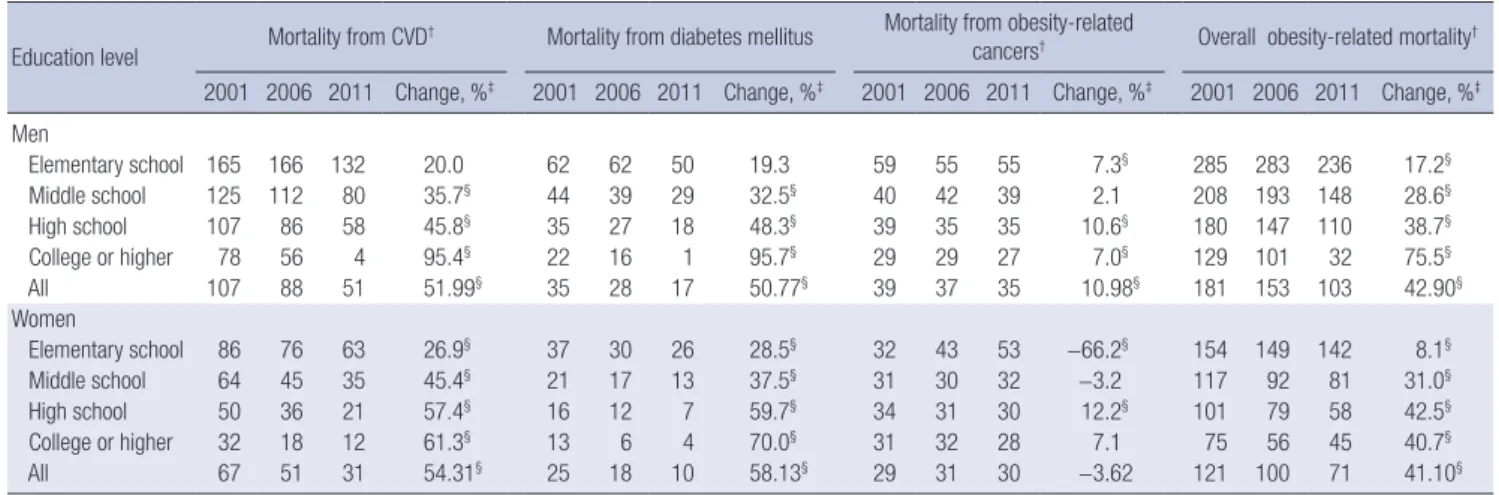
Table 1 shows the mortality rates for obesity-related diseases in
Table 1. Age-standardized obesity-related mortality per 100,000 persons* by education level in 2001, 2006, and 2011 in Koreans of 25–74 years of age Education level Mortality from CVD
† Mortality from diabetes mellitus Mortality from obesity-related
cancers† Overall obesity-related mortality† 2001 2006 2011 Change, %‡ 2001 2006 2011 Change, %‡ 2001 2006 2011 Change, %‡ 2001 2006 2011 Change, %‡ Men Elementary school 165 166 132 20.0 62 62 50 19.3 59 55 55 7.3§ 285 283 236 17.2§ Middle school 125 112 80 35.7§ 44 39 29 32.5§ 40 42 39 2.1 208 193 148 28.6§ High school 107 86 58 45.8§ 35 27 18 48.3§ 39 35 35 10.6§ 180 147 110 38.7§ College or higher 78 56 4 95.4§ 22 16 1 95.7§ 29 29 27 7.0§ 129 101 32 75.5§ All 107 88 51 51.99§ 35 28 17 50.77§ 39 37 35 10.98§ 181 153 103 42.90§ Women Elementary school 86 76 63 26.9§ 37 30 26 28.5§ 32 43 53 −66.2§ 154 149 142 8.1§ Middle school 64 45 35 45.4§ 21 17 13 37.5§ 31 30 32 −3.2 117 92 81 31.0§ High school 50 36 21 57.4§ 16 12 7 59.7§ 34 31 30 12.2§ 101 79 58 42.5§ College or higher 32 18 12 61.3§ 13 6 4 70.0§ 31 32 28 7.1 75 56 45 40.7§ All 67 51 31 54.31§ 25 18 10 58.13§ 29 31 30 −3.62 121 100 71 41.10§ CVD = cardiovascular diseases.
*Direct age standardization was done, using the population in 2005 as the standard population. †CVD includes hypertensive or ischemic heart disease, heart failure, cerebro-vascular disease or stroke, atherosclerosis or peripheral cerebro-vascular disease, and aortic aneurysm; Obesity-related cancers include cancers at colon and rectum, esophagus, kid-ney, pancreas, gallbladder, and thyroid. For women, cancers at endometrium and breast were additionally included; Overall obesity-related mortality includes mortality from CVD, stroke, diabetes mellitus, and obesity-related cancers. ‡Percentage of mortality rate in 2011 compared to the mortality rate in 2001. §P value for trend < 0.05, assessed by the Spearman rank correlation test.
overall and by education level. The mortality rates for overall and specific obesity-related diseases were persistently higher in men than in women, and tended to gradually decrease between 2001 and 2011 in both sexes, except for the obesity-related can-cer mortality in women.
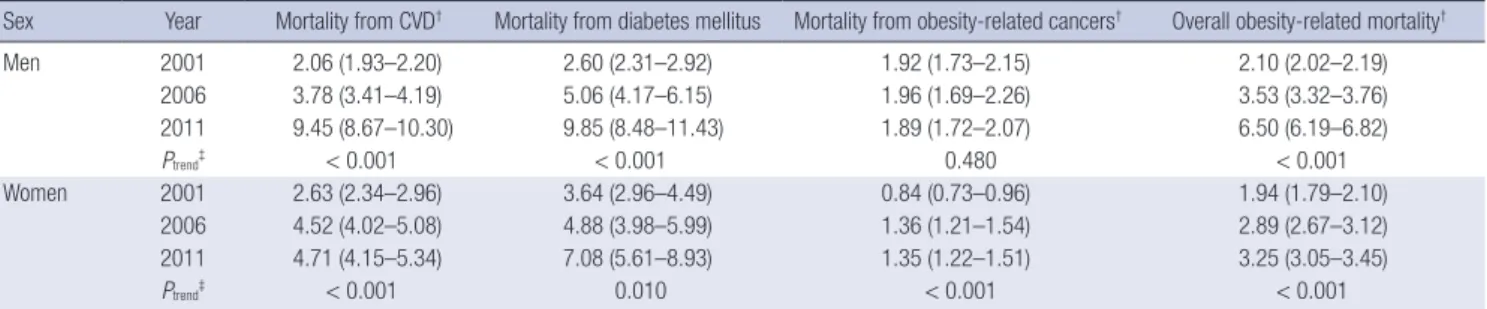
The mortality rates for obesity-related diseases were higher in people with lower education level in all 3 years, except for obesity-related cancer mortality in women. Mortality rates for CVD and diabetes have gradually decreased between 2001 and 2011 in both sexes with all 4 education levels, except for men with the lowest education level. The mortality from obesity-re-lated cancers in men tended to decrease over time in people with most education levels except for middle school education level, whereas the mortality from obesity-related cancers in wom-en showed no consistwom-ent time trwom-end by education level. Table 2 shows the time trend in RII of obesity-related mortal-ity by education level. The RIIs for mortalmortal-ity from CVD and dia-betes in men and women were higher than 1 in 2001, which have gradually increased over time. The RII of mortality from obesity-related cancers in men was higher than 1 in 2001; how-ever, it did not change significantly over time. On the other hand, the RII of mortality from obesity-related cancers in women was lower than 1 in 2001. However, it has turned to be higher than 1 in the year 2006, which persisted until 2011.
We estimated the time trend of RII between 2001 and 2011 of obesity-related mortality by education level in each 10-year age stratum (Table 3). The RII of mortality tended to be higher in younger people than those in older people, for all specific obe-sity-related diseases, in both men and women. The time trend of gradual increase in RII over time was evidently found for CVD mortality, consistently in both men and women across all age strata. However, for mortality from obesity-related cancers in men, the time trend in RII was not observed across all age stra-ta. For mortality from diabetes, the RII has gradually increased in older people aged 45 years or more, while no time trend was found in younger people, in both men and women.
DISCUSSION
In this Korean study, we found that a significant socioeconomic inequality has existed for obesity-related mortality in both men and women, especially in younger Koreans in spite that the mor-tality from these diseases has markedly decreased over the same time period. In addition, our study revealed that the socioeco-nomic inequality in some specific obesity-related mortality (CVD and diabetes) has gradually increased over the last decade in Korea.
In our study, the RII, which reflects socioeconomic disparity, was greater than 1 for all obesity-related diseases in both sexes throughout the whole study period. Even the RII of obesity-re-lated cancer mortality in women that was once less than 1 in 2001 has increased to greater than 1.
Several studies in countries in various developmental stages have also found an inverse association between SES and mor-tality from specific obesity-related causes. For cardiovascular mortality, studies in low and middle income Asian countries (15), African country (16), and Latin America (17) have consis-tently found an inverse association with SES. An inverse associ-ation between SES and diabetes was also reported (6,18). The consistency in the findings of socioeconomic inequality in obe-sity-related mortality and morbidity between studies including our study strongly suggests that the obesity burden falls dispro-portionately on people with low SES and persons with lower SES were found to be at higher risk of death from CVD, diabe-tes, and obesity-related cancers compared to persons with high-er SES.
Obesity results from an energy imbalance where caloric in-take exceeds the energy expenditure by physical activity and metabolic processes in a body, which is influenced by complex interactions between genetic, metabolic, behavioral, cultural, and environmental factors including social networks and com-munity ties (19,20). Socioeconomic disparity in obesity and obe-sity-related diseases may stem from difference in calorie intake
Table 2. Time trend between 2001 and 2011 in RII* (95% CIs) for obesity-related mortality by education level, in Koreans 25–74 years of age
Sex Year Mortality from CVD† Mortality from diabetes mellitus Mortality from obesity-related cancers† Overall obesity-related mortality†
Men 2001 2.06 (1.93–2.20) 2.60 (2.31–2.92) 1.92 (1.73–2.15) 2.10 (2.02–2.19) 2006 3.78 (3.41–4.19) 5.06 (4.17–6.15) 1.96 (1.69–2.26) 3.53 (3.32–3.76) 2011 9.45 (8.67–10.30) 9.85 (8.48–11.43) 1.89 (1.72–2.07) 6.50 (6.19–6.82) Ptrend‡ < 0.001 < 0.001 0.480 < 0.001 Women 2001 2.63 (2.34–2.96) 3.64 (2.96–4.49) 0.84 (0.73–0.96) 1.94 (1.79–2.10) 2006 4.52 (4.02–5.08) 4.88 (3.98–5.99) 1.36 (1.21–1.54) 2.89 (2.67–3.12) 2011 4.71 (4.15–5.34) 7.08 (5.61–8.93) 1.35 (1.22–1.51) 3.25 (3.05–3.45) Ptrend‡ < 0.001 0.010 < 0.001 < 0.001
RII = relative index of inequality, CIs = confidence intervals, CVD = cardiovascular diseases.
*Rate ratio of the mortality rates of those at the lowest education level compared with those at the highest education level. A RII higher than 1 indicates that the mortality rate is higher in the group with lower education level. †CVD includes hypertensive or ischemic heart disease, heart failure, cerebrovascular disease or stroke, atherosclerosis or periph-eral vascular disease, and aortic aneurysm; Obesity-related cancers include cancers at colon and rectum, esophagus, kidney, pancreas, gallbladder, and thyroid. For women, cancers at endometrium and breast were additionally included; Obesity-related mortality includes mortality from CVD, diabetes mellitus, and obesity-related cancers. ‡Assessed by the Poisson regression test.
and physical activity across different SES (21-23).
Interestingly, the direction of socioeconomic inequality in obesity-related mortality in the present study tends to be incon-sistent with the direction of socioeconomic disparity in obesity prevalence. Although a Korean study conducted in a rural area in 2007 showed that the prevalence of obesity was higher in sub-jects with lower education level for both sexes (24), most stud-ies in Korea reported that the direction of socioeconomic dif-ferential in obesity prevalence differed by sex (25-27). A study using the data from Korean National Health and Nutrition Ex-amination Survey (KNHANES) in 2010 reported that obesity prevalence was positively associated with both education level and family income for men, whereas an inverse association was found for women (26).
Time trend in socioeconomic disparity in obesity was scarce-ly studied with inconsistent findings. A study using KNHANES data between 1998 and 2007 also found different directions of time trend in socioeconomic inequality in obesity prevalence by sex: the RII of obesity prevalence by income level was lower than 1 until 2005 for men, while it was higher than 1 in women until 2007 (27). However, in the same study, the RII of obesity prevalence by education level did not show any significant trend from 1998 to 2007 (27). Another Korean study has evaluated a time trend in socioeconomic differentials by household income in obesity prevalence level between 1998 and 2010 and found that a positive association in men and an inverse association in women between obesity prevalence and SES have persisted or deepened over time (28). Therefore, there is a discrepancy in the time trend in socioeconomic inequality between obesity prevalence and obesity-related mortality.
We have considered several probable reasons for the discrep-ancy in socioeconomic differentials between obesity prevalence and obesity-related mortality. First, inequality in the control of related health risk factors could be considered. Kim et al. (25) reported that the positive association between body mass index and education level in men has attenuated, while the inverse association between body mass index and education level in women has become more evident, after adjusting for health-re-lated behavioral factors such as smoking, alcohol use, and phys-ical exercise. This finding suggests that socioeconomic differen-tials in lifestyle factors may intensify the socioeconomic differ-entials in obesity prevalence, and thus, result in greater socio-economic differentials in obesity-related disease burden. Sec-ond, it has been suggested that quality of health care is worse in a person with lower education level (29). A study of Korean men found that the treatment rate for hypertension, 1 of the obesity-related diseases, was lower in men with lower education level compared to those with higher education level (30). Tamayo et al. (31) found that diabetic patients with higher SES are more likely to receive newer anti-hyperglycemic medication than those with lower SES in Germany. A Scottish study also reported that
Table 3.
T
ime trend between 2001 and 2011 in RII* for obesity-related mortality by education level in each 10-year of age strata,
in Koreans 25–74 years of age
Sex/Age,
yr
Mortality from CVD
†
Mortality from diabetes mellitus
†
Mortality from obesity-related cancers
†
Overall obesity-related mortality
† 2001 2006 2011 Ptrend ‡ 2001 2006 2011 Ptrend ‡ 2001 2006 2011 Ptrend ‡ 2001 2006 2011 Ptrend ‡ Men 25–34 10.10 9.87 1,416,075.68 < 0.001 138.3 40.30 4,278,016.39 0.438 8.01 8.86 6.70 0.623 12.76 11.06 325.77 < 0.001 35–44 12.23 7.36 544.20 < 0.001 83.88 28.28 3,119 0.763 6.35 3.27 2.52 0.002 14.31 7.58 49.96 0.066 45–54 4.64 10.13 65.14 < 0.001 10.89 18.09 131.70 < 0.001 3.31 3.12 3.81 0.234 5.09 8.27 25.24 < 0.001 55–64 1.69 3.11 9.91 < 0.001 2.33 6.10 12.26 < 0.001 2.01 1.86 2.07 0.483 1.88 2.98 5.47 < 0.001 65–74 1.07 2.05 4.40 < 0.001 0.90 1.77 3.76 < 0.001 1.21 1.45 1.41 0.088 1.06 1.84 2.91 < 0.001 W omen 25–34 10.03 16.81 17.96 0.373 251.67 95.26 4,758 0.243 1.35 3.79 4.64 0.033 6.05 8.97 11.75 0.108 35–44 14.33 24.54 47.11 0.003 72.50 146.61 40.86 0.633 1.55 2.88 1.83 0.505 5.16 7.27 5.08 0.924 45–54 3.87 8.79 8.49 < 0.001 7.92 23.96 53.67 < 0.001 0.92 1.48 2.03 < 0.001 2.26 3.81 3.95 < 0.001 55–64 2.35 4.59 4.15 < 0.001 2.70 6.29 9.33 < 0.001 0.66 1.24 1.10 0.005 1.64 2.86 2.25 0.002 65–74 1.59 2.79 3.32 < 0.001 2.09 2.30 3.38 0.033 0.65 0.98 1.08 0.006 1.42 2.05 2.25 < 0.001 RII =
relative index of inequality
, CVD
=
cardiovascular diseases.
*Rate ratio of the mortality rates of those at the lowest education level compared with those at the highest education level.
A RII higher than 1 indicates that the mortality rate is higher in the group with lower education level.
†Cardio
-vascular disease includes hypertensive or ischemic heart disease,
heart failure,
cerebrovascular disease or stroke,
atherosclerosis or peripheral vascular disease,
and aortic aneur
ysm; Obesity-related cancers include cancers at colon
and rectum, esophagus, kidney , pancreas, gallbladder , and thyroid. For women,
cancers at endometrium and breast were additionally included; Obesity-related mortality includes mortality from
cardiovascular disease,
diabetes mellitus,
and obesity-related cancers.
SES is associated with glycemic control, cardiovascular risk fac-tors, and complication development in diabetes (18). Third, a discrepancy due to the time lag between the development of obesity and obesity related death may exist. For example, the data on the current obesity related death may reflect the obesity problem several years or several decades ago. A study in Cuba reported the finding compatible with this issue that the decrease in diabetes and cardiovascular mortality occurred about 5 years after the population-wide weight loss (32). However, our study could not address these issues due to the lack of individual in-formation and lack of data over several decades.
In the present study, the educational inequality of obesity-re-lated mortality was larger in younger people than in older peo-ple. We think this finding may reflect larger disparity across dif-ferent educational groups in obesity prevalence, obesity-related disease, and the use of medical services, in younger people than in older people. Although we could not examine the hypothesis in the present study, several previous studies have reported sup-porting evidence. A study in Korean women found that the ed-ucational inequality in obesity prevalence was higher in young-er people than that in middle agyoung-ers (26). A similar pattyoung-ern was observed in a study in Thailand (33) and United Sates (34). In addition, the association of obesity with diseases was found to decrease with aging (35), which might be explained by disease induced loss of weight in older people and higher premature death rate in low socioeconomic group. A study evaluated the trend in socioeconomic disparities of adolescent obesity in the USA found the disparity has gradually increased between 1998 and 2011, which may be reflected in greater disparity in obesity prevalence in younger people than in older people (36). There-fore, the findings of the present study may raise concerns regard-ing the possible aggravation of socioeconomic inequality in obe-sity-related mortality in the future, although more evidence over a longer period is needed. Although more evidence over a lon-ger period is needed, the findings of the present study raise con-cerns regarding the possible aggravation of socioeconomic in-equality in obesity related mortality in the future.
Interestingly, obesity-related cancer mortality rate in women has not materially decreased over the last decade. For women with the lowest education level, the obesity-related cancer mor-tality rate has rather increased. Increased mormor-tality from breast cancer and endometrial cancer over the last decade in Korean women may explain the increase in obesity-related cancer mor-tality in women because breast cancer and endometrial cancer account for a substantial proportion of obesity related cancers (37,38). In our previous study in Korean women, we found that mortality from breast cancer has increased between 2001 and 2011, especially in the women with lower education level with a gradual increase in the RII of breast cancer (37), which is con-sistent with the findings of the present study. When we consid-ered the RII of each cancer that is known to be associated with
obesity such as cancers of the esophagus, gallbladder, colon, and pancreas (Supplementary Table 1), no specific trend was found over time. Meanwhile, the obesity-related cancer mortal-ity in men has decreased over the last decade in our study, which is consistent with the report by Statistics Korea which suggests that the overall age-adjusted cancer mortality in Korean men has decreased (39). However, the change was not so significant compared to CVD and diabetes mellitus. The RII of obesity-re-lated cancers in men was persistently greater than 1, but it did not show any significant trend for change over time. When we considered the RII for each cancer in men (Supplementary Ta-ble 1), we found that the RII of colon cancer has gradually in-creased over time. Based on this finding, introducing screening for colon polyp and colonoscopic polypectomy, which is an ac-tive prevenac-tive strategy against colon cancer (40), can be con-sidered because the high cost of screening colonoscopy can cause socioeconomic differentials in accessibility to the procedure. Our study has some limitations. First, education level used as a SES indicator in our study might not be the best SES indicator. Second, we could not directly prove that obesity in a person with lower SES can lead to higher risk of obesity-related mortality compared to a person with a similar level of obesity but higher SES. Third, we did not consider the contribution of social pat-terning of lifestyle factors and other factors that can also be as-sociated with the risk of obesity-related diseases.
In conclusion, a significant socioeconomic inequality in sity-related mortality such as CVD, diabetes mellitus, and obe-sity-related cancers exists in Korean population. Despite the decreasing trend in obesity-related mortality over the last de-cade, the socioeconomic inequality in obesity-related mortality has persisted or gradually increased over the last decade. Given the increasing obesity prevalence, an active effort to identify the cause and to eliminate the socioeconomic gap in obesity-relat-ed diseases is neobesity-relat-edobesity-relat-ed.
ACKNOWLEDGMENT
Our manuscript was proofread and edited by the professional English editors at HARRISCO.
DISCLOSURE
The authors have no potential conflicts of interest to disclose.
AUTHOR CONTRIBUTION
Conceptualization: Kim MH, Song YM. Data curation: Kim MH. Formal analysis: Kim MH, Song YM. Investigation: Kim MH, Jung-Choi K, Ko H, Song YM. Writing - original draft: Kim MH, Song YM. Writing - review & editing: Kim MH, Jung-Choi K, Ko H, Song YM.
ORCID
Mi-Hyun Kim http://orcid.org/0000-0003-1828-0955 Kyunghee Jung-Choi http://orcid.org/0000-0002-9800-0994 Hyeonyoung Ko http://orcid.org/0000-0001-6064-8931 Yun-Mi Song http://orcid.org/0000-0001-9232-5563
REFERENCES
1. McLaren L. Socioeconomic status and obesity. Epidemiol Rev 2007; 29:
29-48.
2. Song YM. Commentary: varying relation of socioeconomic status with obesity between countries at different stages of development. Int J Epide-miol 2006; 35: 112-3.
3. Dinsa GD, Goryakin Y, Fumagalli E, Suhrcke M. Obesity and socioecono-mic status in developing countries: a systematic review. Obes Rev 2012;
13: 1067-79.
4. Monteiro CA, Moura EC, Conde WL, Popkin BM. Socioeconomic status and obesity in adult populations of developing countries: a review. Bull World Health Organ 2004; 82: 940-6.
5. Maier W, Scheidt-Nave C, Holle R, Kroll LE, Lampert T, Du Y, Heidemann C, Mielck A. Area level deprivation is an independent determinant of prev-alent type 2 diabetes and obesity at the national level in Germany. Results from the National Telephone Health Interview Surveys ‘German Health Update’ GEDA 2009 and 2010. PLoS One 2014; 9: e89661.
6. Saydah S, Lochner K. Socioeconomic status and risk of diabetes-related mortality in the U.S. Public Health Rep 2010; 125: 377-88.
7. Song YM, Ferrer RL, Cho SI, Sung J, Ebrahim S, Davey Smith G. Socioeco-nomic status and cardiovascular disease among men: the Korean nation-al henation-alth service prospective cohort study. Am J Public Health 2006; 96:
152-9.
8. Oh SW. Obesity and metabolic syndrome in Korea. Diabetes Metab J 2011;
35: 561-6.
9. United Nations Development Programme. Power, voice and rights: a turn-ing point for gender equality in Asia and the Pacific [Internet]. Available at http://hdr.undp.org/sites/default/files/rhdr-2010-asiapacific.pdf [ac-cessed on 15 July 2013].
10. Sagar AD, Najam A. The human development index: a critical review. Ecol Econ 1998; 25: 249-64.
11. Flegal KM, Graubard BI, Williamson DF, Gail MH. Cause-specific excess deaths associated with underweight, overweight, and obesity. JAMA 2007;
298: 2028-37.
12. National Cancer Institute (US). Obesity and cancer risk [Internet]. Avail-able at http://www.cancer.gov/cancertopics/factsheet/Risk/obesity [ac-cessed on 15 July 2013].
13. Song DK, Sung YA. Obesity: introduction. Korean J Med 2013; 84: 619-23.
14. Hayes LJ, Berry G. Sampling variability of the Kunst-Mackenbach relative index of inequality. J Epidemiol Community Health 2002; 56: 762-5.
15. Vathesatogkit P, Batty GD, Woodward M. Socioeconomic disadvantage and disease-specific mortality in Asia: systematic review with meta-anal-ysis of population-based cohort studies. J Epidemiol Community Health
2014; 68: 375-83.
16. Stringhini S, Rousson V, Viswanathan B, Gedeon J, Paccaud F, Bovet P. As-sociation of socioeconomic status with overall and cause specific
mortal-ity in the Republic of Seychelles: results from a cohort study in the Afri-can region. PLoS One 2014; 9: e102858.
17. Arroyave I, Burdorf A, Cardona D, Avendano M. Socioeconomic inequali-ties in premature mortality in Colombia, 1998-2007: the double burden of non-communicable diseases and injuries. Prev Med 2014; 64: 41-7.
18. Collier A, Ghosh S, Hair M, Waugh N. Impact of socioeconomic status and gender on glycaemic control, cardiovascular risk factors and diabe-tes complications in type 1 and 2 diabediabe-tes: a population based analysis from a Scottish region. Diabetes Metab 2015; 41: 145-51.
19. Mulvaney-Day N, Womack CA. Obesity, identity and community: lever-aging social networks for behavior change in public health. Public Health Ethics 2009; 2: 250-60.
20. Kaufman L, Karpati A. Understanding the sociocultural roots of childhood obesity: food practices among Latino families of Bushwick, Brooklyn. Soc Sci Med 2007; 64: 2177-88.
21. Gordon-Larsen P, Nelson MC, Page P, Popkin BM. Inequality in the built environment underlies key health disparities in physical activity and obe-sity. Pediatrics 2006; 117: 417-24.
22. Giles-Corti B, Donovan RJ. Relative influences of individual, social envi-ronmental, and physical environmental correlates of walking. Am J Pub-lic Health 2003; 93: 1583-9.
23. Kant AK, Graubard BI. Family income and education were related with 30-year time trends in dietary and meal behaviors of American children and adolescents. J Nutr 2013; 143: 690-700.
24. Kim MY, Oh JK, Lim MK, Yun EH, Kang YH. The Association of socioeco-nomic and psychosocial factors with obesity in a rural Community. Ko-rean J Obes 2012; 21: 18-28.
25. Kim J, Sharma SV, Park SK. Association between socioeconomic status and obesity in adults: evidence from the 2001 to 2009 Korea National Health and Nutrition Examination Survey. J Prev Med Public Health 2014; 47:
94-103.
26. Paek E, Kim J. The relationship between educational attainment and obe-sity among Korean adults : focusing on age variations. J Korean Soc Health Educ Promot 2013; 30: 91-100.
27. Yoo S, Cho HJ, Khang YH. General and abdominal obesity in South Ko-rea, 1998-2007: gender and socioeconomic differences. Prev Med 2010;
51: 460-5.
28. Kim YM, Jung-Choi K. Socioeconomic inequalities in health risk factors in Korea. J Korean Med Assoc 2013; 56: 175-83.
29. Cho HJ. Equity in health care: current situation in South Korea. J Korean Med Assoc 2013; 56: 184-94.
30. Cha SH, Park HS, Cho HJ. Socioeconomic disparities in prevalence, treat-ment, and control of hypertension in middle-aged Koreans. J Epidemiol
2012; 22: 425-32.
31. Tamayo T, Claessen H, Rückert IM, Maier W, Schunk M, Meisinger C, Mielck A, Holle R, Thorand B, Narres M, et al. Treatment pattern of type 2 diabe-tes differs in two German regions and with patients’ socioeconomic posi-tion. PLoS One 2014; 9: e99773.
32. Franco M, Bilal U, Orduñez P, Benet M, Morejón A, Caballero B, Kennelly JF, Cooper RS. Population-wide weight loss and regain in relation to dia-betes burden and cardiovascular mortality in Cuba 1980-2010: repeated cross sectional surveys and ecological comparison of secular trends. BMJ
2013; 346: f1515.
33. Seubsman SA, Lim LL, Banwell C, Sripaiboonkit N, Kelly M, Bain C, Sleigh AC. Socioeconomic status, sex, and obesity in a large national cohort of
15-87-year-old open university students in Thailand. J Epidemiol 2010;
20: 13-20.
34. Zhang Q, Wang Y. Socioeconomic inequality of obesity in the United States: do gender, age, and ethnicity matter? Soc Sci Med 2004; 58: 1171-80.
35. Canning KL, Brown RE, Jamnik VK, Kuk JL. Relationship between obesity and obesity-related morbidities weakens with aging. J Gerontol A Biol Sci Med Sci 2014; 69: 87-92.
36. Frederick CB, Snellman K, Putnam RD. Increasing socioeconomic dis-parities in adolescent obesity. Proc Natl Acad Sci U S A 2014; 111:
1338-42.
37. Kim MH, Jung-Choi K, Kim H, Song YM. Educational inequality in female cancer mortality in Korea. J Korean Med Sci 2015; 30: 1-6.
38. e-National Index (KR). Mortality rate by cause of death [Internet]. Avail-able at http://www.index.go.kr/potal/main/EachDtlPageDetail.do?idx_ cd=1012#quick_02 [accessed on 2 October 2014].
39. Korean Statistical Information Service. Si,gun,gu/death causes (50 items)/ sex/death number, mortality rate, age standardized mortality rate (2005~) [Internet]. Available at http://kosis.kr/statHtml/statHtml.do?orgId=101&t blId=DT_1B34E13&vw_cd=MT_OTITLE&list_id=MT_CTITLE_1&scrId =&seqNo=&lang_mode=ko&obj_var_id=&itm_id=&conn_path=E1# [ac-cessed on 2 July 2015].
40. Skibba RM, Gourley WK, Klotz AP. Early detection and prevention of co-lon cancer. The role of coco-lonscopy. Arch Intern Med 1976; 136: 890-2.
Supplementary Table 1. Time trend of RII* (95% CIs) for mortality from each obesity related cancer by education level in Koreans 25–74 years of age
Sex Year Esophageal cancer Gallbladder cancer Colon cancer Pancreas cancer Breast cancer Endometrial cancer Men 2001 4.39 (3.44–5.61) 2.26 (1.48–3.44) 1.21 (1.02–1.43) 2.01 (1.63–2.46) - -2006 4.99 (3.32–7.49) 3.64 (2.00–6.61) 1.23 (1.00–1.50) 2.36 (1.76–3.15) - -2011 4.47 (3.49–5.74) 2.39 (1.67–3.43) 1.66 (1.44–1.90) 1.41 (1.19–1.68) - -Ptrend† 0.980 0.732 < 0.001 0.028 - -Women 2001 5.22 (1.31–20.82) 1.45 (0.91–2.32) 0.90 (0.70–1.16) 1.07 (0.77–1.49) 1.00 (0.76–1.31) 0.62 (0.40–0.97) 2006 3.24 (0.88–11.99) 2.55 (1.66–3.92) 1.68 (1.35–2.08) 1.65 (1.23–2.20) 0.74 (0.62–0.89) 0.60 (0.44–0.82) 2011 2.57 (0.88–7.46) 2.50 (1.68–3.70) 1.51 (1.24–1.84) 1.43 (1.12–1.83) 0.66 (0.58–0.76) 0.70 (0.51–0.95) Ptrend† 0.501 0.140 0.006 0.272 < 0.001 0.925
RII = relative index of inequality, CIs = confidence intervals.
*Rate ratio of the mortality rates of those at the lowest education level compared with those at the highest education level. A RII higher than 1 indicates that the mortality rate is higher in the group with lower education level. †Assessed by the Poisson regression test.