저작자표시-비영리-변경금지 2.0 대한민국 이용자는 아래의 조건을 따르는 경우에 한하여 자유롭게 l 이 저작물을 복제, 배포, 전송, 전시, 공연 및 방송할 수 있습니다. 다음과 같은 조건을 따라야 합니다: l 귀하는, 이 저작물의 재이용이나 배포의 경우, 이 저작물에 적용된 이용허락조건 을 명확하게 나타내어야 합니다. l 저작권자로부터 별도의 허가를 받으면 이러한 조건들은 적용되지 않습니다. 저작권법에 따른 이용자의 권리는 위의 내용에 의하여 영향을 받지 않습니다. 이것은 이용허락규약(Legal Code)을 이해하기 쉽게 요약한 것입니다. Disclaimer 저작자표시. 귀하는 원저작자를 표시하여야 합니다. 비영리. 귀하는 이 저작물을 영리 목적으로 이용할 수 없습니다. 변경금지. 귀하는 이 저작물을 개작, 변형 또는 가공할 수 없습니다.
의학 석사학위 논문
Analgesic effect of a lidocaine patch for
shoulder pain in patients undergoing
laparoscopic cholecystectomy:
a randomized controlled study
아 주 대 학 교 대 학 원
의 학 과
Analgesic effect of a lidocaine patch for
shoulder pain in patients undergoing
laparoscopic cholecystectomy:
a randomized controlled study
지도교수 김 지 은
이 논문을 의학 석사학위 논문으로 제출함.
2019년 8월
아 주 대 학 교 대 학 원
의 학 과
장 민 영
장민영의 의학 석사학위 논문을 인준함.
심사위원장
김 지 은
인
심 사 위 원
김 진 수
인
심 사 위 원
김 종 엽
인
아 주 대 학 교 대 학 원
2019년 7월 5일
Abstract
Background Laparoscopic cholecystectomy has many advantages compared
with open surgery. However, the incidence of laparoscopy-related shoulder pain reaches 90% in women. The topical lidocaine patch 5% has been used for treatment of acute pain. The purpose of this study was to evaluate the effect of lidocaine patch 5% on the shoulder pain after laparoscopic cholecystectomy in female patients.
M ethods In this randomized, double-blinded controlled study, total 63
female patients were randomly allocated to patch group (n = 31) and control group (n = 32). Patch group received lidocaine patch 5% and dressing retention tape on both shoulder, and control group received only dressing retention tape. Abdominal pain and shoulder pain were evaluated with rating on numeric rating scale (0 = no pain and 10 = the worst pain) at baseline and at 30 min, 6 h, 24 h, and 48 h after surgery.
Results There were no significant differences in patient characteristics and
operation details between the two groups. The overall incidence of shoulder pain was significantly lower in patch group than in control group (42% vs. 78%, P = 0.005). The severity of shoulder pain also was significantly reduced in patch group at 24 h and 48 h after surgery (P = 0.01 and P = 0.015 at 24 h and 48 h, respectively). The number of patients showing more
severe shoulder pain than abdominal pain was higher in the control group (P = 0.041), and the number of patients showing less shoulder pain compared to baseline was higher in the patch group (P = 0.024). No other complications related to lidocaine patch 5% were found except nausea.
Conclusions Lidocaine patch 5% reduced the incidence and severity of
postoperative shoulder pain in patients undergoing laparoscopic cholecystectomy. Application of lidocaine patch 5% on the shoulder can be a simple, non-invasive, and effective analgesic method without adverse effects. Keywords Cholecystectomy, Laparoscopy, Lidocaine patch, Shoulder pain
목 차
Abstract...i
I. Introduction...1
II. Materials and Methods...3
III. Interventions...4
IV. Data collection...6
V. Statistical analysis...8
VI. Results...9
VII. Discussion...16
References...21
그 림 목 차
Fig. 1 Flow diagram...9 Fig. 2 Changes of (A) heart rate and (B) mean blood pressure during surgery...11 Fig. 3 Changes of (A) abdominal pain, and (B) overall, (C) right, and (D) left shoulder pain during the first 48 h after surgery...13 Fig. 4 Comparison between right and left shoulder pain in (A) control group and (B) patch group...14
표 목 차
Table 1. Patients characteristics and operation details...10 Table 2. Incidence of shoulder pain...12 Table 3. Recovery profiles...15
I. Introduction
Laparoscopic cholecystectomy (LC) has become a standard treatment for gall bladder disease because of advantages such as smaller incision, shorter hospital stays and faster recovery compared with open cholecystectomy [1].
Although LC is considered as a less painful procedure, patients may experience shoulder pain after undergoing LC. Shoulder pain after surgery occurs rarely in open surgery, but its incidence rises to 30%–60% in general laparoscopic surgery, reaching 90% in women [2-4]. Some patients
unexpectedly may experience severe pain in laparoscopic surgery than in aggressive, major surgeries [4, 5]. However, laparoscopy-related shoulder pain
is poorly responsive to analgesics [4]. Therefore, the efforts to prevent the
laparoscopy-related shoulder pain are essential.
Although the mechanism has not been fully clarified, laparoscopy-related shoulder pain is generally considered to develop due to diaphragmatic irritations from direct injury, stretching, or CO2gas[2, 3, 6]. Clinically,
diaphragmatic irritation manifests as referred pain in the shoulder arising from the phrenic nerve [4, 7]. Interventions to reduce shoulder pain after LC
aim to minimize diaphragmatic irritation through low-pressure pneumoperitoneum [8, 9], intraperitoneal instillation of analgesics [10], drain
suction [11], active gas aspiration [12] or phrenic nerve block [13]. However,
also been shown to be effective in reducing referred pain in the tibialis muscle [14]; further, trigger point injection or a eutectic mixture of local
anesthetics (EMLA) cream applied to the shoulders, and not the diaphragm, significantly reduced shoulder pain after laparoscopic hysterectomy [15].
Lidocaine patch 5% is a topical analgesic that interrupts pain signals in peripheral nociceptors with minimal systemic absorption and few adverse effects [16]. In a randomized controlled study of myofascial pain syndrome,
lidocaine patch 5% decreased the symptoms of pain and the sensation of the skin as effectively as trigger point injection [17]. We hypothesized that
application of lidocaine patch 5% to the shoulder could also reduce the severity of shoulder pain after LC.
The purpose of this study was to evaluate the analgesic effect of lidocaine patch 5% on shoulder pain after LC in female patients.
II. Materials and Methods
This randomized, double-blinded, prospective, parallel-group controlled study was conducted with patients undergoing elective LC at the Ajou University Health System between February 2017 and September 2017. The present study was approved by the Ajou Hospital Institutional Review Board (AJIRB-MED-CT4-16-076) and registered at ClinicalTrial.gov (NCT02827136). Written informed consent was obtained from all participants. Female patients with American Society of Anesthesiologists (ASA) physical status I or II, aged 19–85 years, were included. Patients were excluded if they met at least one of the following criteria: histories of trauma, infection or surgery involving the shoulders, hypersensitivity to local anesthetics, chronic pain, chronic abuse of opioids, impaired liver or renal function, or refusal to participate in this study.
III. Interventions
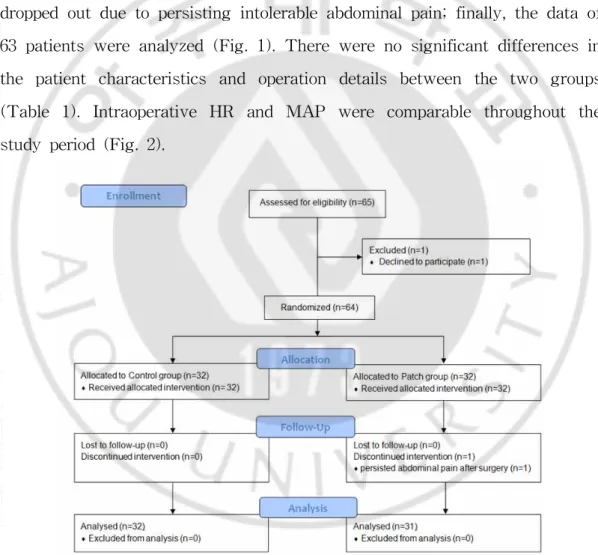
Participants (n = 64) were randomly assigned in a 1:1 ratio into one of two groups by computer-generated randomization (http://www.random.org): the patch group (n = 32) and the control group (n = 32). Group assignment was concealed in a sealed, opaque envelope. Immediately before anesthesia induction, the envelope was opened by an independent investigator who performed all interventions but was not involved in outcome assessment. The anesthesia provider, patients, and preoperative and postoperative outcome assessors were blinded to the type of intervention (group assignment) throughout the study period.
None of the patients received premedication. On arrival to the operating room, basic monitoring including pulse oximetry, electrocardiography, and non-invasive blood pressure measurement was performed. Before anesthesia induction, lidocaine patches (10 ´ 14 cm; Lidotop, Teikoku Seiyaku Co., Kagawa, Japan) were applied to both shoulders of patients in the patch group; then, the lidocaine patches were covered with dressing retention tape (12 ´ 15 cm; Hypafix®,BSN Medical GmbH, Hamburg, Germany). In the
control group, only dressing retention tape(12´ 15 cm; Hypafix®)was applied,
also to both shoulders. Anesthesia was induced with intravenous(IV) propofol 2 mg/kg and remifentanil 0.3 mg/kg, followed by rocuronium 0.8 mg/kg. After endotracheal intubation, mechanical ventilation was initiated
with a tidal volume of 8 mL/kg and an inspired oxygen fraction of 0.5. The inspiratory rate was adjusted to maintain an end-tidal CO2of35–40mm Hg.
Anesthesia was maintained with continuous infusion of remifentanil at a rate of 0.05–0.10 mcg/kg/min and sevoflurane 2%–2.5% within a range of bispectral index score 40–60.
In case of mean arterial pressure (MAP) <60 mmHg or heart rate (HR) <40 beats/min, IV ephedrine 4 mg or atropine 0.5 mg was administered, respectively. Approximately 10 min prior to the end of surgery, IV propacetamol 1g was administered for postoperative analgesia. At the end of surgery, sevoflurane was stopped, and the fresh gas flow was changed to 5 L/min. After confirming the train-of-four count >2 using a nerve stimulator, IV neostigmine 50 mg/kg and glycopyrrolate 10 mg/kg were administered to reverse neuromuscular blockade. After confirming adequate tidal volume, patients were extubated with maintaining the remifentanil infusion of 0.05 mcg/kg/min to prevent the emergence cough. Then, the patients were transferred to a post-anesthesia care unit (PACU).
IV. Data collection
The primary end point of this study was the severity of shoulder pain after surgery. Preoperative variables included age, height, weight, ASA physical status, and diagnosis. Intraoperative variables included anesthesia time, operation time, and amounts of crystalloid and bleeding. Hemodynamic data such as HR and MAP were collected at five time points: at baseline, at pneumoperitoneum, at 20 min and 30 min after pneumoperitoneum, and at the end of surgery. Pain included the abdominal pain, and overall, right, and left shoulder pains. The incidence of shoulder pain was evaluated based on the overall value of shoulder pain and defined as the number of patients who had a pain score that was higher than the value at baseline. “>abdominal pain” was defined as the number of patients who had worse shoulder pain compared with abdominal pain during the 48 h following surgery. “Alleviated pain” was defined as the number of patients who had less shoulder pain compared to value at baseline. The severity of pain was evaluated on a numeric rating scale (NRS) ranging from 0 to 10 (0 = no pain and 10 = the worst pain) at five time points: at baseline, and at 30 min, 6 h, 24 h, and 48 h after surgery. Nausea was classified into four grades (1 = none, 2 = mild, 3 = moderate, and 4 = severe). On arrival to the PACU, IV fentanyl 1 mg/kg was injected as a rescue analgesic in patients reporting an NRS score ≥5. IV ramosetron 0.3 mg was
administered to with vomiting or nausea grade ≥3 or 4. At the ward, IV nefopam 20 mg was administered to patients reporting an NRS score ≥5. The lidocaine patches and/or dressing retention tape were removed by the ward’s attending nurse within 12 h following surgery. Complications related to lidocaine patch 5% (skin erythema, pruritus, blisters, contact hypersensitivity, nausea, headache, and arrythmia) were evaluated by the ward’s attending nurse at ward until discharge from the hospital.
V. Statistical analysis
Sample size was calculated based on the severity of shoulder pain after surgery. In a previous study, the pain score of shoulder pain after LC was 4.43 ± 1.4 [8]. Considering that a mean difference of 1.2 in pain score was
significant [18], 29 participants were required in each group for a significance
level of 5% and a power of 90%. Considering a 10% dropout rate, a total of 64 patients (32 per group) were included.
Data are presented as mean ± standard deviation (or standard error), median (interquartile range), or number of patients (proportion). Normality of distribution was assessed with the Kolmogorov–Smirnov test. Parametric and nonparametric data were analyzed using Student’s t-test and the Mann –Whitney test, respectively. Categorical data were compared using the chi-square test or Fisher’s exact test. Repeated measured data were analyzed by the linear mixed model. When the interaction was statistically significant, the P value was adjusted with Bonferroni correction. A P < 0.05 was considered statistically significant. Statistical analysis was conducted with SPSS for Windows (version 25.0, SPSS Inc., Chicago, IL, USA).
VI. Results
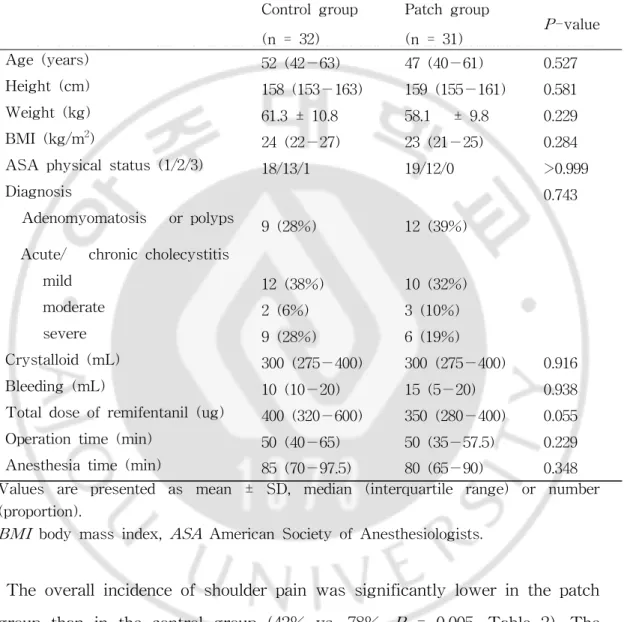
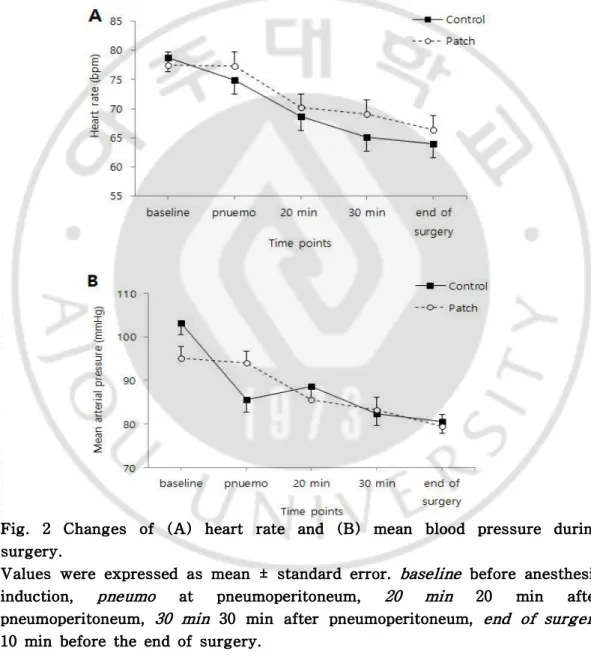
Of the 64 patients included in this study, one patient in the patch group dropped out due to persisting intolerable abdominal pain; finally, the data of 63 patients were analyzed (Fig. 1). There were no significant differences in the patient characteristics and operation details between the two groups (Table 1). Intraoperative HR and MAP were comparable throughout the study period (Fig. 2).
Table 1. Patients characteristics and operation details.
Values are presented as mean ± SD, median (interquartile range) or number (proportion).
BMI body mass index, ASA American Society of Anesthesiologists.
The overall incidence of shoulder pain was significantly lower in the patch group than in the control group (42% vs. 78%, P = 0.005, Table 2). The incidence of shoulder pain at each time point except the baseline was also lower in the patch group. The number of patients showing more severe
Control group (n = 32) Patch group (n = 31) P-value Age (years) 52 (42−63) 47 (40−61) 0.527 Height (cm) 158 (153−163) 159 (155−161) 0.581 Weight (kg) 61.3 ± 10.8 58.1 ± 9.8 0.229 BMI (kg/m2) 24 (22−27) 23 (21−25) 0.284 ASA physical status (1/2/3) 18/13/1 19/12/0 >0.999
Diagnosis 0.743
Adenomyomatosis or polyps 9 (28%) 12 (39%) Acute/ chronic cholecystitis
mild 12 (38%) 10 (32%)
moderate 2 (6%) 3 (10%)
severe 9 (28%) 6 (19%)
Crystalloid (mL) 300 (275−400) 300 (275−400) 0.916
Bleeding (mL) 10 (10−20) 15 (5−20) 0.938
Total dose of remifentanil (ug) 400 (320−600) 350 (280−400) 0.055 Operation time (min) 50 (40−65) 50 (35−57.5) 0.229 Anesthesia time (min) 85 (70−97.5) 80 (65−90) 0.348
shoulder pain than abdominal pain was higher in the control group (P = 0.041), and the number of patients showing less shoulder pain compared to baseline was higher in the patch group (P = 0.024).
Fig. 2 Changes of (A) heart rate and (B) mean blood pressure during surgery.
Values were expressed as mean ± standard error. baseline before anesthesia induction, pneumo at pneumoperitoneum, 20 min 20 min after pneumoperitoneum, 30 min 30 min after pneumoperitoneum, end of surgery
Table 2. Incidence of shoulder pain
Values are presented as median (interquartile range) or number (proportion).
a Incidence was defined as the number of patients having higher shoulder pain compared with baseline.
b The number of patients having worse shoulder pain compared with abdominal pain
c The number of patients having less shoulder pain compared with baseline
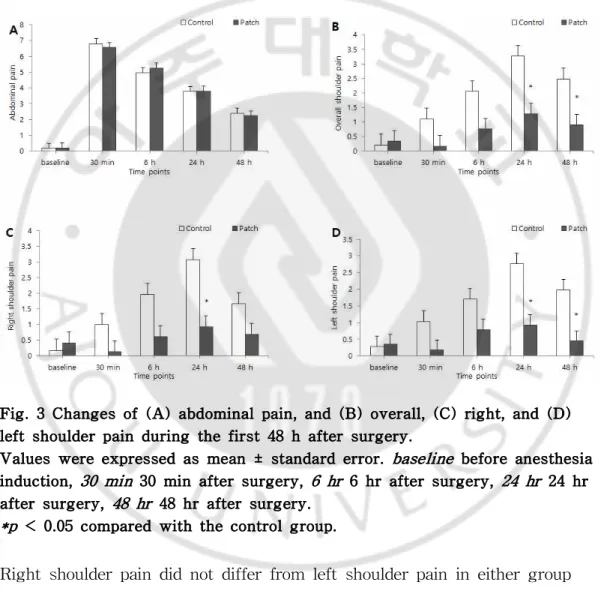
Abdominal pain showed a peak of severity at 30 min after surgery and gradually decreased thereafter in both groups (Pgroup*time = 0.868; Fig. 3A). Overall shoulder pain showed a peak of severity at 24 h after surgery in both groups (Fig. 3B). In addition, overall shoulder pain tended to be significantly different between the two groups over time (Ptime <0.001) and
was significantly lower in the patch group than in the control group at 24 h and 48 h after surgery [mean value (SE); 1.3 (0.4) vs 3.3 (0.4), Padjusted = 0.01 and 0.9 (0.4) vs 2.5 (0.4), Padjusted = 0.015 at 24 h and 48 h, respectively]. Right shoulder pain was lower in the patch group at 24 h
Control group (n = 32) Patch group (n = 31) P-value Incidencea Overall 25 (78%) 13 (42%) 0.005 baseline 4 (13%) 7 (23%) 0.337
30 min after surgery 6 (19%) 0 0.024
6 h after surgery 15 (47%) 6 (19%) 0.032
24 h after surgery 22 (69%) 11 (35%) 0.012
48 h after surgery 20 (63%) 8 (26%) 0.005
>abdominal painb 12 (37%) 4 (13%) 0.041
after surgery (Padjusted = 0.01; Fig. 3C), and left shoulder pain was lower in the patch group at 24 h and 48 h after surgery (Padjusted = 0.005 for both; Fig. 3D) compared with control group.
Fig. 3 Changes of (A) abdominal pain, and (B) overall, (C) right, and (D) left shoulder pain during the first 48 h after surgery.
Values were expressed as mean ± standard error. baseline before anesthesia induction, 30 min 30 min after surgery, 6 hr 6 hr after surgery, 24 hr 24 hr after surgery, 48 hr 48 hr after surgery.
*p < 0.05 compared with the control group.
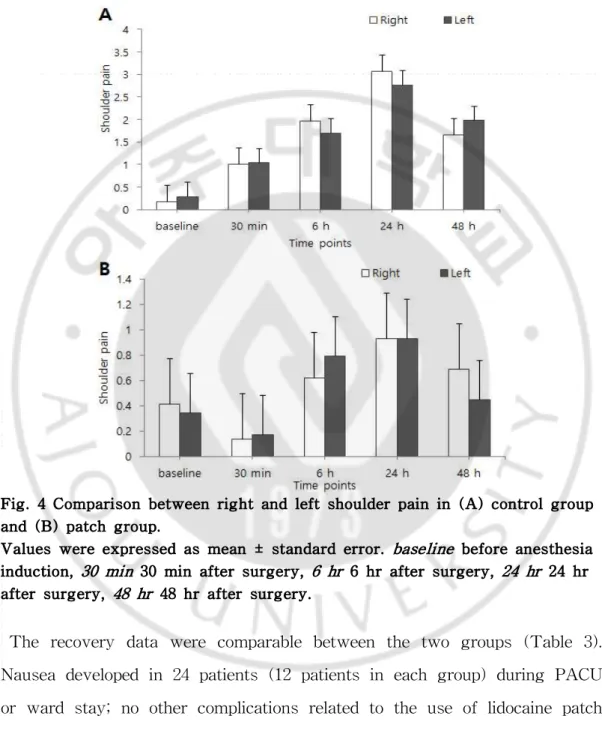
Right shoulder pain did not differ from left shoulder pain in either group (Pgroup*time = 0.613 and Pgroup*time = 0.449 in the control group and patch group, respectively; Fig. 4).
Fig. 4 Comparison between right and left shoulder pain in (A) control group and (B) patch group.
Values were expressed as mean ± standard error. baseline before anesthesia induction, 30 min 30 min after surgery, 6 hr 6 hr after surgery, 24 hr 24 hr after surgery, 48 hr 48 hr after surgery.
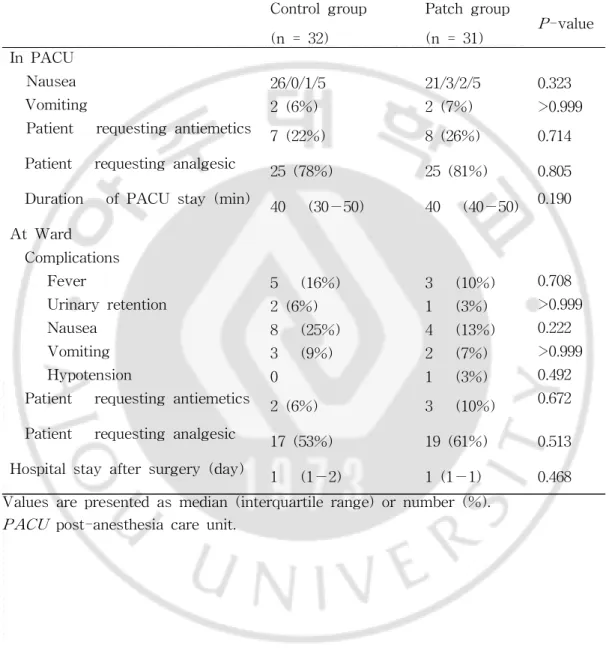
The recovery data were comparable between the two groups (Table 3). Nausea developed in 24 patients (12 patients in each group) during PACU or ward stay; no other complications related to the use of lidocaine patch 5% or dressing retention tape were found.
Table 3. Recovery profiles.
Values are presented as median (interquartile range) or number (%).
PACU post-anesthesia care unit.
Control group (n = 32) Patch group (n = 31) P-value In PACU Nausea 26/0/1/5 21/3/2/5 0.323 Vomiting 2 (6%) 2 (7%) >0.999
Patient requesting antiemetics 7 (22%) 8 (26%) 0.714 Patient requesting analgesic 25 (78%) 25 (81%) 0.805 Duration of PACU stay (min) 40 (30−50) 40 (40−50) 0.190 At Ward Complications Fever 5 (16%) 3 (10%) 0.708 Urinary retention 2 (6%) 1 (3%) >0.999 Nausea 8 (25%) 4 (13%) 0.222 Vomiting 3 (9%) 2 (7%) >0.999 Hypotension 0 1 (3%) 0.492
Patient requesting antiemetics 2 (6%) 3 (10%) 0.672 Patient requesting analgesic 17 (53%) 19 (61%) 0.513 Hospital stay after surgery (day) 1 (1−2) 1 (1−1) 0.468
VII. Discussion
This study demonstrated the beneficial analgesic effect of lidocaine patch 5% on decreasing shoulder pain after LC in female patients. The incidence of shoulder pain in the patch group was significantly reduced up to approximately 50% of that in the control group. The severity of shoulder pain also was significantly reduced in the patch group at 24 h and 48 h after surgery. The number of patients showing more severe shoulder pain than abdominal pain was higher in the control group, and the number of patients having less shoulder pain compared to baseline was higher in the patch group.
Although still unclear, the most probable mechanism for laparoscopy-related shoulder pain is neuropraxia of the phrenic nerve due to diaphragmatic or peritoneal irritation [2, 3, 6, 19]. The phrenic nerve originates
from the anterior branch of cervical spinal nerve roots C3–C5 and provides sensory innervation to the mediastinal pleura, pericardium, and peritoneal surfaces of the diaphragm [7, 13]. The main nerve C4 also provides cutaneous
innervation to the shoulder. Regarding the misinterpretation of the origin of input from the referred pain area [20, 21], diaphragmatic irritation during
laparoscopy can provoke referred shoulder pain. Based on this “misinterpretation theory,” numerous strategies have been developed to reduce laparoscopy-related shoulder pain by minimizing diaphragmatic
irritation. These interventions are sometimes effective, but the results are conflicting and there is no consensus on preventive measures.
There raised a “barrier-dam theory”, in which referred pain develops in consequence of the hyperexcitation of the connective nerves between the referred area and the initial area, thus being primarily peripheral in origin
[22]. In several studies, referred pain was reported to be partly dependent on
spontaneous input from the cutaneous receptors via peripheral control, although being conflicting results [20, 21]. When a EMLA cream was applied
over the referred skin area, referred pain intensity decreased by 22.7% [23].
Complete block of all afferent nerves from the referred area reduced the intensity of referred pain by 40%; however, referred pain persisted [14].
When trigger point injection or an EMLA cream were administered before surgery, these effectively reduced the incidence and severity of shoulder pain after laparoscopic hysterectomy [15]. In contrast, local anesthesia of the
referred area did not affect referred pain in some studies, e.g. [24], which
could be explained by differences in the quality and intensity of the stimulus or the sensitivity of the referred pain area [14]. In the present
study, lidocaine patch 5% was applied on the referred pain area (the shoulder) and the incidence and severity of shoulder pain after LC was reduced significantly.
Lidocaine patch 5% is a skin patch approved for the treatment of post-herpetic neuralgia. It is also used for localized and painful conditions such as vascular access, pain caused by trauma fracture, wound pain after
surgery, and arthritis [18, 25]. Each patch contains 700 mg of lidocaine in
aqueous base, but only 2%–3% of the dose is absorbed; the peak plasma level is 0.13 mg/mL (toxic level, 5 mg/mL), thus showing minimal adverse effects [26]. In a previous study, application of an EMLA cream on the
shoulders reduced laparoscopy-related shoulder pain to an NRS score of <1
[15], which was more effective than the lidocaine patch 5% used in present
study (mean NRS scores of 1.3 and 0.9 at 24 h and 48 h after surgery, respectively). One of differences between the EMLA cream and the lidocaine patch is that EMLA produces local anesthesia by blocking large sensory fibers [16] and the lidocaine patch exerts an analgesic effect by blocking the
small sensory fibers without causing local anesthesia, although a mechanism is less understood. Thus, the skin under the lidocaine patch has a normal sensation [16]. Despite the low analgesia potency, the lidocaine patch might
be better for surgical patients than the EMLA cream due to the lack of numbness and occlusive dressing.
In the present study, the peak shoulder pain score was 1.3 at 24 h after surgery in the patch group. This was lower than the scores ranging from 1.9–4.2 in studies focusing on lessening diaphragmatic irritation during LC
[8, 9, 13]. This is a surprising finding since the present study only included
female patients, and women have a lower pain threshold than men [27]. It is
interesting that shoulder intervention showed more effective analgesia than diaphragmatic intervention during LC, as referred pain is mainly associated with central components (initial area) and not with peripheral components
(referred area).
In the present study, shoulder pain after LC was reduced until 48 h after surgery despite the application of the lidocaine patch during the first 12 h. Lidocaine patch 5% has a half-life of 6–8 h [16]. In patients with myofascial
pain syndrome, the effect of lidocaine patch 5% applied to three focal sites throughout the body for 4 days was superior to that of a placebo patch until day 9 after the beginning of treatment [17]. Similarly, in an area limited
to the upper trapezius, a lidocaine patch applied for 7 days also relieved pain more effectively than a placebo patch for a period of 2 weeks [28].
There are two possible explanations for the long analgesic period of the lidocaine patch. First, after long-term application, lidocaine patch 5% decreases epidermal nerve fiber density without affecting pressure pain and threshold for heat- and cold-induced pain in the skin of healthy volunteers
[29]. Second, central sensitization might play a role in persistent complaints
in patients with shoulder pain [30]; however, this has been hitherto poorly
investigated. In the present study, the antinociceptive effect of lidocaine patch 5% that was initiated before the pneumoperitoneum might inhibit the central sensitization of the shoulder to some degree.
Right and left shoulder pain did not differ in the patch and control groups. Shoulder pain after LC is more frequent in the right side [2]. During
laparoscopic hysterectomy, right shoulder pain is more severe than left shoulder pain [31]. In contrast, Schoeffler et al. reported that more severe
right side of the diaphragm through the liver [32]. Further research is
required to evaluate which side is more affected.
This study has several limitations. First, shoulder pain scores were not evaluated by dividing separately during rest and movement. Second, when patients requested rescue analgesics, the main site of complaint was not evaluated. Third, longer follow-up time of patients would be needed, because post-laparoscopic pneumoperitoneum was detected on upright chest radiographs in patients undergoing LC within the first week after surgery
[33].
In conclusion, lidocaine patches 5% reduced the incidence and severity of postoperative shoulder pain in patients undergoing LC. Application of lidocaine patch 5% on the shoulder can be a simple, non-invasive, and effective analgesic method without adverse effects.
References
1. Keus F, Gooszen HG, van Laarhoven CJ (2010) Open, small-incision, or laparoscopic cholecystectomy for patients with symptomatic cholecystolithiasis. An overview of Cochrane Hepato-Biliary Group reviews. Cochrane Database Syst Rev:Cd008318
2. Bisgaard T, Kehlet H, Rosenberg J (2001) Pain and convalescence after laparoscopic cholecystectomy. Eur J Surg 167:84-96
3. Kandil TS, El Hefnawy E (2010) Shoulder pain following laparoscopic cholecystectomy: factors affecting the incidence and severity. J Laparoendosc Adv Surg Tech A 20:677-682
4. Lee DH, Song T, Kim KH, Lee KW (2018) Incidence, natural course, and characteristics of postlaparoscopic shoulder pain. Surg Endosc 32:160-165
5. Gerbershagen HJ, Aduckathil S, van Wijck AJ, Peelen LM, Kalkman CJ, Meissner W (2013) Pain intensity on the first day after surgery: a prospective cohort study comparing 179 surgical procedures. Anesthesiology 118:934-944
6. Joris J, Thiry E, Paris P, Weerts J, Lamy M (1995) Pain after laparoscopic cholecystectomy: characteristics and effect of intraperitoneal bupivacaine. Anesth Analg 81:379-384
Gonzalez-Bermejo J, Similowski T (2015) Referred shoulder pain (C4 dermatome) can adversely impact diaphragm pacing with intramuscular electrodes. European Respiratory Journal 45:1751-1754 8. Yasir M, Mehta KS, Banday VH, Aiman A, Masood I, Iqbal B
(2012) Evaluation of post operative shoulder tip pain in low pressure versus standard pressure pneumoperitoneum during laparoscopic cholecystectomy. Surgeon 10:71-74
9. Sandhu T, Yamada S, Ariyakachon V, Chakrabandhu T, Chongruksut W, Ko-iam W (2009) Low-pressure pneumoperitoneum versus standard pneumoperitoneum in laparoscopic cholecystectomy, a prospective randomized clinical trial. Surg Endosc 23:1044-1047
10. El-Labban GM, Hokkam EN, El-Labban MA, Morsy K, Saadl S, Heissam KS (2011) Intraincisional vs intraperitoneal infiltration of local anaesthetic for controlling early post-laparoscopic cholecystectomy pain. J Minim Access Surg 7:173-177
11. Jorgensen JO, Gillies RB, Hunt DR, Caplehorn JR, Lumley T (1995) A simple and effective way to reduce postoperative pain after laparoscopic cholecystectomy. Aust N Z J Surg 65:466-469
12. Atak I, Ozbagriacik M, Akinci OF, Bildik N, Subasi IE, Ozdemir M, Ayta NI (2011) Active gas aspiration to reduce pain after laparoscopic cholecystectomy. Surg Laparosc Endosc Percutan Tech 21:98-100
Shin HY (2017) Effect of ultrasound-guided phrenic nerve block on shoulder pain after laparoscopic cholecystectomy-a prospective, randomized controlled trial. Surg Endosc 31:3637-3645
14. Laursen RJ, Graven-Nielsen T, Jensen TS, Arendt-Nielsen L (1997) Referred pain is dependent on sensory input from the periphery: a psychophysical study. Eur J Pain 1:261-269
15. Kim JE, Kim JY, Lee HS, Seok S, Kil HK (2019) Analgesic effect of trigger point injection and EMLA for shoulder pain in patients undergoing total laparoscopic hysterectomy: A randomized controlled study. Medicine (Baltimore) 98:e14087
16. Gammaitoni AR, Alvarez NA, Galer BS (2003) Safety and tolerability of the lidocaine patch 5%, a targeted peripheral analgesic: a review of the literature. J Clin Pharmacol 43:111-117
17. Affaitati G, Fabrizio A, Savini A, Lerza R, Tafuri E, Costantini R, Lapenna D, Giamberardino MA (2009) A randomized, controlled study comparing a lidocaine patch, a placebo patch, and anesthetic injection for treatment of trigger points in patients with myofascial pain syndrome: evaluation of pain and somatic pain thresholds. Clin Ther 31:705-720
18. Khanna M, Peters C, Singh JR (2012) Treating pain with the lidocaine patch 5% after total knee arthroplasty. Pm r 4:642-646 19. Wills VL, Hunt DR (2000) Pain after laparoscopic cholecystectomy.
20. Arendt-Nielsen L, Svensson P (2001) Referred muscle pain: basic and clinical findings. Clin J Pain 17:11-19
21. Kosek E, Hansson P (2003) Perceptual integration of intramuscular electrical stimulation in the focal and the referred pain area in healthy humans. Pain 105:125-131
22. Farasyn A (2007) Referred muscle pain is primarily peripheral in origin: the "barrier-dam" theory. Med Hypotheses 68:144-150
23. Laursen RJ, Graven-Nielsen T, Jensen TS, Arendt-Nielsen L (1997) Quantification of local and referred pain in humans induced by intramuscular electrical stimulation. Eur J Pain 1:105-113
24. Hockaday JM, Whitty CW (1967) Patterns of referred pain in the normal subject. Brain 90:481-496
25. Cheng YJ (2016) Lidocaine Skin Patch (Lidopat(R) 5%) Is Effective in the Treatment of Traumatic Rib Fractures: A Prospective Double-Blinded and Vehicle-Controlled Study. Med Princ Pract 25:36-39
26. Mao J, Chen LL (2000) Systemic lidocaine for neuropathic pain relief. Pain 87:7-17
27. Frot M, Feine JS, Bushnell MC (2004) Sex differences in pain perception and anxiety. A psychophysical study with topical capsaicin. Pain 108:230-236
28. Cohen H, Jones HW (1943) THE REFERENCE OF CARDIAC PAIN TO A PHANTOM LEFT ARM. Br Heart J 5:67-71
29. Wehrfritz A, Namer B, Ihmsen H, Mueller C, Filitz J, Koppert W, Leffler A (2011) Differential effects on sensory functions and measures of epidermal nerve fiber density after application of a lidocaine patch (5%) on healthy human skin. Eur J Pain 15:907-912 30. Noten S, Struyf F, Lluch E, D'Hoore M, Van Looveren E, Meeus M
(2017) Central Pain Processing in Patients with Shoulder Pain: A Review of the Literature. Pain Pract 17:267-280
31. Choi JB, Kang K, Song MK, Seok S, Kim YH, Kim JE (2016) Pain Characteristics after Total Laparoscopic Hysterectomy. Int J Med Sci 13:562-568
32. Schoeffler P, Diemunsch P, Fourgeaud L (1993) [Ambulatory celioscopy]. Cah Anesthesiol 41:385-391
33. Millitz K, Moote DJ, Sparrow RK, Girotti MJ, Holliday RL, McLarty TD (1994) Pneumoperitoneum after laparoscopic cholecystectomy: frequency and duration as seen on upright chest radiographs. AJR Am J Roentgenol 163:837-839
국문요약
복강경하 담낭절제술은 담석증 치료로 널리 시행되고 있으며 빠른 회복 및 짧 은 입원 기간 등의 장점이 있다. 복강경하 담낭절제술 후 통증으로는 내장통증, 체벽통증, 그리고 어깨통증이 있다. 개복수술에 비하여 술 후 통증이 적고 그 기간이 짧은 반면, 개복수술 시에는 없는 어깨통증이 발생하여 상당한 불편감 을 야기하며, 특히 여성 환자에서는 어깨통증의 빈도가 90%에 이른다. 이 연구 의 목적은 여성 환자에서 복강경하 담낭절제술 후 어깨통증에 대한 5% 리도카 인 패치의 진통효과에 대하여 알아보는 것이었다. 본 연구는 전향적 무작위 이중맹검 위약 비교연구로서, 총 63명의 여성 환자가 연구에 등록되었고 실험군(31명) 또는 대조군(32명)에 무작위로 배정되었다. 실 험군은 수술 전 리도카인 패치와 고정테이프(하이퍼픽스)를 양쪽 어깨에 부착 되었고, 대조군은 고정테이프(하이퍼픽스)만 부착되었다. 통증 점수는 수술 전, 수술 후 30 분, 6 시간, 24 시간 그리고 48 시간에 측정되었다. 환자 특성 및 수술 데이타는 두 군 간 유의한 차이를 보이지 않았다. 어깨통증 의 발생빈도는 대조군에 비하여 실험군에서 의미있게 낮았고 (42% vs. 78%, P = 0.005), 어깨통증의 심한 정도 또한 수술 후 24 시간과 48 시간에 실험군에서 의미있게 낮았다 (P = 0.01 and P = 0.015 at 24 h and 48 h). 복통보다 어깨 통증이 더 심한 환자의 수는 대조군에서 더 많았고 (P = 0.041), 수술 전에 비 해 어깨통증이 감소한 환자의 수는 실험군에서 더 많았다 (P = 0.041). 결론적으로 5% 리도카인 패치는 여성 환자에서 복강경하 담낭절제술 후 어깨 통증의 발생빈도 및 심한 정도를 감소시켰다. 어깨에 부착된 5% 리도카인 패치는 부작용 없는, 간단한, 비침습적이고 효과적인 진통 방법이라 할 수 있다. 핵심어: 담낭절제술, 복강경 수술, 리도카인 패치, 어깨 통증