DOI http://dx.doi.org/10.6564/JKMRS.2021.25.1.001
* Address correspondence to: Jin Wook Cha, Natural Product Informatics Research Center, KIST Gangneung Instit ute of Natural Products, Gangneung 25451, Republic of Korea, Tel: 82-33-650-3511; E-mail: [email protected]
Theoretical and practical features of J-scaled distortion-free HSQC
Jin Wook Cha1,* and Sunghyouk Park21Natural Product Informatics Research Center, KIST Gangneung Institute of Natural Products, Gangneung 25451, Republic
of Korea
2Natural Product Research Institute, College of Pharmacy, Seoul National University, 1 Gwanak-ro, Gwanak-gu, Seoul
08826, Republic of Korea
Received Mar 19, 2021; Revised Mar 19, 2021; Accepted Mar 19, 2021 Abstract Employing of 13C stable-isotopes in NMR
metabolomics can give unique splitting patterns and coupling constants information originated from 13 C-13C coupling interaction that provide an important structural information regarding the cellular metabolic process. But it has been known that an undesirable signal distortion in 2D heteronuclear correlation study, due to 13C-13C interaction, hampers an analysis of the coupling information. Recently, we proposed J-scaled distortion-free heteronuclear single-quantum coherence (HSQC) sequence which provides a distortion-free 13C-13C coupling information with a selective resolution enhancement of JCC splitting. In this paper, we dicuss theoretical aspect and practical feature of J-scaled HSQC pulse sequence. The conceptual explanation of orgin of the signal distortion by 13C-13C coupling interaction and design of J-scaled HSQC through exemplified results are provided in brief.
Keywords 13C-13C coupling, 13C-isotope, HSQC, J-scaling, NMR spectroscopy
Introduction
Recent development of high-resolution NMR spectrometers has enabled an obtaining of high-resolution signal in both direct and indirect domains in many nD NMR experiments.1 Nevertheless, for nuclei
with a wider range of chemical shift, such as 13C, it is still challenge to acquire signals of resolution levels of several Hz in the indirect domain. On the other hands, for the cellular metabolic analysis based on NMR spectroscopy 13C stable-isotope labeled compounds were widely employed to address low sensitivity problems on account of the low natural abundance and low gyromagnetic ratio of 13C nucleus.2 Together with the obtained high-sensitivity 13C NMR signal, a specific JCC-coupling pattern due to 13C-13C coupling interaction has been also exploited as a metabolic tracer in NMR metabolomics.3 But, for the J-coupling analysis in HSQC, it is hard to extract coupling information such as splitting pattern or exact coupling constant due to the poor resolution and the signal distortion in the indirect domain.4 Recently, we proposed J-scaled distortion-free HSQC sequence and reported its application for an analysis of metabolic mechanism of a drug with a cellular 13C-isotopomer flux analysis.5 Here, we will describe theoretical and practical aspects of the proposed sequence in brief.
Origin of the HSQC signal distortion by JCC
-coupling with 13C-isotopes
The origins of signal distortion in the indirect domain of HSQC spectrum of the 13C-isotope labeled compounds can be regarded as due to a polarization transfer of 13C-13C J-coupling modulated signal S(t
signal). For the non-13C-isotope labeled compound, as the natural abundance of 13C nucleus is low, their 13 C-13C interaction can be neglected, as for whereas the uniformly 13C-labeled compounds, which are frequently employed in cellular metabolomics study then the effect from 13C-13C interaction will be arisen.
Finite delays in t1-evolution period by broadband
inversion and gradient pulses
Modern NMR pulse sequence exploits adiabatic inversion6 and gradient pulses.7 Since an adiabatic spin inversion has many advantages, such as wide-range coverage, compare to a rectangular inversion pulse, it is not unusual an employing the adiabatic spin inversion for the nuclei which has a wide-range of chemical shift such as 13C nucleus especially in a high-field NMR spectrometer.8 Pulsed field gradient (PFG), in addition, is also an indispensable part for coherence transfer pathway selection and frequency discrimination in modern NMR experiments.7 Each pulse, however, requires a finite delay of several milliseconds, which can be considered a constant delay that cannot be ignored on the NMR time scale.
Product operator analysis of the signal distortion in the indirect domain
As described above, the constant delay during the t1 -evolution period result in a phase distortion due to the survival of both cosine and sine JCC coupling modulation terms during t1. Assume that the product operator at a beginning of t1-evolution period like as −2𝑆̂1𝑦𝐼̂𝑧 with a Hamiltonian 𝐻̂0= Ω𝑆1𝑆̂1𝑧+ 2π𝐽𝐼𝑆1𝐼̂𝑧𝑆̂1𝑧+ 2𝜋 ∑ 𝐽𝑆1𝑆𝑘𝑆̂1𝑧𝑆̂𝑘𝑧
𝐿
𝑘=2 where I- and S-
spins denote 1H and 13C spin, respectively. Ω
𝑆1 is the
chemical shift of 𝑆̂1. 𝐽𝐼𝑆1 and 𝐽𝑆1𝑆𝑘 are scalar
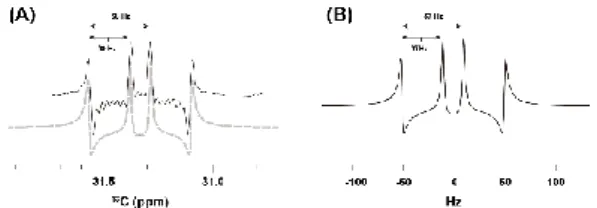
Figure 1. Comparison of actual HSQC using U-13C-lactate
(1 mM) and its simulated signal. (A) Overlay of 1D projection of actual HSQC spectrum (solid line) and simulated spectrum (dotted line). (B) The simulated spectrum. In simulated spectrum, 13C-13C coupling constants
were set to 57 Hz and 36.5 Hz respectively. Delay Δ𝑡 was
set to 1.6 ms and R2 relaxation constant was set to 0.3. For
the Fourier transformation, 𝑓max set to 4000 Hz and
time-domain points were 150 complex points with the final 4096 complex points after zero-filling. For the apodization cosine-squared function was employed
2𝐼̂𝑦𝑆̂1𝑧cos(𝛺𝑆1𝑡1) ∏ cos{𝜋𝐽𝑆1𝑆𝑘(𝑡1+ Δ)}
𝐿
𝑘=2
(1)
cos(𝐴 + 𝐵) = cos 𝐴 cos 𝐵 − sin 𝐴 sin 𝐵 where L is the number of coupled spin with S1. Thus, as the constant delay, Δ, increases by, a ratio of the undesirable dispersive anti-phase term (sine modulated term) is also increased together.
Acquiring a pure-phase inversion by a fast adiabatic inversion pulse pair
Since a constant delay in the t1-evolution period is the origin of the signal distortion, a solution of these problem can be achieved through an introduction of fast adiabatic inversion pulses9 and elimination of PFG in lieu of the conventional sequence. Thus, an introducing a fast broadband adiabatic inversion pulse can alleviate the generation of signal distortion. T-L. Hwang et al.9 reported several fast adiabatic pulses including a tangential frequency sweeps which can accomplish a broadband inversion amount to tens of
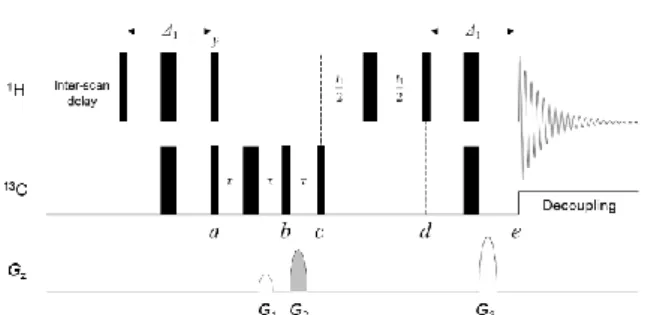
Figure 2. Exemplified pulse sequence for HSQC using gradient pulses with coherence selection step outside of the t1-evolution period.
kilohertz bandwidth using a practical 𝐵1 strength. On the other hand, the single adiabatic inversion pulse cannot provide a desirable inversion for the transverse magnetization. Only magnetization collinear with a starting vector of the adiabatic pulse (z-magnetization) can follow B1 field (adiabatic inversion).8 There are two remedies to acquire a pure-phase refocusing of xy-magnetization, (1) composite adiabatic refocusing pulse10 and (2) employing of adiabatic inversion pulse pair.11 Because the composite adiabatic pulse has a four-fold duration compare to single adiabatic inversion pulse, it is not a proper choice. In contrast, the adiabatic inversion pulse pair only requires a half duration compare to composite adiabatic pulse. After applying the second identical transformation, each of transverse magnetization returns to their original states (pure phase inversion/refocusing) with the intensity of magnetization is attenuated according to the inversion efficiency.
Coherence selection by PFG outside of the t1
-evolution period
The coherence selection module (echo-anti echo frequency discrimination12) requires thousands of microseconds of length. Thereby, with 13C-isotope labeled samples, for the distortion-free indirect domain signal the frequency discrimination by PFG in HSQC spectrum is no longer valid. STATES,13 TPPI14 or STATE-TPPI15 acquisition methods are alternative methods can be used for the frequency discrimination without additional constant delays in many two-dimensional NMR experiments. But, contrary to PFG
Figure 3. Proposed N-fold J-scaling module for two-dimensional HSQC.
method, those methods give rise to t1-noise which arisen from some instrumental imperfections regarding radio-frequency (RF) pulse. This t1-noise, especially from strong signals, usually hampers analysis of weak signals in in vivo or cellular extract samples, generally exhibit low signal-to-noise ratio (SNR). To address this problem one can introduce PFG element instead of phase cycling by placing the PFG module before or after the t1-evolution period. Figure 2 shows exemplified HSQC pulse sequence with coherence selection by PFG outside of the t1 -evolution period. Assume that, at an equilibrium state, the density operator has a form of 𝐼̂z. Then, at a point
‘a’ the product operator became a form −2𝑆̂1y𝐼̂z
where, I- and S-spin denote 1H and 13C-spin, respectively. The Hamiltonian is 𝐻̂0= Ω𝑆
1𝑆̂1𝑧+ 2π𝐽𝐼𝑆1𝐼̂𝑧𝑆̂1𝑧+ 2𝜋 ∑ 𝐽𝑆1𝑆𝑘𝑆̂1𝑧𝑆̂𝑘𝑧
𝐿
𝑘=2 .
Ω
𝑆1 is thechemical shift of 𝑆̂1. 𝐽𝐼𝑆1 and 𝐽𝑆1𝑆𝑘 are the scalar coupling constants between spins in the subscripts. 13C-13C coupling evolution during the rectangular pulse was ignored. Since the ratio of G1 : G3 = 4 : 1 and the observable form of operator is 𝐼̂− , the 11
coherence order of S-spin can only survive. Thus, before the acquisition, at a point ‘e’, final observable operator has a form of
1
4𝑖𝐼̂−exp(−𝑖Ω𝑆1𝑡1) ∏ cos(𝜋𝐽𝑆1𝑆𝑘𝑡1) cos(2𝜋𝐽𝑆1𝑆𝑘𝜏)
𝐿
𝑘=2
(2)
where L is the number of coupled spin with S1. Thereby, N-type coherence selection by PFG outside the t1-evolution period can give rise to a pure in-phase
Figure 4. Pulse sequence of 13C-13C distortion-free J-scaled HSQC. Narrow and wide bars represent 90° and 180° hard pulses,
respectively. Black semi-ellipse boxes indicate adiabatic inversion and refocusing pulses, respectively. Phase of Ф1 and was
shifted by 90° at every increment. 𝜟𝟏 was set to1/41JCH. The phase cycling is as follows. Ф1 = x, -x; Ф2 = -y, -y, y, y; Ф3 =
-x, --x, -x, x Фrec = x, -x, -x, x. Gradient ratios: G1 : G2 = 4 : 1 and G3, G4 and G5 are homospoil gradient pulses.
Implementation of J-scaling sequence into HSQC sequence
For the indirect domain the observation of fine structure and exact coupling constant values of multiplet have been limited due to poor spectral resolution. On the other hands, unlike direct acquisition period in t2 where the time domain data is actually collected, the indirect detection scheme during the t1-evolution period do not requires actual detection of signals by receiver of the spectrometer.16 Thus, one can manipulate acquisition of the indirect detection scheme without the constraints of data acquisition scheme such as J-scaling.17 In the following, first of all, detailed principles based on product operator formalism for J-scaling technique
will be addressed and then the implementation of J-scaling sequence into actual HSQC pulse sequence will be described. Figure 3 exhibits a part of an exemplified J-scaling sequence for the HSQC sequence.
Suppose that a weakly coupled two spin system with a Hamiltonian in the rotating frame of reference 𝐻̂0= Ω𝑆1𝑆̂1𝑧+ 2𝜋𝐽𝑆1𝑆2𝑆̂1𝑧𝑆̂2𝑧
where I- and S-spin denote
1H and 13C-spin, respectively. Ω
𝑆1is the chemical shift of 𝑆̂1z and 𝐽𝑆1𝑆2 is the scalar coupling constant between weakly coupled spins S1 and S2.
Assume that at a point ‘a’ the density operator has a form of 2𝑆̂1𝑦𝐼̂𝑧 , after a free precession with an
inversion pulse the density operator at ‘b’ is
−2𝑆̂1𝑦𝐼̂𝑧cos{(𝑁 − 1)𝜋𝐽𝑆1𝑆2𝑡1} − 𝑆̂1𝑥sin{(𝑁 − 1)𝜋𝐽𝑆1𝑆2𝑡1} (3) A following pulse sequence gives
cos{(𝑁 − 1)𝜋𝐽𝑆1𝑆2𝑡1} cos(Ω𝑆1𝑡1) {2𝑆̂1,𝑦𝐼̂𝑧cos(𝜋𝐽𝑆1𝑆2𝑡1) − 𝑆̂1,𝑥sin(𝜋𝐽𝑆1𝑆2𝑡1)} − cos{(𝑁 − 1)𝜋𝐽𝑆1𝑆2𝑡1} sin(Ω𝑆1𝑡1) {2𝑆̂1,𝑥𝐼̂𝑧cos(𝜋𝐽𝑆1𝑆2𝑡1) + 𝑆̂1,𝑦sin(𝜋𝐽𝑆1𝑆2𝑡1)}
− sin{(𝑁 − 1)𝜋𝐽𝑆1𝑆2𝑡1} cos(Ω𝑆1𝑡1) {𝑆̂1,𝑥cos(𝜋𝐽𝑆1𝑆2𝑡1) + 2𝑆̂1,𝑦𝐼̂𝑧sin(𝜋𝐽𝑆1𝑆2𝑡1)} − sin{(𝑁 − 1)𝜋𝐽𝑆1𝑆2𝑡1} sin(Ω𝑆1𝑡1) {𝑆̂1,𝑦cos(𝜋𝐽𝑆1𝑆2𝑡1) − 2𝑆̂1,𝑥𝐼̂𝑧sin(𝜋𝐽𝑆1𝑆2𝑡1)}
(4)
Using the trigonometric identity, it is simplified to
2𝑆̂𝑦𝐼̂𝑧cos(Ω𝑆1𝑡1) cos(𝑁𝜋𝐽𝑆1𝑆2𝑡1) − 𝑆̂𝑥cos(Ω𝑆1𝑡1) sin(𝑁𝜋𝐽𝑆1𝑆2𝑡1) − 2𝑆̂𝑥𝐼̂𝑧cos(Ω𝑆1𝑡1) cos(𝑁𝜋𝐽𝑆1𝑆2𝑡1) − 𝑆̂𝑦cos(Ω𝑆1𝑡1) sin(𝑁𝜋𝐽𝑆1𝑆2𝑡1)
Figure 5. Comparison of scale-up of the J-coupling constant with difference scaling factor ‘N’. (A-E) The doublet signals of U-13C acetate HSQC spectrum produced
according to each scaling factor ‘N’. The bottom 1D signals are F1 projection spectrum. (F) Structure of acetate and its
𝑱𝐂𝐂
𝟏 coupling constants.
After an applying instantaneous 𝜋/2(𝐼̂𝑥+ 𝑆̂𝑥) pulse
at a point ‘c’ the only observable I-spin operator is −2𝑆̂1,𝑧𝐼̂𝑦cos(Ω𝑆1𝑡1) cos(𝜋𝑁𝐽𝑆1𝑆2𝑡1) (1) Based on result from Eq. (6), a signal in t1 of N-fold J-scaled HSQC with PFG outside t1-evolution period can be expressed as 𝑆(𝑡1) ∝ exp(−𝑖ΩS1𝑡1) × ∏ cos{𝜋𝑁𝐽𝑆1𝑆𝑘(𝑡1+ Δ)} cos(2𝜋𝐽𝑆1𝑆𝑘𝜏) 𝐿 𝑘=2 (7)
where Δ is the total constant delay in t1-period, 2𝜏 is the delay of PFG module outside of t1-period and L is the number of coupled spin with S1.
As a result, we can get the N-fold scaled 13C-13C scalar coupling interaction along the variable t1 while its (S-spin; 13C) chemical shift evolution is retained.
J-scaled distortion-free HSQC pulse sequence Based on thus-obtained theoretical considerations, we have proposed the Jscaled distortionfree HSQC
-Figure 6. Comparison of HSQC signal of alpha carbon of U-13C lactate. (A) Conventional HSQC signal (TD:300;
uniform sampling). (B) Conventional HSQC signal (TD:3000; NUS 10% sampling density was used). (C) J-scaled HSQC signal (TD: 300, scaling factor: 6) (D) Enlarged of (C). (E) Simulated signal (solid line); Dotted line indicates signal of (D). (F) Structure of U-13C lactate
and its 𝑱𝟏𝐂𝐂-coupling constants.
experiment which provides high-resolution J
-modulated pure absorptive signals in the indirect domain. Figure 4 shows a schematic pulse sequence of the proposed sequence and comparison of scale-up of the J-coupling constant by changing a scaling factor ‘N’. In figure 5, a coupling constant of doublet of U-13C acetate methyl carbon signals were increased proportionally according to scaling factor. Finally, the HSQC signals acquired from the proposed pulse sequence (Figure 6) were compared with those produced by the conventional HSQC pulse sequence. To this end, using the U-13C-lactate, conventional HSQC signals with the same t1-time-domain point (TD: 300) and 3000 t1-time-domain points were obtained and compared with the proposed J-scaled
(TD: 300), the correct doublet of doublet signal could be confirmed due to the six-fold increased 13C-13C interaction effect, and signal distortion caused by anti-phase also rarely appeared. Of note, the simulated J-scaled HSQC signal according to the results derived from Eq. (7) also showed almost the same form as the actual signal (Figure 6D and 6E).
Practical considerations for J-scaled HSQC
For the choice of optimal J-scaling factor, in the proposed pulse sequence, the apparent size of the JCC coupling constant in the indirect domain increases with the increase in the scaling factor, but the final signal resolution of the indirect domain of acquired two-dimensional spectrum is also affected by t1 -time-domain (TD) points, spectral width used. Therefore, the value of the optimal scaling factor depends on the several experiment parameters, and can be changed according to the isopotomer to be analyzed. Plus, note that an unconditional increase of the scaling factor can cause unintended signal separation and loss of signal sensitivity by JCC-coupling of two or more bonds and increase the chance of overlapping with adjacent signals by the expanded signal splitting. The preservation of equivalent pathway (PEP)18 in HSQC sequence can give a sensitivity enhancement (√2) by
× ∏ cos(𝜋𝐽𝑆1𝑆𝑘Δ2) cos(2𝜋𝐽𝑆1𝑆𝑘𝜏)
𝑘=2
× cos{𝑁𝜋𝐽𝑆1𝑆𝑘(𝑡1+ Δ)}
(8)
where 𝐽𝐼𝑆1 is the one-bond
1H-13C coupling constant , Δ2 is the delay of the first reversed INEPT sequence
in PEP module and L is the number of coupled spin with S1. Since the PEP sensitivity factor, √2 cos𝑛−1(𝜋𝐽
𝐼𝑆Δ2) ∏ cos(𝜋𝐽𝑆1𝑆𝑘Δ2)
𝐿
𝑘=2 can be
varied depends on an environment of functional groups in a molecule, PEP in J-scaled HSQC not always give a desirable sensitivity enhancement.
Conclusions
In this paper, theoretical explanations and practical considerations of the recently proposed experiment, J-scaled distortion-free HSQC sequence, were described briefly. J-scaled HSQC may be widely applied in metabolite analysis studies in which the concentration of a sample is low or a 13C isotope-labeled compound is frequently used for analysis of a specific metabolic pathway. Through this paper, we hope an increasing interest of our proposed experiment, also look forward future improvement of technical aspect and expanding of application in more various fields.
Acknowledgements
This work was supported by the Korea Institute of Science & Technology—Research Program (2Z06482).
References
1. E. Moser, E. Laistler, F. Schmitt and G. Kontaxis, Front. Phys. 5 (2017)
3. S. Lee, H. Wen, Y. J. An, J. W. Cha, Y. J. Ko, S. G. Hyberts and S. Park, Anal. Chem. 89, 1078 (2017) 4. U. Singh, S. Bhattacharya and B. Baishya, J. Magn. Reson. 311 (2020)
5. J. W. Cha, X. Jin, S. Jo, Y. J. An and S. Park, Chem. Sci., DOI: 10.1039/d0sc06480g (2021) 6. E. Kupce and R. Freeman, J. Magn. Reson., Ser A 117, 246 (1995)
7. J. Keeler, R. T. Clowes, A. L. Davis and E. D. Laue, Methods Enzymol. 239, 145 (1994) 8. R. A. DeGraaf and K. Nicolay, Concepts Magn. Reson. 9, 247 (1997)
9. T. L. Hwang, P. C. M. van Zijl and M. Garwood, J. Magn. Reson. 133, 200 (1998) 10. T. L. Hwang, P. C. M. van Zijl and M. Garwood, J. Magn. Reson. 124, 250 (1997) 11. T. L. Hwang and A. J. Shaka, J. Magn. Reson., Ser A 112, 275 (1995)
12. J. Keeler and D. Neuhaus, J. Magn. Reson. 63, 454 (1985)
13. D. J. States, R. A. Haberkorn and D. J. Ruben, J. Magn. Reson. 48, 286 (1982) 14. D. Marion and K. Wuthrich, Biochem. Biophys. Res. Commun. 113, 967 (1983) 15. D. Marion, M. Ikura, R. Tschudin and A. Bax, J. Magn. Reson. 85, 393 (1989) 16. R. V. Hosur, Prog. Nucl. Magn. Reson. Spectrosc. 22, 1 (1990)
17. W. Willker, U. Flogel and D. Leibfritz, J. Magn. Reson. 125, 216 (1997)