집적 영상술을 이용한 3차원 디지털 홀로그램의 합성
Three-Dimensional Digital Holography Synthesis
Using Integral Imaging
Jae-Hyeung Park*, Nam Kim
School of Electrical & Computer Engineering, Chungbuk National University [email protected]
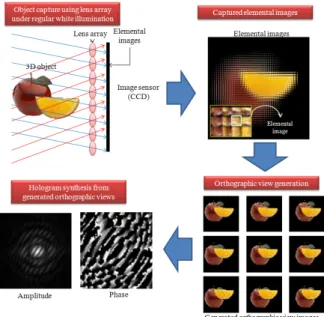
Digital holography has found numerous applications in various research fields. Especially for three-dimensional(3D) imaging and information processing, digital holography is one of the promising techniques due to its unique capability of dealing with wavefront of the object field. We developed a novel method to synthesize digital holography of the 3D objects using integral imaging principle. Figure 1 shows a concept of the proposed method. 3D objects are captured by a lens array under regular white illumination. The captured image is a set of the elemental images each of which is formed by each elemental lens of the lens array. From the obtained elemental images, various view images having orthographic projection geometry are generated. Using these orthographic view images, finally, Fourier or Fresnel hologram of the captured 3D objects is synthesized.1
Fig. 1. Hologram synthesis from the elemental images
Because the objects are captured under regular white illumination, the necessity of coherent illumination and complicated interference optics is avoided. Orthographic
projection geometry of the generated view images enables hologram synthesis in straightforward and intuitive way. We also analyzed maximum size and resolution of the 3D images reconstructed from the synthesized hologram. Figure 2 shows analyzed parameters and size/resolution limitations in case of Fourier hologram. It was found that the maximum image size of the Fourier hologram is determined by the angular separation between two adjacent orthographic view images. If the actual object is larger than this limitation, aliasing occurs in the spatial domain, resulting in partial overlapping of the reconstructed 3D images. Resolution is determined by two factors, i.e. elemental lens size and the maximum projection angle of the generated orthographic view image. Since the 3D object is sampled at each elemental lens position, the elemental lens size (or distance between two neighboring elemental lens centers) dominantly determines maximum resolution. The maximum projection angle of the orthographic view image which is determined by the field of view of the elemental lens acts as a low-pass filter on this sampled version of the object. The principle of the proposed hologram synthesis method and its resolution/size analysis can be used to make the hologram acquisition process more comfortable such that the 3D hologram can be applied to various 3D information processing techniques more easily.
(a) parameters
(b) size limitation (c) resolution limitation Fig. 2. Resolution and size limitation of the reconstructed 3D objects
"This work was supported by the Korea Research Foundation Grant funded by the Korean Government" (KRF-2008-313-D00727).
1. J.-H. Park, M.-S. Kim, G. Baasantseren, and N. Kim, "Fresnel and Fourier hologram generation using orthographic projection images," Opt. Express 17, 6320-6334 (2009).