Kor J Spine 5(3):161-166, 2008
Surgical Treatment of Degenerative Lumbar Spine Disease
in Geriatric Patients Over 70 Years Old:
A Review of Two Decades
Seung-Bok Wee, M.D.1, Sung-Sam Jung, M.D.1, Ki-Seok Park, M.D.1, Sung-Uk Kuh, M.D.2
1Department of Neurosurgery, Eulji University College of Medicine, Daejeon, Korea 2Department of Neurosurgery, Yonsei University College of Medicine, Seoul, Korea
Objective: The aim of this study is to evaluate the transition of lumbar spinal treatments for geriatric patients over 70 years old over two decades.
Methods: We retrospectively assessed 730 patients who were 70 years and older and underwent lumbar surgery. We analyzed the number of diseases, operation methods and complications with 5-year intervals from 1987 to 2006. Result: The number of patients older than 70 years who underwent lumbar surgery increased according to our analysis of the period spanning from 1987 to 2006. Thirty-two (1%), 77 (1.7%), 232 (4.4%), and 389 (8.2%) patients over 70 years underwent lumbar spine surgeries. Among them, the 8, 29 and 45 patients had one level degenerative spondy- lolisthesis for the periods 1992-1996, 1997-2001 and 2002-2006. Twenty-four, 29 and 58 patients had lumbar stenosis during all these time periods. Over time, we performed a larger variety of operations as well as more aggressive operations. From January 2002 to December 2006, a total of 308 patients were over 70 years old and had lumbar spine surgeries performed on them. Among them, the ASA class I was 58 (19%), the ASA class II was 213 (69%) and the ASA class III was 37 (12%). During that period, PLIFs and PS fixations were performed on 69 patients. Among them, 8 patients were ASA III. Large numbers of lumbar arthorodesis have been performed in geriatric patients over the age of 70 years in our series.
Conclusion: The surgical treatment of degenerative spine disease in the elderly patients was increased due to impro- ved surgical technique and advances in medical treatment including anesthesia. The authors suggest that fusion surgery can be done safely in elderly patients even though they have high-grade ASA classification.
Key Words: Geriatric patientㆍLumbar spineㆍDegenerative spine diseaseㆍSpine surgery
●Received: August 1, 2008 ● Accepted: September 3, 2008 ● Published: September 30, 2008 Corresponding Author: Ki-Seok Park, M.D.
Address of reprints: Department of Neurosurgery, Eulji University College of Medicine, Dunsan-dong 1306, Seo-gu, Daejeon, 302-799, Korea Tel: +82-42-611-3275, Fax: +82-42-488-3461, E-mail: [email protected]
INTRODUCTION
As the elderly population increases the number of patients complaining of back or leg pain also increases. Back or leg pain from lumbar spinal disease may cause a loss of function and an inability to perform activities necessary to meet the patient’s basic daily needs1). Therefore, symptomatic lumbar spinal disease should be treated even for elderly patients. However, the treatment method for the geriatric population with comorbid diseases is controversial. Many studies have emphasized the morbidity associated with the surgical treat-
ment of lumbar diseases in the elderly population2,3) and have recommended non‐surgical treatment for elderly lumbar spinal disease1). Johnsson et al.1) demonstrated in a study investiga- ting the natural course of lumbar spinal stenosis that there was no severe deterioration of claudication, so the author suggested that the patient undergo expectant observation as an alternative to surgery. On the other hand, several authors were in favor of surgical treatment4,5). Ragab et al.5) studied the safety and outcome of lumbar spine surgery in patients 70 years of age or older and found that the surgical treat- ment of lumbar diseases in the elderly has a high success and satisfaction level with results comparable to that of a
Table 1. American Society of Anesthesiologists Classi- fication of Physical Status
Definition
I No systemic disease
II Mild to moderate systemic disease III Severe systemic disease
IV Severe systemic disease that is life threatening V Moribund patient with little chance of survival
Table 2. Disease classification
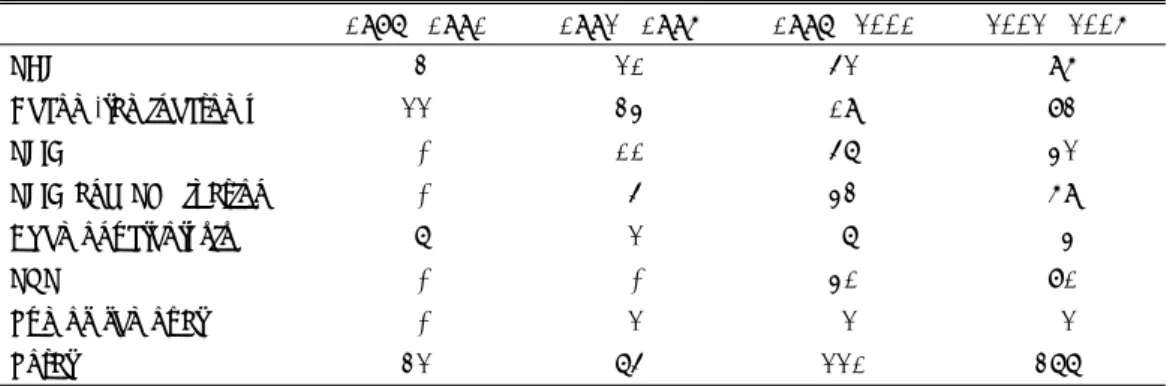
1987~1991 1992~1996 1997~2001 2002~2006 HLD 16 32 90 148 Stenosis 10 25 30 84 Deg. listhesis 6 10 34 54 Lytic listhesis - 6 21 6 Compression Fx - - 41 80 Bursting Fx - - 3 3 Tumor - 2 2 2 Total 32 75 221 377
HLD; Herniated lumbar disc, Deg. listhesis ; Degenerative spondylolisthesis, Lytic listhesis; Spondylolytic spondylolisthesis, Fx; fracture
younger population. Thus, we analyzed the transition of spinal treatment for geriatric patients over 70 years old over a span of two decades.
MATERIALS AND METHODS
A total of 16,517 lumbar spine surgeries were performed from 1987 to 2006 at our institute. Among them, 730 (4.4 %) patients were over 70 years old. Patients were consi- dered for surgery only after attempts at conservative mana- gement, including physical therapy, oral analgesic drugs, epidural steroids, and facet injections had proven unsuccess- ful. We analyzed the types of diseases and operation me- thods over an interval of 5 years from our institute’s medi- cal records. Preoperative diagnosis included herniated lum- bar disc (HLD), lumbar stenosis, degenerative spondylolis- thesis, spondylolytic spondylolisthesis, compression fracture and bursting fracture. The operative methods were: ① PHL (Partial hemilaminectomy); ② Decompressive lami- nectomy; ③ PLIF (Posterior lumbar interbody fusion); ④ PLIF and PS (pedicle screw) fixation; and ⑤ chemonucleolysis. Next, we noted any changes in the operative methods in one level degenerative spondylolisthesis and spinal stenosis
during a five‐year period from 1992 to 2006. Finally, we inves- tigated complications from 2002 to 2006.
1. Data analysis
All charts and medical records of the 730 patients older than 70 years who underwent lumbar spine surgery from 1987 to 2006 were reviewed. The clinical parameters in- cluded a preoperative American Society of Anesthesiolo- gists (ASA) classification (Table 1) and preoperative comor bid diseases. All statistical tests were done with Chi squared analysis. The SPSS program was used and a p value less than 0.05 was considered statistically significant.
RESULTS
According to our study, the 32 (1%), 77 (1.7%), 232 (4.4 %), and 389 (8.2%) patients over 70 years old had lumbar spine surgeries during 1987~1991, 1992~1996, 1997~2001, and 2002-2006, respectively. The p‐value was <0.0001. So, the number of patients over 70 years old who underwent lumbar surgery has increased. The diseases and operative methods for each term are listed in Table 2 and 3. Among them 8, 29 and 45 patients in one level degenerative spondy- lolisthesis underwent operation. Four (50%) decompressive laminectomies, 2 (25%) posterior lumbar interbody fusions (PLIF), and 2 (25%) PLIF and PS (pedicle screw) fixations were performed from 1992 to 1996. Five (17%) decom- pressive laminectomies, 13 (45%) PLIFs, and 11 (38%) PLIF and PS fixations were performed from 1997 to 2001. Lastly, 17 (38%) decompressive laminectomies, 4 (9%) PLIFs, and 24 (53%) PLIF and PS fixations were performed from 2002 to 2006 (Fig. 1). Twentyfour, 29, and 58 patients with lumbar
Fig. 1. Operative method in degenerative spondylolisthesis.
Table 3. Operation method that was performed for each period
1987~1991 1992~1996 1997~2001 2002~2006
PHL 3 21 52 96
Decom.laminectomy 22 34 19 83
PLIF - 11 57 42
PLIF and PS fixation - 5 43 69
Chemonucleolysis 7 2 7 4
PVP - - 41 81
Tumor removal - 2 2 2
Total 32 75 221 377
PHL; Partial hemilaminectomy, Decom; Decompressive, PLIF; Posterior lumbar interbody fusion, PVP ; Percutaneous vertebroplasty, PS; Pedicle Screw
Fig. 2. Operative method in spinal stenosis.
Fig. 3. Distribution of comorbidity.
stenosis also under- went surgery. Of them, 17 (71%) had decompressive laminectomies, 5 (21%) had posterior lumbar interbody fusions (PLIFs), and 2 (8%) had PLIFs and PS fixations from 1992 to 1996. Ten (34.5%) patients had decompressive laminectomies, 10 (34.5%) had PLIFs, and 9 (31%) had PLIFs and PS fixations from 1997 to 2001. Thirty five (60%) decompressive laminectomies, 9 (16%) PLIFs, and 14 (40%) PLIFs and PS fixations were performed from 2002 to 2006 (Fig. 2). There were significant differences between periods with respect to the operation methods for the one level degenerative spondylolisthesis and lumbar stenosis (p=0.005, 0.042). The results showed that we were able to perform more aggressive operations over time. From January 2002 to December 2006, 308 patients were over 70 years of age and had general anesthetic spine surgery. The review of anesthesia records for the 308 patients showed that 58 (19%) were ASA class I, 213 (69%) were ASA class II, and 37 (12%) were ASA class III. Causes of comorbidity included
hypertension, coronary artery obstructive disease (CAOD), congestive heart failure (CHF), chronic obstructive pulmonary disease, asthma, atelectasis, bronchitis, emphysema, tubercu-
losis, lung cancer, diabetes mellitus, chronic renal failure, and liver cirrhosis (Fig. 3). During that period, PLIFs and PS fixations were performed on 69 patients. Among them, 15 patients were ASA class I, 46 patients were ASA II, and 8 were ASA III. This means that lumbar arthorodesis has been performed in elderly patients even when patients had a high‐grade ASA classification. From 2002 to 2006, Compli- cations were seen in 46 patients (15%), but there were no deaths. The most common compli- cation was voiding difficulty, 24 patients (7.8%) showed postoperative voiding difficulty. Wound infection occurred in 8 patients (2.6%), 3 requiring surgical debridement. 2 patients (0.6%) had a post operative hematoma removal. Postoperative weakness was seen in 2 patients (0.6%), both showed Rt. Ankle dor- siflexion weakness. One showed grade 3 and the other grade 4. The other complications were seen in 10 patients (3.2%). These included 6 with delirium, 3 with pneumonia and 1 with gallbladder empyema.
DISCUSSION
Recently, birth and mortality rates have decreased and the average life span has been prolonged due to socioeconomic and scientific advancements. In the report written by the national statistical office, the proportion of the population older than 65 years was only 3.1% in 1970. However, this has increased to 3.8%, 5.1%, 7.1%, and 7.4% in 1980, 1990, 2000, and 2006 respectively6). Thus, as the elderly population has increased, the number of elderly patients undergoing lumbar spinal surgery has also increased7).
1. Improved general condition and advanced medicine With increasing life expectancies and improvements in the overall health of the elderly, an understanding of geri- atric disease becomes an important aspect of medical services. In the elderly, the prevalence of cardiovascular disease, predominantly ischemic heart disease and stroke, increases exponentially with age. In our study, hyperten- sion and diabetes mellitus were the most common comor- bid diseases (55%, 24%, respectively). In comparison with past elderly populations, today’s elderly population benefits from advancements in hygiene, diet, medical care, and public health. As a consequence of aging, the geriatric population will suffer from cardiac disease, congestive heart failure, angina, arrhythmia, chronic pulmonary disease, and rheumatoid arthritis. However, with the aid of a well
managed medical support system and increased concern for maintaining health, these problems can be controlled. In addition, recent advances in anesthesia management enables us to perform prolonged operations in comorbid elderly patients that were not possible in the past8). For example, pedicle screw fixation allows for more rigid fixation and more rapid patient mobilization by limiting the number of immobilized vertebral segments, resulting in a higher rate of arthrodesis10). Nonetheless, pedicle screw fixation is a technically demanding procedure that may require a longer operation time, thereby resulting in a higher incidence of infection and morbidity. Decompressive laminectomy has been undertaken to treat lumbar stenosis and degenerative spondylolisthesis according to our data, but recently, arth- rodesis has increased. Greenfield et al11). have recommen- ded and demonstrated that age was not a predictive factor with regard to outcome, as patients older than 70 years derived the same benefits from lumbar arthrodesis as their younger counterparts.
2. Increased demand and social activity
The elderly should be encouraged to participate in society to ensure that they can lead a healthy life confidently and feel great about themselves while being active in their com- munity. There are various examples of their participation in society such as economic activity, recreation, political acti- vity, religious activity, and volunteer work. Yet despite this, they are given a cold reception in the labor market due to their decreased labor efficiency resulting from aging or disease, and because of this, they often suffer from social or psychological difficulties in addition to financial pro- blems. The symptoms of lumbar spinal diseases, such as stenosis, in elderly patients may decrease their functional capabilities, including their ability to perform daily activities required for living. Patients having symptoms of lumbar spinal disease refractory to conservative treatments such as physical therapy and lumbar epidural steroid injections demand more active treatments, such as operations.
3. Advanced minimally invasive techniques
Lumbar spinal stenosis is one of the most common disea- ses of the spine that affects the elderly population. Tradi- tional surgical treatment includes a posterior decompressive laminectomy. However, many elderly patients are not con- sidered candidates for surgery because of their age, comor-
bidities, or, in some cases, subjective impressions of a patient’s fitness for surgery. Minimally invasive techniques have recently been developed for the surgical treatment of lumbar spinal disease12,13). These techniques differ from conventional open surgeries by making smaller skin incisions, using a tubular muscle retractor, and sparing the posterior ligamentous and muscle complexes. Rosen et al14). reviewed 57 patients who underwent minimally invasive decompression of lumbar dege- nerative disease and who were at least 75 years old from 2002 to 2005 and found that minimally invasive lumbar decompressive surgery can be an effective treatment for elderly patients with lumbar spondy- losis and spinal stenosis. The- refore, minimally invasive spinal surgery has the advantages of the minimal access surgery, including reduction in soft tissue injury, less blood loss, shorter hospitalization time, and a faster recovery in geriatric spine patients.
For example, compression fracture of the vertebral body is common, especially in older adults. Osteoporosis is the most common cause of vertebral collapse, which significantly impairs mobility and quality of life15,16). Traditional con- servative treatments have included bed‐rest, pain control, physical therapy, and pillow reduction. However, prolonged immobilization promotes bone loss and further predisposes a patient for new compression fractures17). Also, it may raise deep vein thrombosis, embolism, gastrointestinal, pul- monary problems, and muscle weakness. Percutaneous ver- tebroplasty (PVP) is a minimally invasive technique whereby an injection is made into a painful vertebral body to relieve pain and provide strength. PVP was first introduced in France in the mid 1980s as a minimally invasive proce- dure in the treatment of vertebral hemangiomas18). It enables elderly compression fracture patients to find immediate pain relief and early ambulation.
CONCLUSION
Despite additional comorbidity, the lumbar fusion was per- formed safely even in patients over 70 years old, and as a result, the number of adequate treatments for degenerative spondylolisthesis and spinal stenosis increased due to impro- ved surgical technique and advances in medical treatment including anesthesia. The authors, therefore, do not use age as a criterion for surgical correction of lumbar diseases.
REFERENCES
1. Johnsson KE, Rosen I, Uden A: The natural course of
lumbar spinal stenosis. Clin Orthop Relat Res: 82-86, 1992
2. Katz JN, Lipson SJ, Larson MG, McInnes JM, Fossel AH, Liang MH: The outcome of decompressive lami- nectomy for degenerative lumbar stenosis. J Bone Joint Surg Am. 73:809-816, 1991
3. Deyo RA, Cherkin DC, Loeser JD, Bigos SJ, Ciol MA: Morbidity and mortality in association with operations on the lumbar spine. The influence of age, diagnosis, and procedure. J Bone Joint Surg Am 74:36-543, 1992 4. Vitaz TW, Raque GH, Shields CB, Glassman SD: Sur-
gical treatment of lumbar spinal stenosis in patients older than 75 years of age. J Neurosurg 91:181-185, 1999
5. Ragab AA, Fye MA, Bohlman HH: Surgery of the lum- bar spine for spinal stenosis in 118 patients 70 years of age or older. Spine 28:348-353, 2003
6. Office NS. Population projection. pp1990, 1991, 7. Kalbarczyk A, Lukes A, Seiler RW: Surgical treatment
of lumbar spinal stenosis in the elderly. Acta Neuro- chir (Wien) 140:637-641, 1998
8. Hosking MP, Warner MA, Lobdell CM, Offord KP, Melton LJ: 3rd. Outcomes of surgery in patients 90 years of age and older. Jama 261:1909-1915, 1989 9. Zdeblick TA: A prospective, randomized study of lum-
bar fusion. Preliminary results. Spine 18:983-991, 1993 10. Greenfield Robert T. III, Capen Daniel A, Thomas
James C Jr., Nelson Russell, Nagelberg Steven, Rimoldi, et al: Pedicle screw fixation for arthrodesis of the lum- bosacral spine in the elderly. An outcome study. Spine 23:1470-1475, 1998
11. Palmer S, Turner R, Palmer R: Bilateral decompression of lumbar spinal stenosis involving a unilateral approach with microscope and tubular retractor system. J Neuro- surg. 97:213-217, 2002
12. Ahn Y, Lee SH, Park WM, Lee HY: Posterolateral percutaneous endoscopic lumbar foraminotomy for L5 -S1 foraminal or lateral exit zone stenosis. Technical note. J Neurosurg 99:320-323, 2003
13. Rosen DS, O'Toole JE, Eichholz KM, et al: Minimally invasive lumbar spinal decompression in the elderly: Outcomes of 50 patients aged 75 years and older. Neu- rosurgery 60:503-509, discussion 509-510, 2007
14. Tamayo‐Orozco J, Arzac‐Palumbo P, Peon‐Vidales H, Mota‐Bolfeta R, Fuentes F: Vertebral fractures associa- ted with osteoporosis: Patient management. Am J Med
103:44S-48S discussion 48S-50S, 1997
15. Rapado A: General management of vertebral fractures. Bone. 18:191S-196S, 1996
16. Papaioannou A, Watts NB, Kendler DL, Yuen CK, Adachi JD, Ferko N: Diagnosis and management of vertebral
fractures in elderly adults. Am J Med 113:220-228, 2002 17. Galibert P, Deramond H, Rosat P, Le Gars D: Preli-
minary note on the treatment of vertebral angioma by percutaneous acrylic vertebroplasty. Neurochirurgie 33: 166-168, 1987