INTRODUCTION
The advantages of nanogels arise from their main proper-ties. First, they have a large specific surface, which increases the interactions with physiological compartments (Rieux et al. 2006) and enhances the solubility and bioavailability of loaded drugs (Kreuter 1991). Second, they can overcome anatomic barriers and reach even small capillaries due to their small size (Hughes 2005). Thus, nanogels have recently attracted significant attention in the drug delivery system for diagnostic and therapeutic applications (Vinogradov et al. 2002; Oh et al. 2007; Gaumet et al. 2008; Oh et al. 2008). These systems represent the closest synthetic approxima-tion to biological tissue and materials due to their high water content and carbon based network structure (Peppas et al.
2000). Moreover, their chemical and physical properties can be tailored with a high degree of control, according to the sel-ected delivery route (Peppas et al. 2006).
A nanogel is considered to be a specific form of macro-molecular substance due to similar form as the coiled config-uration of a linear-chain polymer (Ulanski et al. 1999). Coil-sized hydrogels have been applied in the production of con-tact lenses, controlled drug-release systems, wound dress-ing, soil-humidity conditioning gels (Choi et al. 1995).
Radiation technology (X-rays, electron beams, ion-beams, gamma ray) was used for the applications of nano-science such as production of nanostructures, nano-particles, biolo-gical/electronic sensors, mechanical-chemical transforma-tion, and molecular computers (Van Thienen et al. 2006).
In this study, radiation technology was used for the nano-gel preparation, as this method is capable of sterilization and crosslinking concurrently without a catalyst. We pre-pared a method of radiation induced synthesis of nanogels,
─ ─ 29 ──
Morphological, Physical Characterization of Poly(acrylic acid)
Nanogel Prepared by Electron Beam Irradiation
Jong-Seok Park*, Jong-Bae Choi, Hui-Jeong Gwon, Youn-Mook Lim, Sung-In Jeong, Young-Min Shin, Phil-Hyun Kang and Young-Chang Nho
Advanced Radiation Technology Institute, Korea Atomic Energy Research Institute, Jeongeup 580-185, Korea
Abstract -- Nanogels are internally cross-linked particles of sub-micrometer size made of
hydro-philic polymers and are considered a distinct type of macromolecules, compared with linear and branched polymers or macroscopic gels. In this study, we studied a method of radiation induced synthesis of nanogels, which allows us to obtain tailored intra-molecularly crosslinked macro-molecules of independently chosen molecular weight and dimensions. Thus, we report the possi-bility of applying the prepared nanogels using poly(acrylic acid) through electron beam irra-diation for potential application as biomaterials. The nanogels were characterized by scanning electron microscopy (SEM). In addition, the size and zeta-potential of nanogels were measured by a particle size analyzer (PSA). The nanogels were prepared at an approximate size of 180 nm at 100 kGy and were spherical in shapes. The size of the nanogels decreased with increasing irra-diation doses, and the absolute value of zeta potential increased with increasing irrairra-diation doses. Key words : Nanogel, Poly(acrylic acid), Morphology, Particle size
* Corresponding author: Jong-Seok Park, Tel. +82-63-570-3067, Fax. +82-63-570-3069, E-mail. [email protected]
which allows us to obtain tailored intra-molecularly cross-linked macromolecules of independently chosen molecular weight and dimensions. Thus, we report the possibility of applying the prepared nanogels using poly(acrylic acid) th-rough electron beam irradiation.
MATERIALS AND METHODS
1. Materials
Poly(acrylic acid) (PAAc, Mw==1.0×10⁶) was purchased from Wako chemical Co. (Tokyo, Japan). Hexane was pur-chased from Showa chemical Co. (Japan). Experimental deionized (DI) water was produced by a purification system from Young Lin Instrument Co., Ltd. (Seoul, Korea). All chemicals were used without further purification.
2. Preparation of PAAc nanogels
Various compositions of PAAc nanogels were prepared through electron beam irradiation. One weight percent of PAA and 0~5 wt% Hexane were dissolved in 94~99 wt% of distilled water. The solutions were stirred for 18 hr at room temperature by an electronic overhead stirrer (MS-DL1020D, MTOPS, Korea) at 500 rpm, and the solutions were then poured into square dishes (125×125 mm, SPL, Korea). These samples were irradiated by electron beam accelerator (UELV-10-10S, Russia) (beam current of 1 mA and an energy of 10 MeV). The irradiation dose ranged from 10 kGy to 150 kGy. And then hexane was removed by eva-poration.
3. UV-Vis spectrophotometry
The UV-vis spectra of the PAAc nanogels and the Ag/
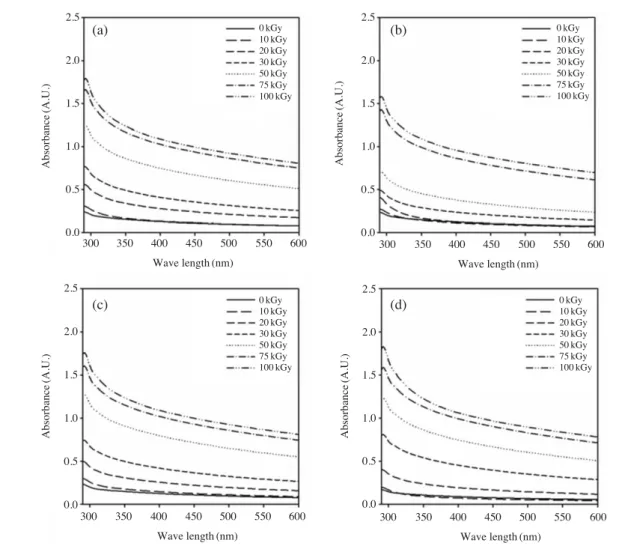
Fig. 1. UV-vis absorption spectra of PAAc nanogels; PAAc 1 wt%, (a) hexane 0 wt%, (b) Hexane 1 wt%, (c) Hexane 3 wt%, (d) Hexane 5
wt%. Absorbance (A.U.) Absorbance (A.U.) Absorbance (A.U.) Absorbance (A.U.) 2.5 2.0 1.5 1.0 0.5 0.0 2.5 2.0 1.5 1.0 0.5 0.0 2.5 2.0 1.5 1.0 0.5 0.0 2.5 2.0 1.5 1.0 0.5 0.0 (a) (b) (c) (d) 300 350 400 450 500 550 600 Wave length (nm) 300 350 400 450 500 550 600 Wave length (nm) 300 350 400 450 500 550 600 Wave length (nm) 300 350 400 450 500 550 600 Wave length (nm) 0 kGy 10 kGy 20 kGy 30 kGy 50 kGy 75 kGy 100 kGy 0 kGy 10 kGy 20 kGy 30 kGy 50 kGy 75 kGy 100 kGy 0 kGy 10 kGy 20 kGy 30 kGy 50 kGy 75 kGy 100 kGy 0 kGy 10 kGy 20 kGy 30 kGy 50 kGy 75 kGy 100 kGy
PAAc nanogels were recorded using a spectrophotometer (BioTek Instruments, Inc., USA) with range of wavelengths from 200 to 900 nm.
4. Particle size distribution and zeta potential analysis
The particle size and zeta potential were measured by photon correlation spectroscopy using a particle size analy-zer (Delsa nano C, Beckman coulter Inc., USA). All samples were measured without any chemicals or filtering. The nano-gel suspentions were distributed by voltex for 3 min. The nanogel suspensions were then poured into approximately 2 ml quart cells. The sizing measurements were performed at 25�C.
5. Scanning electron microscopy (SEM)
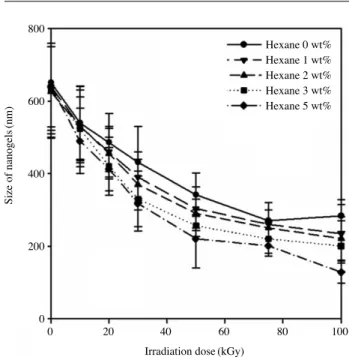
To observe the high-resolution images of the nanogels, Fig. 2. The size of PAAc nanogels; PAAc 1 wt%, hexane 0~5
wt%. Size of nanogels (nm) 800 600 400 200 0 Hexane 0 wt% Hexane 1 wt% Hexane 2 wt% Hexane 3 wt% Hexane 5 wt% 0 20 40 60 80 100
Irradiation dose (kGy)
Fig. 3. The size distribution of PAAc nanogels; PAAc 1 wt%, hexane 3 wt% (a) 10 kGy, (b) 50 kGy, (c) 75 kGy, (d) 100 kGy.
Intensity (%) Intensity (%) Intensity (%) Intensity (%) 25 20 15 10 5 0 25 20 15 10 5 0 25 20 15 10 5 0 25 20 15 10 5 0 (a) (b) (c) (d) 0 200 400 600 800 1000 Size of nanogels (nm) 0 200 400 600 800 1000 Size of nanogels (nm) 0 200 400 600 800 1000 Size of nanogels (nm) 0 200 400 600 800 1000 Size of nanogels (nm) 10 kGy 50 kGy 100 kGy 75 kGy
the samples were covered with a layer of osmium (Os) for 60 sec by sputter coating. The morphology and size of the nanogels was investigated with a field emission scanning electron microscope (FE-SEM S-4700, Hitach) at a resolu-tion of 60 Å at 5 kV, with a magnificaresolu-tion of 5.0 K and a
working distance of 10~12 mm. The size of nanogels can be calculated using the scale provided in the micrograph.
RESULTS AND DISCUSSION
Fig. 1 illustrate the absorption spectra for PAAc nanogels in the range of 300~600 nm. As shown in Fig. 1, the ab-sorption rates of PAAc nanogels were increased with the increasing irradiation doses. These caused a decrease in the transmissivity due to the nanoparticle preparation.
The nanogel size and distribution were measured with a PSA. Fig. 2 shows that the sizes of the PAAc nanogels were decreased with increasing electron beam irradiation doses and the content of hexane. The average size of the PAAc nanogels was determined to be approximately 180 nm at 100 kGy and hexane 5 wt%. These caused that the intra-molecular crosslinking occurs more at high irradiation doses than at low irradiation doses. Also, the size of the PAAc nanogels increased with an increasing content of hexane. This result is that the condensation of PAAc particles was accelerated with an increasing the content of hexane as a nonsolvent.
Fig. 3 shows the size distribution of the PAAc nanogels Fig. 4. Zeta potential (ζ-potential) of PAAc nanogels; PAAc 1 wt%,
hexane 0~5 wt%. Zeta potential (mv) -5 -10 -15 -20 -25 -30 -35 Hexane 0 wt% Hexane 1 wt% Hexane 2 wt% Hexane 3 wt% Hexane 5 wt% 0 20 40 60 80 100
Irradiation dose (kGy)
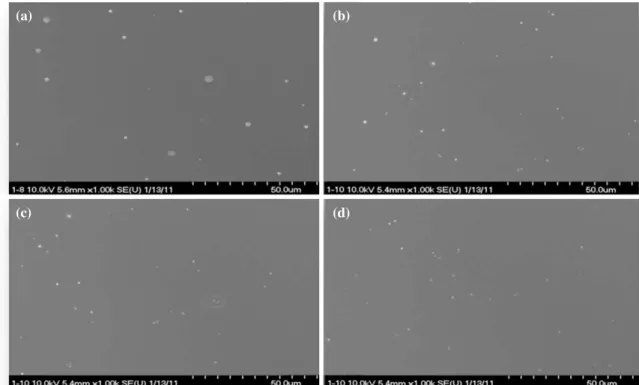
Fig. 5. Scanning electron microscopic images of nanogels; PAAc 1 wt%, hexane 3 wt% (a) 30 kGy, (b) 50 kGy, (c) 75 kGy, (d) 100 kGy.
(a) (b)
at PAAc 1 wt% and hexane 3 wt% with increasing irradia-tion doses. The PAAc nanogels have smaller size and nar-rower distribution with an increasing irradiation dose.
A zeta potential is the net surface charge of the nano-particle when they are inside a solution. The fact that parti-cles push each other and their agglomeration behavior de-pends on large negative or positive zeta potential. The zeta potential playing an important role limits in the stability of solutions is ++30 mV or -30 mV (Akman et al. 2011).
The zeta potential was measured by a particle size an-alyzer to study the interaction of nanogels. As shown in Fig. 4, the absolute value of the zeta potential was increased with increasing irradiation doses. Generally, the higher ab-solute value of the zeta potential, the more nanoparticles that were well distributed (Akman et al. 2011). The highest zeta potential of PAAc nanogels was approximately -29 mV at PAAc 1 wt%, hexane 5 wt% and 100 kGy. This means that the PAAc nanogels at 100 kGy was well distri-buted and that they are not easily aggregated. Also, the ab-solute value of the zeta potential was increased with increas-ing content of hexane. The PAAc nanogels are prepared by slow addition of the hexane to the water under moderate stirring. As previously stated, the PAAc nanogels with a well-defined size are prepared during the rapid condensation by hexane solution.
The morphology of the resulting nanogels was observed by scanning electron microscopy (SEM). Fig. 5 showed the SEM images of the nanogels at PAAc 1 wt%, Hexane 3 wt% with different irradiation doses. It was confirmed from the Fig. 5 that the PAAc nanogels were spherical in shape and the size of the nanogels decreased with an increasing in irradiation doses.
CONCLUSIONS
PAAc nanogels were synthesized at about a 180 nm scale and spherical in shapes without any catalyst by the elect-ron-beam irradiation. The size of the nanogels decreased with increasing irradiation doses, and absolute value of zeta potential increased with increasing irradiation doses. Also, the PAAc nanogels had a spherical in shape and the size of the nanogels decreased with an increasing in irradiation doses. In conclusion, the PAAc nanogels prepared by elec-tron-beam irradiation may contribute to their application as
biomaterials in drug delivery systems.
ACKNOWLEDGMENT
This work was supported by National Research Founda-tion of Korea (NRF) grant funded by the Ministry of Science, ICT (Information & Communication Technology) and Future Planning, Korea government (No.2013M2A2A6042482).
REFERENCES
Akman E, Genc Oztoprak B, Gunes M, Kacar E and Demir A. 2011. Effect of femtosecond Ti: Sapphire laser wavelengths on plasmonic behaviour and size evolution of silver nano-particles. Photonic. Nanostruct. 9:276-286.
Choi HJ and Kunioka M. 1995. Preparation conditions and swelling equilibria of hydrogel prepared by γ-irradiation from microbial poly(γ-glutamic acid). Radiat. Phys. Chem. 46:175-179.
Gaumet M, Vargas A, Gurny R and Delie F. 2008. Nanopar-ticles for drug delivery: The need for precision in reporting particle size parameters. Eur. J. Pharm. Biopharm. 69:1-9. Hughes GA. 2005. Nanostructure-mediated drug delivery.
Nano-medicine 1:22-30.
Kreuter J. 1991. Peroral administration of nanoparticles. J. Adv. Drug Deliv. Rev. 7:71-86.
Oh JK, Siegwart DJ, Lee HI, Sherwood G, Peteanu L, Hol-linger JO, Kataoka K and Matyjaszewski K. 2007. Biode-gradable Nanogels Prepared by Atom Transfer Radical Polymerization as Potential Drug Delivery Carriers: Synthe-sis, Biodegradation, in Vitro Release, and Bioconjugation. J. Am. Chem. Soc. 129:5939-5945.
Oh JK, Drumright R, Siegwart DJ and Matyjaszewski K. 2008. The development of microgels/nanogels for drug delivery applications. Prog. Polym. Sci. 33:448-477.
Peppas NA, Bures P, Leobandung W and Ichikawa H. 2000. Hydrogels in pharmaceutical formulations. Eur. J. Pharm. Biopharm. 50:27-46.
Peppas NA, Hilt JZ, Khademhosseini A and Langer R. 2006. Hydrogels in biology and medicine: from molecular prin-ciples to bionanotechnology. Adv. Mater. 18:1345-1360. Rieux AD, Fievez V, Garinot M, Schneider YJ and Preat V.
2006. Nanoparticles as potential oral delivery systems of proteins and vaccines: A mechanistic approach. J. Control Release 116:1-27.
Ulanski P and Rosiak JM. 1999. The use of radiation technique in the synthesis of polymeric nanogels. Nucl. Instruments
and methods in Phys. Res. B 151:356-360.
Van Thienen TG, Demeester J and De Smedt SC. 2008. Screen-ing poly(ethyleneglycol) micro- and nanogels for drug deli-very purposes. Macromolucules 351:174-185.
Vinogradov SV, Bronich TK and Kabanov AV. 2002. Nanosiz-ed cationic hydrogels for drug delivery: preparation,
pro-perties and interactions with cells. Adv. Drug Deliv. Rev. 54:135-147.V
Manuscript Received: April 3, 2014 Revised: April 16, 2014 Revision Accepted: April 28, 2014