Relationship Identification between Seven-Step
Planning Process and Plan-Do-Check-Act Cycle
Mincheol Kim*
INDEX
Introduction
Relationship between Seven-Step Planning Process and Plan-Do-Check-Act Cyble ifi. Results
I. Introduction
Seven-Step Planning Process and Plan-Do-Check-Act (PDCA) Cycle are approaches to make a decision problem solving, particularly focused on continuous improvement (CI) of quality processes (Barbara, 2008; Don Tapping, 2008). The step 1 of Seven-Step Planning Process is to make the mission or select a theme. The "Theme" is a brief description and statement of the weakness in the process, or the problem to be solved. And step 2 is on gathering facts about the problem and step 3 is to identify the Root Cause. The "Root Cause" is the most fundamental cause that one can discover producing the negative results in the current process. Step 4 is to bring together one's ideas
* Professor, Department of Management Information Systems, College of Economics and Commerce, Jeju National University
50 匿經論集 第30輯 '
of what is actually causing the problem and develop and implement an adjustment to the process and step 5 is to make sure the 'solution" actually solves the initial problem. After step 5, Step 6 is to revise the existing process to incorporate the solution and step 7 is to suggest a new weakness to tackle, and communicate what learned (Barbara, 2008). Also, in the PDCA concept, Plan-Do-Check-ACT cycle was made by Walter Shewart in the 1920s first time and became common by Edwards Deming as Deming cycle. Deming named as 'Study' instead of 'Check' in PDCA (Don Tapping, 2008).
In the context of similar concept, the objective of this study is to identify the relationship between Relationship between Seven-Step Planning Process and Plan-Do-Check-Act Cycle as a idea.
II. Relationship between Seven-Step Planning Process and
Plan-Do-Check-Act Cycle
For the comparison between the two models, this study used , matrix diagram method. The Matrix Diagram allows a many-to-many comparison of two lists (each list of PDCA and 7-Step Process), by changing the second list on its side to make a matrix.1)
1) http://www.syque.com/improvement/Matrix %2oDiagram.htm
Item 1 ∥em 2 Item 3 ∥em 4 ∥em 5 tern A tern B Ileni C Item 3 Item B
Relationship Identification between SevenStep Planning Process and 뫼an Do 이jeckAct Cycle 51
<Figure 1> Matrix Diagram
니si I 니탉 2 쎄 E 쁜 ㅁ F 프 。 ㅌ 르 。 E 르 니 E 르 Item 1 "em 2 0 0 0 0 0 0
꾜
9s,>
tem 3 0 0 ltern 4 0 0 0 tonG 00(Source: http://www.syque.comlimprovement/Matrix%2이iagram.htm)
First, this study analyzed the comparison of Plan (F) and Step 1, 2, 3 (Seven-Step Planning) with relationship proposed by PDCA improvement cycle (figure) of lecture note_lesson 2. Thus, this study made the table with each list for the comparison as follows.
<Table 1> Lists of Plan (F) and Step 1; 2, 3 (Seven-Step Planning)
Seven-Step Planning Process Plan-Do-Check-Act Cycle 1. Mission: Establish a Focus for the project
1.1 Who are the customers being served? 1.2 What are the needs of those customers? 1.3 What is the most important problem? 1.4 How will improvement be measured? 1.5 What is a one-sentence aim of the project?
Plan (P)
P.1 Establish the idea, theory, or prediction. P.2 Define the problem.
P.3. State the mission.
P.4 Identify internal and external customers needs and wants
P.5 Is the data available? P.6 Must a test be conducted? P.7 Localize the problem: what, when,
where it occurs, who is involved. P.8 Identify the root causes and verify them
with data.
P.9 Identify and evaluate possible solutions that address the root causes.
P.10 Plan a pilot solution. 2. Understand the Current Situation to
Determine problem
2.1 What are the steps in the current process? 2.2 How can you gather pertinent information? 2.3 How much information should you gather? Where can you get the information?
3. Determine and Analyze Root Causes 3.1 What are the possible root causes of the
problem that has been identified? 3.2 How will you verify that these are root
causes?
52 麗經論集 第30輯
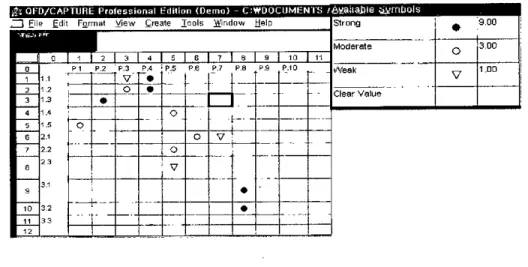
Next, the list table was changed as a matrix form as the following <figure 2>. To show the relationship, QFD software (http:!!qfdcapture.com/) was used and analyzed as follows.
<Figure 2> Matrix relationship between Plan (P) and Step 1, 2, 3 l
=그 E漣 트dit Format yjew 도reate Jㅁ이S 뾰odow 브etp 一 ㅁ 1 2 - 3 4 S 6 7 ㅣ 6 - 8 10 I " 0 P 1 P 2 P 3 V P 4 . P.S F6 P.7 P 8 P9 .1. ∼ .■ n 1 -2 0 ·
a
* 4 0n
0 6 0 Va
0 e V갹
. 10 . -I- Strong * 9.00 ',匕derate 0 ./eal〔 V 이ear valu.Figure 2 shows that 1.1(Who are the customers being served) has a strong relationship with P.4 (Identify internal and external customers needs and wants). However, this means that P.9. P.10 has no relationship with Step 3 of Seven-Step Planning Process and has a strong relationship with Step 4 of Seven-Step Planning Process. Thus, plan phase of PDCA may partly includes Step 4 contents of Seven-Step Planning Process.
Equally, the comparison of Do (P), Check(C) and Step 4, 5 (Seven-Step Planning) were analyzed. Also a matrix form was constituted as follows.
〕 f긔a 트lit FQrmat 切a w glreate ,rn1g 9fx》 ModotSo ㅇ 毓m eak `仍
.蠟· v出絡
Relat沁n짧tip Identification between SevenStep Planning Process and PlanDo--CheckAct C 'cIe 53
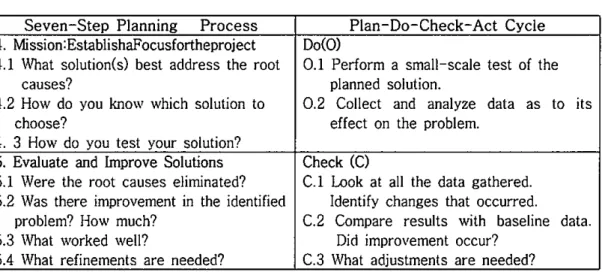
<Table 2> Lists of Do (D) and Step 4, 5 (Seven-Step Planning)
Seven-Step Planning Process Plan-Do-Check-Act Cycle 4. Mission:EstablishaFocusfortheproject Do(0)
4.1 What solution(s) best address the root 0.1 Perform a small-scale test of the causes? planned solution.
4.2 How do you know which solution to 0.2 Collect and analyze data as to its choose? effect on the problem.
3 How do you test your solution?
Evaluate and Improve Solutions Check (C)
5.1 Were the root causes eliminated? C.1 Look at all the data gathered. 5.2 Was there improvement in the identified Identify changes that occurred.
problem? How much? C.2 Compare results with baseline data. 5.3 What rorked well? Did improvement occur?
5.4 What refinements are needed? C.3 What adjustments are needed?
Figure 3 shows that 4.3 (How do you test your solution) has a strong
relationship with 0.1 (Perform a small-scale test of the planned solution). Also
5.2. 5.4 have a strong relationship with C2, C3 and so I think that matching
between Do (D) and Step 4. 5 is very high.
<Figure 3> Matrix relationship between Do (D) and Step 4,
Finally, the comparison of Act (A) and Step 6, 7 (Seven-Step Planning) were
□ 工크lle 트dit FQrmat 쐬ew create 氷ols Windo 낟.·훰래Die 놉【∥v .미S Stro' 」 * 9凹
蔽締-… 寸 ㅇ ;汁凹
欌굻 ∼-걍쟈 卞汕 OcJv.i --' ㅏ 기 2 1 2 3 가 6 6 7 7 7 7 54 産忽!論欒 鄒30絳<Table 3> Lists of Act (A) and Step 6, 7 (Seven-Step Planning)
Seven-Step Planning Process Plan-Do-Check-Act Cycle
6. Implement Solution(s) Full Scale Act (A)
6.1 What key steps in the new process A.1 Take action on a larger scale as a should be monitored to make sure that result of the initial test.
problems do not recur? A.2 Make the change permanent. 6.2 What needs to be done to implement A.3 Describe the new process.
this change on a full scale? A.4 Communicate it to everyone affected. 7. Capture Lessons Learned and Set A.5 Provide training.
Future Plans A.6 Develop methods for monitoring and 7.1 Were objectives met? ongoing evaluation.
7.2 Is further improvement needed? A.7 What was learned as a result of the 7.3 What other problems remain? improvement project?
7.4 What went well in the improvement A.8 How can we improve the process? What could be improved? improvement
process itself?
A.9 Continue with next improvement step in the process or close the project and identify the next one; return to Plan.
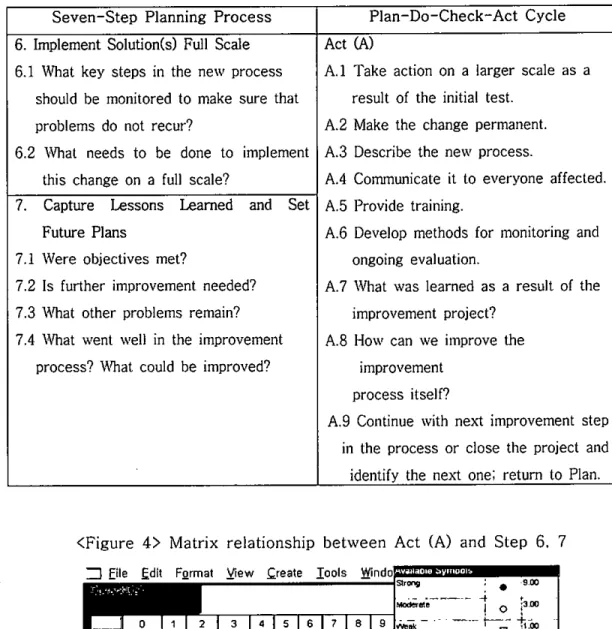
<Figure 4> Matrix relationship between Act (A) and Step 6, 7
Figure 4 shows that each 6.1, 6. 2 have a strong relationship with A.3, A·l.
Relationship Identification between SevenStep Planning Process and FleaDo Check Act Cycle 55
However, 7.1 (Were objectives met?) has no relationship with Act phase of PDCA Cycle and also A4∼A6 is independent lists with Seven-Step Planning Process.
ifi. Results
Seven-Step Planning Process and Plan-Do-Check-Act (PDCA) Cycle are approaches to make a decision problem solving. So far, these concepts were separate approaches. In this context, the objective of this study was to identify the relationship between these concept as a idea. Thus, this study utilized the QFD concept in order to make a matrix that can analyze the relationship. Through this approach, this paper may be expected to make another concept as conceptual combination.
56 産經論集 第30韓
REFERENCES
Barbara A. Carkenord (2008). Seven Steps to Mastering Business Analysis, .J. 77ps8 Publish,77聊 //7c.
Don Tapping (2008). The Simply Lean Pocket Guide - Making Great Organizations Better Through PLAN-DO-CHECK-ACT (PDCA) Kaizen Activities, MCS Media, Inc.
http://www.syque.corn/improvement/Matrix%20Diagram.htm [accessed 04 Feb 2013].
http://qfdcapture.com/ [accessed 04 Feb 20131.