World Journal of
Gastrointestinal
Oncology
W J G O
Submit a Manuscript: https://www.f6publishing.com World J Gastrointest Oncol 2020 October 15; 12(10): 1133-1145
DOI: 10.4251/wjgo.v12.i10.1133 ISSN 1948-5204 (online)
ORIGINAL ARTICLE
Retrospective Study
Minimally invasive vs open pancreatectomy for nonfunctioning
pancreatic neuroendocrine tumors
Juwan Kim, Ho Kyoung Hwang, Woo Jung Lee, Chang Moo Kang
ORCID number: Kim Juwan 0000-0002-2828-1524; Ho Kyoung Hwang
0000-0003-4064-7776; Woo Jung Lee
0000-0003-3116-0472; Chang Moo Kang 0000-0002-5382-4658. Author contributions: Kang CM designed the report; Kim J collected the patient’s clinical data, analyzed the data, and wrote the paper; Hwang HK and Lee WJ revised the paper for important intellectual content.
Institutional review board statement: This study was approved by the Ethics Committee of the Yonsei University Health System, Severance Hospital, Institutional Review Board (No. 4-2019-1136).
Informed consent statement: The Hospital’s Institutional Review Board waived the requirement for informed consent in accordance with the retrospective nature of the study.
Conflict-of-interest statement: The authors declare no conflicts of interest.
Data sharing statement: Data requests should be directed to [email protected]. Open-Access: This article is an open-access article that was
Juwan Kim, Department of Surgery, Yonsei University College of Medicine, Severance Hospital, Seoul 03722, South Korea
Ho Kyoung Hwang, Woo Jung Lee, Chang Moo Kang, Department of Surgery, Yonsei University College of Medicine, Seoul 03722, South Korea
Corresponding author: Chang Moo Kang, MD, PhD, Professor, Department of Surgery, Yonsei University College of Medicine, 50 Yonsei-ro, Seodaemun-gu, Seoul, Korea, Seoul 03722, South Korea. [email protected]
Abstract
BACKGROUND
The mainstay of treating nonfunctioning-pancreatic neuroendocrine tumors(NF-PNETs) is surgical resection. However, minimally invasive approaches to pancreatic resection for treating NF-PNETs are not widely accepted, and the long-term oncological outcomes of such approaches remain unknown.
AIM
To determine the short- and long-term outcomes of minimally invasive pancreatic resection conducted in patients with NF-PNETs.
METHODS
Prospective databases from Severance Hospital were searched for 110 patients who underwent curative resection for NF-PNETs between January 2003 and August 2018.
RESULTS
The proportion of minimally invasive surgery (MIS) procedures performed for NF-PNET increased to more than 75% after 2013. There was no significant difference in post-operative complications (P = 0.654), including pancreatic fistula (P = 0.890) and delayed gastric emptying (P = 0.652), between MIS and open approaches. No statistically significant difference was found in disease-free survival between the open approach group and the MIS group (median follow-up period, 28.1 mo; P = 0.428). In addition, the surgical approach (MIS vs open) was not found to be an independent prognostic factor in treating NF-PNET patients [Exp(β) = 1.062; P = 0.929].
selected by an in-house editor and fully peer-reviewed by external reviewers. It is distributed in accordance with the Creative Commons Attribution
NonCommercial (CC BY-NC 4.0) license, which permits others to distribute, remix, adapt, build upon this work non-commercially, and license their derivative works on different terms, provided the original work is properly cited and the use is non-commercial. See: htt p://creativecommons.org/licenses /by-nc/4.0/
Manuscript source: Unsolicited manuscript
Received: June 21, 2020
Peer-review started: June 21, 2020 First decision: July 30, 2020 Revised: August 17, 2020 Accepted: September 14, 2020 Article in press: September 14, 2020 Published online: October 15, 2020 P-Reviewer: Wada Y
S-Editor: Zhang H L-Editor: A P-Editor: Li JH
Regardless of the type of surgery, a minimally invasive approach can be safe and feasible for select NF-PNET patients.
Key Words: Nonfunctioning-pancreas neuroendocrine tumor; Pancreatic neuroendocrine
tumor; Minimally invasive surgery; Oncologic outcome; Laparoscopic pancreaticoduodenectomy; Laparoscopic distal pancreatectomy
©The Author(s) 2020. Published by Baishideng Publishing Group Inc. All rights reserved.
Core Tip: The mainstay of treating nonfunctioning-pancreatic neuroendocrine tumors
(NF-PNETs) is surgical resection. However, minimally invasive approaches to pancreatic resection for treating NF-PNETs are not widely accepted and the long-term oncological outcomes of such approaches remain unknown. In this Long-term retrospective study with large numbers of subjects, there was no significant difference the short-term outcomes and recurrence rate of open resection and minimally invasive resection of NF-PNET.
Citation: Kim J, Hwang HK, Lee WJ, Kang CM. Minimally invasive vs open pancreatectomy for nonfunctioning pancreatic neuroendocrine tumors. World J Gastrointest Oncol 2020; 12(10): 1133-1145
URL: https://www.wjgnet.com/1948-5204/full/v12/i10/1133.htm
DOI: https://dx.doi.org/10.4251/wjgo.v12.i10.1133
INTRODUCTION
Pancreatic neuroendocrine tumors (PNETs) are rare neoplasms of the pancreas, which are produced by multipotent stem cells in the pancreatic ductal epithelium. PNETs comprise only 1%-2% of pancreatic neoplasms but their incidence is increasing[1]. Nonfunctioning (NF)-PNETs account for 15%-50% of PNETs, and their incidence may be increasing because of increased rates of incidental detection in imaging studies for other reasons[1].
The main method for treating PNETs is surgical resection. The resection of primary tumors in patients with PNETs is associated with improved survival across all disease stages[2,3]. Low-risk PNETs in the pancreas body and tail are ideally treated with minimally invasive surgery (MIS), which should be tailored to the individual patient[4]. Some studies have shown that laparoscopic distal pancreatectomy of NF-PNETs has comparable post-operative complications and oncological outcomes to an open approach[5-7]. However, minimally invasive approaches to pancreaticoduo-denectomies and other types of surgery for treating NF-PNETs are not widely accepted, and the long-term oncological outcomes of such approaches remain unknown.
The objective of this study was to determine the short- and long-term outcomes of minimally invasive pancreatic resection performed in patients with NF-PNETs.
MATERIALS AND METHODS
Data collection
Prospective databases from Severance Hospital (Seoul, South Korea) were searched for patients who underwent curative resection for NF-PNETs between January 2003 and August 2018. Patients who underwent pancreatectomy in combination with resection were excluded. The Institutional Review Board approved this study (No. 4-2019-1136). Patients’ demographic, clinicopathologic and perioperative data were collected in an electronic medical record format and retrospectively reviewed. Patients who underwent distal pancreatectomy were defined as the distal-locating NF-PNET group; patients who underwent pylorus-preserving pancreaticoduodenectomy, central pancreatectomy, or total pancreatectomy for tumors located in the proximal part of the pancreas were defined as the proximal-locating NF-PNET group.
surgeon’s preference. R0 resection was characterized as a minimum margin length > 1 mm. When there was no direct margin involvement by the tumor or such involvement was < 1 mm from the resection margin, such resections were classified as R1. Incomplete resection of all gross residual tumor structures was defined as an R2 resection[8]. Tumor location was classified by the center of the tumor. Tumor grade was evaluated according to World Health Organization (WHO) classifications, using data from final pathological reports[9]. Post-operative complications were classied using the Clavien-Dindo classication system[10]. Post-operative pancreatic stulae were dened according to the definition created by the International Study Group of Pancreatic Fistula (commonly known as the ISGPF)[11]. Delayed gastric emptying was also defined according to the definition by the International Study Group of Pancreatic Surgery[12]. Disease recurrence was defined as suspicious image findings during post-operative surveillance. The duration of disease-free survival (DFS) was calculated from the date of surgery to the date of recurrence.
Statistical analysis
SPSS (version 22.0; IBM Corp., Armonk, NY, United States) and R 3.3.3 software was used to conduct statistical analyses. Numerical variables are presented as medians with interquartile ranges, and the group results were compared with the Student’s t-test or Mann-Whitney U t-test. Nominal variables are expressed as values and percentages and compared with the results of the chi-squared or Fisher’s exact test. Recurrence probabilities were estimated using Kaplan-Meier methodology and compared by log-rank analysis. Potential risk factors associated with tumor recurrence were analyzed using univariate and multivariate cox hazard regression models. To evaluate the correlation of tumor recurrence with MIS and open approaches, variables that were found to be associated with overall survival on univariate cox analysis and MIS were included in a multivariate cox proportional model. In all analyses, a two-tailed P value less than 0.05 was considered to be statistically significant.
RESULTS
General patient characteristics
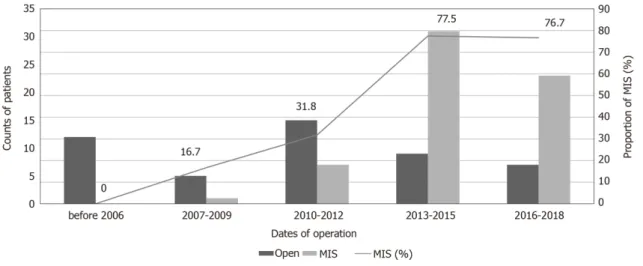
Between January 2003 and August 2018, a total of 110 patients underwent curative resection for NF-PNETs. Forty-eight patients (43.6%) underwent open curative resection, sixty-two (56.4%) minimally invasive curative resection, forty-seven laparoscopic curative resection (42.7%), and fifteen robot-assisted (13.6%) curative resection. Over the 15-year analysis period, the proportion of minimally invasive approaches increased to approximately 75% after 2013 (before 2007: 0%; 2007-2009: 16.7%; 2010-2012: 31.8%; 2013-2015: 77.5%; 2016-2018: 76.7%, P = 0.001, Figure 1).
The median age of the 110 patients who underwent curative resection for NF-PNETs was 56.0 years (range: 46.0-63.0 years), with more female patients than male patients (n = 59, 53.6%). Fifty-one (46.4%) patients underwent distal pancreatectomy, twenty-two (20.0%) enucleation, seven (6.4%) central pancreatectomy, twenty-one (19.1%) pylorus-preserving pancreaticoduodenectomy, and nine (8.2%) total pancreatectomy. The median tumor size was 1.8 cm (range: 1.2-3.2 cm). Approximately three-quarters of patients (n = 78, 70.9%) were grade 1 according to the 2010 WHO classification, 27 (24.54%) were grade 2, and 4 (3.63%) were grade 3. One patient (0.9%) who underwent open central pancreatectomy in 1993 could not be defined according to the 2010 WHO classification, due to the lack of mitotic counts and other information in the final pathological reports. After surgery, approximately 50% of patients experienced complications, of whom 9 (8.1%) experienced severe complications, defined as Clavien-Dindo grades III–IV. The median length of patient stay in the hospital was 11.5 d (range: 8.0-17.0 d). The clinicopathological characteristics and surgical details of NF-PNET patients are given in Table 1.
Comparative analysis of open and minimally invasive approaches in terms of distal
locations of NF-PNETs
A comparison of the clinicopathological characteristics and surgical details of distal pancreatectomy are given in Table 2. Overall, there were no significantly different perioperative clinical parameters between the open distal pancreatectomy group and the minimally invasive distal pancreatectomy group (P > 0.05). Complication rates also did not differ significantly between groups (P = 0.729). In addition, the occurrence of post-operative pancreatic fistulae also did not differ significantly between groups.
Table 1 Clinicopathological characteristics of resected nonfunctioning pancreatic neuroendocrine tumors
Variable Finding
Age in yr, median (range) 56.0 (46.0–63.0)
Male, n (%) 51 (46.4)
BMI in kg/m², median (range) 24.1 (22.1–26.3)
ASA, grade, n (%)
I 30 (27.3)
II 59 (53.6)
III 21 (19.1)
Diabetes, preoperative, n (%) 20 (18.2)
Pancreatic tumor location, n (%)
Head 41 (35.7) Neck 6 (5.2) Body 26 (22.6) Tail 42 (36.5) Type of surgery, n (%) Distal pancreatectomy 51 (46.4) Enucleation 22 (20.0) Central pancreatectomy 7 (6.4) Pylorus-preservingpancreaticoduodenectomy 21 (19.1) Total pancreatectomy 9 (8.2) MIS or open, n (%) MIS 62 (56.4) Open 48 (43.6)
Post-operative length of stay in d, median (range) 11.5 (8.0–17.0) Clavien-Dindo grade, n (%) 0: no complications 58 (52.7) I 35 (31.8) II 8 (7.3) IIIa 5 (4.5) IIIb 3 (2.7) IVa 1 (0.9) IVb 0 (0) POPF by ISGPF Grade A 47 (40.9%) Grade B 6 (5.2%) Grade C 0 (0%) DGE by ISGPS Grade A 18 (15.7%) Grade B 1 (0.9%) Grade C 0 (0%)
Resection margin status, n (%)
R1 5 (4.5)
R2 8 (7.3)
Pathological tumor size in cm, median (range) 1.8 (1.2–3.2) T stage by ENETS classification
T1 56 (50.9%) T2 18 (16.4%) T3 36 (32.7%) T4 0 (0.0%) N status Negative 57 (51.9%) Positive 9 (8.1%) No lymphadenectomy 44 (40.0%) Metastasis present, n (%) 5 (4.5)
2010 WHO classification grade, n (%)
G1 78 (70.9)
G2 27 (24.54)
G3 4 (3.63)
Unknown 1 (0.9)
ASA: American Society of Anesthesiologists; BMI: Body mass index; DGE: Delayed gastric emptying; ENETS: European Neuroendocrine Tumor Society; ISGPS: International Study Group on Pancreatic Surgery; ISGPF: International Study Group on Pancreatic Fistula; POPF: Post-operative pancreatic stulae; WHO: World Health Organization.
However, the minimally invasive distal pancreatectomy group tended to have a shorter average post-operative length of stay (8.0 d) than the open distal pancreatectomy group (14.0 d, P < 0.001). There were no significantly difference in the number of lymph node sampling between the open group and the minimally invasive group (P = 0.767).
Comparative analysis of open and minimally invasive approaches in terms of
proximal locations of NF-PNETs
Of the 110 patients, 37 were in the proximal location NF-PNET group, and 21 underwent pylorus-preserving pancreaticoduodenectomy (57%), 7 (19%) central pancreatectomy, and 9 (27%) total pancreatectomy because the tumor was located on the proximal part or involved the whole pancreas.
In the comparative analysis, there was no significant difference in the average rates of post-operative complications, including post-operative pancreatic fistulae and delayed gastric emptying, between the open and MIS groups (Table 3). The average length of post-operative stay did not significantly differ between the open group (20.0 d) and the MIS group (13.0 d) (P = 0.210). However, the average body mass index (referred to as BMI) of the open group (24.6) was significantly higher than that of the MIS group (21.9) (P = 0.006). The MIS group had a longer average operation time (512 min) than the open group (346 min) (P < 0.001). The average pathological tumor size (1.5 cm) was significantly smaller in the MIS group than in the open group (2.6 cm, P = 0.041). There were no significantly difference in the number of lymph node sampling between the open group and the minimally invasive group (P = 0.804).
Long-term oncological outcomes of NF-PNET resections
After a median follow-up period of 28.1 mo (range: 11.3–53.0 mo), 12 patients (10.9%) experienced recurrence (Open: 16.7%, MIS: 6.5%). Comparative analysis showed that there was no statistically significant difference in DFS rates between the open group and the MIS group (P = 0.428, Figure 2). In a subgroup analysis of distal location of NF-PNETs, with a median follow-up period of 22.1 mo (range: 10.7-41.3), 7 (13.7%) of the 51 patients who underwent distal pancreatectomy experienced recurrence (Open: 25%, MIS: 10.3%). There was no significant difference in DFS rates between the open
Table 2 Clinicopathological characteristics of minimally invasive and open approaches in terms of the distal location of nonfunctioning pancreatic neuroendocrine tumors
Variable Open approach, n = 12 MIS, n = 39 P value
Male 7 (58.3%) 19 (48.7%) 0.801
Age in yr, median (range) 58.5 (51.0-64.5) 56.0 (47.0-64.5) 0.617 BMI in kg/m², median (range) 24.6 (22.1-25.5) 24.8 (22.9-27.3) 0.418
ASA grade, n (%) 0.243
I 5 (41.7) 7 (17.9)
II 5 (41.7) 23 (59.0)
Ш 2 (16.7) 9 (23.1)
Spleen-preserving distal pancreatectomy 5 (41.7%) 26 (66.6%)
Conversion, n (%) - 4 (10.2)
Robot-assisted - 8 (20.5%)
Operative time as minimum, median (range) 179.0 (159.5–251.5) 216.0 (185.5–276.0) 0.105 Blood loss in cc, median (range) 175.0 (65.0–450.0) 100 (45.0–275.0) 0.093
Clavien-Dindo grade 0.729 0: no complications 7 (58.3%) 26 (66.7%) I 4 (33.3%) 10 (25.6%) II 1 (8.3%) 2 (5.1%) IIIa 0 (0.0%) 1 (2.6%) DGE by ISGPS 0.561 Grade A 0 (0.0%) 4 (10.3%) Grade B 0 (0.0%) 0 (0.0%) Grade C 0 (0.0%) 0 (0.0%) POPF by ISGPF 0.805 Grade A 7 (58.3%) 20 (51.3%) Grade B 0 (0.0%) 1 (2.6%) Grade C 0 (0.0%) 0 (0.0%)
Post-operative length of stay in d, median (range)
14.0 (11.5-16.0) 8.0 (7.0-10.5) < 0.001
Resection margin status 0.612
R0 12 (100.0%) 36 (92.3%)
R1 0 (0.0%) 2 (5.1%)
R2 0 (0.0%) 1 (2.6%)
Pathological tumor size in cm, median (range) 2.5 (1.4-3.9) 2.0 (1.5-3.2) 0.548
T stage by ENETS classification 0.563
T1 5 (41.7%) 20 (51.3%) T2 2 (16.7%) 9 (23.1%) T3 5 (41.7%) 10 (25.6%) N stage 0.056 Negative 9 (75.0%) 38 (97.4%) Positive 3 (25.0%) 1 (2.6%) M stage
0 12 (100.0%) 39 (100.0%)
Nodal harvest, median (range) 0.0 (0.0-5.5) 1.0 (0.0-3.5) 0.767
2010 WHO grade 0.365
G1 7 (57.1%) 25 (64.1%)
G2 4 (42.9%) 14 (35.9%)
G3 1 (8.3%) 0 (0%)
ASA: American Society of Anesthesiologists; BMI: Body mass index; DGE: Delayed gastric emptying; ENETS: European Neuroendocrine Tumor Society; ISGPS: International Study Group on Pancreatic Surgery; ISGPF: International Study Group on Pancreatic Fistula; MIS: Minimally invasive surgery; POPF: Post-operative pancreatic stulae; WHO: World Health Organization.
and MIS groups (P = 0.418). In addition, with a median follow-up period of 31.8 mo (range: 10.0–41.3 mo), 5 (13.5%) of the 37 patients, who had proximally located NF-PNETs, experienced recurrence. There were also no significant differences in terms of DFS rates between the Open and MIS groups for treatment of proximally located NF-PNETs (P = 0.178).
Univariate analysis showed that tumor size > 2.5 cm [hazard ratio (HR): 22.21, 95%CI: 2.86-172.69; P = 0.003], 2010 WHO classification of G3 (HR: 71.55, 95%CI: 6.43-795.75; P = 0.001), and lympho-vascular invasion (HR: 8.77, 95%CI: 2.75-27.93; P < 0.001) were associated with tumor recurrence. Multivariate analysis also showed that these factors were associated with tumor recurrence. However, surgical approach, namely either MIS or open, was not associated with tumor recurrence (Table 4,
Figure 2).
DISCUSSION
The current study showed that there was no significant difference in the short- and long-term outcomes of open resection and MIS. The surgical approach was not found to be an independent prognostic factor in treating NF-NET patients.
Since Gumbs et al[13] (2008) reported that minimally invasive distal pancreatectomy had shorter surgical durations and lengths of hospital stay than open distal pancreatectomy and similar levels of post-operative complications and oncological outcomes, many centers that perform laparoscopic distal pancreatectomies on PNET patients have shown the feasibility of a laparoscopic approach and its relative safety compared to open resection[14-16]. Laparoscopic distal pancreatectomies have similar oncological outcomes and levels of post-operative complications as open distal pancreatectomies but shorter hospital stays[6,7,17]. The other study also showed that robotic assisted distal pancreatectomy and laparoscopic distal pancreatectomy were similar in post-operative complication and long term outcomes[18]. Some studies have also been conducted in functional-PNET and NF-PNET patients. The current study was conducted with NF-PNET patients only, but its results were similar to those on distal pancreatectomies.
Previous studies showed lymph node metastasis in pNET indicated poor prognosis[19,20]. However a study have suggested that routine conventional distal pancreatectomies with splenectomies to retrieve regional lymph nodes may be too extensive for NF-PNET patients with 2010 WHO classification grade 1[21]. In this study, there are no significant difference between MIS and open approach in nodal harvest. Thus, minimally invasive distal pancreatectomies are a feasible and safe method for treating NF-PNET patients.
Some studies have compared minimally invasive and open pancreatic resections to other types of pancreatic resections for PNETs. One study showed that a minimally invasive approach and parenchyma-sparing techniques for treating PNETs did not increase morbidity or reduce survival rates[22]. In addition, other studies showed that minimally invasive and parenchyma-sparing operations were associated with shorter hospital stays[23,24,25]. However, that study did not compare the minimally invasive approach and open resection but rather compared traditional pancreatic resection and minimally invasive approaches with parenchyma-sparing techniques (central pancreatectomy, enucleation). In this study, in proximal pancreatic resections, including central pancreatectomies, pancreaticoduodenectomies and total pancreatectomies, open and minimally invasive resections had similar levels of
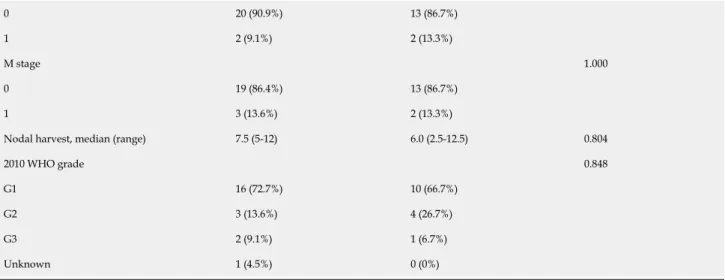
post-Table 3 Clinicopathological characteristics of the minimally invasive surgery and open groups in terms of the proximal location of nonfunctioning pancreatic neuroendocrine tumors
Variable Open, n = 22 MIS, n = 15 P value
Male 11 (50.0%) 5 (33.3%) 0.505
Age in yr, median (range) 53.5 (40.0–65.0) 53.0 (43.0–65.5) 0.631 BMI in kg/m², median (range) 24.6 (22.7–27.3) 21.9 (21.1–23.4) 0.006
ASA grade, n (%) 0.069 I 6 (27.3) 0 (0.0) II 14 (63.6) 12 (80.0) III 2 (9.1) 3 (20.0) Type of surgery 0.541 Central pancreatectomy 3 (13.6%) 4 (26.7%) PPPD 14 (63.6%) 7 (46.7%) Total pancreatectomy 5 (22.7%) 4 (26.7%)
Operative time in min, median (range) 346.0 (295.0-400.0) 512.0 (462.5-530.0) < 0.001 Blood loss in cc, median (range) 450.0 (100.0-1020.0) 400. (175.0-450.0) 0.515
Clavien-Dindo grade 0.489 0: no complications 10 (45.5%) 4 (26.7%) I 8 (36.4%) 5 (33.3%) II 1 (4.5%) 3 (20.0%) IIIa 1 (4.5%) 1 (6.7%) IIIb 2 (9.1%) 1 (6.7%) IV 0 (0.0%) 1 (6.7%) DGEby ISGPS 0.457 Grade A 7 (31.8%) 5 (33.3%) Grade B 0 (0.0%) 1 (6.7%) Grade C 0 (0.0%) 0 (0.0%) POPF by ISGPF 0.571 Grade A 5 (22.7%) 4 (26.7%) Grade B 1 (4.5%) 2 (13.3%) Grade C 0 (0.0%) 0 (0.0%)
Post-operative length of stay in d, median (range)
20.0 (14.0–30.0) 13.0 (10.5–24.5) 0.210
Resection margin status 0.505
R0 20 (90.9%) 15 (100.0%)
R1 0 (0.0%) 0 (0.0%)
R2 2 (9.1%) 0 (0.0%)
Pathological tumor size incm, median (range) 2.6 (1.5-4.5) 1.5 (1.3-2.2) 0.041
T stage by ENETs classification 0.081
T1 6 (27.3%) 8 (53.3%)
T2 5 (22.7%) 0 (0.0%)
T3 11 (50.0%) 7 (46.7%)
0 20 (90.9%) 13 (86.7%)
1 2 (9.1%) 2 (13.3%)
M stage 1.000
0 19 (86.4%) 13 (86.7%)
1 3 (13.6%) 2 (13.3%)
Nodal harvest, median (range) 7.5 (5-12) 6.0 (2.5-12.5) 0.804
2010 WHO grade 0.848
G1 16 (72.7%) 10 (66.7%)
G2 3 (13.6%) 4 (26.7%)
G3 2 (9.1%) 1 (6.7%)
Unknown 1 (4.5%) 0 (0%)
ASA: American Society of Anesthesiologists; BMI: Body mass index; DGE: Delayed gastric emptying; ENETS: European Neuroendocrine Tumour Society; ISGPS: International Study Group on Pancreatic Surgery; ISGPF: International Study Group on Pancreatic Fistula; MIS: Minimally invasive surgery; POPF: Post-operative pancreatic stulae; PPPD: Pylorus-preserving pancreaticoduodenectomy; WHO: World Health Organization.
Table 4 Factors associated with tumor recurrence after curative resection of nonfunctioning pancreatic neuroendocrine tumors
Univariate analysis Multivariate analysis Variable
HR 95%CI P value HR 95%CI P value
Age > 60 yr 0.40 0.09-1.83 0.239
Male 1.95 0.62-6.16 0.254
Minimally invasive surgery 0.61 0.18-2.09 0.432 1.062 0.28-4.03 0.929 Tumor size > 2.5 cm 22.21 2.86-172.69 0.003 16.21 1.99-128.8 0.009 Positive resection margin 1.52 0.33–6.99 0.589
Poor differentiation, G3 71.55 6.43-795.75 0.001 24.429 1.99-277.95 0.017 Positive lymph node 1.93 0.42–8.83 0.398
Lympho-vascular invasion 8.77 2.75-27.93 < 0.001 3.56 0.96-13.2 0.058
HR: Hazard ratio.
operative complications. There was no difference between the rates of post-operative pancreatic fistulae. PNET patients had high risks of forming post-operative pancreatic fistulae, because the pancreas is soft and its ducts have small diameters[26]. Large tumor size, poor differentiation, and lympho-vascular invasion are associated with NF-PNET tumor recurrence in this study and other study[27]. The diagnosis and treatment of NF-PNETs may be slow because of its rarity[28]. Delayed diagnosis and treatment of PNETs are associated with more advanced tumor characteristics and higher recurrence rates[29]. The early diagnosis of PNETs is an important component of good prognoses for NF-PNET patients.
In this study, BMI and pathological tumor size in the Open and MIS groups differed for proximal pancreatic resections. The baseline characteristics of the groups may have differed because the resection approach was determined by tumor factors and surgeon’s preference. Other studies have suggested criteria for selecting a minimally invasive approach to treat left-sided pancreatic cancer[16,30]. The criteria used to select resected PNET patients may help improve the prognosis of the minimally invasive approach. In the current study, there was no difference in length of hospital stay between the minimally invasive approach group and the open resection group for proximal pancreatic resections. However, several studies have shown that a minimally invasive approach to pancreatic resection is strongly correlated with shorter hospital stays[6,7]. The fact that the current study showed no differences between groups may be a product of patient heterogeneity.
Figure 1 Changes in surgical approaches for treating nonfunctioning-pancreatic neuroendocrine tumors over time. MIS: Minimally invasive surgery.
Figure 2 Comparison of disease-free survival rates between open pancreatic resection and minimally invasive approaches for treating patients with nonfunctioning pancreatic neuroendocrine tumors. DFS: Disease-free survival; MIS: Minimally invasive surgery; NF-PNET:
Nonfunctioning-pancreatic neuroendocrine tumors.
retrospective review of patient data and analyzed patients from a single center. Most of the patients who underwent a minimally invasive approach were diagnosed after 2007, so they had shorter follow-up durations than the open pancreatic resection group. As the skills of pancreatic surgeons improve in using a minimally invasive approach, surgical duration, intra-operative bleeding amount, post-operative complication rates, conversion rates, and long-term outcomes are expected to differ over time. Surgeons chose whether to apply a minimally invasive approach, and subgroup analysis showed that the open pancreatic resection group had more advanced tumor features and a higher BMI than the MIS group. In the current study, minimally invasive approaches included laparoscopic and robotic approaches, so future studies should compare these approaches for the treatment of PNET patients.
CONCLUSION
The proportion of minimally invasive approaches for the treatment of NF-PET has increased to more than 75%. There were no significant differences in the short- and long-term outcomes between open resection and minimally invasive distal pancreatectomy for the treatment of NF-PNET patients. Minimally invasive approaches including pylorus-preserving pancreaticoduodenectomies, central pancreatectomies, and total pancreatectomies had comparable post-operative complication rates and short-term outcomes. Regardless of the type of surgery, a minimally invasive approach may be safe and feasible for selected NF-PNET patients undergoing pancreatic resection.
ARTICLE HIGHLIGHTS
Research background
The mainstay of treatment for nonfunctioning (NF)-pancreatic neuroendocrine tumors (PNETs) is surgical resection. Minimally invasive approaches to pancreatic resection are not yet widely accepted as NF-PNET treatment.
Research motivation
Some studies have shown laparoscopic distal pancreatectomy of NF-PNETs as producing post-operative complications and oncological outcomes that are comparable to the open approach. However, the long-term oncological outcomes of minimally invasive approaches to pancreaticoduodenectomies and other types of surgery for treating NF-PNETs remain unknown.
Research objectives
The current study was designed to determine the short- and long-term outcomes of minimally invasive pancreas resection conducted on patients with NF-PNETs.
Research methods
Severance Hospital’s prospective databases were searched for patients who underwent curative resections for NF-PNETs between January 2003 and August 2018. Patients who underwent pancreatectomy in combination with resection were excluded.
Research results
Groups of patients who underwent proximal pancreas resections (central pancreatectomies, pancreaticoduodenectomies, and total pancreatectomies), open resection, and minimally invasive resection showed similar levels of post-operative complications. The groups showed no difference between the rates of post-operative pancreatic fistulae. However, PNET patients showed high risk of forming post-operative pancreatic fistulae, due to the softness of the pancreas and small diameter of its ducts. Large tumor size, poor differentiation, and lympho-vascular invasion were associated with NF-PNET tumor recurrence.
Research conclusions
Minimally invasive approaches of pylorus-preserving pancreaticoduodenectomy, central pancreatectomy, and total pancreatectomy led to comparable post-operative complication rates and short-term outcomes. The type of surgical approach (minimally invasive vs open) was not an independent prognostic factor in treating NF-PNET patients [Exp(β) = 1.062, P = 0.929]. Regardless of the type of surgery, a minimally invasive approach could be safe and feasible for select NF-PNETs patients who are undergoing pancreas resection.
Research perspectives
The current study of minimally invasive pancreatic surgeries collectively evaluated laparoscopic and robotic approaches. Future studies should involve comparison of the two ¾ laparoscopic vs robotic ¾ in treating PNET patients. Furthermore, use of the latest criteria to select resected PNET patients may help improve prognosis of the minimally invasive approach.
REFERENCES
Anderson CW, Bennett JJ. Clinical Presentation and Diagnosis of Pancreatic Neuroendocrine Tumors. Surg
Oncol Clin N Am 2016; 25: 363-374 [PMID: 27013370 DOI: 10.1016/j.soc.2015.12.003] 1
Hill JS, McPhee JT, McDade TP, Zhou Z, Sullivan ME, Whalen GF, Tseng JF. Pancreatic neuroendocrine
tumors: the impact of surgical resection on survival. Cancer 2009; 115: 741-751 [PMID: 19130464 DOI:
10.1002/cncr.24065] 2
Kang CM, Kim KS, Choi JS, Lee WJ, Kim BR. Experiences with nonfunctioning neuroendocrine neoplasms
of the pancreas. Dig Surg 2005; 22: 453-458 [PMID: 16543738 DOI: 10.1159/000092011] 3
D'Haese JG, Tosolini C, Ceyhan GO, Kong B, Esposito I, Michalski CW, Kleeff J. Update on surgical
treatment of pancreatic neuroendocrine neoplasms. World J Gastroenterol 2014; 20: 13893-13898 [PMID:
25320524 DOI: 10.3748/wjg.v20.i38.13893] 4
Cienfuegos JA, Salguero J, Núñez-Córdoba JM, Ruiz-Canela M, Benito A, Ocaña S, Zozaya G,
Martí-Cruchaga P, Pardo F, Hernández-Lizoáin JL, Rotellar F. Short- and long-term outcomes of laparoscopic organ-sparing resection in pancreatic neuroendocrine tumors: a single-center experience. Surg Endosc 2017;
31: 3847-3857 [PMID: 28127714 DOI: 10.1007/s00464-016-5411-y] 5
Han SH, Han IW, Heo JS, Choi SH, Choi DW, Han S, You YH. Laparoscopic versus open distal
pancreatectomy for nonfunctioning pancreatic neuroendocrine tumors: a large single-center study. Surg
Endosc 2018; 32: 443-449 [PMID: 28664429 DOI: 10.1007/s00464-017-5702-y] 6
Zhang XF, Lopez-Aguiar AG, Poultsides G, Makris E, Rocha F, Kanji Z, Weber S, Fields R, Krasnick BA,
Idrees K, Smith PM, Cho C, Schmidt CR, Maithel SK, Pawlik TM; United States Neuroendocrine Tumor Study Group. Minimally invasive versus open distal pancreatectomy for pancreatic neuroendocrine tumors: An analysis from the U.S. neuroendocrine tumor study group. J Surg Oncol 2019; 120: 231-240 [PMID:
31001868 DOI: 10.1002/jso.25481] 7
Standards and Minimum Datasets for Reporting Cancers. Minimum Dataset for the Histopathological Reporting of Pancreatic, Ampulla of Vater and Bile Duct Carcinoma. London, UK: The Royal College of Pathologists, 2019
8
Klöppel G, Perren A, Heitz PU. The gastroenteropancreatic neuroendocrine cell system and its tumors: the
WHO classification. Ann N Y AcadSci 2004; 1014: 13-27 [PMID: 15153416 DOI: 10.1196/annals.1294.002] 9
Dindo D, Demartines N, Clavien PA. Classification of surgical complications: a new proposal with
evaluation in a cohort of 6336 patients and results of a survey. Ann Surg 2004; 240: 205-213 [PMID:
15273542 DOI: 10.1097/01.sla.0000133083.54934.a] 10
Bassi C, Dervenis C, Butturini G, Fingerhut A, Yeo C, Izbicki J, Neoptolemos J, Sarr M, Traverso W,
Buchler M; International Study Group on Pancreatic Fistula Definition. Postoperative pancreatic fistula: an international study group (ISGPF) definition. Surgery 2005; 138: 8-13 [PMID: 16003309 DOI:
10.1016/j.surg.2005.05.00] 11
Wente MN, Bassi C, Dervenis C, Fingerhut A, Gouma DJ, Izbicki JR, Neoptolemos JP, Padbury RT, Sarr
MG, Traverso LW, Yeo CJ, Büchler MW. Delayed gastric emptying (DGE) after pancreatic surgery: a suggested definition by the International Study Group of Pancreatic Surgery (ISGPS). Surgery 2007; 142: 761-768 [PMID: 17981197 DOI: 10.1016/j.surg.2007.05.005]
12
Gumbs AA, Grès P, Madureira F, Gayet B. Laparoscopic vs open resection of pancreatic endocrine
neoplasms: single institution's experience over 14 years. Langenbecks Arch Surg 2008; 393: 391-395 [PMID:
18196267 DOI: 10.1007/s00423-007-0255-5] 13
Xourafas D, Tavakkoli A, Clancy TE, Ashley SW. Distal pancreatic resection for neuroendocrine tumors: is
laparoscopic really better than open? J Gastrointest Surg 2015; 19: 831-840 [PMID: 25759075 DOI:
10.1007/s11605-015-2788-] 14
Ishida H, Lam AK. Pancreatic neuroendocrine neoplasms: The latest surgical and medical treatment
strategies based on the current World Health Organization classification. Crit Rev OncolHematol 2020; 145: 102835 [PMID: 31864179 DOI: 10.1016/j.critrevonc.2019.102835]
15
DiNorcia J, Lee MK, Reavey PL, Genkinger JM, Lee JA, Schrope BA, Chabot JA, Allendorf JD. One
hundred thirty resections for pancreatic neuroendocrine tumor: evaluating the impact of minimally invasive and parenchyma-sparing techniques. J Gastrointest Surg 2010; 14: 1536-1546 [PMID: 20824378 DOI:
10.1007/s11605-010-1319-3] 16
Hu BY, Wan T, Zhang WZ, Dong JH. Risk factors for postoperative pancreatic fistula: Analysis of 539
successive cases of pancreaticoduodenectomy. World J Gastroenterol 2016; 22: 7797-7805 [PMID:
27678363 DOI: 10.3748/wjg.v22.i34.7797] 17
Alfieri S, Butturini G, Boggi U, Pietrabissa A, Morelli L, Vistoli F, Damoli I, Peri A, Fiorillo C, Pugliese L,
Ramera M, De Lio N, Di Franco G, Esposito A, Landoni L, Rosa F, Menghi R, Doglietto GB, Quero G; Italian Robotic pNET Group. Short-term and long-term outcomes after robot-assisted versus laparoscopic distal pancreatectomy for pancreatic neuroendocrine tumors (pNETs): a multicenter comparative study.
Langenbecks Arch Surg 2019; 404: 459-468 [PMID: 31055639 DOI: 10.1007/s00423-019-01786-x] 18
Boninsegna L, Panzuto F, Partelli S, Capelli P, DelleFave G, Bettini R, Pederzoli P, Scarpa A, Falconi M.
Malignant pancreatic neuroendocrine tumour: lymph node ratio and Ki67 are predictors of recurrence after curative resections. Eur J Cancer 2012; 48: 1608-1615 [PMID: 22129889 DOI: 10.1016/j.ejca.2011.10.030] 19
Hashim YM, Trinkaus KM, Linehan DC, Strasberg SS, Fields RC, Cao D, Hawkins WG. Regional
lymphadenectomy is indicated in the surgical treatment of pancreatic neuroendocrine tumors (PNETs). Ann
Surg 2014; 259: 197-203 [PMID: 24253141 DOI: 10.1097/SLA.0000000000000348] 20
Yoo YJ, Yang SJ, Hwang HK, Kang CM, Kim H, Lee WJ. Overestimated Oncologic Significance of Lymph
Node Metastasis in G1 Nonfunctioning Neuroendocrine Tumor in the Left Side of the Pancreas. Medicine
(Baltimore) 2015; 94: e1404 [PMID: 26356692 DOI: 10.1097/MD.0000000000001404] 21
Paiella S, De Pastena M, Korrel M, Pan TL, Butturini G, Nessi C, De Robertis R, Landoni L, Casetti L,
Giardino A, Busch O, Pea A, Esposito A, Besselink M, Bassi C, Salvia R. Long term outcome after 22
International multicenter retrospective study. Eur J SurgOncol 2019; 45: 1668-1673 [PMID: 31005470 DOI:
10.1016/j.ejso.2019.04.004]
Gharios J, Hain E, Dohan A, Prat F, Terris B, Bertherat J, Coriat R, Dousset B, Gaujoux S. Pre- and
intraoperative diagnostic requirements, benefits and risks of minimally invasive and robotic surgery for neuroendocrine tumors of the pancreas. Best Pract Res Clin Endocrinol Metab 2019; 33: 101294 [PMID:
31351817 DOI: 10.1016/j.beem.2019.101294] 23
Weilin M, Xu H, Yang L, Wenqi C, Huanyu W, Wentao Z, Dayong J, Wenchuan W, Dansong W, Tiantao
K, Lei Z, Wenhui L, Xuefeng X. Propensity score-matched analysis of clinical outcome after enucleation versus regular pancreatectomy in patients with small non-functional pancreatic neuroendocrine tumors.
Pancreatology 2020; 20: 169-176 [PMID: 31941586 DOI: 10.1016/j.pan.2019.12.007] 24
Memeo R, Roselli S, Lupo L, Cherkaoui Z, Pessaux P. Laparoscopic management of neuroendocrine tumors:
state-of-the-art. Transl Gastroenterol Hepatol 2017; 2: 109 [PMID: 29354766 DOI:
10.21037/tgh.2017.11.19] 25
Andreasi V, Muffatti F, Guarneri G, Falconi M, Partelli S. Surgical Principles in the Management of
Pancreatic Neuroendocrine Neoplasms. Curr Treat Options Oncol 2020; 21: 48 [PMID: 32350693 DOI:
10.1007/s11864-020-00736-w] 26
Assi HA, Mukherjee S, Kunz PL, Machiorlatti M, Vesely S, Pareek V, Hatoum H. Surgery Versus
Surveillance for Well-Differentiated, Nonfunctional Pancreatic Neuroendocrine Tumors: An 11-Year Analysis of the National Cancer Database. Oncologist 2020; 25: e276-e283 [PMID: 32043766 DOI:
10.1634/theoncologist.2019-0466] 27
Kang CM, Park SH, Kim KS, Choi JS, Lee WJ, Kim BR. Surgical experiences of functioning
neuroendocrine neoplasm of the pancreas. Yonsei Med J 2006; 47: 833-839 [PMID: 17191313 DOI:
10.3349/ymj.2006.47.6.833] 28
Lee L, Ito T, Jensen RT. Prognostic and predictive factors on overall survival and surgical outcomes in
pancreatic neuroendocrine tumors: recent advances and controversies. Expert Rev Anticancer Ther 2019; 19: 1029-1050 [PMID: 31738624 DOI: 10.1080/14737140.2019.1693893]
29
Lee SH, Hwang HK, Kang CM, Lee WJ. The Yonsei criteria as a clinically detectable parameter for
excellent prognosis in resected left-sided pancreatic cancer: outcomes of a propensity score-matched analysis. Surg Endosc 2017; 31: 4656-4664 [PMID: 28389802 DOI: 10.1007/s00464-017-5529-6] 30