Acupuncture Treatment about Medial Meniscus Posterior Horn Rupture
: A Case Report
Hey-Jin Lee, Nam-Heon Lee, Chang-Gue Son, Jung-Hyo Cho
Dept. of Internal Medicine, College of Korean Medicine, Daejeon University
Ⅰ. Introduction
The knee joint disease is one of the most common conditions of Korean. 2,869,031 patients visited hospitals for a total of 20,057,289 days in 2018, according to the National Health Insurance Statistical Yearbook in 2018. The frequency of knee joint disease ranked 20th, and the cost of medical treatment amounts to 1,506,815,942 won1. Especially meniscal posterior horn tear has
an inadequate response to preservation treatment2, arthroscopic treatment or restoration
is being applied as a top priority, incurring a financial and temporal loss.
The medial meniscus posterior horn plays an essential role in the knee joint dynamics 3, the reason that the knee joint movement promotes degenerative changes. Recent studies show that 87% of patients failed preservation treatment, and 31% of patients performed total knee arthroplasty with the medial meniscus posterior horn ruptures
2.
Treatment of medial meniscus rupture includes non-operative treatment, meniscectomy, posterior meniscal root repair, suture anchor repair, transtibial pull-out repair. Non-operative treatment is the last choice of patients whose prognosis is not good even after operation 4.
Arthroscopy was the first choice, but the priority choice has changed the restoration. 79.7% of Patients who got operation avoided degenerative changes after surgical repair 5.
On the other hand, acupuncture treatments are not commonly used for a meniscus tear. However, many studies show that chronic knee pain could be reduced by acupuncture implementation. More than four acupoints, 20 minutes needle retaining, once a week, and six times acupuncture treatment could treat the chronic knee pain according to the meta-analysis of the acupoint treatment of chronic knee pain 6.
Arthroscopic treatment or restoration aims for relieving pain and preventing additional damage of the knee joint, restoring the normal dynamic
Objectives : In this case, the knee joint inconvenience with deteriorating pain has been relieved by acupuncture
treatment for a patient was 51-year-old male with a left medial meniscal posterior horn rupture in 2012.
Methods : Twenty-four times of acupuncture treatments were performed for Twelve weeks from July 2016 to
improve the disease. SP8(Jigi; 地機), BL63(Geummun; 金門), KI3(Taegye; 太谿), LI4(Hapgok; 合谷) were chosen for treatment by principles of Traditional Korean Medicine.
Results : Numeric Rating Scales, which means subjective pain, decreased from 6 points to 3 points out of 10
points in total. Pressure Pain Threshold, which means sensitivity to pressure applied to the affected area, increased from 21N to 47N on the lateral-inferior side and from 19N to 50N on the lateral side. K-WOMAC, which indicates discomfort of knee-related activity, was 56 points out of 96 points in total before treatment and 4 points after treatment, 13 points after two years, and 15 points after four years. However, MRI tests conducted before and after treatment did not identify any significant changes.
As a result, we confirmed that a total of 24 acupuncture treatments had resulted in the relief objective and subjective pain and functional recovery, especially in the case of the knee function, maintained until after four years later. There was no significant substrate recovery in meniscal rupture.
mechanism4. Therefore, if acupuncture treatments
relieve pain and protect from deterioration of the knee joint, patients will reduce the cost of the treatment and prevent the dysfunction due to surgery itself.
Thus, we illustrate the case in which acupuncture has reduced pain and restored function of a left medial meniscal posterior horn rupture.
Ⅱ. A Patient
In 2016, a 51-year-old male patient was treated for medial left knee pain. Symptoms began two years before the first medical examination in 2012. The patient could not remember the onset as a specific event because there was no traumatic event at the onset and no medical history relating to the knee joint. The patient used to play golf, tennis, and do other physical activities frequently, but had all stopped because of pain. After onset, he had done conservative care without surgical treatment.
At the first examination of our acupuncture treatment in July 2016, he was 171cm tall and weighed 84kg. BMI was 28.7. There was no underlying disease without hypertension. He walked under 2 hours and used stairs under three times per day. There was no squatting or any other movement to apply direct load to knees daily.
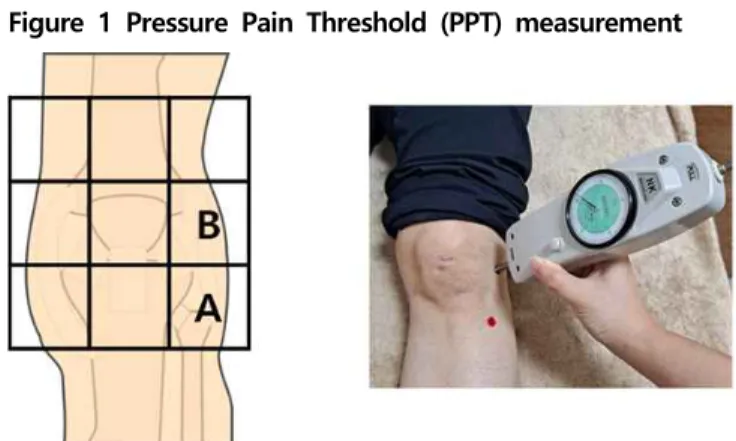
The pain was concentrated on the lateral-inferior(A point) and lateral(B point) side of the left knee. (Figure 1) There was no resistance of knee flexion and extension, and no edema of the anterior, posterior, and lateral side of knees. MRI revealed a degenerative change of knee joint cartilage and rupture of a medial meniscal posterior horn on 6th July 2016. There
was no definite fracture line at the femur and tibia.
Figure 1 Pressure Pain Threshold (PPT) measurement
Ⅲ. Acupuncture treatments
From 12th July 2016 to 14th October 2016,
the patient got twice acupuncture treatments per week. Acupoints are selected by Traditional Korean Medicine theory; SP8(Jigi; 地機), BL63(Geummun; 金門), KI3(Taegye; 太谿), LI4(Hapgok; 合谷)(All left side only). Acupunctures did not stimulate the pain point directly. Disposable stainless-steel acupunctures (0.20 mm × 30 mm; Dong-Bang Acupuncture Instruments Co. Ltd, Daejeon, South Korea) were hypodermically inserted 3mm deep in selected acupoints in the supine position. Infrared radiation was applied to the left knee during treatment. Acupunctures were performed manually and removed after 15 minutes without any manipulation. No treatment was performed at the same time except for the irradiation of infrared rays to maintain the temperature of the knee. Licensed Traditional Korean Medicine doctor performed all therapy.
Ⅳ. Data collection
At the first treatment, we examined physical statements and knee condition: height, weight, gender, age, medical history of knee, onset, pain areas, a pattern of pain, pattern of activity, NRS(Numeric Rating Scale), PPT(Pressure Pain Threshold), the residence of knee flexion and extension, crackling during movement, edema of the knee. PPT was measured by NK-50 analog
force gauge (Hand-pi, Yueqing, Zhejiang, China) without a tip on spots attached red sticker. (Figure 1) We also confirmed MRI images (Figure 2) and an orthopedic opinion.
Figure 2. MRI images before and after treatments
Before and after every treatment, we examined knee conditions as followed: (1) NRS, (2) limitation of knee movement, (3) PPT at lateral(marked A) and lateral posterior(marked B) point of the left knee (Figure 1) (4)Palpation of knee edema.
Every four weeks, the patient filled out the K-WOMAC test form7. After a total of 24 times
treatments, we used MRI scans to confirm the substantial changes.
After 2 and 4 years of treatments, we followed up maintenance treatment through the K-WOMAC test. We also confirmed that the patient never got another care after our implementations.
Ⅴ. Measurement of outcomes
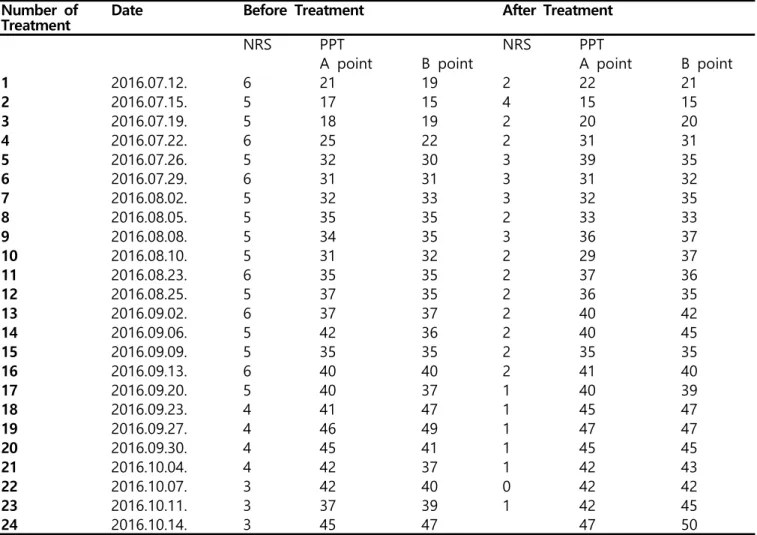
After 12 weeks, a total of 24 treatments, NRS decreased from the first 6 to 3, showing objective pain was relieved. PPT increased from 21 to 45 at point A and from 19 to 47 at point B, showing pressure pain has reduced. (Figure 4)
Figure 3 NRS and K-WOMAC change
There was a strong negative correlation between the number of treatments and NRS. (The Pearson Correlation -0.7966) Furthermore, PPT at A and B points based on the number of treatments showed a strong positive correlation. (The Pearson Correlation 0.8809 and 0.8617 respectively)(calculated with the Microsoft Excel)(Figure 4)
Figure 4 PPT changes during treatment
Before and after each acupuncture treatment, NRS decreased by an average of 3, PPT at point A increased by an average of 1.12, and PPT at point B increased by an average of 2.54. Between
the next treatment and the previous treatment, NRS decreased by an average of 0.130, PPT at point A increased by an average of 1.04, and PPT at point B increased by an average of 1.21. The difference before and after each treatment was larger than the difference between the next treatment and the previous treatment, showing that the post-treatment symptoms partially rebounded.
The K-WOMAC test was conducted once every four weeks continuously reduced during the 12-week treatment period; the result that shows that the discomfort of patients in their daily lives has been decreasing. In the same test conducted two years later, it was still down 43 points and 45 percentage points than at the beginning of treatment. In the same test results achieved four years later, the results maintained, down 45 points and 43 percentage points from the previous treatment. (performed via Google Questionnaire)(Figure 4)
The meniscal tear did not significantly change before and after treatment, examined by MRI. (Figure 2)
Ⅵ. Discussion
The medial meniscus posterior horn plays an essential role in the knee joint dynamics3. Many
loads are applied to the area during normal movement of the knee joint, especially in Koreans, due to sedentary lifestyle8. The normal
dynamics of knee joint motion causes collapse in the event of posterior horn rupture, promoting degenerative changes in knee joint4. It is reported
that such ruptures often do not improve with preservation treatment, that 87% of patients failed preservation treatment, and 31% of patients performed total knee arthroplasty2.
The treatment of medial meniscus rupture aims at restoring normal dynamics to prevent tissue damage to the knee joint4. Treatment of
medial meniscus rupture includes non-operative treatment, meniscectomy, posterior meniscal root
repair, suture anchor repair, transtibial pull-out repair. Non-operative treatment is only applied first to patients with Outerbridge grades 3-4 with whom show poor prognosis even after reconstruction performed4. In the past,
arthroscopy was the first choice, but now(2020), restoration is a priority. The post-rehabilitation results are 79.7% of patients avoiding degenerative changes after surgical repair5.
On the other hand, acupuncture treatments are commonly implied to chronic knee pain. It was effective that the treatment was performed more than four acupoints, 20 minutes needle retaining, once a week, and six times, according to the meta-analysis of the acupoint treatment of chronic knee pain6. The most highly used
acupoints were ST35(Dokbi; 犢鼻), GB34(Yangneungchoen; 陽陵泉), Sulan(膝眼), ST36(Joksamni; 足三里), and SP9(Eumneungcheon; 陰陵泉). Also, acupoints of SP10(Hyeolhae; 血海), ST34(Yanggu; Yanggu), SP6(Sameumgyo, 三陰交), BL60(Gollyun; 崑崙), KI3(Taegye; 太谿), and LI4(Hapgok; 合谷) were frequently used9. It is also reported that the
manipulation, such as electro-acupuncture or de-qi, is valid9.
The Cleft Point(郄穴) of the bladder meridian(BL; 足太陽膀胱經) and the spleen meridian(SP; 足太陰脾經) and the Source point(原穴) were chosen for this case by the principles of Traditional Korean Medicine. BL63, which is the Cleft point of BL, relax muscles and loosen blood vessels; It was reported that it could reduce leg numbness, cramping, and malleolus pain when used with BL57. SP8, which is the Cleft point of SP, resolves static blood, stops hemorrhage, relieves numbness, and stops pain. KI3, which is the Source point of the kidney meridian (KI; 足少陰腎經), restore Source Qi(原氣) of a renal, strengthens the waist and knees, relieves the numbness, and stops the pain. Besides, LI4, which is the Source point of the large intestine meridian (LI; 手陽明大腸經), is effective in reducing heat and edema, eliminating
pain, and facilitating blood circulation, so it is added when the knee edema, caused by drinking or overuse of the knee10.
24 treatments in 12 weeks failed to show a substrate recovery from the rupture of the medial meniscus posterior horn. It is reported that Aqua-acupuncture11 and
Bee-venom-acupuncture12 restore the cartilage.
Therefore, they could have a good effect on the substrate recovery of the knee joint. Further research is also needed on the efficacy of changes in treatment methods, such as changing acupoints, causing cartilage regeneration, extending the treatment period, or increasing the amount of stimulation.
In this study, pressure gauges were used, not medical goniometers. The tool was so large that it was inconvenient to use with one hand. Also, the measurement range of pressure was limited to 50 N, making it difficult to measure in the later study at a level above 50 PPT. Also, the tip was not smooth, causing pain due to the tip itself. We attached stickers to the measurement area, marking pain point, and relieving the suppression pain caused by the tip.
When using a goniometer for future research, the following conditions should be taken into account: (1) the size and weight available with one hand, (2) the measurement range of pressure should be around 100 N, and (3) The tip is rounded so that contact will not cause pain.
In this case, a 51-year-old male patient diagnosed with a left medial meniscal posterior horn rupture from 2012 was treated with 24 acupuncture treatments for 12 weeks from July 2016. A medial meniscal posterior horn rupture is often not improved by preservation treatment, and surgical treatment is performed to restore normal dynamics of the knee joint to prevent further damage to the knee joint tissue. To repair rupture, we chose Cleft Point and Source point of BL, SP, K, L as the primary acupoints. As a result of treatment, substrate recovery was not observed, but it showed excellent efficacy in
relieving pain and recovering function.
Ⅶ. Conclusion
After 24 times acupuncture treatments during 12 weeks of 51 years-old Korean male, there was no significant change of a medial meniscus, but could relieve objective and subjective pain and improve knee-related activities.
Acknowledgment
This study was supported by the Society for Yeongchu-Sanghan Korean Medicine(SYSKM), which is one of the Traditional Oriental Medicine study groups in the South of Korea.
Reference
1. (Korea) HIR& AS. National Health Insurance Statistical Yearbook. 2018.
2. Krych AJ, Reardon PJ, Johnson NR, Mohan R, Peter L, Levy BA, Stuart MJ. Non-operative management of medial meniscus posterior horn root tears is associated with worsening arthritis and poor clinical outcome at 5-year follow-up. Knee Surgery, Sports Traumatology, Arthroscopy [Internet]. Springer Verlag; 2017 Feb 1 [cited 2020 Sep 10];25(2):383–389. Available from: https://link.springer.com/article/10.1007/s00167-01 6-4359-8 PMID: 27761625
3. Pache S, Aman ZS, Kennedy M, Nakama GY, Moatshe G, Ziegler C, LaPrade RF. Meniscal roots: Current concepts review. Archives of Bone and Joint Surgery. 2018;6(4):250–259.
4. Ko T, Ph.D., Kim S, Lee J. Reliability and Validity of the Korean Western Ontario and McMaster Universities(WOMAC) Osteoarthritis Index in Patients with Osteoarthritis of the Knee. J Oriental Rehab Med 2009;19(2):251–260. 5. Bhatia S, Laprade CM, Ellman MB, Laprade RF. Meniscal root tears: Significance, diagnosis, and treatment. American Journal of Sports
Medicine. 2014;42(12):3016–3030. PMID: 24623276
6. Bin S il, Kim JM, Shin SJ. Radial Tears of the Posterior Horn of the Medial Meniscus.
Arthroscopy - Journal of Arthroscopic and Related Surgery [Internet]. W.B. Saunders; 2004 [cited 2020 Sep 10];20(4):373–378. Available from: https://pubmed.ncbi.nlm.nih.gov/15067276/ PMID: 15067276
7. Chung KS, Ha JK, Ra HJ, Kim JG. A meta-analysis of clinical and radiographic
outcomes of posterior horn medial meniscus root repairs [Internet]. Knee Surgery, Sports
Traumatology, Arthroscopy. Springer Verlag; 2016 [cited 2020 Sep 10]. p. 1455–1468. Available from: https://pubmed.ncbi.nlm.nih.gov/26493550/ PMID: 26493550
8. The Korean Acupuncture & Moxibustion Medicine Society. Acupunctural Clinical Guideline for Knee Pain A. 2013.
9. Kim E, Lee S, Jung C, … EY-J of, 2009 U. Review of randomized controlled trials on ideal acupuncture treatment for degenerative knee osteoarthritis. koreascience.or.kr [Internet]. 2009 [cited 2020 Sep 10];26(2):125–145. Available from
:https://www.koreascience.or.kr/article/JAKO20092 8038433840.page
10. Colleges M& ACC of KM. Details of meridians & acupoints: a guidebook for college students 1 & 2. 7th ed. 2016.
11. Choi Won Joo, Min Sang Yeon KJH. Effect of Yukmijihwang-Tang Gamibang Aqua-acupuncture on the Recovery of Chondrocyte Phenotype. J Korean Oriental Pediatrics. 2010;24(1):117–125. 12. Kim D, Yu D, Yeom S, Kwon Y, Song Y. The Effect of Intra-articular Bee Venom Injection on Meniscal Injury : Four Cases Report. J Oriental Rehab Med 2010;20(1):219–230.
13. MacPherson H, Altman DG, Hammerschlag R, Youping L, Taixiang W, White A, Moher D. Revised STandards for Reporting Interventions in Clinical Trials of Acupuncture (STRICTA): Extending the CONSORT Statement. PLoS Med
2010; 7(6): e1000261.
Appendix
Table 1 Checklist for items in STRICTA 2010 13)
Item Detail Page
number 1. Acupuncture rationale 1a) Style of acupuncture (e.g. Traditional Chinese
Medicine, Japanese, Korean, Western medical, Five Element, ear acupuncture, etc)
31, 33
1b) Reasoning for treatment provided, based on historical context, literature sources, and/or consensus methods, with references where appropriate
33
1c) Extent to which treatment was varied 33
2. Details of needling 2a) Number of needle insertions per subject per
session (mean and range where relevant) 31 2b) Names (or location if no standard name) of
points used (uni/bilateral) 31 2c) Depth of insertion, based on a specified unit of measurement, or on a particular tissue level 31 2d) Response sought (e.g. de qi or muscle twitch
response) 31
2e) Needle stimulation (e.g. manual, electrical) 31 2f) Needle retention time 31 2g) Needle type (diameter, length, and
manufacturer or material) 31
3. Treatment regimen 3a) Number of treatment sessions 31, 32
3b) Frequency and duration of treatment sessions 31, 32
4. Other components of treatment 4a) Details of other interventions administered to
the acupuncture group (e.g. moxibustion, cupping, herbs, exercises, lifestyle advice)
31
4b) Setting and context of treatment, including instructions to practitioners, and information and explanations to patients
31
5. Practitioner background 5) Description of participating acupuncturists (qualification or professional affiliation, years in acupuncture practice, other relevant experience)
31
6. Control or comparator
interventions 6a) Rationale for the control or comparator in the context of the research question, with sources that justify this choice
X
6b) Precise description of the control or
comparator. If sham acupuncture or any other type of acupuncture-like control is used, provide details as for Items 1 to 3 above.
Table 2 PPT and NRS change during treatment
Table 3 K-WOMAC score changes during treatment (Total point is 96) Number of
Treatment Date Before Treatment After Treatment
NRS PPT NRS PPT
A point B point A point B point
1 2016.07.12. 6 21 19 2 22 21 2 2016.07.15. 5 17 15 4 15 15 3 2016.07.19. 5 18 19 2 20 20 4 2016.07.22. 6 25 22 2 31 31 5 2016.07.26. 5 32 30 3 39 35 6 2016.07.29. 6 31 31 3 31 32 7 2016.08.02. 5 32 33 3 32 35 8 2016.08.05. 5 35 35 2 33 33 9 2016.08.08. 5 34 35 3 36 37 10 2016.08.10. 5 31 32 2 29 37 11 2016.08.23. 6 35 35 2 37 36 12 2016.08.25. 5 37 35 2 36 35 13 2016.09.02. 6 37 37 2 40 42 14 2016.09.06. 5 42 36 2 40 45 15 2016.09.09. 5 35 35 2 35 35 16 2016.09.13. 6 40 40 2 41 40 17 2016.09.20. 5 40 37 1 40 39 18 2016.09.23. 4 41 47 1 45 47 19 2016.09.27. 4 46 49 1 47 47 20 2016.09.30. 4 45 41 1 45 45 21 2016.10.04. 4 42 37 1 42 43 22 2016.10.07. 3 42 40 0 42 42 23 2016.10.11. 3 37 39 1 42 45 24 2016.10.14. 3 45 47 47 50 Point Percentage 2016.07.08 56 58.3 2016.08.08. 27 28.1 2016.09.13. 23 24.0 2016.10.14 4 4.2 2018.10.15 13 13.5 2020.08.07 15 15.6