Korean Heritage Learners Versus Non-Heritage Learners
Min Jung Jee (The University of Queensland)
Jee, Min Jung. (2015). Language Learners’ Strategy Use and Self-Efficacy:
Korean Heritage Learners Versus Non-Heritage Learners. Language Research, 51.1, 167-195.
In recent decades, language learners’ strategy use and self-efficacy have been an important research topic for many researchers in second lan- guage acquisition as they are related to students’ success of learning a target language. To expand the discussion, this study investigated 92 Korean language learners’ strategy use and self-efficacy and their rela- tions to achievement. The data were analysed based on learner groups
-heritage learners (n = 40) and non-heritage learners (n = 52)- in or- der to explore differences between the two groups. A survey with 78 items for strategy use and self-efficacy was distributed at the end of the semester, and final grades were used to measure achievement. The re- sults indicated that the students, overall, were moderate strategy users, and non-heritage students (M = 2.82) tended to use strategies more of- ten than heritage students (M = 2.42), with significant differences. By achievement, the high-achievement students used the strategies the most frequently, followed by the low-achievement group and the mid-achieve- ment group. Moreover, the ranking of frequently used strategy catego- ries was different depending on the learner groups and achievement levels. Regarding self-efficacy, heritage students (M = 3.35) showed higher self-efficacy than non-heritage students (M = 2.83), with statisti- cally significant differences. The high-achievement group also showed higher self-efficacy than the mid-achievement and low-achievement group. Regarding the correlations, there were statistically significant pos- itive relations among strategy use, self-efficacy, and achievement, espe- cially with non-heritage students. Issues such as effective use of strat- egies rather than frequency and cultural background were discussed.
Keywords: language learning strategy, self-efficacy, Korean as a foreign language learners, Korean as a heritage language learners, learner differences
1. Introduction
In recent decades, as the focus of learning and teaching has moved to what a leaner is doing rather than what a teacher can do, learner differences have been one of the major interests for teachers and researchers in second language acquisition (SLA). One area that has received great attention is determining the factors that distinguish successful learners from less successful learners. That interest has led to various studies on the characteristics of “good” language learners, such as having positive attitudes toward speakers of the target language, being active participants, showing attention to both form and meaning, monitoring what they say and what others say, and using more strategies than less successful learners (Chamot, 2005; Dörnyei, 2005; Ellis and Sinclair, 1989; Green and Oxford, 1995; Oxford, 1990; Wenden, 1985).
Among these characteristics, language learning strategy use has received great attention because it is directly related to learner autonomy or self-di- rected learning (Dickinson, 1987). Moreover, because strategies are
“teachable,” and ideally all students can be successful if they learn and use “good” strategies in their learning, numerous studies have been done using various methods with different learner groups, suggesting teaching implications such as diagnosing students’ strategy use, having on-going open discussion with students, and training in useful strategies or giving explicit strategy instruction (Graham and Harris, 2000; Harris, 2003;
Murray, 2010; Oxford, 1990; Pressley, 2000). Furthermore, diverse ele- ments were evaluated associated with strategy use, such as language profi- ciency (Anderson, 2005; Bruen, 2001; Chatmot and El-Dinary, 1999;
Green and Oxford, 1995; O’Malley and Chamot, 1990; Wharton, 2000), gender (Kaylani, 1996; Oxford, Park-Oh, Ito and Sumrall, 1993;
Vandergrift, 1997; Wharton, 2000), motivation (Ehrman and Oxford, 1989, 1990; Oxford and Ehrman, 1988; Oxford and Nyikos, 1989), and ethnicity (Grainger, 1997) in order to test which factor(s) contributed the most to students’ use of strategy.
Recently, self-efficacy has been considered to be an influencing factor, indicating a positive relationship between self-efficacy and language learn-
ing strategies (Gahungu, 2010; Magogwe and Oliver 2007; Wong, 2005).
As a construct of learner difference, self-efficacy is defined as a cognitive construct which comprises “people’s judgments of their capabilities to organize and execute courses of action required to attain designated types of performances (Bandura, 1986, p. 391),” and it is important because self-efficacy predicts one’s capability of accomplishing tasks and involves participation in the tasks. In the literature, self-efficacy has been proven to have a positive relation with motivation (Pintrich, 1999), and a negative relation with language anxiety (Tremblay and Gardner, 1995), confirming self-efficacy as a factor of impacting students’ foreign and/or second lan- guage learning. In addition, studies have reported concurrent findings that high self-efficacy students tended to achieve high level of proficiency (Gahungu, 2010; Huang and Shanmao, 1996; Magogwe and Oliver, 2007;
Templin, 1999; Templin, Guile and Okuma, 2001, Wong, 2005; Yilmaz, 2010). In other words, more frequent strategy users showed higher self-effi- cacy than less frequent strategy users. Since the frequency of strategy use is proved to be related to achievement, high self-efficacy students tend to achieve high proficiency, too.
Thus, two elements, strategy use and self-efficacy, are important factors for students’ achievement, and the present study examines these two fac- tors in relation to the achievement levels of students learning Korean, one of the less commonly taught languages in the U.S. The data was also analysed according to learner groups, Korean heritage students and non-heritage students, in order to fully investigate the influence of ethnicity on strategy use and self-efficacy. Considering how few studies have been done on students of Korean as a foreign language (KFL) with respect to strategy use and self-efficacy, the findings will provide substantial peda- gogical implications for teachers and researchers who are interested in students with various backgrounds learning Korean in various contexts.
2. Literature Review
One of the main issues of research about strategy use is identifying the concept of language learning strategies because of their complex nature (Chamot 2004). Oxford (1990) said that learning strategies are “specific actions taken by the learner to make learning easier, faster, more enjoyable, more self-directed, more effective, and more transferrable to new situation (p. 8),” and Cohen (1998) defined them as “those processes which are consciously selected by learners and which may result in action to enhance the learning or use of a second or foreign language (p. 3).” In other words, learning strategies are “goal-directed, intentionally invoked, and require effort (Murray 2010, p. 625)”. Because it is hard to observe what strategies a learner use, many studies adopted verbal reports such as retrospective interviews and stimulated recall interviews after a learner completed a task (Chamot 2004). The most frequently used method is the use of a questionnaire or survey. For example, the Strategy Inventory for Language Learning (SILL) by Oxford (1990) was used in great numbers of studies so far, allowing researchers to compare findings across studies. There have been numerous studies on language learning strategies and their relation to learner proficiency or achievement, and the findings are con- sistent, indicating that high proficient learners use more strategies than low proficient learners (Anderson 2005; Bruen 2001; Chatmot and El-Dinary 1999; Green and Oxford 1995; Murrary 2010; O’Malley and Chamot 1990; Park 1997; Wharton 2000).
Among the studies, Murray (2010) investigated 66 English native speak- ers’ language learning strategy use and achievement in a KFL context using SILL. In her study, students were relatively high strategy users, and compensation strategies and social strategies were the most frequently used strategies. Murray observed the positive relationship between strategy use and achievement, but it was not strong, revealing that the strongest relations (at .30) were between cognitive strategies and achievement.
Several studies have illuminated diverse variables affecting students’ lan- guage learning strategies. For example, Wharton’s (2000) study originated from limitations of previous studies (too much attention on ESL learners
in the U.S.) and expanded the learner group to bilingual students in Singapore, a multilingual and multicultural society, in order to avoid the ethnocentricity of the findings. Among the variables, self-rated proficiency was investigated along with the strategy use in two groups of bilingual students learning Japanese and French. The results confirmed a sig- nificantly positive relation in 35 items, and social strategies and compensa- tion strategies were the most frequently used strategies regardless of their level. Interestingly, students of French tended to use more strategies than students of Japanese, and bilingual Asian students used social strategies the most.
Thus, the findings suggested that such factors as the language studied, the cultural background, and the proficiency level should be considered in research on language learning strategies. A study by Grainger (1997) focused on ethnicity as a variable of strategy use, and three ethnic groups, English-speaking background, European background, and Asian back- ground, learning Japanese were investigated. The findings were that European background students used strategies the most followed by Asian background and English-speaking background. By category, Asian back- ground students preferred to use compensation strategies and meta- cognitive strategies, whereas European and English-speaking background students used social strategies the most. The findings also implied that learner ethnicity or cultural differences played a role in using strategies, even for students learning the same target language.
Some researchers were interested in specific linguistic abilities, such as listening and writing (Olivares-Cuhat 2002; Murrary 2007; Yeon 2002).
For example, Olivares-Cuhat (2002) examined the relationship between the strategy use and the writing proficiency of two groups of students learning Spanish: L1 group and L2/FL group. Overall, cognitive and compensation strategies were most frequently used, and the L1 group students, who had higher grades than L2/FL students, used affective and memory strategies more than the L2/FL group students. Moreover, memo- ry strategies and writing grades were significantly correlated, accounting for 40 percent of the overall variability in grades.
More recently, some studies investigated the inter-relationship of lan-
guage learning strategies and self-efficacy. Wong (2005) investigated 74 ESL pre-service teachers’ language learning strategy use and self-efficacy in Malaysia. The participants used predominantly cognitive and social strategies, and there was a significant positive relationship between lan- guage learning strategies and self-efficacy. High self-efficacy pre-service teachers used more strategies than low self-efficacy pre-service teachers in terms of quantity and type. In three stages of school contexts, primary school, secondary school, and university, in Botswana, Magogwe and Oliver (2007) conducted an extensive study on the language learning strat- egy use, proficiency, age, and self-efficacy of 480 EFL students. They reported that overall, high proficient learners used more strategies than low proficient students, especially among younger students, and a different pattern of strategy use in relation to the categories of strategies was ob- served: primary school students used social strategies the most, followed by metacognitive strategies; secondary school students used metacognitive strategies the most, followed by social strategies; and university students used metacognitive and cognitive strategies the most. With self-efficacy, high proficient students showed higher levels of self-efficacy than low proficient students, and a significantly positive correlation between self-ef- ficacy and strategy use was observed in secondary and university students.
However, the correlation was weak with primary school students.
Moreover, there was a tendency that as the proficiency level increased, the correlation between self-efficacy and strategy use decreased. With Turkish EFL students, Yilmaz (2010) reported similar findings. In this study, more proficient and high self-efficacy students used more language learning strategies than less proficient and low self-efficacy students.
Moreover, the students used compensation strategies and metacognitive strategies the most and affective strategies the least. Another study by Gahungu (2010) with American students learning French confirmed the findings of the previous studies: the existence of positive and significant relationships among strategy use, self-efficacy, and proficiency level.
In sum, even though there was consistent agreement in language learn- ing strategy use, self-efficacy, and proficiency, other factors such as cultural and educational background seemed to influence students’ preference of
strategy use (O’Malley and Chamot 1990; Yilmaz, 2010). In addition, a number of limitations were pointed out in terms of research methods and study populations of the previous studies on language learning strategy use. As Chamot (2004) indicated, students may have a difficult time inter- preting the items of the survey, and sometimes they may not remember strategies they used. Moreover, the majority of the studies were done with ESL students in the U.S. or with American students studying a foreign language in the U.S. (Wharton 2000). Therefore, there is a need to study students who are learning foreign or second languages other than English, such as less commonly taught languages in the U.S., with different learner groups, such as heritage language learners. Moreover, a lack of studies exists on the relationship between language learning strategies and self-efficacy (Wang 2004). In order to fill the gap in the literature, the present study aims to investigate language learning strategy and self-efficacy of students learning Korean and their relations to achievement. The research questions are:
1. What types of strategies do KFL students use? Are there any differ- ences between heritage and non-heritage students?
2. How did KFL students rate their self-efficacy in learning Korean?
Are there any differences between heritage and non-heritage students?
3. What are the relationships among KFL students’ strategy use, self-effi- cacy, and achievement?
3. Methods
3.1. Participants
A total of 92 KFL students who enrolled in Korean courses offered by a large public university in the U.S. participated in this study. 47 were male and 45 were female. Their ages ranged 18 to 35, and the mean age was 20.8. Among them, 40 students were heritage learners (or students of learning Korean as a heritage language) who enrolled in a heritage-track Korean course. This course was offered only to students who were Korean-American, had parents who were immigrants in the
U.S., and had 10 years of education in the U.S. before entering college (Kang and Kim 2012; Lee 2002). None of the heritage learners had experi- ence learning Korean in an educational institute officially, and the course was for enhancing four language skills with special emphasis on the formal use of Korean, reading, and writing. The starting speaking level of the course was intermediate-low, and its reading and writing level were nov- ice-mid, based on the ACTFL Proficiency Guidelines1) (2012).
52 non-heritage students also had no learning experience of Korean before they took the Korean course, First-Year Korean. The course for non-heritage students or “true novice” learners was designed to foster students’ four language skills up to novice-high level by the end of the semester. Both classes emphasized communicative skills and cultural activ- ities such as experiencing Korean traditional plays and watching Korean movies. Moreover, both classes were intensive (six credit-hours for the heritage learner class and five credit-hours for the non-heritage learner class throughout a 15-week long semester) with weekly dictations and quizzes, and frequent role plays during the class time.
3.2. Instruments
A survey (Appendix I) consisting of 40 items of strategy use and 38 items of self-efficacy was developed based on a short version of Strategy Inventory for Language Learning (SILL) by Oxford (1990) and a self-effi- cacy scale (Gahungu 2010).2) SILL is composed of six categories: memory strategies (remembering more effectively), cognitive strategies (using men- tal processes), compensation strategies (compensating for missing knowl- edge), metacognitive strategies (organizing and evaluating learning), affec- tive strategies (managing emotions), and social strategies (learning with others) (Grainger 1997), and the self-efficacy scale contained questions relating motivation and beliefs about learning Korean. Each item was
1) http://www.actfl.org/publications/guidelines-and-manuals/actfl-proficiency-guide- lines-2012
2) Based on literature review, the self-efficacy scale by Gahungu (2010) was adopted be- cause the scale was appropriate for the purpose of the present study and its Cronbach’s alpha was very high (.96).
rated on a 6-Likert scale ranging from 0 (never) to 5 (always). Cronbach’s alpha of strategy use items was 0.92, and that of self-efficacy items was 0.96 in this study. For achievement, students’ final exam grades were used: quiz (15%), dictation (15%), homework (15%), midterm oral exam (10%), midterm written exam (10%), final oral exam (10%), final written exam (15%), and culture activity (10%).
3.3. Procedures and data analysis
At the end of a semester, students were informed about the study and volunteered to participate. Students’ consent forms were collected, and the surveys was distributed. For statistical data analysis, SPSS version 21 was used. Descriptive data analysis, AVOVA, and Pearson Correlations were implemented.
4. Results
4.1. RQ 1: What types of strategies do KFL students use? Are there any differences between heritage and non-heritage students?
Considering that the theoretical mean of the survey is 2.5, and following Oxford’s (1990) classification of the scores3), the students (M = 2.64) used strategies with moderate frequency. As Table 1 shows, non-heritage students (M = 2.82) used strategies more frequently than heritage students (M = 2.42). As the ANOVA results indicated (Table 2), there were sig- nificant differences between the two groups of students in terms of using language learning strategies (F(1,90) = 7.094, p = 0.009).
3) The original score set (Oxford, 1990) was converted as the following:
High strategy use: 3.2-5, Medium strategy use: 2-3.1, Low strategy use: 0-1.9.
Table 1. Descriptive Statistics for Strategy Use Scores: Overall Heritage learners
(n = 40)
Non-heritage learners (n = 52)
Overall (n = 92)
Strategy use M SD M SD M SD
2.42 .75 2.82 .67 2.64 .73
Table 2. ANOVA Results of Strategy Use: Overall
SS df MS F Sig.
Between Groups 3.596 1 3.596 7.094 .009
Within Groups 45.620 90 .507
Total 49.216 91
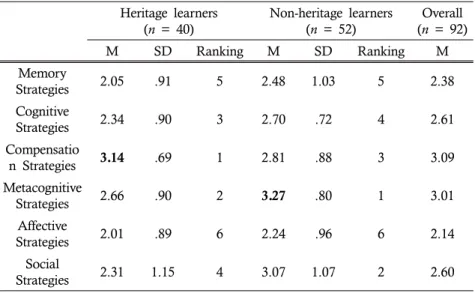
By categories of strategy, the ranking for the frequency of each category was different between the two groups of students (Table 3). In fact, heritage students used compensation strategies the most, and metacognitive strat- egies the next most frequently. However, non-heritage students used meta- cognitive strategies the most frequently and social strategies the next most frequently. Interestingly, memory strategies and affective strategies were the least used strategies in both groups.
Table 3. Descriptive Statistics for Strategy Use Scores: by Category Heritage learners
(n = 40) Non-heritage learners
(n = 52) Overall (n = 92)
M SD Ranking M SD Ranking M
Memory
Strategies 2.05 .91 5 2.48 1.03 5 2.38
Cognitive
Strategies 2.34 .90 3 2.70 .72 4 2.61
Compensatio
n Strategies 3.14 .69 1 2.81 .88 3 3.09
Metacognitive
Strategies 2.66 .90 2 3.27 .80 1 3.01
Affective
Strategies 2.01 .89 6 2.24 .96 6 2.14
Social
Strategies 2.31 1.15 4 3.07 1.07 2 2.60
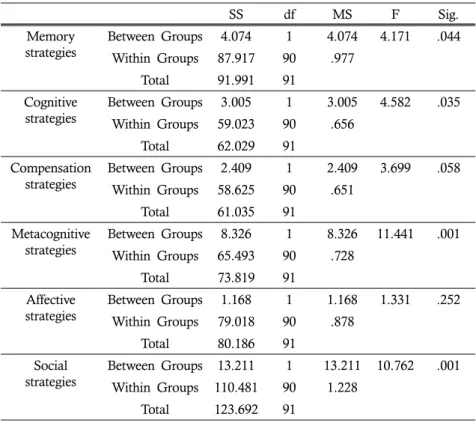
In addition, as Table 4 indicates, there were significant differences between
the two groups of students except in the categories of affective strategies and compensation strategies (marginal difference, p = .058). In other words, non-heritage students tended to use memory strategies, cognitive Strategies, metacognitive strategies, and social strategies more often than heritage students.
Table 4. AVONA Results for Strategy Use: by Category
SS df MS F Sig.
Memory
strategies Between Groups 4.074 1 4.074 4.171 .044 Within Groups 87.917 90 .977
Total 91.991 91
Cognitive
strategies Between Groups 3.005 1 3.005 4.582 .035 Within Groups 59.023 90 .656
Total 62.029 91
Compensation
strategies Between Groups 2.409 1 2.409 3.699 .058 Within Groups 58.625 90 .651
Total 61.035 91
Metacognitive
strategies Between Groups 8.326 1 8.326 11.441 .001 Within Groups 65.493 90 .728
Total 73.819 91
Affective
strategies Between Groups 1.168 1 1.168 1.331 .252 Within Groups 79.018 90 .878
Total 80.186 91
Social
strategies Between Groups 13.211 1 13.211 10.762 .001 Within Groups 110.481 90 1.228
Total 123.692 91
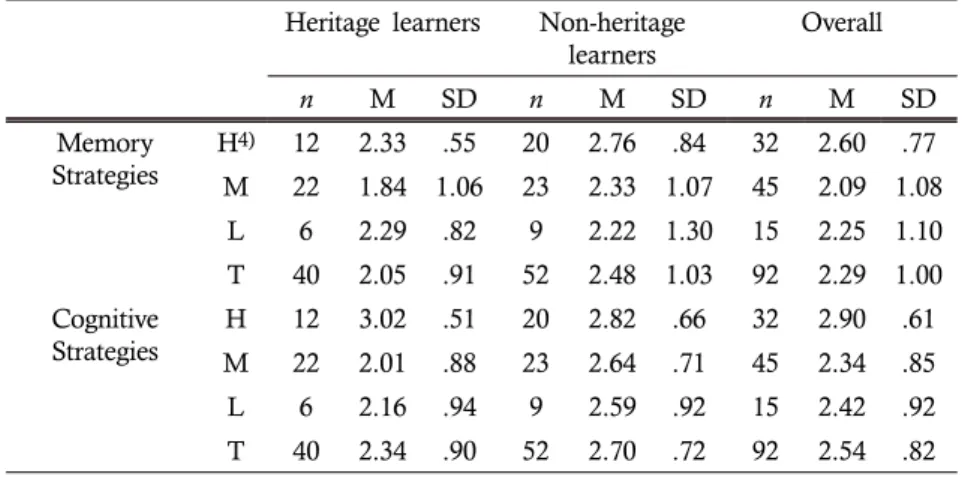
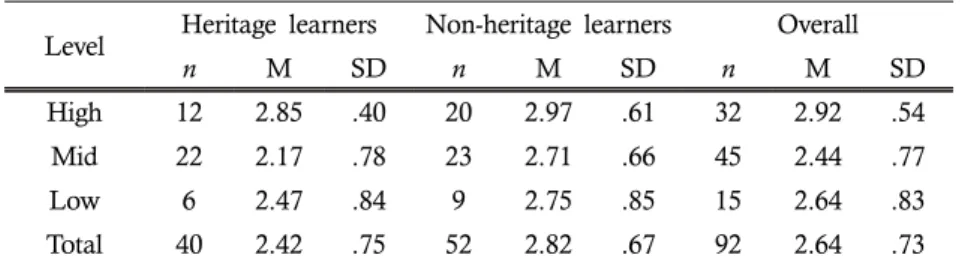
Based on the mean scores of the final grades, the students were divided into three groups in terms of achievement: high, mid, and low achievement. Overall, students in the high achievement group used strat- egies more often than the mid and low proficiency groups (Table 5), and there were significant differences (F(2,89) = 4.214, p = .018). In addition, students in the low achievement group used more strategies than the mid achievement group students. By learner groups, both heritage and non-her- itage students followed the overall pattern (Table 5), but there were statisti-
Heritage learners Non-heritage
learners Overall
n M SD n M SD n M SD
Memory Strategies
H4) 12 2.33 .55 20 2.76 .84 32 2.60 .77 M 22 1.84 1.06 23 2.33 1.07 45 2.09 1.08
L 6 2.29 .82 9 2.22 1.30 15 2.25 1.10
T 40 2.05 .91 52 2.48 1.03 92 2.29 1.00 Cognitive
Strategies H 12 3.02 .51 20 2.82 .66 32 2.90 .61
M 22 2.01 .88 23 2.64 .71 45 2.34 .85
L 6 2.16 .94 9 2.59 .92 15 2.42 .92
T 40 2.34 .90 52 2.70 .72 92 2.54 .82
cally significant differences only among the subgroups of heritage students (F(2,37) = 3.674, p = .035).
Table 5. Descriptive Statistics for Strategy Use Scores: by Achievement Level Heritage learners Non-heritage learners Overall
n M SD n M SD n M SD
High 12 2.85 .40 20 2.97 .61 32 2.92 .54
Mid 22 2.17 .78 23 2.71 .66 45 2.44 .77
Low 6 2.47 .84 9 2.75 .85 15 2.64 .83
Total 40 2.42 .75 52 2.82 .67 92 2.64 .73
By category, the high achievement group students used metacognitive strategies the most (M = 3.38), followed by compensation strategies (M
= 3.03). The mid achievement group students, however, used compensa- tion strategies (M = 2.86) more often than metacognitive strategies (M
= 2.79). The low achievement group students used compensation strategies (M = 3.10) the most, followed by social strategies (M = 2.96). Table 6 shows the results.
Table 6. Descriptive Statistics for Strategy Use Scores: by Category and Achievement
4) “H” stands for “High achievement group,”, “M” stands for “Mid achievement group,”
“L” stands for “Low achievement group,” and “T” stands for “Total.”
Heritage learners Non-heritage
learners Overall
n M SD n M SD n M SD
Compensation
Strategies H 12 3.22 .58 20 2.91 .95 32 2.02 .83
M 22 3.01 .74 23 2.71 .79 45 2.86 .77
L 6 3.45 .71 9 2.86 1.00 15 3.10 .92
T 40 3.14 .69 52 2.81 .88 92 2.95 .81
Metacognitive
Strategies H 12 3.16 .82 20 3.51 .74 32 3.38 .78
M 22 2.41 .86 23 3.15 .84 45 2.79 .92
L 6 2.59 .94 9 3.02 .78 15 2.85 .84
T 40 2.66 .90 52 3.27 .80 92 3.00 .90
Affective
Strategies H 12 2.35 .49 20 2.42 .89 32 2.39 .75
M 22 1.68 .97 23 2.08 .92 45 1.88 .96
L 6 2.56 .79 9 2.24 1.24 15 2.37 1.06
T 40 2.01 .89 52 2.24 .96 92 2.14 .93
Social
Strategies H 12 2.55 1.08 20 3.06 1.10 32 2.87 1.11 M 22 2.17 1.09 23 2.96 .98 45 2.57 1.10 L 6 2.33 1.56 9 3.38 1.26 15 2.96 1.44 T 40 2.31 1.15 52 3.07 1.07 92 2.74 1.16
In addition, among the heritage students, the three groups of students followed the same pattern: they used compensation strategies the most, followed by metacognitive strategies. However, both the high achievement group and the mid achievement group of non-heritage students used meta- cognitive strategies the most, followed by social strategies, whereas the low achievement group students used social strategies the most, followed by metacognitive strategies (Table 6). In other words, because heritage students used the strategies of the high achievement group students in a similar way, the heritage students can be said to be more successful learners than non-heritage learners. Moreover, overall, there were statisti- cally significant differences in cognitive strategies (F(2,89) = 4.957, p = .009), metacognitive strategies (F(2,89) = 4.635, p = .012), and affective strategies (F(2,89) = 3.414, p = .037). By groups, there were no significant differences among the different achievement groups in non-heritage students. With heritage students, however, there were significant differ-
ences in cognitive strategies (F(2,37) = 6.298, p = .004), metacognitive strategies (F(2,37) = 2.972, p = .064), and affective strategies (F(2,37)
= 4.017, p = .026).
4.2. RQ 2: How did KFL students rate their self-efficacy in learning Korean? Are there any differences between heritage and non-heritage students?
In general, students showed a high level of self-efficacy (M = 3.06), and heritage students tended to show higher efficacy than non-heritage students with significant differences (F(1,90) = 10.097, p = .002). Tables 7 and 8 reveal the results.
Table 7. Descriptive Statistics for Self-Efficacy Scores: Overall Heritage learners
(n = 40) Non-heritage
learners (n = 52) Overall (n = 92)
Self-efficacy M SD M SD M SD
3.35 .70 2.83 .82 3.06 .81
Table 8. ANOVA Results of Self-Efficacy
SS df MS F Sig.
Between Groups 6.095 1 6.095 10.097 .002
Within Groups 54.329 90 .604
Total 60.424 91
Interestingly, both groups of students ranked the statement, “I’m sure I can learn more Korean than I know now (heritage students M = 4.65, non-heritage students M = 4.46),” the highest followed by “I’m sure I can develop more vocabulary,” and “I strongly believe that, given enough time, I can achieve at least near-native fluency in Korean.” Moreover, they also rated the statement, “I’m sure I can read a novel in Korean (heritage M = 1.72, non-heritage M = 0.84),” the lowest followed by
“I know I can write essays or longer texts in Korean on a familiar topic.”
Thus, both heritage and non-heritage students showed high motivation on mastering Korean in the future, but they had anxiety on literacy skills.
(Yilmaz 2010). Given that they were taking the Korean course for the first time and their level was still low, their responses were quite predictable.
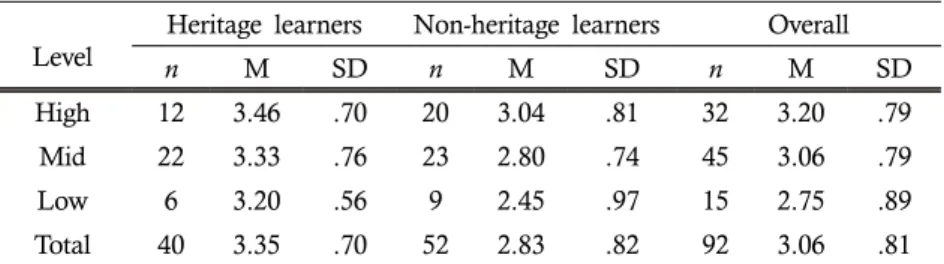
By achievement, self-efficacy increased with achievement level: the high achievement students of both groups tended to have higher self-efficacy than the mid and low achievement group students (Table 9). However, there were no significant differences.
Table 9. Descriptive Statistics of Self-Efficacy Scores: by Achievement Level Heritage learners Non-heritage learners Overall
n M SD n M SD n M SD
High 12 3.46 .70 20 3.04 .81 32 3.20 .79
Mid 22 3.33 .76 23 2.80 .74 45 3.06 .79
Low 6 3.20 .56 9 2.45 .97 15 2.75 .89
Total 40 3.35 .70 52 2.83 .82 92 3.06 .81
4.3. RQ 3: What are the relationships among KFL students’ strategy use, self-efficacy, and achievement?
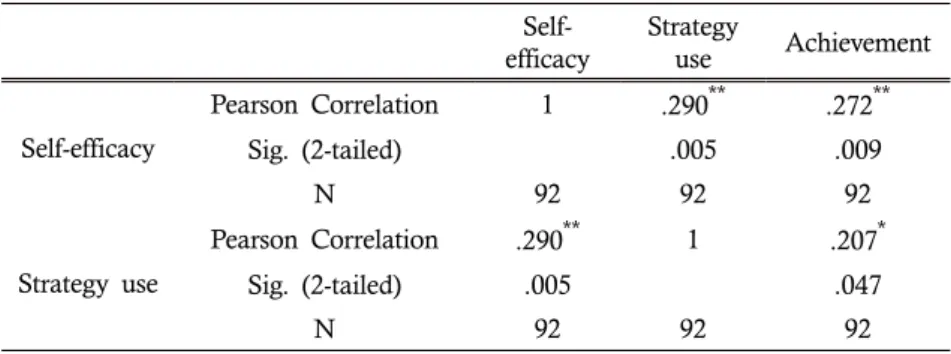
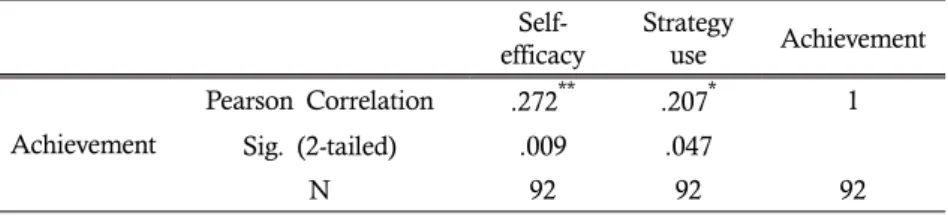
Overall, there were statistically significant positive relationships among the three variables: language learning strategy use, self-efficacy, and ach- ievement (Table 10). In other words, students who used strategies more frequently and had higher self-efficacy tended to have better grades than students who used less strategies with lower self-efficacy.
Table 10. Correlations: Overall
Self-
efficacy Strategy
use Achievement
Self-efficacy
Pearson Correlation 1 .290** .272**
Sig. (2-tailed) .005 .009
N 92 92 92
Strategy use
Pearson Correlation .290** 1 .207*
Sig. (2-tailed) .005 .047
N 92 92 92
Self-
efficacy Strategy
use Achievement
Achievement
Pearson Correlation .272** .207* 1 Sig. (2-tailed) .009 .047
N 92 92 92
*Correlation is significant at the 0.05 level (2-tailed).
**Correlation is significant at the 0.01 level (2-tailed).
By learner groups, heritage students showed no statistically significant correlations among the variables, but non-heritage students showed sig- nificant positive relations among the variables except between strategy use and final grades (Table 11). That is, non-heritage students who had high self-efficacy tended to use strategies often and had high grades.
Table 11. Correlations: Non-Heritage Students Self- efficacy
Strategy
use Final grades Self-efficacy Pearson Correlation 1 .579** .302*
Sig. (2-tailed) .000 .030
N 52 52 52
Strategy use Pearson Correlation .579** 1 .206
Sig. (2-tailed) .000 .143
N 52 52 52
Final grades Pearson Correlation .302* .206 1 Sig. (2-tailed) .030 .143
N 52 52 52
*Correlation is significant at the 0.05 level (2-tailed).
**Correlation is significant at the 0.01 level (2-tailed).
5. Discussion and Conclusion
The present study explored the language learning strategy use and the self-efficacy of university students learning Korean and their relations to achievement. Both heritage learners and non-heritage learners were largely moderate frequency strategy users, with non-heritage learners using strat-
egies more often than heritage learners. Unlike previous studies (Green and Oxford 1995; Gahungu 2010; Khaldieh 2000; Magogwe and Oliver 2007; O’Malley and Chamot 1990; Park 1997; Wharton 2000; Yilmaz 2010), this study shows that low achievement group students were more active strategy users than mid achievement group students, especially with heritage Korean students. However, the high achievement students were the most active strategy users, as was reported in the previous studies.
As Chen (1990) and Oxford (1990) suggested, that may be explained by effectiveness rather than the amount or frequency of using strategies by higher proficient students, because the relationship between achieve- ment level and strategy use is complex. In other words, mid achievement students may be more efficient strategy users than low achievement stu- dents in this study. Thus, more studies on the effectiveness of using strat- egies are required. In addition, high and mid achievement students tended to use metacognitive strategies and compensation strategies often, and low achievement students liked to use compensation strategies and social strategies more often than other strategies. By learner groups, heritage students of the three achievement levels used compensation strategies and metacognitive strategies the most, like the high and mid achievement level students, while those of non-heritage students used metacognitive and social strategies the most. Thus, based on the findings, heritage students can be considered to be better language learners than non-heritage students in terms of achievement. Furthermore, social strategies were frequently used when the students’ level was not high enough, probably because they needed to collaborate with other learners in order to fill their knowl- edge gap. Asking questions would be easier for low proficient students when they did not know something. For high proficient students as well as heritage students, metacognitive strategies and compensation strategies were frequently used (Yilmaz, 2010), which implies that high proficient students tend to organize their learning process, and that they tried to guess or use circumlocution in order to overcome language barriers instead of seeking help.
With respect to categories, compensation strategies were used the most frequently among the heritage students, similar to previous studies with
Chinese students (Chang 1991) and Turkish students (Yilmaz 2010).
However, among the non-heritage students, metacognitive strategies were most frequently used, concurring with other studies with students in Botswana (Magogwe and Oliver 2007), Palestinian students (Shmais 2003), Indian students (Sheorey 1998), and Korean students (Park 1997).
Moreover, heritage students followed pattern similar to that of students of Asian background, and non-heritage students followed pattern similar to that of students with a background of speaking English (Grainger 1997).
Thus, various factors such as culture, ethnicity, the language being learned, and the educational context may influence students’ use of strategies (Hsiao and Oxford 2002; Magogwe and Oliver 2007; O’Malley and Chamot 1990; Yilmaz 2010), and the interpretation of strategy use seems to be very complex, requiring more in-depth studies.
Regarding self-efficacy, the findings of the present study are more straightforward than strategy use. The students, overall, showed a high level of self-efficacy, especially among the heritage students. Considering the achievement level, the results were concurrent with previous studies (Gahungu 2010; Magogwe and Oliver 2007; Wong 2005; Yilmaz 2010) with the same pattern: the higher the achievement, the higher the self-efficacy. Moreover, both groups of students showed least self-efficacy on literacy skills (Yilmaz 2010), probably because of their low proficiency in reading and writing and their acknowledgment that it takes a long time to master reading and writing. With relations among strategy use, self-efficacy, and achievement, there were significant positive correlations, as has been shown in previous studies (Chamot, Robbins and El-Dinary 1993; Feather 1988; Fincham and Cain 1986; Gahungu 2010; Magogwe and Oliver 2007; Pape and Wang 2003; Pajares and Schunk 2001; Wong 2005; Zimmerman and Martinez-Pons 1990; Yilmaz 2010): students with high frequency strategy use tended to have high self-efficacy; students with high frequency strategy use tended to have high achievement; students with high self-efficacy tended to have high achievement, and vice versa.
Interestingly, no statistically significant correlations were observed in the heritage group, but some significant positive correlations were observed in the non-heritage group: between self-efficacy and strategy use, and be-
tween self-efficacy and achievement. In other words, strategy use was not a predicator for non-heritage students’ achievement.
In sum, the findings of the present study were largely consistent with previous findings in strategy use, self-efficacy, and achievement. However, some findings were new in terms of the context of learning Korean; more specifically, learning Korean as a heritage language (for heritage students) and learning Korean as a foreign language (for non-heritage students).
For example, the preference of using strategy was different, and the level of self-efficacy and its influence on achievement were different. Moreover, while heritage students showed a high frequency of use of strategies that were similar to high achievement students, none of the variables (strategy use, self-efficacy, and achievement) predicted each other. Therefore, in- structors should apply different teaching approaches to each group of students. Caution is recommended for teachers, especially in a class with a mixture of heritage and non-heritage students. Diagnosing the survey before a semester would be helpful in order to figure out what types of strategies were used by what learner group students (either heritage or non-heritage group)as well as the level of self-efficacy of the groups.
Group or individual discussion on effective strategy use and on heightening self-efficacy would be a way to improve students’ performance in the class.
Future studies may need to focus on the effectiveness of strategy use with in-depth quantitative (i.e., structural equation model) and qualitative methods, and on heritage language learners of other languages in order to compare and contrast the findings. That may contribute to an ex- planation of how ethnicity and learning environment (bilingual, foreign, or second language) contribute to students’ use of strategy and self-efficacy.
Moreover, further studies with Korean heritage students in different coun- tries other than U.S.A. may lead to interesting findings to the field.
As for limitations of the study, because the survey was done in a large public university in the U.S., the findings should be interpreted in this context. Moreover, the number of participants of each group was still low, so the validity of the results may not be conclusive. In addition, the survey items were adopted and modified, and some items may not
be appropriate to compare with previous studies with different scales.
Despite the limitations, the findings may be used for future pedagogical purposes for teaching learners of Korean in various contexts (Korean as a foreign language, Korean as a second language, and Korean as a heritage language), given that the present study would be the first attempt to inves- tigate the inter-relationship of strategy use, self-efficacy, and achievement of students learning Korean.
References
Anderson, N. J. (2005). L2 learning strategies. In E. Hinkel, ed., Handbook of Research in Second Language Teaching and Learning, 757-772. Mahwah, NJ:
Lawrence Erlbaum.
Bandura, A. (1986). Social foundations of thought and action: A social cognitive theory.
Englewood Cliffs, NJ: Prentice-Hall.
Bruen, J. (2001). Strategies for success: Profiling the effective learner of German.
Foreign Language Annals 34.3, 216-225.
Chamot, A. U. (2004). Issues in language learning strategy research and teaching.
Electronic Journal of Foreign Language Teaching 1.1, 14-26.
Chamot, A. U. (2005). Language learning strategy instruction: Current issues and research. Annual Review of Applied Linguistics 25, 112-130.
Chamot, A. U. and El-Dinary, P. B. (1999). Children’s learning strategies in im- mersion classrooms. The Modern Language Journal 83.3, 319-341.
Chamot, A. U., Robbins, J., and El-Dinary, P.B. (1993). Learning strategies in Japanese foreign language instruction. ERIC Document Reproduction Service No.
ED370346.
Chang, S. F. (1991). A study of language learning behaviours of Chinese students at the University of Georgia and the relation of those behaviours to oral proficiency and other factors. Athens, University of Georgia.
Chen, S. Q. (1990). A study of communication strategies in interlanguage pro- duction by Chinese EFL learners. Language Learning 40, 155-187.
Cohen, A. (1998). Strategies in using a second language. New York: Longman.
Dickinson, L. (1987). Self-instruction in language learning. Cambridge: Cambridge University Press.
Dörnyei, Z. (2005). The psychology of the language learner: Individual differences in sec- ond language acquisition. Mahwah, NJ: Lawrence Erlbaum.
Ehrman, M. and Oxford, R. (1989). Effects of sex differences, career choice, and psychological type on adult language learning strategies. Modern Language Journal 73, 1-13.
Ehrman, M. and Oxford, R. (1990). Adult language learning strategies in an in- tensive training setting. The Modern Language Journal 74, 311-327.
Ellis, G. and Sinclair, B. (1989). Learning to learn English: A course in learner training. Teacher’s book. Cambridge, England: Cambridge University Press.
Feather, N. T. (1988). Values, valences, and course enrolment: testing the role of personal values within an expectancy-valence framework. Journal of Educational Psychology 80, 381-391.
Fincham, F. and Cain, K. (1986). Learned helplessness in humans: a devel- opmental analysis. Developmental Review 6, 138-156.
Gahungu, O. (2010). Are Self-Efficacy, Language Learning Strategies, and Foreign Language Ability Interrelated? The Buckingham Journal of Language and Linguistics 2, 47-60.
Graham, S. and Harris, K. R. (2003). Students with learning disabilities and the process of writing: A meta-analysis of SRSD studies. In L. Swanson, K. R.
Harris, and S. Graham, eds., Handbook of research on learning disabilities, 323-344.
New York: Guildford.
Grainger, P. (1997). Language-learning strategies for learners of Japanese:
Investigating Ethnicity. Foreign Language Annals 30.3, 378-385.
Green, J. and Oxford, R. (1995). A closer look at learning strategies, L2 profi- ciency and sex. TESOL Quarterly 29, 261-297.
Harris, V. (2003). Adapting classroom-based strategy instruction to a distance learning context. TESL-EJ 7.2, 1-19.
Huang, S. C. and Shanmao, C. F. (1996). Self-efficacy of English as a Second Language Learner: An example of four learners. ERIC Document Reproduction Service No. ED396536.
Kang, H. S. and Kim, I. S. (2012). Perceived and actual competence and ethnic identity in heritage language learning: A case of Korean-American college students. International Journal of Bilingual Education and Bilingualism 15.3, 279-294.
Kaylani, C. (1996). The influence of gender and motivation on EFL learning strat- egy use in Jordan. In R. L. Oxford, ed., Language learning strategies around the world: Cross-cultural perspectives, 75-88. Honolulu, HI: University of Hawaii Press.
Khaldieh, S. (2000). Learning strategies and writing processes of proficient versus less proficient learners of Arabic. Foreign Language Annals 33.5, 522-534.
Lee, J. (2002). The Korean language in America: The role of cultural identity in heritage language learning. Language, Culture and Curriculum 15.2, 117-133.
Magogwe, J. and Oliver, R. (2007). The relationship between language learning strategies, proficiency, age and self-efficacy beliefs: A study of language learners in Botswana. System 35, 338-352.
Murrary, B. (2007). Metacognitive strategies and the achievement of listening pro- ficiency in the language classroom. Korean Journal of Applied Linguistics 23, 1-15.
Murray, B. (2010). Students’ language learning strategy use and achievement in the Korean as a foreign language classroom. Foreign Language Annals 43.4, 624-634.
O’Malley, J. and Chamot, A. (1990). Learning strategies in second language
acquisition. Cambridge, UK: Cambridge University Press.
Olivares-Cuhat, G. (2002). Learning strategies and achievement in the Spanish writing classroom: A case study. Foreign Language Annals 35.5, 561-570.
Oxford, R. (1990). Language learning strategies: What every teacher should know.
Boston: Heinle and Heinle.
Oxford, R. and Ehrman, M. (1988). Psychological type and adult language learn- ing strategies: A pilot study. Journal of Psychology Type 16, 22-32.
Oxford, R. and Nyikos, M. (1989). Variables affecting choice of language learning strategies by university students. Modern Language Journal 73, 291-300.
Oxford, R., Park-Oh, Y., Ito, S., and Sumrall, M. (1993). Japanese by satellite:
Effects of motivation, language learning styles and strategies, gender, course level, and previous language learning experiences on Japanese language achievement. Foreign Language Annals 26, 359-371.
Pajares, F. and Schunk, D. H. (2001). Self-beliefs and school success: Self-efficacy, self-concept, and school achievement. In R. Riding and S. Rayner, eds., Perception, 239-266. London: Ablex Publishing.
Pape, S. J. and Wang, C. (2003). Middle school children’s strategic behaviour:
classification and relation to academic achievement and mathematical prob- lem-solving. Instructional Science 31, 419-449.
Park, G. (1997). Language learning strategies and English proficiency in Korean university students. Foreign Language Annals 30.2, 211-221.
Pintrich, P.R. (1999). The role of motivation in promoting and sustaining self-regulated learning. International Journal of Educational Research 31, 459-470.
Pressley, M. (2000). What should comprehension instruction be the instruction of?
In M. Kamil, P. B. Mosenthal, P. D. Pearson, and R. Barr, eds., Handbook of reading research: Volume III, 545-561. Mahwah, NJ: Lawrence Erlbaum.
Sheorey, R. (1998). The state of English and English language teaching in India.
TESOL Matters 8, 19.
Shmais, W. A. (2003). Language learning strategy use in Palestine. TESL-EJ 7.2, A-3.
Templin, S. A. (1999). The relationship between self-efficacy and language learn- ers’ grades. JALT Journal 21.1, 112-121.
Templin, S. A., Guile, T. C. and Okuma, T. (2001). Creating a reliable and valid self-efficacy questionnaire and English test to raise learners L2 achievement via raising their self-efficacy. Paper presented at the Annual Meeting of the Japanese Association for Language Teaching, Shizouka, Japan, November, 2001.
Tremblay, P. F. and Gardner, R. C. (1995). Expanding the motivation construct in language learning. Modern Language Journal 79, 505-518.
Vandergrift, L. (1997). The comprehension strategies of second language (French) listeners: A descriptive study. Foreign Language Annals 30.3, 387-409.
Wang, C. (2004). Self-regulated learning strategies and self-efficacy beliefs of chil- dren learning English as a second language. Unpublished Doctoral Dissertation.
Ohio State University.
Wenden, A. (1985). Learner strategies. TESOL Newsletter 19, 1-7.
Wharton, G. (2000). Language learning strategy use of bilingual foreign language learners in Singapore. Language Learning 50.2, 203-243.
Wong, M. (2005). Language learning strategies and language self-efficacy. Regional Language Centre Journal 36.3, 245-269.
Yeon, S. (2002). The writing strategies used by graduate students of English as a second language. Korean Journal of Applied Linguistics 18, 127-144.
Yilmaz, C. (2010). The relationship between language learning strategies, gender, proficiency and self-efficacy beliefs: a study of ELT learners in Turkey. Procedia Social and Behavioral Sciences 2, 682-687.
Zimmerman, B. and Martinez-Pons, M. (1990). Student differences in self-regu- lated learning: Relating grade, sex, and giftedness to self-efficacy and strategy use. Journal of Educational Psychology 82, 51-59.
Min Jung Jee, Ph.D
School of Languages and Cultures The University of Queensland
3rd Floor, Gordon Greenwood Building St Lucia, 4072, Australia
E-mail: [email protected] Received: February 11, 2015
Revised version received: March 18, 2015 Accepted: March 22, 2015
Appendix
[Strategy Use]
Directions: on a scale of 0 to 5, please rate yourself by writing the number that best represents the degree to which the corresponding statement ap- plies to you.
Never Always 0 --- 1 --- 2 --- 3 --- 4 --- 5 A. Memory Strategies
1. I use new Korean words in sentences so I can remember them.
2. I make mental pictures of new Korean words.
3. I use flashcards to remember new Korean words.
4. I review Korean lessons regularly.
B. Cognitive Strategies
5. I say or write new words several times.
6. I try to imitate the way Korean native speakers talk.
7. I start conversations in Korean.
8. I watch Korean language TV shows or movies on my own.
9. I read for pleasure in Korean.
10. I write notes, letters or messages in Korean.
11. I read over a Korean passage quickly, then go back and read carefully.
12. I look for similarities between Korean and English words.
14. I attend and participate in out-of-class events where Korean is spoken.
16. I take notes in my Korean class.
22. I frequently use dictionaries and other reference material to learn Korean.
38. I look for patterns in the Korean language.
C. Compensation strategies
13. If I can’t find the right word to use in a conversation, I use gestures.
15. I read in Korean without looking up every new word.
19. If I do not understand all the words I read or hear, I use clues from the context or situation.
23. I ask my interlocutor to tell me the right word if I cannot think of it in a conversation.
D. Metacognitive strategies
17. I pay attention to my mistakes in Korean and use that information to help myself do better.
18. I pay attention in class or when someone is speaking in Korean.
20. I plan y time so as to have enough time to study Korean outside of class.
21. I look for people I can talk to in Korean.
24. I think about my progress in learning Korean.
25. I have clear plans for improving my Korean.
32. I try to understand the reasons for my language errors.
33. I organize my Korean notes in special ways.
34. I plan what I’m going to accomplish in my Korean learning each day or each week.
E. Affective strategies
26. I try to relax when I feel nervous while using Korean.
27. I encourage myself to speak Korean when I’m afraid of making mistakes.
28. I keep track of my feelings in a language learning diary.
35. I encourage myself to try hard and do my best if I feel nervous.
36. I give myself a reward when I have done something well in my Korean learning.
F. Social strategies
29. I ask other Korean speakers to correct my mistakes.
30. If I do not understand what someone is saying in Korean, I ask him or her to repeat or slow down.
31. I practice Korean with other students.
37. I ask other people to correct my pronunciation.
39. When I’m talking with fluent Korean speakers, I let them know
if I need help.
40. I look for information about Korean culture.
[Self-efficacy]
Directions: on a scale of 0 to 5, please rate yourself by writing the number that best represents the degree to which the corresponding statement ap- plies to you.
Never Always 0 --- 1 --- 2 --- 3 --- 4 --- 5
1. I know I can read a text in Korean and answer questions about specific information.
2. I’m sure I can figure out the meaning of words or phrases I don’t understand in a Korean text.
3. I’m sure I can read a novel in Korean.
4. After reading a text in Korean, I’m sure I can retell it in English.
5. I know I can understand the gist of what I read in Korean.
6. While listening to someone speaks Korean, I’m sure I can figure out the main topic of what I hear.
7. While listening to someone speaks Korean, I’m sure I can understand details.
8. I’m sure I can retell in English what I hear in Korean.
9. I’m sure I can use information heard in Korean to accomplish a task in real life (e.g., hear weather report and decide what to wear outside)
10. I’m confident I can communicate the major points of what I need to say in Korean.
11. I’m sure I can tell my interlocutor details and explanations if the listener asks for me.
12. I’m sure I can tell if my listener understands what I’m saying in Korean.
13. If my listener doesn’t understand what I’m saying in Korean, I’m sure I can find ways to solve such communication problems.
14. I’m sure I can learn the meaning of most Korean words and
expressions.
15. I know I could accomplish a real life task in which I have to speak Korean (e.g., if I become sick in Korea, I will be able to describe my symptoms to a doctor.)
16. I’m sure I can understand a Korean text in which some words are new to me.
17. I’m sure I can correctly spell most words in Korean.
18. I know I can write complete and correct sentences in Korean.
19. I’m sure I can correctly use each Korean word in a sentence after learning it.
20. I know I can write essays or longer texts in Korean on a familiar topic.
21. I’m sure I am able to hear or read sentences with words I have learned and understand the meaning of these sentences.
22. I know I’m able to remember the meaning of each Korean word a month later.
23. I’m sure I can use or understand new Korean words in real life settings.
24. I feel confident that I can master the Korean language.
25. I’m sure I can correctly pronounce words that I have already learnt.
26. I’m sure I can correctly pronounce words I see for the first time.
27. I’m sure I can conjugate most verbs in Korean.
28. I know I can master Korean grammar.
29. I am able to motivate myself to practice Korean.
30. I am confident about my ability to interact with other Korean speakers.
31. I know I’m able to actively participate in my Korean class.
32. I’m sure I can use Korean outside the classroom.
33. I’m sure I can develop more vocabulary.
34. I’m sure I can learn more Korean than I know now.
35. I’m sure I know what to do if I have a negative feeling during my Korean learning experience.
36. I’m confident in my ability to use a Korean text to accomplish a task in real life (e.g., find a location by reading Korean directions).
37. I believe I am a good language learner.
38. I strongly believe that, given enough time, I can achieve at least near-native fluency in Korean.