영어 평가 지문 읽기에서 영어 영재 학생과 일반 중학생의 메타인지 읽기전략 사용 차이에 대한 연구
Differences in Metacognitive Awareness of Reading Strategy Use in English Test-typed Text Reading between Gifted English Language Learners and General
Middle School Learners
부산광역시영재교육진흥원 연구팀방준
Jyun Bang([email protected]) 요약
본 연구의 목적은 영어 영재 학생들과 일반 중학생의 영어 평가 지문을 읽는 동안 메타인지 읽기전략사용의 차이점을 알아보고자 하는데 있다. 이를 위해, C시의 영어 영재 74명과 일반 중학생 90명을 대상으로 연구를 실시하였다. 두 그룹의 연구 대상자들의 메타인지 읽기전략을 살펴보기 위해 학기 말에 두 연구대상자들에게 MARSI 설문지를 배포하여 작성하게 하였다. 연구 대상자들의 메타인지 읽기전략의 차이점을 분석하기 위해 빈도 분석과 t-검정을 실시하였다. 그 결과, 일반적으로 영어 영재 학생들과 일반 중학생들이 영어 평가 지문 을 읽는 동안의 메타인지 읽기전략 사용에는 차이를 보였다. 다시 말해, 영어 영재 학생들이 일반 중학생들에 비해 영어 평가 지문 읽기에서 더 자주 메타인지 읽기전략을 사용하는 것으로 나타났다. 개별 전략에 대해 말하자면, 영어 영재 학생들이 일반 중학생들에 비해 총체적 전략과 문제해결 전략을 더 자주 사용하는 것으로 나타났다. 하지만, 두 그룹의 연구대상자들은 지원전략의 사용에서는 통계적으로 유의미한 차이를 보이지는 않았다. 이 연구 결과를 바탕으로 본 연구는 영어 영재 학생들과 일반 중학생을 위한 효과적인 영어 읽기 지도 에 대한 교육적인 시사점을 제공할 것이다.
■ 중심어 :∣영어 읽기∣메타인지읽기전략∣영어 영재∣중학생∣
Abstract
The purpose of this study was to explore the differences of the metacognitive awareness of reading strategies which gifted English language learners (GELLs) and general middle school learners (GMSLs) used while reading English test-typed texts. 74 GELLs in a gifted program of C city and 90 GMSLs in the southern part of C city participated in this study. The MARSI questionnaire was administered to the GELLs and GMSLs at the end of the semester. Frequency and t-test were used to examine the differences in metacognitive awareness of reading strategy use between GELLs and GSMLs when reading the English test-typed texts. Based on the analysis, the study discovered that GELLs were likely to use metacognitive awareness of reading strategies more frequently than GMSLs. Also, GELLs tended to use more global and problem-solving strategies than GMSLs. However, there is no significant difference in support strategy use between the two groups. In conclusion, the study suggests pedagogical implications for GELLs and GMSLs’ effective English reading.
■ keyword :∣English Reading∣Metacognitive Awareness of Reading Strategy∣Gifted English Language Learner∣Middle School Student∣
* 이 논문은 2020년 부산광역시영재교육진흥원의 지원을 받아 수행된 연구임.
접수일자 : 2019년 10월 08일
수정일자 : 2019년 11월 18일 심사완료일 : 2019년 11월 18일
교신저자 : 방준, e-mail : [email protected]
I. Introduction
Reading is one of the most significant skills to learn English and other languages because reading plays one of the primary roles in language learning. Due to the primary role, each learner wants to acquire reading abilities displaying various reading strategies from general learners to highly advanced learners or gifted learners. In the same vein, it may be assumed that gifted learners use different reading strategies or metacognitive awareness of reading strategies when they read, especially when reading English texts.
Many studies have been conducted on the metacognitive awareness of reading strategy use based on various students' levels such as high school learners, college ones and gifted ones between different levels of learners[1][2], within gifted learner groups, or between gifted learners and general ones in their reading[3-5]. They discovered that high level of learners or gifted learners tended to use metacognitive awareness of reading strategies more frequently than low-level of learners or the general learners during their reading. However, few studies have explored the kinds of metacognitive awareness of reading strategies GELLs(Gifted English Language Learners) and GMSLs(General Middle School Learner) use when reading English test-typed texts.
The purpose of this study was to explore the differences in metacognitive awareness of reading strategy use between GELLs and GMSLs while reading test-typed texts in English. In order to do so, the study investigated the differences of metacognitive reading strategies GELLs and GMSLs used while reading the English texts. Also, it examined the differences
in the subscales of metacognitive awareness of reading strategies between two groups when reading the texts. The research questions are as follows:
(1) Are there any differences in metacognitive awareness of reading strategy use between GELLs and GMSLs?
(2) What kinds of metacognitive awareness of reading strategies do GELLs and GMSLs use in their English reading?
Ⅱ. Literature Review
1. Gifted learners, gifted English language learners and gifted readers
Gifted learners, in general, tend to have high level of intelligence, advanced verbal performance, rapid development, and creativity with their own learning characteristics which general learners do not have as follows: gifted learners, in general, can learn faster than general learners; they are able to find, solve, and act on problems more readily; they use higher thinking skills; and they can figure out the abstract ideas and connect them more easily[6-8].
GELLs can be defined as those who have the characteristics of giftedness and exhibit talents such as advanced verbal skills, language learning potentials, higher order thinking skills, and commitments to the tasks for those who English is a second or foreign language[9].
GELLs have one or more of the following characteristics: they tend to have advanced verbal abilities like understanding English expressions, translating at an advanced level, and switching between two languages easily;
they have high language learning potentials for rapid competence development; they have higher order thinking skills such as higher level of curiosity, unusual problem-solving abilities, and involving in abstract reasoning; they commit to their tasks with strong desires to communicate meaning to others and absorbed in self-efficiency; and they are independent and self-sufficient[10-13].
Not all gifted learners or GELLs are talented readers, at the same time, not all talented readers are gifted learners or GELLS[14][15].
However, gifted learners or GELLs, in general, tend to be talented readers[3]. Talented readers can be defined as those who read approximately two or three years above grade level as measured by a standardized reading tests or those who may have been intellectually gifted with potentials for high reading performance including the following characteristics: talented readers begin reading earlier and can read at least two or more years grade level above their chronological grade placement and may be self-taught; they can use enhanced language skills and have advanced understanding of language; and they have other language-related abilities like maintaining a large quantity of information, enjoying reading differently with different purposes as well as various interests and curiosity in texts[16-20].
2. Metacognition and metacognitive awareness of reading strategies of gifted learners
Metacognition refers to 'one's knowledge concerning one's own cognitive processes and products or anything related to them' including 'the active monitoring and consequent regulation and orchestration' of information
processing activities[21](p.232). It simply defines metacognition as the knowledge, awareness, and control of one' own learning. It is widely regarded as a critical hallmark of professional performance because experts tend to organize greater amount of knowledge more effectively, use more appropriate strategies, and regulate their thoughts and performances more effectively than nonprofessionals[22]. It has been hypothesized that gifted learners are different from their colleagues since they think like experts, particularly within the individual's area of exceptional ability[23].
As such, gifted learners tend to be more proficient and can use the different metacognitive awareness of reading strategies compared to general learners. Some studies have been conducted to discover the difference in metacognitive awareness of reading strategy use within gifted learners or between gifted learners and general ones. For instance, in Berlpwitz and Cicchelli’s study about high achieving and underachieving gifted learners’
use of metacognitive reading strategies, they discovered that the gifted high achievers used a wide variety of reading strategies and applied them more often than the gifted underachievers did[4]. Fehrenbach compared the reading processing strategies of gifted readers with those of average readers. He found that talented learners employed the reading strategies more frequently than average learners[5]. Choi and Jin explored the values of reading metacognition as tools for identifying gifted learners in languages, ones in math and science compared to 301 general students[3]. The study showed that gifted learners in language tended to use more metacognitive awareness of reading strategies than gifted learners in math
and science and general learners. These studies provided useful insights about the differences of metacognitive awareness of reading strategy use within gifted learners or between gifted learners and general ones while they read texts.
However, few studies have been conducted about metacognitive awareness of reading strategies which GELLs used in their English reading compared to GMSLs.
Ⅲ. Research Method 1. Participants
The participants are 74 GELLs enrolled in a program for gifted learners in C city and 90 GMSLs matriculated in the middle of the Southern part of C city. [Table 1] below shows the detailed information of the participants.
Table 1. Detailed information about the participants
As [Table 1] shows, all the participants are middle school students. The GELLs are 57 female learners and 17 male ones. The first grade GELLs are 36 and the second ones are 38.
Also, GMSLs are 35 male learners and 65 female ones. The first grade GMSLs are 37 and the second grade ones are 53.
2. Data collection and data analysis The MARSI designed by Mokhtari and Sheorey was adapted in this study[24]. The MARSI
consists of three major categories: global, problem-solving and support strategies. For this study, the MARSI questionnaire was translated from English into Korean. After the translation, the questionnaire was revised to help the participants understand each question better by asking three middle school learners to read for checking whether they could understand the questionnaire.
The participants read the English test-typed texts, which consisted of 5 English passages and 4 questions about each passage. After reading, the questionnaire was administered to participants directly. The process took approximately 30 minutes.
The data from the questionnaire were analyzed using the Statistical Packages for Social Science (SPSS) 21.0 for Windows.
Descriptive statistics were used to find out frequency, percentages, means, and standard deviations. The paired t-test was employed to figure out the differences in metacognitive awareness of reading strategy use between GELLs and GMSLs.
Ⅳ. Finding
1. Metacognitive awareness of reading strategy use between GELLs and GMSLs The differences of metacognitive awareness of reading strategy use between GELLs and GMSLs are shown as follows:
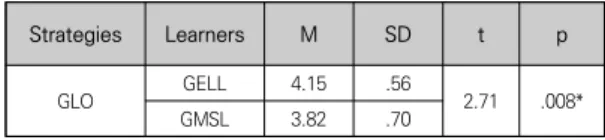
Table 2. Difference of global, problem-solving, and support strategy use
Learners Number of
learners Percentage
GELL Gender Male 17 23%
Female 57 67%
Grade First 36 49%
Second 38 51%
GMSL Gender Male 35 39%
Female 65 61%
Grade First 37 41%
Second 53 59%
Strategies Learners M SD t p
GLO GELL 4.15 .56
2.71 .008*
GMSL 3.82 .70
*<.05
As shown in [Table 2], there is a significant difference in metacognitive reading strategy use between GELLs and GMSLs when they read the English texts (t=2.28, p=.024 (GELL M=4.09, GMSL M=3.84)). With regard to global reading strategies and problem-solving reading strategies, there is a significant difference (GLO:
t=2.71, p=.008, PRO: t=2.56, p=.012) between GELLs (GLO: M=4.15, PRO: M=4.28) and GMSLs (GLO: M=3.82, PRO: M=3.99). Meanwhile, there is no significant difference (t=1.03, p=.318) in support strategies.
2. Global strategy use between GELLs and GMSLs
With regard to global strategies which GELLs and GMSLs employed, the differences between the two groups are shown in [Table 3].
Table 3. Global strategy use between GELLs and GMSLs
*<.05
As shown in the [Table 3], there is a significant difference in global strategies like 1 (t=4.44, p=.000 (GELL=4.26, GMSL=3.47)), 2 (t=2.13, p=.037 (GELL=4.47, GMSL=4.11)) and 12 (t=2.08, p=.039 (GELL=3.88, GMSL=3.42)). In contrast, there is no significant difference in global strategies such as 4 (t=.939, p=.350 (GELL=4.27, GMSL=409)), 6 (t=.825, p=.411 (GELL=3.70, GMSL=3.51)), 8 (t=1.06, p=.288 (GELL=4.03, GMSL=3.82)), 15 (t=.392, p=.696 (GELL=3.92, GMSL=3.89)), 17 (t=1.81, p=.072 (GELL=4.43, GMSL=4.16)), 20 (t=1.48, p=.140 (GELL=4.16, GMSL=3.87)), 21 (t=1.58, p=.117 (GELL=4.15, GMSL=3.84)), 23 (t=1.12, p=.261 (GELL=4.09, GMSL=3.87)), and 24 (t=1.13, p=.257 (GELL=4.35, GMSL=4.16)).
The global strategies which GELLs used the most frequently are "thinking about what they know to help them understand what they read,"
"using context clues to help them better understand what they are reading" and "taking an overall view of the text to see what it is about before reading it." On the other hand, GELLs employed the strategies like "thinking about whether the content of the text fits their reading purpose," "when reading, deciding what to read closely and what to ignore," and "using
PRO GELL 4.28 .55
2.56 .012*
GMSL 3.99 .67
SUP GELL 3.84 .63
1.03 .318
GMSL 3.71 .78
Total GMSLGELL 4.093.84 .53.67 2.28 .024*
Strategies Learners M SD t p
1.Setting purpose for reading
GELL 4.26 .845
4.44 .000*
GMSL 3.47 1.07
2. Using prior knowledge GELL 4.47 .687
2.13 .037*
GMSL 4.11 1.00
4. Previewing text before reading
GELL 4.27 .997
.939 .350
GMSL 4.09 1.06
6. Checking how text content fits purpose
GELL 3.70 1.19
.825 .411
GMSL 3.51 1.29
8. Skimming to note text characteristics
GELL 4.03 1.11
1.06 .288
GMSL 3.82 .834
12. Determining what to read
GELL 3.88 1.17
2.08 .039*
GMSL 3.42 1.13
15. Using text features(e.g. tables)
GELL 3.97 1.09
.392 .696
GMSL 3.89 1.19
17. Using context clues GELL 4.43 .778
1.81 .072
GMSL 4.16 .852
20. Using typographical aids (e.g., italics)
GELL 4.16 .980
1.48 .140
GMSL 3.87 1.16
21. Critically evaluating what is read
GELL 4.15 .946
1.58 .117
GMSL 3.84 1.12
23. Resolving conflicting information
GELL 4.09 1.03
1.12 .261
GMSL 3.87 1.12
24. Predicting and guessing text meaning
GELL 4.35 .928
1.13 .257
GMSL 4.16 .878
tables, figures, and pictures in a text to increase their understanding" the least frequently.
Interestingly, GMSLs tended to use global strategies such as "thinking about what they know to help them understand what they read,"
"using context clues to help them better understand what they am reading" and "taking an overall view of the text to see what it is about before reading it." the most frequently like GELLs. However, they employed "when reading, deciding what to read closely and what to ignore," "having a purpose in mind when they read" and "thinking about whether the content of the text fits their reading purpose"
the least frequently.
The [Figures 1] describing in [Table 3] can be represented in the graph as follows:
0 0.5 1 1.5 2 2.5 3 3.5 4 4.5 5
GLO 1
GLO 3
GLO 4
GLO 6
GLO 8
GLO 12
GLO 15
GLO 17
GLO 20
GLO 21
GLO 23
GLO 24
GLO 27
Gifed General
Figure 1. Global strategy use between GELLs and GMSLs
As shown in [Figure 1], GELLs and GMSLs used all global strategies in similar manners.
However, GELLs employed global strategies more frequently than GMSLs while they read the English texts. First of all, GELLs used global strategies 3, 17 and 24 the most frequently.
They utilized global strategy 6 and 12 less frequently. On the other hand, GMSLs used global strategies 3, 4, 17 and 24 while 1reading English the most frequently. They employed global strategy 1, 6, 12 and 27 the least
frequently.
3. Problem-solving strategy use between GELLs and GMSLs
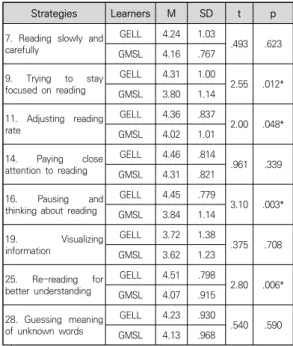
With regard to the problem-solving strategies, the differences in the reading strategy use between GELLs and GMSLs are shown in the below [Table 4].
Table 4. Problem-solving strategy use between GELLs and GMSLs
*<.05
In the [Table 4], there is a significant difference in problem-solving strategies such as 9 (t=2.55, p=.012 (GELL=4.31, GMSL=3.80)), 11 (t=2.00, p=.048 (GELL=4.36, GMSL=4.02)), 16 (t=3.10, p=.003 (GELL=4.45, GMSL=3.84)), and 25 (t=2.80, p=.006 (GELL=4.51, GMSL=4.07)).
Meanwhile, there is no significant difference in problem-solving strategies like 7 (t=.493, p=.623 (GELL=4.24, GMSL=4.16)), 14 (t=.961, p=.339 (GELL=4.46, GMSL=4.31)), 19 (t=.375, p=.708 (GELL=3.72, GMSL=3.62)), and 28 (t=.540, p=.590
Strategies Learners M SD t p
7. Reading slowly and carefully
GELL 4.24 1.03
.493 .623
GMSL 4.16 .767
9. Trying to stay focused on reading
GELL 4.31 1.00
2.55 .012*
GMSL 3.80 1.14
11. Adjusting reading rate
GELL 4.36 .837
2.00 .048*
GMSL 4.02 1.01
14. Paying close attention to reading
GELL 4.46 .814
.961 .339
GMSL 4.31 .821
16. Pausing and thinking about reading
GELL 4.45 .779
3.10 .003*
GMSL 3.84 1.14
19. Visualizing information
GELL 3.72 1.38
.375 .708
GMSL 3.62 1.23
25. Re-reading for better understanding
GELL 4.51 .798
2.80 .006*
GMSL 4.07 .915
28. Guessing meaning of unknown words
GELL 4.23 .930
.540 .590
GMSL 4.13 .968
(GELL=4.23, GMSL=4.13)).
GELLs employed all problem-solving strategies more frequently than GMSLs. Both used problem-solving strategies in different ways. In terms of individual subscales of problem-solving strategies, GELLs utilized 3 problem-solving strategies such as "when text becomes difficult, re-reading it to increase their understanding," "when text becomes difficult, paying closer attention to what they are reading," and "stopping from time to time and thinking about what they are reading" the most frequently.
GMSLs employed 3 problem-solving strategies such as "when text becomes difficult, re-reading it to increase their understanding,"
"reading slowly and carefully to make sure they understand what they are reading" and "when they read, guessing the meaning of unknown words or phrases" the most frequently. Both learners were inclined to use a problem-solving strategy like "trying to picture or visualize information to help remember what they read"
the least frequently.
Detailed differences of problem-solving strategies which two groups of learners used in their English reading are shown in the following figure.
0 0.5 1 1.5 2 2.5 3 3.5 4 4.5 5
PRO 7 PRO 9 PRO 11 PRO 14 PRO 16 PRO 19 PRO 25 PRO 28 Gifted General
Figure 2. Problem-solving strategy use between GELLs and GMSLs
Problem-solving strategies 14, 16 and 25 were used by GELLs the most frequently while problem-solving strategies 7, 25 and 28 were displayed by GMSLs the most frequently.
Interestingly, the use of problem-solving strategy 19 was made by both groups the least frequently.
4. Support strategy use between GELLs and GMSLs
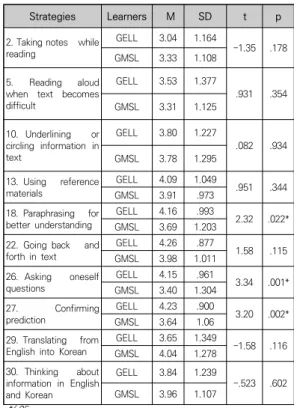
Considering support strategies, the differences between GELLs and GMSLs are as follows.
Table 5. Support strategy use between GELLs and GMSLs
*<.05
There is a significant difference in support strategies like 18 (t=2.23, p=.022 (GELL=4.16, GMSL=3.69)), 26 (t=3.34, p=.001 (GELL=4.15, GMSL=3.40)) and 27(t=3.20, p=.002 (GELL=4.23,
Strategies Learners M SD t p
2. Taking notes while reading
GELL 3.04 1.164
-1.35 .178 GMSL 3.33 1.108
5. Reading aloud when text becomes difficult
GELL 3.53 1.377
.931 .354 GMSL 3.31 1.125
10. Underlining or circling information in text
GELL 3.80 1.227
.082 .934 GMSL 3.78 1.295
13. Using reference
materials GELL 4.09 1.049
.951 .344
GMSL 3.91 .973
18. Paraphrasing for
better understanding GELL 4.16 .993
2.32 .022*
GMSL 3.69 1.203 22. Going back and
forth in text GELL 4.26 .877
1.58 .115 GMSL 3.98 1.011
26. Asking oneself
questions GELL 4.15 .961
3.34 .001*
GMSL 3.40 1.304 27. Confirming
prediction GELL 4.23 .900
3.20 .002*
GMSL 3.64 1.06
29. Translating from
English into Korean GELL 3.65 1.349
-1.58 .116 GMSL 4.04 1.278
30. Thinking about information in English and Korean
GELL 3.84 1.239
-.523 .602 GMSL 3.96 1.107
GMSL=3.64). On the contrary, there is no significant differences between support strategies such as 2 (t=-1.35, p=.178 (GELL=3.04, GMSL=3.33)), 5 (t=.931, p=.354 (GELL=3.53, GMSL=3.31)), 10 (t=.082, p=.934 (GELL=3.80, GMSL=3.78)), 13 (t=.951, p=.344 (GELL=4.09, GMSL=3.91)), 22 (t=.158, p=.115 (GELL=4.26, GMSL=3.98)), 29 (t=-1.58, p=.116 (GELL=3.65, GMSL=4.04)), and 30 (t=-.523, p=.602 (GELL=3.84, GMSL=3.96)).
In general, GELLs tended to use more support strategies than GMSLs while the formers read English materials. GELLs were inclined to employ support strategies like "going back and forth in the text to find relationships among ideas in it", "asking themselves questions they like to have answered in the text" and
"paraphrasing to better understand what they read" the most frequently. They used support strategies like "taking note while reading to help them understand what they read", "when text becomes difficult, reading aloud to help them understand what they read" and "When reading, translating from English into their native language" the least frequently.
On the other hand, GMSLs were inclined to use support strategies like "when reading, translating from English into their native language", "when reading, thinking about information in both in English and their mother tongue" and "going back and forth in the text to find relationships among ideas in it" the most frequently while they read in English. They employed supporting strategies such as "taking note while reading to help them understand what they read", "when text becomes difficult, reading aloud to help them understand what they read" and "asking themselves questions they like to have answered in the text" the least
frequently.
GELLs tended to use most of the support strategies more frequently than GMSLs.
Interestingly, GMSLs employed support strategies "taking note while reading to help them understand what they read", "When reading, translating from English into their native language" and "when reading, thinking about information in both in English and in their mother tongue" more frequently than GELLs.
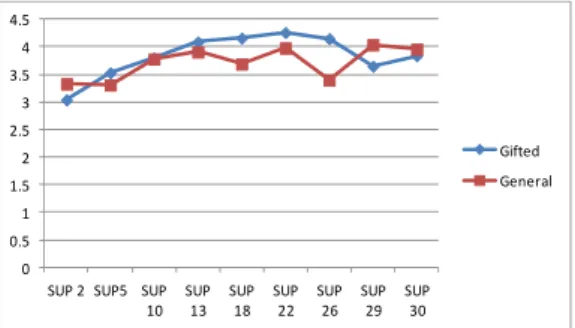
The detailed differences of support strategy use between GELLs and GMSLs in their English reading are as follows:
0 0.5 1 1.5 2 2.5 3 3.5 4 4.5
SUP 2 SUP5 SUP 10
SUP 13
SUP 18
SUP 22
SUP 26
SUP 29
SUP 30
Gifted General
Figure 3. Support strategy use between gifted English language learners and general middle school students
Support strategy 18, 22 and 26 were displayed by GELLs the most frequently while support strategy 2, 5 and 29 were used by GELLs the least frequently when reading the English texts.
On the other hand, support strategy 22, 29 and 30 were utilized by GMSLs the most frequently while support strategy 3, 5 and 26 were employed the least frequently reading the English texts. Interestingly, support strategy 2, 29 and 30 were used by GMSLs more frequently than by GELLs.
5. Top and bottom five strategies between GELLs and GMSLs
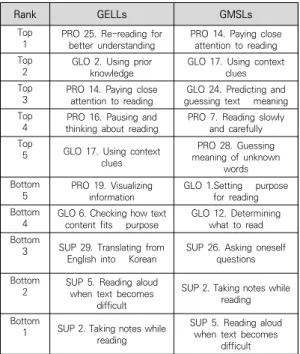
Top and bottom five metacognitive awarenes of reading strategies which GELLs and GMSLs used the most and the least frequently while they read the English test-typed texts were represented in the following [Table 6].
Table 6. Top and bottom five strategies between GELLs and GMSLs
Top and bottom five metacognitive awareness of reading strategies were displayed by GELLs and GMSLs in difference manners.
Problem-solving strategies 25 and 14, 16 and global strategies 2 and 17 were employed by GELLs the most frequently. Meanwhile, problem-solving strategies 14, 7, 28 and global strategies 17 and 24 were used by GMSLs the most frequently.
Considering rarely used strategies, the support strategies 2 and 5 were commonly reported as the bottom five by two groups. However,
problem-solving strategy 19, global strategy 6 and support strategy 29 were displayed by GELLs the least frequently. Global strategies 1 and 12, and support strategy 26 were used by GMSLs the least frequently.
Ⅴ. Conclusion and Discussion
The purpose of this study was to examine the differences in metacognitive awareness of reading strategy use between GELLs and GMSLs in the English test-typed text reading. As a result of data analysis, it was found that GELLs used a greater number of metacognitive awareness of reading strategies than GMSLs, which is consistent with the findings in Choi and Jin's study[3]. Interestingly, while both GELLs and GMSLs were likely to use the problem-solving strategies the most, they employed global strategies the second and support strategies the least frequently.
As for subscales of the metacognitive awareness of reading strategies, GELLs used more global and problem-solving strategies than GMSLs as reported by Berkowitz and Cichelli's, Choi and Jin's and Bang’s studies[3][4][25]. GELLs tended to use their previous knowledge and context clues, and predict text meaning the most frequently. It implies that GELLs were likely to make use of top-down reading. Meanwhile, GMSLs were apt to determine what to read and use text features the most frequently. The problem-solving strategies were used by GELLs more frequently than GMSLs like the result of Choi and Jin's research[3]. GELLs tried to pay close attention to reading and to pause and think about reading while GMSLs used to read slowly and
Rank GELLs GMSLs
Top1 PRO 25. Re-reading for
better understanding PRO 14. Paying close attention to reading Top 2 GLO 2. Using prior
knowledge GLO 17. Using context clues Top 3 PRO 14. Paying close
attention to reading GLO 24. Predicting and guessing text meaning Top 4 PRO 16. Pausing and
thinking about reading PRO 7. Reading slowly and carefully Top5 GLO 17. Using context
clues
PRO 28. Guessing meaning of unknown
words Bottom
5 PRO 19. Visualizing
information GLO 1.Setting purpose for reading Bottom
4 GLO 6. Checking how text
content fits purpose GLO 12. Determining what to read Bottom
3 SUP 29. Translating from
English into Korean SUP 26. Asking oneself questions Bottom
2 SUP 5. Reading aloud when text becomes
difficult
SUP 2. Taking notes while reading Bottom
1 SUP 2. Taking notes while reading
SUP 5. Reading aloud when text becomes
difficult
carefully and to guess the unknown words the most frequently, which means that GMSL tended to be involved in bottom-up reading.
Both groups were likely to re-read for better understanding frequently. Support strategies were displayed by both groups the least frequently as suggested by Berkowitz and Cichelli[4]. GELLs had a tendency to paraphrase for better understanding and ask themselves questions while GMSLs were apt to translate from English into Korean and think about information in English and Korean. However, both groups tended to come back and forth in the text the most frequently.
In terms of top five strategies, GELLs tended to re-read for better understanding, to use prior knowledge, and to pause and think about reading the most frequently while GMSLs were likely to predict and guess text meanings, to read slowly and carefully, and to guess the meanings of unknown words the most frequently. Two groups were apt to pay close attention to reading and using context clues the most frequently. With regards to the bottom five strategies, GELLs were apt to visualize information, check how text content fits its purpose, and translate from English into Korea the least frequently while GMSLs were likely to set the purpose for reading, determine what to read, and ask themselves questions the least frequently. Both tended to read aloud when a text becomes difficult and to take notes the least frequently while reading.
Based on the findings, some pedagogical implications can be provided. First, the findings showed that GMSLs used less metacognitive awareness of reading strategies than GELLs, suggesting that GMSLs should be encouraged and motivated to use more metacognitive
awareness of reading strategies more effectively and frequently in their English reading. Second, the results indicated that both groups tended to use fewer support strategies than the two others, which means that learners, in general, were unlikely to analyze or evaluate text information. Thus, the learners should be provided trainings to practice analyzing and evaluating the information which they get from the texts by asking themselves question about texts or taking notes while reading.
참 고 문 헌
[1] C. Y. Ahn and M. S. Han, “A study on the use of high school students’ metacognitive strategies in accordance with the degree of difficulty of reading passages and the students’
level,” Journal of Learner-Center Curriculum and Instruction, Vol.16, No.5, pp.787-809, 2016.
[2] M. A. Jung and N. K. Kim, “Reading strategies in L1 and L2: Comparison of Korean EFL learners’ reading strategy use,” Studies Modern Grammar, Vol.68, pp.211-240, 2012.
[3] S. I. Choi and S. K. Jin, “Exploring of the validity of reading metacognition inventory for identifying gifted students’ in languages,” The Journal of the Korean Society for the Gifted and Talented, Vol.14, No.3, pp.103-126, 2015.
[4] E. Berlowwitz and T. Cicchelli, “Metacognitive strategy use in reading of gifted high school achieving and gifted underachieving middle school students in New York City,” Emotion and Urban Society, Vol.37, No.1, pp.37-57, 2004.
[5] C. R. Fehrenbach, “Gifted / average readers:
Do they use the same reading strategy?,”
Gifted Child Quarterly, Vol.35, pp.125-127, 1991.
[6] H. J. Feldhusen, Individualized teaching of
gifted children in regular classroom, New York:D.O.K., 1989.
[7] J. S. Renzulli, What Makes Giftedness?, New York:Chronicle Guidance, 1978.
[8] A. H. Passow, “The nature of giftedness and talent,” Gifted Child Quarterly, Vol.25, pp.5-10, 1981.
[9] A. M. Blackburn, L. Cornish, and S. Smith,
“Gifted English language learners: Global understanding and Australian perspectives,”
Journal for the Education of the Gifted, Vol.39, No.4, pp.338-360, 2016.
[10] T. Deveau, “Strategies for gifted second language learners,” Academic Exchange Quarterly, March 22, 2006.
[11] K. Gallagher, Deep Reading, Portland:Stern house, 2004.
[12] P. Hoh, “The linguistic advantage of the intellectually gifted child: An empirical study of spontaneous speech,” Reeper Rev., Vol.27, No.3, pp.178-185, 2005.
[13] J. VanTassel-Baska, “The on-going dilemma of effective identification practices in gifted education,” The Communicator, Vol.31, pp.87-99, 2000.
[14] D. Durkin, “Matching classroom instruction with reading abilities: An unmet need,”
Remedial and Special Education, Vol.11, No.3, pp.23-28, 1990.
[15] N. F. Jackson, “Precocious Reading ability:
What does it mean?,” Gifted Child Quarterly, Vol.32, pp.200-204, 1988.
[16] B. Clark, Grouping up gifted, Columbia:
Merrill/ Practice Hall, 1997.
[17] J. A. Dole and P. J. Adams, “Reading curriculum for gifted readers: A survey,” Gifted Child Quarterly, Vol.27, pp.64-72, 1983.
[18] C. Dooley, “The challenge: Meeting the needs of gifted readers,” Reading Teacher, Vol.46, pp.546-551, 1993.
[19] S. Kaplan, “Reading strategies for gifted readers,” Teaching for High Potential, Vol.1, No.2, pp.1-2, 1999.
[20] D. Levande, “Identifying and serving the gifted reader,” Reading Improvement, Vol.30, pp.147-150, 1993.
[21] J. H. Flavell, “Metacognition and cognitive
monitoring: A new area of
cognitive-developmental inquiry,” American Psychologist, Vol.34, pp.906-907, 1979.
[22] K. E. Snyder, J. L. Nierfeld, and L.
Linnenbrink-Garcia, “Giftedness and metacognition: A short-term longitudinal investigation of metacognitive monitoring in the classroom,” Gifted Child Quarterly, Vol.55, No.3, pp.181-193, 2011.
[23] M. Carr and G. Taasoobshirazi,
“Metacognition: A recent review of research, theory, and perspective,” M. F. Shaughness, M.
V. J. Veenman, and C. Kleyn-Kennedy(eds.), Metacognition in the Gifted: Connections to Expertise, New York:Nova, Chapter 6, pp.109-125, 2008.
[24] K. Mokhtari and R. Sheorey “Measuring ESL students’ awareness of reading strategies,”
Journal of Development Education, Vol.25, No.3, pp.2-10, 2002.
[25] J. Bang, “Metacognitive reading strategy use in L1 and L2 reading between general middle school learners and gifted English language learners,” Advanced Science Letters, Vol.23, No.10, pp.10451-10455, 2017.
저 자 소 개
방 준(Jyun Bang) 정회원
▪2005년 7월 : Ball State University(영어교육학석사)
▪2011년 2월 : Indiana University of Pennsylvania(영어교육학박사)
▪2015년 9월 ~ 현재 : 부산광역시영 재교육진흥원
<관심분야> : 영어교육과정, 뇌과학과 영어교육, 영어영재