• 검색 결과가 없습니다.

#Looksperfectgram: The Relationship between Perfectionistic Self-Presentation, Self-Construal, Self-Efficacy and Intention to Use Instagram

N/A
N/A
Protected

Academic year: 2021

Share "#Looksperfectgram: The Relationship between Perfectionistic Self-Presentation, Self-Construal, Self-Efficacy and Intention to Use Instagram"

Copied!
13
0
0

로드 중.... (전체 텍스트 보기)

전체 글

(1)

#Looksperfectgram:

The Relationship between Perfectionistic Self-Presentation, Self-Construal, Self-Efficacy and Intention to Use Instagram

Gayoung Ahn 1 , Eun-Kyoung Han 2*

1

Brand Reputation Institute, Researcher;

2

Department of Media and Communication, Sungkyunkwan University, Professor

개인특성에 따른 인스타그램 사용의도:

완벽주의적 자기제시, 자기효능감, 자아해석을 중심으로

안가영 1 , 한은경 2*

1

브랜드 평판 연구소 연구원,

2

성균관대학교 미디어커뮤니케이션학과 교수

Abstract Instagram, a photo and image centered social networking service, has received increasing attention these days, from scholars and practitioners. However, little is known about the social and psychological factors that lead consumers to use this service. To provide a baseline understanding on Instagram users, the current study was conducted to discover perfectionistic self-presentation tendency expressed by the Instagram users and explore the relationships between identified perfectionistic self-presentation and intention to use Instagram variables with 250 participants. In addition, this study tried to determine the moderator effect of self-efficacy and self-construal. A comprehensive survey was directed and a total of 380 participants were recruited to verify anticipated hypotheses and research questions.

The research results suggest that perfectionistic self-presentation has five sub factors: others conscious self-presentation, subjective self-presentation, environmental adaptation self-presentation, self-expansion self-presentation, and social self-presentation. The implications of this research findings are discussed.

Key Words : SNS, Perfectionistic self-presentation, Self-efficacy, Self-construal, Intention to use Instagram

요 약 요즘 들어, 사진이나 이미지 중심의 소셜 네트워킹 서비스인 인스타그램은 학계와 업계의 주목을 받고 있다.

이러한 관심에도 불구하고 소비자들이 이 서비스를 사용하도록 유도하는 사회적, 심리적 요인에 대해서는 거의 알려진 바가 없다. 이러한 상황 속에서, 본 연구는 인스타그램 사용자에 대한 기본적인 이해를 제공하기 위해 250명의 참가자 를 대상으로 인스타그램 사용자들에게서 나타나는 완벽주의적 자기제시 성향과 그 하위 요소를 찾아내고, 또한 이들과 인스타그램 사용의도 변수와의 관계를 탐구하였다. 그리고 자기 효능감과 자아 해석의 조절효과에 대해서도 살펴보았 다. 이를 위해, 총 380명의 참가자를 예측된 가설과 연구문제를 검증하기 위해 모집하였다. 연구결과에 따르면 완벽주 의적 자기제시는 다섯 가지 하위 요소인 타인의식적 자기제시, 주관적 자기제시, 환경적응적 자기제시, 자아 확장적 자기제시, 사회적 자기제시 등을 포함하고 있음을 확인하였다. 또한, 이러한 다섯 가지 요소를 지닌 완벽주의적 자기제 시가 자기 효능감과 자아 해석의 조절효과를 통하여 인스타그램 사용의도에 긍정적인 영향을 미친다는 것을 밝혀냈다.

이러한 연구결과를 바탕으로 본 연구의 함의가 논의되었다.

주제어 : 인스타그램 사용의도, SNS(소셜 네트워킹 서비스), 완벽주의적 자기제시, 자기 효능감, 자아 해석

*Corresponding Author : Eun-Kyoung Han([email protected])

Received April 24, 2019 Revised May 26, 2019

Accepted July 20, 2019 Published July 28, 2019

(2)

1. Introduction

1.1 SNS and Instagram

In the era of digital convergence, SNS, social media, big data, and Internet of Things are pushed to the point where we can not keep up with the digital technology and devices. This innovative change improves the efficiency in work of users and enhances their quality of life.

Over the last decade, social networking services (SNS) especially have grown and changed faster than any other internet activities [1, 2]. Global Web Index has analyzed people’s use of SNS and determined which kind of SNS would become popular or powerful around the world by examining the use and time spent by the users [3].

Instagram, one of the SNSs that facilitates communications via images and other visual information, had an increase of 46% in active users [4, 5]. On the other hand, it was found that Facebook was the only SNS that had a decline in active users. Despite the decrease of active users, still several researches on the demographic characteristics of Facebook users, motivations for use, self-presentation, and social interactions [6, 7] have been proceeded continuously by some scholars. However, it can be seen that there are few studies on Instagram, nevertheless, the number of Instagram users are increasing.

Instagram, which has remarkably emerged since 2010, is estimated to be 100 million users a month and is rapidly gaining popularity through sharing photos and videos using filter options [8]. The Instagram, designed specifically for mobile devices, is a ‘light-weight’ social media [9, 10]. Instagram has a great advantage of being able to spread visual information to everyone who is interested and to receive various information through uploaded pictures and videos.

The operation method of this Instagram makes it possible to freely browse the page or the feed

of another person even with the passive use pattern of the user. The nature of Instagram enables the users to edit and upload photos to make them look stylish, sophisticated or beautiful to show to others [11]. Another advantage is that it is easy to obtain self-satisfaction, recognition and envy from others by positively suggesting user's desire and values.

However, Instagram users tend to try to hide their true self and show themselves in an excessively self-conscious manner [9, 11]. As a result, users likely show feelings of relative deprivation, inferiority, low self-esteem, jealousy, envy and depression. Instagram users also want to be seen as perfect in order to hide these negative emotions.

These kinds of unique tendencies of Instagram users intrigue them to use perfectionistic self-presentation [12] as their communication tactics in Instagram space. Therefore, it is significant to discover the factors constituting perfectionistic self-presentation. Moreover, it is also important to examine how perfectionistic self-presentation factors affect the intention to use Instagram in accordance with self-construal and self-efficacy.

1.2 Perfectionistic Self-Presentation

Self-presentation consists of behaviors designed to make a desired impression on others.

When people must effortfully plan and alter their

behaviors to convey the intended image of

themselves, the success of self-presentation will

heavily depend on effective self-regulation. This

is common when people have to present

themselves under difficult circumstances or in

unfamiliar ways [13]. Besides, self-presentation

may follow habitual or well-learned patterns of

behavior. In those cases, it may not require much

of self-regulation. Self-presentation predicts

success in human groups and relationships [14,

15]. Early in life, people are instructed that they

(3)

must convey positive images of themselves so that they can fit their group’s values of social desirability and admired traits. Consequently, most people develop some skills of self-presentation derived from overlearned or automatic patterns of self-presentation.

However, given that social life is marked by irregular encounters with social contexts and relationship partners, it might be impossible for self-presentation to become entirely automatized.

As a consequence, the person has to use effortful and deliberate control over his or her behavior, which is different from self-regulation, to select and convey an optimal image. Kowalski and Leary (1990) have depicted impression construction, an active process of creating a public image, by combining the following two processes that require deliberate and effortful self-regulation:

selection of self-images for public portrayal and strategic conveying of those images. For example, if a person’s habitual mode of self-presentation were a flirter, an aggressive athlete, or a hard drinker, then a job interview or meeting with prospective in-laws might motivate the person to override now-easily-conveyed image in favor of another using more promising version of self, such as an ambitious hard worker or a doting caregiver. By the same token, many people might moderate their extreme attitudes on sensitive issues to make a better impression on a new colleague who has quite different views. In these ways, self-presentation can benefit from self-regulation when circumstances call for a departure from the person’s habitual style and image.

However, it is said that the natural motivation to leave a favorable impression to others has become a dramatic self-presentation, and it has tendency to be 'perfectionistic self-presentation' [12]. This perfectionistic self-presentation is a different dimension from perfectionism. If perfectionism reflects the desire to be perfect, perfectionistic self-presentation reflects one’s desire to be looked perfect, and perfectionistic

self-presenters may attempt to present themselves perfectly, whether or not they are actually performing perfectly. This perfectionistic self-presentation is a neurotic interpersonal relationship that affects maladaptive interpersonal relationships and is associated with psychological distress, especially in social contexts such as low self-esteem and social disruption, excessive attention to the evaluation of others [12, 17, 18].

The perfectionistic self-presentation tendency starts from the pure belief that should be seen as 'perfect' to leave a good impression to others.

However, the greatest contradiction of these tendencies is that the initial pure intention to give a good impression to others results in a negative outcome that ultimately blocks the relationship with others. If the interpersonal relationship is impaired, it will adversely affect the sense of self-worth and self-identity, and can cause emotional distress. Considering these different points of views, the following research question and hypothesis were drawn:

RQ1: What are the construct variables for the perfectionistic self-presentation in using Instagram?

H1: Perfectionistic self-presentation will positively affect the intention to use Instagram.

1.3 Moderator Effect of Self-Construal and Self-Efficacy

In this study, the two moderators of the relationship between perfectionistic self-presentation and intention to use Instagram are examined.

Self-construal theory could be defined as a person’s perception of their relationship with others as either connected or disconnected. In self-construal theory, the self is divided into independent self and interdependent self [18, 19].

Independent self has a very vivid self-identity.

Such person makes judgments based on inner

elements instead of other people’s opinions or

thoughts. Aaker and Lee (2001) have stated that

(4)

people who have independent characteristics show self-centered tendencies. This type of people can be found in most Western cultures. In contrast, interdependent self considers other people’s thoughts, ideas, and opinions to create harmony [21, 22, 19]. People in Eastern countries and Latin America have characteristics of collectivism. They tend to place the group before themselves [23, 19].

Self-efficacy refers to an individual’s assessment of his or her capacity to accomplish a given task [24, 25, 26]. This cognitive process is closely associated with varied activities that people pursue in order to achieve their goals. It serves as a means of coping with potential

‘‘obstacles and aversive experiences’’ [14 (p. 287)].

In particular, self-efficacy actively confronts outside stressors and upgrades quality of life. It has been indicated that individuals who demonstrate low self-efficacy are more likely to lose their pace when they convert their plans into action [27]. For example, people with low self-efficacy are likely to become addicted to substances or activities such as online gaming or alcohol. Based on these findings, the following hypothesis is generated:

H2: Self-efficacy will moderate the relationship between perfectionistic self-presentation and the intention to use Instagram positively.

RQ2: Will self-construal moderate the relationship between perfectionistic self-presentation and the intention to use Instagram positively?

2. Methods

2.1 Study 1

The initial steps in developing a measure of the perfectionistic self-presentation involve perfectionistic self-presentation scale, multidimensional

perfectionism scale, and self-monitoring scale [12, 28, 29]. The purpose of Study 1 was to develop a reliable set of items, derived from self-presentation and self-perfectionism theory, tapping the five main factors of perfectionistic self-presentation.

2.1.1 Participants

As respondents, 250 South Korean participants who are also active in using Instagram in their 20s and 30s were recruited [7] from online panel.

Since the highest percentage of using SNS, especially Instagram, was found in the population of the age between 20 and 39. Additionally, the participants who have more than 50 followers as well as following 60 Instagram pages with uploading more than 60 of their own images and pictures via their own page were selected, since these numbers prove a person as an active Instagram user.

2.1.2 Measures

In order to ensure the active Instagram user, questions, such as ‘how many followers do you have in Instagram’, ‘how many Instagram pages are you currently following’, ‘how many pictures or images are you uploading to your own Instagram page’ were asked. Respondents had to answer these questions by writing down the specific numbers. With these processes, the survey was implemented. The survey questions were consisted of perfectionistic self-presentation scale [12, 30] with the 27 questions, multidimensional perfectionism scale [28] with 45 questions, and 18-item of self-monitoring scale [29]. All the participants were asked to pick the most agreeable answers using 7-point Likert type scale ranging from “1= strongly disagree” to “7=

strongly agree”. Intention to use Instagram was

measured with the 4 items that were used for

behavioral intention. The 4 items were modified

from Ma’s (2013) research.

(5)

2.1.3 Results

1) Exploratory Factor Analysis (EFA) and Principal Component Analysis (PCA) In order to obtain factors of the newer version of perfectionistic self-presentation and answer to the first research question, 120 participants were recruited for the EFA. Principal component analysis (PCA) with varimax rotation in the process of EFA was performed to determine what underlying structure might have existed for perfectionistic self-presentation for this research.

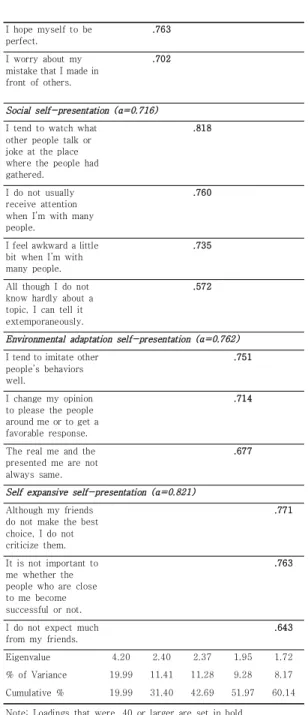
The PCA was evaluated with Eigen value (>1.0), variance explained by each component, loading the score for each factor (≥0.4), and the meaningfulness of each dimension. As a result, 5 meaningful and interpretable components with overall 21 items were obtained. They could explain 60.14% of the total variance.

As the Table 1., the 1st component labeled as

‘‘others conscious self-presentation’’ accounted for 19.99% of the variance after rotation. Its 8 items formed a reliable scale with Cronbach’s alpha (α) value of 0.864. The 2nd component

‘‘subjective self-presentation’’ consisted of three items. It accounted for 11.41% of the variance (α

=0.758). The 3rd component ‘‘social self-presentation’’

1 2 3 4 5

Others conscious self-presentation (α=0.864) It is important for me

to be looked as “a person who knows everything” in all situations.

.817

I always need to be looked as perfect.

.810

I feel other people’s level of works should be perfect.

.777

Making my task successful is meaning I should work much harder to please other people.

.698

I should be seen to other people as I’m controlling my own behaviors.

.653

I never tell other people how I feel hard on the given tasks to me.

.613

I need to be seen as I’m capable for everything that I do.

.586

I can’t stand seeing people who do not try to be better.

.440

Subjective self-presentation (α=0.758) I try to be perfect as

possible.

.782

Table 1. Perfectionistic Self-presentation (PCA; N=120)

I hope myself to be perfect.

.763

I worry about my mistake that I made in front of others.

.702

Social self-presentation (α=0.716) I tend to watch what

other people talk or joke at the place where the people had gathered.

.818

I do not usually receive attention when I’m with many people.

.760

I feel awkward a little bit when I’m with many people.

.735

All though I do not know hardly about a topic, I can tell it extemporaneously.

.572

Environmental adaptation self-presentation (α=0.762) I tend to imitate other

people’s behaviors well.

.751

I change my opinion to please the people around me or to get a favorable response.

.714

The real me and the presented me are not always same.

.677

Self expansive self-presentation (α=0.821) Although my friends

do not make the best choice, I do not criticize them.

.771

It is not important to me whether the people who are close to me become successful or not.

.763

I do not expect much from my friends.

.643

Eigenvalue 4.20 2.40 2.37 1.95 1.72

% of Variance 19.99 11.41 11.28 9.28 8.17

Cumulative % 19.99 31.40 42.69 51.97 60.14

Note: Loadings that were .40 or larger are set in bold.

(6)

explained 11.28% of the variance. The scale with 4 items were found to be reliable (α=0.716). The 4th component ‘‘environmental adaptation self-presentation’’ included three items (α=0.762).

It could explain 9.28% of the variance. The 5th component ‘‘self expansive self-presentation’’

with 3 items accounted for 8.17% of the variance (α=0.821). The overall result of reliability checks revealed Cronbach’s alpha value of 0.929. Given the acceptable reliabilities, the 5 motivation indices were created by averaging the corresponding items.

2) Confirmatory Factor Analysis (CFA) Next, confirmatory factor analysis (CFA) was conducted to validate and assess replicability of the 5-factor (21 items) structure. Overall 130 participants were recruited for this analysis. The 8 items for others conscious self-presentation, 3 items for subjective self-presentation, 4 items for social self-presentation, 3 items for environmental adaptation self-presentation, and 3 items for self expansive self-presentation were confirmed to be valid for further analyses. The overall goodness fit values were also acceptable (x

2

=226.723, df=1.417, GFI=0.949, CFI=0.976, NFI=0.924, IFI=0.976, RMR=0.073, RMSEA=0.033). Therefore, the CFA for an independent variable was successful and each factor was confirmed.

2.1.4 Discussion

This study investigated whether perfectionistic self-presentation positively affected the intention to use Instagram. In addition, this study evaluated how self-efficacy and self-construal theory could strengthen or weaken the relationship between perfectionistic self-presentation and the intention to use Instagram.

Research question 1 predicted that how many sub-factors were constructed for perfectionistic self-presentation. Total 90 measurement items were retrieved from various precedent researches in order to measure South Korean Instagram users having their perfectionistic self-presentation characteristics. With the process of exploratory factor analysis (EFA) and confirmatory factor analysis (CFA), overall 5 factors and 21 measurement items were revealed. The 5 factors and measurement items were; ‘others conscious self-presentation’ with 8 items, ‘subjective self-presentation’ with 3 items, ‘social self-presentation’

with 4 items, ‘environmental adaptation self-presentation’

with 3 items and ‘self expansive self-presentation’ with 3 items.

Several research studies have focused on SNS and related psychological behaviors of users.

However, not that many researchers have studied the factors, which might influence people to use Instagram. This research widens the barriers to such study regarding the intention to use Instagram and found a new variable, perfectionistic self-presentation that could cause people to use Instagram. This research broadened the term of perfectionistic self-presentation based on South Korean participants’ answers and perceptions. It was found that people might pay a lot of attention to other peoples’ opinions and thoughts.

However, they will have certain behaviors based on their own beliefs and values at the same time.

2.2 Study 2

One way of determining an instrument's validity is to examine the underlying structure of the measure using factor-analytic techniques. Because this study has proposed that the perfectionistic self-presentation construct assesses five factors of perfectionistic self-presentation from PCA, with varimax rotation in the process of exploratory factor analysis (EFA). In this part of the study, the key five factors of perfectionistic self-presentation were assessed by using South

x

2

df GFI CFI NFI IFI RMR RMSEA

226.723 1.417 0.949 0.976 0.924 0.976 0.073 0.033 Table 2. Confirmatory Factor Analysis Model Fitness

Index

(7)

Korean Instagram users, who are in their 20s and 30s.

Another important step in assessing an instrument's validity is to establish a relationship between perfectionistic self-presentation, intention to use Instagram, self-construal, and self-efficacy.

This procedure provides evidence that people’s perfectionistic self-presentation affects those users’ intention to use Instagram and that how people’s self-construal and self-efficacy moderate the relationship between perfectionistic self-presentation and intention to use Instagram.

2.2.1 Participants

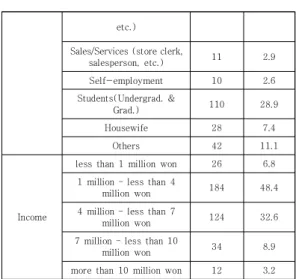
380 South Korean participants of various ages were recruited for this research. All participants were recruited through panel research from a South Korean survey company. In order to gather credible and meaningful answers, participants from age 20 to over age 50 were grouped into the following age ranges of: 20 to 24, 25 to 29, 30 to 34, 35 to 39, 40 to 44, 45 to 49, and above 50. Other demographic questions such as, vocation, gender, household incomes, and others were asked.

2.2.2 Measures

Again, the 7-point Likert scale anchored by

“1= strongly disagree” and “7= strongly agree” was used for these questions. In order to measure the relationships among variables for this whole research, the 21-item scale that was retrieved from the pre-test was used. Regarding the self-efficacy, scale from Scholz et al. (2002) was adapted, since the scale and its items were well organized and it was worth of applying. In order to measure self-construal, 14-item scale of Hardin et al. (2004) was used for this research.

Intention to use Instagram was measured with the 4 items that were used for behavioral intention.

The 4 items were modified from Ma’s (2013) research after retrieving and modifying Fishbein and Ajezen’s (1975) theory of reasoned action.

2.2.3 Results

In order to test hypothesis 1 and 2 and answer research question 2 for this study, multiple regression analysis was conducted. For this, the effect of independent variables on dependent variables was analyzed. In addition, how self-construal and self-efficacy moderate the relationship between perfectionistic self-presentation and intention to use Instagram was identified. F-test results for each step were F=27.983 (p<0.001),

Classification Freq. (%)

Gender Male 184 48.4

Female 196 51.6

Age

under 19yrs. 61 16.1

20-24yrs. 64 16.8

25-29yrs. 59 15.5

30-34yrs. 67 17.6

35-39yrs. 65 17.1

above 40yrs. 64 16.8

Vocation

Profession (professor, doctor, legal person, accountant, media, artist,

etc.)

30 7.9

Management position (captains or team leader or

higher/level officials of grade 5 or higher)

15 3.9

Office/technical jobs (production simple/technical workers, simple functional workers,

134 35.3

Table 3. Results of Demographic Characteristics

etc.) Sales/Services (store clerk,

salesperson, etc.) 11 2.9

Self-employment 10 2.6

Students(Undergrad. &

Grad.) 110 28.9

Housewife 28 7.4

Others 42 11.1

Income

less than 1 million won 26 6.8 1 million – less than 4

million won 184 48.4

4 million – less than 7

million won 124 32.6

7 million – less than 10

million won 34 8.9

more than 10 million won 12 3.2

(8)

F=6.123 (p<0.001), and F=4.909 (p<0.001). R

2

values for step 1, step 2, and step 3 were 0.318, 0.332, and 0.371, respectively. Therefore, independent variable and moderator variable explained 31.8%

and 33.2% of the variation while interaction variables with each moderating independent variable explained about 37.1% of the variation.

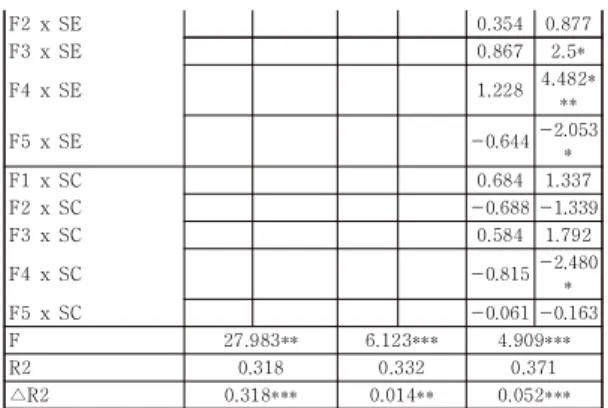
Results of step wise moderator regression analysis between variables are shown in Table 4., β values for independent variables, especially others conscious self-presentation ( β =0.181, p <.001) and environmental adaptation self-presentation ( β

=0.186, p <.001), had significant cause and effect relationships with the intention to use Instagram.

In other words, out of 5 factors of the independent variable, only factor 1 and factor 3 affected the intention to use Instagram. In step 2, independent variables, self-efficacy, and self-construal were input as moderators. However, only self-efficacy had moderating effect. It was significant since the value of the β coefficient was 0.166 ( p < 0.05).

In the last step, the interactions with each independent variable and the moderators were entered. It was found that the interaction between environmental adaptation self-presentation ( β

=0.867, p <0.05) with self-efficacy and social self-presentation with self-efficacy ( β =1.228, p <0.001) were statistically significant. Change in R

2

was also significant (△R

2

= 0.052, p <0.001).

Hypothesis 1 predicted that all 5 factors of the perfectionistic self-presentation had positive effect on intention to use Instagram. However, in Table 4., only others conscious self-presentation and environmental adaptation self-presentation affected the intention to use Instagram in multiple regression analysis. The R

2

value was 0.318, indicating that the interactions between independent variables (others conscious self-presentation and environmental adaptation self-presentation) and dependent variable could explain up to 31.8% of the intention to use Instagram. As shown in Table 4., the F value was 27.983 with significant probability ( p <0.001), indicating that the regression line for the overall model was suitable. Other factors of the independent variable such as subjective self-presentation, social self-presentation, and self expansive self-presentation also affected the intention to use Instagram since the p-values were all smaller than 0.05. Therefore, hypothesis 1 was partially supported.

Hypothesis 2 assumed that self-efficacy has a moderator effect on the relationship between perfectionistic self-presentation and the intention to use Instagram. As shown in Table 4., the correlation between the independent and the dependent variable was somewhat high at .770 (R

2

=0.332). This implied that the interactions between the independent variables and the dependent variable could explain up to 33.2%.

According to the table above, the F value was

Independent Variable

Step 1 Step 2 Step 3

β t β t β t

(Constant) - 2.347 - 0.929 - 3.107

others conscious

self-presentation F1 0.181 3.158*** 0.122 1.815 -0.192 -0.538 subjective

self-presentation F2 0.092 1.698 -0.048 -0.827 -0.011 -0.032 environmental

adaptation self-presentation F3

0.186 3.237*** 0.183 3.195 -0.61 -1.981

social

self-presentation F4 -0.242 -4.748 0.361 5.834 -0.929 -3.268 self expansive

self-presentation F5 -0.190 3.536 -0.197 -3.671 0.428 1.438

self-efficacy     0.166 2.946* -0.804 -2.574

self-construal     0.066 1.196 -0.225 -0.577

F1 x SE         0.086 0.970

Table 4. Result of Moderator Regressions between Variables

F2 x SE         0.354 0.877

F3 x SE         0.867 2.5*

F4 x SE         1.228 4.482*

**

F5 x SE         -0.644 -2.053

*

F1 x SC         0.684 1.337

F2 x SC         -0.688 -1.339

F3 x SC         0.584 1.792

F4 x SC         -0.815 -2.480

*

F5 x SC         -0.061 -0.163

F 27.983** 6.123*** 4.909***

R2 0.318 0.332 0.371

△R2 0.318*** 0.014** 0.052***

Dependent Variable: Intention to use Instagram, p<.05*, p<.01**,

p<.001***

(9)

6.123 and the significance probability was 0.001 (p<.001). Moreover, in step 3, only self-efficacy had moderator effect on the relationship between independent and dependent variable.

The interaction between social self-presentation and self-efficacy and the interaction between self expansive self-presentation and self-efficacy had significant moderator effect. The interaction between social self-presentation and self-efficacy showed a t-value of 0.867 and a p-value of 0.013 ( p <.05). The interaction between self expansive self-presentation and self-efficacy had a t-value of 1.228 and a p-value of 0.000 ( p <.001). Therefore, hypothesis 2 was supported.

Research question 2 examined whether self-construal had a moderator effect on the relationship between the 5 factors of perfectionistic self-presentation and the intention to use Instagram in order to determine the moderator effect. The result was revealed that when self-construal was entered as an interaction variable with the 5 factors of the perfectionistic self-presentation, only social self-presentation showed interactions with the self-construal. The regression model showed that self-construal had a moderator effect on the relationship between perfectionistic self-presentation and the intention to use Instagram.

Especially, social self-presentation with the self-construal showed a moderator effect on the relationship between independent and dependent variables ( β

=-0.815; p =0.014, p >.05). Self-construal, a moderator, showed its influence on the relationship between perfectionistic self-presentation and the intention to use Instagram, research question 2 proved its partial clarification.

2.2.4 Discussion

This study investigated whether perfectionistic self-presentation with 5 factors positively affected the intention to use Instagram. In addition, this study evaluated how self-efficacy and self-construal theory could strengthen or weaken the relationship between perfectionistic

self-presentation and the intention to use Instagram.

Hypothesis 1 predicted that perfectionistic self-presentation with 5 factors had a positive effect on the intention to use Instagram. As a result of multiple regression analysis, only factor 1 ‘others conscious self-presentation’ and factor 3 ‘environmental adaptation self-presentation’

had positive effect on the intention to use Instagram. Therefore, hypothesis 1 was partially supported.

This can explain that people who use Instagram are using the service to be in the same social public groups with other people because they have concerns over what other people would think and see them. Therefore, they are following the new social trends by using Instagram to share small amount of their private lives with others.

Hypothesis 2 assumed that self-efficacy would positively moderate the relationship between 5 factors of perfectionistic self-presentation and intention to use Instagram. Multiple regressions analysis revealed that only factor 3 ‘social self-presentation’ and factor 4 ‘self expansive self-presentation’ with self-efficacy could positively influence the intention to use Instagram.

Therefore, hypothesis 2 was partially supported.

This result implies that the more users have higher level of self-efficacy, the more they have self expansive self-presentation and social self-presentation toward the intention to use Instagram. The interesting point is that individuals are showing their intention to use Instagram in order to fulfill their own sakes or show off their personal life as an ideal life they admire, even though people have concerns about other people’s perspectives and opinions on them. Moreover, people who present their pictures with very little comments, get much less negative reactions or hatred replies. This could be the stark difference between Instagram and Facebook.

Research question 2 was drawn by considering

(10)

South Korean people’s natural behaviors of being conscious of other people’s opinions. Similar to hypothesis 2, research question 2 expected that self-construal would affect the relationship between 5 factors of perfectionistic self-presentation and intention to use Instagram as another moderator.

Multiple regressions analysis results revealed that there was a moderator effect of social relationship with self-construal on perfectionistic self-presentation and the intention to use Instagram. Therefore, research question 2 was partially verified.

This indicates that South Korean people’s consciousness of other people can be explained as self-construal. People who use Instagram to upload ideal pictures think that other people might envy his or her life by looking at those pictures.

However, those users might compare their pictures to other users’ pictures and feel insufficient.

Therefore, they try to seek for good comments and replies. These behaviors indicate that people do have self-construal with other people. This might be the reason why self-construal with social self-presentation can affect the relationship between the perfectionistic self-presentation and the intention to use Instagram.

This research widens the boundaries to such study regarding the intention to use Instagram and finds a new variable, perfectionistic self-presentation that could cause people to use Instagram. In addition, this study identified 5 factors that could categorize the perfectionistic self-presentation. Current research broadened the term of perfectionistic self-presentation by drawing a total of 21 items that can describe perfectionistic self-presentation based on South Korean participants’ answers and perceptions.

As a result of extracting items of the 5 factors, it was found that people might pay a lot of attention to other peoples’ opinions and thoughts. However, they will have certain behaviors based on their own beliefs and values at the same time.

3. Conclusion and Discussion

3.1 Theoretical Implications

In this study, three implications were derived from examining the effects of South Koreans’

five perfectionistic self-presentation tendencies on intention to use Instagram with the moderation effects of self-efficacy and self-construal. First, the others conscious self-presentation and the environmental adaptation self-presentation had positive effect on intention to use Instagram.

This explains Koreans’ tendencies to focus on the opinions and judgments of others and oversolicitous attentions to the appearance of oneself to others.

Moreover, Koreans are afraid of being isolated from the mainstream group they belong to or desire to belong to, and anxious to adapt themselves to their culture and want to be seen as members of the group. This self-presentation tendencies can be seen as the driving forces for Koreans to use Instagram more.

Second, self-efficacy, one of the moderators was the only variable that shows moderation effect within the relationship between the five perfectionistic self-presentation and the intention to use Instagram. Self-efficacy, the self-belief on one’s ability to successfully achieve the given task [14], means that the self-presentation tendency of Korean Instagram users has a synergy effect on the intention to use Instagram.

In other words, it can be seen that Koreans strongly express their desire to share through the Instagram if they have certain images, pictures or life styles that they want to show to the public.

Third, the correlation between environmental adaptation self-presentation, social self-presentation, self expansive self-presentation and self-efficacy has a statistically significant effect on the intention to use Instagram.

These results show that Koreans have tendencies

to follow the mainstream, culture and emotion of

(11)

the peer group to which they belong, and the propensity to express freely the self, and these tendencies of Koreans could intrigue their intention to use Instagram more.

As Korean cultural characteristics and common notion, such as face work, decency and awareness, prevent them from revealing themselves perfectly, Koreans feel a hunger for self-presentation.

Instagram is used as a window to solve this shortage.

Instagram enables Koreans to show their unveiled self adequately, but highly intentional.

3.2 Practical Implications

Unlike previous studies, this study showed that perfectionistic self-presentation has five factors, such as other conscious, subjective, environmental adaptation, social and self expansive self-presentation.

As a result of this study, it is necessary to construct a marketing or advertising strategy that utilizes Instagram as a useful media platform by fully analyzing the tendencies of Korean Instagram users, who want to concur with other people’s consciousness and to belong to the mainstream.

In other words, Koreans tend to pursue a lifestyle that is recognized and envied by others because they are sensitive to others’ gaze and evaluation. Consequently, they show a tendency to conspicuous consumption or show interest in consumption of high-priced products.

Therefore, marketers and advertising practitioners need to create a natural environment that allows them- to access target customers with smooth access to brand pages or advertisement feeds that have already been made, using the unique consumption patterns of Korean consumers.

3.3 Limitations and Future Research

There are some limitations of this study. First, this study was limited to South Korean people.

International comparisons would yield more diverse and dynamic results. If the research was extended inter-culturally with data from the US

or other western countries, the results would be more thorough and more meaningful. Such results can also help us identify how South Korean Instagram users are unique and different from those in other countries.

Second, the number of participants is not large. If the sample size was bigger, the overall research results would be more reliable and easier to be generalized in real field situations. In future studies, more thorough data collection and choice of samples would be necessary. Pilot studies and pretests should therefore be considered. In addition, monthly household income level and careers of participants should be included.

Finally, more interesting and newer moderator variable should be included for better study other than self-construal since this variable can overlap with perfectionistic self-presentation. If there are any attractive and valuable variables for the moderator, this study could be developed better to expand our perspectives and find out the social phenomena that are currently happening.

REFERENCES

[1] S. H. Yu. (2018). A study on usability improvement of Instagram for users in their 40s and 50s. Journal of the Korea Convergence Society, 9(9) , 177-182.

[2] S. H. Choi. (2016). A study on smart campus information services. Journal of Convergence for Information Technology, 6(3) , 79-83.

[3] J. K. Lee, K. J. Lee, & J. S. Yang. (2019). Analysis of a causal relationship between collective emotion and behavior to sport issues in SNS. Journal of Convergence for Information Technology, 9(2) , 165-171.

[4] J. Mander. (2016. Jan. 17). GWI social Q1-4 2015:

Global Web Index’s quarterly report on the latest trends in social networking.

http://insight.globalwebindex.net/social.

[5] J. Mander. (2018. Mar. 3). GWI Social Q1-4 2017:

Global Web Index’s quarterly report on the latest trends in social networking.

https://cdn2.hubspot.net/.../GWI-Social-Summary-Q1 -2017.pdf

[6] Y. Amichai-Hamburger, & G. Vinitzky. (2010). Social

(12)

network use and personality. Computers in Human Behavior, 26(6) , 1289-1295.

[7] E. Lee, J. A. Lee, J. H. Moon, & Y. Sung. (2015).

Pictures speak louder than words: Motivations for using Instagram. Cyberpsychology, Behavior, and Social Networking, 18(9) , 552-556.

[8] J. A. Seo, & Y. J. Huh. (2019). Art class for preventing from cyberbullying by using pictogram. Journal of the Korea Convergence Society, 10(2) , 149-158.

[9] N. B. Ellison, C. Steinfield, & C. Lampe. (2007). The benefits of Facebook friends: Social capital and college students’ use of online social network sites.

Journal of Computer‐Mediated Communication, 12(4) , 1143-1168.

[10] X. Ma. (2013). The Analysis about the Korean Overseas Students’ Behavioral Intention of China’s Domestic Tourism Based on the Model of Extensive Goal-Directed Behavioral . Master’s thesis, Daegu University, South Korea.

[11] K. Lup, L. Trub, & L. Rosenthal. (2015). Instagram#

instasad?: exploring associations among instagram use, depressive symptoms, negative social comparison, and strangers followed. Cyberpsychology, Behavior, and Social Networking, 18(5) , 247-252.

[12] P. L. Hewitt, G. L. Flett, S. B. Sherry, M. Habke, M.

Parkin, R. W. Lam, B. McMurtry, E. Ediger, P. Fairlie &

M. B. Stein. (2003). The interpersonal expression of perfection: Perfectionistic self-presentation and psychological distress. Journal of Personality and Social Psychology, 84(6) , 1303-1325.

[13] J. L. Ridgway, & R. B. Clayton. (2016). Instagram unfiltered: Exploring associations of body image satisfaction, Instagram #selfie posting, and negative romantic relationship outcomes. Cyberpsychology, Behavior, and Social Networking, 19(1) , 2-7.

[14] A. Bandura. (1999). Social cognitive theory of personality. In L. Pervin, & O. John (Eds.), Handbook of personality, 2nd ed. .

[15] R. Hogan. (1982). A socioanalytic theory of personality . In Nebraska symposium on motivation . University of Nebraska Press.

[16] R. M. Kowalski, & M. R. Leary. (1990). Strategic self-presentation and the avoidance of aversive events: Antecedents and consequences of self-enhancement and self-depreciation. Journal of Experimental Social Psychology, 26(4) , 322-336.

[17] M. Jain, & P. M. Sudhir. (2010). Dimensions of perfectionism and perfectionistic self-presentation in social phobia. Asian Journal of Psychiatry, 3(4) , 216-221.

[18] S. B. Sherry, P. L. Hewitt, G. L. Flett, D. L. Lee-Baggley,

& P. A. Hall. (2007). Trait perfectionism and perfectionistic self-presentation in personality pathology. Personality and Individual Differences, 42(3) , 477-490.

[19] G. Ahn. (2015). How does the self congruity with the luxury brands and emotional brand attachment affect brand loyalty: Moderating effects of self-construal.

Master’s thesis. Sungkyunkwan University: Seoul.

[20] J. L. Aaker, & A. Y. Lee. (2001). I seek pleasures and we avoid pains: The role of self-regulatory goals in information processing and persuasion. Journal of Consumer Research, 28(1) , 33-49.

[21] H. R. Markus, & S. Kitayama. (1991). Culture and the self: Implications for cognition, emotion, and motivation. Psychological Review, 98(2) , 224-253.

[22] H. R. Markus, S. Kitayama, & R. J. Heiman. (1996).

Culture and basic psychological principles. In E. T.

Higgins & A. W. Kruglanski (Eds.), Social psychology:

Handbook of basic principles . (pp. 857-913). New York: Guilford.

[23] D. A. Briley, & R. S. Wyer. (2002). The effect of group membership salience on the avoidance of negative outcomes: Implications for social and consumer decisions. Journal of Consumer Research, 29(3) , 400-415.

[24] K. A. Bollen. (1989). Structural equations with latent variables. New York: Wiley.

[25] M. E. Gist, & T. R. Mitchell. (1992). Self-efficacy: A theoretical analysis of its determinants and malleability. Academy of Management Review, 17(2) , 183-211.

[26] H. Khang, J. K. Kim, & Y. Kim. (2013). Self-traits and motivations as antecedents of digital media flow and addiction: The internet, mobile phones, and video games. Computers in Human Behavior, 29 , 2416-2424.

[27] H. J. Woo. (2007). A study on the influence of mobile phone users' self-traits on mobile phone addiction:

Focusing on self-esteem, self-efficacy, and self-control.

Korean Journal of Broadcasting, 21(2) , 391-427.

[28] P. L. Hewitt, & G. L. Flett. (1991). Perfectionism in the self and social contexts: Conceptualization, assessment, and association with psychopathology.

Journal of Personality and Social Psychology, 60(3) , 456-470.

[29] M. Snyder, & S. Gangestad. (1986). On the nature of self-monitoring: Matters of assessment, matters of validity. Journal of Personality and Social Psychology, 51(1) , 125-139.

[30] J. H. Ha. (2011). Development and validation study of perfectionistic self-presentation scale-korean version, Korean Journal of Counseling, 12(4) , 1211-1230.

[31] U. Scholz, B. G. Doña, S. Sud, & R. Schwarzer. (2002).

Is general self-efficacy a universal construct?

Psychometric findings from 25 countries . European Journal of Psychological Assessment, 18(3) , 242-251.

[32] E. E. Hardin, F. T. Leong, & A. A. Bhagwat. (2004).

Factor structure of the self-construal scale revisited

implications for the multidimensionality of

(13)

self-construal. Journal of Cross-Cultural Psychology, 35(3) , 327-345.

[33] M. Fishbein, & I. Ajzen. (1975). Belief, attitude, intention and behavior: An introduction to theory and research. Reading, MA: Addison-Wesley.

안 가 영(Gayoung Ahn) [정회원]

․ 2011년 8월 : Minnesota State University, Mankato (BA in Speech Communication)

․ 2015년 2월 : 성균관대학교(언론학석 사)

․ 2018년 8월 : 성균관대학교(언론학박 사)

․ 2017년 3월 ~ 현재 : 브랜드 평판 연구소 연구원

․ 관심분야 : 광고, 브랜드, 시니어 소비자

․ E-Mail : [email protected]

한 은 경(Eun-Kyoung Han) [정회원]

․ 1982년 2월 : 성균관대학교(영어영문 학사)

․ 1986년 2월 : 성균관대학교(정치학석 사)

․ 1992년 2월 : 성균관대학교(정치학박 사)

․ 2000년 3월 ~ 현재 : 성균관대학교 미 디어커뮤니케이션학과 교수

․ 관심분야 : 광고, 브랜드, 평판, IMC

․ E-Mail : [email protected]

수치

Table 1. Perfectionistic Self-presentation (PCA; N=120)
Table  3.  Results  of  Demographic  Characteristics
Table  4.  Result  of  Moderator  Regressions  between  Variables F2  x  SE         0.354 0.877F3  x  SE    0.8672.5*F4  x  SE    1.228 4.482***F5  x  SE    -0.644 -2.053*F1  x  SC    0.6841.337F2  x  SC    -0.688 -1.339F3  x  SC    0.5841.792F4  x  SC    

참조

관련 문서

The Effect of Shared Leadership on Voice and Knowledge Sharing Behavior: Creative Self-Efficacy and Change.. Self-Efficacy

The Relationships between Elementary School Students' Expectancy-Value Beliefs, Self-Efficacy, and Intention for Class Participation in Expressive Activity..

The purpose of this research was to identify the mediating effect of unconditional self-acceptance and the moderated mediating effect of emotional

This study was conducted to recognize the importance of self - management of dance major students and to understand the relationship between the sub -

This study aims for investigating the relationship between the satisfaction based on one’s participation in physical education class and a physical self-concept

The purpose of study are analyzing the effects of dance majors' self-management on dance performance ability, self-efficacy and concentration, In the future,

To achieve the purpose of educational processes, 'expansion of self-leading instructional ability', the research and the development for the methods

‘embodied’ cognitive tools for searching for self: for Avvakum, searching for inner self through different semantic domains, which is a metaphor, and for Epifanij searching