1. Preface
I thought that by the time I got to be this age, once [my son] went off and got married, my work would be done. But since [my son] is earning money
Familism and the Sociocultural Construction of Grandmother- Motherhood
Kim Hee-Kyoung*
(In lieu of an abstract) This article investigates the phenomenon of halma (combination of grandmother and mother, grandma-mom) who undertake intensive mothering of their grandchildren despite not being their mothers. The article shows that those elderly women consider taking care of their grand- children burdensome yet are unable to escape this task. Analyzing the act of taking care of grandchildren as a form of shadow labor, the article details the elderly women’s experiences with their family, their grandchildren, and their peers, both young mothers and other halma, and explores how they adjust their roles in those contexts. The article shows that the elderly women are not merely the victims of familism, but rather independent actors who are, on the one hand, affected by Korean familism but, on the other, are also the ones who reproduce it. Thus, the article critically reviews the process by which grandmother- motherhood is created through the alternation of Korean familism and the practices of elderly women themselves.
This article was originally published in 『
한국문화인류학
』 [Korean cultural anthropology]52(2): 101–143. Translated from Korean by Grace Payer.
* Professor, Department of Archaeology and Anthropology, Kyungpook National University.
Korean Anthropology Review vol. 6 (February 2022): 1–32.
© 2022 Department of Anthropology, Seoul National University
and trying to make a life of his own, I wound up helping him again. When I tell them that I’m on my way to go look after my grandson, do you know what the other old folks say? They ask me, “Are you on your way to wring out your tears?” (nunmureul jjareo gani). And so, I’d say, “That’s a strange thing to say. Why would I cry? My kids are grateful when I go look after my grandkids, right?” But that’s not the case. That’s just what it’s like when you get old. I’m going through life wringing out my own tears now.
On my way home, after dropping off my five-year-old daughter at daycare, I met the grandmother of a boy named Seonu (five years old), who attended the same daycare as my daughter. As soon as she saw me, Seonu’s Grandma1 abruptly began chronicling to me all the difficulties of raising her grandchild. Seonu’s Grandma lived with her only son and his wife. Both her son and her daughter-in-law worked fairly stable jobs. Having lost her own husband at an early age, Seonu’s Grandma raised Seonu’s Dad on her own. When her grandson was born, she moved in with her son and his wife. Any time that Seonu’s Grandma ran into someone she knew within the apartment complex, she latched onto them to bemoan her circumstances.
The impetus for this study came from one question: “Are you on your way to wring out your tears?” People who knew Seonu’s Grandma asked her this question when she was on her way to look after her grandson.
Providing childrearing support for one’s grandchildren is a widespread phenomenon that can be observed across the world as a form of intergene- rational support and intergenerational transfer. Many grandmothers will tell you that they adore their grandchildren far more than they do their children. So why, then, is caring for one’s grandchildren regarded as a task which would lead a person to be “on their way to wring out their tears”?
This question harkens back to a documentary entitled Mother Shock that aired on EBS2 in 2011. The mothers featured in this documentary ask,
“I’m a mom, so why do I find caring for my child so difficult?” Women featured in the documentary wonder if they are “bad mothers who lack motherly love” and are shocked with themselves over an apparent absence of instinctual motherly love. The fact that there are an increasing number of older women who, despite being grandmothers, are experiencing a
1 (Editor’s note) It is common in South Korea to refer to parents and grandparents by their eldest child’s or grandchild’s name respectively.
2 (Editor’s note) Korea Educational Broadcasting System, an educational public broadcaster in South Korea.
similar sense of shock, is intriguing.
In modern South Korean society, grandparents are emerging as agents who oversee the parenting of their grandchildren. According to findings from a 2015 nationwide childcare survey, the proportion of families that have entrusted the care of their children to grandparents (alongside preschool and childcare institutions) has risen to 65.6 percent. These findings from 2015 show that of the grandparents who are involved in the raising of their grandchildren, 56.9 percent are maternal grandmothers and 38.8 percent are paternal grandmothers (Korea Institute of Child Care and Education 2015). Terms such as halma (grandma-mom), halppa (grandpa-dad), sinieo eomma (senior moms) and hwanghonyuka (childrearing in one’s twilight years) began to appear in media in the late 2000s. With this, research on care provided to grandchildren by grandparents started to pick up as well.
There were only five research articles related to childrearing support from grandparents published in the 1990s, but this number rapidly shot up to 80 papers by the turn of the millennium (Kim Wongyeong and Jeon Jea 2010).
For many grandparents who have recently become childcare providers for their grandchildren, doing so is not a happy or joyful task. There are numerous instances of grandparents regarding it as a burden that they
“would like to avoid,” but they are unable to callously refuse the request for help from their children outright. Indicating that caring for grandchildren is a draining task for most older women, grandmothers say things like, “I’m happy to see my grandson when he comes over to my house, but I’m happier to see him go back to his own”; and halma console other grandmothers who have been entrusted with the childcare of their grandchildren by saying, “So you’re off to wring out your tears.” Recently, there have been calls to legally recognize the toils of these grandparents by providing them with monetary family childrearing benefits as well as by providing discounts at national and local facilities that grandparents may take their grandchildren to on outings.
Current research tells us that childcare provided by grandparents for their grandchildren replaces other forms of child caretaking to a large degree (Kim Yang Jiyeong 2015: 89). According to a study conducted by the Gyeonggido Family and Women Research Institute concerning days of the week that grandparents did not participate in childcare, it was reported that only one percent (three respondents) had a day off during the work week, and only 0.3 percent (one respondent) rested only on Saturdays, with
29.7 percent (89 respondents) resting only on Sundays, and 51.7 percent (155 respondents) resting on weekends. Of those grandparents surveyed, 17 percent (51 respondents) responded that they provided care for their grandchildren without any days off. Furthermore, it was found that grandparents spend an average of 47.2 hours per week caring for their grandchildren (Gyeonggido Family and Women Research Institute 2011).
Scholarship thus far has focused on the situation faced by the current generation of young parents that precipitates them asking for help from their own parents (Kim Yang Jiyeong 2015; Kim Yang Jiyeong 2017; Baek Gyeongheun, Song Dayeong, and Jang Sujeong 2018). Though there has been some research on the perspectives of grandparents, these have largely discussed the types of challenges faced by grandparents in the process of caring for their grandchildren as well as whether some sort of remuneration for these ordeals is necessary (Kim Munjeong 2007; Kang Yujin 2011).
However, it is difficult to find research looking at deeper questions: Why do older women in South Korea accept their role in raising their grand- children despite finding it burdensome? How does the experience of being entrusted with the care of their grandchildren transform the identities of older women? What sorts of effects does the act of older women managing their grandchild’s childcare have on the gender order? By connecting the micro-level childcare practices of women aged 60 years and older to the macro-level context of the changing forms of practices of Korean familism, this study critically reflects on the sociocultural con struc tion of grandmother- motherhood as well as its consequences.
2. Literature Review and Introduction of Research Subject
1) Review of Previous Research
According to Kulp (1966 [1925]: xxix), who was the first to propose a definition for the term, familism is a “social system wherein all behavior, all standards, ideals, attitudes and values arise from, center in, or aim at the welfare of those bound together by the blood nexus fundamentally.”
Familism has been discussed as an “essential component of Korean culture”
(Yi Gwanggyu 1994; Jo Hyejeong 1985; Bak Hyegyeong 2011). In particular, Jo (1985: 83–85) points out that as Korea underwent a process of colonial modernization and then the Korean War, along with other
historical crises of various forms, the collectivistic and exclusionary qualities of the family became even further entrenched, and its utilitarian nature became evident.
As South Korea suffered through the 1997 Asian financial crisis and as concerns over the breakdown of the family and interest in the family crisis exploded due to massive unemployment, familism was reinforced by patriarchal discourses such as campaigns to “support and revive the energy of the husband head of the family” (Cho Han 2000; Bak Hyegyeong 2011;
Song Jesuk 2016). Familism as the “practical foundation for survival and status acquisition” (Bak Sojin 2017: 41), as it exists under the capitalist system of competition, remains to this day. In her analysis of gireogi (goose) families,3 Jo Eun stressed that the Korean family comprises a sort of team that aids adult males and sons so that they can come out on top in social competitions. Rather than being a site of intimacy, the family in Korea is the “site of reproducing class differentiation based on completely con- sangu ineous exclusion” (Jo Eun 2004: 167). We can see that in the global system, “instrumental familism, which instrumentalizes the family in order to achieve strategic goals for the entire family (reproduction of class and upward mobility) as well as sacrifices the interests of individual family members for the sake of a common family goal,” is on the rise (An Gyeongju 2013: 236).
In addition, Korean familism is interrelated with the continuation of, as well as the changes in, the patriarchal system (Jo Hyejeong 1985; Cho Han 2000; Yun Taekrim 2001). According to Bak Hyegyeong (2011), who studied the characteristics of post-1990s familism, the discursive response to the economic crisis in South Korean society was to make the crisis into a men’s issue and reproduce the discourse on the gendered division of labor.
Moreover, starting in the 1990s, both the private education and early education markets rapidly mushroomed, corresponding with a trend of neoliberal education reform in South Korean society. With this, the importance of educating one’s child became even further reinforced as a part of mothering (Park and Abelmann 2004; Bak Sojin 2007). In particular, class polarization and the crisis of the middle class, which
3 (Translator’s note) Gireogi (goose), commonly used in combination with appa (dad;
gireogi appa, goose dad), is a term used to refer to a phenomenon in which a father remains in Korea to work in order to financially support his spouse and child(ren) who live abroad. Generally, this is done for the sake of providing educational opportunities to their children.
occurred following the economic crisis in South Korea, made it so that class reproduction or social mobility through education became an even more pressing objective of the family project (Bak Sojin 2007).
The course of familism has also had effects on mothering. Within the context of the process of rapid industrialization and the proliferation of the nuclear family in the 1960s and 1970s, the education of one’s children came to be recognized as an important role for married women to assume (Yun Taekrim 2001: 27–28). As a result of the growth of the private education market and the fervor surrounding early education in the 1990s, the importance of properly educating one’s children was further cemented as a part of mothering. With the growth of this diverse and stratified private education industry came the emergence of a new type of “manager mom,” with “qualifications” such as information wealth, drive, and diligence, acting in a way that public education had not previously expected of them (Bak Sojin 2007: 44). When compared to the previous era, the responsi- bilities and roles of mothers became far more demanding (Bak Hyegyeong 2009: 7).
Within the global neoliberal system of competition, motherhood ideology can be summarized by the term “intensive mothering” (Hays 1996: 6–9). A so-called “good” mother is one who continuously provides care, is involved in their child’s upbringing, devotes her time and energy to fulfilling her child’s wants and, as the primary care provider, prioritizes her child’s wellbeing before her own desires. This type of mothering demands emotional involvement, intensive labor, and great financial cost. The ideology of the intensive-mother role is spreading widely, indiscriminate of tribe, race, nationality, or socioeconomic level (Göransson 2016; Kim and Okazaki, 2017).
Ivan Illich referred to activities that are necessary for reproducing labor and supplementing wage labor but are neither rewarded with wages nor recognized as labor as “shadow work” (Illich 2015: 152–153). Because household labor and reproductive labor are perceived as being performed out of love or intimacy, or even a sense of motherhood, we can recognize them as being marginalized shadow work, in that they are not often accorded the status of work. In particular, care work performed out of a sense of motherhood is “mythologized by the ideology of motherhood and celebrated as the vocation of women, thus making its nature as labor invisible” (Jeong Seunghwa 2015: 75–76). The emergence of an ideology of motherhood such as intensive mothering naturally only serves to
intensify the shadow work performed by mothers.
In the case of South Korean society, we see that halma are performing intensive mothering as well. Grandparents helping raise their grand- children is something that can be seen across the world. However, when we look more closely at the nature of the support provided in the raising of a person’s grandchildren, we can see that in the USA, support provided by grandparents has the characteristics of being secondary or temporary and occurs mostly in families of color or lower-income families (see Yi Jaerim 2013). In South Korea, on the other hand, both grandmothers with promising economic outlooks and those without have been observed participating in the raising of their grandchildren (Lee and Bauer 2010).
The first reason for grandparents’ involvement in their grandchildren’s upbringing becoming so widespread in South Korea is that public childcare support cannot adequately fill the gaps in childcare that arise due to the long working hours of parents. South Korea is ranked third in the Organisation for Economic Co-operation and Development (OECD) for longest working hours, behind only Mexico and Costa Rica (OECD 2017). However, there are too few childcare facilities where parents can, with ease of mind, leave their children until they get off work. When seen from the perspective of working parents, compared to babysitters—who are not only unreliable because they often quit without notice but are also not
“bound to the family by blood”—grandmothers (and grandfathers) are a godsend of an alternative. Moreover, parents are able to solve their child- care problem at a relatively low cost when compared to hiring a babysitter.
Employing Illich’s concept of shadow work, both Jeong Seunghwa (2015) and Macdonald (2010) conceptualized the practices of women who watch their children, work in the kitchen, and perform housework as
“shadow motherhood.” Because grandmothers have an in-between identity, playing the role of the mother while not being the mother, the concept of shadow motherhood remains applicable to their situation. However, laborers who work in kitchens and perform domestic labor only partake in a role of sharing in and supplementing motherhood due to their economic interests. In contrast, within grandmother-motherhood there is a desire to fill the gaps left by absent working parents.
In this article, I investigate why it is that older Korean women are unable to forgo providing parenting support for their grandchildren, even when it drives them into a state of “shock,” and how this phenomenon relates to familism. In addition, I lock onto the intersection of the micro-
level practices of halma supporting the parenting of their children’s generation and the macroscopic dimension with regards to the gender order. In order to do so, I first focus on the process of transition that older women go through from being grandmothers to care workers. Second, I analyze the process of older women plugging into the field of educational competition through the networking that they carry out with young moms and their halma peers. Third, by taking into consideration these women’s relationships with their grandchildren and other family members, I discuss the position of grandmother-motherhood within the norms of the
“normal” family. Through such a discussion, I critically reflect on the process by which grandmother-motherhood is socioculturally constructed within South Korea as well as its characteristics.
2) Research Subjects and Methodology
There are many cases in which research on the role of the mother has been greatly influenced by Freud’s psychoanalytic theories and thus are premised on the idea that childhood experiences of being mothered have a deter- minative impact on one’s character after maturing. In such an arrangement, mothers are described as being environmental factors and mere conduits of culture, influencing the character development of a child (Jeong Haeyeong 2012: 81–83).
Recent research, however, has focused on the substance of not only children’s relationships with their families, mother included, but the social relationships that they have with their peer group as well as the experiences children go through in these relationships (Kousholt 2011). Additionally, there has been more focus on children’s interactions with not only their mothers but with “multiple caretakers” involved in the child’s upbringing as well as on the effects that experiences in various social contexts can have on practicing mothering (Seymour 2004; Cho et al. 2005; Jeong Haeyoung 2012: 86). However, because the majority of research on the caretaking activities of halma has focused either on the relationship between mothers and halma or exclusively on the experiences of halma, they have failed to grasp what sorts of experiences halma have in various diverse social relationships (see Yi Jaerim 2013).
The study presented in this article used participant observation and in-depth interviews for its research methods, selecting halma as the focus of study in order to get a picture of the complete context in which
grandmother-motherhood is constructed. In doing so, it elucidates the emotions that these women feel, not only in their relationships with their family but in the process of interacting with a variety of actors, such as their grandchildren’s peers, young moms, and other halma, as well as how they mediate their own role through such experiences.
This research took place between March 2014 and February 2018. I first met the research participants while I myself was a “young mom,”
raising my five-year-old daughter. On the way to and from dropping off and picking up my daughter at daycare, I naturally conversed with halma and sat with them when they gathered together to talk in small groups as their grandchildren played on the playground, observing as a participant.
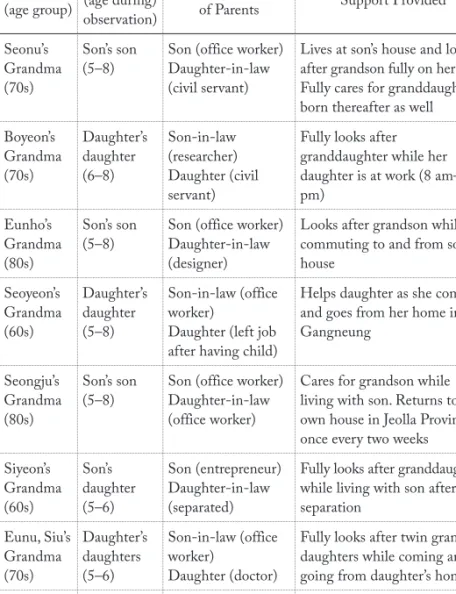
Because of this, for more than a year, I was able to observe children inter- acting with the halma as well as the companionship between the halma and the relationship between halma and young moms. In instances where in-depth interviews were necessary, I explained the nature of my research and conducted interviews after obtaining consent. Outlines of the research participants are displayed in Table 1. The names of informants have all been altered and the ages of their grandchildren that appear in this article reflect their age at the time of interviews.
As can be seen in Table 1, because the majority of the halma’s intensive caretaking takes place before their grandchildren reach school age, the children were all 8 years old or younger at the start of the study. This research took place near a middle-class apartment complex within Seoul. With the exception of a few cases in which they live with one of their children, the halma care for their grandchildren while coming and going between their own home and the home of their child/grandchild. According to a survey of households in which grandparents take care of grandchildren, the majority of those grandparents live with their spouse. Over 90 percent of the house- holds that entrust childcare to a child’s grandparent are dual earning, with a majority (61.2 percent) of earners working white-collar jobs. The most common (38.2 percent) average monthly household income was between five and 6.9 million won, and approximately 60 percent of income earners graduated with a four-year college degree or higher, thus representing the archetypal middle-class household (Korea Institute of Child Care and Education 2015: 4). The households of participants in the present study also shared these widespread characteristics. For my analysis I also utilized writings on grandmothers’ involvement in childcare found within internet communities, in newspaper articles, and in a variety of media.
3. The Yoke of Single Caretaking: The Transition from Grandmother to Care Worker
In this section, I shed light on the context in which halma began to be involved in raising their grandchildren as well as the process of them
Table 1. Basic information on informants Case
No. Informant (age group)
Grandchild (age during) observation)
Employment Status
of Parents Support Provided 1 Seonu’s
Grandma (70s)
Son’s son
(5–8) Son (office worker) Daughter-in-law (civil servant)
Lives at son’s house and looks after grandson fully on her own.
Fully cares for grand daughter born thereafter as well 2 Boyeon’s
Grandma (70s)
Daughter’s daughter (6–8)
Son-in-law (researcher) Daughter (civil servant)
Fully looks after granddaughter while her daughter is at work (8 am–10 pm)
3 Eunho’s Grandma (80s)
Son’s son
(5–8) Son (office worker) Daughter-in-law (designer)
Looks after grandson while commuting to and from son’s house
4 Seoyeon’s Grandma (60s)
Daughter’s daughter (5–8)
Son-in-law (office worker)
Daughter (left job after having child)
Helps daughter as she comes and goes from her home in Gangneung
5 Seongju’s Grandma (80s)
Son’s son
(5–8) Son (office worker) Daughter-in-law (office worker)
Cares for grandson while living with son. Returns to own house in Jeolla Province once every two weeks 6 Siyeon’s
Grandma (60s)
Son’s daughter (5–6)
Son (entrepreneur) Daughter-in-law (separated)
Fully looks after granddaughter while living with son after his separation
7 Eunu, Siu’s Grandma (70s)
Daughter’s daughters (5–6)
Son-in-law (office worker)
Daughter (doctor)
Fully looks after twin grand- daughters while coming and going from daughter’s home 8 Sang-uk’s
Grandma (70s)
Son’s son
(5–6) Son (office worker) Daughter-in-law (office worker)
Fully looks after grandson while coming and going from son’s home
taking on the position of the main caretaker. In the case of participants in this study, while the majority had a daughter or daughter-in-law who was working, there were no cases in which the grandmothers themselves were working out of financial need. That is, the grandmothers involved in childcare did not lead lives that would be much harder off without the allowance given to them by their children. The majority of them cared for their grandchild while going back and forth between their own home and that of their child, and there were cases in which a child lived at the grand- mother’s home as well.
When asked how they came to be entrusted with the caretaking of their grandchildren, my informants responded that “it seemed like it would be better for someone like myself, who just stays home all day, to look after my grandchildren rather than have [my child] give up on the career they worked so hard to find,” and as such, had accepted their child’s request for help. Because, in comparison to the work done by their children, the care work performed by these older women is considered to be of relatively less economic value. At surface level, their choice may seem voluntary, but, in reality, they accepted the position of caretaker for their grandchildren reluctantly.
There are cases in which, as the child advances in school and a mother’s role as her child’s education manager begins to become necessary, a mother will take time off from work or plan to leave her job. In the case of Boyeon’s Grandma (informant 2), she was the primary caretaker for her grand- daughter. Boyeon’s Grandma considered taking care of her grand daughter fully on her own to be difficult and found it burdensome. She even refused to do it at first, crying that she “didn’t want to watch the kid” and was
“scared to do it.” But she was unable to refuse her daughter’s plea that she
“couldn’t trust anyone else.” Though her daughter considered taking time off from work when Boyeon started elementary school, ultimately the girl’s grandmother decided to continue taking care of her. Boyeon’s Grandma told me, “Since it’s not like they are learning anything in first grade, [my daughter] said that once Boyeon reached a higher grade, she’d take a leave of absence then. Because by that point the girl won’t listen to what her grandmother has to say anyway.” In this way, in the process of grand- mothers taking charge of raising their grandchildren, a family’s strategic calculation regarding when is best to start utilizing care from the parent’s generation plays a part.
When halma begin to take care of their grandchildren, they end up
helping with their children’s household chores as well. Because it is generally the older women’s children who are in the position of receiving help, they only asked that the grandmother look after their grandchild. But once they arrive at their child’s home, they wind up providing domestic work for them as well, such as preparing meals, tidying up the house, and even grocery shopping. The reason they “take care of the housework,”
despite not being asked to, can be found in their compulsion related to patriarchal gender roles. Even when drained from taking care of her grand- daughter all day, Boyeon’s Grandma still felt bad, saying, “What would my son-in-law think of me [if I didn’t]? He’d be thinking that the house was a mess and there was nothing to eat despite his mother-in-law having been there all day.” In fact, many of the parents naturally accepted the halma’s help with housework, saying, “Such is the heart of a parent.”
But as this way of life continued, parents discounted the work done by halma as being completely expected and natural. Boyeon’s Grandma related her discontent with her son-in-law in the following manner:
Every day when my son-in-law comes home after getting off work, he goes straight to his room. Gosh, if he’s done with work he should look after his kid, but since he just goes into his room and sits at his computer, I can’t even go home until the kid’s mom is back.
The halma are appalled with their children’s generation because they act like grandmothers are supposed to be the ones fully taking care of their children. These older women compare their positions to that of “live-in servants” and were disheartened, saying, “I can’t believe that after raising my kids, here I am being their servant. Isn’t life supposed to go from suffering and struggling to having a nice, livable time before dying?
Thinking about stuff like this makes me so sad.” When they came into the role of halma, my informants felt that their status had fallen to that of a care worker, such as a domestic servant. However, because they believe this is something that they brought upon themselves, they have no choice but to persevere.
Rather than enforcing heavy-handed discipline, mothers today believe that relationship-oriented motherhood, in which a mother “provides play time that a child can participate in joyfully, thereby practicing discipline which curtails minor conflicts between them and their child” (Sirota 2010), is tantamount to being a “good mother” and thus endeavor to practice it.
Young mothers in South Korea are being influenced by Western parenting
ideology (Jeong Haeyeong 2012: 86) that is premised on relationships of close-knit attachment between mother and child. This represents a qualitatively different form of childrearing than that of the halma, who became proficient in instrumental mothering (Kim Munjeong 2007: 919) by not only having to raise their own children but also simultaneously taking care of their in-laws in already challenging economic circumstances.
Empathizing with everything their grandchild said and humoring them was extremely difficult for the halma I spoke with. Soyeon’s Grandma divulged her toils, saying, “I’m a person too, you know. While watching after a kid, there are a lot of times I end up losing my temper. Because [she’s] not my kid, I have to hold myself back from hitting her, and that’s so difficult. Young moms are good at pampering them.” Parents also sent their children to private afterschool academies (hagwon) to alleviate the demanding work of the halma. But from the perspective of the halma, sending a child who is sobbing because they do not want to go to their academy and then having to pick them up not long after dropping them off is no simple task. One informant told me that “in the past, they used to cry for us to send them to an academy, not cry about not wanting to go,”
struggling to come to terms with how things had changed since raising her own children.
Moreover, these women were bound by the yoke of “single parenting”
(dokbagyuga)4 (Baek Gyeongheun et al. 2018) in which they must prioritize their grandchildren above all else. Most of all, when the child is hurt or if there is a problem relating to the child, these grandmothers felt a sense of responsibility and a sense of guilt akin to that of a parent. Once, a boy named Eunho (a five-year-old) fell off his bike and skinned his knee.
When a different grandmother asked Eunho’s Grandma the next day,
“Didn’t his mom say anything about it?” Eunho’s Grandma (who was in her 80s) was upset and responded:
What’s Eunho’s mom going to say to me? She just talked to Eunho about it.
Still, when he gets hurt, I wish I could go hide in a mouse’s hole. I feel so sorry towards his mom. I feel the sorriest and worst [of everyone]. This is
4 (Translator’s note) While in English this term often refers to a situation in which a person parents by themselves due to death or divorce of a child’s other parent, in Korean it can refer to a situation in which a person does not receive assistance from others and shoulders the entirety of the parenting burden on their own, even in the case of married couples, or as presented here, the presence of both parents.
why I said I didn’t want to look after the kid, because I was worried something like this might happen.
There were also many instances when the women went back home and told the child’s parent about everything that had happened, then ended up fighting over parenting styles. In order to avoid such difficult situations, the halma kept a much tighter rein on their grandchildren’s behavior.
Due to their in-between identities in which they perform the role of a mother while not being the mother of the child they are looking after, these halma could not go about scolding their grandchildren, even when the child threw a tantrum or did not listen to them. Moreover, in order to justify their own parenting methods, the child’s parents would either tell the halma that her parenting style or way of thinking was antiquated, or even criticize the halma by telling her that they had a hard upbringing because of her parenting style.
When I told my daughter to go comfort Seoyeon because she was crying, my daughter asked why I did what I did when she was young. “I wanted to be comforted by you when I was young, so why didn’t you comfort me?” she asked me. She says that’s why she can put up with everything else, but she can’t stand when the kid whines. She says [I] never comforted her when she was going through something difficult, so she doesn’t know how to comfort other people. And so that’s why she acts like that to her daughter, she told me. She’ll cry because she finds it so difficult. I don’t know what to say to that.
The above is an excerpt from my in-depth interview with Seoyeon’s Grandma (informant 4). While Seoyeon’s Grandma was watching her granddaughter, Seoyeon’s Mom said that she was disciplining her daughter by not com- forting Seoyeon, who was crying sorrowfully. This caused Seoyeon’s Grandma to rebuke her daughter by asking, “Why are you so coldhearted?”
Upon being confronted, Seoyeon’s Mom shot back that it was because she had never received love from her own mother when she was young.
Seoyeon’s Grandma married her husband, who was the eldest son in his family, and went through an arduous time living with her in-laws upon her marriage. Because she was walking on eggshells around her sister-in-law while she was caring for her mother-in-law, during ancestor ceremonies (jesa), and in supporting her parents-in-law, she was unable to properly soothe her own daughter when she cried. Seoyeon’s Grandma was hurt that her daughter would criticize her in that way despite being aware of her
mother’s situation. Seoyeon’s Mom justified her own parenting method while criticizing that of her mother. Though the current generation of parents is receiving help from their own parents, they expressed that they want to raise their children using their own parenting style. In order to defend their own parenting methods, these young parents characterized the grandmothers’ parenting skills as something requiring constant scrutiny due to its flawed nature. In this process, the halma became hurt, both as grandmothers and as mothers.
Curiously enough, the halma utilized the very patriarchal gender norms that placed them in the yoke of care labor in order to criticize their own children. The halma often sat together on a bench at the playground and reviled the parenting practices of their children’s generation. The quotes below are a part of a conversation between Seongju’s Grandma (informant 5) and Seonu’s Grandma (informant 1) at the playground, edited for clarity. As can be seen in this conversation, Seongju’s Grandma and Seonu’s Grandma criticize their daughters-in-law, listing all the ways they are inept at raising a child and how “unladylike” they are. In this manner, halma demonstrated their value by using patriarchal gender norms as a shield against criticism and stressing the incompetence of the younger generation of parents.
Seongju’s Grandma: I go down to my house in the countryside once every two weeks. But my daughter-in-law calls me, saying that she can’t pick up her kid from preschool, and so I call Siyeon’s Grandma, and Changyeong’s Aunt to get some help. It was chaos. You might call her a mother, but because she doesn’t have enough experience, because she fumbles with it, she doesn’t know what to do with two kids. My daughter-in-law was the youngest daughter in her family, and her mother was a fulltime homemaker, so she just ate whatever her mom gave her and has lived like a robot up till now, that’s why. So even when she’s grocery shopping, she doesn’t know what she should get and just ends up buying random things and bringing them home. When I ask her what she’s going to make, she’ll go, “I don’t know.”
She doesn’t make any plans in her life. When I come back from my house in the countryside, I look to see what she’s bought to eat and I see dumplings, chueotang (loach soup), and gomtang (ox-bone soup), and figure that’s what she’s been eating. She likes eating, that’s for sure. But if there are leftovers, she should either put them away [in the fridge] or throw them away, you know? But they were just sitting there, left behind in their packaging, going bad and covered with a layer of mold. It was a complete mess.
Seonu’s Grandma: But is she as bad as my daughter-in-law? [Her kid is] 6 years old, so it’s a time where he needs his mom and dad the most, right?
When he calls out, “Mom,” she should answer him right away, you know.
Even yesterday he was pestering his mom, asking to go somewhere. She should be calming him down, saying, “If you eat all your food, we’ll go later,”
even if they don’t actually go. But my daughter-in-law acts just like a man does, really. She’s so blunt and all.
Amidst various historic crises, such as the course of colonial modernization and the Korean War, the Korean family has functioned as a unit of
“survival,” and it became the practical foundation for survival within the capitalist system of competition (Bak Sojin 2017: 42). In a situation where social supports are insufficient for coping with the ever-increasing precarity of life caused by employment instability, heightened competition, indivi- dualization, class polarization, and the crisis of the middle class following the Asian financial crisis, the cementing of the family as a unit for realizing the project of class reproduction has been reinforced even further. That is to say, older women came into their roles as halma as part of an “inter- generational gendered project” (Park and Abelmann 2004: 647) to stabilize the human and economic capital of their children’s generation. In this manner, while grandmother-motherhood supplements a mother’s defi- ciencies, it also is constructed as a precondition of instrumental familism that aims at class differentiation in South Korean society.
Grandmother-motherhood in South Korean society directly confronts the demands for double care in which older women simultaneously perform their role as not only grandmothers but as mothers supporting their own busy children. While looking after their grandchildren, halma also shoulder the housework for their busy children, even providing care so that their children’s generation have time to accrue more human capital. In this process, halma have experienced a fall in status to that of a care worker, similar to that of a “servant.” Moreover, though halma become the de facto primary caretaker and feel a sense of responsibility and guilt like that of a parent while raising their grandchildren, their children’s generation characterized the grandmothers’ motherhood as being imperfect in order to justify their own parenting methods. Halma thus use patriarchal gender norms to protect themselves and make efforts to have their value recognized. By finding their own value within patriarchal gender norms, halma firmly uphold familism.
4. “If No One Were Watching”: Networking Work with Young Moms and Other Halma
In this section, I will examine the process by which halma access the field of educational competition by interacting with young moms and other halma. As information has grown more vital for school entrance exams, externally exclusive but internally cooperative networks between mothers with information to exchange have begun to form, generally around the first year of grade school and even earlier in some cases, primarily centered on full-time mothers (Bak Hyegyeong 2009). In fact, in the same area where I conducted this research, the social network between moms that formed when their children were around five years old continued to operate even after their children had finished grade school. In particular, there were many cases where the network of these children (around the age of five) was the same as the social network between moms. In the eyes of the halma, who were relatively disadvantaged when it came to accessing information, young moms are figures who have all the necessary information:
what types of supplies are needed when taking a child to daycare or preschool and where to find such items, which daycares/preschools are the best, and which academies are the best. Because of this, the halma carried on their relationships with young moms by giving the young moms who were comparatively welcoming to them vegetables that they grew them- selves or by buying snacks for their children. The halma felt burdened by the networking work that they had to put in with young moms. Boyeon’s Grandma lamented,
I have to live my life among the young moms, you know. In my mind, that’s the hardest part. Even when the moms are nice to me, I find it burdensome.
If I [were in their position and] had to be with grandmas even older than myself, I don’t think I’d like it either. The young moms must be so uncom- fortable with me around.
As for the young moms, the presence of halma is not entirely pleasant. The halma not only lack information to exchange with young moms, there are also many instances in which their parenting methods deviate as well.
Young moms criticized the halma for giving their grandchildren candy and allowing them to watch TV, and they were concerned that the halma’s parenting methods might negatively impact their own children. Because of this, when the young moms met a child’s mother, they equivocatingly
criticized the halma’s parenting style, saying things like, “I think that their grandma is giving them too much chocolate,” or “Last time, she just slapped [the kid] on the cheek for saying that they didn’t want to go to their academy.”
The child’s mother would, in fact, agree with the young mom’s criticism, saying, “You’re right. I tell her this all the time, but she doesn’t want to listen to me.” In this way, the maternity of halma remained something considered inadequate and in need of adjustment in their relationships with young moms as well.
Because of this, when halma met other halma while watching their grandchildren at the same preschool or playground, they were very welcoming and maintained their own friendly relationships. The following is an edited excerpt from a conversation between Seongju’s Grandma (informant 5) and Siyeon’s Grandma (informant 6) at the playground after dropping off their grandsons at daycare.
Seongju’s Grandma: There goes Miss Stylish.
Siyeon’s Grandma: You mean Seonghyeon’s Mom? Because of her sunglasses? They say that lately the UV rays are intense, so you absolutely have to wear them. It’s not for style, it’s out of necessity.
Seongju’s Grandma: What are you talking about, UV rays? On a cloudy day like this? She looks like that 360 days a year.
Siyeon’s Grandma: Ha-ha! 360 days?
Seongju’s Grandma: And she always is sure to wear those sunglasses, even when it’s overcast like this. Not long ago, Seonghyeon was bad at school, so he was punished by his teacher, but, my god, did his mom lash out at that teacher. And then she switched daycares, I heard. That teacher turned in their resignation because of it. She has something really wicked about her.
Maybe because she’s a teacher, but Sihyeon’s Mom is understanding and is good with kids no matter what. She’s good to me too. But there are some moms like Seonghyeon’s Mom who are only good to their own kid.
Siyeon’s Grandma: That’s true. Moms nowadays coddle their kids so much that it seems like they just become hard hearted.
Seongju’s Grandma: A person should raise their kid on their own terms, but my daughter-in-law and daughter all just scroll through the internet.
While running into one another frequently at the playground, Seongju’s Grandma and Siyeon’s Grandma became close, calling one another eonni
(older sister) and dongsaeng (younger sibling). They often talked about all sorts of things at the playground after dropping their grandchildren off at daycare. In particular, they judged the young moms as “knowing nothing about anything but their own kid, not having a backbone, and being too interested in how they look,” thus justifying their own parenting styles. In fact, the reason halma exhibited negative sentiments about young moms in such a way stemmed from having felt excluded from the networks formed by and centered around young moms. Occasionally the halma felt hurt and would tell me, “Young moms these days won’t give you an answer when you ask them about something, and when they see grandmas, they start walking away to avoid us. What’s their problem?” Accordingly, the halma were close with other halma. When they made kimchi or received a shipment of vegetables from the countryside, they shared with one another.
One expressed her gratitude, saying, “There could be ten young moms around and I’d feel awkward, but having Seongju’s Grandma makes me feel reassured.” In this way, the halma solidified a close-knit bond of their own.
However, maintaining a network among the halma was not all that easy.
Occasionally their grandchildren would fight, and, because they needed to maintain their relationships, the halma could not openly express their feelings, even if one halma thought that their grandchild was the victim and the other child was in the wrong. Yet each time a conflict actually arose between children, the halma empathized with the pain that their grandchild felt and grew enraged. Once, when I told Seongju’s Grandma (informant 5) that I had been invited to Siyeon’s Grandma’s home (informant 6), Seongju’s Grandma expressed some of the resentment and grievances that she had regarding Siyeon:
Yesterday I got a call from Siyeon’s Grandma. She was asking me to send Seongju to her house since she had to look after Siyeon the next day, and he is hard to look after on his own. I sent Seongju to that house once and, my god, that little rascal Siyeon must have been upset with my Seongju over something because he said, “Dad. Let’s throw Seongju away.” Our Seongju is so sweet and never once heard a thing like that in his life and came back home shocked. After that, I’ll never send him back to Siyeon’s.
Seongju and Siyeon played together often. But Seongju’s Grandma thought that each time they played, Seongju was being picked on by Siyeon, who was slightly older and mature for his age. When she went to the playground, however, her only friend was Siyeon’s Grandma, so she was unable to
express her emotions about Siyeon in front of his grandmother. The day I told her that I had been invited to Siyeon’s house, she expressed the bitter feelings that had built up inside her all along, saying, “It’s best not to send your kid there.” In this way, the bond between halma is an unstable one because it can be broken at any moment depending on other concerns.
Halma are profoundly aware of the fact that a child’s success is not guaranteed, no matter how much networking they do or how many academies a child attends. Because of this, they even tell their daughters or daughters-in-law to “absolutely not hang around with other moms; they’re completely useless,” and they receive guarantees that they will not. In addition, they were skeptical of the private education system, saying, “Someone who’s going to study will study, and someone who won’t just won’t.” They pitied their fatigued grandchildren for having to go to and from multiple hagwons starting at age five, often asking, “What are they going to learn at such an age?”
Nevertheless, if they caught wind of a hagwon with good instructors, the halma urged their children to send their grandchildren there. Some halma even went so far as to hit their grandchild if they were clinging to the door frame and going limp in an attempt to avoid going to hangwon.
As such, English academies that were known among the young moms as being “far too harsh” were seen as “hagwon that take ahold of a kid and teach them correctly” by the halma. Moreover, by passing along the infor- mation that they received from networking with other halma and young moms, they aided in keeping their grandchildren from falling behind the competition.
For instance, while discussing English-language education when meeting with the other halma, Boyeon’s Grandma heard that there was a hagwon near her house that taught English well. The halma who heard the conversation all immediately flocked to the hagwon and rashly sat in on a class. They discovered that the hagwon only taught older students, middle school and up, who had lived abroad at least once. But after sitting in on a class, Boyeon’s Grandma gained a sense of trust in the instructor, so she continued to drop by the hagwon until Boyeon was finally accepted.
Moreover, Boyeon’s Grandma made sure that Boyeon’s Mom stopped by the hagwon as well. In the end, the English instructor taught Boyeon the year that she turned 8 years old, under the condition that she did a group lesson with three of her friends. When hagwon staff finally accepted Boyeon’s Grandma’s appeals, they apparently were awed, saying, “What
kind of grandmother has such a strong sense of motherly love?” Parents, who were relatively in the dark because of their work schedules, were able to collect relatively fresh information through the halma and were able to connect better to the private education market.
The reason that the halma participated more actively than others, while still voicing doubts over the utility of networking labor and private education, was because of their fear of a decline in their social status. In their relationships with the children’s parents and young moms, the halma’s style of parenting was considered unscientific and something inadequate, in need of repair. Accordingly, halma criticized the parenting styles of their children and young moms, thus justifying their own parenting styles.
However, once they actually saw their grandchild falling behind, they were unable to break free from the idea that it traced back to their own inadequacies. On the one hand, halma can fly into a rage, saying, “I feel the worst when I hear someone say a kid is doing poorly because their grandma raised them”; on the other hand, when they themselves meet their grandchild’s daycare teacher or homeroom teacher, the halma demonstrate personal dismay, saying things like, “My grandchild’s not doing so well because they’re being raised by their grandma, right?” Fundamentally, halma took over the care of their grandchildren in order to support their children so that they would be able to maintain their current social status or live an even better life. But, if their grandchild lags behind scholastically, halma see it as evidence that this intergenerational project has failed;
consequently, despite being skeptical of private education for youngsters, these older women continue to rely on the private education market to make up for their perceived failures. Though seeing their grandchildren struggle, having been thrust into the private education market at such an early age, evoked a sense of pity in the halma, seeing their grandchild lag behind was something even less acceptable. While they resisted and refuted those who looked down on them, the halma also attempted to network in order to avoid the risk of losing their social class. Ultimately, rather than sticking to their own parenting methods as differentiated from those of young moms, halma immersed themselves in their role of shadow mothering, filling the place left void by their own children.
5. Fated to Remain in the Shadows: The Status of Grandmother- motherhood within the Norms of the “Normal” Family
In this section, I will reflect on the status of grandmother-motherhood in the norms of the “normal” family by examining the relationships between halma and their grandchildren as well as their relationships with other family members. As outlined above, halma have been influenced by Western attachment theory and maintain intimately sentimental relationships with their grandchildren. When raising their own children, it was often the case that these women had multiple children and thus, as parents, they did not have the energy to comprehend and respond to each and every one of their children’s emotions. In addition, because their children could spend most of their time with their brothers and sisters, there was no need for them to wander around in search of friends as is necessary now. As these women grew to have sentimental relationships with their grandchildren, half willingly and half not, their grandchildren began to think of them as their
“real moms” and grew to depend on them. The following is an excerpt from an in-depth interview with Boyeon’s Grandma.
You know, Boyeon told me that when she was six, she thought that I was her mom. Every time that I left to go home, she cried and cried. She cried like a baby separated from its mother. Later Boyeon told me that when she was young, she thought I was her mom because I was always there when she opened her eyes [in the morning]; she’d cling to me and cry because she thought her mom was leaving. What could I say to that? I just said, “Ah, so that’s why. So that’s why you cried like that.” That’s what I said. That was hard on me too. Leaving her and going at night. I wondered why on earth she was crying like that…. Sometimes she’d come with me to my house.
When she told me that when she was a bit older, I could finally understand it.
As we can see in the above quote, Boyeon thought of her grandmother as her mom and clung to her. Boyeon’s Grandma also came to have a deep affection for Boyeon. After Boyeon was born, Boyeon’s Grandma’s eldest son had a son of his own. Though the thought that she should take care of him since he was her son’s son did enter her mind, she ultimately turned down her son’s request to do so because it “did not seem loyal” to Boyeon, who listened to her and believed she was her mom. These older women formed relationships of deep attachment with their grandchildren in this manner and immersed themselves in their role as halma.
Often times, however, the more these older women immersed them-
selves in the role of halma, the deeper the conflicts between them and other family members grew. When Boyeon’s Grandma grumbled, saying that taking care of Boyeon was too hard on her and she did not feel like she could go on it with it any longer, Boyeon’s Grandpa welcomed the sentiment, saying, “I agree completely.” There were many days that his wife returned home later than 10:00 p.m. due to taking care of Boyeon, and upon returning would lie down and say that her body ached all over, meaning that her relationship with him was put on the backburner.
In addition, there were cases where the women’s other, unmarried daughters blatantly expressed their own grievances. Eunu and Siu’s Grandma (informant 7) took care of her twin granddaughters for her first daughter, who had opened a hospital. But Eunu and Siu’s Grandma told me that her third daughter, who was single, regularly said that Eunu and Siu’s Grandma only cherished her eldest sister and did not care about her other daughters, which hurt her feelings. So looking after her granddaughters made her feel like she was walking on eggshells. In this manner, halma had no choice but to be conscious of their other family member’s criticisms that by mothering their grandchildren they are perhaps unable to properly perform their roles as wife and mother.
Halma made efforts to fill the gaps in their roles as wives to their husbands and mothers to their single children, which had appeared due to them mothering their grandchildren, which led to successive shadow work.
For instance, because Eunu and Siu’s Grandma had a tough time watching her grandchildren on her own, she brought her husband along as well. She told me that when she did:
Come mealtime, I have to make something for my husband to eat too. And I have to watch the kids. And on top of that I have to make food for when their parents go to work and come back from work. If the house gets messy, I have to tidy it up. Because I do all the housework [for them] on top of that, I totally exhaust myself.
Seongju’s Grandma’s youngest son married later in life and had Seongju when he was 43. In order to help out with her son and daughter-in-law, who both worked, Seongju’s Grandma took care of Seongju on the condition that she was able to go down to her countryside home once every two weeks. The year that Seongju turned five, Seongju’s Grandma’s daughter-in-law became pregnant with their second child. Seongju’s Grandma, who had been taking a bit of a breather because Seongju had
reached an easier age, did not welcome this news. She wanted to tell her daughter-in-law to quit working and take care of both her children, but when she considered her son’s age and their economic circumstances, she had to continue helping out so that her daughter-in-law could keep working. Her other children consoled Seongju’s Grandma while taking her out to lunch:
Seongju’s Grandma: Yesterday Seongju’s Dad’s older brother and sister came to get me at lunch time, saying we should eat lunch together. And his older brother was telling me, “I mean, how is he so careless? He’s 48 years old now, so when his kid is 10, he’s going to be 60, so why is he having another kid?”
That’s what he said. [Laughs.] Cause he’s going to have a kid in his 50s, a kid in his 60s.
Siyeon’s Grandma: He’s just acting like that because he’s worried that the burden is going to be placed on your shoulders.
Seongju’s Grandma: That’s the thing. It’s not like I can refuse to look after him after all this, so what am I to do? His older brother was telling me,
“Mom, I’ll buy you a townhouse in the suburbs, so let go of the house and the land in the countryside, and that way you can go back and forth while helping out Seongju’s Mom and Dad. Don’t worry too much. It’ll be fine.
Think of it as good news.” With all my kids gathered there comforting me, I dunno, I decided to go with it. I dunno.
Siyeon’s Grandma: Gosh. What can you do? When you think about the kids, they’re lonely on their own. Still, if you told me to raise another one. Gosh.
It’s better to just have one and raise it well. Gosh. I said the same to my oldest son: Siyeon is enough on her own, don’t get greedy and try to have a son.
Seongju’s Grandma: You’re right. Kids are a burden for your whole life. Your whole life. And it’s not like I can just not stop by their house once they have [their son].
Just as Seongju’s Grandma bitterly mumbled at the end, no matter how old one is or what their situation is, a mother is perceived as being a figure that pushes everything aside and helps their child if something happens. Halma spoke of their children as “lifelong burdens,” lamenting the cum bersome responsibility that weighs on them until they die:
Maybe I’ll forget them when I die, but while I’m alive…gosh. That’s why babies are cutest when they’re small. And fun too. All you need is for those
little things to grow up well. To sleep well, eat well—you have nothing else to worry about then. Now look at them. You’d think your job is over once they get married, right? Get married, have kids, gosh. Who knows about when I die, but as long as I live there’s no end to it, no end at all.
Though they provided such unending care, ultimately, halma had to disappear within the norms of the standard family. Perhaps not happy with the fact that she was always accompanied by her grandmother, unlike her peers, Siyeon began to call her grandmother “mom.” Siyeon’s friends asked her, “Why do you call your grandma ‘mom?’ She’s an old lady,” criticizing Siyeon for how she referred to her grandmother. Once they had grown up a bit, other children similarly felt embarrassed that their grandmother was picking them up rather than their mother. Even while saying that it was
“only natural for kids to be attached to their mom and dad,” halma still felt hurt when seeing their grandchildren strongly attached to their parents.
What follows below is an excerpt from a conversation between Seongju’s Grandma (informant 5) and Eunu and Siu’s Grandma (informant 7) that they had at the playground after sending their grandchildren to daycare.
Seongju’s Grandma: You know, originally Seongju said that he liked [me] the best. This doesn’t seem right. When I saw him with his mom, I thought it was all talk before, but seeing him cling tight to his mom, worried she might go somewhere…gosh, that really hits you in the heart, it does.
Eunu and Siu’s Grandma: That’s what I’m saying. Me too. At first Eunu didn’t even go to her mom, and Siu would just cry when she went to her mom. But lately they’re stuck to their mom like glue, I say. When I see that, it hurts.
Seongju’s Grandma: There’s nothing to be hurt about. It’s only natural.
As we can see in the above exchange, though Eunu and Siu’s Grandma had a hard time when her grandchildren were attached to herself more than their mother, she felt an equivalent amount of responsibility. However, the older her grandchildren became, the more they sought their mom and dad. She confessed that they had gone on a family trip together and she had felt disappointed when Eunu tossed her hand aside after holding hands while walking and instead went to her mother. Accordingly, the halma comforted each other, saying, “We don’t get any credit for looking after our grandkids.” This expression, used self-deprecatingly by the halma, is also related to their understanding that even if they devotedly care for
their grandchildren, they are unable to expect the same type of care that they provided for their parents, from either their own children or grand- children.
In sum, these older women formed deep relationships of affection with their grandchildren and were immersed in their roles as halma. However, the more that they immersed themselves in the role of halma, the more criticism they received from other family members that they were not properly carrying out their roles as wives and mothers. In the process of supplementing imperfect mothering, halma performed “multiple respon- sibilities of care combined in a layered fashion” (Baek Gyeongheun et al.
2018: 45), and this turned into continuous shadow work. Though they provided devoted care, halma were a presence that needed to naturally disappear from the picture of the normal family made up of their own children and grandchildren.
6. Conclusion
This article has focused on the intensive mothering performed by halma, or grandma-moms, despite not being the mother of the child they are mothering. It has reflected on the questions of why older women today find the act of caring for their grandchildren, which has long been an aspect of intergenerational support, burdensome, as well was why they are unable to break free of the work of caring for their grandchildren, relating it to the development of South Korean familism.
In South Korean society, which lacks an established social safety net, familism was utilized as an instrumental mechanism of competition (Jo Eun 2004: 150). In particular, following the economic crisis of the late 1990s, families of diverse classes have pursued a strategy of raising their children’s human value (injeokgachi) in order to maximize their upward social mobility (Jo Eun 2004: 150; Bak Sojin 2007). The rapidly growing market of private education requires much more of mothers than public education does. While stabilizing the human and economic capital of their children’s generation, older women took up the parenting of their grandchildren, somewhat against their will, as part of the familism strategy of making up for the insufficiencies of mothers.
While not only raising their grandchildren but also practicing double care by supporting their own children (and their spouses), these halma did
not receive proper recognition from their children’s generation. Their children’s generation defined the parenting of the grandmas as something imperfect and unscientific, requiring frequent scrutiny by the children’s generation themselves. In this process, older women were wounded in their identities as both mothers and grandmothers. In their relationships with young moms as well, the motherhood of these grandmothers was considered imperfect or flawed, something to be evaluated and adjusted based on the younger generation’s standards.
The halma used the very patriarchal norms that placed the yoke of care work on them as a resource for criticizing the incompetence of their children’s generation. Moreover, they were hurt by the young moms who excluded them from their networks, but they established formidable net works with other halma. However, this bond between halma was something unstable that could come apart at any moment over a quarrel between their grand- children. Above all, these halma were afraid that their grandchildren would fall behind educationally because the halma lacked relevant information.
Due to this, they maintained networks with their halma peers and young moms, thus connecting to the private education market in lieu of the children’s parents.
When Siyeon missed her mom and was unable to sleep, Siyeon’s Grandma (informant 6), offered her granddaughter her “empty teat out of which came nothing” to put her to sleep. This recollection from Siyeon’s Grandma is reminiscent of Nancy Folbre’s assertion that “the development of the modern economy relies not only on the ‘invisible hand’ of self-interest, but the ‘invisible heart’ of care” (2007: 14). Daughters and daughters-in- law received help from their mothers and mothers-in-law, who raised their children while offering even their empty teat, and braved the wage-labor market. But that does not mean that the patriarchal gender order is weakening. The story of the son-in-law who, even after coming home from work, went into his room to be on his computer illustrates that the patriarchal gender order that considers caring for children as women’s work remains intact.
These grandmothers participated in the rearing of their grandchildren, going so far as to offer their own empty breasts, but the value placed on their care only diminishes further. The more that they immerse themselves in acting as a halma, the more their other family members ask them to perform their role as a wife or as a mother. In order to fill the gaps in their motherhood that had become imperfect while parenting their grand-