• 검색 결과가 없습니다.

Cephalometric predictors of future need for orthognathic surgery in Korean patients with unilateral cleft lip and palate despite long-term use of facemask with miniplate

N/A
N/A
Protected

Academic year: 2022

Share "Cephalometric predictors of future need for orthognathic surgery in Korean patients with unilateral cleft lip and palate despite long-term use of facemask with miniplate"

Copied!
12
0
0

로드 중.... (전체 텍스트 보기)

전체 글

(1)

Cephalometric predictors of future need for orthognathic surgery in Korean patients with

unilateral cleft lip and palate despite long-term use of facemask with miniplate

Objective: To investigate the cephalometric predictors of the future need for orthognathic surgery in Korean patients with unilateral cleft lip and palate (UCLP) despite long-term use of facemask with miniplate (FMMP). Methods:

The sample consisted of 53 UCLP patients treated by a single orthodontist using an identical protocol. Lateral cephalograms were taken before commencement of FMMP therapy (T0; mean age, 10.45 years), after FMMP therapy (T1; mean age, 14.72 years), and at follow-up (T2; mean age, 18.68 years). Twenty-eight cephalometric variables were measured. At T2 stage, the subjects were divided into FMMP-Nonsurgery (n = 33, 62.3%) and FMMP-Surgery (n = 20, 37.7%) groups according to cephalometric criteria (point A-nasion-point B [ANB]

< –3°; Wits-appraisal < –5 mm; and Harvold unit difference [HUD] > 34 mm for FMMP-Surgery group). Statistical analyses including discrimination analysis were performed. Results: In FMMP-Surgery group, the forward position of the mandible at T0 stage was maintained throughout the whole stages and Class III relationship worsened with significant growth of the mandibular body and ramus and counterclockwise rotation of the maxilla and mandible at the T1 and T2 stages. Six cephalometric variables at T0 stage including ANB, anteroposterior dysplasia indicator, Wits-appraisal, mandibular body length, HUD, and overjet were selected as effective predictors of the future need for surgical intervention to correct sagittal skeletal discrepancies. Conclusions: Despite long-term use of FMMP therapy, 37.7% of UCLP patients became candidates for orthognathic surgery. Therefore, differential diagnosis is necessary to predict the future need for orthognathic surgery at early age.

[Korean J Orthod 2021;51(1):43-54]

Key words: Unilateral cleft lip and palate, Cephalometric predictors, Orthognathic surgery, Facemask with miniplate

Sang-Hun Yu

a

Seung-Hak Baek

a

Jin-Young Choi

b

Jong-Ho Lee

b

Sukwha Kim

c

Sung-Woon On

b,d

a

Department of Orthodontics, School of Dentistry, Seoul National University, Seoul, Korea

b

Department of Oral and Maxillofacial Surgery, School of Dentistry, Seoul National University, Seoul, Korea

c

Department of Plastic and Reconstructive Surgery, College of Medicine, Seoul National University, Seoul, Korea

d

Division of Oral and Maxillofacial Surgery, Department of Dentistry, Hallym University Dongtan Sacred Heart Hospital, Hallym University College of Medicine, Hwaseong, Korea

Received July 29, 2020; Revised August 19, 2020; Accepted August 21, 2020.

Corresponding author: Sung-Woon On.

Clinical Assistant Professor, Division of Oral and Maxillofacial Surgery, Department of Dentistry, Hallym University Dongtan Sacred Heart Hospital, Hallym University College of Medicine, 7 Keunjaebong-gil, Hwaseong 18450, Korea.

Tel +82-31-8086-2740 e-mail [email protected]

How to cite this article: Yu SH, Baek SH, Choi JY, Lee JH, Kim S, On SW. Cephalometric predictors of future need for orthognathic surgery in Korean patients with unilateral cleft lip and palate despite long-term use of facemask with miniplate. Korean J Orthod 2021;51:43-54.

© 2021 The Korean Association of Orthodontists.

This is an Open Access article distributed under the terms of the Creative Commons Attribution Non-Commercial License (http://creativecommons.org/licenses/by-nc/4.0) which permits unrestricted non-commercial use, distribution, and reproduction in any medium, provided the original work is properly cited.

pISSN 2234-7518 • eISSN 2005-372X

https://doi.org/10.4041/kjod.2021.51.1.43

(2)

INTRODUCTION

Due to inherited growth deficiencies in the midface and post-surgical scar tissues in the lip and palate, cleft patients often develop specific skeletodental growth pat- tern.

1-3

When the degree of cleft involvement increases from the primary palate to the secondary palate, cleft patients exhibit the predominance of the Class III rela- tionship and a hyperdivergent pattern.

2,3

For adolescent cleft patients, facemask with miniplate (FMMP) therapy using skeletal anchorage has been applied to treat the maxillary hypoplasia.

4-10

FMMP therapy has two main advantages as follows

4,5,8

: (1) The miniplates can be in- stalled and removed under local anesthesia; and (2) The FMMP therapy can produce the maximum orthopedic effect and reduce unwanted side effects. However, some cleft patients still need orthognathic surgery or distrac- tion osteogenesis (DO) to correct their sagittal skeletal discrepancy.

11,12

Several previous studies have reported that a wide range (20% to 76.5%) of patients with unilateral (UCLP) and bilateral cleft lip and palate (BCLP) need orthogna- thic surgery or DO.

1,13-15

Antonarakis et al.

16

implied that Asian patients with UCLP might have a higher frequency of orthognathic surgery requirement compared to other populations. Recently, Park et al.

15

reported that the frequency of surgical intervention to correct the sagittal skeletal discrepancy was significantly higher in the BCLP group, followed by the UCLP group and the cleft lip and alveolus (CLA) group (30.0%, 21.4%, and 8.5%, respec- tively; p < 0.05; [CLA, UCLP] < [UCLP, BCLP]).

Meazzini et al.

17

reported that children with UCLP showed a significant decrease in maxillary prominence from the age of 5 years to the end of growth. Further- more, Heliövaara and Rautio

18

suggested that UCLP children with an point A-nasion-point B (ANB) angle of less than 1° at the age of 6 years would be candidates for orthognathic surgery in adulthood. However, there is no study that investigated that how many percentage of cleft patients would need orthognathic surgery or DO despite long-term use of FMMP therapy and which cephalometric parameters at the initial stage were re- lated to the future need for orthognathic surgery or DO after completion of facial growth.

Yun-Chia Ku et al.

19

suggested that if an unfavorable prognosis is expected in cleft patients, extraction and camouflage orthodontic treatment should be delayed.

However, since treatment of cleft patients has a vari- ety of confounding factors to interpret the data, it is necessary to use relatively strict inclusion criteria for in- creasing the sample purity as follows

15,20,21

: (1) The cleft type of the samples should be confined; (2) Treatment protocols for the timing and methods of cheiloplasty, palatoplasty and alveolar bone grafting (ABG) and the

methodology of orthodontic and orthopedic treatment should be identical; and (3) The racial and ethnic back- grounds of the samples should be identical. Therefore, the purpose of this retrospective study was to investi- gate the cephalometric predictors of the future need for orthognathic surgery or DO in Korean UCLP patients despite long-term use of FMMP.

MATERIALS AND METHODS

The samples consisted of 53 Korean patients with nonsyndromic UCLP (40 males and 13 females), who were treated at the Departments of Orthodontics and Oral and Maxillofacial Surgery, Seoul National University Dental Hospital (SNUDH) and the Department of Pedi- atric Plastic and Reconstructive Surgery, Seoul National University Children's Hospital (SNUCH). This retrospective study was reviewed and approved by the Institutional Review Board of SNUDH (ERI20020).

The inclusion criteria were as follows: (1) patients who were diagnosed as UCLP, (2) patients who were born between 1993 and 2004, (3) patients who were treated with an identical treatment protocol by a single ortho- dontist (SHB), (4) patients whose lateral cephalograms were taken just before secondary ABG and commence- ment of FMMP therapy (T0; mean age, 10.45 years), just after stop using the FMMP (T1; mean age, 14.72 years), and at a minimum of 15 years of age (T2; mean age, 18.68 years). The exclusion criteria were as follows: (1) patient with syndromic cleft including Van der Woude syndrome; (2) patient with craniofacial anomalies; (3) patient with previously fractured face; and (4) patient with endocrine diseases such as diabetes mellitus and hyperparathyroidism.

The treatment protocol used in SNUDH and SNUCH is summarized as follows: (1) Primary cheiloplasty (Mil- lard rotation and advancement flap) at the age of 3–5 months; (2) Palatoplasty (Furlow double opposing Z- plasty or V-Y pushback method for one-stage palator- rhaphy) at the age of 12–18 months; (3) If needed, the maxillary arch was expanded before performing the sec- ondary ABG; (4) During the mixed dentition stage, sec- ondary ABG with particulate cancellous bone and mar- row from the iliac crest was conducted; (5) If patients had moderate-to-severe maxillary hypoplasia at the pre- pubertal growth stage, two curvilinear surgical miniplate (KLS Martin, Tuttlingen, Germany) were installed on the infrazygomatic crest area. Then, the FMMP therapy was applied to correct the anterior crossbite and protract the maxilla with a Petit type facemask (Kwang Myung DAI- COM, Seoul, Korea; downward and forward force vector, 500 g per each side, 12 to 14 hours of wearing per day;

Figure 1); and (6) Fixed orthodontic treatment was per-

formed during the permanent dentition stage.

4,5,8,15

(3)

A total of 28 cephalometric variables were measured to evaluate the status and amount of changes in the skeletal, dental, and soft tissue relationship. To evalu- ate the actual anteroposterior change of point A with consideration of the forward growth of Nasion during FMMP therapy, the vertical and horizontal reference planes, and a linear variable were defined as follows:

(1) Horizontal reference plane, a horizontal line pass- ing through the Sella at an angle of 7 degree clockwise with the Sella-Nasion (SN) plane

22

; (2) Vertical reference plane, a plane perpendicular to the horizontal reference plane passing through the Sella; (3) A-VRP, the hori- zontal distance from the vertical reference plane to the point A. Cephalometric tracing and measurement were conducted by a single operator (SWO) utilizing the V- ceph program (version 7.0, Osstem Implant Co., Seoul, Korea).

At the T2 stage, the subjects were divided into the FMMP-Surgery and FMMP-Nonsurgery groups accord- ing to two criteria: (1) If patients met the cephalometric criteria with ANB < –3°, Wits appraisal < –5 mm, and Harvold unit difference (ΔCoGn-CoSn) > 34 mm, they were classified into the FMMP-Surgery group.

15,16,20,23

(2) If patients had been treated with preoperative orth- odontic treatment or had already undergone orthogna- thic surgery or DO, they were automatically classified into the FMMP-surgery group.

15,16,20

As a result, UCLP patients were divided into the FMMP-Nonsurgery group

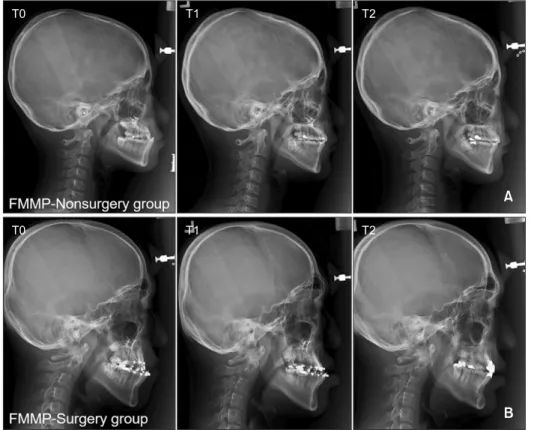
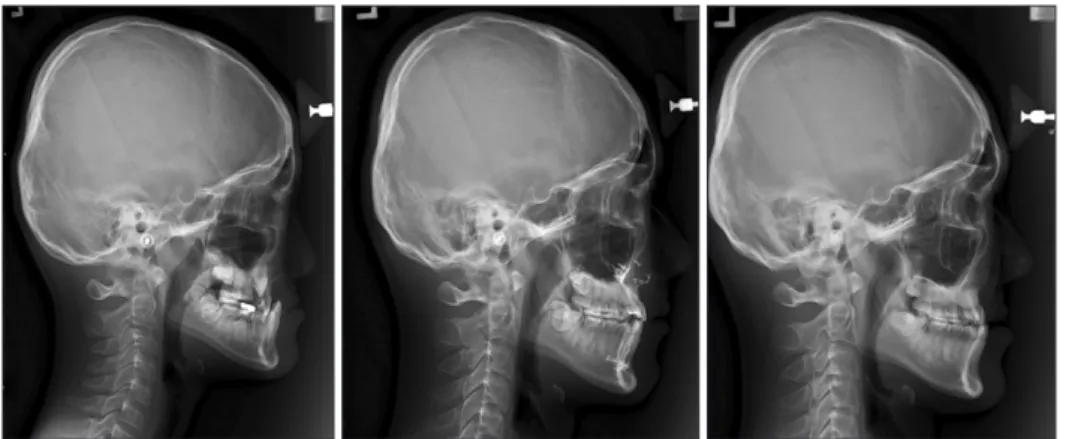
(n = 33, 62.3%) and the FMMP-Surgery group (n = 20, 37.7%) (Table 1 and Figure 1).

All cephalometric variables in 10 randomly selected samples were reanalyzed to verify the intra-examiner reliability with an interval of one-month using the Dahlberg formula.

24

The differences in the angular mea- surement ranged from 0.25° to 0.49°, and those in the linear measurement ranged from 0.14 to 0.49 mm. As a result, the first measurement was adopted for further statistical analysis.

Mann–Whitney test, Wilcoxon signed-rank test, chi- square test, Fisher’s exact test, and discrimination analy- sis were performed using SPSS ver. 22.0 (IBM Corp., Armonk, NY, USA). p-values of < 0.05 were considered statistically significant.

RESULTS

Demographic data of the two groups (Table 1)

The distributions of sex and cleft side were not differ- ent between the FMMP-Nonsurgery and FMMP-Surgery groups (all p > 0.05).

Differences in the mean ages at T0 stage of the two groups were statistically significant but clinically in- significant (10.27 years in FMMP-Nonsurgery group vs. 10.75 years in the FMMP-Surgery group, p < 0.05).

There were no significant differences in the mean ages at T1 and T2 stages between the two groups (all p >

T0 T1 T2

T0 T1 T2

A

B

Figure 1. Serial lateral ceph-

alograms taken before face-

mask with miniplate (FMMP)

therapy (T0), after FMMP

therapy (T1), and follow-up

(T2) in the FMMP-Nonsurgery

group (A) and FMMP-Surgery

group (B).

(4)

0.05).

There were also no significant differences in the mean duration of FM-MP therapy (T0–T1), follow-up (T1–T2), and total duration (T0–T2) between the FMMP-Nonsur- gery and FMMP-Surgery groups (all p > 0.05).

Comparison of missing teeth and space management between the two groups (Table 2)

The frequency of missing maxillary lateral incisor was higher in the FMMP-Nonsurgery group than the FMMP- Surgery group (83.3% [n = 25/30] vs. 45.0% [n = 9/20], p < 0.05). However, there was no significant difference in the space management (opening and closure) of miss- ing maxillary lateral incisor between the FMMP-Nonsur- gery and FMMP-Surgery groups (48.0% [n = 12/25] and 52.0% [n = 13/25] vs. 44.4% [n = 4/9] and 55.6% [n = 5/9]; p > 0.05).

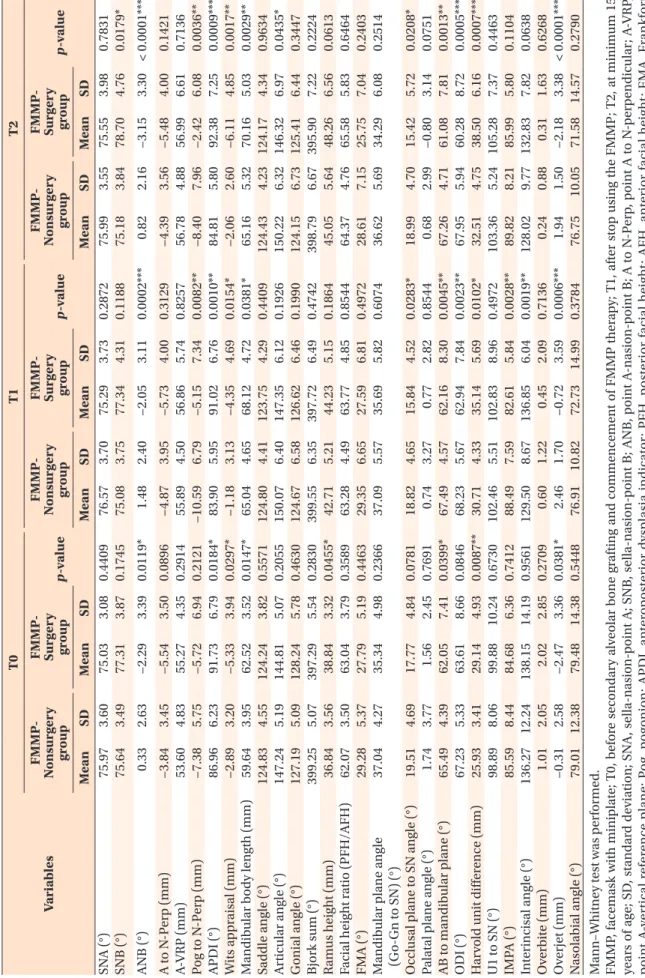
Comparison of the cephalometric parameters between the two groups at each stage (Table 3)

At the T0 stage, the FMMP-Surgery group showed more severe Class III relationship (ANB, anteroposterior dysplasia indicator [APDI], and Wits appraisal; p < 0.05;

Harvold unit difference, p < 0.01), longer mandibular body length (p < 0.05), longer ramus height (p < 0.05), more acute point A-point B (AB) to mandibular plane angle (p < 0.05), and more negative overjet (p < 0.05) than the FMMP-Nonsurgery group.

At the T1 stage, the FMMP-Surgery group still showed more severe Class III relationship (Wits appraisal and Harvold unit difference, p < 0.05; pogonion [Pog] to N- perpendicular [N-Perp] and APDI, p < 0.01; ANB, p <

0.001), longer mandibular body length (p < 0.05), more acute AB to mandibular plane angle (p < 0.01), and more negative overjet (p < 0.001) than the FMMP-Non- surgery group. At this stage, the FMMP-Surgery group Table 2. Comparison of missing teeth, extraction, and space management between FMMP-Nonsurgery and FMMP- Surgery groups

UCLP patient FMMP-Nonsurgery group (n = 33) FMMP-Surgery group (n = 20) p-value Missing of the maxillary

lateral incisor

25 cases with missing and 8 cases without missing (including 8 peg lateralis)

9 cases with missing and 11 cases without missing (including 10 peg lateralis)

0.0236*

Space management of missing maxillary lateral incisor

12 cases with space opening and 13 cases with space closure

4 cases with space opening and 5 cases with space closure

1.0000

FMMP, facemask with miniplate; UCLP, unilateral cleft lip and palate.

*p < 0.05.

chi-square test was performed.

Fisher’s exact test was performed.

Table 1. Demographic data of the FMMP-Nonsurgery and FMMP-Surgery groups

UCLP patient FMMP-Nonsurgery group (n = 33) FMMP-Surgery group (n = 20)

p-value

Mean SD Mean SD

Sex (M:F)

24:9 16:4 0.6534

Side involvement

12 cases with right side and 21 cases with left side

6 cases with right side and 14 cases with left side

0.7678

Age

§

(yr) T0 10.27 0.63 10.75 0.97 0.0368*

T1 14.76 0.94 14.65 0.99 0.9534

T2 18.42 1.54 19.10 1.33 0.1791

Duration

§

(mo) T0–T1 53.79 11.65 45.65 15.63 0.0718

T1–T2 44.45 18.72 53.05 17.41 0.1743

T0–T2 98.76 18.56 99.10 20.82 0.9634

FMMP, facemask with miniplate; UCLP, unilateral cleft lip and palate; SD, standard deviation; T0, before secondary alveolar bone grafting and commencement of FMMP therapy; T1, after stop using the FMMP; T2, at minimum 15 years of age.

*p < 0.05.

Fisher’s exact test was performed.

chi-square test was performed.

§
Mann–Whitney test was performed.

(5)

Table 3. Comparison of the cephalometric par ameter s between the FMMP-Nonsur gery and FMMP-Sur gery gr oups at each stage Vari able s

T0 T1 T2 FMMP - N ons ur ger y gr oup

FMMP - Sur ger y gr oup p -valu e FMMP - N ons ur ger y gr oup FMMP - Sur ger y gr oup p -valu e FMMP - N ons ur ger y gr oup

FMMP - Sur ger y gr oup p -valu e Me an SD Me an SD Me an SD Me an SD Me an SD Me an SD SN A (°) 75.97 3.60 75.03 3.08 0.4409 76.57 3.70 75.29 3.73 0.2872 75.99 3.55 75.55 3.98 0.7831 SNB (°) 75.64 3.49 77.31 3.87 0.1745 75.08 3.75 77.34 4.31 0.1188 75.18 3.84 78.70 4.76 0.0179* ANB (°) 0.33 2.63 −2.29 3.39 0.0119* 1.48 2.40 −2.05 3.11 0.0002*** 0.82 2.16 −3.15 3.30 < 0.0001*** A t o N -P erp (mm) −3.84 3.45 −5.54 3.50 0.0896 −4.87 3.95 −5.73 4.00 0.3129 −4.39 3.56 −5.48 4.00 0.1421 A -V RP (mm) 53.60 4.83 55.27 4.35 0.2914 55.89 4.50 56.86 5.74 0.8257 56.78 4.88 56.99 6.61 0.7136 P og t o N -P erp (mm) −7.38 5.75 −5.72 6.94 0.2121 −10.59 6.79 −5.15 7.34 0.0082** −8.40 7.96 −2.42 6.08 0.0036** AP DI (°) 86.96 6.23 91.73 6.79 0.0184* 83.90 5.95 91.02 6.76 0.0010** 84.81 5.80 92.38 7.25 0.0009*** W its a ppr ais al (mm) −2.89 3.20 −5.33 3.94 0.0297* −1.18 3.13 −4.35 4.69 0.0154* −2.06 2.60 −6.11 4.85 0.0017** M andib ul ar b od y len gth (mm) 59.64 3.95 62.52 3.52 0.0147* 65.04 4.65 68.12 4.72 0.0381* 65.16 5.32 70.16 5.03 0.0029** Saddle an gle (°) 124.83 4.55 124.24 3.82 0.5571 124.80 4.41 123.75 4.29 0.4409 124.43 4.23 124.17 4.34 0.9634 Ar tic ul ar an gle (°) 147.24 5.19 144.81 5.07 0.2055 150.07 6.40 147.35 6.12 0.1926 150.22 6.32 146.32 6.97 0.0435* G oni al an gle (°) 127.19 5.09 128.24 5.78 0.4630 124.67 6.58 126.62 6.46 0.1990 124.15 6.73 125.41 6.44 0.3447 Bj or k s um (°) 399.25 5.07 397.29 5.54 0.2830 399.55 6.35 397.72 6.49 0.4742 398.79 6.67 395.90 7.22 0.2224 R am us hei gh t (mm) 36.84 3.56 38.84 3.32 0.0455* 42.71 5.21 44.23 5.15 0.1864 45.05 5.64 48.26 6.56 0.0613 Faci al hei gh t r atio (P FH/AFH) 62.07 3.50 63.04 3.79 0.3589 63.28 4.49 63.77 4.85 0.8544 64.37 4.76 65.58 5.83 0.6464 FMA (°) 29.28 5.37 27.79 5.19 0.4463 29.35 6.65 27.59 6.81 0.4972 28.61 7.15 25.75 7.04 0.2403 M andib ul ar pl ane an gle (G o-G n t o S N ) (°) 37.04 4.27 35.34 4.98 0.2366 37.09 5.57 35.69 5.82 0.6074 36.62 5.69 34.29 6.08 0.2514 O cc lus al pl ane t o S N an gle (°) 19.51 4.69 17.77 4.84 0.0781 18.82 4.65 15.84 4.52 0.0283* 18.99 4.70 15.42 5.72 0.0208* Pal atal pl ane an gle (°) 1.74 3.77 1.56 2.45 0.7691 0.74 3.27 0.77 2.82 0.8544 0.68 2.99 −0.80 3.14 0.0751 AB t o m andib ul ar pl ane (°) 65.49 4.39 62.05 7.41 0.0399* 67.49 4.57 62.16 8.30 0.0045** 67.26 4.71 61.08 7.81 0.0013** ODI (°) 67.23 5.33 63.61 8.66 0.0846 68.23 5.67 62.94 7.84 0.0023** 67.95 5.94 60.28 8.72 0.0005*** H ar vold unit differ ence (mm) 25.93 3.41 29.14 4.93 0.0087** 30.71 4.33 35.14 5.69 0.0102* 32.51 4.75 38.50 6.16 0.0007*** U1 t o S N (°) 98.89 8.06 99.88 10.24 0.6730 102.46 5.51 102.83 8.96 0.4972 103.36 5.24 105.28 7.37 0.4463 IMP A (°) 85.59 8.44 84.68 6.36 0.7412 88.49 7.59 82.61 5.84 0.0028** 89.82 8.21 85.99 5.80 0.1104 In ter incis al an gle (°) 136.27 12.24 138.15 14.19 0.9561 129.50 8.67 136.85 6.04 0.0019** 128.02 9.77 132.83 7.82 0.0638 O ver bit e (mm) 1.01 2.05 2.02 2.85 0.2709 0.60 1.22 0.45 2.09 0.7136 0.24 0.88 0.31 1.63 0.6268 O verj et (mm) −0.31 2.58 −2.47 3.36 0.0381* 2.46 1.70 −0.72 3.59 0.0006*** 1.94 1.50 −2.18 3.38 < 0.0001*** N as ol abi al an gle (°) 79.01 12.38 79.48 14.38 0.5448 76.91 10.82 72.73 14.99 0.3784 76.75 10.05 71.58 14.57 0.2790 M ann–W hitne y t es t w as p er for me d. FMMP , facem as k w ith minipl at e; T0, b efor e s econd ar y alv eol ar b one gr aftin g and commencemen t of FMMP ther ap y; T1, aft er s top us in g the FMMP ; T2, a t minim um 15 ye ar s of ag e; S D , s tand ar d de vi ation; S N A , s ell a-n as ion- p oin t A; S NB , s ell a-n as ion- p oin t B; ANB , p oin t A -n as ion- p oin t B; A t o N -P erp , p oin t A t o N -p erp endic ul ar ; A -V RP , p oin t A -v er tic al r efer ence pl ane; P og , p og onion; AP DI, an ter op os ter ior d ys pl as ia indic at or ; P FH, p os ter ior faci al hei gh t; AFH, an ter ior faci al hei gh t; FMA , Fr ankfor t to m andib ul ar pl ane an gle; G o, g onion; G n, g n athion; S N , s ell a-n as ion; AB , p oin t A -p oin t B; ODI, o ver bit e depth indic at or ; U1, upp er cen tr al incis or ; IMP A , incis or m andib ul ar pl ane an gle . *p < 0.05, ** p < 0.01, *** p < 0.001.

(6)

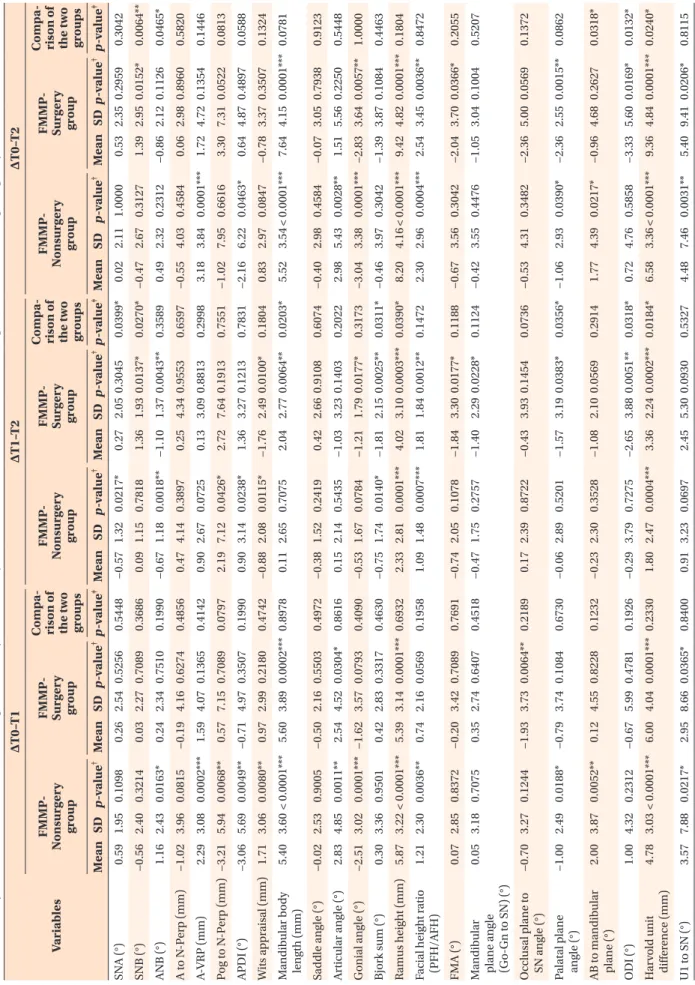
Table 4. Comparison of the amount of change in the cephalometric par ameter s between the FMMP-Nonsur gery and FMMP-Sur gery gr oups V ari able s ΔT0– T1 ΔT1– T2 ΔT0– T2 FMMP - N ons ur ger y gr oup

FMMP - Sur ger y gr oup Comp a- ris on of th e t w o gr oup s

FMMP - N ons ur ger y gr oup FMMP - Sur ger y gr oup Comp a- ris on of th e t w o gr oup s

FMMP - N ons ur ger y gr oup FMMP - Sur ger y gr oup

Comp a- ris on of th e t w o gr oup s Me an SD p -valu e

Me an SD p -valu e

p -valu e

Me an SD p -valu e

Me an SD p -valu e

p -valu e

Me an SD p -valu e

Me an SD p -valu e

p -valu e

SN A (°) 0.59 1.95 0.1098 0.26 2.54 0.5256 0.5448 −0.57 1.32 0.0217* 0.27 2.05 0.3045 0.0399* 0.02 2.11 1.0000 0.53 2.35 0.2959 0.3042 SNB (°) −0.56 2.40 0.3214 0.03 2.27 0.7089 0.3686 0.09 1.15 0.7818 1.36 1.93 0.0137* 0.0270* −0.47 2.67 0.3127 1.39 2.95 0.0152* 0.0064** ANB (°) 1.16 2.43 0.0163* 0.24 2.34 0.7510 0.1990 −0.67 1.18 0.0018** −1.10 1.37 0.0043** 0.3589 0.49 2.32 0.2312 −0.86 2.12 0.1126 0.0465* A t o N -P erp (mm) −1.02 3.96 0.0815 −0.19 4.16 0.6274 0.4856 0.47 4.14 0.3897 0.25 4.34 0.9553 0.6597 −0.55 4.03 0.4584 0.06 2.98 0.8960 0.5820 A -V RP (mm) 2.29 3.08 0.0002*** 1.59 4.07 0.1365 0.4142 0.90 2.67 0.0725 0.13 3.09 0.8813 0.2998 3.18 3.84 0.0001*** 1.72 4.72 0.1354 0.1446 P og t o N -P erp (mm) −3.21 5.94 0.0068** 0.57 7.15 0.7089 0.0797 2.19 7.12 0.0426* 2.72 7.64 0.1913 0.7551 −1.02 7.95 0.6616 3.30 7.31 0.0522 0.0813 AP DI (°) −3.06 5.69 0.0049** −0.71 4.97 0.3507 0.1990 0.90 3.14 0.0238* 1.36 3.27 0.1213 0.7831 −2.16 6.22 0.0463* 0.64 4.87 0.4897 0.0588 W its a ppr ais al (mm) 1.71 3.06 0.0080** 0.97 2.99 0.2180 0.4742 −0.88 2.08 0.0115* −1.76 2.49 0.0100* 0.1804 0.83 2.97 0.0847 −0.78 3.37 0.3507 0.1324 M andib ul ar b od y len gth (mm) 5.40 3.60 < 0.0001*** 5.60 3.89 0.0002*** 0.8978 0.11 2.65 0.7075 2.04 2.77 0.0064** 0.0203* 5.52 3.54 < 0.0001*** 7.64 4.15 0.0001*** 0.0781 Saddle an gle (°) −0.02 2.53 0.9005 −0.50 2.16 0.5503 0.4972 −0.38 1.52 0.2419 0.42 2.66 0.9108 0.6074 −0.40 2.98 0.4584 −0.07 3.05 0.7938 0.9123 Ar tic ul ar an gle (°) 2.83 4.85 0.0011** 2.54 4.52 0.0304* 0.8616 0.15 2.14 0.5435 −1.03 3.23 0.1403 0.2022 2.98 5.43 0.0028** 1.51 5.56 0.2250 0.5448 G oni al an gle (°) −2.51 3.02 0.0001*** −1.62 3.57 0.0793 0.4090 −0.53 1.67 0.0784 −1.21 1.79 0.0177* 0.3173 −3.04 3.38 0.0001*** −2.83 3.64 0.0057** 1.0000 Bj or k s um (°) 0.30 3.36 0.9501 0.42 2.83 0.3317 0.4630 −0.75 1.74 0.0140* −1.81 2.15 0.0025** 0.0311* −0.46 3.97 0.3042 −1.39 3.87 0.1084 0.4463 R am us hei gh t (mm) 5.87 3.22 < 0.0001*** 5.39 3.14 0.0001*** 0.6932 2.33 2.81 0.0001*** 4.02 3.10 0.0003*** 0.0390* 8.20 4.16 < 0.0001*** 9.42 4.82 0.0001*** 0.1804 Faci al hei gh t r atio (P FH/AFH) 1.21 2.30 0.0036** 0.74 2.16 0.0569 0.1958 1.09 1.48 0.0007*** 1.81 1.84 0.0012** 0.1472 2.30 2.96 0.0004*** 2.54 3.45 0.0036** 0.8472 FMA (°) 0.07 2.85 0.8372 −0.20 3.42 0.7089 0.7691 −0.74 2.05 0.1078 −1.84 3.30 0.0177* 0.1188 −0.67 3.56 0.3042 −2.04 3.70 0.0366* 0.2055 M andib ul ar pl ane an gle (G o-G n t o S N ) (°)

0.05 3.18 0.7075 0.35 2.74 0.6407 0.4518 −0.47 1.75 0.2757 −1.40 2.29 0.0228* 0.1124 −0.42 3.55 0.4476 −1.05 3.04 0.1004 0.5207 O cc lus al pl ane t o S N an gle (°) −0.70 3.27 0.1244 −1.93 3.73 0.0064** 0.2189 0.17 2.39 0.8722 −0.43 3.93 0.1454 0.0736 −0.53 4.31 0.3482 −2.36 5.00 0.0569 0.1372 Pal atal pl ane an gle (°) −1.00 2.49 0.0188* −0.79 3.74 0.1084 0.6730 −0.06 2.89 0.5201 −1.57 3.19 0.0383* 0.0356* −1.06 2.93 0.0390* −2.36 2.55 0.0015** 0.0862 AB t o m andib ul ar pl ane (°) 2.00 3.87 0.0052** 0.12 4.55 0.8228 0.1232 −0.23 2.30 0.3528 −1.08 2.10 0.0569 0.2914 1.77 4.39 0.0217* −0.96 4.68 0.2627 0.0318* ODI (°) 1.00 4.32 0.2312 −0.67 5.99 0.4781 0.1926 −0.29 3.79 0.7275 −2.65 3.88 0.0051** 0.0318* 0.72 4.76 0.5858 −3.33 5.60 0.0169* 0.0132* H ar vold unit differ ence (mm) 4.78 3.03 < 0.0001*** 6.00 4.04 0.0001*** 0.2330 1.80 2.47 0.0004*** 3.36 2.24 0.0002*** 0.0184* 6.58 3.36 < 0.0001*** 9.36 4.84 0.0001*** 0.0240* U1 t o S N (°) 3.57 7.88 0.0217* 2.95 8.66 0.0365* 0.8400 0.91 3.23 0.0697 2.45 5.30 0.0930 0.5327 4.48 7.46 0.0031** 5.40 9.41 0.0206* 0.8115

(7)

appeared to show more counterclockwise rotation of the occlusal plane to SN angle (p < 0.05), smaller overbite depth indicator (ODI) (p < 0.01), and more dental com- pensation of the mandibular incisor (incisor mandibular plane angle [IMPA] and interincisal angle, p < 0.01) compared to the FMMP-Nonsurgery group.

At the T2 stage, the FMMP-Surgery group still showed more severe Class III relationship (sella-nasion-point B [SNB], p < 0.05; Pog to N-Perp and Wits appraisal, p <

0.01; ANB, APDI, and Harvold unit difference, p < 0.001), longer mandibular body length (p < 0.01), more coun- terclockwise rotation of the occlusal plane to SN angle (p

< 0.05), more acute AB to mandibular plane angle (p <

0.01), smaller ODI (p < 0.001), and more negative overjet (p < 0.001) than the FMMP-Nonsurgery group. At this stage, the FMMP-Surgery group appeared to show more counterclockwise rotation of the mandible (articular angle, p < 0.05) compared to the FMMP-Nonsurgery group.

Throughout the whole stages, seven cephalometric variables, including ANB, APDI, Wits appraisal, mandibu- lar body length, AB to mandibular plane angle, Harvold unit difference, and overjet, exhibited significant dif- ferences between the two groups. At both T1 and T2 stages, Pog to N-Perp, occlusal plane to SN angle, and ODI appeared to have significant differences between the two groups.

Comparison of the amount of change in the cephalometric parameters between the two groups (Table 4)

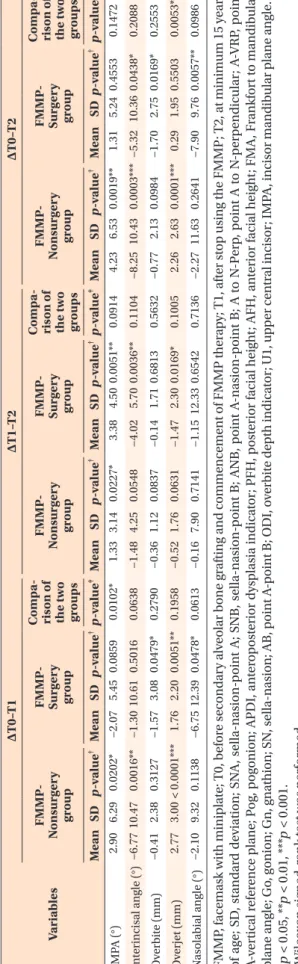
When compared the two groups, during T0–T1, there was no difference in the cephalometric parameters ex- cept ΔIMPA (p < 0.05). These findings suggested that the effects of FMMP therapy might be similar between the two groups. However, considering the values at the T0 and T1 stages, more severe Class III relationship, longer mandibular body length, more acute AB to man- dibular plane angle, and more negative overjet in the FMMP-Surgery group were not fully corrected despite long-term use of FMMP.

During T1–T2, the FMMP-Surgery group showed sig- nificant pubertal and late mandibular growth (ΔSNB, ΔMandibular body length, ΔRamus height, and ΔHarvold unit difference, p < 0.05) and counterclockwise rota- tion of the maxilla and mandible (ΔPalatal plane angle, ΔODI, and ΔBjork sum, p < 0.05) compared to the FMMP-Nonsurgery group.

During T0–T2, the FMMP-Surgery group exhib- ited a more worsening of Class III relationship (ΔANB, ΔHarvold unit difference, ΔAB to Mandibular plane angle, and ΔODI, p < 0.05; ΔSNB, p < 0.01) and less increase in overjet (p < 0.01) compared to the FMMP- Nonsurgery group.

Table 4. Continued V ari able s

ΔT0– T1 ΔT1– T2 ΔT0– T2 FMMP - N ons ur ger y gr oup FMMP - Sur ger y gr oup Comp a- ris on of th e t w o gr oup s

FMMP - N ons ur ger y gr oup FMMP - Sur ger y gr oup Comp a- ris on of th e t w o gr oup s

FMMP - N ons ur ger y gr oup FMMP - Sur ger y gr oup

Comp a- ris on of th e t w o gr oup s Me an SD p -valu e

Me an SD p -valu e

p -valu e

Me an SD p -valu e

Me an SD p -valu e

p -valu e

Me an SD p -valu e

Me an SD p -valu e

p -valu e

IMP A (°) 2.90 6.29 0.0202* −2.07 5.45 0.0859 0.0102* 1.33 3.14 0.0227* 3.38 4.50 0.0051** 0.0914 4.23 6.53 0.0019** 1.31 5.24 0.4553 0.1472 In ter incis al an gle (°) −6.77 10.47 0.0016** −1.30 10.61 0.5016 0.0638 −1.48 4.25 0.0548 −4.02 5.70 0.0036** 0.1104 −8.25 10.43 0.0003*** −5.32 10.36 0.0438* 0.2088 O ver bit e (mm) −0.41 2.38 0.3127 −1.57 3.08 0.0479* 0.2790 −0.36 1.12 0.0837 −0.14 1.71 0.6813 0.5632 −0.77 2.13 0.0984 −1.70 2.75 0.0169* 0.2553 O verj et (mm) 2.77 3.00 < 0.0001*** 1.76 2.20 0.0051** 0.1958 −0.52 1.76 0.0631 −1.47 2.30 0.0169* 0.1005 2.26 2.63 0.0001*** 0.29 1.95 0.5503 0.0053** N as ol abi al an gle (°) −2.10 9.32 0.1138 −6.75 12.39 0.0478* 0.0613 −0.16 7.90 0.7141 −1.15 12.33 0.6542 0.7136 −2.27 11.63 0.2641 −7.90 9.76 0.0057** 0.0986 FMMP , facem as k w ith minipl at e; T0, b efor e s econd ar y alv eol ar b one gr aftin g and commencemen t of FMMP ther ap y; T1, aft er s top us in g the FMMP ; T2, a t minim um 15 y ear s of a ge; S D , s tand ar d de vi ation; S N A , s ell a-n as ion- p oin t A; S NB , s ell a-n as ion- p oin t B; ANB , p oin t A -n as ion- p oin t B; A t o N -P erp , p oin t A t o N -p erp endic ul ar ; A -V RP , p oin t A -v er tic al r efer ence pl ane; P og , p og onion; AP DI, an ter op os ter ior d ys pl as ia indic at or ; P FH, p os ter ior faci al hei gh t; AFH, an ter ior faci al hei gh t; FMA , Fr ankfor t t o m andib ul ar pl ane an gle; G o, g onion; G n, g n athion; S N , s ell a-n as ion; AB , p oin t A -p oin t B; ODI, o ver bit e depth indic at or ; U1, upp er cen tr al incis or ; IMP A , incis or m andib ul ar pl ane an gle . *p < 0.05, ** p < 0.01, *** p < 0.001.

W ilco xon s ig ne d-r ank t es t w as p er for me d.

M ann–W hitne y t es t w as p er for me d.

(8)

Prediction cephalometric variables at the T0 stage for the future need for orthognathic surgery (Tables 5 and 6)

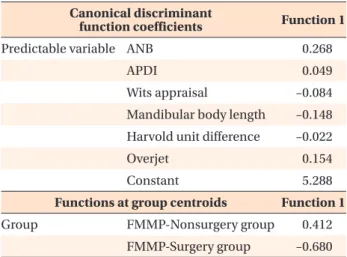
From the simultaneous estimation-discriminant analy- sis, the discriminant function affecting the future need for orthognathic surgery is as follows: D = 5.288 + [0.268

× ANB (°)] + [0.049 × APDI (°)] – [0.084 × Wits ap- praisal (mm)] – [0.148 × mandibular body length (mm)]

– [0.022 × Harvold unit difference (mm)] + [0.154 × overjet (mm)]. The centroids of the FMMP-Nonsurgery group and FMMP-surgery group were 0.412 and –0.680, respectively (Table 5). The percentage of correctly classi- fied original grouped cases was 69.8%, with a sensitivity of 69.7% and specificity of 70.0% (Table 6).

DISCUSSION

Although this study was performed with a single university hospital-based data, this study might have some originalities. First, we used relatively strict inclu- sion criteria to increase the purity of the samples. Sec- ond, the identical treatment protocol was used to avoid confounding factors in interpreting the results. Third, to the authors’ knowledge, it is the first study to report

the cephalometric parameters at the initial stage related to the risk of future orthognathic surgery or DO despite long-term use of FMMP therapy.

Candidates for orthognathic surgery or distraction osteogenesis

In the present study, 37.7% of UCLP patients became candidates for orthognathic surgery or DO despite long- term use of FMMP therapy (Table 1). It was higher than Park et al’s result (21.4%).

15

The reasons might be (1) the UCLP subjects used in Park et al’s study

15

were a com- bination of patients with various degrees of maxillary hypoplasia and (2) in the present study, FMMP therapy was applied to subjects with moderate-to-severe maxil- lary hypoplasia.

Comparison of the cephalometric parameters at each stage and the amount of change between the two groups (Tables 3 and 4)

In the FMMP-Surgery group, a forward position of the mandible at the T0 stage was maintained through- out the whole stages and Class III relationship worsened with significant pubertal and late mandibular growth and counterclockwise rotation of the maxilla and man- dible at the T1 and T2 stages. These findings were simi- lar to those in Meazzini et al.

17

and Yun-Chia Ku et al.,

19

who reported that a significant late mandibular growth in UCLP children played an important role in deciding the need for orthognathic surgery. Scheuer et al.

25

also reported that UCLP patients showed more significant amounts of change in SNA and SNB from 12 to 16 years compared to that of 8 to 12 years.

Previous studies insisted that the vertical cephalo- metric variables including palatal plane inclination, mandibular plane angle, and facial height would not be the determining factors for orthognathic surgery.

17,19,21

However, it is necessary to investigate the effects of the rotation of the maxilla and mandible and the changes in the vertical dimension on worsening of Class III relation- ship in future studies.

Table 5. Discriminant analysis to identify cephalometric predictors of future need for orthognathic surgery

Canonical discriminant

function coefficients Function 1

Predictable variable ANB 0.268

APDI 0.049

Wits appraisal –0.084

Mandibular body length –0.148 Harvold unit difference –0.022

Overjet 0.154

Constant 5.288

Functions at group centroids Function 1

Group FMMP-Nonsurgery group 0.412

FMMP-Surgery group –0.680 ANB, point A-nasion-point B; APDI, anteroposterior dys- plasia indicator; FMMP, facemask with miniplate.

Table 6. Classification results in discrimination analysis Number of cases

Predicted membership (%) FMMP-Nonsurgery group

(n = 29) FMMP-Surgery group (n = 24)

Actual group FMMP-Nonsurgery group (n = 33) 23 (69.7) 10 (30.3)

FMMP-Surgery group (n = 20) 6 (30.0) 14 (70.0)

Percent of original cases correctly classified: 69.8%.

FMMP, facemask with miniplate.

(9)

Prediction cephalometric variables at the T0 stage for the future need for orthognathic surgery (Tables 5 and 6)

Zemann et al.

26

reported that UCLP children with neg- ative values of ANB angle at the age of 6 years showed no improvement after a 4-year period. Antonarakis et al.

16

and Meazzini et al.

21

suggested that ANB would be a powerful predictor in cleft patients at the age of 5–6 years. These findings were similar to the result of this study, which selected ANB as one of the major predic- tors from the discriminant analysis. However, since ac- curate tracing and cephalometric analysis of the anterior maxilla (including point A) might be difficult at the age of 5–6 years, it would be better to use the samples with completely erupted permanent maxillary incisors.

15

Therefore, the mean age at the T0 stage in the present study was around 10 years (Table 1).

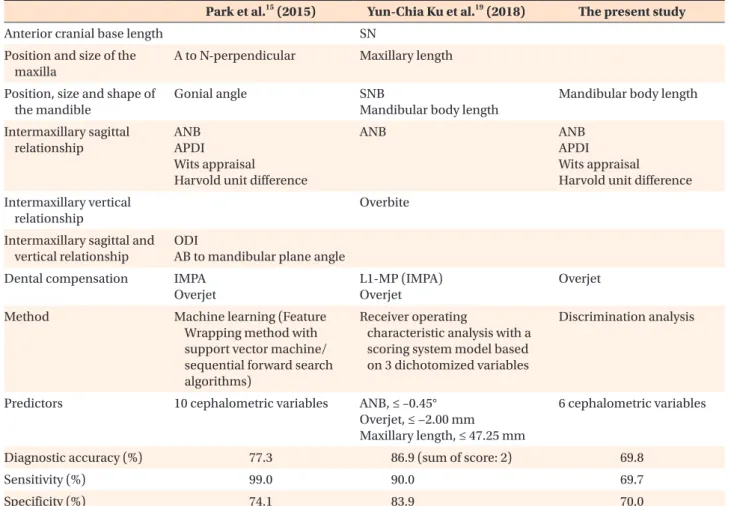
Comparison of the cephalometric predictors in previous studies (Table 7)

The present study selected six cephalometric variables

at the T0 stage related to the size of the mandible (man- dibular body length), intermaxillary sagittal relationship (ANB, APDI, Wits appraisal, and Harvold unit difference) and dental compensation (overjet). These findings were similar to those reported by Park et al.

15

and Yun-Chia Ku et al.

19

However, there were some differences in the cephalometric parameters. Park et al.

15

included more cephalometric parameters such as position of the max- illa (A to N-Perp), shape of the mandible (gonial angle), intermaxillary sagittal and vertical relationship (ODI and AB to mandibular plane angle), and dental compensa- tion (IMPA) compared to the present study. Yun-Chia Ku et al.

19

also added more cephalometric parameters in- cluding size of the maxilla (maxillary length), position of the mandible (SNB), intermaxillary vertical relationship (overbite), anterior cranial base length (SN), and dental compensation (IMPA); while they did not use the cepha- lometric variables explaining the intermaxillary sagittal relationship (APDI, Wits appraisal, and Harvold unit dif- ference) compared to the present study.

Table 7. Comparison of the cephalometric predictors in previous studies

Park et al.

15

(2015) Yun-Chia Ku et al.

19

(2018) The present study

Anterior cranial base length SN

Position and size of the maxilla

A to N-perpendicular Maxillary length

Position, size and shape of the mandible

Gonial angle SNB

Mandibular body length

Mandibular body length

Intermaxillary sagittal relationship

ANB APDI Wits appraisal

Harvold unit difference

ANB ANB

APDI Wits appraisal

Harvold unit difference Intermaxillary vertical

relationship

Overbite

Intermaxillary sagittal and vertical relationship

ODI

AB to mandibular plane angle Dental compensation IMPA

Overjet

L1-MP (IMPA) Overjet

Overjet

Method Machine learning (Feature

Wrapping method with support vector machine/

sequential forward search algorithms)

Receiver operating

characteristic analysis with a scoring system model based on 3 dichotomized variables

Discrimination analysis

Predictors 10 cephalometric variables ANB, ≤ –0.45°

Overjet, ≤ −2.00 mm Maxillary length, ≤ 47.25 mm

6 cephalometric variables

Diagnostic accuracy (%) 77.3 86.9 (sum of score: 2) 69.8

Sensitivity (%) 99.0 90.0 69.7

Specificity (%) 74.1 83.9 70.0

SN, sella-nasion; SNB, sella-nasion-point B; ANB, point A-nasion-point B; APDI, anteroposterior dysplasia indicator;

ODI, overbite depth indicator; AB, point A-point B; IMPA, incisor mandibular plane angle; L1-MP, lower central incisor to

mandibular plane.

(10)

The reasons for these differences might be as fol- lows: First, Park et al.

15

and Yun-Chia Ku et al.

19

did not confine the subjects who were treated with long- term use of FMMP. Second, in the present study, be- cause the amounts of change during T0–T1 in the two groups were similar (Table 4), Class III relationship at the T0 stage was not fully corrected at the T1 stage in the FMMP-Surgery group (Table 3). Third, in the pres- ent study, the FMMP-Surgery group showed significant pubertal and late growth of the mandibular body and ramus and counterclockwise rotation of the maxilla and mandible at the T1 and T2 stages, resulting in worsen- ing of the skeletal Class III relationship (Tables 3 and 4).

In the present study, accuracy, sensitivity and speci- ficity (69.8%, 69.7%, and 70.0%) were relatively lower than those in previous studies.

15,19

It is assumed that this difference came from the sample size, statistical method, various treatment responses of patients, need of or- thognathic surgery for correction of transverse or other dimensional problems, and the patient’s desire for facial esthetics. Therefore, it is necessary to investigate the ef- fects of aforementioned issues on the accuracy, sensitiv- ity and specificity in future studies.

Clinical implications

The results from this study indicated that, although Class III relationship would not be fully corrected in the FMMP-Surgery group, the two groups did not exhibit the difference in the absolute amount of sagittal change in the cephalometric parameters by FMMP therapy (Tables 3 and 4). Therefore, it can be stated that the FMMP therapy has a possibility of reducing the amount of maxillary advancement in orthognathic surgery or DO in UCLP patients.

As clinical suggestions, when a future need for or- thognathic surgery is expected in children with UCLP (Tables 5 and 6), there might be three recommendations for using the FMMP therapy. First, it is necessary to inform the parents about the possibility of poor prog- nosis and the possibility of orthognathic surgery after

completion of facial growth. Second, after placing two miniplates in the mandibular symphysis area as well as two miniplates in the infrazygomatic crest of the max- illa, use of Class III elastics between the maxillary and mandibular miniplates at day time and FMMP at night time would be recommended (Figure 2).

7,9,10

Third, it might be better to install two additional miniplates on the lateral nasal wall in the maxilla or combine the in- traoral anchorage in the maxillary dentition to increase the orthopedic effect.

Limitations of this study and suggestions for future studies

Although this is the first study that investigated the cephalometric predictors for the future need for or- thognathic surgery, despite long-term use of FM-MP, in Korean adolescent patients with UCLP, the present study has some limitations as follows: First, this study had a retrospective study design with a relatively small sample size. Second, the samples were not subdivided accord- ing to the amount and degree of scar tissue on the lip and palate. Third, since patient’s compliance is one of the important factors in obtaining the successful treat- ment outcome, especially in long-term FMMP therapy, it is necessary to identify a method to objectively measure patient’s compliance. In the near future, it is necessary to perform a nationwide multi-center study with a large sample size and more sophisticated statistical analysis methods.

CONCLUSION

• Despite long-term use of FMMP therapy, 37.7% of UCLP patients became candidates for orthognathic sur- gery or DO. Therefore, differential diagnosis is necessary to predict the future need for orthognathic surgery at early age.

• A total of six cephalometric variables including ANB, APDI, Wits appraisal, mandibular body length, Harvold unit difference, and overjet at the age of 10 years were

Figure 2. An example of in-

stallation of two additional

miniplates on the mandibular

symphysis and use of Class III

elastics between the maxillary

and mandibular miniplates at

day time and facemask with

miniplate at night time.

(11)

selected as predictors of the future need for orthogna- thic surgery in Korean UCLP patients.

CONFLICTS OF INTEREST

No potential conflict of interest relevant to this article was reported.

REFERENCES

1. Ross RB. Treatment variables affecting facial growth in complete unilateral cleft lip and palate. Cleft Pal- ate J 1987;24:5-77.

2. Baek SH, Moon HS, Yang WS. Cleft type and Angle's classification of malocclusion in Korean cleft pa- tients. Eur J Orthod 2002;24:647-53.

3. Seo YJ, Park JW, Kim YH, Baek SH. Initial growth pattern of children with cleft before alveolar bone graft stage according to cleft type. Angle Orthod 2011;81:1103-10.

4. Baek SH, Kim KW, Choi JY. New treatment modality for maxillary hypoplasia in cleft patients. Protraction facemask with miniplate anchorage. Angle Orthod 2010;80:783-91.

5. Ahn HW, Kim KW, Yang IH, Choi JY, Baek SH. Com- parison of the effects of maxillary protraction using facemask and miniplate anchorage between unilat- eral and bilateral cleft lip and palate patients. Angle Orthod 2012;82:935-41.

6. Jahanbin A, Kazemian M, Eslami N, Pouya IS. Max- illary protraction with intermaxillary elastics to miniplates versus bone-anchored face-mask therapy in cleft lip and palate patients. J Craniofac Surg 2016;27:1247-52.

7. Yatabe M, Garib DG, Faco RAS, de Clerck H, Janson G, Nguyen T, et al. Bone-anchored maxillary pro- traction therapy in patients with unilateral complete cleft lip and palate: 3-dimensional assessment of maxillary effects. Am J Orthod Dentofacial Orthop 2017;152:327-35.

8. On SW, Baek SH, Choi JY. Effect of long-term use of facemask with miniplate on maxillary protraction in patients with cleft lip and palate. J Craniofac Surg 2018;29:309-14.

9. Faco R, Yatabe M, Cevidanes LHS, Timmerman H, De Clerck HJ, Garib D. Bone-anchored maxillary protraction in unilateral cleft lip and palate: a ceph- alometric appraisal. Eur J Orthod 2019;41:537-43.

10. Ren Y, Steegman R, Dieters A, Jansma J, Stamata- kis H. Bone-anchored maxillary protraction in patients with unilateral complete cleft lip and pal- ate and Class III malocclusion. Clin Oral Investig 2019;23:2429-41.

11. Cohen SR, Burstein FD, Stewart MB, Rathburn MA.

Maxillary-midface distraction in children with cleft lip and palate: a preliminary report. Plast Reconstr Surg 1997;99:1421-8.

12. Figueroa AA, Polley JW. Management of severe cleft maxillary deficiency with distraction osteogenesis:

procedure and results. Am J Orthod Dentofacial Or- thop 1999;115:1-12.

13. Schnitt DE, Agir H, David DJ. From birth to matu- rity: a group of patients who have completed their protocol management. Part I. Unilateral cleft lip and palate. Plast Reconstr Surg 2004;113:805-17.

14. Good PM, Mulliken JB, Padwa BL. Frequency of Le Fort I osteotomy after repaired cleft lip and palate or cleft palate. Cleft Palate Craniofac J 2007;44:396- 401.

15. Park HM, Kim PJ, Kim HG, Kim S, Baek SH. Predic- tion of the need for orthognathic surgery in pa- tients with cleft lip and/or palate. J Craniofac Surg 2015;26:1159-62.

16. Antonarakis GS, Watts G, Daskalogiannakis J. The need for orthognathic surgery in nonsyndromic pa- tients with repaired isolated cleft palate. Cleft Palate Craniofac J 2015;52:e8-13.

17. Meazzini MC, Giussani G, Morabito A, Semb G, Garattini G, Brusati R. A cephalometric intercenter comparison of patients with unilateral cleft lip and palate: analysis at 5 and 10 years of age and long term. Cleft Palate Craniofac J 2008;45:654-60.

18. Heliövaara A, Rautio J. A comparison of craniofacial cephalometric morphology and the later need for orthognathic surgery in 6-year-old cleft children. J Craniomaxillofac Surg 2011;39:173-6.

19. Yun-Chia Ku M, Lo LJ, Chen MC, Wen-Ching Ko E.

Predicting need for orthognathic surgery in early permanent dentition patients with unilateral cleft lip and palate using receiver operating characteris- tic analysis. Am J Orthod Dentofacial Orthop 2018;

153:405-14.

20. Daskalogiannakis J, Mehta M. The need for orthog- nathic surgery in patients with repaired complete unilateral and complete bilateral cleft lip and palate.

Cleft Palate Craniofac J 2009;46:498-502.

21. Meazzini MC, Capello AV, Ventrini F, Autelitano L, Morabito A, Garattini G, et al. Long-term follow-up of UCLP patients: surgical and orthodontic burden of care during growth and final orthognathic sur- gery need. Cleft Palate Craniofac J 2015;52:688-97.

22. Legan HL, Burstone CJ. Soft tissue cephalomet- ric analysis for orthognathic surgery. J Oral Surg 1980;38:744-51.

23. Linton JL. Comparative study of diagnostic mea- sures in borderline surgical cases of unilateral cleft lip and palate and noncleft Class III malocclusions.

Am J Orthod Dentofacial Orthop 1998;113:526-37.

(12)

24. Dahlberg G. Statistical methods for medical and biological students. Br Med J 1940;2:358-9.

25. Scheuer HA, Höltje WJ, Hasund A, Pfeifer G. Prog- nosis of facial growth in patients with unilateral complete clefts of the lip, alveolus and palate. J Craniomaxillofac Surg 2001;29:198-204.

26. Zemann W, Kärcher H, Drevenšek M, Koželj V. Sag-

ittal maxillary growth in children with unilateral

cleft of the lip, alveolus and palate at the age of 10

years: an intercentre comparison. J Craniomaxillofac

Surg 2011;39:469-74.

수치

Figure 1. Serial lateral ceph- ceph-alograms taken before  face-mask with miniplate (FMMP)  therapy (T0), after FMMP  therapy (T1), and follow-up  (T2) in the FMMP-Nonsurgery  group (A) and FMMP-Surgery  group (B).
Table 1. Demographic data of the FMMP-Nonsurgery and FMMP-Surgery groups
Table 3. Comparison of the cephalometric parameters between the FMMP-Nonsurgery and FMMP-Surgery groups at each stage VariablesT0T1T2FMMP-Nonsurgery  groupFMMP-Surgery groupp-valueFMMP-Nonsurgery groupFMMP-Surgery groupp-valueFMMP-Nonsurgery group
Table 4. Comparison of the amount of change in the cephalometric parameters between the FMMP-Nonsurgery and FMMP-Surgery groups  VariablesΔT0–T1ΔT1–T2ΔT0–T2FMMP-Nonsurgery  group
+5

참조

관련 문서

Sixth, the skills of core manpower in Korean electronic industry tend to be converging toward the long-term cumulative skill formation. Keyword:

In the future, we need further studies on prevention of illegal copy and settlement of legal software products by analysing use characteristics of softwares and

Cephalometric comparisons of craniofacial and upper airway structure by skeletal subtype and gender in patients with obstructive sleep apnea.. Nasal

In chapter two the definition of cleft sentences and syntactic feature of cleft constructions are presented.. And in chapter three semantic properties of

“Transition-based dependency parsing with stack long short-term memory”, Proceedings of the 53 rd Annual Meeting of the Association for Computational

approval but there is no limit for the amount of national bonds and.. public bonds in scale with GDP. 3) maturity for national bonds and public bonds is making a long-term.

In Table 4, for the problems with 10, 20, and 30 nodes, the computational results of tabu search are shown with a recency based short term memory, a frequency based long term

6 Division of Endocrinology and Metabolism, Department of Internal Medicine, Soonchunhyang University Seoul Hospital, Soonchunhyang University College of Medicine, Seoul,..