Min Soo KIM
Department of Mechanical and Aerospace Engineering Seoul National University
Optimal Design of Energy Systems ( M2794.003400 )
Chapter 15. Dynamic Behavior of
Thermal Systems
Chapter 15. Dynamic Behavior of Thermal Systems
15.1 In What Situations is Dynamic Analysis Important?
Steady-state Dynamic
More frequently than dynamic simulations Can be justified in the design
Ex. Part-load efficiency,
Potential operating problems
Address transient problems Can be corrected in in the field
Ex. System shutdown, Damage the plant, Imprecise control
Dynamic Analysis : with respect to time, on/off, under control, disturbance
Chapter 15. Dynamic Behavior of Thermal Systems
15.2 Scope and Approach of This Chapter
Intention
Concentration on thermal components Emphasis of behavior in the time domain
The translation of physical situations into symbolic or mathematical representation
Object
More comfortable in making dynamic analysis
Representation of the performance in the time domain Experience in block diagram
Chapter 15. Dynamic Behavior of Thermal Systems
15.3 One Dynamic Element in a Steady-State Simulation
steady-state
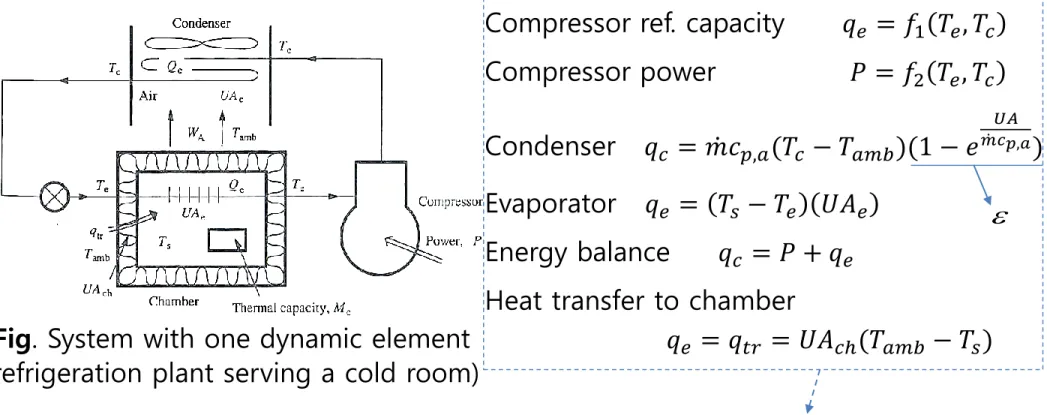
Fig. System with one dynamic element (refrigeration plant serving a cold room)
Compressor ref. capacity 𝑞𝑒 = 𝑓1 𝑇𝑒, 𝑇𝑐 Compressor power 𝑃 = 𝑓2 𝑇𝑒, 𝑇𝑐 Condenser 𝑞𝑐 = 𝑚𝑐𝑝,𝑎(𝑇𝑐 − 𝑇𝑎𝑚𝑏)(1 − 𝑒
𝑈𝐴 𝑚𝑐𝑝,𝑎) Evaporator 𝑞𝑒 = 𝑇𝑠 − 𝑇𝑒 𝑈𝐴𝑒
Energy balance 𝑞𝑐 = 𝑃 + 𝑞𝑒 Heat transfer to chamber
𝑞𝑒 = 𝑞𝑡𝑟 = 𝑈𝐴𝑐ℎ(𝑇𝑎𝑚𝑏 − 𝑇𝑠)
Chapter 15. Dynamic Behavior of Thermal Systems
15.3 One Dynamic Element in a Steady-State Simulation
Pull-down 𝑞𝑡𝑟 = 𝑈𝐴𝑐ℎ 𝑇𝑎𝑚𝑏, −𝑇𝑠 𝑞𝑡𝑟 = 𝑞𝑒 + 𝑚𝑐𝑝 𝑑𝑇𝑠
𝑑𝑡
Dynamic : during pull-down 𝑞𝑡𝑟 ≠ 𝑞𝑒 𝑇𝑠
𝑞𝑡𝑟 𝑞𝑒
𝑚, 𝑐𝑝
15.4 Laplace transform
Powerful tool in predicting dynamic behavior One way to solve ODEChapter 15. Dynamic Behavior of Thermal Systems
𝐿 𝐹 𝑡 =
0
∞
𝐹 𝑡 𝑒−𝑠𝑡𝑑𝑡 = 𝑓(𝑠)
𝐿 𝐹′ 𝑡 =
0
∞
𝐹′ 𝑡 𝑒−𝑠𝑡𝑑𝑡
= 𝑒−𝑠𝑡𝐹(𝑡)]0∞- 0∞𝐹(𝑡)(−𝑠) 𝑒−𝑠𝑡𝑑𝑡
= −𝐹 0 + 𝑠𝑓(𝑠)
𝐿 𝐹′′ 𝑡 =
0
∞
𝐹′′ 𝑡 𝑒−𝑠𝑡𝑑𝑡
= 𝑒−𝑠𝑡𝐹′(𝑡)]0∞- 0∞𝐹′(𝑡)(−𝑠) 𝑒−𝑠𝑡𝑑𝑡
= −𝐹′ 0 + 𝑠[−𝐹 0 + 𝑠𝑓 𝑠 ]
= −𝐹′(0) − 𝑠𝐹(0) + 𝑠2𝑓 𝑠
Chapter 15. Dynamic Behavior of Thermal Systems
15.4 Laplace Transforms
Example 15.1 : What is the Laplace transform of the constant c ? (Solution)
𝓛{c} = 0∞𝑐 𝑒−𝑠𝑡𝑑𝑡 = −𝑐
𝑠 𝑒−𝑠𝑡]0∞=𝑐
𝑠
Example 15.2 : What is the Laplace transform of bt ? (Solution)
𝓛{bt} = 0∞𝑏𝑡 𝑒−𝑠𝑡𝑑𝑡 = −𝑏 𝑑
𝑑𝑠 0
∞𝑒−𝑠𝑡𝑑𝑡 = −𝑏𝑑( 1 𝑠)
𝑑𝑠 = 𝑏/𝑠2
15.5 Inversion of Laplace Transforms 𝐿
−1𝑓 𝑠 = 𝐹(𝑡)
Example 15.4 : Invert 𝑠+10 (𝑠−2)2(𝑠+1)
(Solution) 𝑠+10
(𝑠−2)2(𝑠+1)
=
𝐴(𝑠+1)
+
𝐵(𝑠−2)2
+
𝐵′𝑠−2 𝑐𝑜𝑛𝑠𝑡𝑎𝑛𝑡𝑠 ∶ 10 = 4𝐴 + 𝐵 − 2𝐵′
𝑠 ∶ 1 = −4𝐴 + 𝐵 − 𝐵′ 𝑠2 ∶ 0 = 𝐴 + 𝐵′ 𝐴 = 1, 𝐵 = 4, 𝐵′ = −1
∴ 𝐿
−1 𝑠+10(𝑠−2)2(𝑠+1)
= 𝑒
−𝑡+ 4𝑡𝑒
2𝑡− 𝑒
2𝑡Chapter 15. Dynamic Behavior of Thermal Systems
15.5 Inversion of Laplace Transforms 𝐿
−1𝑓 𝑠 = 𝐹(𝑡)
(Another Solution of Example 15.4)
For non-repeated roots 𝑁(𝑠)
𝐷(𝑠)
=
𝐴𝑠−𝑎
+
𝐵𝑠−𝑏
+ ⋯ 𝐴 =
𝑁(𝑠)(𝑠−𝑎)𝐷(𝑠)
│
𝑠→𝑎𝐵 =
𝑁(𝑠)(𝑠−𝑏)𝐷(𝑠)
│
𝑠→𝑏 For repeated roots 𝑁(𝑠)
𝐷(𝑠)
=
𝐴𝑠−𝑎
+
𝐵(𝑠−𝑏)2
+
𝐵′𝑠−𝑏
𝐵 =
𝑁(𝑠)(𝑠−𝑏)2𝐷(𝑠)
│
𝑠→𝑏𝐵′ =
𝑑𝑑𝑠
[
𝑁(𝑠)(𝑠−𝑏)2𝐷(𝑠)
]
𝑠→𝑏→ 𝐴 =
𝑠+10(𝑠−2)2
│
𝑠→−1= 1 𝐵 =
𝑠+10𝑠+1
│
𝑠→2= 4 𝐵
′=
𝑠+10𝑠+1
│
𝑠→2= −1
Chapter 15. Dynamic Behavior of Thermal Systems
15.6 Solution of ordinary differential equations
Example 15.6 : Solve 𝒀′′ 𝒕 + 𝒌𝟐𝒀 𝒕 = 𝟎
(boundary conditions : Y(0) = A, Y’(0) = B) (Solution)
Transform the differential equation 𝑠2𝑦 𝑠 − 𝑠𝑌 0 − 𝑌′ 0 + 𝑘2𝑦 𝑠 = 0 Boundary conditions
𝑦 𝑠 = 𝐴𝑠
𝑠2 + 𝑘2 + 𝐵 𝑠2 + 𝑘2 Invert y(s)
𝑌 𝑡 = 𝐴𝑐𝑜𝑠 𝑘𝑡 + (𝐵/𝑘)𝑠𝑖𝑛(𝑘𝑡)
Chapter 15. Dynamic Behavior of Thermal Systems
15.7 Blocks, Block diagrams, and transfer functions
Transfer function : 𝑇𝐹 = 𝐿{𝑂 𝑡 }
𝐿{𝐼 𝑡 } = 𝑂(𝑠)
𝐼(𝑠)
ratio of the output to the input
- Variable in S domain (not in time domain)
Chapter 15. Dynamic Behavior of Thermal Systems
Fig. Symbols used in block diagrams Fig. Transfer function and cascading of blocks
Proper T.F. = 분모 차수 ≥ 분자 차수
15.7 Blocks, Block diagrams, and transfer functions
Transfer function : 𝑇𝐹 = 𝐿{𝑂 𝑡 }
𝐿{𝐼 𝑡 } = 𝑂(𝑠)
𝐼(𝑠)
ratio of the output to the input
- Variable in S domain (not in time domain)
Chapter 15. Dynamic Behavior of Thermal Systems
mu(t) x(t)
𝑢 𝑡 + 𝑚𝑔 − 𝑘 ∗ 𝑥 𝑡 = 𝑚𝑥(𝑡)
0 − 𝑘𝛿𝑥 + 𝛿𝑢 = 𝑚 𝛿𝑥
Inverse Laplace −𝑘∆𝑋 𝑠 + ∆𝑈 𝑠 = 𝑚𝑠2∆𝑋(𝑠)
𝑇𝐹 = ∆𝑋(𝑠)
∆𝑈(𝑠) = 1 𝑚𝑠2 + 𝑘
15.8 Feedback Control Loop
Unity feedback
𝑇𝐹 =
𝐺(𝑠)1+𝐺(𝑠)
Non-unity feedback
𝑇𝐹 =
𝐺(𝑠)1+𝐺 𝑠 𝐻(𝑠)
Chapter 15. Dynamic Behavior of Thermal Systems
Fig. (a) Unity feedback loop
(b) Nonunity feedback loop
15.9 Time Constant Blocks
Standard technique for developing transfer function 1. Write differential equation 𝑚𝑐𝑑𝑇
𝑑𝑡 = 𝑇𝑓 − 𝑇 ℎ𝐴 2. Transform equation 𝑚𝑐
ℎ𝐴 𝑠𝐿 𝑇 − 𝑇 0 = 𝐿(𝑇𝑓) − 𝐿(𝑇) 3. Solve for transfer function (𝐿 𝑂 /𝐿{𝐼}) 𝑇𝐹 = 𝑇(𝑠)
𝑇𝑓(𝑠) =
1+𝑇(0) 𝐵
𝑇𝑓(𝑠)
1+𝐵𝑠 (𝐵 = 𝑚𝑐
ℎ𝐴) For special case 𝑇 0 = 0 ∶ 𝑇𝐹 = 1
Chapter 15. Dynamic Behavior of Thermal Systems
Fig. (a) Response of a temperature-sensing bulb to a change in fluid temperature (b) Transfer function of this time-constant block
15.9 Time Constant Blocks
Chapter 15. Dynamic Behavior of Thermal Systems
𝑚𝑐 𝑑(𝑇 − 𝑇0)
𝑑𝑡 = 𝑇𝑓 − 𝑇0 − 𝑇 − 𝑇0 ℎ𝐴 𝑇𝐹 = 𝐿{𝑇 − 𝑇0}
𝐿{𝑇𝑓 − 𝑇0} = 1 𝐵𝑠 + 1
𝑇𝑓 ∶ unit step increase 𝑇𝑓 𝑠 = ∆ 𝑠 𝐿 𝑇 − 𝑇0 = 𝐿 𝑇𝑓 − 𝑇0 1
𝐵𝑠 + 1 = ∆
𝑠(𝐵𝑠 + 1) = ∆ 𝛼
𝑠 − 𝛽
𝐵𝑠 + 1 = ∆(1
𝑠 − 𝐵 𝐵𝑠 + 1)
𝑇 − 𝑇0 = ∆ 1 − 𝑒−𝐵𝑡 𝐵 = 𝑚𝑐
ℎ𝐴 ∶ time constant
𝛼𝛽 − 𝛽 = 0, 𝛼 = 1, 𝛽 = 𝐵
desired temperature
cf) Time Constant Blocks - additional
• Control
• Feedback
• Block diagrams Reference
sensor Actuator process
output sensor
2
-
+ controlinput output
disturbance
desired room
temperature T → V Inverter Refrigeration
system Thermometer
2
-
+ Actual Temp.
Ex)
Chapter 15. Dynamic Behavior of Thermal Systems
15.10 Cascade Time-constant Blocks
Chapter 15. Dynamic Behavior of Thermal Systems
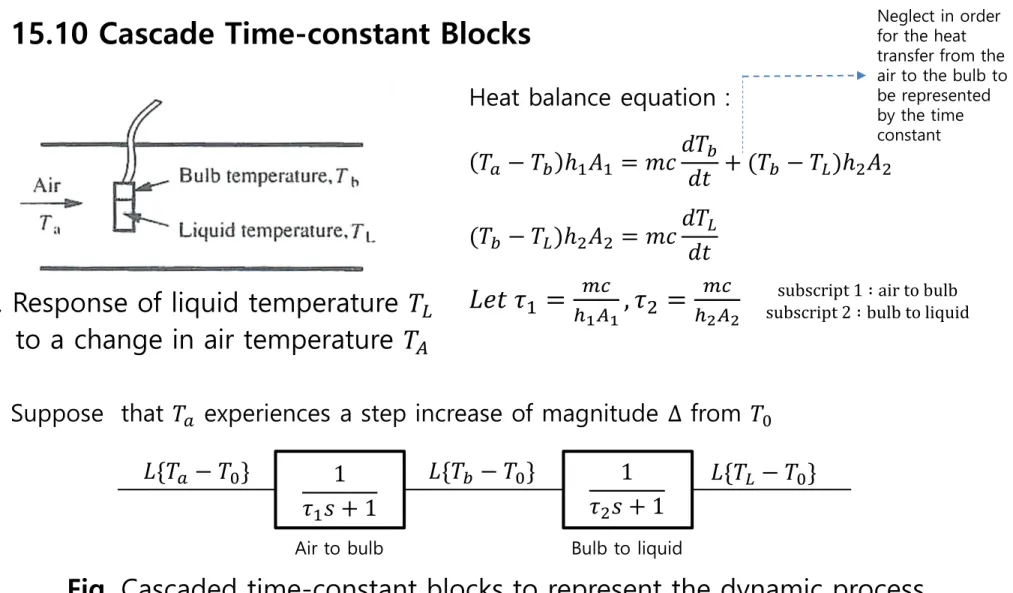
Fig. Response of liquid temperature 𝑇𝐿 to a change in air temperature 𝑇𝐴
Heat balance equation :
𝑇𝑎 − 𝑇𝑏 ℎ1𝐴1 = 𝑚𝑐𝑑𝑇𝑏
𝑑𝑡 + (𝑇𝑏 − 𝑇𝐿)ℎ2𝐴2 (𝑇𝑏 − 𝑇𝐿)ℎ2𝐴2 = 𝑚𝑐𝑑𝑇𝐿
𝑑𝑡
𝐿𝑒𝑡 𝜏1 = 𝑚𝑐
ℎ1𝐴1, 𝜏2 = 𝑚𝑐
ℎ2𝐴2
subscript 1 ∶ air to bulb subscript 2 ∶ bulb to liquid
Neglect in order for the heat transfer from the air to the bulb to be represented by the time constant
Air to bulb Bulb to liquid
𝐿{𝑇𝑎 − 𝑇0} 𝐿{𝑇𝑏 − 𝑇0} 1 𝐿{𝑇𝐿 − 𝑇0} 𝜏2𝑠 + 1
1 𝜏1𝑠 + 1
Suppose that 𝑇𝑎 experiences a step increase of magnitude ∆ from 𝑇0
For unit step input
𝐿 𝑇𝐿 − 𝑇0 = ∆
𝑠 ( 1
𝜏1𝑠 + 1)( 1 𝜏2𝑠 + 1) Inversion
𝑇𝐿 − 𝑇0
∆ = 1 − 𝜏1
𝜏1 + 𝜏2𝑒−
𝑡
𝜏1 − 𝜏2
𝜏2 + 𝜏1𝑒−
𝑡 𝜏2
Chapter 15. Dynamic Behavior of Thermal Systems
15.10 Cascade Time-constant Blocks
①𝑡 = 0, 𝑇𝐿 − 𝑇0 = 0
② 𝑑(𝑇𝐿 − 𝑇0)
𝑑𝑡 = 0 𝑎𝑡 𝑡 = 0
③𝑖𝑓 𝜏2 ≪ 𝜏1 𝑇𝐿 − 𝑇0 = ∆(1 − 𝑒−𝑡/𝜏)
④𝑖𝑓 𝜏2 = 𝜏1 𝑇𝐿−𝑇0
∆ = 1 − 𝑒−𝑡/𝜏 −𝑡𝑒−𝑡/𝜏
𝜏
15.11 Stability Analysis
Chapter 15. Dynamic Behavior of Thermal Systems
- Bode diagram expresses the frequency response of the system
- Bode diagram offers an excellent technique for explaining the mechanics of instability
15.11 Stability Analysis
Chapter 15. Dynamic Behavior of Thermal Systems
- The sum of the phase lags around the loop and the product of the amplification ratio are computed
- The principle that leads to the Bode Criterion for stability is based on transmission of sine waves throughout the loop
- Example : Air heater – controlled by a loop that senses the outlet air temperature 𝑇𝑎 and converts this sensed temperature 𝑇𝑏 to a control voltage 𝑉𝑐
15.11 Stability Analysis
Chapter 15. Dynamic Behavior of Thermal Systems
- Air temperature 𝑇𝑎 experiences a disturbance that is the top half of a sine wave - The sensed temperature 𝑇𝑏 lags the variation in 𝑇𝑎 by an angle 𝜙1
- The variation in 𝑇𝑏 translates to a half sine wave of 𝑉𝑠𝑒𝑡 − 𝑉𝑐, but reversed in sign
15.11 Stability Analysis
At the frequency f where sum of phase lags = 180o Fig.(a)
At the frequency f where product of amplitude ratio > 1 Fig.(b)
Phase lag =180o Amplitude ratio > 1
Chapter 15. Dynamic Behavior of Thermal Systems
the loop becomes unstable
cf) Bode plot
At Linear time-invariant(LTI) system with transfer function H(s), Bode plot consists of magnitude plot & phase plot
Chapter 15. Dynamic Behavior of Thermal Systems
Function of filter
Represent the gain and
phase of a system as a
function of frequency
ex) TF(s) = s+a
Chapter 15. Dynamic Behavior of Thermal Systems
i) s = jw << a ii) s = jw >> a
Magnitude Phase
(degree)
0 a 90
w w
ex) Why Bode plot?
Chapter 15. Dynamic Behavior of Thermal Systems
Magnitude (dB)
Phase (degree) 40
𝑑𝐵 = 20𝑙𝑜𝑔10 𝑇𝐹(𝑠 = 𝑗𝑤)
Crossover frequency 𝑤𝑐 ∶ 𝑓𝑟𝑒𝑞𝑢𝑒𝑛𝑐𝑦 𝑤 𝑎𝑡 0𝑑𝐵
w w
0
𝒘𝒄 𝒘𝒄
-180
Phase margin
𝒘𝟏 𝒘𝟏
Gain margin
cf) Pole-zero plot
Pole-zero plot shows the location in the complex plane of the poles and zeros of the transfer function of a dynamic system, such as a controller, sensor, filter.
Chapter 15. Dynamic Behavior of Thermal Systems
26
stability
causal / anti-causal system
region of convergence
Representing
cf) Pole-zero plot
Chapter 15. Dynamic Behavior of Thermal Systems
𝑇𝐹 𝑠 = 𝑂(𝑠) 𝐼(𝑠)
Pole : value of s that makes TF(s) -> ∞ zero : value of s that makes TF(s) -> 0 Stable : f(t) -> 0 as t -> ∞
Unstable : f(t) -> ∞ as t -> ∞
Marginally stable : f(t) -> a or oscillation as t -> ∞
ex) TF(s) =
𝟏𝒔+𝒂
(𝒑𝒐𝒍𝒆 ∶ 𝒔 = −𝒂)
𝑓 𝑡 = 𝑒−𝑎𝑡
a>0 : stable
a=0 : marginally stable a<0 : unstable
Inverse Laplace
stable unstable m-stable
Chapter 15. Dynamic Behavior of Thermal Systems
ex) TF(s) =
𝒔+𝟏𝒔𝟐+𝟐𝒔+𝟐
(𝒑𝒐𝒍𝒆 ∶ 𝒔 = −𝟏 ± 𝒋)
𝑓 𝑡 = 𝑒−𝑡cos(𝑡)
Inverse Laplace
stable
At proper TF, real negative pole only -> stable
15.14 Restructuring the Block Diagram
Chapter 15. Dynamic Behavior of Thermal Systems
- Reconstructing the block to simplify the loop
1. Combine two transfer function in series
2. Exchange two adjacent summing points
15.14 Restructuring the Block Diagram
Chapter 15. Dynamic Behavior of Thermal Systems
3. Move a summing point upstream or downstream of a block
4. Move a take off point
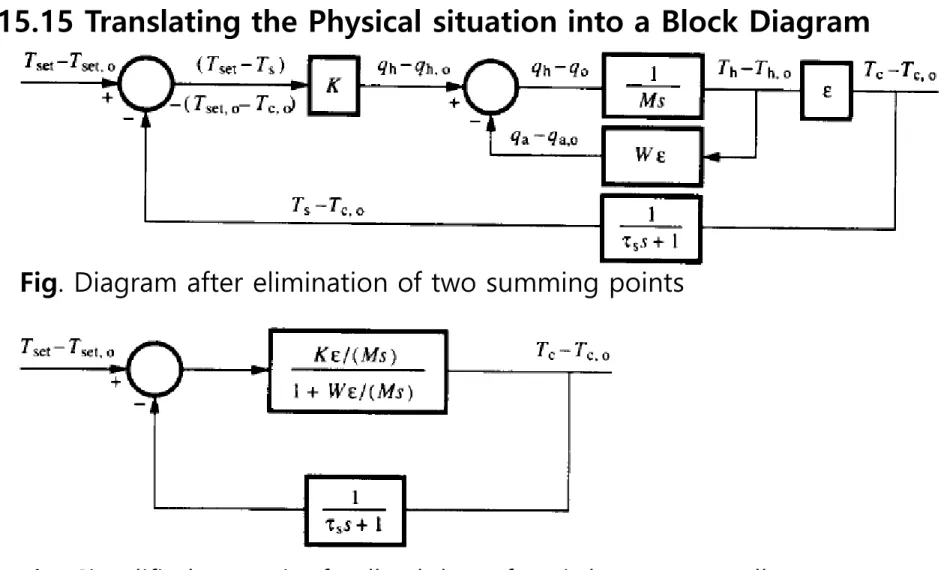
15.15 Translating the Physical situation into a Block Diagram
qa
Chapter 15. Dynamic Behavior of Thermal Systems
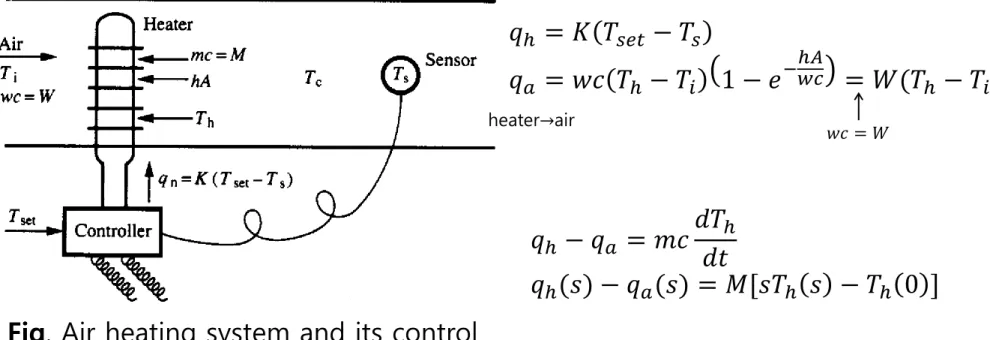
Fig. Air heating system and its control
𝑞ℎ = 𝐾 𝑇𝑠𝑒𝑡 − 𝑇𝑠
𝑞𝑎 = 𝑤𝑐 𝑇ℎ − 𝑇𝑖 1 − 𝑒−ℎ𝐴𝑤𝑐 = 𝑊(𝑇ℎ − 𝑇𝑖)𝜀
heater→air
𝑤𝑐 = 𝑊
𝑞ℎ − 𝑞𝑎 = 𝑚𝑐𝑑𝑇ℎ
𝑞ℎ(𝑠) − 𝑞𝑎(𝑠) = 𝑀[𝑠𝑇𝑑𝑡 ℎ 𝑠 − 𝑇ℎ 0 ]
Chapter 15. Dynamic Behavior of Thermal Systems
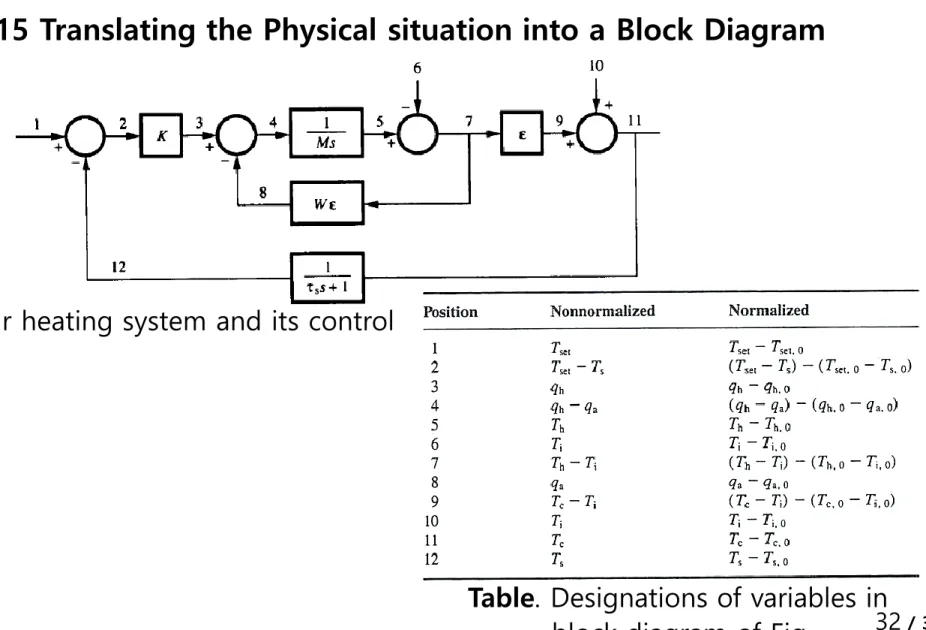
15.15 Translating the Physical situation into a Block Diagram
Fig. Air heating system and its control
Table. Designations of variables in block diagram of Fig. 32 / 33
Chapter 15. Dynamic Behavior of Thermal Systems
15.15 Translating the Physical situation into a Block Diagram
Fig. Diagram after elimination of two summing points
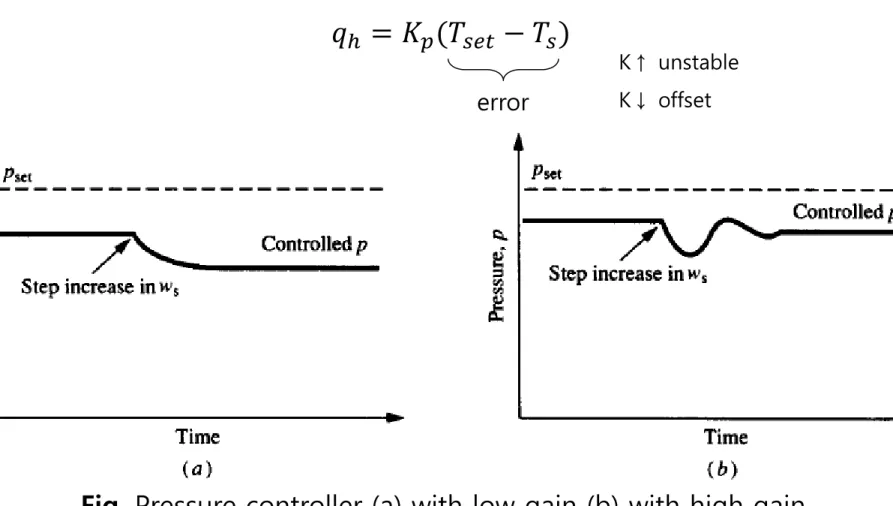
15.16 Proportional Control
error
K↑ unstable K↓ offset
Chapter 15. Dynamic Behavior of Thermal Systems
Fig. Pressure controller (a) with low gain (b) with high gain
𝑞
ℎ= 𝐾
𝑝(𝑇
𝑠𝑒𝑡− 𝑇
𝑠)
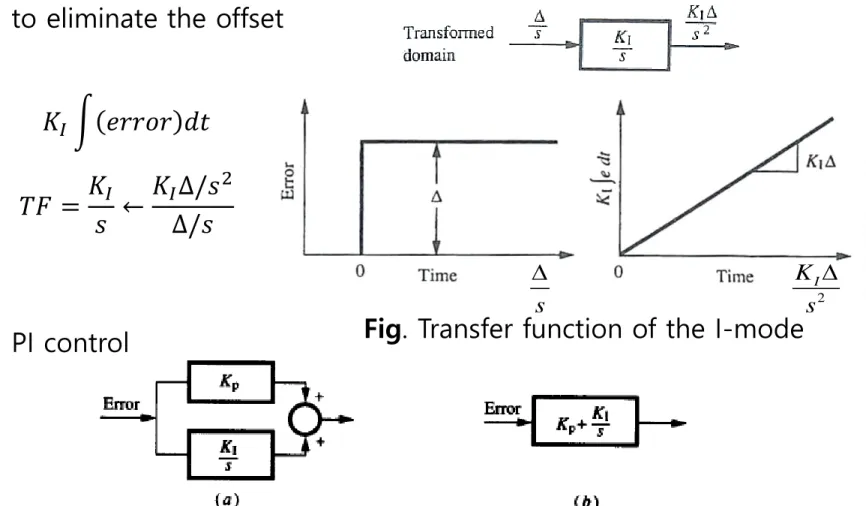
15.17 Proportional – Integral (PI) Control
- to eliminate the offset
- PI control
s
2
KI
s
Chapter 15. Dynamic Behavior of Thermal Systems
Fig. Transfer function of the I-mode 𝐾𝐼 𝑒𝑟𝑟𝑜𝑟 𝑑𝑡
𝑇𝐹 = 𝐾𝐼
𝑠 ← 𝐾𝐼∆/𝑠2
∆/𝑠
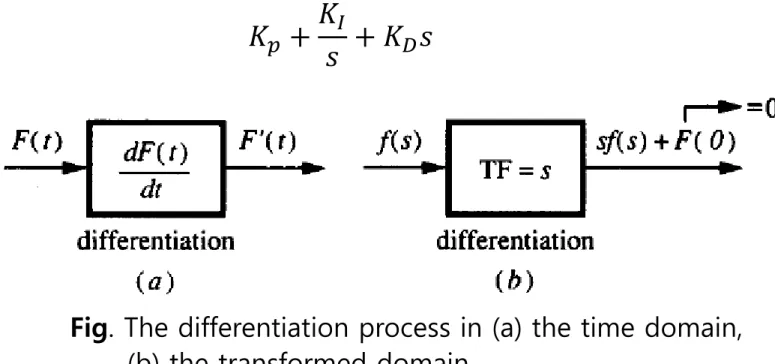
15.18 Proportional-Integral-Derivative(PID) Control
Chapter 15. Dynamic Behavior of Thermal Systems
Fig. The differentiation process in (a) the time domain, (b) the transformed domain
𝐾
𝑝+ 𝐾
𝐼𝑠 + 𝐾
𝐷𝑠
Reaction curve
TF may be approximated by
Time delay of td seconds
Chapter 15. Dynamic Behavior of Thermal Systems
cf) PID control – Ziegler-Nichols Tuning of PID controller (1942)
𝑒−𝑡/𝜏
𝐷 𝑠 = 𝐾 1 + 1
𝑇1𝑠 + 𝑇𝐷𝑠
𝐾 𝐾
𝑅 =𝐾
𝜏 : reaction rate
𝐿 = 𝑡𝑑 𝜏
𝐾 𝜏
𝑇𝐹 = 𝐾𝑒−𝑡𝑑 𝑆 𝜏𝑠 + 1
open loop control
cf) Feedforward control
(a) No control
(b) Feed forward control (c) Feedback control
Chapter 15. Dynamic Behavior of Thermal Systems