저작자표시-비영리-변경금지 2.0 대한민국 이용자는 아래의 조건을 따르는 경우에 한하여 자유롭게
l 이 저작물을 복제, 배포, 전송, 전시, 공연 및 방송할 수 있습니다. 다음과 같은 조건을 따라야 합니다:
l 귀하는, 이 저작물의 재이용이나 배포의 경우, 이 저작물에 적용된 이용허락조건 을 명확하게 나타내어야 합니다.
l 저작권자로부터 별도의 허가를 받으면 이러한 조건들은 적용되지 않습니다.
저작권법에 따른 이용자의 권리는 위의 내용에 의하여 영향을 받지 않습니다. 이것은 이용허락규약(Legal Code)을 이해하기 쉽게 요약한 것입니다.
Disclaimer
저작자표시. 귀하는 원저작자를 표시하여야 합니다.
비영리. 귀하는 이 저작물을 영리 목적으로 이용할 수 없습니다.
변경금지. 귀하는 이 저작물을 개작, 변형 또는 가공할 수 없습니다.
이학석사 학위논문
The Efficacy of Shinbaro for the preventive treatment of migraine:
A pilot study
신바로의 편두통 예방 효과에 대한 파일럿 연구
2019년 08월
서울대학교 대학원
협동과정 뇌과학 전공
정 예 솔
이학석사 학위논문
The Efficacy of Shinbaro for the preventive treatment of migraine:
A pilot study
신바로의 편두통 예방 효과에 대한 파일럿 연구
2019년 08월
서울대학교 대학원
협동과정 뇌과학 전공
정 예 솔
The Efficacy of Shinbaro for the preventive treatment of
migraine: A pilot study
지도교수 김 만 호
이 논문을 이학석사 학위논문으로 제출함
2019년 08월
서울대학교 대학원
협동과정 뇌과학 전공
정 예 솔
정예솔의 이학석사 학위논문을 인준함
2019년 08월
위 원 장 (인) 부위원장 (인) 위 원 (인)
ABSTRACT
The Efficacy of Shinbaro for the preventive treatment of migraine:
A pilot study
Yesol Jung Interdisciplinary Program in Neuroscience The Graduate School Seoul National University
Objective: To investigate the therapeutic potential and efficacy of Shinbaro, an herbal medication for inflammatory diseases and bone disorders, as a preventive treatment of migraine.
Methods: In this prospective, interventional, single-arm, pre-post study, 37 migraine patients took 600mg bid of Shinbaro for 12 weeks. At 4-week intervals, the migraine frequency and the rescue medications frequency were measured from each patient’s headache diary. The modified Migraine Disability Assessment (MIDAS) questionnaires to assess migraine associated disabilities
were also completed at each visit. The serum calcitonin gene- related peptide (CGRP) concentrations before and after 12 weeks of Shinbaro administration were compared.
Results: The monthly migraine frequency was significantly reduced from 20.5 days at baseline to 16.4 days at week 12 (P =0.003), and 22% of the participants showed ≥ 50% reduction. The frequency reduction was observed by week 4 (P =0.035) and continuously occurred through week 8 (P =0.001) and week 12 (P =0.003). The rescue medications frequency also decreased significantly from 17.4 days at baseline to 13.2 days at week 12 (P =0.035). Lastly, the serum CGRP concentration dropped from 434.6 pg/mL at baseline to 371.4 pg/mL at week 12, which was statistically significant (P <0.001).
Conclusions: Shinbaro demonstrated prophylactic effects in migraine patients, significantly reducing their mean migraine frequency, rescue medications frequency, and the serum CGRP concentration after 12 weeks of treatment.
………
Keywords: Migraine prophylaxis, Rescue medications, Migraine frequency, MIDAS, CGRP
Student number: 2017-20029
CONTENTS
List of Tables and Figures...iv
Introduction ... 1
Methods... 4
Results ... 9
Discussions...14
Conclusions...21
References ...22
Abstract in Korean...30
LIST OF TABLES AND FIGURES
Table 1. Characteristics of the participants ...11
Figure 1. The study flow ...12
Figure 2. The efficacy variables during 12 weeks of Shinbaro
treatment...13
INTRODUCTION
First-line acute migraine medications such as non-steroidal anti- inflammatory drugs (NSAIDs) and oral triptans (i.e., 5-HT1B/1D receptor agonists) can abort migraine and its associated symptoms within 30 minutes of administration, if they are effective [1].
However, since therapeutic response to a single treatment is usually low, most patients are prescribed several classes of medications. The problem is that increased dependence on the acute treatments can complicate migraine over time, by increasing the risks of chronic migraine (CM), medication-overuse headache (MOH), and intractable or status migraines, especially for the episodic migraine (EM) patients [2–4]. Meanwhile, β-blockers, anticonvulsants, 5-HT2 antagonists, tricyclic anti-depressants, and calcium antagonists are commonly prescribed as migraine prophylaxes that are daily administered to reduce the frequency and severity of migraine and enhance patients ’ therapeutic responses to the acute treatments [5, 6]. However, various side effects ranging from mild fatigues to more severe cases of cognitive impairments, and even Parkinsonian symptoms have been commonly reported [7, 8]. Treatments that are effective yet safe are continue to be investigated.
The pathophysiology of migraine involves the activation of trigeminovascular pathway and neurogenic inflammation, which are inseparable processes that are largely mediated by a multifunctional neuropeptide called calcitonin gene-related peptide (CGRP) [9, 10].
Peripherally, CGRP triggers vasodilation of the sensory fibers and degranulation of the mast cells. In consequence, proinflammatory cytokines such as bradykinin, histamine, and tumor necrosis factor- α (TNF-α) are released from the brain, and further stimulate the release of CGRP in a positive feedback loop [11–13]. This cascade of inflammatory reactions along the central and peripheral nervous systems sensitizes the meningeal nociceptors and arouses migraine associated symptoms and pains [11–13].
Shinbaro is an herbal medicine that has been approved for treating bone and joint disorders and several inflammatory conditions. Preclinical studies with osteoarthritis (OA) rats have demonstrated that Shinbaro ameliorates pain-related behaviors by increasing the pain thresholds, and also by inhibiting the CGRP expression through the suppression of proinflammatory cytokines [14–18]. In a series of clinical studies in OA patients, Shinbaro exhibited anti-nociceptive and anti-inflammatory functions that were non-inferior to those of cyclooxygenase-2 (COX-2) inhibitors and NSAIDs [19, 20]. Because the migraine
pathophysiology also involves neurogenic inflammation and sensitization of the nociceptive neurons, we proposed that the therapeutic effects of Shinbaro may be extended to the treatment of migraine. The efficacy of Shinbaro as a migraine prophylaxis was investigated for the first time.
METHODS
The study drug
Shinbaro® is a prescription drug that is manufactured and sold by GC Pharma (formerly called Green Cross Corporation, Yongin, Korea). It is composed of the following six oriental herbs that are commonly used in the traditional East Asian medicines to treat several bone disorders: Ledebouriellae Radix (Fang Feng), Achyranthis Radix (Huai Niu Xi), Acanthopanacis Cortex (Wu Jia Pi), Cibotii Rhizoma (Gou Ji), Glycine Semen (Hei Dou), and Eucommiae Cortex (Du Zhong) [19]. A number of in vitro and in vivo studies have revealed that these herbal components contribute to either or both of the anti-inflammatory and analgesic properties of Shinbaro, although Acanthopanacis Cortex seemed to have specific anti-arthritic effect in OA [16, 17, 19, 21–23]. A tablet of Shinbaro contains 300mg of a dried extract from the six herbs, and two tablets are orally administered twice a day. It was approved as a treatment for bone disorders and inflammatory conditions by the Korea Food and Drug Administration (FDA) in 2011.
Subject eligibility
This study was conducted in migraine patients who had visited the
neurology clinic at Seoul National University Hospital and referred to the study by the physician. Eligible participants were women and men of ages between 19 and 65, who were diagnosed with migraine according to the criteria of the International Classification of Headache Disorders-III guidelines, had ≥ 4 migraine days in a month for at least three months, and could read and complete the migraine questionnaires. Women of child-bearing ages agreed to use contraceptives and showed negative pregnancy test results.
Individuals who fell into one or more of the following criteria were excluded from the study: (1) experienced migraine attacks at baseline or during the treatment period due to a substance withdrawal, (2) first onset of migraine occurred later than at the age of 50, (3) had progressive neurological diseases, peptic ulcer, cardiovascular diseases, or any other serious medical conditions that could pose safety issues or influence the study results, (4) had impaired hepatic or renal functions with the blood creatinine, AST, ALT, and total bilirubin levels being ≥ 1.5 times greater than the upper limit of the normal range, (5) were allergic to NSAIDs or to the study drug, (6) women who were pregnant or lactating, (7) were participating in any other clinical studies, (8) had taken one or more of the migraine prophylactic drugs such as propranolol, flunarizine, verapamil, tricyclic antidepressant, valproic acid,
topiramate, and gabapentin, within four weeks prior to the study participation, (9) had a history of substance or alcohol abuse.
Design and protocol
This study was designed as a prospective, interventional, single- arm, pre-post study, and received a written approval from the Institutional Review Boards (IRB) of Seoul National University Hospital (https://cris.snuh.org/ncris/). All subjects provided informed consents before participating in the study. Eligible participants self-administered the indicated daily dose or 600mg bid of Shinbaro for 12 weeks. The dose was not to be titrated, and any other migraine prophylaxes were prohibited during the study.
NSAIDs and tryptamine-based medications to abort migraine attacks were permitted and recorded for the rescue medications frequency. Each participant returned every four weeks with a ± five days visit window, submitted the headache diary which recorded the monthly migraine headache days, and completed the modified Migraine Disability Assessment Score (MIDAS) questionnaires, which measured the number of missed or affected days per month at home and at work due to migraine. In addition, patients reported any adverse event that had occurred since their last visits. Incentives were given to increase the participants ’
compliance. Blood samples were obtained at baseline and at week 12, and the serum CGRP levels were measured using the Human CGRP ELISA kit (Elabscience, Wuhan, China). Specifications for the ELISA kit can be obtained from the protocol provided by the manufacturer.
Study objectives
The primary efficacy endpoint of this study was change in the participants’ mean migraine frequency at week 12, compared with baseline. The secondary efficacy endpoints were the overall % reduction of the migraine frequency, % of the participants who showed ≥ 50% reduction, and changes in the mean rescue medications frequency and the mean MIDAS at week 12, compared with baseline. Furthermore, differences of the means at week 4 and week 8, vs. baseline were observed to examine the time-dependent therapeutic effects of Shinbaro. The exploratory endpoint was change in the mean serum CGRP concentration after 12 weeks of Shinbaro treatment.
Statistical analysis
The sample size was determined by the central limit theorem to
implement the following parametric tests. The paired sample t-test was used to compare the variable measures at week 12 vs. baseline, and the one-way repeated measures analysis of variance (ANOVA) was used to determine the time trend of Shinbaro ’ s efficacy, particularly for the variables that were measured at 4-weeks interval. The variables measures at week 4 and week 8 were each compared with the measures at baseline using the Fisher’s least significant difference (LSD) t-tests without adjusting for multiple comparisons [24]. The efficacy analyses were conducted per protocol, including only the participants who had completed 12 weeks of Shinbaro administration without major protocol deviations, whereas the safety analysis included participants who had received at least one dose of the study medication. Statistical tests were two-sided, and P <0.05 was considered significant. All analyses were conducted on IBM SPSS version 23.0 (SPSS Inc., Chicago, IL, USA).
RESULTS
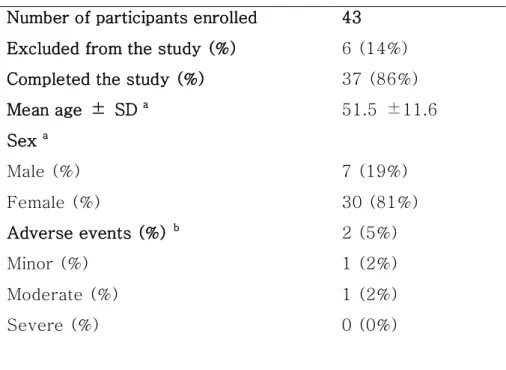
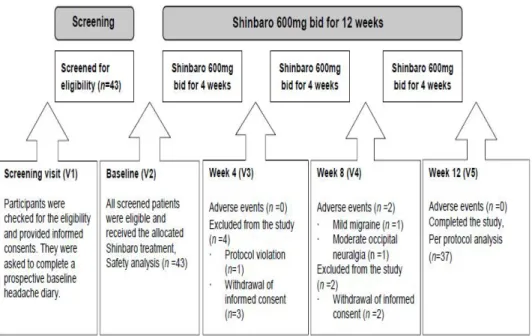
A total of 37 subjects who had completed 12 weeks of Shinbaro treatment were included in the efficacy analyses. This excluded one subject who had been dropped out due to protocol violation in the eligibility criteria, and five subjects who had withdrawn their consents for unspecified reasons during the treatment period. Two participants each experienced a minor occipital neuralgia and a moderate migraine attack, which were uncaused by the study medication. Both cases were reported to IRB, and the subjects completed the study participation without further complications. No vital signs or laboratory abnormalities were observed during the study. 81% of the participants were women and 19% were men, and the mean age was 51.5 years. The participants’characteristics are outlined in Table 1, and Figure 1 shows the study flow.
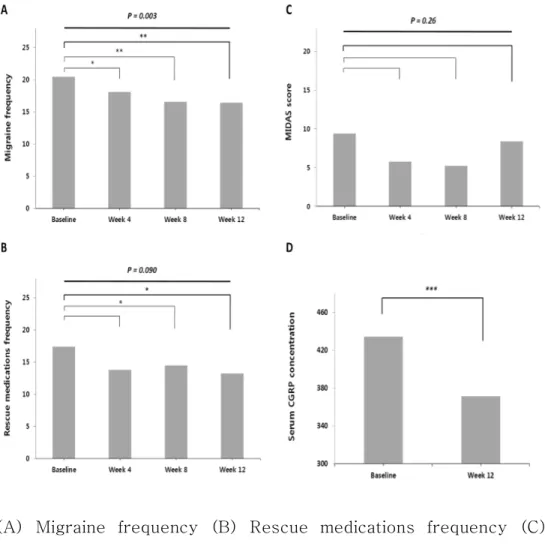
The mean migraine frequency of the participants was 20.5
±7.6 days at baseline, and continued to decrease at 4-weeks
intervals down to 16.4 ±9.4 days at week 12 (P=0.003). (Figure 2–
A). The overall mean % reduction after 12 weeks of treatment was 19%, and about 22% of the participants showed ≥50% reduction in their frequency after 12 weeks of treatment. There was a significant time effect in that the differences of the means at
sequential follow-ups were statistically significant; F (3,108) = 4.85, P =0.003 (Figure 2–A). The LSD t-tests indicated that the differences were significant at week 4 vs. baseline, and also at week 8 vs. baseline (Figure 2–A). The mean rescue medications frequency was 17.4 ±10.3 days at baseline, and 13.2 ±11.6 days at week 12, which was significantly different (P =0.035) (Figure 2–B).
Although there was a significant mean difference to the medications frequency by week 8 vs. baseline (P=0.024), the P-value from the ANOVA indicated that the effect of time was not significant; F (2.43, 87.52) = 2.35, P =0.090 (Figure 2–B). The degree of freedom was adjusted using the Huynh-Feldt estimates of Sphericity (ε =0.76).
The MIDAS did not decrease significantly at week 12 (8.4 ±17.2) vs. baseline (9.4 ±14.2); P =0.79 (Figure 2–C). No significant time-dependent MIDAS differences could be observed at week 4 nor at week 8 vs. baseline, after correcting for the Greenhouse- Geisser estimates of Sphericity (ε=0.52); F (1.57, 56.40) =1.37, P
=0.26, (Figure 2–C). The serum CGRP concentration at week 12 was 371.4 ±63.9 pg/mL, which was significantly lower than 434.6
±59.2 pg/mL of baseline, P <0.001 (Figure 2–D).
Table 1. Characteristics of the participants Number of participants enrolled 43 Excluded from the study (%) 6 (14%)
Completed the study (%) 37 (86%)
Mean age ± SD a 51.5 ±11.6
Sex a
Male (%) 7 (19%)
Female (%) 30 (81%)
Adverse events (%) b 2 (5%)
Minor (%) 1 (2%)
Moderate (%) 1 (2%)
Severe (%) 0 (0%)
a Per protocol analysis, n =37, b Safety analysis, n=43.
Figure 1. The study flow
Figure 2. The efficacy variables during 12 weeks of Shinbaro treatment
(A) Migraine frequency (B) Rescue medications frequency (C) MIDAS (D) Serum CGRP concentration measured in pg/mL. P- values in bold were obtained from the one-way repeated measures ANOVA. The migraine frequency decreased time-dependently (P
=0.003), whereas changes to the rescue medications frequency and the MIDAS score were not time-dependent (P > 0.05). The paired t-tests showed that differences of the means were significant at * P < 0.05, ** P <0.01, and *** P <0.001 significance levels. Per protocol analysis, n =37.
DISCUSSION
The participants’ migraine frequency began to decrease significantly within four weeks of the treatment initiation and continued to decrease throughout the treatment period. These fast- onset of and persisting therapeutic effects are important attributes of a migraine prophylaxis, considering that patients often fail to adhere to the recommended dose and duration of a treatment when migraine recurs after therapeutic effects shortly subside, or when various adverse events occur even before therapeutic effects are set [25, 26]. For instance, Hepp et al. (2014) reported that adverse events were the main causes for discontinuation among patients who were treated with topiramate (24%) or amitriptyline (17%), whereas other reasons such as patients’ choice and lost to follow- up contributed little to the discontinuation rate [27]. In comparison, participants of the current study experienced relatively low rate (5%) of mild and moderate adverse events that were uncaused by the study drug and completed the study without further safety concerns. Furthermore, observing a significant reduction in the acute medications frequency implies that migraine complications such as MOH from the sustained use of acute treatments may be prevented, and responses to the medications may be enhanced in a long term.
The central roles of CGRP in the migraine pathophysiology have been well-established ever since increased levels of CGRP were observed from the peripheral blood and saliva of patients who were experiencing migraine attacks [28, 29]. Although there are conflicting findings that CGRP is elevated outside migraine attacks—
implying that CGRP is a biomarker for CM, but not so much for EM [30], or that CGRP does not reflect patients’ migraine status at all [31], — the general concept that CGRP reflects the trigeminal activation during migraine has been carried forward to pioneer novel migraine therapeutics [32, 33]. Several CGRP receptor antagonists were tested first and showed promising clinical results for the migraine prevention, although some of them had considerable side effects on the liver [34, 35]. More recently, three monoclonal antibodies against CGRP: “ALD-403” (developed by Alder Biopharmaceuticals), “LY2951742” (developed by Arteaus Therapeutics and acquired by Eli Lilly and Co.), “TEV-48125”
(developed by Labrys Biologics-Pfizer and acquired by Teva Pharmaceuticals), and a monoclonal antibodies for the CGRP receptors “AMG334” (co-developed by Amgen, Inc. and Novartis), were found to have same anti-migraine effects but with more prolonging effects —they are injected monthly—, and better safety profiles and target specificity [35, 36]. As of September 28, 2018,
“LY2951742” or also called “Galcanezumab-gnim” has received the United States FDA approval as a preventive treatment of migraine.
Even though clinical results from the recent studies of CGRP antibody therapeutics are promising, we suggest that Shinbaro may have several advantages over the direct CGRP binding proteins.
First of all, the orally administered Shinbaro can prevent common adverse events that are caused by the injection procedure such as injection-site pain and discomfort, and therefore, yield higher adherence and compliance from the patients [36]. Next, because CGRP is involved in multiple physiological functions, direct blockade of CGRP or its receptors may cause considerable long-term safety issues. For examples, CGRP is a potent vasodilator that may also protect against several cardiovascular diseases such as cardiac ischemia and vasospasm [37]. Moreover, the long-term efficacy and safety of the CGRP antibodies still needs to be established through anti-drug antibodies testing to prevent immunogenicity problems, and immune tolerance to the drug at low dose does not give a complete safety assurance [37, 38]. On the other hand, Shinbaro has been prescribed to patients with OA or inflammatory disorders for almost a decade now, and its herbal components give the drug a better safety profile. Lastly, the initial market prices for the CGRP antibodies can further limit patients’ choice, whereas
Shinbaro is a cost-efficient medication that can be easily prescribed to patients who visit clinics. Overall, we suggest that Shinbaro, a natural medication of six herbal constituents, is a potent migraine prophylaxis that can be considered a great alternative to the direct CGRP inhibiting molecules that are in trials.
The pharmacological actions of Shinbaro have been well- established through previous studies in OA rats and patients. In 2016, HK Cho et al. examined the dorsal root ganglion tissues of the lumbar disc herniation rats, and found that the group that was treated with 300mg of Shinbaro showed downregulated neuroglial activity, as well as decreased expressions of CGRP and transient receptor potential cation channel subfamily V member 1 (TRPV1), compared to the aceclofenac treated group, or to a vehicle control group [14]. Importantly, attenuation of the pain behaviors was observed through the course similar to that of CGRP and TRPV1 downregulations, and the reduction of TRPV1, an integrator of multiple sensory inputs, may particularly explain the antinociceptive mechanism of Shinbaro. Among the six constituents, Cibotii Rhizoma and Eucommiae Cortex demonstrated strong analgesic effects, whereas Cibotii Rhizoma, Achyranthis Radix, Eucommiae Cortex, and Ledebouriellae Radix were reported to have strong anti- inflammatory effects in various inflammatory pain models [16, 17].
Moreover, it has been already established that these herbal constituents can inhibit nitric oxide production and reduce the TNF-α and COX-2 serum and protein levels [39–41]. Modulation of such proinflammatory mediators and cytokines is an effective anti-inflammatory mechanism that can contribute to the downregulation and inhibition of CGRP, which is the central player of the migraine pathophysiology [9-13]. The current study’s finding that Shinbaro administration reduced the serum CGRP level is consistent with the findings from the earlier OA studies, and supports the proposed pharmacological actions of Shinbaro, also in migraine.
However, this study results should be taken as preliminary data, and further studies should corroborate that Shinbaro can efficiently decrease the blood CGRP level, and therefore, treat migraine. First, we suggest that the correlation between the migraine frequency reduction and the serum CGRP reduction must be established. That is, although only the serum CGRP samples at baseline and week 12 were collected and compared according to the study protocol, additional blood collections and CGRP analysis at week 4 and week 8 would demonstrate that the migraine frequency was reduced in relation to the serum CGRP reduction along the administration period. Additionally, several factors that can affect
the CGRP level at the time of blood collection, such as patients’
migraine status, duration of the headache or migraine attacks, and the time away from rescue medications intake should be accounted for to obtain more reliable measures [29–31]. Furthermore, because this is a single-arm, non-randomized study, the placebo effect and subject bias cannot be eliminated. To address these issues, participants should be assigned to different dose groups or to a control group in future double-blinded, randomized, controlled studies. In addition, generalization of our findings regardless of patients’migraine types can be misleading. For example, Wang et al.
(2013) pointed out that EM and CM patients have significantly different migraine features, symptoms, psychological states, and impacts to daily lives [42]. Distinctions were further made for CM with MOH patients from those with migraine without aura [43]. In light of these literatures, the fact that Shinbaro did not improve MIDAS of the participants may be explained by the variation to the migraine types among the participants [44]. Therefore, further classification of the migraines based on the internationally accepted standardized migraine criteria, and subgroup analyses may be necessary with increased sample size per group. Lastly, because patients of different migraine types can have different responses to Shinbaro, more accurate and possibly higher response rate may be
derived by specifying the subgroup population; 22% of the participants showed ≥ 50% reduction in their migraine frequency after 12 weeks of Shinbaro treatment. Proceeding with current study’s findings, future studies with improved study design and more sensitive CGRP assay would help to extend therapeutic application of Shinbaro as a prophylactic treatment for migraine.
CONCLUSION
Shinbaro, an herbal medication for several bone disorders and inflammatory diseases, was investigated as a migraine prophylaxis in this pilot study. After 12 weeks of Shinbaro administration, the mean migraine frequency, rescue medications frequency, and the serum CGRP concentration decreased significantly compared with baseline. The anti-inflammatory and anti-nociceptive properties of the herbal components of Shinbaro seem to intervene in the CGRP mediated pathophysiology, thus reducing the migraine frequency.
Although further randomized controlled studies with increased sample sizes and more sensitive CGRP assay are still needed, we anticipate that the therapeutic application of Shinbaro may be extended to the treatment of migraine.
REFERENCES
1. Pascual, J., V. Mateos, C. Roig, M. Sanchez-Del-Rio, and D.
Jimenez. "Marketed Oral Triptans in the Acute Treatment of Migraine: A Systematic Review on Efficacy and Tolerability."
Headache 47, no. 8 (2007): 1152-68.
2. Johnson, J. L., M. R. Hutchinson, D. B. Williams, and P. Rolan.
"Medication-Overuse Headache and Opioid-Induced Hyperalgesia: A Review of Mechanisms, a Neuroimmune Hypothesis and a Novel Approach to Treatment." Cephalalgia 33, no. 1 (2013): 52-64.
3. Bigal, M. E., A. M. Rapoport, F. D. Sheftell, S. J. Tepper, and R.
B. Lipton. "Transformed Migraine and Medication Overuse in a Tertiary Headache Centre--Clinical Characteristics and Treatment Outcomes." Cephalalgia 24, no. 6 (2004): 483-90.
4. Voigt, A. W., and H. J. Gould, 3rd. "Chronic Daily Headache:
Mechanisms and Principles of Management." Curr Pain Headache Rep 20, no. 2 (2016): 016-0542.
5. Lipton, R. B., M. E. Bigal, M. Diamond, F. Freitag, M. L. Reed, and W. F. Stewart. "Migraine Prevalence, Disease Burden, and the Need for Preventive Therapy." Neurology 68, no. 5 (2007): 343-9.
6. Silberstein, SD, and PJ Goadsby. "Migraine: Preventive Treatment." Cephalalgia 22, no. 7 (2002): 491-512.
7. Evers, S. "Treatment of Migraine with Prophylactic Drugs."
Expert Opin Pharmacother 9, no. 15 (2008): 2565-73.
8. Afridi, S., and H. Kaube. "Prophylactic Therapy for Migraine."
Curr Treat Options Neurol 5, no. 6 (2003): 431-40.
9. Durham, P. L. "Calcitonin Gene-Related Peptide (CGRP) and Migraine." Headache 46, no. 1 (2006): S3-8.
10. Pietrobon, D., and M. A. Moskowitz. "Pathophysiology of Migraine." Annu Rev Physiol 75 (2013): 365-91.
11. Olesen, J., R. Burstein, M. Ashina, and P. Tfelt-Hansen.
"Origin of Pain in Migraine: Evidence for Peripheral Sensitisation." Lancet Neurol 8, no. 7 (2009): 679-90.
12. Raddant, A. C., and A. F. Russo. "Calcitonin Gene-Related Peptide in Migraine: Intersection of Peripheral Inflammation and Central Modulation." Expert Rev Mol Med 29, no. 13 (2011).
13. Noseda, R., and R. Burstein. "Migraine Pathophysiology:
Anatomy of the Trigeminovascular Pathway and Associated Neurological Symptoms, CSD, Sensitization and Modulation of Pain." Pain 154, no. 1 (2013): 021.
14. Cho, H. K., S. Y. Kim, M. J. Choi, S. O. Baek, S. G. Kwak, and S.
H. Ahn. "The Effect of GCSB-5 a New Herbal Medicine on Changes in Pain Behavior and Neuroglial Activation in a Rat Model of Lumbar Disc Herniation." J Korean Neurosurg Soc 59, no. 2 (2016): 98-105.
15. Kim, W. K., H. J. Chung, Y. Pyee, T. J. Choi, H. J. Park, J. Y.
Hong, J. S. Shin, et al. "Effects of Intra-Articular Shinbaro Treatment on Monosodium Iodoacetate-Induced Osteoarthritis in Rats." Chin Med 11, no. 17 (2016): 016- 0089.
16. Kim, J. K., S. W. Park, J. W. Kang, Y. J. Kim, S. Y. Lee, J. Shin, S. Lee, and S. M. Lee. "Effect of GCSB-5, a Herbal Formulation, on Monosodium Iodoacetate-Induced Osteoarthritis in Rats." Evid Based Complement Alternat Med 730907, no. 10 (2012): 4.
17. Chung, H. J., H. S. Lee, J. S. Shin, S. H. Lee, B. M. Park, Y. S.
Youn, and S. K. Lee. "Modulation of Acute and Chronic Inflammatory Processes by a Traditional Medicine Preparation GCSB-5 both in Vitro and in Vivo Animal Models." J Ethnopharmacol 130, no. 3 (2010): 450-9.
18. Kim, T. H., S. J. Yoon, W. C. Lee, J. K. Kim, J. Shin, S. Lee, and S. M. Lee. "Protective Effect of GCSB-5, an Herbal Preparation, against Peripheral Nerve Injury in Rats." J
Ethnopharmacol 136, no. 2 (2011): 297-304.
19. Lee, S. Y., H. K. Kwon, and S. M. Lee. "Shinbaro, a New Herbal Medicine with Multifunctional Mechanism for Joint Disease: First Therapeutic Application for the Treatment of Osteoarthritis." Arch Pharm Res 34, no. 11 (2011): 1773-7.
20. Park, Y. G., C. W. Ha, C. D. Han, S. I. Bin, H. C. Kim, Y. B. Jung, and H. C. Lim. "A Prospective, Randomized, Double-Blind, Multicenter Comparative Study on the Safety and Efficacy of Celecoxib and GCSB-5, Dried Extracts of Six Herbs, for the Treatment of Osteoarthritis of Knee Joint." J Ethnopharmacol 149, no. 3 (2013): 816-24.
21. Wu, J., J. Li, W. Li, B. Sun, J. Xie, W. Cheng, and Q. Zhang.
"Achyranthis Bidentatae Radix Enhanced Articular Distribution and Anti-Inflammatory Effect of Berberine in Sanmiao Wan Using an Acute Gouty Arthritis Rat Model." J Ethnopharmacol 221 (2018): 100-08.
22. Wang, J. Y., X. J. Chen, L. Zhang, Y. Y. Pan, Z. X. Gu, and Y.
Yuan. "Anti-Inflammatory Effects of Eucommia Ulmoides Oliv.
Male Flower Extract on Lipopolysaccharide-Induced Inflammation." Chin Med J 132, no. 3 (2019): 319-28.
23. Zhang, Z., J. Dong, M. Liu, Y. Li, J. Pan, H. Liu, W. Wang, et al.
"Therapeutic Effects of Cortex Acanthopanacis Aqueous
Extract on Bone Metabolism of Ovariectomized Rats." Evid Based Complement Alternat Med 492627, no. 10 (2012): 11.
24. Armstrong, R. A. "When to Use the Bonferroni Correction."
Ophthalmic Physiol Opt 34, no. 5 (2014): 502-8.
25. Estemalik, E., and S. Tepper. "Preventive Treatment in Migraine and the New US Guidelines." Neuropsychiatr Dis Treat 9 (2013): 709-20.
26. D'Amico, D., and S. J. Tepper. "Prophylaxis of Migraine:
General Principles and Patient Acceptance." Neuropsychiatr Dis Treat 4, no. 6 (2008): 1155-67.
27. Hepp, Z., L. M. Bloudek, and S. F. Varon. "Systematic Review of Migraine Prophylaxis Adherence and Persistence." J Manag Care Pharm 20, no. 1 (2014): 22-33.
28. Ashina, M., L. Bendtsen, R. Jensen, S. Schifter, and J. Olesen.
"Calcitonin Gene-Related Peptide Levels During Nitric Oxide- Induced Headache in Patients with Chronic Tension-Type Headache." Eur J Neurol 8, no. 2 (2001): 173-8.
29. Ramon, C., E. Cernuda-Morollon, and J. Pascual. "Calcitonin Gene-Related Peptide in Peripheral Blood as a Biomarker for Migraine." Curr Opin Neurol 30, no. 3 (2017): 281-86.
30. Cernuda-Morollon, E., D. Larrosa, C. Ramon, J. Vega, P.
Martinez-Camblor, and J. Pascual. "Interictal Increase of
CGRP Levels in Peripheral Blood as a Biomarker for Chronic Migraine." Neurology 81, no. 14 (2013): 1191-6.
31. Tvedskov, J. F., K. Lipka, M. Ashina, H. K. Iversen, S. Schifter, and J. Olesen. "No Increase of Calcitonin Gene-Related Peptide in Jugular Blood during Migraine." Ann Neurol 58, no.
4 (2005): 561-8.
32. Goadsby, P. J. “Calcitonin Gene-Related Peptide (CGRP) Antagonists and Migraine: Is This a New Era?” Neurology.
2008 Apr 15; 70(16):1300-1.
33. Edvinsson, L. "The Trigeminovascular Pathway: Role of CGRP and CGRP Receptors in Migraine." Headache 2 (2017): 47-55.
34. Olesen, J., H. C. Diener, I. W. Husstedt, P. J. Goadsby, D. Hall, U. Meier, S. Pollentier, and L. M. Lesko. "Calcitonin Gene- Related Peptide Receptor Antagonist Bibn 4096 Bs for the Acute Treatment of Migraine." N Engl J Med 350, no. 11 (2004): 1104-10.
35. Giamberardino, M. A., G. Affaitati, R. Costantini, F. Cipollone, and P. Martelletti. "Calcitonin Gene-Related Peptide Receptor as a Novel Target for the Management of People with Episodic Migraine: Current Evidence and Safety Profile of Erenumab." J Pain Res 10 (2017): 2751-60.
36. Tso, A. R., and P. J. Goadsby. "Anti-CGRP Monoclonal
Antibodies: The Next Era of Migraine Prevention?” Curr Treat Options Neurol 19, no. 8 (2017): 017-0463.
37. MaassenVanDenBrink, A., J. Meijer, C. M. Villalon, and M. D.
Ferrari. "Wiping out CGRP: Potential Cardiovascular Risks."
Trends Pharmacol Sci 37, no. 9 (2016): 779-88.
38. Deen, M., E. Correnti, K. Kamm, T. Kelderman, L. Papetti, E.
Rubio-Beltran, S. Vigneri, L. Edvinsson, and A. Maassen Van Den Brink. "Blocking CGRP in Migraine Patients - a Review of Pros and Cons." J Headache Pain 18, no. 1 (2017): 017-0807.
39. Wang, C. C., L. G. Chen, and L. L. Yang. "Inducible Nitric Oxide Synthase Inhibitor of the Chinese Herb I. Saposhnikovia Divaricata (Turcz.) Schischk." Cancer Lett 145, no. 1-2 (1999): 151-7.
40. Kim, B. H., K. S. Park, and I. M. Chang. "Elucidation of Anti- Inflammatory Potencies of Eucommia Ulmoides Bark and Plantago Asiatica Seeds." J Med Food 12, no. 4 (2009): 764- 9.
41. Kim, H. W., Y. B. Kwon, T. W. Ham, D. H. Roh, S. Y. Yoon, H. J.
Han, S. K. Kang, et al. "The Antinociceptive and Anti- Inflammatory Effect of Ethylacetate Extracts from Bang- Poong (Radix Ledebouriellae) on the Freund's Adjuvant- Induced Arthritis in Rats." J Vet Sci 3, no. 4 (2002): 343-9.
42. Wang, S. J., P. J. Wang, J. L. Fuh, K. P. Peng, and K. Ng.
"Comparisons of Disability, Quality of Life, and Resource Use between Chronic and Episodic Migraineurs: A Clinic-Based Study in Taiwan." Cephalalgia 33, no. 3 (2013): 171-81.
43. D'Amico, D., L. Grazzi, S. Usai, A. Rigamonti, M. Curone, and G.
Bussone. "Disability Pattern in Chronic Migraine with Medication Overuse: A Comparison with Migraine without Aura." Headache 45, no. 5 (2005): 553-60.
44. Bigal, M. E., A. M. Rapoport, R. B. Lipton, S. J. Tepper, and F.
D. Sheftell. "Assessment of Migraine Disability Using the Migraine Disability Assessment (MIDAS) Questionnaire: A Comparison of Chronic Migraine with Episodic Migraine."
Headache 43, no. 4 (2003): 336-42.
국문 초록
본 연구는 생약 성분에 대한 건조 추출물로 소염, 진통, 및 골관 절염 치료제로 사용되고 있는 신바로의 편두통 예방 효과를 알아보기 위 해 진행되었다. 전향적, 중재적 연구로 대조군 없이 대상자의 전과 후의 데이터가 비교 분석되었으며, 총 37명의 대상자가 12주간 600mg의 신 바로정을 하루에 두 번 매일 복용하였다. 평가 변수로 대상자 평균 편두 통 빈도, 구제약 사용 빈도가 두통일기를 통해 4주 간격으로 조사되었고, 이때 수정된 버전의 편두통 장애 평가 설문지인 MIDAS가 시행되었다.
또 다른 평가 변수인 serum CGRP 레벨은 12주간의 신바로 복용 전과 후에 측정되어 비교 분석되었다.
대상자의 월평균 편두통 빈도는 baseline 20.5일에서 12주째 16.4일로 현저히 감소하였으며 (p =0.003), 대상자의 22%가 50% 이 상의 편두통 빈도 감소율을 보였다. 이때 4주째부터 편두통 빈도가 감소 하기 시작하였으며 (p =0.035), 8주째와 12주째 점차 감소하는 것을 확인할 수 있었다. 구제약 사용 빈도 역시 baseline 17.4일에서 12주째 13.2일로 유의하게 감소하였다 (p =0.035). MIDAS 점수의 변화는 유 의하지 않았다. 마지막으로, serum CGRP 레벨은 신바로 복용 전 (baseline) 434.6 pg/mL에서 12주째 371.4 pg/mL로 통계적으로 유의 하게 감소하였다 (p <0.001).
본 연구에서 12주간 신바로 복용 후 대상자 평균 편두통 빈도, 구제약 사용 빈도, 그리고 serum CGRP 레벨이 유의하게 감소하였다.
이는 신바로가 CGRP 감소를 통한 편두통 기전을 막는 예방적 치료 효 과를 보인다고 사료되며, 또한 최근 편두통 예방치료제로 미국 FDA 승 인을 받은 CGRP antibody 치료제에 대한 고찰을 할 수 있다. 향후 임 상연구에서의 본 파일럿 연구에 대한 보완과 응용이 중요할 것으로 생각 된다.
………
주요어 : 편두통 예방약, 구제약, 편두통 빈도, MIDAS, CGRP
학 번 : 2017-20029