저작자표시-비영리-변경금지 2.0 대한민국 이용자는 아래의 조건을 따르는 경우에 한하여 자유롭게
l 이 저작물을 복제, 배포, 전송, 전시, 공연 및 방송할 수 있습니다. 다음과 같은 조건을 따라야 합니다:
l 귀하는, 이 저작물의 재이용이나 배포의 경우, 이 저작물에 적용된 이용허락조건 을 명확하게 나타내어야 합니다.
l 저작권자로부터 별도의 허가를 받으면 이러한 조건들은 적용되지 않습니다.
저작권법에 따른 이용자의 권리는 위의 내용에 의하여 영향을 받지 않습니다. 이것은 이용허락규약(Legal Code)을 이해하기 쉽게 요약한 것입니다.
Disclaimer
저작자표시. 귀하는 원저작자를 표시하여야 합니다.
비영리. 귀하는 이 저작물을 영리 목적으로 이용할 수 없습니다.
변경금지. 귀하는 이 저작물을 개작, 변형 또는 가공할 수 없습니다.
의학 석사 학위논문
사구체 과여과와 치매와의 연관성 : 국민 건강 보험 공단 자료를
기반으로 한 연구
2020 년 2 월
서울대학교 대학원 의학과 내과학 전공
강 민 우
의학 석사 학위논문
사구체 과여과와 치매와의 연관성 : 국민 건강 보험 공단 자료를
기반으로 한 연구
2020 년 2 월
서울대학교 대학원 의학과 내과학 전공
강 민 우
사구체 과여과와 치매와의 연관성 : 국민 건강 보험 공단 자료를
기반으로 한 연구
지도교수 김 동 기
이 논문을 의학 석사 학위논문으로 제출함
2019 년 10 월
서울대학교 대학원 의학과 내과학 전공
강 민 우
의학 석사 학위논문을 인준함 2019 년 1 월
위 원 장 (인 )
부 위 원 장 (인 )
위 원 (인 )
Abstract
Glomerular hyperfiltration is
associated with dementia: a nationwide population-based study
Min Woo Kang College of medicine, internal medicine Seoul National University
Background: Glomerular hyperfiltration may be a clinical phenotype of endothelial dysfunction. Endothelial dysfunction may cause vascular dementia through the deterioration of cerebral blood flow. The purpose of this study is to identify the risk of dementia in people with glomerular hyperfiltration.
Methods: Using the Korean National Health Information Database, subjects aged
≥45 years who underwent national health screening examinations between 2012 and 2015 and who had no previous history of end-stage renal disease or dementia were included (n=2,244,582). The primary exposure was glomerular hyperfiltration. This study divided the subjects into groups by sex and five-year age intervals and categorized each group into 8 intervals according to estimated glomerular filtration (eGFR). The subjects with an eGFR ≥95 percentile in each group were defined as the hyperfiltration group. The outcomes were development of all types of dementia, Alzheimer's dementia and vascular dementia.
Multivariable Cox proportional hazards models were used to analyze the hazard ratios (HRs) for outcomes.
Results: The Hyperfiltration group showed a higher risk for the development of all types of dementia [adjusted HR 1.09 (95% CI, 1.03-1.15)] and vascular dementia [adjusted HR 1.33 (95% CI, 1.14-1.55)] than the reference group. The HRs of both all types of dementia and vascular dementia according to the eGFR percentile tended to be U-shaped. However, the association between hyperfiltration and Alzheimer's dementia was not statistically significant. Hyperfiltration groups
showed a significantly increased risk of vascular dementia in both male [adjusted HR 1.40 (95% CI, 1.11-1.77)] and female [adjusted HR 1.25 (95% CI, 1.01-1.53);
p for interaction=0.16]. Furthermore, hyperfiltration group had a higher risk of vascular dementia both in subjects aged ≥ 65 years [adjusted HR 1.29 (95% CI, 1.08-1.53)] and in subjects with age < 65 years [adjusted HR 1.46 (95% CI, 1.04- 2.06); p for interaction=0.06].
Conclusions: Glomerular hyperfiltration may be a predictor of dementia, especially vascular dementia, and identifying individuals with hyperfiltration may be an effective preventive strategy in dementia. Healthcare providers should be aware of the risk of dementia in people with glomerular hyperfiltration. Clinical conditions that cause glomerular hyperfiltration, including diabetes mellitus, hypertension, obesity, and smoking, may be considered to be target for treatment. Whether treatments of these clinical conditions can prevent or retard the development of dementia should be studied in long-term intervention studies.
………
keywords: Glomerular hyperfiltration, dementia, vascular dementia, Alzheimer’s dementia
Student Number :2018-16885
목 차
1.
Introduction
42. Materials and Methods
5A. Data source
5B. Study population
6C. Study outcomes
6D. Data collection
7E. Statistical analysis
73. Results
8A. Study subjects
8B. Baseline characteristics
9C. Risk of all dementia types,
Alzheimer ’ s dementia and vascular dementia
94. Discussion
115. Reference
156. Figure legend
237. Tables & Figures
24Introduction
Dementia is a common but devastating disease with a very large burden on patients, caregivers, and society as a whole. Dementia affected more than 47 million patients in 2015 worldwide, and the number of patients is predicted to be approximately 135 million in 2050 [1]. Given that there is no specific treatment for advanced dementia, the identification of high-risk patients and the management of their risk factors are crucial for reducing the burden of the disease [2,3].
The risk of cognitive impairment and dementia in patients with kidney dysfunction is higher than that in the general population with normal kidney function [4-8]. In this regard, vascular damage through endothelial dysfunction has explained the association of a decline in kidney function with an increased risk of dementia [8].
The prevalence of cognitive impairment is higher in patients with mild to moderate chronic kidney disease (CKD) than in those with normal kidney function and much more elevated in patients with end-stage renal disease (ESRD) [5,7,8].
Interestingly, previous studies have shown that glomerular hyperfiltration, as well as a decline in glomerular filtration rate (GFR), is associated with cardiovascular morbidity and mortality [9-15]. In this regard, glomerular hyperfiltration may be one of the clinical phenotypes of endothelial dysfunction [16,17]. Since decreased cerebrovascular reactivity and increased blood vessel tortuosity as a result of endothelial dysfunction are essential pathophysiological components of cognitive dysfunction and dementia [18], dementia might share its pathophysiology with glomerular hyperfiltration in terms of endothelial dysfunction [19,20].
The purpose of this study is to evaluate the association between glomerular hyperfiltration and dementia using data from a nationwide population-based cohort as an effort to identify people at high risk for dementia. The risks of Alzheimer’s and vascular dementia were analyzed separately because of their different pathophysiology and management strategies [19].
Materials and Methods Data source
The data from the Korean National Health Information Database (NHID) from the Korean National Health Insurance System (NHIS), which is a public data resource that includes data from the whole population of South Korea, were obtained and analyzed. Since the NHID includes insured medical services, health screenings, and sociodemographic variables, the diagnostic codes, admission history, demographics and laboratory data were reviewed. The NHIS provides this charge- free health screening for workplace subscribers and for every Korean aged ≥40 years old at least biannually. This health screening is provided for approximately 15 million people every year, and the total examination rate has been consistently higher than 70% since 2011 [20].
Study population
The subjects aged ³45 years who had two or more national health screening examinations between Jan 2012 and Dec 2015 were included. Those who had end- stage renal disease (ESRD) or dementia before participating in the national health screening examinations were excluded. ESRD was defined as the commencement of dialysis or receiving kidney transplantation. The study subjects were divided based on five-year age intervals in both sexes. The estimated GFR (eGFR) distribution in each of the groups was assessed and the eGFR values corresponding to the 5, 20, 35, 50, 65, 80, and 95 percentiles were calculated. This study categorized the groups divided by sex and five-year age intervals into eGFR percentile groups of <5, 5-19, 20-34, 35-49, 50-64, 65-79, 80-94 and ≥95 percentiles. eGFR was calculated using the Chronic Kidney Disease-Epidemiology Collaboration (CKD-EPI) equation [21]. Hyperfiltration was defined as eGFR ≥95 percentile in each group.
Study outcomes
The primary outcome was the development of all types of dementia, which included vascular dementia, Alzheimer’s dementia, and other kinds of dementia.
The definitions of Alzheimer’s and vascular dementia were based on the recording of International Classification of Diseases (ICD)-10 codes [22] and the prescription of medications for dementia, which were rivastigmine, galantamine, memantine, or
donepezil. According to ICD-10 codes, the recording of F00 (dementia in Alzheimer’s disease), F01 (vascular dementia), F02 (dementia in other diseases classified elsewhere), F03 (unspecified dementia), G30 (Alzheimer’s disease) or G31 (other degenerative diseases of nervous system, not elsewhere classified) was defined as all types of dementia, F00 or G30 was defined as Alzheimer’s disease and F01 was defined as vascular dementia. If the subjects had codes for both Alzheimer's dementia and vascular dementia, the principal diagnosis was chosen.
Data collection
Data including age, sex, body mass index, smoking, alcohol consumption, exercise, income, diabetes mellitus, hyperlipidemia, and hypertension were collected.
Smoking history was categorized into a current smoker, ex-smoker and never smoker. Alcohol consumption history was categorized into heavy drinking, mild drinking, and nondrinking. The definition of heavy drinking was a daily alcohol consumption of 30 g/day or more, and the definition of mild drinking was a daily alcohol consumption below 30 g/day. People included in the lowest quartile of the required insurance fees or receiving free insurance were categorized as the low- income group.
Statistical analysis
Mean (± standard deviation) is used to describe continuous variables. Data are
presented as percentages for categorical variables. Comparisons between normally distributed continuous variables were performed using analysis of variance. When comparing categorical variables, the chi-squared test was used. Cox proportional hazards model was used to calculate hazard ratios (HRs) for the occurrence of all types of dementia, vascular dementia and Alzheimer’s dementia separately within the study groups. The cubic spline regression model was analyzed, setting the 60 percentile of eGFR as the reference for further investigation of the relationship between GFR percentile and the development of dementia. All the variables including age, sex, body mass index, smoking history, alcohol consumption history, exercise, income, diabetes mellitus, hypertension and hyperlipidemia were adjusted in multivariable analyses. Statistical analysis was performed using the SAS 9.4 program (SAS Institute, United States). A P value less than 0.05 was considered statistically significant.
Results
Study subjects
There were 2,278,248 health examinees aged 45 years or older who underwent ≥2 national health screenings between Jan 2012 and Dec 2015. Subjects with ESRD (n=4,244) or dementia (n=29,422) before the first health screening during the study period were excluded. Therefore, 2,244,582 subjects were included in the study
(Fig 1). Among the subjects, 58,624 were categorized into the hyperfiltration group.
The cutoff eGFR values for hyperfiltration tended to decrease as age increased (Fig 2).
Baseline characteristics
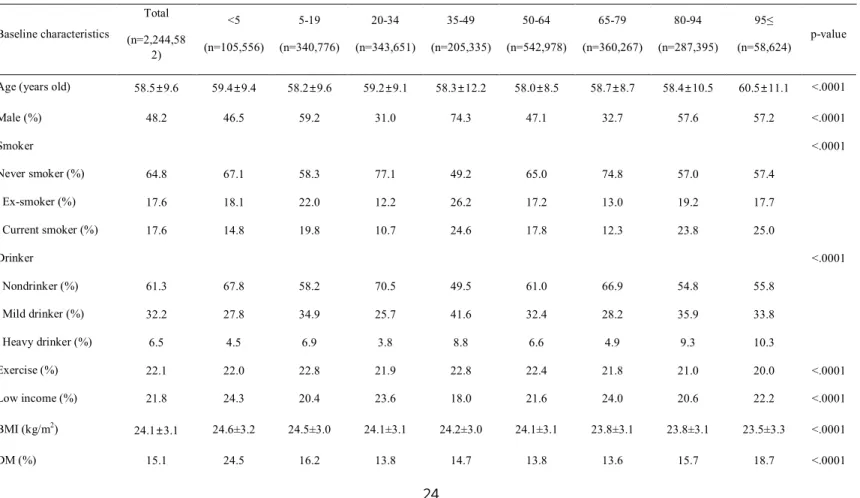
Baseline characteristics are shown in Table 1. Among the 8 eGFR percentile interval groups, the hyperfiltration group had the oldest age and the highest proportions of both current smokers and heavy drinkers. The hyperfiltration group had the lowest BMI. The mean eGFR value of the hyperfiltration group was 110.8 mL/min/1.73 m2.
Risk of all dementia types, Alzheimer’s dementia and vascular dementia
A total of 37,513 (1.67%) out of 2,244,582 subjects developed dementia during the study period [median follow-up duration: 3.13 (interquartile range: 2.01-4.08) years]. Alzheimer's and vascular dementia accounted for 77.3% (28,991) and 12.1%
(4,551) of all types of dementia, respectively. In the hyperfiltration group, 1,596 (2.72%) subjects developed dementia. The proportions of Alzheimer's and vascular dementia in all types of dementia were similar to that in the total population (Table 2). After adjustment for age, sex, body mass index, smoking, alcohol, exercise,
income, diabetes mellitus, hypertension and hyperlipidemia, the hyperfiltration group showed a higher risk of all types of dementia [adjusted hazard ratio (HR) 1.09 (95% CI, 1.03-1.15)] than the reference group. A statistically significant association was identified only for vascular dementia [adjusted HR 1.33 (95% CI, 1.14-1.55)], not in Alzheimer's dementia [adjusted HR 1.04 (95% CI, 0.98-1.11)]
(Fig 3). Fig 4 shows cubic spline curves and 95% confidence intervals adjusted for multivariable covariates. The HRs of both all types of dementia and vascular dementia according to the eGFR percentile tended to be U-shaped. However, Alzheimer's dementia did not show this tendency (Fig 4).
Subgroup analysis was conducted by dividing the patients by sex. In males, the hyperfiltration group had a higher risk of all types of dementia [adjusted HR 1.23 (95% CI, 1.12-1.35); p for interaction<0.01]. When analyzing Alzheimer's and vascular dementia separately in males, the hyperfiltration groups showed a significantly increased risk of both Alzheimer's dementia [adjusted HR 1.16 (95%
CI, 1.04-1.29); p for interaction<0.01] and vascular dementia [adjusted HR 1.40 (95% CI, 1.11-1.77); p for interaction=0.16] with the same pattern for all types of dementia. In comparison, the hyperfiltration group did not show a significantly increased risk of all types of dementia [adjusted HR 1.02 (95% CI, 0.95-1.09)] in females. In females, the hyperfiltration group had a higher risk of only vascular dementia [adjusted HR 1.25 (95% CI, 1.01-1.53)] but not Alzheimer’s dementia [adjusted HR 0.99 (95% CI, 0.92-1.07)] (Fig 5).
In subjects aged ≥ 65 years, the hyperfiltration group had a higher risk of all types
of dementia [adjusted HR 1.06 (95% CI, 1.00-1.13)] and vascular dementia [adjusted HR 1.29 (95% CI, 1.08-1.53)] compared with the risks of the reference group. In subjects with age < 65 years, the hyperfiltration group had a higher risk of all types of dementia [adjusted HR 1.46 (95% CI, 1.25-1.71); p for interaction<0.01], Alzheimer’s dementia [adjusted HR 1.50 (95% CI, 1.24-1.81); p for interaction<0.01] and vascular dementia [adjusted HR 1.46 (95% CI, 1.04-2.06);
p for interaction=0.06] than the reference group (Fig 5).
Discussion
In this nationwide population-based study including 2.2 million people, this study identified a significantly high risk of vascular dementia, but not Alzheimer’s dementia, in subjects with glomerular hyperfiltration. The result was statistically significant even after adjusting for well-known risk factors for vascular dementia, including diabetes mellitus, hypertension, and smoking [23-26]. Vascular dementia showed a U-shaped risk according to the GFR percentile. Subgroup analysis showed that the patterns of vascular dementia did not differ by age or sex.
Glomerular hyperfiltration is associated with various clinical outcomes, including cardiovascular events [9-15]. In a cohort of Turkish adults, the subjects with glomerular hyperfiltration, which was defined as the highest eGFR quartile, showed a 6-fold relative risk of death and cardiopulmonary events when compared to the risk of subjects with normal eGFR [11]. Similarly, glomerular hyperfiltration,
which was defined as GFR>95th percentile, was associated with a significantly higher risk of cardiovascular death even after adjustment for multiple risk factors such as age, sex, muscle mass, diabetes and hypertension in an Asian cohort of a general population [10]. Previous studies have suggested a J-shaped or U-shaped association between GFR and all-cause or cardiovascular mortality, which is a similar pattern of association between eGFR and dementia in this study [10,27-31].
The pathophysiological mechanisms of hyperfiltration have not been well identified. Various hormonal factors, including the renin-angiotensin system and cyclooxygenase-2, have been suggested to contribute to the development of hyperfiltration [32,33]. Furthermore, hyperfiltration has also been shown to be associated with endothelial dysfunction in several clinical conditions [16,17,34,35].
In previous studies, the association between increased risk of cardiovascular events and hyperfiltration was explained by endothelial dysfunction and arterial stiffness [9,16]. Hyperfiltration may be associated with the risk of impaired ability to induce arterial vasodilation after an ischemic stimulus and reflect general endothelial dysfunction [16]. Hyperfiltration was also associated with a paradoxical state of high renal and low systemic vascular nitric oxide (NO) bioactivity [17]. Overall, glomerular hyperfiltration may be associated with vascular damage through which cardiovascular and kidney disease can be potentially influenced [9,36,37]. Hypoxia caused by cerebral blood flow deterioration is an important cause of vascular dementia [38]. Because of the impaired ability to induce arterial vasodilation after an ischemic stimulus and low systemic NO bioactivity, the risk of hypoxia may be higher in patients with hyperfiltration than in healthy people, resulting in a high
risk of vascular dementia. Vascular damage potentially associated with glomerular hyperfiltration may contribute to the development of vascular dementia.
In the present study, hyperfiltration groups among males or individuals less than 65 years old showed a higher risk of Alzheimer's dementia than the reference group.
The incidence rate of Alzheimer's disease was higher in women than in men [39,40], indicating that there may be differences in the mechanisms of development and progression of Alzheimer's dementia between males and females [41,42].
Additionally, the incidence rate of Alzheimer’s dementia differs by age [43-45], and vascular dysfunction has also been identified as one of the pathogenic factors in Alzheimer's dementia [46,47], indicating that the degree of the contribution of endothelial dysfunction in the pathogenesis of Alzheimer's dementia might be relatively greater in men or people younger 65 years than in other populations.
However, further study is needed to identify the exact cause and pathophysiology.
No single definition of glomerular hyperfiltration has been agreed upon [35].
Conventionally, a range of eGFR, which is over two standard deviations above the mean GFR of healthy individuals, has been used as the definition of glomerular hyperfiltration. Some studies have defined hyperfiltration with an absolute eGFR value without considering the age-dependent decline in GFR [48,49], which could cause normal GFR in young subjects to be misclassified as hyperfiltration. The present study used the 95th percentile of eGFR after dividing by sex and five-year age intervals as a cutoff value, which might be more reasonable than the simple definitions of hyperfiltration used in previous studies. Adjusting the definition of
hyperfiltration for age allowed us to classify elderly subjects with hyperfiltration correctly.
The strength of this study was that the association of glomerular hyperfiltration with dementia was studied in a large cohort from the NHIS, which covers all people with South Korean nationality. In addition, present study investigated the risk of Alzheimer’s dementia and vascular dementia separately, which would further enhance the comprehensibility of our study results.
There are several limitations in this study. First, muscle mass was not considered in the definition of hyperfiltration. The overestimation of true GFR by eGFR based on serum creatinine level in subjects with decreased muscle mass could result in misclassification of hyperfiltration. Second, the definition of dementia was defined by diagnostic codes not using cognitive function tests or other modalities. Patients whose diagnosis had changed over the follow-up duration could be misclassified.
Besides, because the development of dementia was defined using the recording of ICD-10 codes, it was difficult to identify the exact time that dementia occurs.
Finally, as creatinine was measured once at the time when follow-up started to calculate eGFR, transient renal function changes may have caused the misclassification of the hyperfiltration group.
In conclusion, Glomerular hyperfiltration may be a predictor of dementia, especially vascular dementia, and identifying individuals with hyperfiltration may be an effective preventive strategy in dementia. Healthcare providers should be aware of the risk of dementia in people with glomerular hyperfiltration. Clinical
conditions that cause glomerular hyperfiltration, including diabetes mellitus, hypertension, obesity, and smoking, may be considered to be target for treatment.
Whether treatments of these clinical conditions can prevent or retard the development of dementia should be studied in long-term intervention studies.
참고문헌
1. Prince M GM, Prina M. The Epidemiology and Impact of Dementia:
Current State and Future Trends. World Health Organization. 2015.
2. Perng CH, Chang YC, Tzang RF. The treatment of cognitive dysfunction in dementia: a multiple treatments meta-analysis. Psychopharmacology (Berl).
2018;235(5):1571-1580.
3. Tsoi KK, Hirai HW, Chan JY, Kwok TC. Time to Treatment Initiation in People With Alzheimer Disease: A Meta-Analysis of Randomized Controlled Trials.
J Am Med Dir Assoc. 2016;17(1):24-30.
4. Antoine V, Souid M, Andre C, Barthelemy F, Saint-Jean O. [Symptoms and quality of life of hemodialysis patients aged 75 and over]. Nephrologie.
2004;25(3):89-96.
5. Kurella M, Chertow GM, Luan J, Yaffe K. Cognitive impairment in chronic kidney disease. J Am Geriatr Soc. 2004;52(11):1863-1869.
6. Kurella M, Mapes DL, Port FK, Chertow GM. Correlates and outcomes of
dementia among dialysis patients: the Dialysis Outcomes and Practice Patterns Study. Nephrol Dial Transplant. 2006;21(9):2543-2548.
7. Murray AM, Tupper DE, Knopman DS, Gilbertson DT, Pederson SL, Li S, et al. Cognitive impairment in hemodialysis patients is common. Neurology.
2006;67(2):216-223.
8. Bugnicourt JM, Godefroy O, Chillon JM, Choukroun G, Massy ZA.
Cognitive disorders and dementia in CKD: the neglected kidney-brain axis. J Am Soc Nephrol. 2013;24(3):353-363.
9. Reboldi G, Verdecchia P, Fiorucci G, Beilin LJ, Eguchi K, Imai Y, et al.
Glomerular hyperfiltration is a predictor of adverse cardiovascular outcomes.
Kidney Int. 2018;93(1):195-203.
10. Park M, Yoon E, Lim YH, Kim H, Choi J, Yoon HJ. Renal hyperfiltration as a novel marker of all-cause mortality. J Am Soc Nephrol. 2015;26(6):1426-1433.
11. Altay S, Onat A, Ozpamuk-Karadeniz F, Karadeniz Y, Kemaloglu-Oz T, Can G. Renal "hyperfiltrators" are at elevated risk of death and chronic diseases.
BMC Nephrol. 2014;15:160.
12. Mogensen CE, Christensen CK. Predicting diabetic nephropathy in insulin-dependent patients. N Engl J Med. 1984;311(2):89-93.
13. Nelson RG, Bennett PH, Beck GJ, Tan M, Knowler WC, Mitch WE, et al.
Development and progression of renal disease in Pima Indians with non-insulin-
dependent diabetes mellitus. Diabetic Renal Disease Study Group. N Engl J Med.
1996;335(22):1636-1642.
14. Schmieder RE, Messerli FH, Garavaglia G, Nunez B. Glomerular hyperfiltration indicates early target organ damage in essential hypertension.
JAMA. 1990;264(21):2775-2780.
15. Chagnac A, Weinstein T, Herman M, Hirsh J, Gafter U, Ori Y. The effects of weight loss on renal function in patients with severe obesity. J Am Soc Nephrol.
2003;14(6):1480-1486.
16. Cherney DZ, Sochett EB, Lai V, Dekker MG, Slorach C, Scholey JW, et al.
Renal hyperfiltration and arterial stiffness in humans with uncomplicated type 1 diabetes. Diabetes Care. 2010;33(9):2068-2070.
17. Cherney DZ, Reich HN, Jiang S, Har R, Nasrallah R, Hébert RL, et al.
Hyperfiltration and effect of nitric oxide inhibition on renal and endothelial function in humans with uncomplicated type 1 diabetes mellitus. Am J Physiol Regul Integr Comp Physiol. 2012;303(7):R710-718.
18. Raz L, Knoefel J, Bhaskar K. The neuropathology and cerebrovascular mechanisms of dementia. J Cereb Blood Flow Metab. 2016;36(1):172-186.
19. 2018 WAR. The state of the art of dementia research: New frontiers.
Alzheimer Disease International. 2018.
20. Cheol Seong S, Kim YY, Khang YH, Heon Park J, Kang HJ, Lee H, et al.
Data Resource Profile: The National Health Information Database of the National Health Insurance Service in South Korea. Int J Epidemiol. 2017;46(3):799-800.
21. Levey AS, Stevens LA, Schmid CH, Zhang YL, Castro AF 3rd, Feldman HI, et al. A new equation to estimate glomerular filtration rate. Ann Intern Med.
2009;150(9):604-612.
22. Quan H, Sundararajan V, Halfon P, Fong A, Burnand B, Luthi JC, et al.
Coding algorithms for defining comorbidities in ICD-9-CM and ICD-10 administrative data. Med Care. 2005;43(11):1130-1139.
23. Peters R, Poulter R, Warner J, Beckett N, Burch L, Bulpitt C. Smoking, dementia and cognitive decline in the elderly, a systematic review. BMC Geriatr.
2008;8:36.
24. Zhong G, Wang Y, Zhang Y, Guo JJ, Zhao Y. Smoking is associated with an increased risk of dementia: a meta-analysis of prospective cohort studies with investigation of potential effect modifiers. PLoS One. 2015;10(3):e0118333.
25. Gudala K, Bansal D, Schifano F, Bhansali A. Diabetes mellitus and risk of dementia: A meta-analysis of prospective observational studies. J Diabetes Investig.
2013;4(6):640-650.
26. Emdin CA, Rothwell PM, Salimi-Khorshidi G, Kiran A, Conrad N, Callender T, et al. Blood Pressure and Risk of Vascular Dementia: Evidence From a Primary Care Registry and a Cohort Study of Transient Ischemic Attack and Stroke.
Stroke. 2016;47(6):1429-1435.
27. Matsushita K, Selvin E, Bash LD, Franceschini N, Astor BC, Coresh J.
Change in estimated GFR associates with coronary heart disease and mortality. J Am Soc Nephrol. 2009;20(12):2617-2624.
28. Nitsch D, Grams M, Sang Y, Black C, Cirillo M, Djurdjev O, et al.
Associations of estimated glomerular filtration rate and albuminuria with mortality and renal failure by sex: a meta-analysis. BMJ. 2013;346:f324.
29. Turin TC, Coresh J, Tonelli M, Stevens PE, de Jong PE, Farmer CK, et al.
Change in the estimated glomerular filtration rate over time and risk of all-cause mortality. Kidney Int. 2013;83(4):684-691.
30. Coresh J, Turin TC, Matsushita K, Sang Y, Ballew SH, Appel LJ, et al.
Decline in estimated glomerular filtration rate and subsequent risk of end-stage renal disease and mortality. JAMA. 2014;311(24):2518-2531.
31. Puddu PE, Bilancio G, Terradura Vagnarelli O, Lombardi C, Mancini M, Zanchetti A, et al. Serum uric acid and eGFR_CKDEPI differently predict long- term cardiovascular events and all causes of deaths in a residential cohort. Int J Cardiol. 2014;171(3):361-367.
32. Sochett EB, Cherney DZ, Curtis JR, Dekker MG, Scholey JW, Miller JA.
Impact of renin angiotensin system modulation on the hyperfiltration state in type 1 diabetes. J Am Soc Nephrol. 2006;17(6):1703-1709.
33. Cherney DZ, Miller JA, Scholey JW, Bradley TJ, Slorach C, Curtis JR, et al. The effect of cyclooxygenase-2 inhibition on renal hemodynamic function in
humans with type 1 diabetes. Diabetes. 2008;57(3):688-695.
34. Cherney DZ, Miller JA, Scholey JW, Nasrallah R, Hébert RL, Dekker MG, et al. Renal hyperfiltration is a determinant of endothelial function responses to cyclooxygenase 2 inhibition in type 1 diabetes. Diabetes Care. 2010;33(6):1344- 1346.
35. Helal I, Fick-Brosnahan GM, Reed-Gitomer B, Schrier RW. Glomerular hyperfiltration: definitions, mechanisms and clinical implications. Nat Rev Nephrol.
2012;8(5):293-300.
36. Eriksen BO, Lochen ML, Arntzen KA, Bertelsen G, Eilertsen BA, von Hanno T, et al. Subclinical cardiovascular disease is associated with a high glomerular filtration rate in the nondiabetic general population. Kidney Int.
2014;86(1):146-153.
37. Chagnac A, Zingerman B, Rozen-Zvi B, Herman-Edelstein M.
Consequences of Glomerular Hyperfiltration: The Role of Physical Forces in the Pathogenesis of Chronic Kidney Disease in Diabetes and Obesity. Nephron.
2019:1-5.
38. Venkat P, Chopp M, Chen J. Models and mechanisms of vascular dementia. Exp Neurol. 2015;272:97-108.
39. Yoshitake T, Kiyohara Y, Kato I, Ohmura T, Iwamoto H, Nakayama K, et al. Incidence and risk factors of vascular dementia and Alzheimer's disease in a defined elderly Japanese population: the Hisayama Study. Neurology.
1995;45(6):1161-1168.
40. Liu CK, Lai CL, Tai CT, Lin RT, Yen YY, Howng SL. Incidence and subtypes of dementia in southern Taiwan: impact of socio-demographic factors.
Neurology. 1998;50(6):1572-1579.
41. Mielke MM, Vemuri P, Rocca WA. Clinical epidemiology of Alzheimer's disease: assessing sex and gender differences. Clin Epidemiol. 2014;6:37-48.
42. Mielke MM. Sex and Gender Differences in Alzheimer's Disease Dementia. Psychiatr Times. 2018;35(11):14-17.
43. Jorm AF, Jolley D. The incidence of dementia: a meta-analysis. Neurology.
1998;51(3):728-733.
44. Kukull WA, Higdon R, Bowen JD, McCormick WC, Teri L, Schellenberg GD, et al. Dementia and Alzheimer disease incidence: a prospective cohort study.
Arch Neurol. 2002;59(11):1737-1746.
45. Fratiglioni L, Launer LJ, Andersen K, Breteler MM, Copeland JR, Dartigues JF, et al. Incidence of dementia and major subtypes in Europe: A collaborative study of population-based cohorts. Neurologic Diseases in the Elderly Research Group. Neurology. 2000;54(11 Suppl 5):S10-15.
46. Iadecola C. Cerebrovascular effects of amyloid-beta peptides:
mechanisms and implications for Alzheimer's dementia. Cell Mol Neurobiol.
2003;23(4-5):681-689.
47. Zlokovic BV. Neurovascular mechanisms of Alzheimer's neurodegeneration. Trends Neurosci. 2005;28(4):202-208.
48. Ruggenenti P, Porrini EL, Gaspari F, Motterlini N, Cannata A, Carrara F, et al. Glomerular hyperfiltration and renal disease progression in type 2 diabetes.
Diabetes Care. 2012;35(10):2061-2068.
49. Steinicke R, Gaertner B, Grittner U, Schmidt W, Dichgans M, Heuschmann PU, et al. Kidney function and white matter disease in young stroke patients: analysis of the stroke in young fabry patients study population. Stroke.
2012;43(9):2382-2388.
Figure legends
Figure 1. Diagram showing the study population
Figure 2. Distribution of eGFR corresponding to the definition of hyperfiltration according to age in males (A) and females (B) Figure 3. The hazard ratios of all types of dementia (A), Alzheimer's (B) and vascular dementia (C) according to eGFR
Figure 4. Spline curves for hazard ratios of all types of dementia (A), Alzheimer's (B) and vascular dementia (C) according to eGFR
Figure 5. The hazard ratios of all types of dementia, Alzheimer's, and vascular dementia according to eGFR in males (A), females (B), individuals aged < 65 years (C) and individuals aged ≥ 65 years (D)
Table 1. Baseline characteristics of the study population.
eGFR percentile group
Baseline characteristics
Total (n=2,244,58
2)
<5 (n=105,556)
5-19 (n=340,776)
20-34 (n=343,651)
35-49 (n=205,335)
50-64 (n=542,978)
65-79 (n=360,267)
80-94 (n=287,395)
95≤
(n=58,624) p-value
Age (years old) 58.5±9.6 59.4±9.4 58.2±9.6 59.2±9.1 58.3±12.2 58.0±8.5 58.7±8.7 58.4±10.5 60.5±11.1 <.0001
Male (%) 48.2 46.5 59.2 31.0 74.3 47.1 32.7 57.6 57.2 <.0001
Smoker <.0001
Never smoker (%) 64.8 67.1 58.3 77.1 49.2 65.0 74.8 57.0 57.4
Ex-smoker (%) 17.6 18.1 22.0 12.2 26.2 17.2 13.0 19.2 17.7
Current smoker (%) 17.6 14.8 19.8 10.7 24.6 17.8 12.3 23.8 25.0
Drinker <.0001
Nondrinker (%) 61.3 67.8 58.2 70.5 49.5 61.0 66.9 54.8 55.8
Mild drinker (%) 32.2 27.8 34.9 25.7 41.6 32.4 28.2 35.9 33.8
Heavy drinker (%) 6.5 4.5 6.9 3.8 8.8 6.6 4.9 9.3 10.3
Exercise (%) 22.1 22.0 22.8 21.9 22.8 22.4 21.8 21.0 20.0 <.0001
Low income (%) 21.8 24.3 20.4 23.6 18.0 21.6 24.0 20.6 22.2 <.0001
BMI (kg/m2) 24.1±3.1 24.6±3.2 24.5±3.0 24.1±3.1 24.2±3.0 24.1±3.1 23.8±3.1 23.8±3.1 23.5±3.3 <.0001
DM (%) 15.1 24.5 16.2 13.8 14.7 13.8 13.6 15.7 18.7 <.0001
BMI, body mass index; DM, diabetes mellitus; HTN, hypertension; eGFR, estimated glomerular filtration rate
HTN (%) 40.4 55.1 43.3 39.8 40.4 38.1 37.5 39.9 44.6 <.0001
Hyperlipidemia (%) 32.2 43.7 35.1 34.2 27.6 31.6 30.9 28.6 28.9 <.0001
Creatinine (mg/dL) 0.85±0.33 1.49±1.07 1.06±0.13 0.88±0.11 0.94±0.11 0.80±0.10 0.67±0.10 0.65±0.12 0.52±0.10 <.0001 eGFR
(mL/min/1.73㎡) 88.1±16.1 52.6±13.7 69.7±7.8 80.0±7.6 84.4±10.3 94.9±6.0 99.5±6.9 103.1±8.2 110.8±10.2 <.0001
Table 2. The incidence of all types of dementia, Alzheimer's and vascular dementia according to eGFR percentile groups
eGFR percentile group
Total
(n=2,244,582) <5
(n=105,556) 5-19
(n=340,776) 20-34
(n=343,651) 35-49
(n=205,335) 50-64
(n=542,978) 65-79
(n=360,267) 80-94
(n=287,395) 95≤
(n=58,624)
All types of Dementia (n, %)
37,513 (1.67)
2,594 (2.46)
5,890 (1.73)
5,711 (1.66)
4,751 (2.31)
6,517 (1.20)
5,048 (1.40)
5,406 (1.88)
1,596 (2.72)
Alzheimer's dementia (n, %)
28,991
(1.29) 1,944
(1.84) 4,518
(1.33) 4,388
(1.28) 3,762
(1.83) 5,030
(0.93) 3,933
(1.09) 4,200
(1.46) 1,216
(2.07)
Vascular dementia (n, %)
4,551
(0.20) 370
(0.35) 737
(0.22) 723
(0.21) 532
(0.26) 795
(0.15) 599
(0.17) 591
(0.21) 204
(0.35)
eGFR = estimated glomerular filtration rate
Figure 1.
Figure 2.
Figure 3.
Figure 4.
Figure 5.
논 문 초 록
배경: 사구체 과여과는 endothelium의 장애가 원인으로 발생 할 수 있다.
endothelium의 기능 장애는 뇌 혈류의 악화를 통해 혈관성 치매를 유발할 수 있는 것으로 알려져 있다. 본 연구의 목적은 사구체 과여과를 가진 사람들에서 치매의 위험성이 일반 인구에 비해서 높은 것을 확인하는 것이다.
방법: 한국 국민 건강 보험 공단 데이터베이스 및 국민 건강검진 자료를
이용하여 2012 년에서 2015 년 사이에 국가 건강 검진을 받았으며 말기
신장 질환 또는 치매의 과거 병력이 없는 45 세 이상의 성인을 대상으로
(n = 2,244,582) 분석하였다. 성별 및 5 세 연령 간격으로 연구 대상들을
나누고 estimated glomerular filtration rate (eGFR)에 따라 나누어진 대상들을 8 개의 군으로 (<5, 5-19, 20-34, 35-49, 50-64, 65-79, 80-94, ≥95 백분위) 분류했다. 각 군에서 eGFR ≥95 백분위 수를 갖는 대상자들을 사구체 과여과 군으로 정의하였다. Primary outcome은 모든 유형의 치매, 알츠하이머 치매 및 혈관성 치매의 발생으로 하였고 다변량 콕스 비례 위험 모델을 사용하여 outcome에 대한 hazard ratio (HR)를 분석했다.
결과: 사구체 과여과 군은 모든 유형의 치매 발병 위험 [adjusted HR 1.09 (95 % CI, 1.03-1.15)] 및 혈관성 치매 발병 위험 [adjusted HR 1.33 (95 % CI, 1.14-1.55)]이 대조군보다 높았다. eGFR에 따른 모든 유형의 치매 및 혈관성 치매의 발병 위험도는 U-모양의 경향이 있었다. 그러나, 사구체 과여과와 알츠하이머 치매의 연관성은 통계적으로 유의하지 않았다.
사구체 과여과 군은 남자와 [adjusted HR 1.40 (95% CI, 1.11-1.77)] 여자 [adjusted HR 1.25 (95% CI, 1.01-1.53); p for interaction=0.16] 모두에서 혈관성 치매 발병 위험이 높았다. 또한, 사구체 과여과 군은 65세 미만 [adjusted HR 1.46 (95% CI, 1.04-2.06); p for interaction=0.06]과 65세 이상 [adjusted HR 1.29 (95% CI, 1.08-1.53)]의 대상자 모두에서 혈관성 치매 발병 위험이 높았다.
결론: 사구체 과여과가 있는 사람은 치매, 특히 혈관성 치매의 위험성이
높으며 의료인들은 사구체 과여과가 있는 환자의 치매 위험에 대해 미리 주의를 갖어야 한다. 또한, 사구체 과여과를 일으킬 수 있는 임상 상태를 치료하는 것이 치매를 예방하는데 도움이 될 수 있다.
………
주요어 : 사구체 과여과, 치매, 혈관성 치매, 알츠하이머 치매 학 번 : 2018-26885