• 검색 결과가 없습니다.

Clinicopathologic characteristics of ovarian clear cell carcinoma in the background of endometrioma: a surveillance strategy for an early detection of malignant transformation in patients with asymptomatic endometrioma

N/A
N/A
Protected

Academic year: 2022

Share "Clinicopathologic characteristics of ovarian clear cell carcinoma in the background of endometrioma: a surveillance strategy for an early detection of malignant transformation in patients with asymptomatic endometrioma"

Copied!
8
0
0

로드 중.... (전체 텍스트 보기)

전체 글

(1)

https://doi.org/10.5468/ogs.2019.62.1.27 pISSN 2287-8572 · eISSN 2287-8580

Introduction

Endometriosis is a common disease entity affecting around 10% of reproductive-age women [1]. It has a wide variety of clinical consequences ranging from benign lesions to ma- lignant transformation [2-4]. In a pooled analysis of case- control studies, endometriosis was found to be significantly correlated with increased risk of epithelial ovarian cancer,

Clinicopathologic characteristics of ovarian clear cell carcinoma in the background of endometrioma:

a surveillance strategy for an early detection of malignant transformation in patients with asymptomatic endometrioma

Joo-Hyuk Son 1,2 , Seokyoung Yoon 2 , Seokyung Kim 2 , Tae-Wook Kong 1,2 , Jiheum Paek 1,2 , Suk-Joon Chang 1,2 , Hee-Sug Ryu 1,2

1
Division of Gynecologic Oncology,

2

Department of Obstetrics and Gynecology, Ajou University School of Medicine, Suwon, Korea

Objective

This study aimed to analyze the clinical features of clear cell carcinoma in relation to endometriosis and to determine an appropriate surveillance strategy for the early detection of malignant transformation of endometrioma in asymptomatic patients.

Methods

We retrospectively reviewed the clinicopathologic data of 50 patients with ovarian clear cell carcinoma.

Clinicopathologic characteristics, treatment outcomes, and the association between endometriosis and the risk of malignant transformation were analyzed.

Results

Ten (20%) patients had been diagnosed with endometrioma before the diagnosis of clear cell carcinoma. The median period from the diagnosis of endometrioma to clear cell carcinoma diagnosis was 50 months (range, 12–213 months).

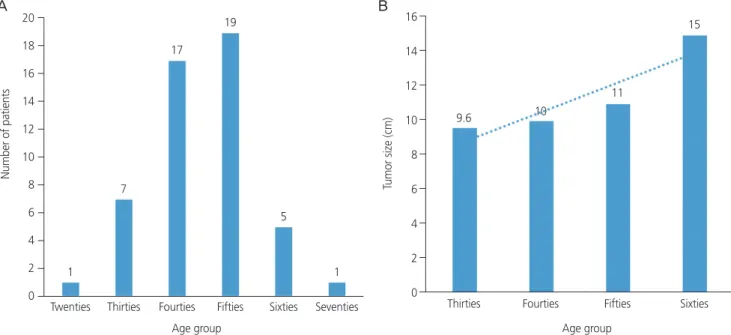
After complete staging surgery, histological confirmation of endometriosis was possible in 35 (70%) patients. Of the 50 patients, 39 (78%) had not undergone any gynecologic surveillance until the onset of symptoms, at which time many of them presented with a rapidly growing pelvic mass (median 10 cm, range 4.6–25 cm). With the exception of 2 patients, all cancer diagnoses were made when the patients were in their late thirties, and median tumor size was found to increase along with age. Asymptomatic patients (n=11) who had regular gynecologic examinations were found to have a relatively smaller tumor size, lesser extent of tumor spread, and lower recurrence rate (P=0.011, 0.283, and 0.064, respectively). The presence of endometriosis was not related to the prognosis.

Conclusion

Considering the duration of malignant transformation and the timing of cancer diagnosis, active surveillance might be considered from the age of the mid-thirties, with at least a 1-year interval, in patients with asymptomatic endometrioma.

Keywords: Endometrioma; Neoplastic cell transformation; Epithelial ovarian cancer; Prognosis

Received: 2017.12.06. Revised: 2018.07.03. Accepted: 2018.07.17.

Corresponding author: Suk-Joon Chang

Divison of Gynecologic Oncology, Department of Obstetrics and Gynecology, Ajou University School of Medicine, 164 World cup- ro, Yeongtong-gu, Suwon 16499, Korea

E-mail: [email protected]

https://orcid.org/0000-0002-0558-0038

Articles published in Obstet Gynecol Sci are open-access, distributed under the terms of the Creative Commons Attribution Non-Commercial License (http://creativecommons.

org/licenses/by-nc/3.0/) which permits unrestricted non-commercial use, distribution, and reproduction in any medium, provided the original work is properly cited.

Copyright © 2019 Korean Society of Obstetrics and Gynecology

(2)

especially clear cell adenocarcinoma [5]. In addition, a recent study has provided significant evidence of an association between endometriosis-related genetic variation and ovarian cancer risk, especially in those with clear cell histotypes [6]. In spite of these risks, there are still debates and disagreements as to the optimal treatment and follow-up strategies for pa- tients with endometriosis. Although several guidelines have been developed to provide information on the diagnosis, treatment, and prevention of endometriosis, there is still a lack of evidence regarding follow-up intervals and the timing of surgical intervention especially in patients with asymp- tomatic endometriosis [7-10]. Surgical treatment of endome- triomas may confer the benefit of histological confirmation along with a protective effect against later development of ovarian cancer [7,11]. On the other hand, universal surgical resection of endometriomas may cause operative risk and decreased ovarian reserve [12,13]. Previous studies suggested that the risk of malignant transformation of endometrio- sis was approximately 1% for premenopausal women and 1–2.5% for postmenopausal women [14,15]. In a Japanese prospective study, malignant transformation was reported in about 46 (0.72%) of 6,398 patients with endometriosis after a median follow-up period of 12.8 years [16].

Despite the low potential for malignant transformation of endometriosis and the relatively long latent period, studies investigating the management strategies for endometriosis, especially in asymptomatic patients, are urgently needed. The aim of this study was to examine the treatment outcomes of clear cell carcinoma of the ovary in relation to endometriosis and to determine an appropriate management strategy for asymptomatic patients with endometrioma.

Materials and methods

A retrospective review of medical records was performed in patients with clear cell carcinoma of the ovary who were diagnosed and treated between 2001 and 2017 at Ajou University Hospital, Suwon, Korea. A total of 50 consecutive patients with ovarian clear cell carcinoma were identified.

All the patients were evaluated with Siemens Acuson S2000 Ultrasound system (Siemens Healthcare, Ultrasound Business Unit, Mountain View, CA, USA) and computed tomographic (CT) scans to inspect the characteristics of the adnexal mass- es before surgery. Forty-nine patients underwent complete

staging surgery, while one patient refused to undergo sur- gery.

After the surgery, patients received adjuvant systemic che- motherapy with paclitaxel (175 mg/m

2

) plus 3 to 6 cycles of carboplatin (area under the curve [AUC] of 6). Clinico- pathologic characteristics including age at diagnosis, parity, body mass index (BMI), initial symptoms, maximum tumor diameter, and ovarian involvement (laterality) were analyzed.

Treatment outcomes including the type of treatment, Inter- national Federation of Gynecology and Obstetrics (FIGO) stage, status of residual disease, and disease recurrences were analyzed. Recurrence was defined based on Gyneco- logic Cancer Intergroup criteria after evaluation using the Response Evaluation Criteria in Solid Tumors guidelines [17].

If a patient was diagnosed with endometrioma prior to sur- gery, the associations between endometriosis and clear cell carcinoma were analyzed, including a previous diagnosis of endometriosis and the latent period until the diagnosis of clear cell carcinoma. Statistical analysis was performed using IBM SPSS Statistics for windows (version 20.0, IBM Corp., Armonk, NY, USA). Risk factors were compared according to recurrence status using the Mann-Whitney U test for con- tinuous data and Pearson’s χ

2

test or Fisher’s exact test for categorical data. P-values less than 0.05 were considered statistically significant.

Results

During the study period, a total of 533 patients with epithe-

lial ovarian cancer (EOC) were identified. Clear cell carcinoma

of the ovary comprised 9.3% (50/533) of the EOC. Median

age at diagnosis was 49.5 (range, 25–75) years; 42 patients

(42/50, 82%) were older than 40 years at the time of diag-

nosis, and only 2 patients were younger than 37 years in this

patient cohort. The median tumor size increased with in-

creasing patient age (Fig. 1). Most patients’ symptoms were

related to the mass effect of the tumor. Frequent symptoms

included palpable mass (32%), abdominal distention (20%),

and abdominal pain (20%). Only 11 (22%) patients were di-

agnosed during gynecologic evaluation and did not have any

symptoms. Of the 50 patients, 40 patients (80%) had a uni-

lateral ovarian tumor with a size greater than 8 cm. Ten (20%)

patients had been diagnosed with endometrioma before the

diagnosis of clear cell carcinoma. The initial diagnosis of en-

(3)

dometrioma was made by ultrasonography. Nine of the pa- tients self-reported the previous diagnosis of endometrioma in a local clinic, and 1 patient was diagnosed in our institu- tion. However, not all patients had follow-up visits after the initial diagnosis of endometrioma made by ultrasonography.

Histologic confirmation of endometriosis was possible in 35 (70%) patients after complete staging surgery. The median time period from the diagnosis of endometriosis to clear cell carcinoma was 50 (range, 12–213) months in the 10 patients (Table 1).

The median tumor size in the patients without and with an endometriosis background was 9.7 cm (range, 5–20) and 10.5 cm (range, 4.6–25), respectively. Presence of endome- triosis on pathology was not associated with tumor size or patient age (P=0.519 and 0.451, respectively), nor was it related to the prognosis (FIGO stage, P=0.747; disease recur- rence, P=0.672) (Table 2). Interestingly, among patients who had been diagnosed via routine gynecologic examination, only 1 patient experienced disease recurrence (1/11, 6.7%).

Asymptomatic patients (n=11) who had regular gynecologi- cal examinations were found to have a relatively smaller tu- mor size, lesser extent of tumor spread, and lower recurrence rate (P=0.011, 0.283, and 0.064, respectively) (Table 3).

Thirty-eight patients underwent primary debulking surgery, 3 had neoadjuvant chemotherapy with interval debulking surgery due to a comorbid condition or extensive disease

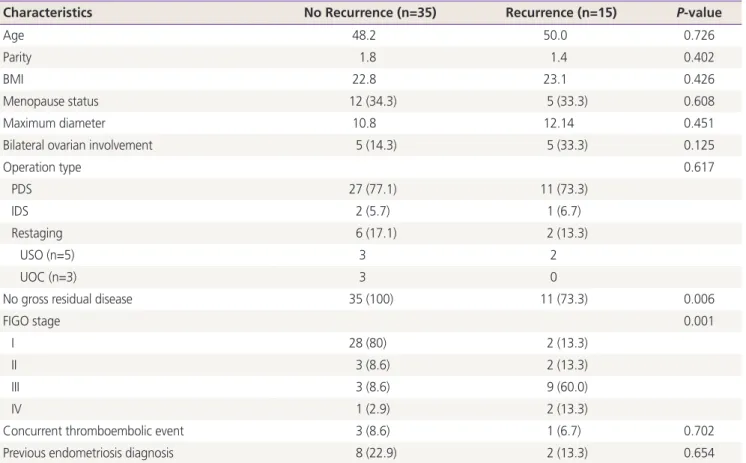
burden, and 8 had re-staging surgery after unilateral ovarian cystectomy or unilateral salpingo-oophorectomy. Of the 50 patients, 35 (70%) were diagnosed with FIGO stage I or II disease. Four patients (8%) were found to have concurrent thromboembolic disease during the follow-up period. Fifteen patients experienced disease recurrence (Table 4). Among the various clinicopathologic factors, FIGO stage and the status of residual disease were the only significant factors affecting disease recurrence. A previous history of endometriosis was not a significant factor for recurrence (P=0.654) (Table 5).

Discussion

According to this study, nearly three-quarters of the clear cell carcinoma cases were confirmed in the background of en- dometriosis. Most patients were diagnosed during their late thirties or forties with a median of 4 years until malignant change. Yet, asymptomatic patients who were diagnosed during regular gynecologic evaluations were more likely to present with a smaller tumor size and early FIGO stage. More importantly, they experienced a low rate of recurrent disease.

Considering the risk of malignant potential in endome- triosis, appropriate follow-up strategies are indispensable.

Previous epidemiological and molecular studies have indi- cated that endometriosis is the most plausible precursor of

20 18 16 14 12 10 8 6 4 2 0

16

14

12

10

8

6

4

2

0

Number of patients Tumor size (cm)

Age group Age group

Seventies 1

Twenties 1

Thirties 7

Thirties 9.6

Fourties 17

Fourties 10

Fifties 19

Fifties 11

Sixties 5

Sixties 15

A B

Fig. 1. (A) Number of patients diagnosed with clear cell carcinoma according to the age group. (B) Median tumor size according to the

age at diagnosis of clear cell carcinoma.

(4)

Table 1. Clinicopathologic characteristics of patients with ovarian clear cell carcinoma (n=50)

Characteristics Values

Age at diagnosis 49 (25–75)

Parity 2 (0–4)

BMI (kg/m

2

) 22.2 (17.9–36.1)

Menopause patients 17 (34)

Age of menopause 48 (46–55)

Initial symptoms and median tumor size (cm)

Palpable mass 16 (32), 11.5 (9–25)

Incidental diagnosis during follow-up 11 (22), 8.5 (4.6–10.8)

Abdominal distension 10 (20), 11.4 (5–16)

Abdominal pain 10 (20), 10.0 (7.3–15)

Urinary symptom 2 (4), 17 (15–19)

Vaginal discharge 1 (2), 5

Maximum diameter of tumor by pelvic ultrasound (cm)

4–8 10 (20)

8–12 25 (50)

>12 15 (30)

Median diameter (cm) 10 (4.6–25)

Ovarian involvement

Unilateral 40 (80)

Right 17 (46)

Left 23 (34)

Bilateral 10 (20)

Diagnosis of endometrioma or endometriosis

Before staging surgery for clear cell carcinoma (based on ultrasonographic diagnosis) 10/50 (20) After staging surgery for clear cell carcinoma (based on histologic diagnosis) 35/50 (70)

Latent period (month) 50 (12–213)

Data are presented as median (range) or number (%).

BMI, body mass index.

Table 2. Characteristics of the patients with or without endometriosis background Characteristics Patients with endometriosis

background (n=35)

Patients without endometriosis

background (n=15) P-value

Tumor size (cm) 9.7 (5–20) 10.5 (4.6–25) 0.519

Age at diagnosis 47 (33–60) 50 (25–65) 0.451

FIGO stage

I or II 25 (71.4) 10 (66.7) 0.747

III or IV 10 (28.6) 5 (33.3)

Recurrence event 11 (31.4) 4 (26.6) 0.572

Data are presented as median (range) or number (%).

FIGO, International Federation of Gynecology and Obstetrics.

(5)

ovarian clear cell carcinoma [5,6,18-20]. In a meta-analysis of 13 case-control studies including 7,911 women with EOC, women with a self-reported history of endometriosis had three times the risk of clear cell carcinoma (odds ratio [OR], 3.05; 95% confidence interval [CI], 2.43–3.84; P<0.0001) and double the risk of endometrioid (OR, 2.04; 95% CI,

1.67–2.48; P<0.0001) and low-grade serous carcinoma (OR, 2.11, 95% CI, 1.39–3.20) [5]. In previous studies, the mech- anisms of malignant transformation were suggested to be related to the activation of oncogenic KRAS and PI3K path- ways and inactivation of tumor suppressor genes PTEN and ARID1A [19,20]. Menopause status has also been indicated as a potential risk factor [14]. In premenopausal woman, the risk of malignant transformation of endometriosis has been estimated at around 1 percent [15]. However, there have been no age-specific guidelines for the timing of active surveillance in asymptomatic patients. Current guidelines rec- ommend that endometriomas be removed only if they have an atypical appearance on imaging studies or other concern- ing features such as enlarged size in asymptomatic patients, though no information as to the timing or interval of surveil- lance has been provided [21].

In this patient cohort, many patients were asymptomatic until the median tumor size was about 10 cm. In addition, 80% of the patients did not receive any surveillance until the onset of symptoms, and many of them characteristically pre- sented with a rapidly growing pelvic mass in a background of endometriosis. In a Japanese study of 33 patients with clear cell carcinoma, tumor size was found to have doubled in the 6 months prior to the diagnosis of malignant transformation in 30 patients. These patients had been followed for at least 2 years after the diagnosis of ovarian endometrioma and continued to be followed after the identification of malig- nant transformation [22]. In the current study, asymptomatic patients who had regular gynecologic examinations were found to have a relatively smaller tumor size with less tu- mor spreading. In light of the median duration (50 months;

range, 12–123 months) of malignant transformation and the age of cancer incidence, surveillance should be started from the age of the mid-thirties, with at least 1-year interval sur- Table 3. Clinical stages and recurrence events during the follow-up periods in patients with ovarian clear cell carcinoma

Characteristics Incidental diagnosis during gynecologic

follow-up (n=11) Symptomatic diagnosis (n=39) P-value

Tumor size 9.6 (4.6–10.8) 11 (5–25) 0.011

FIGO stage 0.283

I, II 9 (9/11, 81.8) 26 (26/39, 66.7)

III, IV 2 (2/11, 18.2) 13 (13/39, 33.3)

Recurrence event 1 (1/11, 9.1) 14 (14/39, 35.8) 0.064

Data are presented as median (range) or number (%).

FIGO, International Federation of Gynecology and Obstetrics.

Table 4. Treatment outcomes

Characteristics Values

Operation type

PDS 38 (76)

IDS 3 (6)

Re-staging operation 8 (16)

Biopsy only 1 (2)

FIGO stage

I 30 (60)

II 5 (10)

III 12 (24)

IV 3 (6)

Synchronous endometrial cancer 1 (2) Concurrent thromboembolic disease

DVT 1 (2)

PTE 3 (6)

Recurrence event by stage (%)

I 2 (6.7)

II 2 (40)

III 9 (75)

IV 2 (67)

Total 15 (30)

Total follow up period (month) 34.0 (2–164) Data are presented as median (range) or number (%).

PDS, primary debulking surgery; IDS, interval debulking surgery;

FIGO, International Federation of Gynecology and Obstetrics; DVT,

deep vein thrombosis; PTE, pulmonary thromboembolism.

(6)

veillance in asymptomatic patients with endometriosis. Ow- ing to the rapid growth characteristics of clear cell carcino- ma, patients should be also informed as to the risk of cancer and the necessity of regular gynecologic surveillance despite a lack of symptoms. If the tumor size increases during regu- lar follow-up, surgical treatment should be considered, since ovarian clear cell carcinoma has been known to be chemo- resistant with an extremely low chemo-response rate [23,24].

The current study has some limitations. First, the retrospec- tive nature of the study might have inevitably led to a patient or treatment selection bias. Second, since the most patients with endometriosis were diagnosed at a local clinic, we could not confirm the effectiveness of various multimodal screen- ing tools including CA-125 and sonography. Third, other than age, the risk factors for malignant transformation were not confirmed in this study. Further large studies focusing on the risk factors and screening tools for malignant transfor- mation are necessary. Despite these limitations, the current

study has proposed a surveillance strategy for asymptomatic patients with endometriosis. Despite the overall low inci- dence of ovarian clear cell carcinoma, the current study had a relatively long follow-up period in a single institution. In addition, all patients were treated with the same quality of medical and surgical treatment.

In summary, early detection of malignant transformation during gynecologic evaluation and surgical intervention are directly associated with oncologic prognosis in asymptomatic endometriosis patients. For the timely detection of malignant transformation of ovarian endometrioma, at least 1-year in- terval surveillance and counseling should be provided, com- mencing in the patients’ mid-thirties.

Conflict of Interest

No potential conflict of interest relevant to this article was Table 5. Risk factors for ovarian clear cell carcinoma recurrence

Characteristics No Recurrence (n=35) Recurrence (n=15) P-value

Age 48.2 50.0 0.726

Parity 1.8 1.4 0.402

BMI 22.8 23.1 0.426

Menopause status 12 (34.3) 5 (33.3) 0.608

Maximum diameter 10.8 12.14 0.451

Bilateral ovarian involvement 5 (14.3) 5 (33.3) 0.125

Operation type 0.617

PDS 27 (77.1) 11 (73.3)

IDS 2 (5.7) 1 (6.7)

Restaging 6 (17.1) 2 (13.3)

USO (n=5) 3 2

UOC (n=3) 3 0

No gross residual disease 35 (100) 11 (73.3) 0.006

FIGO stage 0.001

I 28 (80) 2 (13.3)

II 3 (8.6) 2 (13.3)

III 3 (8.6) 9 (60.0)

IV 1 (2.9) 2 (13.3)

Concurrent thromboembolic event 3 (8.6) 1 (6.7) 0.702

Previous endometriosis diagnosis 8 (22.9) 2 (13.3) 0.654

Data are presented as number (%).

BMI, body mass index; PDS, primary debulking surgery; IDS, interval debulking surgery; USO, unilateral salpingo-oophoretomy; UOC, unilateral

ovarian cystectomy; FIGO, International Federation of Gynecology and Obstetrics.

(7)

reported.

Ethical approval

This retrospective study was approved by Institutional Review Board of Ajou University Hospital (AJIRB-MED-MDB-18-438).

Patient consent

Patient consent was waived by the Institutional Review Board since, in this study, a retrospective chart review was utilized as a method of data collection.

References

1. Gupta D, Hull ML, Fraser I, Miller L, Bossuyt PM, Johnson N, et al. Endometrial biomarkers for the non-invasive diagnosis of endometriosis. Cochrane Database Syst Rev 2016;(4):CD012165.

2. Santoro L, D’Onofrio F, Flore R, Gasbarrini A, Santoliq- uido A. Endometriosis and atherosclerosis: what we already know and what we have yet to discover. Am J Obstet Gynecol 2015;213:326-31.

3. Kvaskoff M, Mu F, Terry KL, Harris HR, Poole EM, Farland L, et al. Endometriosis: a high-risk population for major chronic diseases? Hum Reprod Update 2015;21:500-16.

4. Ferreira AL, Bessa MM, Drezett J, de Abreu LC. Quality of life of the woman carrier of endometriosis: system- atized review. Reprod Clim 2016;31:48-54.

5. Pearce CL, Templeman C, Rossing MA, Lee A, Near AM, Webb PM, et al. Association between endometriosis and risk of histological subtypes of ovarian cancer: a pooled analysis of case-control studies. Lancet Oncol 2012;13:385-94.

6. Lee AW, Templeman C, Stram DA, Beesley J, Tyrer J, Ber- chuck A, et al. Evidence of a genetic link between endo- metriosis and ovarian cancer. Fertil Steril 2016;105:35- 43.e1.

7. Schleedoorn MJ, Nelen WL, Dunselman GA, Vermeulen N; EndoKey Group. Selection of key recommendations for the management of women with endometriosis by an international panel of patients and professionals.

Hum Reprod 2016;31:1208-18.

8. Johnson NP, Hummelshoj L; World Endometriosis Soci- ety Montpellier Consortium, Abrao MS, Adamson GD, Allaire C, et al. Consensus on current management of endometriosis. Hum Reprod 2013;28:1552-68.

9. American College of Obstetricians and Gynecologists.

ACOG updates guideline on diagnosis and treatment of endometriosis. Am Fam Physician 2011;83:84-5.

10. Hwang H, Chung YJ, Lee SR, Park HT, Song JY, Kim H, et al. Clinical evaluation and management of endometrio- sis: guideline for Korean patients from Korean Society of Endometriosis. Obstet Gynecol Sci 2018;61:553-64.

11. Melin AS, Lundholm C, Malki N, Swahn ML, Sparèn P, Bergqvist A. Hormonal and surgical treatments for en- dometriosis and risk of epithelial ovarian cancer. Acta Obstet Gynecol Scand 2013;92:546-54.

12. Uncu G, Kasapoglu I, Ozerkan K, Seyhan A, Oral Yilmaz- tepe A, Ata B. Prospective assessment of the impact of endometriomas and their removal on ovarian reserve and determinants of the rate of decline in ovarian re- serve. Hum Reprod 2013;28:2140-5.

13. Biacchiardi CP, Piane LD, Camanni M, Deltetto F, Del- piano EM, Marchino GL, et al. Laparoscopic stripping of endometriomas negatively affects ovarian follicular reserve even if performed by experienced surgeons. Re- prod Biomed Online 2011;23:740-6.

14. Van Gorp T, Amant F, Neven P, Vergote I, Moerman P.

Endometriosis and the development of malignant tu- mours of the pelvis. A review of literature. Best Pract Res Clin Obstet Gynaecol 2004;18:349-71.

15. Oxholm D, Knudsen UB, Kryger-Baggesen N, Ravn P.

Postmenopausal endometriosis. Acta Obstet Gynecol Scand 2007;86:1158-64.

16. Kobayashi H, Sumimoto K, Moniwa N, Imai M, Takakura K, Kuromaki T, et al. Risk of developing ovarian can- cer among women with ovarian endometrioma: a cohort study in Shizuoka, Japan. Int J Gynecol Cancer 2007;17:37-43.

17. Eisenhauer EA, Therasse P, Bogaerts J, Schwartz LH, Sar- gent D, Ford R, et al. New response evaluation criteria in solid tumours: revised RECIST guideline (version 1.1). Eur J Cancer 2009;45:228-47.

18. Prowse AH, Manek S, Varma R, Liu J, Godwin AK,

Maher ER, et al. Molecular genetic evidence that endo-

metriosis is a precursor of ovarian cancer. Int J Cancer

(8)

2006;119:556-62.

19. Munksgaard PS, Blaakaer J. The association between endometriosis and ovarian cancer: a review of histologi- cal, genetic and molecular alterations. Gynecol Oncol 2012;124:164-9.

20. Grandi G, Toss A, Cortesi L, Botticelli L, Volpe A, Cag- nacci A. The association between endometriomas and ovarian cancer: preventive effect of inhibiting ovulation and menstruation during reproductive life. BioMed Res Int 2015;2015:751571.

21. Dunselman GA, Vermeulen N, Becker C, Calhaz-Jorge C, D’Hooghe T, De Bie B, et al. ESHRE guideline: man- agement of women with endometriosis. Hum Reprod

2014;29:400-12.

22. Taniguchi F, Harada T, Kobayashi H, Hayashi K, Momoe- da M, Terakawa N. Clinical characteristics of patients in Japan with ovarian cancer presumably arising from ovar- ian endometrioma. Gynecol Obstet Invest 2014;77:104- 10.

23. Takano M, Tsuda H, Sugiyama T. Clear cell carcinoma of the ovary: is there a role of histology-specific treatment?

J Exp Clin Cancer Res 2012;31:53.

24. Itamochi H, Kigawa J, Terakawa N. Mechanisms of che-

moresistance and poor prognosis in ovarian clear cell

carcinoma. Cancer Sci 2008;99:653-8.

수치

Fig. 1. (A) Number of patients diagnosed with clear cell carcinoma according to the age group
Table 2. Characteristics of the patients with or without endometriosis background Characteristics Patients with endometriosis
FIGO stage  0.283
FIGO stage 0.001

참조

관련 문서