• 검색 결과가 없습니다.

김원묵 기념 봉생병원 신장내과

N/A
N/A
Protected

Academic year: 2022

Share "김원묵 기념 봉생병원 신장내과"

Copied!
6
0
0

로드 중.... (전체 텍스트 보기)

전체 글

(1)

B형 간염 보균자에서 공여받아 B형 간염 감염 없이 성공적으로 시행한 1:512의 고역가 혈액형 부적합 신장이식 1예

이진호1ㆍ김한새1ㆍ이동열1ㆍ오준석1ㆍ신용훈1ㆍ김중경1ㆍ박종현2ㆍ허 길2ㆍ박종인3

김원묵 기념 봉생병원 신장내과

1

, 외과

2

, 진단검사의학과

3

A Successful Case of a High Anti A/B Antibody Titer ABO Incompatible Kidney Transplantation Patient Who Received a Kidney from a Hepatitis B Carrier

Jin Ho Lee, M.D.1, Han Sae Kim, M.D.1, Dong Yeol Lee, M.D.1, Joon Seok Oh, M.D.1, Yong Hun Sin, M.D.1, Joong Kyung Kim, M.D.1, Jong Hyun Park, M.D.2, Kill Huh, M.D.2 and Jong In Park, M.D.3

Departments of Internal Medicine

1

, General Surgery

2

, and Laboratory Medicine

3

, Bong Seng Memorial Hospital, Busan, Korea

Kidney transplantation (KTP) lowers the mortality and morbidity of patients with end-stage renal disease. Post-transplantation infection and antibody mediated rejection (AMR) are the most common complications. Hepatitis B surface antigen (HBsAg) positive carrier donors and high anti A/B antibody titer ABO incompatible KTP could lead to recipient hepatitis B virus (HBV) infection and AMR. Here, we report a case of successful KTP in a 41-year-old male with a high titer of ABO incompatible and HBsAg positive donor. He underwent seven rounds of plasmapheresis, low dose intravenous immunoglobulin and rituximab treatment to inhibit antibody production and remove antibodies from the serum, after which he was administered anti-viral agent for HBV prophylaxis.

The recipient maintained successful allograft function for 6 months after transplantation; therefore, we report that desensitization and anti-viral treatment achieved successful outcome in a 1:512 anti A/B antibody titer ABO incompatible and hepatitis B carrier donor KTP.

Key Words: ABO incompatibility, Hepatitis B surface antigen positive donor, Kidney transplantation

중심 단어: 혈액형 부적합, B형 간염 보균 기증자, 신장이식

Received May 20, 2016 Revised December 7, 2016 Accepted December 8, 2016

Corresponding author: Joong Kyung Kim

Department of Internal Medicine, Bong Seng Memorial Hospital, 401 Jungang-daero, Dong-gu, Busan 48775, Korea

Tel: 82-51-664-4000, Fax: 82-51-664-4229 E-mail: [email protected]

서 론

신장이식은 말기 신부전 환자의 생존율을 높여 주고 삶 의 질에 도움이 되는 최적의 치료이다(1-4). 하지만 신장 이식 후에는 거부반응(5), 거대세포바이러스 등의 감염

(6), 심혈관 질환(7), 이식 후 발생하는 암(8)이나 당뇨병 (9) 등 여러 가지 위험인자들이 존재한다. 그 중에서 고역 가의 혈액형 부적합과 기증자의 B형 간염 바이러스 (hepatitis B virus, HBV) 감염은 이식을 할 수 있는 기증자 의 숫자를 줄이고, 이식 후에 발생할 수 있는 항체 매개성 거부반응(10,11), 급성 세포성 거부반응(12,13), 수혜자의 HBV 감염(14)의 우려가 있어 신장이식 분야의 중대한 위 험인자로 알려져 있다. 불과 수년 전에는 이식의 금기 사 항으로 알려져 있었으나, 현재는 각각의 위험인자들을 극 복하여 성공적으로 이식을 시행한 경험이 늘어나고 있다 (15). HBV의 보균자로부터 신장을 공여받아 HBV의 감염 없이 1:512의 고역가 혈액형 부적합 이식을 성공적으로 시

(2)

행한 예가 있어 보고하고자 한다.

증 례

환자: 남자, 41세

병력: 환자는 전신 부종이 있어 시행한 건강검진상 혈청 크레아티닌이 8.1 mg/dL로 측정되어 신 대체 요법을 위해 본원으로 전원 되었다. 과거력상 고혈압과 당뇨를 검진 당 시에 진단받은 상태였고 그 외 질병이나 수술력은 없었다.

가족력상 아버지가 당뇨병성 심혈관 질환으로 사망하였 다. 핵의학적 검사 및 24시간 소변으로 측정한 크레아티닌 청소율은 10 mL/min/1.73 m2 전후로 말기 신부전으로 진 단한 후 투석용 도관을 삽입하여 주 3회 혈액투석 치료를 시작하였다.

진찰소견: 하지 부종 외에 특이 병색은 보이지 않았으며 의식은 명료하였다. 활력 징후는 혈압 140/90 mmHg, 맥박 수 분당 68회, 호흡수 분당 18회, 체온 36.5oC였다.

검사소견: 본원 내원 당시 시행한 초음파 소견상 신장의 크 기는 좌측 114 mm, 우측 121 mm 보였고, 피질과 수질의 경 계가 명확하지 않았다. 혈액검사상 당화혈색소 8.7%, 헤모글 로빈 8.7 g/dL, 백혈구 10,300/mm3, 혈소판 277,000/mm3, 혈 액요소질소/크레아티닌 97.8/8.0 mg/dL, 부갑상선호르몬 235.3 pg/mL, 나트륨 134 mEq/L, 칼륨 6.2 mEq/L, 칼슘 7.5 mg/dL, 인 6.5 mg/dL, 24시간 소변검사상 14 g의 단백 뇨 소견을 보였다. B형 간염 표면항원(hepatitis B surface antigen, HBsAg) 음성, B형 간염 표면항체(anti-hepatitis B surface antibody) 양성, B형 간염 핵심항체(anti-hepatitis B core antibody, anti-HBcAb) 음성, C형 간염 항체(anti-hep- atitis C virus antibody) 음성 소견을 보였다.

이식 관련 임상 경과

환자의 부모와 누나에게 고혈압과 당뇨의 병력이 있어 기증자 조사에서 제외되었다. 이에 환자의 부인이 검사를 시행하였다. 환자의 부인은 기초 검사상에 HBsAg (+), HBcAb (+), B형 간염 e 항원(hepatitis B e antigen) (−), B형 간염 e 항체(hepatitis B e antibody) (+), HBV DNA titer 5,451 copies/mL 소견을 나타내었고, 항바이러스제는 복용하고 있지 않았다. 패널 반응성 항체(panel reactive antibody)는 class I 14.3%, class II negative였다. 환자와 환 자의 부인 간에 시행한 교차 반응 검사상 보체 의존성 림 프구 독성 교차반응 검사상 T 세포 양성(T 세포 항인글로 불린 양성 +1:1, dithiothreitol [DTT] 처리 후: +), B 세포

음성을 보였지만, 유세포 분석법에 의한 T 세포 음성, B 세포 음성, 평균 형광 강도(mean fluorescence intensity) 1.33의 소견을 보였다. 혈액형은 공여자가 A+, 수혜자가 O+으로, 혈액형 부적합이었으며, 동종응집소에 의한 튜 브법으로 측정한 면역글로불린 G 타입 역가는 1:512였다.

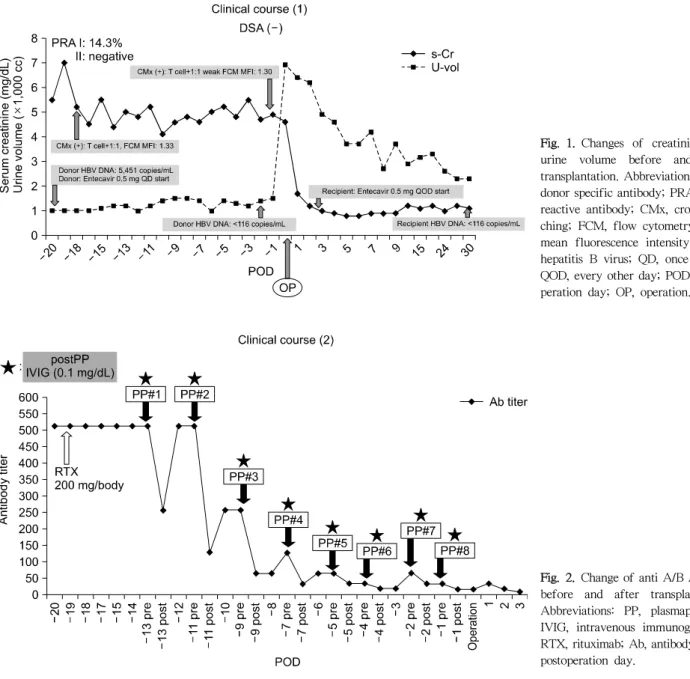
사람백혈구항원(human leukocyte antigen, HLA) 부적합 개수는 6개였고, 공여자 특이 항체(donor specific antibody) 검사는 음성 소견을 보였다. 고역가의 혈액형 부적합이고 기증자가 HBV의 보균자이지만 다른 기증자를 찾을 수 없 었으며, 탈감작 치료와 HBV에 대한 항바이러스 치료로 극 복이 가능하여 부인으로부터 신장을 공여받아 이식 수술 을 시행하기로 하였다. 이에 따라 rituximab 200 mg 1회 정맥 투여와 총 7회의 혈장교환술, 경정맥 면역글로불린 투여(0.1 g/kg)의 탈감작 치료와 수술 전후의 공여자와 수 혜자의 항바이러스 치료를 시행하기로 결정하였다. 공여 자는 수술 30일전부터 entecavir (Baraclude, Bristol-Myers Squibb, New York, NY, USA) 0.5 mg 하루 한 번 복용을 시작하였다. 술 전 30일에 시행한 공여자의 HBV DNA 정 량검사에서는 5,451 copies/mL였고, 수술 2일 전 시행한 HBV DNA 정량검사에서는 116 copies/mL 이하로 측정되 었다. 수혜자에게 수술 20일 전 rituximab 200 mg 정맥 투 여하였고, 수술 13일 전부터 격일마다 혈장교환술을 시행 하고 경정맥 면역글로불린을 투여하였다. 1 혈장 용량 (plasma volume)으로 알부민 보충 3회, 신선 동결 혈장 보 충 4회 시행하였다. 동종응집소에 의한 튜브법으로 측정 한 면역글로불린 G 타입 역가는 혈장교환술 시행 전에 1:512였고, 총 7회 혈장교환술 시행하여 수술 당일 1:16 소 견을 나타냈다. 탈감작 치료를 완료하고 신장이식 수술을 시행하였다. 수술 후 즉각적인 신기능을 보였으며, 급성 거부반응의 소견은 없었다(Fig. 1). 또한, 동종응집소에 의 한 튜브법으로 측정한 면역글로불린 G 타입 역가는 수술 후 첫째 날 1:32까지 증가한 후 1:4까지 떨어지고, 수술 2 주 후부터 1:8로 안정적인 수치를 나타내었다(Fig. 2). 한 편, 이식신 동맥과 수혜자의 우측 내장골 동맥을 연결하고 1시간 프로토콜 조직검사(1 hour protocol biopsy)를 시행 하였는데 조직검사 결과 no specific pathology (Banff score all 0) 소견을 보였다. 이식 수술 전날 B형 간염 사람 면역 글로불린(human hepatitis B immunoglobulin, HBIG;

Hepabig, Greencross, Yongin, Korea) 10,000 unit 근육 주사 하고, 술 후 1일부터 entecavir (Baraclude) 0.5 mg을 격일 로 복용하였다. 주기적으로 시행한 HBV DNA 정량검사는 116 copies/mL 이하로 측정되었다. 수혜자는 수술 후 6개 월 이상 경과하였고, 정상 신기능을 유지하고 있으며,

(3)

Fig. 1. Changes of creatinine and urine volume before and after transplantation. Abbreviations: DSA, donor specific antibody; PRA, panel reactive antibody; CMx, cross mat- ching; FCM, flow cytometry; MFI, mean fluorescence intensity; HBV, hepatitis B virus; QD, once a day;

QOD, every other day; POD, posto- peration day; OP, operation.

Fig. 2. Change of anti A/B Ab titer before and after transplantation.

Abbreviations: PP, plasmapheresis;

IVIG, intravenous immunoglobulin;

RTX, rituximab; Ab, antibody; POD, postoperation day.

HBV의 감염 소견은 보이지 않고 있다.

고 찰

신장이식은 혈액투석이나 복막투석과 같은 다른 신 대 체 요법에 비해 신기능의 회복뿐만 아니라 심혈관계, 운동 능력, 인지나 기억력 등의 뇌 기능, 생식 기능 개선 등의 효과가 뚜렷하다(2,3,16-19). 특히 노년층에 비해 활동량 이 많고 사회적으로 활발한, 젊은 말기 신부전 환자에게는 신 대체 치료로 신이식이 더욱 추천된다. 하지만, 수혜자 나 기증자의 건강 상태, 혈액형 부적합이나 간염 등의 만 성 감염은 생체 신장이식을 할 때 중요한 인자이며, 부적

합한 결과는 이식으로 이어지지 못하는 결과를 나타낼 수 있다. 수혜자와 공여자간의 고역가 혈액형 부적합 이식 수 술 또는 공여자의 HBV의 감염력은 급성 항체 매개성 거부 반응, 또는 수혜자의 HBV 감염의 위험인자이다(20,21).

특히 1990년대까지 이러한 위험인자는 이식 수술의 금기 사항이었다. 하지만 2000년대에 들어 탈감작 치료가 발전 하고, HBV의 약물 치료가 효과적으로 입증되면서 각각의 위험인자들을 극복하고 성공적으로 이식을 시행하는 사례 가 증가하였다(15). T 세포 교차반응 양성은 고역가에서 는 거부반응의 위험도가 높지만, 저역가에서는 탈감작 치 료와 함께 성공적인 유지 면역치료를 통해 이식신 기능을 유지할 수 있다고 알려졌다(22,23). 하지만 보체 의존성 림

(4)

프구 독성 교차반응 검사는 감염이나 약제 사용 등의 원인 으로 위양성을 보이는 경우가 빈번하여 유세포검사가 함 께 시행된다(24). 유세포검사는 보체 의존성 림프구 독성 교차반응보다 50배가량 민감하며 면역글로불린 G 타입의 항HLA 항체만 추출 가능하여 수여자의 림프구와 반응하 는 면역글로불린 M 항체에 의한 위양성이 낮으며, 이를 불활성화하기 위한 DTT 처리가 필요 없고 또한 객관적이 고 정량화할 수 있는 장점이 있다. 따라서 보체 의존성 림 프구 독성 교차반응 검사에서 양성 소견이 나타나도 유세 포검사에서 음성 소견을 보이는 경우가 있다. 이때는 환자 혈청에서 이미 생성된 면역글로불린 M 타입의 비항HLA 항체에 의한 경우이며, 감염이나 자가항체의 존재가 원인 이 된다(25). 한편, 혈액형 부적합 이식도 동종응집소에 의 한 튜브법으로 측정한 면역글로불린 G 타입 역가가 1:

2,000 이상인 경우에는 항체 제거에 실패하거나 이식 후에 거부반응의 빈도가 증가한다(26,27). 하지만 튜브법으로 시행한 면역글로불린 G 타입 1:512의 항체가는 rituximab 과 혈장교환술로 극복이 가능한 것으로 보고된다(28). 교 차반응 양성과 혈액형 부적합 이식은 rituximab을 투여하 여 B 세포의 사멸을 유도하고 이후 이미 생성된 항체를 제거하기 위해서 혈장교환술을 시행하고 저용량 경정맥 면역글로불린을 투여하는, 탈감작 치료가 공통적으로 필 요하다(29). 90년대 초반 Alexandre 등(30)은 혈액형 부적 합 신장이식 시 체액성 거부반응의 예방을 위해 모든 예에 서 비장적출을 권고하였다. Tanabe 등(10)은 1989년부터 ABOi 신장이식 시 비장적출을 함께 시행한 결과 환자의 생존율은 높았지만, 이식신 생존율은 다소 낮았다고 보고 하였다. 하지만, 이후 Tyden 등(31)은 ABOi 신장이식에서 비장적출 대신 rituximab을 투여하여 더 나은 결과를 보였 다. 2009년 Tanabe 등(32)이 비장적출 대신 rituximab을 이 용한 ABOi 신장이식이 급성 거부반응을 감소시켰고, 감염 의 빈도를 줄였으며, 높은 이식신 생존율을 나타내었다고 보고하였다. 기존에는 rituximab은 375 mg/m2의 양으로 정 맥 투여를 하였으나 최근 Lee 등(33)은 200 mg/body의 정 맥 투여에도 B 세포 억제 효과와 더불어 감염의 위험도를 낮출 수 있다고 보고하였다. 저용량 경정맥 면역글로불린 의 역할은 명확하지는 않지만, 형질 세포를 억제하고, 자 가항체를 중성화하며, 보체의 활성화를 억제하는 역할을 하는 것으로 알려져 있다(33). 하지만 ABOi 신장이식에서 탈감작으로 사용되는 양은 명확히 정해져 있지 않다. 그리 고 HBV를 가진 공여자로부터 HBV 음성인 수혜자가 신장 을 공여받았을 때 수혜자가 감염되어 이환율을 증가시킬 위험이 커지고 장기간 생존율이 떨어지는 우려가 있었으

며(20,21), Chung 등(34)은 HBsAg 양성의 공여자로부터 신장을 공여받아 이식 수술을 시행하는 경우에 수혜자의 HBV의 위험도는 매우 증가하는 것을 보고하였다. 수술 전 공여자는 항바이러스제를 복용하고, 수혜자는 수술 직전 HBIG 및 항바이러스제를 투여하여 바이러스의 전파로 인 한 수혜자의 감염 없이 성공적으로 이식 수술을 시행한 사 례들이 늘고 있다(35). Jiang 등(36)은 65명의 HBsAg 양성 의 공여자로부터 HBsAg 음성의 수혜자로의 신장이식에 대해 발표하였고, 수술 직전 및 술 후 3개월에 HBIG를 투 여하였고 술 후 6개월간 lamivudine으로 예방적 치료를 하 였다. 한 명의 수혜자에서 HBsAg 양성을 보였지만 대부분 에서는 성공적인 결과를 보였다. 이러한 위험인자들을 이 겨내고 신장이식 수술을 성공적으로 시행한 예들은 많지 만, 고역가의 혈액형 부적합 및 HBV의 공여자로부터 이식 이라는 위험인자들이 함께 있는 경우는 이식 수술을 시행 하는 예가 흔하지 않다. 저자들은 신장이식 관련한 중대한 위험인자들이 공존한 경우에 성공적으로 이식을 시행한 경험이 있어 이에 증례 보고를 한다.

REFERENCES
1) Kim MH, Kim MS, Kwon OJ, Kang CM. Comparison of quality of life between kidney transplant patients and dialy- sis patients. J Korean Soc Transplant 2009;23:65-70. (김명 희, 김민수, 권오정, 강종명. 신장이식환자와 투석환자의 삶의 질 비교. 대한이식학회지 2009;23:65-70.)

2) Ogutmen B, Yildirim A, Sever MS, Bozfakioglu S, Ataman R, Erek E, et al. Health-related quality of life after kidney transplantation in comparison intermittent hemodialysis, peritoneal dialysis, and normal controls. Transplant Proc 2006;38:419-21.

3) Tonelli M, Wiebe N, Knoll G, Bello A, Browne S, Jadhav D, et al. Systematic review: kidney transplantation com- pared with dialysis in clinically relevant outcomes. Am J Transplant 2011;11:2093-109.

4) Ojo AO, Hanson JA, Meier-Kriesche H, Okechukwu CN, Wolfe RA, Leichtman AB, et al. Survival in recipients of marginal cadaveric donor kidneys compared with other recipients and wait-listed transplant candidates. J Am Soc Nephrol 2001;12:589-97.

5) Almond PS, Matas A, Gillingham K, Dunn DL, Payne WD, Gores P, et al. Risk factors for chronic rejection in renal allograft recipients. Transplantation 1993;55:752-6.

6) Peterson PK, Balfour HH Jr, Marker SC, Fryd DS, Howard

RJ, Simmons RL. Cytomegalovirus disease in renal allograft

recipients: a prospective study of the clinical features, risk

(5)

factors and impact on renal transplantation. Medicine (Baltimore) 1980;59:283-300.

7) Kasiske BL. Risk factors for accelerated atherosclerosis in renal transplant recipients. Am J Med 1988;84:985-92.

8) Kasiske BL, Snyder JJ, Gilbertson DT, Wang C. Cancer after kidney transplantation in the United States. Am J Transplant 2004;4:905-13.

9) Cosio FG, Kudva Y, van der Velde M, Larson TS, Textor SC, Griffin MD, et al. New onset hyperglycemia and diabetes are associated with increased cardiovascular risk after kid- ney transplantation. Kidney Int 2005;67:2415-21.

10) Tanabe K, Takahashi K, Sonda K, Tokumoto T, Ishikawa N, Kawai T, et al. Long-term results of ABO-incompatible living kidney transplantation: a single-center experience.

Transplantation 1998;65:224-8.

11) Toma H. ABO-incompatible renal transplantation. Urol Clin North Am 1994;21:299-310.

12) Patel R, Terasaki PI. Significance of the positive crossmatch test in kidney transplantation. N Engl J Med 1969;280:735-9.

13) Suehiro T, Shimada M, Kishikawa K, Shimura T, Soejima Y, Yoshizumi T, et al. Influence of HLA compatibility and lymphocyte cross-matching on acute cellular rejection fol- lowing living donor adult liver transplantation. Liver Int 2005;25:1182-8.

14) Natov SN, Pereira BJ. Transmission of viral hepatitis by kidney transplantation: donor evaluation and transplant policies (part 1: hepatitis B virus). Transpl Infect Dis 2002;4:117-23.

15) Warren DS, Zachary AA, Sonnenday CJ, King KE, Cooper M, Ratner LE, et al. Successful renal transplantation across simultaneous ABO incompatible and positive crossmatch barriers. Am J Transplant 2004;4:561-8.

16) Murray JE, Reid DE, Harrison JH, Merrill JP. Successful preg- nancies after human renal transplantation. N Engl J Med 1963;269:341-3.

17) McKay DB, Josephson MA, Armenti VT, August P, Coscia LA, Davis CL, et al. Reproduction and transplantation: report on the AST Consensus Conference on Reproductive Issues and Transplantation. Am J Transplant 2005;5:1592-9.

18) Kramer L, Madl C, Stockenhuber F, Yeganehfar W, Eisen- huber E, Derfler K, et al. Beneficial effect of renal trans- plantation on cognitive brain function. Kidney Int 1996;49:833-8.

19) van den Ham EC, Kooman JP, Schols AM, Nieman FH, Does JD, Franssen FM, et al. Similarities in skeletal muscle strength and exercise capacity between renal transplant and hemodialysis patients. Am J Transplant 2005;5:1957- 65.

20) Lutwick LI, Sywassink JM, Corry RJ, Shorey JW. The trans-

mission of hepatitis B by renal transplantation. Clin Nephrol 1983;19:317-9.

21) Wolf JL, Perkins HA, Schreeder MT, Vincenti F. The trans- planted kidney as a source of hepatitis B infection. Ann Intern Med 1979;91:412-3.

22) Scornik JC, Clapp W, Patton PR, Van der Werf WJ, Hemming AW, Reed AI, et al. Outcome of kidney transplants in pa- tients known to be flow cytometry crossmatch positive.

Transplantation 2001;71:1098-102.

23) Piazza A, Poggi E, Borrelli L, Servetti S, Monaco PI, Buonomo O, et al. Impact of donor-specific antibodies on chronic rejection occurrence and graft loss in renal transplantation:

posttransplant analysis using flow cytometric techniques.

Transplantation 2001;71:1106-12.

24) Schlaf G, Mauz-Korholz C, Ott U, Leike S, Altermann W.

General insufficiency of the classical CDC-based cross- match to detect donor-specific anti-HLA antibodies leading to invalid results under recipients' medical treatment or underlying diseases. Histol Histopathol 2012;27:31-8.

25) Won DI. Experimental application of whole blood flow cytometry to HLA crossmatch for renal transplantation.

Korean J Lab Med 2006;26:45-51. (원동일. 신장 이식을 위한 HLA 교차시험에서 전혈 유세포분석법의 실험적 적용. 대한진단 검사의학회지 2006;26:45-51.)

26) Stegall MD, Dean PG, Gloor JM. ABO-incompatible kidney transplantation. Transplantation 2004;78:635-40.

27) Tobian AA, Shirey RS, Montgomery RA, Cai W, Haas M, Ness PM, et al. ABO antibody titer and risk of anti- body-mediated rejection in ABO-incompatible renal transplantation. Am J Transplant 2010;10:1247-53.

28) Montgomery RA. ABO incompatible transplantation: to B or not to B. Am J Transplant 2004;4:1011-2.

29) Vo AA, Lukovsky M, Toyoda M, Wang J, Reinsmoen NL, Lai CH, et al. Rituximab and intravenous immune globulin for desensitization during renal transplantation. N Engl J Med 2008;359:242-51.

30) Alexandre GP, Squifflet JP, De Bruyere M, Latinne D, Moriau M, Ikabu N, et al. Splenectomy as a prerequisite for success- ful human ABO-incompatible renal-transplantation. Trans- plant Proc 1985;17:138-43.

31) Tyden G, Kumlien G, Fehrman I. Successful ABO-incompat- ible kidney transplantations without splenectomy using an- tigen-specific immunoadsorption and rituximab. Trans- plantation 2003;76:730-1.

32) Tanabe K, Ishida H, Shimizu T, Omoto K, Shirakawa H,

Tokumoto T. Evaluation of two different preconditioning

regimens for ABO-incompatible living kidney donor

transplantation. A comparison of splenectomy vs. ritux-

imab-treated non-splenectomy preconditioning regimens.

(6)

Contrib Nephrol 2009;162:61-74.

33) Lee J, Lee JG, Kim S, Song SH, Kim BS, Kim HO, et al.

The effect of rituximab dose on infectious complications in ABO-incompatible kidney transplantation. Nephrol Dial Transplant 2016;31:1013-21.

34) Chung RT, Feng S, Delmonico FL. Approach to the manage- ment of allograft recipients following the detection of hep- atitis B virus in the prospective organ donor. Am J Transplant 2001;1:185-91.

35) Kang MG, Lee SJ, Oh JS, Lim YA. Comparison of ABO iso-

agglutinin titers by different tube hemagglutination techni- ques. Korean J Blood Transfus 2009;20:227-34. (강민구, 이승재, 오진숙, 임영애. 시험관법을 이용한 검사법에 따른 ABO 동종 응집소 역가 비교. 대한수혈학회지 2009;20:227-34.) 36) Jiang H, Wu J, Zhang X, Wu D, Huang H, He Q, et al.

Kidney transplantation from hepatitis B surface antigen

positive donors into hepatitis B surface antibody positive

recipients: a prospective nonrandomized controlled study

from a single center. Am J Transplant 2009;9:1853-8.

수치

Fig. 1. Changes  of  creatinine  and  urine  volume  before  and  after  transplantation

참조

관련 문서

Abstract — Many studies have provided evidences that hepatitis B surface antigen (HBsAg) including preS region could be an ideal candidate for a new hepatitis B virus

In 2015, World Health Organization (WHO) estimates that 257 million people were liv- ing with chronic hepatitis B virus (HBV) infection (defined as hepatitis B surface anti- gen

MMR, measles, mumps, and rubella vaccine; HAV, hepatitis A virus; HBsAb, hepatitis B surface antibody; HBV, hepatitis B virus; Tdap, tetanus, diphtheria toxoid, and pertussis

Detection rate of hepatitis B virus DNA among blood donors showing HBsAg positi- vity or negativity and relatedness with other hepatitis B viral markers..

Prevention of de novo hepatitis B virus infection in living donor liver transplantation using hepatitis B core antibody positive donors.. Prevention of de novo

Serologic assays of the detection for hepatitis B surface antigen(HBsAg) and hepatitis B antibody(Anti-HBs) were useful markers for the diagnosis of viral

Abbreviations: HBsAg, hepatitis B surface antigen; anti-HIV, anti-human immunodeficiency virus; anti-HBs, antibody to hepatitis B surface antigen; anti-HCV, anti-hepatitis C

Abbreviations: HBsAg, hepatitis B surface antigen; anti-HBs, antibody to hepatitis B surface antigen; anti-HIV, anti-human immunodeficiency virus; anti-HCV, anti-hepatitis C