ISSN 2234-3806 • eISSN 2234-3814
http://dx.doi.org/10.3343/alm.2014.34.6.456
Standardization of ABO Antibody Titer Measurement at Laboratories in Korea
Young Ae Lim, M.D. and Seon Joo Kang, M.D.
Department of Laboratory Medicine, School of Medicine, Ajou University, Suwon, Korea
Background: Measurement of the ABO antibody (Ab) titer is important in ABO-incompati- ble transplantation. However, to the best of our knowledge, no standard protocol or exter- nal survey program to measure the ABO Ab titer has been established in Korea. We inves- tigated the current status of ABO Ab titer measurements at various laboratories in Korea and the impact of the protocol provided to reduce interlaboratory variations in the meth- ods and results of ABO Ab titers.
Methods: The Korean external quality assessment of blood bank laboratories sent external survey samples with a questionnaire to 68 laboratories across Korea for the measurement of ABO Ab titers in May 2012. After 6 months, a second set of survey samples were sent with a standard protocol to 53 of the previously surveyed laboratories. The protocol recom- mended incubation at room temperature only and use of the indirect antihuman globulin method for the tube test as well as and the column agglutination test (CAT).
Results: Several interlaboratory variations were observed in the results, technical proce- dures, and methods selected for measurement. We found that 80.4% laboratories hoped to change their protocol to the provisional one. Additionally, CAT showed significantly lower variation among laboratories (P =0.006) than the tube test.
Conclusions: Our study provides baseline data regarding the current status of ABO Ab ti- ter measurement in Korea. The standard protocol and external survey were helpful to standardize the technical procedures and select methods for ABO Ab titer measurement.
Key Words: ABO blood group system, Antibody, Titer, Standard
Received: February 24, 2014 Revision received: April 29, 2014 Accepted: August 27, 2014 Corresponding author: Young Ae Lim Department of Laboratory Medicine, School of Medicine, Ajou University,
164 World cup-ro, Yeongtong-gu, Suwon 443-380, Korea
Tel: +82-31-219-5786 Fax: +82-31-219-5778 E-mail: [email protected]
© The Korean Society for Laboratory Medicine This is an Open Access article distributed under the terms of the Creative Commons Attribution Non-Commercial License (http://creativecom- mons.org/licenses/by-nc/3.0) which permits unrestricted non-commercial use, distribution, and reproduction in any medium, provided the original work is properly cited.
INTRODUCTION
ABO-incompatible renal transplantations have become increas- ingly common because of shortage of ABO-compatible donors [1, 2]. Accurate measurement of the ABO antibody (Ab) titer is important for successful ABO-incompatible transplantations and is mainly determined by the tube test involving observation of agglutinated red blood cells (RBC) with different incubation tem- peratures, including a phase at ambient room temperature, fol- lowed by one at 37°C and conversion to the antihuman globulin phase [3]. In addition to reports on large interlaboratory varia- tion in the results of ABO Ab titer measurements [4-6], a reduc- tion in this variation has been reported by using a standard pro-
tocol or an external survey. However, to the best of our knowl- edge, neither a standard protocol nor an external survey pro- gram for measurement of the ABO Ab titer has been established in Korea.
The aims of the study were to investigate 1) the current status of ABO Ab titer measurements at various laboratories in Korea, and 2) the impact of the provisional standard protocol on inter- laboratory variations in the selection of techniques and results of ABO Ab titer measurements.
METHODS
The Korean external quality assessment (KEQA) for blood bank
laboratories sent fresh frozen plasma (FFP) of blood group O as external survey samples with a questionnaire to 68 laboratories across Korea for the measurement of anti-A and anti-B titers, in May 2012. The samples were prepared as follows: 2 units of thawed, blood group O FFP were mixed well and 3 mL of this FFP was sent as samples to the laboratories. The questionnaire consisted of 19 questions regarding the technical procedures used, the RBC suspension, the specimen, treatment with dithio- threitol (DTT), and reading the end-point, etc. for each technique.
After 6 months, a second set of survey samples from FFP of blood groups O and B were sent with the final report from the first external survey as well as a provisional, standard protocol (defined as standard protocol in the study) to 53 of the laborato- ries, which participated in the first survey.
The techniques for measurement of the ABO Ab titer were defined as IS for procedures with immediate spin without incu- bation, RT for procedures with room temperature incubation, 37°C for procedures with 37°C incubation, and AHG for proce- dures using the indirect antihuman globulin method for the tube test as well as the column agglutination test (CAT), irrespective of the use of DTT. The protocol allowed the participant labora- tory to select one or more methods and techniques.
The standard protocol was written after the review of literature [4, 5, 7-9]. And the Summary of Uniform Procedure of Anti-A ti- ter in ABT from the College of American Pathologists (CAP), re- sults of the first survey in our study (Table 1), and review by ex- perts were also included in the protocol. A standard protocol was recommended for aspects such as the technical procedure, the type of sample [7, 8], method of treatment with DTT, use of 0.9%
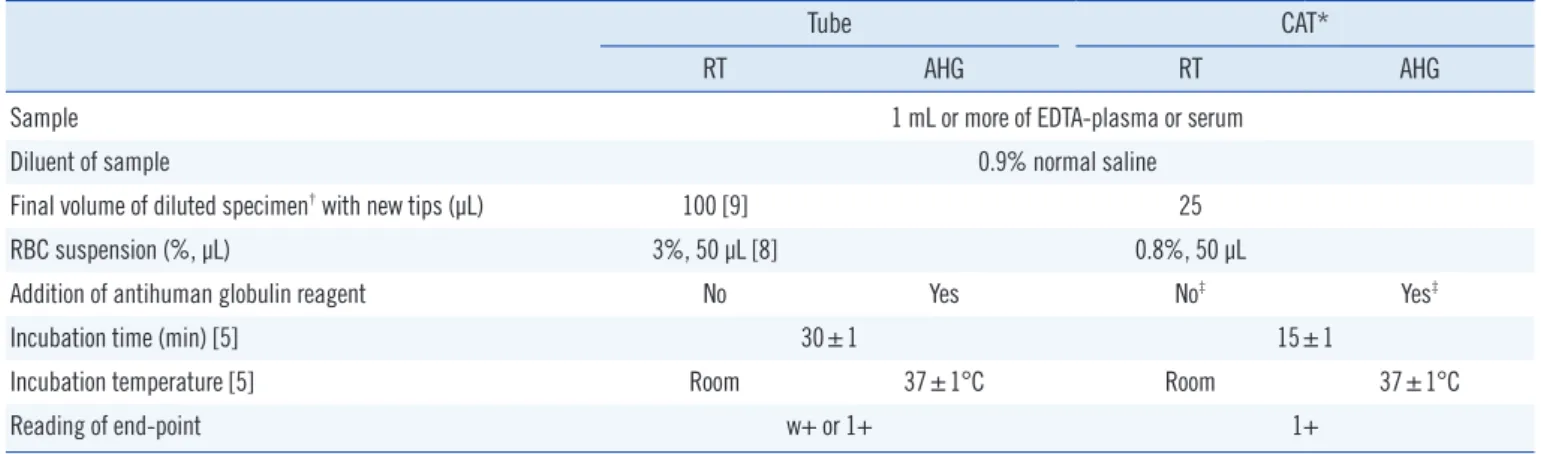
normal saline as diluents [4, 5, 7, 8], method of dilution of the sample [9], incubation [5], and reading of the end point for the tube test. The standard protocol for CAT was as per the manu- facturer’s instructions. The standard protocol recommended RT conditions only and AHG technique for the tube test as well as CAT, irrespective of whether DTT was used. A summary of the procedures is shown in Table 2.
The acceptable range of the titer results was defined as one dilution on either side of the most common result plus an addi- tional dilution in the direction of the log, mean value among 10 or more responders. The number of titer steps was defined as the frequency of dilution.
All the statistical analyses were performed by using a software program (SPSS for Windows v. 12.0; SPSS, Chicago, IL, USA).
The rates at which results from various laboratories were found to be within the acceptable range of the ABO Ab titer were ana- lyzed statistically by using the Pearson Chi-square test and/or
Fisher’s exact test with 2-sided exact significance. Differences in the number of titer steps between techniques and the survey were analyzed statistically by using the Student t-test and the Table 1. Number (%) of laboratories and their responses to items in the questionnaire in the first survey
Procedures N of laboratories
Laboratories Tube 50* CAT 11*
Origin of RBC Commercial 20 (40) 4 (36)
suspension Donor RBC (CPDA-1) 16 (32) 4 (36) Patient RBC (EDTA) 14 (28) 3 (27)
Specimen Serum 45 (90) 7 (64)
EDTA plasma 4 (8) 4 (36)
Serum or EDTA plasma 1 (2) 0 (0)
DTT treatment Use 6 (12) 1 (9)
Max. dilution 512 12 (24) 1 (9)
1,024 33 (66) 9 (82)
2,048 2 (4) 0 (0)
4,096 0 (0) 1 (9)
Max. 3 (6) 0 (0)
End-point 1+ 28 (56) 8 (78)
w+ or +/- 13 (26) 3 (27)
Use of microscopy 9 (18) 0 (0) Antiglobulin (n=18) Polyspecific 14 (78) -
Monospecific 4 (22) -
Specimen:RBC 1:1 40 (80) -
in tube test 2:1 9 (18) -
for volume 4:1 1 (2) -
Specimen:RBC (%) IgM 1:1 (0.8) - 4 (100) in CAT for volume IgG 1:1 (0.8) - 3 (27)
2:1 (0.8) - 6 (55) 1:1 (3) - 2 (18) Incubation time/ Immediate spin 37* (74) -
temperature 30 min/37°C 14* (28) -
(Tube) 30 min/Room† 5* (10) -
etc. 12* (18) -
(CAT) IgM 15 min/Room† - 4 (100) IgG 10 min/Room† - 1 (9) 15 min/37°C - 9 (82) 30 min/37°C - 1 (9)
*Number of techniques used including overlapped laboratories; †With DTT treatment.
Abbreviations: Tube, tube test; CPDA-1, citrate phosphate dextrose adenine- 1; Room, room temperature; DTT, dithiothreitol; CAT, column agglutination test; RBC, red blood cells; w+ reactivity, barely visible agglutination against a turbid background.
paired t-test, respectively. A P value less than 0.05 was consid- ered statistically significant.
RESULTS
1. Current status of ABO Ab titer measurement at laboratories in Korea
The response rates were 77.9% (53/68) for the first survey and 86.8% (46/53) for the second survey.
As shown in Table 1, several interlaboratory variations were found in the procedures used, including those with respect to the dilution, reading of the end point, incubation, sample, and reagents. Most of the laboratories used either serum as the sam- ple (90%), polyspecific AHG (78%), 1:1 (v/v) ratio of specimen to RBC (80%), or immediate spin condition for incubation (74%) in the tube test. Additionally, 18% (9/53) of the laboratories used microscopy when reading the end-points with the tube test (Ta- ble 1).
Of the laboratories that responded to the first survey, 36 were part of university hospitals, while 17 were affiliated to tertiary or secondary hospitals. Among these, only 28 laboratories reported to have conducted ABO Ab titer testing at least once in the past year (2011). Fifty laboratories (excluding duplicates) reported using the tube test with IS (37), RT (8), 37°C (5), and AHG (18), while 11 laboratories (excluding duplicates) reported using the CAT-based gel card test with RT (4) and AHG (11) (Table 3).
Thirty laboratories used only one, 16 used two, while 7 used three techniques. Of the remaining 25 laboratories where any ABO Ab titer measurements had not been conducted in 2011, 19 reported to have previously used only the tube-test with IS.
In all, only 24 (45%) laboratories used the AHG method in the
Table 2. Summary of the recommended protocol for measuring the ABO antibody titer in the second survey
Tube CAT*
RT AHG RT AHG
Sample 1 mL or more of EDTA-plasma or serum
Diluent of sample 0.9% normal saline
Final volume of diluted specimen† with new tips (µL) 100 [9] 25
RBC suspension (%, µL) 3%, 50 µL [8] 0.8%, 50 µL
Addition of antihuman globulin reagent No Yes No‡ Yes‡
Incubation time (min) [5] 30±1 15±1
Incubation temperature [5] Room 37±1°C Room 37±1°C
Reading of end-point w+ or 1+ 1+
*Manual insert from the manufacturer; †Irrespective of the dithiothreitol; ‡Inclusion of cassette.
Abbreviations: RT, procedures with room temperature incubation; AHG, procedures with indirect antihuman globulin test; CAT, column agglutination test;
RBC, red blood cells; Room, room temperature; w+ reactivity, barely visible agglutination against a turbid background.
Table 3. Number of laboratories, listed as per techniques used, for ABO Ab titer measurement in both surveys
Techniques Survey Techniques Survey
Tube CAT 1st 2nd Tube CAT 1st 2nd
IS 23 3 IS 37 6
IS, AHG 7 RT 8 35
IS, AHG AHG 4 2 AHG 18 (4*) 26 (3*†)
RT 3 9 37°C 5 (3*) 1 (1*)
RT, AHG 3 14† RT 4 7
RT, AHG AHG 7 AHG 11 (1*) 18 (1*)
37°C 2
AHG 2
RT, AHG 2 4
AHG AHG 1
IS, 37°C 1
IS AHG 1
AHG 1
IS RT, AHG 1
RT, 37°C, AHG 1
RT RT, AHG 1 1
RT, AHG RT, AHG 1
IS, RT, AHG 1
RT, 37°C, AHG RT, AHG 1
RT AHG 1
AHG 1
Unknown 1
Total 53 46 83 93
*Number of laboratories for DTT treatment; †One laboratory used samples with and without DTT treatment for Tube-AHG.
Abbreviations: Tube, tube test; CAT, column agglutination test; IS, proce- dures with immediate spin; RT, procedures with room temperature incuba- tion; AHG, procedures with indirect antihuman globulin test.
tube test or CAT for IgG type of ABO Ab testing.
2. Effects of the provisional standard protocol on interlaboratory variation
In the second survey, 80.4% (37/46) laboratories answered that they would change their protocol to the standard protocol of measuring the ABO Ab titer. After receiving the standard proto- col, many laboratories chose to use the recommended tech- niques from the standard protocol. The proportion of laboratories (number of participants that used the tube-test/number of total participants) increased from 15.1% (8/53) to 76.1% (35/46) for
RT and from 34.0% (18/53) to 56.5% (26/46) for AHG in the second survey. The proportion of laboratories (number of partici- pants that used CAT/number of total participants) increased from 7.5% (4/53) to 15.2% (7/46) for RT and from 20.8%
(11/53) to 37.0% (17/46) for AHG in the second survey (Table 3). None of the laboratories used microscopy to read the end- point for the tube test in the second survey.
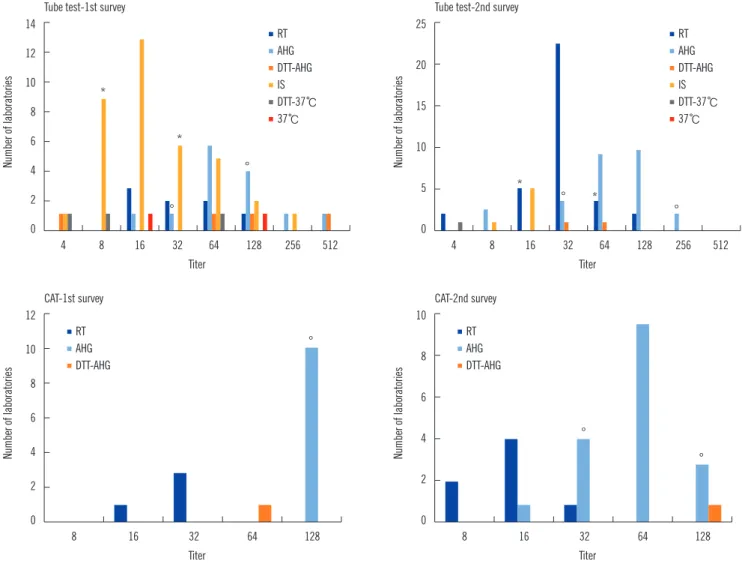
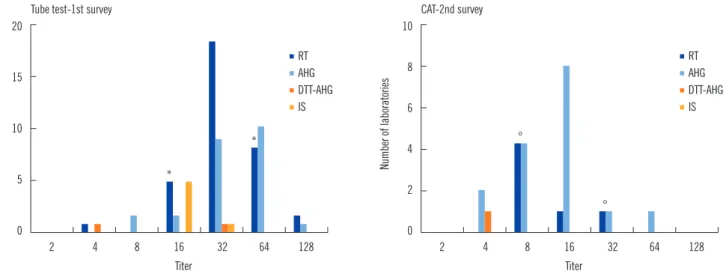
The distribution of titer results for anti-A in Fig. 1 and anti-B in Fig. 2 for blood group O and that for anti-A in Fig. 3 for blood group B are shown, grouped as per the technique used. The maximum differences of titer step (range of titer) between labo-
Fig. 1. Number of laboratories with distribution of the anti-A titers as per method and survey results in blood group O. Number of laborato- ries reading ‘1+’ as the only end point; The asterisk (*) and empty circle (°) mean the acceptable range of the titers, which was defined as one dilution either side of the most common response plus an additional dilution in the direction of the log mean response among 10 or more responders, for RT or IS and AHG, respectively. There were no significant differences in the rate at which laboratory results were with- in acceptable range using the tube test between both surveys; the rates were 77.8% (33/45) and 87.8% (36/41) for Tube-RT including Tube-IS (P =0.110) and 78.6% (11/14) and 92.0% (23/25) for Tube-AHG (P =0.329).
Abbreviations: IS, procedures with immediate spin; RT, procedures with room temperature incubation; 37°C, procedures with 37°C incubation; AHG, proce- dures with indirect antihuman globulin test; CAT, column agglutination test; DTT-37°C, procedure with 37°C incubationin dithiothreitol treated sample; DTT- AHG, procedures with indirect antihuman globulin test in dithiothreitol treated sample.
Number of laboratories Number of laboratories
CAT-1st survey CAT-2nd survey
Titer Titer
12 10 8 6 4 2
0
10
8
6
4
2
0
8 16 32 64 128 8 16 32 64 128
RT AHG DTT-AHG
RT AHG DTT-AHG
°
°
°
Number of laboratories Number of laboratories
Tube test-1st survey Tube test-2nd survey
Titer Titer
14 12 10 8 6 4 2 0
25
20
15
10
5
0
4 8 16 32 64 128 256 512 4 8 16 32 64 128 256 512
RT AHG DTT-AHG IS DTT-37℃
37℃
RT AHG DTT-AHG IS DTT-37℃
37℃
*
*
°
°
*
* °
°
ratories for Tube-RT including Tube-IS and Tube-AHG were six (4-256) and five (16-512) for the first survey and five (4-128) and five (8-256) for the second survey, respectively. The differ- ences of titer step (range of titer) for CAT-RT and CAT-AHG were one (16-32) and zero (128) for the first survey and two (8-32) and three (16-128) for the second survey, respectively. Differ- ence in the average of titer steps in CAT (1.5) was significantly lower than that for the tube test (5.25, P =0.006). This finding indicates that CAT has significantly less interlaboratory variation than the tube test. However, there was no significant difference in the number of titer steps between the first (3.0) and second (3.75) survey.
There were no significant differences in the rate at which lab- oratory results were within acceptable range using the tube test between both surveys: the rates of anti-A of blood group O were 77.8% (33/45) and 87.8% (36/41) for Tube-RT including Tube-IS (P =0.110) and 78.6% (11/14) and 92.0% (23/25) for Tube-AHG (P =0.329); the rates for anti-B of blood group O were 88.9% (40/
45) and 78.0% (32/41) for Tube-RT including Tube-IS (P =0.244) and 85.7% (12/14) and 88.0% (22/25) for Tube-AHG (P =1.000).
DISCUSSION
In previous studies, we found interlaboratory variations in IgM- Fig. 2. Number of laboratories with distribution of the anti-B titer as per method and survey results, in blood group O. There were no signifi- cant differences in the rate at which laboratory results were within acceptable range using the tube test between both surveys; the rates were 88.9% (40/45) and 78.0% (32/41) for Tube-RT including Tube-IS (P =0.244) and 85.7% (12/14) and 88.0% (22/25) for Tube-AHG (P =1.000). Number of laboratories reading ‘1+’ as the only end point; Asterisk (*), empty circle (°).
Abbreviations: IS, procedures with immediate spin; RT, procedures with room temperature incubation; 37°C, procedures with 37°C incubation; AHG, proce- dures with indirect antihuman globulin test; CAT, column agglutination test; DTT-37°C, procedure with 37°C incubationin dithiothreitol treated sample; DTT- AHG, procedures with indirect antihuman globulin test in dithiothreitol treated sample.
Number of laboratories Number of laboratories
CAT-1st survey CAT-2nd survey
Titer Titer
5
4
3
2
1
0
12 10 8 6 4 2
0
4 8 16 32 64 4 8 16 32 64
RT AHG DTT-AHG
RT AHG DTT-AHG
°
° °
°
Number of laboratories Number of laboratories
Tube test-1st survey Tube test-2nd survey
Titer Titer
14 12 10 8 6 4 2 0
20
15
10
5
0
2 4 8 16 32 64 128 256 512 2 4 8 16 32 64 128 256 512
RT AHG DTT-AHG IS DTT-37℃
37℃
RT AHG DTT-AHG IS DTT-37℃
37℃
*
*
*
° *
°
°
°
Fig. 3. Number of laboratories with distribution of the anti-B titer as per method in the second survey, in blood group A. Number of labora- tories reading ‘1+’ as the only end point; Asterisk (*), empty circle (°).
Abbreviations: IS, procedures with immediate spin; RT, procedures with room temperature incubation; 37°C, procedures with 37°C incubation; AHG, proce- dures with indirect antihuman globulin test; CAT, column agglutination test; DTT-37°C, procedure with 37°C incubationin dithiothreitol treated sample; DTT- AHG, procedures with indirect antihuman globulin test in dithiothreitol treated sample.
Number of laboratories Number of laboratories
Tube test-1st survey CAT-2nd survey
Titer Titer
20
15
10
5
0
10
8
6
4
2
0
2 4 8 16 32 64 128 2 4 8 16 32 64 128
RT AHG DTT-AHG IS
RT AHG DTT-AHG IS
*
* °
°
type ABO Ab titer as large as 16-fold [6], 32-fold [4], and 32- fold using Tube-RT, while in IgG-type ABO Ab titer variations were up to 32-fold [6], 256-fold [4], and 64-fold using Tube- AHG techniques. The study from three European centers re- ported that there was a six-titer-step difference in the tube test among institutions. The interlaboratory variation for the IgG tends to be higher than that for the IgM ABO Ab titer. This may be related to the more complicated techniques involved in IgG ABO Ab titer measurement than that used for IgM. Differences in the ABO Ab titer have been reported not only between labo- ratories but also between techniques in the same laboratory [10]. Therefore, a standard protocol is necessary to reduce in- ter- and intralaboratory titer variations.
The standard protocol recommends EDTA-plasma or serum to be used as the sample since serum is widely used [8] while EDTA in plasma can prevent complement activation and hemo- lysis during incubation at 37°C [7]. Therefore, if a laboratory uses the AHG technique for ABO Ab titer measurement, then EDTA-plasma would be the specimen of choice. For diluting the sample, 0.9% normal saline without any potentiator is the rec- ommended diluent, since any form of enhancement may result in false elevation of titers [9]. Either 2 drops of 2% RBC suspen- sion or 1 drop of 3% RBC suspension can be used [8, 9]. In our study, we selected 1 drop of 3% RBC suspension, as 40%
of laboratories in our study used the 3% commercial RBC sus- pension for the measurement of the ABO Ab titer.
CAP recommends w+ or the trace end-point instead of 1+ re- activity to reduce interlaboratory variability as the difference be-
tween 1+ and 2+ may be less discernible than that between w+
and 1+ [5]. Although our study could not analyze the effect of w+ reactivity owing to the limited responders with the w+ end- point, a similar tendency could not be found in our study. Since other reports recommended the 1+ end-point, except for CAP, our protocol recommended the w+ or 1+ end-point as per the laboratory, without the use of microscopy when using the tube test [8]. After distribution of the standard protocol, 18% (9/53) of the laboratories that used microscopy in the first survey changed their protocols to macroscopic observations.
Before the distribution of the standard protocol, 55% of the laboratories in Korea used only Tube-IS, Tube-RT, and Tube- 37°C methods. Although both IgM and IgG can agglutinate RBC at room temperature or cooler [9], these techniques primarily detect IgM, while IgG cannot be accurately measured. However, AHG titer values are known to be critical for the clinical man- agement of ABO-incompatible kidney transplantation, and IS or RT titers offer no additional data to influence clinical decisions [11]. IgG is the major isotype for anti-A and anti-B in blood group O, while IgM is the predominant isotype found in group A and group B individuals [9]. In our study, 80% of laboratories showed willingness to change their protocols for ABO Ab titer measurement according to the standard protocol, and there was a 70-80% increase in the number of laboratories using Tube-AHG or CAT-AHG in the second survey as compared to the first survey. The standard protocol thus contributed to a change in the technique used by local laboratories for ABO Ab titer measurements to detect IgG.
Although the Tube-IS is simpler and faster than Tube-RT and 70% (37/53) of the laboratories in our study used it, our stan- dard protocol chose Tube-RT for detecting the IgM type of ABO Ab to conform to CAP [5], which recommends 30 ±1 min as the incubation time for Tube-RT.
A study from 3 European centers showed that CAT signifi- cantly decreased intercenter variation as compared to the tube test [12]. In our study, CAT also showed a significantly lower dif- ference in the reported titer range than the tube test. Moreover, CAT is known to reduce the turnaround time of the ABO AB titer by 50% [3].
However, the reagents for CAT are very expensive under the domestic health insurance system; thus the routine use of the CAT technique is not feasible in Korea. The practical difficulties of using CAT for routine measurement of the ABO Ab titer should be discussed in further detail to reduce interlaboratory variation in results.
In conclusion, we found interlaboratory variations in the re- sults, methods, and technical procedures of measurement of the ABO Ab titer in Korea. Our study provides baseline data regard- ing the current status of ABO Ab titer measurement in Korea, and the standard protocol was helpful to standardize the techni- cal procedures and selection of methods for ABO Ab titer mea- surement. Although the standard protocol could not significantly reduce interlaboratory variation in the results of the second sur- vey, a periodically conducted external survey could help in con- tinued improvement of the results of ABO Ab titer measurement.
Authors’ Disclosures of Potential Conflicts of Interest
No potential conflicts of interest relevant to this article were re- ported.
Acknowledgments
This work was supported by the KAQACL Research Fund of 2012-2. We thank all the 53 participating laboratories and their staff for their cooperation in this study.
REFERENCES
1. Alexandre GP, Squifflet JP, de Bruyere M, Latinne D, Moriau M, Ikabu N, et al. Splenectomy as a prerequisite for successful human ABO-incom- patible renal-transplantation. Transplant Proc 1985;17:138-43.
2. Chang CL, Jeong JH, Kim JP, Lee DR, Kong JM, Kim BC. A single cen- ter experience of ABO incompatible kidney transplantation. J Korean Soc Transplant 2012;26:261-8.
3. Tobian AA, Shirey RS, King KE. ABO antibody titer monitoring for in- compatible renal transplantation. Transfusion 2011;51:454-7.
4. Kobayashi T and Saito K. A series of surveys on assay for anti-A/B anti- body by Japanese ABO-incompatible Transplantation Committee. Xeno- transplantation 2006;13:136-40.
5. AuBuchon JP, de Wildt-Eggen J, Dumont LJ. Reducing the variation in performance of antibody titrations. Vox Sang 2008:95:57-65.
6. Lee EY, Kim S, Kim HO, Kwon SW, Kim DW, Han KS. Survey analysis of ABO antibody titration at four university hospitals in Korea. Korean J Blood Transfus 2011;22:24-30.
7. Roback JD, Grossman BJ, Harris T, Hillyer CD, ed. Technical manual.
17th ed. Bethesda: American Association of Blood Banks, 2011:369.
8. Roback JD, Grossman BJ, Harris T, Hillyer CD, ed. Technical manual.
17th ed. Bethesda: American Association of Blood Banks, 2011:907- 10.
9. Roback JD, Grossman BJ, Harris T, Hillyer CD, ed. Technical manual.
17th ed. Bethesda: American Association of Blood Banks, 2011:935-7.
10. Kang MG, Lee SJ, Oh JS, Lim YA. Comparison of ABO isoagglutinin ti- ters by different tube hemagglutination techniques. Korean J Blood Transfus2009;20:227-34.
11. Tobian AA, Shirey RS, Montgomery RA, Ness PM, King KE. The critical role of plasmapheresis in ABO-incompatible renal transplantation.
Transfusion 2008;48:2453-60.
12. Kumlien G, Wilpert J, Säfwenberg J, Tydén G. Comparing the tube and gel techniques for ABO antibody titration, as performed in three Euro- pean centers. Transplantation 2007;84(S12):S17-9.