Journal of the Korean Society for Power System Engineering http://dx.doi.org/10.9726/kspse.2015.19.1.050 Vol. 19, No. 1, pp. 50-55, February 2015
Microstructure and Wear Characteristics of Nickel Reinforced AC8A Composites
Hyung-Jin Kim*, Kelimu Tulugan** and Won-Jo Park***†
(Received 02 October 2014, Revision received 08 January 2015, Accepted 07 February 2015)
Abstract: This study takes AC8A, which is a representative light weight alloy as matrix, and nickel as reinforcement for its superior properties. The manufacturing method applied in this study required low pressure for the infiltration of the metal matrix into the reinforcement. Porous Ni was applied as preform. The fabrication was conducted under 0.3 MPa at 600, 700 and 750 degrees centigrade, respectively. Intermetallic compounds Al3 generated between Al and Ni were observed in the composites.
Microstructure, Vickers’ hardness and wear characteristics of the composites were also investigated. The result indicates that the structures of compounds created at 650 degree centigrade were distributed densely; the grain size of the substances and the compounds was increased with the infiltration temperature.
Key Words:Composites, Intermetallic, Grain boundaries, Microstructure, Wear-resistant
***†Won-Jo Park(corresponding author) : Department of energy and Mechanical Engineering, GyeongSang National University.
E-mail : [email protected], Tel : 055-772-9113
**Kelimu Tulugan : Department of Ocean System Engineering, GyeongSang National University.
*Hyung-Jin Kim : Department of Mechanic System Engineering, Gyeongsang Natioanal University
1. Introduction
At present, automobile, shipping and aircraft etc.
require high speed and large output of power. The required parts have demands to increase mechanical characteristics. Therefore, a considerable number of studies have been conducted on lightweight and new material development of unit parts about the internal combustion engine. In Metal Matrix Composite (MMC), interaction allows reinforcing material to mix with the base metal and disperse appropriately
and, unlike alloy materials such MMCs possess not only the properties of the matrix metal but also the characteristics of the reinforcement material.
Therefore, MMCs can attain mechanical properties that fit the desired purpose which are difficult to acquire in single metal.
Among such composites, it is particularly the Al alloy matrix composites in which nickel with its superior strength, thermal properties, and corrosion resistance properties is added in preform or powder form that exhibit greatly enhanced wear resistance, high temperature properties and corrosion resistance in comparison to existing Al alloys.1)
They are,
therefore, currently used for pistons or piston
rings in automobile diesel engines. Global
industrial sectors are also conducting studies
with the goal of applying composite materials
with superior high-temperature strength, wear
resistance and heat conductivity for use in
special functional structural parts.
2-4)In view of the current trend toward greater demands for materials with such functionalities, it is expected that these materials will be applied and utilized for an even wider range of uses.
5)Such piston or piston ring materials are manufactured by a molten metal casting method, wherein the Al molten alloy is injected into the Ni preform.
During the manufacturing process, a reaction occurs in the interface between the Ni and the Al matrix, causing their transformation into a hard intermetallic compound and thereby greatly improving wear resistance. Therefore, the problem of exercising appropriate control over the interface reaction between the reinforcement and the metal matrix is a factor that must be taken into constant consideration at every stage, from the manufacture of the material to its final use. Such pressurization causes a transformation in the preform that was intended to facilitate the distribution of the reinforcement, and thus cause deficiencies in the completed composite, such as the deterioration of consistency in the reinforcement. In general, an infiltration pressure of 60~80 MPa is used when manufacturing by the Squeeze Casting method, and such high pressure necessitates large scale machinery as well as making it difficult to cast composites in complex forms.
6)For this reason, it is necessary to consider manufacturing MMCs using low pressure infiltration that takes into account the strength of the preform, and, recently many studies are being conducted on ways to reduce
infiltration pressure. 7)This study takes AC8A, which is a representative light-weight alloy as matrix, and nickel as reinforcement for its superior properties. The manufacturing method applied in this study required
low pressure for the infiltration of the metal matrix into the reinforcement. This research aimed to observe microstructures for the characterization of intermetallic compounds that are generated by the reaction of Ni and Al. Moreover, the wear resistance of the manufactured composites under different conditions was studied as well.
2. Experiment
The matrix used in this study is AC8A (KS D 2330), which is an Al-Cu-Mg-Si type alloy generally used for automobile and internal combustion engines (Dooin Co., Ltd., South Korea).
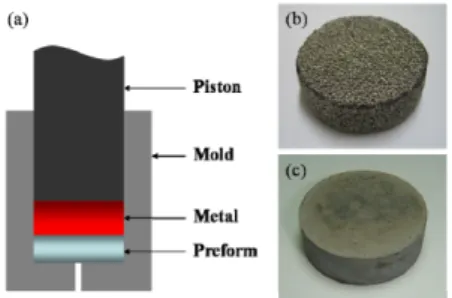
Porous nickel preform with 5% volume fraction (Vf) was used as reinforcement (Sumitomo Electric Toyama o., Ltd. Japan), as shown Figure 1 The principle of infiltration used in molten metal casting manufacturing method is shown in Fig. 1 (a), where preform is placed in the cylinder mold and piston pressure is used to make the molten matrix metal penetrate into the preform. Fig. 1 (b) exhibits the Nickel preform with diameter of 30 mm and height of 10mm, which was the porous preform used as the reinforcement in this experiment. Fig. 1 (c) shows the completed MMC after infiltration. In this experiment, hydraulic cylinders and load cells were employed to detect load with a maximum pressure limit of 0.3 MPa which was used to induce penetration of the reinforcement by the matrix
Fig. 1 Principle of MMC by low pressure infiltration
metal. Meanwhile during the manufacture of infiltration, different temperature conditions (650, 700 and 750 °C) have been applied during the composite infiltration.
The wear test was conducted according to the regulations of ASTM E8, using a Ball on Disc method wear tester (R&B Friction & Wear Tester PD-102). The diameter of the wear track was 7.5 mm and the counterpart material was a SUJ-2 ball (800Hv) of high carbon chrome steel. To check the wear properties according to infiltration temperature, the following conditions were observed: load of the specimen was maintained constant at 30N; machine speed was fixed at 50 rpm; sliding time applied was 1 hour (3600 seconds); and a 2 minute Pre-track was granted to impose identical conditions on each test specimen. For the wear properties, friction coefficient and wear loss were examined in accordance with the infiltration temperature, taking into consideration the microstructure and hardness.
3. Experimental results and discussion
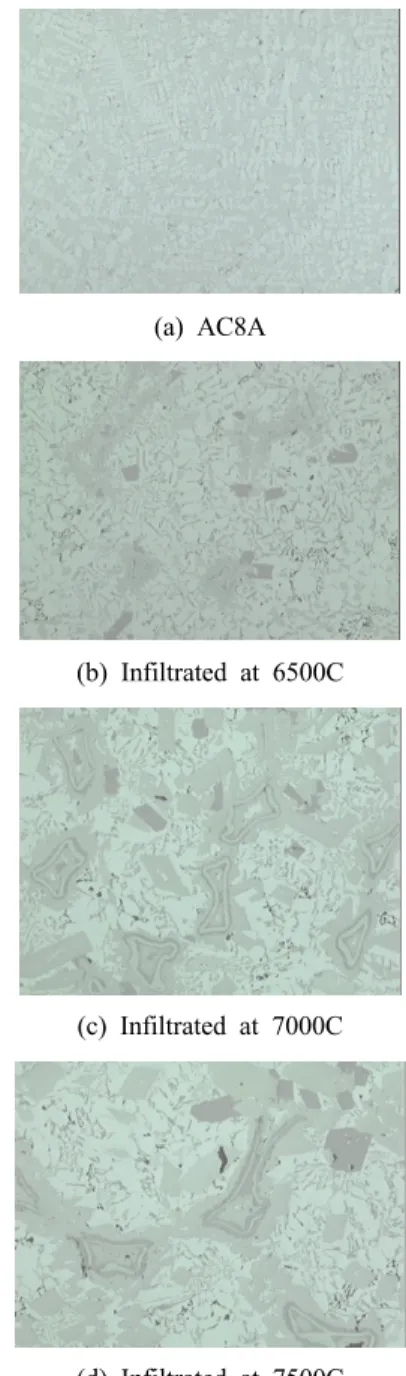
Fig. 2 exhibits the observed microstructures according to the respective infiltration temperatures.
Since the porous perform is easier to infiltrate than the perform composed of fibers and due to its sufficient space for the matrix metal to penetrate, it allowed sufficient infiltration even with a minimum pressure of 0.3 MPa during the manufacture of the composite.8)Moreover,observationofthestructureconfirm edthattherewerenoporesinthecompositecausedbyinfiltrat iondefects.Figure 2 reflects the microstructure of the composites in the optical microscope at 500X magnification. As reflected, figure 2 (a) is the microstructure of matrix metal, and in figure 2
(b, 650
°C), the grain size is the finest comparing with the composites fabricated at 700
°Cand 750
°C.
Infigure 2 (c: 700°C) and figure 2 (d:750°C), bright colored structures are more widely distributed compared to (a). Also, an observation of the characteristics of the reinforcement indicates that as the infiltration temperature increases, the relative surface area of the reinforcement diminishes, thereby
(a) AC8A
(b) Infiltrated at 6500C
(c) Infiltrated at 7000C
(d) Infiltrated at 7500C
Fig. 2 Microstructure of MMC (Ni/AC8A) by optical microscope
causing transformation in the boundary layer where it meets the matrix metal. Structures such as the red-colored grain showed uniform size and distribution regardless of the infiltration temperature.
The bright-colored grain structure, the size of the grain increased with the increasing of the fabricating temperature.
Because Ni/AC8A composites contain a variety of forms and characteristics, it is impossible to detect the characteristics of each respective structure using only the optical microscope. Therefore, to examine each unique structure and characteristics, XRD (X-ray diffraction) were employed. The structures generated by infiltration were examined using elemental analysis. Figure 3 shows the substances that were revealed through XRD (X-ray diffraction) analysis which included Al, Al3Ni,
Si and also Al compounds. In particular, the Al
3Ni substance is an intermetallic compound
9)that is created by molten reaction or during the manufacture of composites by casting, and as can be seen in the Al-Ni phase diagram, it is generated when a small quantity of Al reacts with the Ni element at a relatively low temperature. In general, the Al
3Ni substance has excellent hardness and strength but is very brittle. Therefore, when the grain size of Al
3Ni increases, its brittleness may cause an inversely negative effect on the composite. This effect of strength, which is dependent on grain size in conjunction with the characteristic of the intermetallic compound, is another matter that should be taken into consideration in the manufacturing of composites.
10-13)
The Al substance indicates the matrix metal, and the Si substance is the element that is most abundantly contained in the matrix metal AC8A and is assumed to be a precipitate formed during melting.
Fig. 3 Analysis of Ni/AC8A composites microstructure by XRD
The experiment condition for the Vickers’
hardness is load of 50g for 10seconds, each phases were measured 10 times.
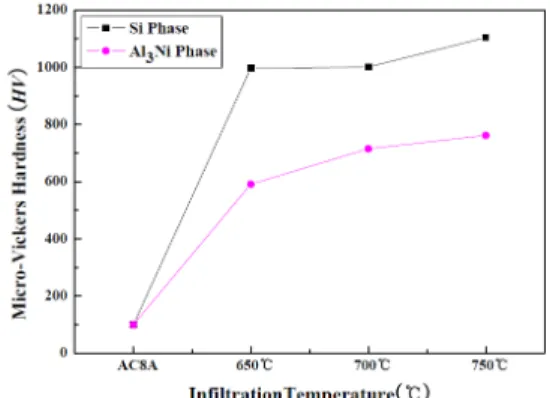
The Vickers hardness of matrix metal AC8A under room temperature is 99.7HV. Figure 4 exhibits the hardness average value of Si phase and Al3Ni
phase in composites infiltrated at 650
°C, 700
°C and 750
°C, respectively. With the increasing of temperature, both phases show an increase of hardness, and Si phase reached to the hardness peak at the fabricating temperature of 750
°C with the hardness of 1104HV, while Al
3Ni phase peaked with 762HV under fabricating temperature of 750
°C. The conclusion
Fig. 4 Vickers hardness of Al3Ni and Si phase in Ni/AC8A composites
can be drawn that with the participation of Si phase and Al
3Ni phase, the hardness of the composites will be improved.
To observe the influence of the intermetallic compounds or precipitated substances in the MMC, the wear characteristics of Nickel-reinforced MMCs were compared according to the infiltration temperature. In particular, the degree of wear of the composite was assessed by the friction coefficient and wear loss. Figure 5 shows the friction coefficient derived by conducting a wear experiment for 60 minutes. The friction coefficient formed an unstable curve for 20-30 minutes, and became relatively stabilized after 30 minutes. Table 2 organizes the friction coefficient and the wear loss data for each specimen. The friction coefficients confirm the wear resistances of MMCs which were reinforced with Ni were superior to those of the ACA8 specimens and that the composites were also superior in terms of wear loss. Because, the precipitated substances and intermetallic compounds with high hardness values contribute to improve the wear property. Comparing the wear properties according to the infiltration temperature, it was seen from this experiment that the relatively low temperature of 650 0C
led to superior wear resistance, and with the infiltration temperature increasing, the wear resistance inclined to deteriorate. These results of the wear test appear to have been influenced by the grain size of the brittle intermetallic compound which reacted accordingly with the temperature. Compared to the dense structure at 650
0C, the precipitated substances such as the brittle compounds of Si, Al
3Ni compounds etc. began to crystallize and size increased with the infiltration temperature increasing, which caused the decrease in wear resistance.
Fig. 5 Coefficient of friction on Ni/AC8A composites
5. Conclusions
Ni/AC8A MMCs were manufactured by the low pressure infiltration method and tested their characteristics. The findings are summarized as:
(1) The microstructures of the MMC revealed that there were differences in the precipitated or generated substances according to the infiltration temperature. While the structures of compounds created at 650 0C
were distributed densely, the grain size of the substances and the compounds was increased with the infiltration temperature.
(2) The molten reaction precipitated the Si substance as well as the intermetallic compound Al3Ni,
and while these structures have high hardness value. It was also observed that as the temperature at the time of the infiltration increases, the grain size of the Al
3Ni was enlarged. In the case of the reinforcement, as the infiltration temperature increases it disappears in the molten reaction, leading to the decrease in the amount of pure Ni that had been added as the reinforcement.
(3) Wear tests on the MMCs revealed that it had greater wear resistance properties than the matrix structure (AC8A), however, as the infiltration temperature increases, the wear properties cut down.
The matrix metal which showed fractures of abrasive wear cracked under the load of the counterpart material which led to unstable friction coefficients and the deterioration of wear loss.
References
1. C. S. Liauo, J. C. Huang, 1999, Materials Science and Engineering A 271 1-2 pp.79 2. H. K. Lee, C. Jin, K. Cho and I. M. Park,
1995, J. of the Korean Inst. of Met. & Mater.
33, pp. 242.
3. J. C. Lee, G. H. Kim, J. I. Lee and H. I. Lee, 1997, Met. Trans A. 28, pp. 1251.
4. Anil Borah, P. S. Robi , Ajit L. Mujumdar, 2008, A. Srinivasan, Met. & Mater. International 14, pp. 123.
5. S. H. Lee, S. H. Choo and M. H. Rhee, 1997, J. of the Korean Inst. of Met. & Mater. 35 1, pp. 104.
6. Clyne, T. W. and Mason, J. F., Metal I. 1987, Trans 18A, pp. 1519.
7. T. H. Song, H. J. Lee, Y. B. Choi, S. J. Kim and W. J. Park, 2008, J. of Ocean Engineering and Technology 22 5, pp. 106.
8. W. J. Park, Md. A. Hossian, Y. B. Choi, S. H.
Park, S. C. Huh, 2007, J. of Mechanical Science and Technology 21, pp. 1649.
9. Huabin Wang, Derek O. Northwood, 2008, Intermetallics 16 3, pp. 479-484.
10. C. Curfs, X. Turrillas, G. B. M. Vaughan, A. E.
Terry, A. Kvick and M. A. Rodríguez, 2007, Intermetallics 15, pp. 1163–1171.
11. J. B. Fogagnolo, E. M. J. A. Pallone, D. R.
Martin, C. S. Kiminami, C. Bolfarini, W. J.
Botta, 2009, Journal of Alloys and Compounds 471 1-2, pp. 448.
12. Y. Fukui, N. Yamanaka, Y. Enokida, 1997, Composites. Part B, Engineering 28 1-2, pp. 37.
13. H. Chen, A. T. Alpas, Wear 192 1-2 (1996),
pp. 186-198.