1. Introduction
Saving the fabrication cost of crystalline silicon is one of the important tasks to reduce material costs in Si solar cells. One possible approach to reach this goal might be epitaxial growth of thin Si film on glass substrate so that the fabrication cost of Si wafer by crystal growing, slicing, and polishing can be eliminated.
Solid phase crystallization (SPC) of an amorphous Si film has been approached to grow a polycrystalline silicon (poly-Si) film for low-cost solar cells
1,2). But the grain size of the Si film with the SPC process is too small. Al induced crystallization (AIC) of a-Si film was employed to increase the grain size of Si film
3,4). However, the thickness of Si film grown by the process ranges from 50 to 100 nm, which is too thin to be used for Si solar cells
5,6). We need thicker film with a large grain sizes. For the thick film, a poly-Si film grown by AIC process was used as seed layer and an epitaxial Si film with a thickness of 2 to 6 μm was grown at 1,130°C by hot wire chemical vapor deposition on
alumina substrate
7,8). The highest conversion efficiency of the Si solar cell with the film was close to 11%
9,10).
We utilize the same AIC process for the growth of epitaxial Si. We grow an epitaxial Si film at low temperature (450°C) instead of high temperature (1,100°C). For the epitaxial growth, Si source is continuously supplied from SiH
4gas, not from a-Si.
The Si supplied from SiH
4gas will be dissolved in the Si-Al solid solution layer and precipitated on the existing Si crystal.
As a result, it is expected that a thick epitaxial Si film can be grown at low temperature by Al-assisted crystal growth.
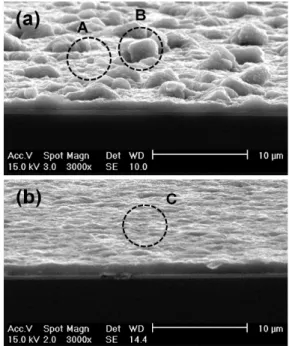
It was found that the epitaxial growth of Si film on Al metal layer resulted in a severe surface roughness with uncontrollable Al contamination. To reduce the surface roughness, we introduced a thin a-Si layer on the Al metal layer as a crystal Si seed layer.
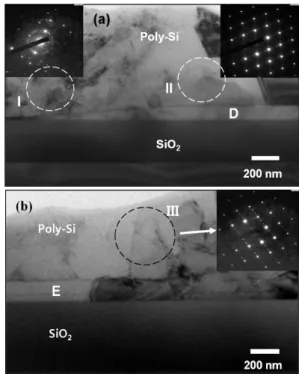
As a result, the surface roughness was much improved and the crystallinity of the film was also greatly improved.
2. Experimental
A SiO
2-grown p-type Si (100) wafer and Corning glass was used as substrates. The silicon oxide was grown by wet oxidation at 1,050°C to a thickness of 500 nm to prevent
Low-temperature Epitaxial Growth of a Uniform Polycrystalline Si Film with Large Grains on SiO 2 Substrate
by Al-assisted Crystal Growth
Kyung Min Ahn
1,2)․ Seung Mo Kang
1)․ Seon Hong Moon
1)․ HyukSang Kwon
1)․ Byung Tae Ahn
1)*
1)
Department of Materials Science and Engineering, Korea Advanced Institute of Science and Technology, Yuseong-gu, Daejeon 305-701, Korea
2)