49
ABBREVIATIONS: CMP, Cordyceps militaris protein; SDS-PAGE, sodium dodecyl sulfate-polyacrylamide gel electrophoresis; HPLC, high-performance liquid chromatography; PMSF, phenylmethylsul- fonyl fluoride; DMSO, dimethyl sulfoxide; EDTA, ethylenediamine- tetraacetic acid.
Corresponding to: Ha Hyung Kim, Physical Pharmacy Laboratory, College of Pharmacy, Chung-Ang University, 221, Huksuk-dong, Dongjak-gu, Seoul 156-756, Korea. (Tel) 82-2-820-5612, (Fax) 82-2-823-5612, (E-mail) [email protected]
Antifungal and Anticancer Activities of a Protein from the Mushroom Cordyceps militaris
Byung Tae Park, Kwang Heum Na, Eui Cha Jung, Jae Wan Park, and Ha Hyung Kim Physical Pharmacy Laboratory, College of Pharmacy, Chung-Ang University, Seoul 156-756, Korea
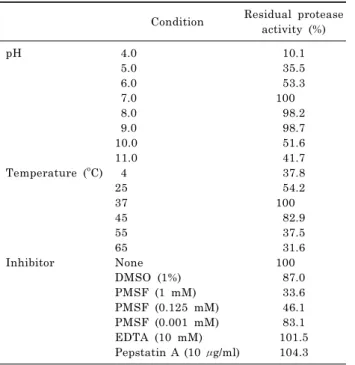
The mushroom Cordyceps militaris has been used for a long time in eastern Asia as a nutraceutical and in traditional Chinese medicine as a treatment for cancer patients. In the present study, a cytotoxic antifungal protease was purified from the dried fruiting bodies of C. militaris using anion-exchange chromatography on a DEAE-Sepharose column. Electrophoretic analyses indicated that this protein, designated C. militaris protein (CMP), has a molecular mass of 12 kDa and a pI of 5.1. The optimum conditions for protease activity were a temperature of 37
oC and pH of 7.0∼ 9.0. The enzyme activity was specifically inhibited by the serine protease inhibitor phenylmethylsulfonyl fluoride. Amino acid composition of intact CMP and amino acid sequences of three major peptides from a tryptic digest of CMP were determined. CMP exerted strong antifungal effect against the growth of the fungus Fusarium oxysporum, and exhibited cytotoxicity against human breast and bladder cancer cells. These results indicate that C. militaris represents a source of a novel protein that might be applied in diverse biological and medicinal applications.
Key Words: Mushroom, Cordyceps militaris, Protease, Antifungal activity, Cytotoxicity
INTRODUCTION
Mushrooms contain numerous compounds that exhibit in- teresting biological activities, including antibacterial, anti- fungal, antiviral, antitumor, antiproliferative, immunomo- dulatory, lectin-like, protease, and nuclease activities (Ng 2004; Lindequist et al, 2005). The mushroom Cordyceps militaris is a species of entomogenous fungus that is para- sitic on insects, attacking the underground pupae and lar- vae of lepidopteran insects. These fungi produce inhibitors of the phenoloxidase-activating systems of insects, and then they secrete various enzymes that facilitate the infection of parasites, which then proliferate within the insects (St Leger et al, 1987; Watanabe et al, 2006).
C. militaris has been used for a long time in eastern Asia as a nutraceutical and in traditional Chinese medicine as a treatment for cancer patients. The biological functions of its chemical constituents, including cordycepin (Cunning- ham et al, 1950), polysaccharide (Yu et al, 2004), and en- zymes (Hattori et al, 2005; Kim et al, 2006) has been re- ported, and we recently purified a lectin from C. militaris that showed mitogenic activity against mouse splenocytes (Jung et al, 2007).
In the present study, we purified a novel protease from C. militaris, designated C. militaris protein (CMP), which exhibits antifungal activity and cytotoxicity against human cancer cells, and the molecular properties of CMP, includ- ing molecular mass, isoelectric point, number of subunits,
amino acid composition, and partial amino acid sequence.
METHODS Purification
Dried fruiting bodies (1 g) of C. militaris mushrooms were collected in Yangpyong, Korea, and homogenized and ex- tracted overnight in 10 mM Tris-HCl (pH 8.0) at 4
oC. The homogenate was dialyzed against the same buffer for 3 days, filtered using a 0.45 μm membrane filter, and sub- jected to centrifugation at 1,000 g for 30 min. The super- natant was then loaded onto an anion-exchange column (3×8 cm) of DEAE-Sepharose (Sigma-Aldrich, St Louis, MO, USA) that had been equilibrated in 20 mM Tris-HCl (pH 8.0), and the protein was eluted by stepwise increase of the NaCl concentration from 0 to 1.0 M in 10 mM Tris-HCl (pH 8.0). Eluted fractions (1 ml of each) were stored at 4
oC.
The protein concentration was determined by the method of Bradford (Bradford, 1976), using bovine serum albumin as the standard.
Electrophoretic analyses
Sodium dodecyl sulfate-polyacrylamide gel electro-
phoresis (SDS-PAGE) was performed according to the
method of Laemmli (Laemmli, 1970) using a 15% acryl- amide slab gel in the presence and absence of 2-mercaptoethanol. The gel was stained with Coomassie Brilliant Blue R-250 or silver nitrate. Isoelectric focusing (IEF) was carried out on a gel using a 2% ampholyte IEF-ready gel (pH 3∼10) according to the manufacturer’s instructions (Bio-Rad, Hercules, CA, USA).
Gel-filtration chromatography
Gel-filtration chromatography was performed using a TSK-GEL G3000SW column (Tosoh, Tokyo, Japan) with a conventional high-performance liquid chromatography (HPLC) system (Shimadzu, Kyoto, Japan) equilibrated with 20 mM Tris-HCl (pH 8.0) containing 0.1 M NaCl at a flow rate of 0.5 ml/min, and monitored at 280 nm. Molecular mass markers (13.7∼2,000 kDa) were used with gel-filtra- tion calibration kit (Amersham Biosciences, Piscataway, NJ, USA).
Protease activity
Protease activity was measured using the EnzChek Protease Assay Kit (Invitrogen, Groningen, NL, USA) ac- cording to the manufacturer’s instructions. This kit de- termines the rate of hydrolysis of casein labeled with pH-in- sensitive green-fluorescent BODIPY dye. CMP or bovine pancreatic trypsin (Sigma-Aldrich, St Louis, MO, USA) was incubated with 2 μM substrate at 37
oC, and the appear- ance of hydrolyzed peptide labeled with fluorescent BODIPY dye was measured using a microplate reader (GENios-Pro, Tecan, Durham, NC, USA) with excitation at 492 nm and emission at 535 nm. Protease activity was ex- pressed as the fluorescence change per minute, and the de- tection limit was defined as the amount of enzyme required to cause a 10% change in fluorescence compared to the con- trol sample. The specific activity was expressed as the ratio of protease activity per protein (mg/ml). The kinetics pa- rameters of the hydrolysis reaction were determined from Lineweaver-Burk plots.
Optimal pH and temperature and effect of inhibitors CMP dissolved in neutral buffer was dialyzed first over- night against Milli-Q at 4
oC, and then against buffers with pH values ranging from 4.0 to 11.0. The buffers contained 0.1 μM NaCl and 20 mM citric acid for pH 4.0, 5.0, and 6.0; 20 mM Tris-HCl for pH 7.0, 8.0, and 9.0; or 20 mM NaHCO
3-NaOH for pH 10.0 and 11.0. The dialyzed CMP was then assayed for protease activity. In the neutral con- dition, protease activity was measured after incubating CMP for 1 h at 4, 25, 37, 45, 55, and 65
oC. Phenylmethylsul- fonyl fluoride (PMSF, in 1% dimethyl sulfoxide, DMSO), ethylenediaminetetraacetic acid (EDTA), and pepstatin A (in 1% DMSO) were used as protease inhibitors. Control samples contained either no protease inhibitors or 1%
DMSO.
Amino acid composition
CMP (30 μg) was hydrolyzed in vacuo with 6 N HCl for 24 h at 110
oC. For the analysis of cysteic acid and Trp, oxidized CMP (30 μg) treated with performic acid and hy- drolyzed CMP (30 μg) with methanesulfonic acid were pre- pared, respectively. PITC-amino acids were analyzed by
HPLC (Waters, Milford, MA, USA) with Nova-Pak C18 col- umn (3.93×300 mm).
Amino acid sequence
CMP (20 μg) was applied to a 15% SDS-PAGE gel, elec- troblotted onto a PVDF membrane (Bio-Rad, Hercules, CA, USA), and analyzed using an Automatic Protein Sequencer (476A-01-120, Applied Biosystems, Foster city, CA, USA).
In order to obtain the amino acid sequence, CMP was sub- jected to in-gel digestion with trypsin (Promega, Madison, WI, USA), and the digestion products were desalted and concentrated. MS/MS of peptides generated by the in-gel digestion was performed by nano-ESI on a mass spec- trometer (Q-TOF2, Micromass, Milford, MA, USA). Product ions were analyzed using an orthogonal TOF analyzer fitted with a reflector, a microchannel plate detector, and a time-to-digital converter. The data were processed using a PC running Mass Lynx software on the Windows NT environment. Sequence homologues were searched for us- ing BLAST (www.ncbi.nlm.nih.gov/BLAST.cgi).
Antifungal activity
Standardized fungal strains Fusarium oxysporum and Botrytis cinerea were purchased from the ATCC (American Type Culture Collection, Rockville, MD, USA). The anti- fungal activity was assessed as described previously (Moreno et al, 2003). Briefly, antifungal activity was meas- ured under sterile conditions using Petri dishes containing 15 ml of potato dextrose agar (39 g/l). The mycelium of the fungi was inoculated in the middle of the plate. After 3∼4 days, the discs were wetted with serial fivefold dilutions of CMP, after which the dishes were incubated at 37
oC for another 24∼48 h.
Cytotoxicity against human cancer cells
The human cell lines MCF-7 (breast cancer), 5637 (bladder cancer), and A-549 (lung cancer) were purchased from the KCLB (Korean Cell Line Bank, Seoul, Korea). The cells were incubated at 6×10
4cells/0.1 ml/well with 100 μl of serial threefold dilutions of CMP in 96-well culture plates (Costar, Cambridge, MA, USA) at 37°C for 72 h in a hu- midified atmosphere of 5% CO
2. The percentage viability of cancer cells was determined by performing a CCK assay (Dojindo, Kumamoto, Japan) according to a modified ver- sion of Mosmann’s method (Mosmann, 1983) and calculated as described previously (Kim et al, 2004).
RESULTS
Purification and molecular characterization
Crude protein extract from C. militaris was subjected di-
rectly to anion-exchange chromatography on a DEAE-
Sepharose column. After washing the unbound fractions,
stepwise elution with a buffer containing NaCl produced
five major peaks (Fig. 1). SDS-PAGE analysis on a 15% gel
revealed that fractions 446∼462 eluted at 0.1 M NaCl con-
tained CMP. These fractions showed a single band corre-
sponding to a molecular mass of 12 kDa under both non-
reducing (lane 2, 4) and reducing conditions (lane 3), re-
gardless of whether the gel was stained with Coomassie
Fig. 1. Elution profile of C. militaris protein extract applied to DEAE-Sepharose anion-exchange column chromatography, showing absorbance at 280 nm and NaCl concentration gradient.
Fig. 2. (A) SDS-PAGE and (B) IEF gel of purified CMP. Lane 1, standard protein markers; lane 2, CMP without 2-mercaptoethanol;
lane 3, CMP with 2-mercaptoethanol; lane 4, CMP stained with silver nitrate; lane 5, standard pI markers; lane 6, CMP.
Fig. 3. (A) Comparison of the protease activities of CMP (●) and trypsin (■) using casein as a substrate. Protease activity is expressed as the fluorescence change per minute. (B) Lineweaver- Burk plots of casein hydrolysis by CMP (●) and trypsin (■).
Table 1. Summary of CMP purification from C. militaris
Fraction Protein
(mg/ml) Volume
(ml) Protease
activity
aSpecific
activity
bRelative
purification Yield (%) Crude protein extract
CMP 12.6
0.2 7
15 471.1
130.4 37.4
652.0 1
17.4 100.0
3.4
a