INTRODUCTION
Background and Significance
Aggressive behavior frequently occurs among nursing home residents, particularly those with cognitive impair-
ment. The prevalence of aggressive behavior in nursing home residents has been reported as 74-96% (Oh, Eom,
& Kwon, 2004; Oh, 1998; Ryden, Bossenmaier, &
McLachlan, 1991; Souriel, McCusker, Cole, &
Abrahamowicz, 2001). Ryden (1988) defined aggressive behavior as “a hostile action directed towards other per-
Development and Analysis of the Effects of Caregiver Training Program on
Aggressive Behavior in Elders with Cognitive Impairment
Heeyoung Oh, PhD, RN
1, Myung-Haeng Hur, PhD, RN
2, Miran Eom, PhD, RN
1Purpose. The purposes of this study were to 1) describe the type and frequency of aggressive behavior of cogni- tively impaired nursing home resident, 2) develop a caregiver training program on prevention and manage- ment of aggressive behavior, 3) examine the effects of caregiver training program on the incidence of aggressive behavior of cognitively impaired nursing home resident, and 4) examine the effects of caregiver training program on nursing staff’s aggressive behavior management skills.
Methods. One-group, time series, quasi-experimental design with a pre-test and two post- tests was used. Data were collected from cognitively impaired home residents (N = 32) and nursing staff (N = 36) in a proprietary nursing home using Ryden Aggression Scale I, II, and Aggressive Behavior Management Scale. Data were entered and analyzed by descriptive statistics and repeated measures ANOVA.
Results. Incidence of aggressive behavior was high with a mean score of 3.09 (SD = 3.11) at baseline. Caregiver training program was developed based on Progressively Lowered Stress Threshold (PLST) model and gerontological and psychiatric literature. The mean scores of aggressive behavior at baseline, Post I, and II did not differ significantly although the difference approached to the significant level (F = 2.925, p = .066).
Nursing staff’s aggressive behavior management skills increased at Post I, and at Post II when compared to baseline, and the difference was significant (F=12.736, p=<.001).
Conclusion. Caregiver training program showed potential impact on reduction of aggressive behavior in elders with cognitive impairment and was effective in increasing nursing staff’s aggressive behavior management skills.
Key Words : Aged, Aggression, Dementia
1. Associate professor, Eulji University, School of Nursing 2. Assistart professor, Eulji University, School of Nursing
This work was supported by the Korea Research Foundation Grant (KRF-2002-041-E00263)
Corresponding author: Myung-Haeng Hur, PhD, RN, Eulji University College of Nursing, Assistart professor, Joong Gu Yong Du 2 Dong 143-5, Taejon 305-762, Korea.
Tel: 82-42-259-1714 Fax: 82-42-259-1709 E-mail: [email protected]
Received March 6, 2005 ; Accepted June 17, 2005
sons or objects or towards oneself.” Aggressive behavior is characterized by resistance to care, verbal outburst, and physical combativeness. Aggressive behavior may be caused by frustration arising from lack of ability to perform certain task or inability to understand the pur- pose of an activity (Neugroschl, 2002). The frustration caused by loss of control, inability to release tension through physical activity, muscular discomfort, and pos- sibly the unmet needs are likely to be expressed in ag- gressive behavior as a futile attempt to gain control.
There are three types of aggressive behaviors reported in the literature (Marx, Cohen-Mensfield, & Warner, 1990; Oh, 1998; Ryden, Bossenmaier, & McLachlan, 1991). These include physical aggressive behavior (PAB), verbal aggressive behavior (VAB), and sexual aggressive behavior (SAV). Many gerontological nurses find that ag- gressive behaviors are abusive, distressing, and potential- ly dangerous and are mostly targeted towards nursing staff or residents. Nevertheless, nursing staff often under report and take it as “just part of the job” (Beck, Robinson, & Baldwin, 1992).
In many nursing homes, nursing assistants provide most of direct care to the residents. Therefore, experi- encing aggressive behaviors is often unavoidable.
Providing nursing care to aggressive residents can be ex- tremely difficult and stressful to nursing assistants.
Nursing staff experience various emotional reactions such as anger, frustration, and fear (Oh, 2000). Negative impact of aggressive behavior is commonly noted in the literature. Nursing staff’s inability to cope with the emo- tional and physical stress from aggressive behavior can lead to dissatisfaction, reciprocal aggression against the residents (Oh, Eom, & Kwon, 2004), low staff morale, and high staff turnover(Hagen & Sayers, 1995).
Unfortunately, nursing staff in nursing homes have mini- mal training on management of aggressive behaviors (Gates, Fitzwater, & Deets, 2003). In a recent study, caregivers reported that ‘don’t know what do’, ‘ignore the situation’, or ‘confront’ in the episode of aggressive behavior (Oh, Eom, & Kwon, 2004). The findings pro- vide evidence of lack of caregiver training on how to manage aggressive behaviors.
In the past few years, there has been a growing aware- ness among gerontological nursing researchers and nurs- ing home staff that many episodes of aggressive behavior may well be related to nursing staff’s lack of knowledge regarding aggressive behavior, inappropriate interaction with cognitively impaired residents, and ineffective com-
munication skills. This implies that although a certain degree of aggressive behavior is unavoidable, many episodes of aggressive behavior can be prevented or re- duced by educating and training nursing staff. Hagen and Sayer (1995) assert that educational programs are not only needed, but can also be effective in helping staff to prevent many incidences of aggressive behavior from oc- curring.
In western countries, researchers conducted experi- mental studies testing caregiver training program under supportive therapeutic milieu (Burgio et al., 2002;
DeYoung, Just, & Harrison, 2002; Gormley, Lyons, &
Howard, 2001; Hagen & Sayer, 1995) to prevent or re- duce the incidence of aggressive behavior. Researchers employed various aggressive behavior management strategies, guidelines, and skills in long term care set- tings. In a study by DeYoung and colleague (2002), both behavioral and environmental strategies were incorpo- rated in management strategies. Their program was de- veloped based on the fact that modifying environmental demands to create a supportive and less challenging at- mosphere would support more adaptive behavior for pa- tients with dementia ( Hall & Buckwalter, 1987). In an- other study by Burgio et al. (2002), in-service classes and hands on training was provided to nursing staff.
Researchers taught nursing staff to increase effective nonverbal and verbal communication skills (e.g., appro- priate eye contact, announcing single activities, and de- laying physical assistance following a verbal prompt) and decrease ineffective communication skills (e.g., announc- ing multiple activities and using multiple verbal prompts). They also taught to increase the use of effec- tive antecedent and consequent behavioral techniques (e.g., distraction and diversion) and decrease ineffective response (e.g., arguing with residents). Similarly, Fitzwater and Gates (2004) suggested 12 aggression-pre- vention skills based upon reviews of the literature and their personal experiences. Authors explained that pa- tient, staff, and environmental factors (e.g., anger, poor sleep, or frustration, inadequate training, workload, noise, and crowded spaces) trigger aggressive behavior, so such factors need be removed to prevent aggressive behaviors.
Despite high prevalence of aggressive behavior among
Korean demented elders residing in nursing home (Oh,
Eom, & Kwon, 2004; Oh, 1998), experimental research
testing the effect of caregiver training program on ag-
gressive behavior of demented elders is rare. This study,
therefore, was conducted with Korean demented elders in a nursing home as a continuation of what has been done in western countries.
Purpose of the study
The purposes of this study were to
1) describe the type and frequency of aggressive be- havior of cognitively impaired nursing home resident.
2) develop a caregiver training program on prevention and management of aggressive behavior.
3) examine the effects of caregiver training program on the incidence of aggressive behavior of cognitively im- paired nursing home resident.
4) examine the effects of caregiver training program on nursing staff’s aggressive behavior management skills.
METHODS
Design
This study used one-group, time series, quasi-experi- mental design with a pre-test and two post- tests to eval- uate the effects of caregiver training program on inci- dence of aggressive behavior of nursing home residents and on nursing staff’s aggressive behavior management skills.
Setting and Sample
The study was conducted in a proprietary nursing home located in urban in Choongchung providence. The resident subjects were required to meet the following in- clusion criteria: (a) 65 years or older (b) have cognitive impairment (MMSE score < 24) (c) stayed in nursing home 1 month or longer (d) demonstrate aggressive be- havior more than once per month and (e) agreed to par- ticipate. Nursing staff, nurses and nursing assistants, who met the following inclusion criteria were eligible for the study: (a) provide direct care to residents more than 3 days per week and (b) agreed to participate.
Procedure
Data were collected from April, 2003 to August, 2003.
Researcher contacted administrator and explained the purposes, procedures, benefits and risks involved in the study. After obtaining agreement from administrator, re- searcher met potential subjects including residents and nursing staff. Subjects were informed about the study and that their participation was voluntary and assured of anonymity. Consent was sought from families and
guardians for cognitively impaired residents. Written consents were obtained from nursing staff.
Residents were screened to identify resident who demonstrate aggressive behavior more than once per month. One licensed nurse and two nursing assistants were asked to evaluate each residents on their aggressive behaviors using RAS I, the retrospective measure. Of 111 residents evaluated using RAS I, 39 subjects were screened as aggressive at least once per week. Next, baseline data were obtained. Close observation and recording of aggressive behaviors on RAS II were con- ducted for 3 days. At baseline, characteristics of resi- dents were assessed by researcher and demographic data were obtained from medical records. Upon completion of data collection at baseline, the education part of the training program consisted of a series of four structured educational sessions, each 60 minutes in length, was pro- vided by researchers over a four week period. Then, re- inforcement sessions were conducted over an eight week period. Throughout the 12weeks of the intervention pe- riod, researchers stayed at the nursing home, day and evening shift 2 times per week. Researchers assisted caregivers to implement strategies, role modeled effec- tive communications and tried out strategies described in the training program. Caregivers were encouraged to dis- cuss and share their experiences throughout the pro- gram. Upon completion of 12 weeks of intervention, ag- gressive behavior of the subjects was documented for 3 days (Post I). The period between the 13th week to the 16th week was intended to act as a weaning time from researcher guided intervention. Researchers were out at the nursing home once a week to meet caregivers to re- mind and encourage them to employ strategies learned in previous sessions. Then, aggressive behaviors were documented for 3 days at the end of the 16th week (Post II). Researcher and research assistants were available during the data collection period to provide support, an- swer questions, and monitor the staff’s documentation of RAS II. Nursing staff were asked to complete aggressive behavior management questionnaire at baseline, in the 12th week, and in the 16th weeks.
Measurements
The instruments originally developed in English were
translated into Korean by a researcher, then translated
back into English by two nursing professors who com-
pleted graduate study in the US. Any discrepancies were
discussed with two bilingual nursing scholars and the re-
visions were made upon agreement. Aggressive behavior was measured using RAS I and RAS II (Ryden, 1988).
The RAS I is a 26 item, 6 point likert scale that has 3 subscales: physically aggressive behavior (PAB), verbally aggressive behavior (VAB), and sexually aggressive be- havior (SAB). It is designed as a retrospective measure, score ranges from 0 (none) to 5 (more than once/day) with higher score indicating higher frequency of aggres- sive behavior. Inter-rater reliability of RAS I was .89 (Oh, Eom, & Kwon, 2004). RAS II include 26 items of aggressive behavior listed in a table form with space for recording the number of times each behavior is ob- served. Cronbach’s alpha of RAS II was .80 (Ryden, 1999). Nursing staff’s management skills for aggressive behavior was assessed using Aggressive Behavior Management Scale (ABMS). The ABMS was developed based on aggression prevention skills suggested in the lit- erature (Hagen & Sayers, 1995; Ryden & Feldt, 1992).
The ABMS has 10 items with response options ranging from 0(never) to 4(always). For example, nursing staff were asked to respond to the statement, “Use calm voice and attitude at all times”, “Allow sufficient time when providing nursing care”, “Call name before touch- ing”. Total score of ABMS is 40 with higher score indi- cating better management skills for aggressive behavior.
The Cronbach’s alpha for this study sample was .86.
Resident’s characteristics on cognitive status and func- tional status were measured using Folstein Mini Mental State Exam (Folstein, Folstein & McHugh, 1975) and Modified Barthel Index (Fricke & Unworth, 1997). The internal consistency of MMSE was .99 (Tombaugh &
McIntyre, 1992) and that of Modified Barthel Index was .92 (Oh, Eom, & Kwon, 2004) respectively.
Development of the caregiver training program Progressively Lowered Stress Threshold (PLST) model (Hall & Buckwalter, 1987) and gerontological and psy- chiatric literature served as the theoretical framework in development of educational training program. In PLST model, Hall and Buckwalter proposed that behavioral problems result from excess environmental stress. The stress threshold is lower in cognitively impaired persons which increases to cause anxiety and therefore increases dysfunctional behavior. Stress can be caused by numer- ous factors, for example, fatigue, multiple stimuli, and demand that exceed abilities. This model implies that ag- gressive behavior can be managed by reducing environ- mental stress and by modifying caregiver approaches. In
addition, in-depth review of gerontological and psychi- atric literature was conducted. Researcher incorporated techniques and strategies suggested in the work of four expert groups of DeYoung, Just, & Harrison, 2002;
Mistretta & Kee, 1997; Gardner, Hall, & Buckwalter, 1996; Maas, Swanson, Specht, & Buckwalter, 1994.
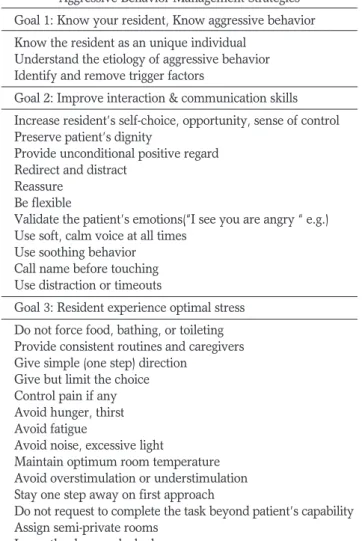
Researcher obtained consultation from three gerontolog- ical nursing experts to ensure the content validity of the program. The program was designed relatively short to optimize the ability of caregivers to complete the train- ing sessions and to maximize the actual adoption of strategies in caregiving settings. The objectives, contents of program and specific management strategies are de- scribed in (Table 1) and (Table 2).
Data analysis
Data were analyzed using SPSS/PC 12.0. Descriptive statistics were used to examine demographic characteris- tics of subjects, frequency, and types of aggressive be- havior. The repeated measures ANOVA analysis was used to compare the incidence of aggressive behavior and nursing staff’s management skills for aggressive be- havior at baseline, at the 12th week (Post I) and at the 16th week (Post II).
Limitations of study
The research sample was a non-random convenient sample in the settings to which the researcher had access for data collection. Thus, generalizability of the findings is limited . Also, interpretation of the study result should be regarded with caution because of relatively small sample size and use of one experimental group without a control group. The lack of a control group made it diffi- cult to state with any confidence that it was the training program per se which was responsible for changes in fre- quency of aggressive behavior among demented elders or nursing staff’s management skills for aggressive be- havior.
RESULTS
Characteristics of subjects (N = 32)
A total of 111 residents were screened and 39 elderly subjects were eligible for participation. At the beginning of study, 39 subjects participated. Subjects who trans- ferred to other facility (n = 1) and who had significant decline in physical condition (n = 1) were excluded.
Also, data with incomplete/invalid documentation on
RAS II at any measurement point (n = 5) were excluded.
The final 32 subjects’ data were entered for data analy- sis.
The mean age of the residents was 79.47 years (SD = 7.12) ranged from 65 to 93 years. Seventy two percent
(n = 23) were female; all were Korean. Forty-seven per- cent (n = 15) were married and about 59% (n = 19) had no education. All subjects had cognitive impairment.
The MMSE score ranged from 0 to 23 with the mean score of 10.75 (SD = 5.95). About 16% (n = 5) were to- tally dependent for physical functioning and the majori- ty had severe (21.9%, n = 7) to moderate (21.9%, n = 7) dependency.
At baseline, 46 nursing staff participated. Of 46 nurs- ing staff, those who did not complete Aggressive Behavior Management Scale at post I, and II (n = 3) were excluded. Also nursing staff who failed to attend more than one of four educational training sessions (n = 7) were excluded. Data from 36 nursing staff were en- tered for final analysis. The age of the nursing staff ranged from 22 to 53 with the mean age of 34.9 years (SD = 7.67). About 61% (n = 22) were female. Mean length of nursing experience was 25.2 months (SD = 21.7). The demographic characteristics of resident and nursing staff subjects are shown in (Table 3).
Type and frequency of aggressive behavior observed for 3 days at baseline
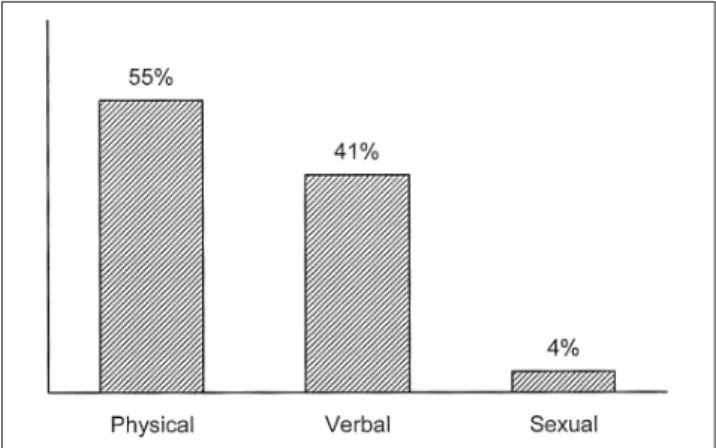
At baseline, 99 aggressive behaviors were documented on RAS II. The most frequently observed form was PAB (n = 54, 54.5%) followed by VAB (n = 41, 41.4%), and SAB (n = 4, 4.4%). Four most frequently observed ag- gressive behaviors were making verbal threats (n = 17, 17.1%), cursing/obscene/vulgar languages (n = 11, 11.1%), hostile language (n = 9, 9%), and making threatening gesture (n = 9, 9%). Frequency and types of aggressive behavior occurred at baseline are presented in (Figure 1) and (Figure 2).
Effect of caregiver training program on frequency of aggressive behavior of cognitively impaired nursing home resident (N = 32)
The mean score of aggressive behavior was 3.09 (SD =
Table 2. Objectives and Content Areas of Educational Sessions of Training Program
Session Objectives Content Area
1 Understanding cognitive impairment 1) Cause, incidence, symptoms, stages of dementia 2) Functional behavioral changes with cognitive loss 2 Understanding Aggressive behavior 1) Etiology & types of aggressive behavior
2) Trigger factors of aggressive behaviors 3 Improve Interaction/Communication Skills 1) Basic strategies for effective interaction
2) Communication with cognitively impaired elders
4 Know strategies 1) Specific strategies designed to reduce internal and external negative stimuli Table 1. Management Strategies for Aggressive Behaviors of
Elders with Cognitive Impairment
Aggressive Behavior Management Strategies Goal 1: Know your resident, Know aggressive behavior Know the resident as an unique individual
Understand the etiology of aggressive behavior Identify and remove trigger factors
Goal 2: Improve interaction & communication skills Increase resident’s self-choice, opportunity, sense of control Preserve patient’s dignity
Provide unconditional positive regard Redirect and distract
Reassure Be flexible
Validate the patient’s emotions(“I see you are angry “ e.g.) Use soft, calm voice at all times
Use soothing behavior Call name before touching Use distraction or timeouts
Goal 3: Resident experience optimal stress Do not force food, bathing, or toileting Provide consistent routines and caregivers Give simple (one step) direction
Give but limit the choice Control pain if any Avoid hunger, thirst Avoid fatigue
Avoid noise, excessive light
Maintain optimum room temperature Avoid overstimulation or understimulation Stay one step away on first approach
Do not request to complete the task beyond patient’s capability Assign semi-private rooms
Leave the doors unlocked Avoid physical restraint
Little staff and visitors traffic(avoid overcrowded places)
3.11) at baseline. When compared to baseline, the mean score of aggressive behavior decreased to 2.94(SD = 2.72) at Post I and to 2.56(SD = 2.66) at Post II, but the difference did not reach significant level (F = 2.925, p = .066). The changes in mean score of aggressive behavior overtime are presented in (Figure 3).
Effect of caregiver training program on nursing staffs’ aggressive behavior management skills.
(N = 36)
The mean score of nursing staff’s management skills for aggressive behavior increased at Post I (M = 21.83, SD = 4.53), and at Post II (M = 22.25, SD = 4.36) when compared to that of baseline (M = 18.75, SD = 3.56).
Table 3. Characteristics of Subjects
Nursing home residents (N = 32)
n % n %
Gender Marital status
Male 09 28.1 Married 15 46.9
Female 23 71.9 Widowed 13 40.6
Not married 01 03.1
Other/Unknown 03 09.4
Age MMSE
65-69 03 09.4 00- 10 13 40.6
70-79 16 50 11- 20 17 53.2
80-89 10 31.2 21- 23 02 06.2
90-93 03 09.4 Mean (SD) = 10.75(5.95)
Mean (SD) = 79.47(7.12)
Education Physical function
No education 19 59.4 Totally dependent 05 15.6
Elementary 08 25.0 Severely dependent 07 21.9
Middle School 02 06.3 Moderately dependent 07 21.9
High School & over 00 0 Slightly dependent 06 18.7
Unknown 03 09.4 Independent 07 21.9
Nursing staff (N = 36)
n % n %
Gender Education
Male 14 38.9 High school 17 47.2
Female 22 61.1 College & over 19 52.8
Age Length of nursing experience (months)
22-30 11 30.6 02- 6 06 16.7
31-40 16 44.4 07- 12 04 11.1
41-50 08 22.2 13- 23 08 22.2
51 & over 01 02.8 24- 36 11 30.6
Mean (SD) = 34.92(7.67) 37 & more 07 19.4
Mean(SD) = 25.19(21.7) Figure 1. Frequency of aggressive behaviors by nature occurred
for 3 days at baseline (N = 32)
Figure 2. Types of aggressive behaviors occurred for 3 days at baseline (N = 32)
Others
30% Verbal threats
17%
Cursing/
Obscene/Vulgar language 11%
Hostile language 9%
Making threatening gesture 9%
Pushing 8%
Hitting 8%
Grabbing 8%