- 54 -
A Study on Recovery from Smell Dysfunction Induced by 3-Methylindole in Rats*
Hun-Jong Dhong, M.D.
ABSTRACT
Background and Objectives:Evaluating the olfactory function is as important in animal research as morphological study.
However, it is difficult to gauge the smell function in rats because of the underdevelopment of current electrophysiologic mea- suring devices. The aim of this study is to assess changes in smell dysfunction induced by 3-methylindole (3-MI) in rats using an 8-odor olfactometer. Materials and Method:Eight female Sprague-Dawley rats were used. Ethyl acetate at 10
-4.0(v/v) concentration was used as an S+ odorant, and six different concentrations (10
-4.0, 10
-4.5, 10
-5.0, 10
-5.5, 10
-6.0, 10
-6.5) of butanol mixed with ethyl acetate were used as an S- odorant. S+ and S- stimuli were delivered randomly using the 8-odor olfactometer.
After injection of 3-MI at a dosage of 300 mg/kg, mixed odor discrimination test was performed for five weeks. Results:No- rmal rats were able to discriminate ethyl acetate from ethyl acetate mixed with butanol to a concentration down to 10
-6.2(v/v).
Immediately after the 3-MI injection, the rats lost all capacity for smell. From 16 days later, the smell function began improving spontaneously. At the end of the fifth week, the discrimination threshold was 10
-5.7(v/v), which was almost equal to the original level. Conclusions:Systematically administered 3-MI caused smell loss in rats. Though not completely, the smell function was recovered spontaneously. An olfactometer is a reliable and accurate device in evaluating the olfactory function in rats.
KEY WORDS:Olfactometer·3-methylindole·Rat·Recovery·Olfactory function.
INTRODUCTION
Two general and common methods in evaluating olfactory function are the detection threshold test and the identification test. These tests determine whether or not subjects can smell an odor by evaluating their response to a given stimulus. Psych- ophysical methods are used since a clinically applicable psych- ophysiologic test, such as one that can assess electrophysiologic phenomena, has yet to be developed.
1)In animal research, it is important to evaluate the actual status of the olfactory function because morphological change in the olfactory organ does not necessarily coincide with changes in the olfactory function.
2)Until an electrophysiologic test is developed to a desirable le- vel, psychophysical tests that observe the responses of animals to given stimuli must be used.
3)The 3-methylindole (3-MI), an olfactotoxicant, has been used in studies on olfactory fun-
ction regeneration, because it does not affect the respiratory epithelium but damages the olfactory epit-helium.
4)5)In this study, we systematically dosed Sprague-Dawley rats with 3-MI, which is known to damage the olfactory epithelium selecti- vely before regenerating it over time by partially accompanying fibrosis. The purpose of this study is to establish a foundation for studies on the olfactory function in rats by evaluating, th- rough the use of an olfactometer, the recovery process of da- maged olfactory function.
MATERIALS AND METHODS Materials
Eight female, 3-4-week-old Sprague-Dawley rats with he- althy outlooks and clean nasal cavities were used as subjects.
Two of each were put in acrylic boxes with sawdust on the floors and lattices on the upper sides, where water tubes were installed. The rats were kept in an environment where the te- mperature and humidity were maintained at 23.5±2℃ and at 50±5%, respectively, and the light was turned on and off ev- ery 12 hours. The rats were also fed sufficiently. For a period spanning two weeks before starting begin program to the end of this experiment, the subjects’ weights were maintained at 80% of their original weights by supplying only 5-10 ml of water a day.
*This study was conducted with the support of the Samsung Bi- omedical Research Institute C-97-011-2.
Department of Otorhinolaryngology, Sung Kyun Kwan Unive- rsity, College of Medicine, Samsung Medical Center
Address correspondences and reprint requests to Hun-Jong Dhong, M.D., Department of Otorhinolaryngology, Samsung Medical Center, 50 Ilwon-dong, Kangnam-gu, Seoul, 135-710, Korea
Tel:82-2-3410-3573, Fax:82-2-3410-3879
Accepted for publication on April 2, 1998
3-MI injection
We injected 3-MI 300 mg/kg intraperitoneally without an- esthesia four weeks after starting the mixed odor discrimina- tion test. The 3-MI was diluted to a 4% concentration in corn oil and injected under a ventilation hood due to its unpleasant smell.
Olfactometer
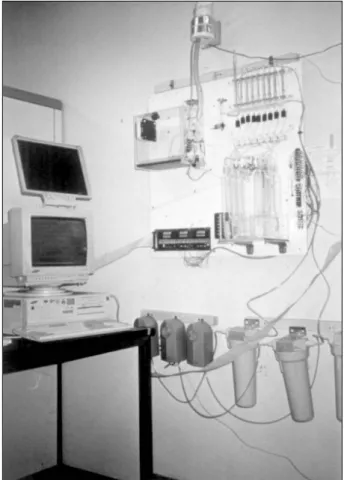
The olfactory function test was conducted using a Knosys 8-odor olfactometer and a program developed by Slotnick of American University (Washington D.C., USA) The olfacto- meter consisted of a test chamber, air flow meters, manifolds, an interface and a 486 IBM computer (Fig. 1). The interface, a Knosys 48 I/O board, was controlled through a CIO-DIO 48 internal interface and connected to the DIO 48 through a 50 line cable. The Knosys program was operated with QBASIC.
Stimulant odorant
For the test, 1% ethyl acetate diluted in distilled water and butanol of six different concentrations-1%, 0.5%, 0.1%, 0.05%, 0.01%, 0.005%-were used as the stimulant odorant. Every
passage of the stimulant odorant was made in glass and Tef- lon to prevent adhesion of smell. Air inducted through the air flow manifold of the olfactometer was pressed with an Optima air pump (Hagen Co., Ma, USA) and supplied as clean air th- rough a Charcoal filter (Omni Co., In, USA). The filtered air was then divided again into a clean main flow (2,000 cc/min), which was odorless, and an odor flow (20-30 cc/min). Bec- ause the stimulus odor flow is supplied to sampling tube mi- xed with clean main flow, the 1% liquid ethyl acetate diluted in distilled water resulted in a 0.01% vapor saturated with et- hyl acetate at a concentration of 10
-4.0(v/v).
Test chamber
The test chamber consisted of an acrylic box measuring 25
×16×23 cm and a sampling tube 3 cm in diameter for the odorant input. The sampling tube was mounted with a photo cell that generated light and a photo sensor that sensed light on the opposite side to detect the movements of the rats as they pushed their snouts into the sampling tube. Attached on the front of the test chamber was an electricity-conducting metal response tube (2 mm in diameter) through which water was supplied. The test chamber floor was made of conductible me- tal plates, so that, by monitoring for electric circuit through the rat from the metal plates to the response tube, the com- puter was able to detect when a rat licked up water from the response tube.
Operant training-the begin program
In this phase, rats were allowed water only when there was a certain smell, the smell of ethyl acetate. From two weeks before the operant training, only 5-10 ml water had been supplied a day, causing extreme thirst in rats.
The begin program was divided into three phases. In the first phase, water was supplied only when the rat touched the response tube. The rats were trained to lick at the water in the response tube 20 times per round. This procedure was repeated 4-5 times before proceeding to the second phase. In the se- cond phase, water was supplied only when a rat pushed its snout into the sampling tube. By pushing its snout in, the rat blocked the light to the photo sensor, which then triggered the interface to supply the water. After the rats were trained to lick at the water in the response tube 60 times per round, they were moved along to the third phase. In the third phase, the strongest odor concentration, 10
-4.0(v/v) ethyl acetate, was released 0.2 seconds after a rat pushed its snout into the sam- pling tube. Only after the rat had endured 0.12 seconds of the smell was water supplied through the response tube, for 0.15 seconds. The rats proceeded to the next step when they sho- wed correct responses in 200 trials.
Fig. 1. Overall view of the 8-odor olfactometer.
Odor detection test
The odor detection test was conducted on those rats that completed the previous three phases. For the S+ trial, ethyl acetate at a concentration of 10
-4.0(v/v) was used, and for the S- trial, clean air was used. In accordance with the Knosys program, the S+ and S- trials were each delivered ten times in a random pattern, and the combined 20 trials consisted of one session. During the S+ trial, water was supplied to the response tube when a rat smelled the odor for a certain period of time (for 0.12 second following closure of the final valve).
A correct response required that the rat makes at least seven licks on the water in the response tube, while less than seven licks was considered a miss. During the S- trial, it was con- sidered a correct rejection if the rat endured the odor for 0.12 second following closure of the final valve and made less than seven licks on the water in the response tube. A false alarm was recorded if the rat made more than seven licks during the S- trial. Each session was considered correct if the percenta- ges of correct responses and correct rejections in the 20 trials exceeded 80%. After ten correct sessions, the rats were ass- umed to be aware of the fact that they could have access to water only in the presence of the ethyl acetate odor.
Odor discrimination test
Those rats that passed the odor detection test were given the odor discrimination test. Clean air was used for the S- trial portion of the odor detection test. In the odor discrimination test, meanwhile, the use of butanol at a concentration of 10
-4.0(v/v) caused the rats to discriminate ethyl acetate and butanol.
Ten sessions were conducted, and the procedure and response criteria were identical to those of the odor detection test. One session consisted of 20 trials and the ratio of correct responses and correct rejections was calculated as the performance score.
When the performance score exceeded 80% in four consec- utive sessions, the animals were judged able to identify ethyl acetate and butanol.
Mixed odor discrimination test
After passing the odor discrimination test by identifying the odors of ethyl acetate and butanol, the rats were passed to the mixed odor discrimination test. The S+ stimuli supplied ethyl acetate at a concentration of 10
-4.0(v/v) only, while the S- stimuli consisted of 10
-4.0(v/v) ethyl acetate mixed with butanol at one of six concentrations. By gradually decreasing the concentrations, the weakest level of butanol discernible by the rats could be determined. The strongest concentration was made by mixing 10
-4.0(v/v) butanol. When their performance scores exceeded 80% in four consecutive times, the rats were
subjected to next S- stimuli, which used ethyl acetate mixed with a one-step weaker butanol concentration of 10
-4.5(v/v).
When the performance scores continued to stay above 80%
in four consecutive sessions, the butanol-mixed S- stimuli te- sts were conducted with butanol at concentrations of 10
-5.0, 10
-5.5, 10
-6.0, and 10
-6.5(v/v). The threshold concentration was the weakest concentration of butanol in the mixed odor disc- rimination test to evaluate olfactory function. Changes in the olfactory function were observed through the mixed odor di- scrimination test daily except Sundays for four weeks from one week after the injection of 3-MI.
RESULTS Begin program
The rats were severely dehydrated after having been supp- lied with only 5-10 ml of water a day for two weeks prior to the start of the odor detection test. When they happened to lick at the response tube while sniffing and licking here and there in the test chamber, water was supplied to the rats. The rats then continued to lick at the response tube, and through the process, they learned that water was supplied through the response tube.
After the first phase, the water supply was stopped, and lick- ing at the response tube no longer brought the expected result.
This caused the rats to sniff out other places, and when they happened to push their snouts into the sampling tube, the light sensor triggered the supply of water to the response tube. Thus, through trial and error, the rats recognized that water was su- pplied only when they put their snout into the sampling tube.
In the third phase, however, water was supplied to the resp- onse tube only after the rats had left their snout in the sampling tube for more than 0.2 second. At this time, ethyl acetate at a concentration of 10
-4.0(v/v) passed through the sampling tube to the rats. Though the learning period in the third phase was longer than in the second phase, the rats ultimately recognized that they could have water only by leaving their snouts in the sampling tube for an extended period of time. The begin pro- gram of the odor detection test took an average of four days, and rats that did not complete the third phase satisfactorily were moved back to the second phase.
Odor detection test
Those rats that completed the begin program showed correct
responses in the S+ trial, since they knew to expect water
after leaving their snouts in the sampling tube and smelling
the ethyl acetate. However, in the S- trial, which didn’t inv-
olve an odor, the rats exhibited false alarms by licking at the
response tube. When putting their snouts into the sampling tube
for the required period of time did not elicit water in the S-
trial, the rats became inattentive and the intervals between tr- ials became longer. But with repeat sessions, the rats learned there was no water in the S- trial and displayed correct reje- ctions. When the performance scores failed to exceed 80% in ten consecutive sessions, the third phase was repeated. Through this process, the rats recognized that they could drink water only when they put their snouts into the sampling tube and smelled the ethyl acetate. The learning process took three to four days.
Odor discrimination test
Rats that passed the odor detection test were subjected to the odor discrimination test. Unlike in the odor detection test, butanol at a concentration of 10
-4.0(v/v) was used in the S- trial. The performance scores were higher than 80% in four to seven sessions. The rats that recognized ethyl acetete as the cue for water learned easily to discriminate butanol from ethyl acetate. They licked at the sampling tube if they smelled ethyl acetate and did not if the odor was butanol.
Mixed odor discrimination test
In the mixed odor discrimination test, only ethyl acetate at a concentration of 10
-4.0(v/v) used in the S+ trial portion, while ethyl acetate at the same concentration was mixed with six different concentrations of butanol for the S- trial. We determined the lowest concentration of butanol that the rats could identify ethyl acetate from ethyl acetate mixed with bu- tanol. The mixed odor discrimination test lasted four weeks, and by the last week, all of the rats were consistently able to
discriminate the mixed concentrations down to a butanol co- ncentration of 10
-6.0(v/v). The average discrimination thre- shold was 10
-6.2(v/v).
Mixed odor discrimination test after injection of 3-MI
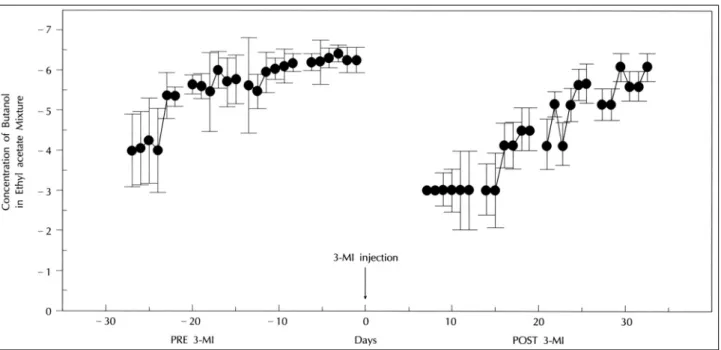
From one week after intraperitoneally injecting 300 mg/kg 3-MI into the rats, the mixed odor discrimination test was star- ted. Ten days after the injection, only two rats out of the subject pool were able to discriminate the strongest concentration of butanol while the remaining showed no response to the mixed odor discrimination test. From 16 days after the 3-MI injection, seven rats started to discriminate the strongest concentration of butanol, and from 21 days after the injection, the rats exhi- bited rapid recovery of the olfactory function (Fig. 2). By the fourth week, the average threshold concentration was 10
-5.4(v/v), and by the fifth and final week, the olfactory function was recovered to a level of 10
-5.7(v/v), not quite at the level before the 3-MI injection.
DISCUSSION
There are two ways to measure the sensory organs:the ps- ychophysical method and the psychophysiologic method. In measuring the degree of olfactory dysfunction in a patient, psychophysical methods such as the UPSIT (University of Pe- nnsylvania Smell Identification Test) and the butanol threshold test are used more widely, because psychophysiologic methods using chemosensory-evoked potential have not been developed fully enough to be used clinically.
1)For test animals, however, it is not easy to assess through the psychophyical method wh-
Fig. 2. Mixed odor discrimination threshold before and after 3-MI Injection.
ether the olfactory function is normal or experimentally dys- functioned.
The following are common ways of observing and meas- uring the olfactory function of animals.
6)In one method, test animals are conditioned to associate certain odors with food or water. Then they are given an odor at different levels of concentration and trained to perform various responses to the odor to obtain foods or water. Thus observable clues are pro- vided for judging olfactory function.
In this test, we proceeded through four steps to measure the correlation between the stimuli and the response:1) The rats were put in an extremely dehydrated state by supplying 5- 10 ml of water a day for two weeks;2) The rats were placed in the test chamber and trained to recognize that water was supplied through the response tube;3) The rats learned that they could have access to water by putting their snouts into the sampling tube, which was equipped with a photo sensor;
and 4) The highest concentration of odor was released when the rats put their snouts into the tube and blocked the photo cell for longer than a certain period of time. This caused the rats to associate the supply of water with the odor.
The sampling tube was installed with a photo cell and a ph- oto sensor that informed the computer when the rats put their snouts into the tube. The floor of the test chamber was made of a metal plate, and the metal cup and the plate were conne- cted with an electrical wire that conducted electricity through a circuit that was completed when the rats licked from the cup.
By monitoring for the electrical current, the computer-equ- ipped olfactometer could detect very minor movements of the test animals in less than 0.1 seconds. This not only allowed precise and objective observation of the animals’ responses to stimuli;it made it unnecessary for the researchers to mo- nitor the chamber at all times.
7)Olfactory stimuli should be standardized according to inte- nsity, duration and variety, in the same way stimuli are stand- ardized for testing of vision and hearing. Uncontrolled complex odors, which can vary according to source, strong odors, which can cause desensitization, or odors at irregular concentrations, which can cause variations in start and end times, will tend to decrease the signal value and degrade the performance score.
Odors of this nature will also reduce the ability of the test an- imals to respond sufficiently to the stimuli. Thus, it is very im- portant to select a proper odorant.
In this study, we used ethyl acetate and butanol. The reasons for these selections are that they have relatively high evapor- ation pressures and are not easily absorbed in the olfactometer’s surface, which makes it easy to adjust concentration levels. The odors also do not cause abhorrence in test animals.
2)3)Several olfactometers have been developed since Dravnieks
8)and Moulton
9)invented the odor generator. Most of them use pressure to generate stimulus odor, a vapor saturator to gene-
rate evaporated odor, a dilution system that changes the con- centration of the odor, and a delivery system that exposes the odor to the test animals. As described by Dravnieks, odor can be an effective stimulus when air is passed at a speed of 100 ml/m through the odor-containing-solution, which is contained in a tube measuring 15×1.25 cm, to evaporate more than 95%
of the solution. However, due to its use of air, this method re- quires a complicated diluting system, it makes varying the concentrations of the odors difficult, and it is inappropriate for making mixed odors for odor discrimination tests. Therefore, we used a liquid-based diluting method in this study.
Generally, in the psychobehavioral study of animals, a per- formance score of more than 75% is considered a significant rate of response to given stimuli. But in this study, a perform- ance score of 80% was chosen as the threshold in evaluating responses to the lowest level of butanol mixed in ethyl acetate.
At least three steps of odor dilution are needed for a psycho- physical study.
4)In this study, we used six different concentr- ations of butanol. Higher concentration of odorant also stim- ulates olfactory receptor cells and nasal mucosa, causing the test animals to exhibit different responses to varying stimuli.
2)10)In order to minimize olfactory desensitization, we set the st- rongest concentration of ethyl acetate and butanol at 10
-4.0(v/v). To prevent the odors from adhering to the equipment, we used glass in the aisle where concentrations of the stimu- lus odor were controlled and the coupling area was made with Teflon.
Rats have been used commonly to study learning but odor has rarely been used as a discriminative cue. In a study by Murphy,
11)rodents with malfunctioning olfactory sensors sh- owed significant changes in their sexual and nursing behavi- ors. Slotnick and Brosvic
12)report that rodents in their study learned quickly to respond to olfactory stimuli and showed hi- gher performance scores when trained with olfactory stimuli than with visual, audio or gustatory stimuli.
In our study, using olfactory stimuli was an effective means to modifying the rats behavior, and the rats ability to discrim- inate mixed odor showed relatively stable performance scores.
With the discovery of olfactotoxicants that are not chroni- cally toxic to the central nervous system, various behavioral studies on the olfactory organ were made possible. One olfa- ctotoxicant is 3-MI, which is a fermented material of tryptophan created by microorganisms. The substance is obtained from the stomachs of cows. Administered orally or intravenously through an injection, 3-MI causes acute pulmonary edema and interstitial edema in cows, lambs and goats. Even in its natural state, the substance is considered to be a cause of acute bovine pulmonary edema, a major respiratory organ illness affecting livestock cows.
13)3-MI is metabolized by mixed function oxidases (MFO).
MFO activity is very high in the olfactory epithelial cells of
rats, mice, rabbits, hamsters and guinea pigs, so 3-MI selecti- vely destroys the olfactory mucosa without damaging the re- spiratory epithelium.
4)14)In a study by Peele,
5)an olfactory learning task was used to observe the olfactory function of rats injected with 100 mg/kg and 400 mg/kg of 3-MI. Rats injected with 3-MI at a dose of 400 mg/kg exhibited weak breathing for three to four hours and reduced movement. There was also significant loss of olfactory function.
In the present study, rats injected with 300 mg/kg of 3-MI showed slow breathing and lethargy. But unlike in studies by Peele and others, the rats became more active three days after the injection, and measurements of the olfactory function be- gan from one week after activity had recovered to normal st- atus. Initial signs of olfactory loss were a failure to respond to the olfactory function test and a failure to detect the strongest concentration of 10
-4.0(v/v) butanol. Compared to Peele’s method, which evaluated olfactory function by measuring the time needed to recognize a certain odor, methods using an ol- factometer like the one used in this study has several advan- tages:1) Researchers do not have to monitor the animals at all times;2) Objective results can be obtained by using co- mputers;3) The animals responses can be monitored preci- sely, accurate to within 0.1 seconds;and 4) Changes in the olfactory function can be observed in detail by measuring the olfactory thresholds for odors at various concentrations.
CONCLUSION
It was possible to study olfactory learning in Sprague-Da- wley rats by using an olfactometer and measuring olfactory capability. In the mixed odor discrimination test, which used ethyl acetate and butanol, the rats showed a stable ability to discriminate butanol at a concentration of 10
-6.0(v/v) mixed in ethyl acetate at a concentration of 10
-4.0(v/v). After intra- peritoneal injection of 3-MI, the rats lost use of their olfactory sensors, but from 16 days after the injection, a recovered ab- ility to discriminate strong concentrations of mixed odor was observed. By the fifth post-injection week, the rats were res- ponding at an average threshold of 10
-5.7(v/v), near pre- injection levels. The functional testing of rats using olfacto-
meters is important for basic studies on the olfactory organ and can be applied usefully in studies on olfactotoxicants, envir- onmental pollutants, regeneration of the olfactory epithelium and medicines for the olfactory organ.
REFERENCES
1)
Doty RL, Deems DA, Stellar S. Olfactory dysfunction in parkins- onism: A general deficit unrelated to neurologic signs, disease stage, or disease duration. Neurology 1988;38:1237-44.2)
Slotnick BM, Schoonover FW. Olfactory thresholds in unilateral bulbectomized rats. Chem Senses 1984;9:325-40.3)
Doty RL, Risser JM, Brosvic GM. Influence of adreralectomy on the odor detection performance of rats. Physiol Behav 1991;49:1273-7.
4)
Turk MAM, Henk W, Flory W. 3-Methylindole-induced nasal mu- cosal damage in mice. Vet Pathol 1987;24:400-3.5)
Peele DB, Allison SD, Bolon B, Prah JD, Jensen KF, Morgan KT.Functional deficits produced by 3-methyl indole-induced olfactory mucosal damage revealed by a simple olfactory learning task. To- xicol Appl Pharmacol 1991;107:191-202.
6)
Slotnick BM, Kufera A, Silberberg AM. Olfactory learning and odor memory in the rat. Physiol Behav 1991;50:555-61.7)
Dhong HJ. Mixed odor discrimination test in rats using an 8-odor olfactometer. J Rhinol 1996;3:142-6.8)
Dravnieks A. Instrumental aspects of olfactometry. In: Moullton DG, Turk A, Johnston JW, editors. Methods in olfactory research.New York: Academic Press;1975. p.1-61.
9)
Moulton DG. The use of animals in olfactory research. In: Gray WI, editor. Methods of animal experimentation. Vol 4, Environment and the special senses. New York: Academic Press;1973. p.143-223.10)
Silver WL, Moulton DG. Chemosensitivity of rat nasal trigeminal receptors. Physiol Behav 1982;28:927-31.11)
Murphy MR. Olfactory impairment, olfactory bulb removal, and mammalian reproduction. In: Doty RL, editor. Mammaian olfaction, reproductive processes, and behavior. New York: Academic Press;1976. p.96-117.
12)
Slotnick BM, Brosvic GM. Failure of rats to acquire a taste reve- rsal learning set. Chem Senses 1987;12:333-9.13)
Bradley BJ, Carlson JR, Dickinson EO. 3-methylindole induced pulmonary edema and emphysema in sheep. Am J Vet Res 1978;39:1355-8.