학교 급식종사자를 대상으로 한 위험성평가의 실효성에 관한 연구
조규선
1*, 이대호
1, 전진우
21호서대학교 안전행정공학과, 2한국로봇산업진흥원
A Study on the Effectiveness of Risk Assessment for School Food
Service Workers
Guy-Sun Cho
1*, Dae-Ho Yi
1, Jin-Woo Jun
21Department of Safety and Public Administration, Hoseo University
2Division of Policy Planning, KIRIA
요 약 2017년부터 학교 급식업무에 대한 산업안전보건법이 전면 적용되고 그에 따라 2019년부터 위험성평가가 시행되
었으나 타 업종에 비해 도입이 늦고 비전문가인 영양(교)사에 의해 평가되고 있어 제도 정착의 한계가 있었다. 서울시교
육청 산하 모든 학교에서는 고용노동부의 학교 급식업무의 산업안전보건법 및 고용노동부 고시에 따라 매년 안전보건공
단에서 제공하는 위험성평가 지원 시스템의 KRAS 기법을 적용하고 있다. 이렇듯 법적 규제에 따라 위험성평가를 적용
하고 있으나 위험의 빈도와 강도 기준이 정성적이고 주관적이어서 평가자에 따라 다른 결과를 도출하여 위험성평가의
실효성이 의문시되었으나 지금까지 학교 급식업무에 대한 위험성평가와 관련된 연구는 없었다. 본 연구에서는 급식종사
자의 재해통계를 바탕으로 위험의 빈도와 강도 기준을 정량적이고 객관적으로 제시하고 급식업무 중 일부 작업에 대해
새로운 산정기준을 적용하여 위험성평가를 실시하고 기존 위험성평가 결과와 비교하였다. 그 결과 위험도가 높아지고
그에 따른 개선방안이 구체적으로 제시되어 실효성 제고가 확인되었으므로 급식업무 전체에 대해 시범평가를 확대하고
타당성을 확인하여 모든 학교에 확대 적용함으로써 위험성평가의 실효성과 작동성 제고에 기여하기를 기대한다.
Abstract Since 2017, the Occupational Safety and Health Act has been fully applied to school food
services, and risk assessments have been implemented since 2019. The introduction was slow compared
to other industries and was evaluated by non-professional nutritionists, so there was a limit to
establishing the system. All schools under the Seoul Metropolitan Office of Education apply the KRAS
every year in accordance with the OSH Act for school foodservice and a notice from the Ministry of
Employment and Labor. A risk assessment is applied according to legal regulations. On the other hand,
the effectiveness of risk assessment has been questioned because the frequency and intensity criteria of
the risk are qualitative and subjective. Based on the accident statistics of catering workers, the frequency
and intensity criteria of risk were presented quantitatively and objectively, and a risk assessment was
conducted by applying a new calculation standard for some work during the catering service and
compared with current risk assessment results. The risk was increased, and the improved effectiveness
was confirmed by the specific suggestions for improvement. Thus, the pilot evaluation for the entire food
service should be expanded, and the feasibility confirmed. The pilot evaluation should be applied to all
schools to enhance the effectiveness and operability of the risk assessment.
Keywords : Frequency, Intensity, Risk Assessment, Catering workers, School catering room
*Corresponding Author : Guy-Sun Cho(Hoseo Univ.) email: [email protected]
Received January 4, 2021 Revised February 24, 2021 Accepted April 2, 2021 Published April 30, 2021
1. 서론
국내 학교급식종사자 약 7만명
1)[1][2]은 단체급식 현장
에서 전처리 및 세척, 조리, 이동 및 운반, 청소 및 뒷정리
업무
2)를 급식소라는 제한된 공간에서 동시다발적으로 작
업하고 있다. 급식작업은 40~50대의 고령 여성근로자가
단시간에 많은 양을 조리하는 노동집약적인 산업으로 높
은 노동 강도와 단순반복 및 무거운 조리기구와 다양한 형
태의 식자재 취급 등에 따른 근골격계질환
3)[3], 칼에 베임,
화상
4)위험, 부딪힘, 넘어짐
5)에 따른 타박상 위험이 상존
하여 안전사고와 질환이 다발(교육서비스업 재해자 1,318
명, 2016년
6)[4])하고 있으나 인력부족에 따른 산재보험 미
처리와 짧은 요양기간으로 완치하지 못하고 출근함으로써
휴유증이 남는
[5]등 악순환이 반복되고 있다. 끓이고, 튀
기고, 찌고, 삶고, 데치고, 부치는 조리 및 청소, 설거지에
따른 고온다습한 현장, 조리 및 운반과정에서 반복동작,
부자연스러운 자세, 과도한 힘의 사용으로 요통, 손목, 어
깨 등 근골격계질환을 유발, 2식 또는 3식으로 인한 과로
[4][6]
, 고령 여성근로자의 사고회피 지체, 음식 또는 기름이
떨어져서 미끄러운 바닥
[4][7], 협소한 조리실에서 부딪힘,
장시간 서서하는 작업으로 무릎, 다리, 발목의 부담, 과다
한 노동과 부족한 휴식시간으로 인한 피로 누적
[8][9], 시끄
러운 소음으로 인해 작업자의 집중력 저하
[10]등으로 각
종 안전사고와 질환이 발생하고 있다.
급식종사자의 급식안전 인식도 조사에 따르면 타박상
(3.29점
[4])이 가장 자주 발생하는 재해형태
7)8)[11]로 조사
1) 급식종사자 71,219명(교육부 2018.2월) : 영영(교)사 10,169
명, 조리사 10,572명, 조리원 50,478명
2) 학교급식 작업공정 : 식자재 입고 및 검수 → 식자재 분류 및
보관 → 전처리 → 조리 → 배식, 운반 → 후처리(설거지)
3) 대구지역 학교급식 조리사의 안전사고 실태조사(2016년) : 반
복적인 작업으로 신체 특정 부위가 아프다(3.92점)
4) 뜨거운 음식물을 취급하면서 무리하게 옮기거나 보호장갑 등의
재해예방 용품을 미착용하여 발생. 또한 튀김 등의 작업 시 식
용유가 튀거나 국을 끓일 때 내용물이 튀어서 화상 발생
5) 바닥에 이물질, 물기 등이 많거나 통로 미확보, 장애물(문턱, 배
관, 패인 곳 등) 트렌치 덮개 탈락 등이 원인
6) 교육서비스업 중 단체급식 재해현황(안전보건공단, 2017년) :
넘어짐 366명, 화상 183명
7) 대구지역 학교급식 조리사의 안전사고 실태조사(2016년) : 타
박상 3.29점, 화상 2.10점, 유해물질 접촉 2.07점, 전도 2.06
점, 염좌 2.04점
되었으며 안전보건공단의 산업재해 현황(2018)에서도
넘어짐(27.8%)이 화상(13.9%) 보다 높게 나타났다. 이와
같이 급식종사자는 근골격계 부담, 넘어짐 및 부딪힘, 화
상, 피로, 고온다습한 환경 등이 시급한 위험요소로 파악
되었다. 특히 넘어짐 또는 부딪힘에 의한 타박상은 빈번
하게 발생하고 있으나 경미하다는 이유로 아차사고로 인
식되어 대부분 공상(58.2%
[7]) 또는 자비로 치료(71.6
%)
[12][13][14][15]하고 있는 실정이다.
서울시교육청 산하 모든 학교(2,197개소)에서는 고용
노동부의 학교 급식업무의 산업안전보건법 전부 적용지
침에 따라 2019년부터 안전보건공단의 KRAS 기법
9)을
적용하여 매년 위험성평가를 실시하고 있으나 위험의 빈
도(발생 가능성), 강도(피해 심각성)에 대한 명확한 기준
이 제시되지 않아 부정확한 위험도 산정으로 개선 우선
순위를 합리적으로 도출하지 못하고 있으며 대부분이 ‘현
상태 유지’로 결정하고 있다. 이러한 이유로 위험요인을
발굴하고 그 위험도를 산정하여 개선을 통해 위험을 감
소 또는 제거함으로써 근로자를 산업재해로부터 보호하
기 위한 위험성평가의 실효성이 떨어지고 있다. 따라서
안전보건공단의 산업재해통계와 산업안전보건법을 토대
로 합리적인 빈도와 강도 선정기준을 제시하여 객관적이
고 정량화된 위험도를 산정하고 위험요인 개선을 통해
위험성평가의 실효성을 높여 산업재해를 예방하고자 한다.
2. 본론
현행 KRAS 기법의 위험성 추정은 Table 1에서와 같
이 부상이나 질병의 발생가능성과 Table 2에서와 같이
중대성의 곱셈식으로 산출한다. Table 1의 빈도기준은
발생가능성 높음(고, 3), 발생가능성 있음(중, 2), 발생가
능성 없음(저, 1)으로 구체적 또는 명확하지 않아 평가자
의 주관적인 판단에 따라 차이가 날 수 밖에 없다. Table
2의 강도기준은 사망, 실명, 발암성, 의료기관 치료, 직업
병 유소견자, 아차사고, 노출기준의 정도 등으로 선정한
전관리 인식 조사(2010년) : 근골격계질환 65.6%, 전도
64.8%, 화상 57.5%, 창상 48.6%
9) 위험성평가지원시스템(Korea Risk Assessment System,
https://kras.kosha.or.kr/)은 안전보건공단이 위험성평가의
사업장 보편화를 위해 개발한 온라인 기반 시스템으로 위험성
추정(3×3)과 결정(낮음, 보통, 높음)이 간편하고 쉬워 전문지
식이 부족한 급식종사자도 이용하기 쉽고 업종별 예시를 제공
다. Table 3에서와 같이 위험성결정은 유해위험요인의
발생 가능성과 중대성을 조합하여 매트릭스하고 Table
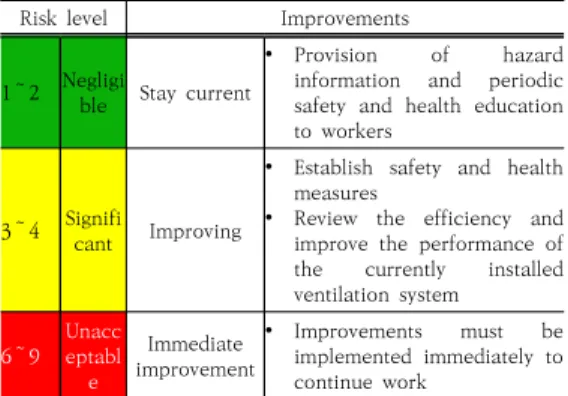
4에서와 같이 위험 관리수준은 무시할 수 있는 수준으로
현행 유지인 ‘낮음(1~2)’, 관리적·교육적·기술적 개선이
필요한 ‘보통(3~4)’, 그리고 진행 중인 공정이나 작업을
멈추고 즉각적인 개선이 필요한 ‘높음(6~9)’으로 3단계
구분하여 관리우선 순위를 결정한다
[16]. Table 1과
Table 2와 같은 위험의 빈도와 강도 기준은 정성적이며
객관적이지 않아 평가자의 경험, 지식, 성향에 따라 주관
적으로 다르게 판단하는 문제가 발생하는 한계가 있다.
Frequency Criteria
High 3
High probability of occurrence
Actual exposure time to hazards is more than 6 hours each day Medium 2 Possibility
Actual exposure time to hazards is more than 2~6 hours each day Low 1 Low probability of occurrence
Actual exposure time to hazards is less than 2 hours each day
Table 1. Possibility (frequency) criteria table
Severity Criteria
High 3
Accidents that may cause death
Exceeding exposure standards (recommended standards) such as chemicals, dust, and noise
Handling of carcinogenic, mutagenic, and reproductive toxic substances
Occurrence of occupational diseases
Medium 2
Accidents that may cause injury such as blindness or amputation
Accidents requiring medical treatment
More than 50% of the exposure standard (recommended standard) such as chemical substances, dust, and noise
Low 1
Causes that near miss
Less than 50% of the exposure standard (recommended standard) such as chemical substances, dust, and noise
Table 2. Strength (severity) criteria table
Frequency Severity
High(3) Medium
(2) Low
(1)
High(3) High
(9) High
(6) Medium
(3) Medium
(2) High
(6) Medium
(4) Low
Low (2)
(1) Medium
(3) Low
(2) Low
(1)
Table 3. Risk Matrix
Risk level Improvements
1~2 Negligible Stay current
Provision of hazard information and periodic safety and health education to workers
3~4 Significant Improving
Establish safety and health measures
Review the efficiency and improve the performance of the currently installed ventilation system
6~9 Unacc eptabl e
Immediate improvement
Improvements must be implemented immediately to continue work
Table 4. Risk Management Criteria
이러한 위험성평가 기법의 주관적이고 정성적인 문제
점을 개선하기 위해 본 연구에서는 급식종사자의 산업재
해 통계자료를 활용하여 객관적이고 정량적인 위험의 빈
도와 산업안전보건법에 명시된 명확한 강도 기준을 제시
하였다.
본 연구의 빈도 및 강도 기준 수립을 위한 조사조건
및 재해자의 특성은 다음과 같다.
재해발생기간 : 2014.1.1.~2018.12.31.
재해자 연령 : 30대 미만, 30대, 40대, 50대, 60대
이상(Fig. 1)
근무경력 : 1년미만, 1~3년, 3~5년, 5~10년, 10
년 이상(Fig. 2)
고용형태 : 정규(상용, 88%), 비정규(일용직, 임시
직 등, 12%)
근무학교 : 초, 중, 고, 대학, 특수, 그 외(Fig. 3)
근로손실일수 : 3일 미만, 4~29일, 30~89일, 90
일 이상(Fig. 4)
직종 : 영양(교)사, 조리사, 조리실무사(Fig. 5)
Fig. 1. Age distribution of the injured
Fig. 2. Distribution of work experience
Fig. 3. Distribution of working schools
Fig. 4. Distribution of lost days
Fig. 5. Ratio of food service workers
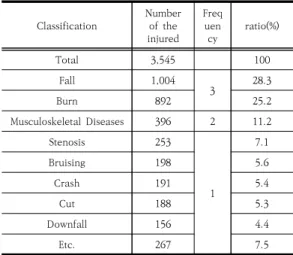
최근 5년간 학교급식관련 재해자수는 총 3,545명(안
전보건공단, 2014~2018)
[17]이고 이들 재해를 분석한 결
과, 발생순위는 넘어짐, 화상, 근골격계질환 등 순이며
초·중·고 모든 학교의 급식업무에서 발생하는 안전사고
도 동일한 경향
[9][18][19]을 보이므로 발생재해 건수에 따
라 재해발생 비율이 4.4%에서 28.3%이므로 3구간으로
균등하여 20~30%는 빈도 ‘3’, 10~20%는 빈도 ‘2’, 10%
미만은 ‘1’로 하였다. ‘새로운 빈도 기준’을 적용하여면
Table 5과 같이 넘어짐과 화상의 발생빈도가 높게 나타
난다.
산업안전보건법 시행규칙 제3조제1호 및 제2호에 따
라 사망, 3개월 이상 요양이 필요한 부상은 강도 ‘3’, 같
은 법 시행규칙 제73조제1항에 따라 3일 이상의 휴업이
필요한 부상은 강도 ‘2’, 2일 이하의 휴업이거나 손실일
수가 없는 당일 통원치료와 같은 경미한 사고 또는 아차
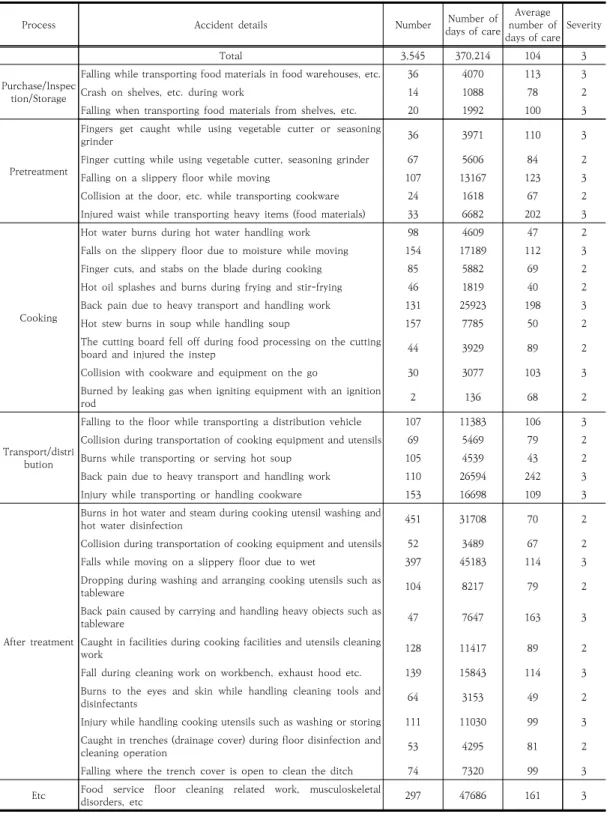
사고는 강도 ‘1’로 하였다. 또, 재해자 총 3,545명을 분석
한 결과, 총 요양일수는 370,214일, 재해발생 건당 평균
손실일수(요양일수)는 104일이었다. ‘새로운 강도 기준’
을 적용하여 정리하면 Table 6과 같이 대부분의 재해가
90일 이상으로 사고결과의 중대성(강도)은 ‘3’에 해당된다.
이는 Table 7에서와 같이 재해자 3,545명 중 사망자
는 2명으로 연평균 사망만인율은 0.06
0/
000이고 전업종
사망만인율 0.51
0/
000보다 8.5 배 낮으나 근로자
71,219명 중 재해자는 854명(2018년)으로 재해율
1.20%이고 전업종 재해율 0.54%에 비해 2.7 배 높아 치
명적인 사망재해는 잘 일어나지 않는 반면, 요양 90일 이
상의 재해는 총 1,407명 발생(39.7%)하여 요양일수는
280,427일이며 재해자당 평균 199일을 요양하였다.
Classification Number of the injured
Frequen
cy ratio(%)
Total 3,545 100
Fall 1,004
3 28.3
Burn 892 25.2
Musculoskeletal Diseases 396 2 11.2
Stenosis 253
1
7.1
Bruising 198 5.6
Crash 191 5.4
Cut 188 5.3
Downfall 156 4.4
Etc. 267 7.5
Table 5. Possibility (frequency) criteria table
Process Accident details Number Number of days of care
Average number of days of careSeverity
Total 3,545 370,214 104 3
Purchase/Inspec tion/Storage
Falling while transporting food materials in food warehouses, etc. 36 4070 113 3
Crash on shelves, etc. during work 14 1088 78 2
Falling when transporting food materials from shelves, etc. 20 1992 100 3
Pretreatment
Fingers get caught while using vegetable cutter or seasoning
grinder 36 3971 110 3
Finger cutting while using vegetable cutter, seasoning grinder 67 5606 84 2
Falling on a slippery floor while moving 107 13167 123 3
Collision at the door, etc. while transporting cookware 24 1618 67 2 Injured waist while transporting heavy items (food materials) 33 6682 202 3
Cooking
Hot water burns during hot water handling work 98 4609 47 2
Falls on the slippery floor due to moisture while moving 154 17189 112 3
Finger cuts, and stabs on the blade during cooking 85 5882 69 2
Hot oil splashes and burns during frying and stir-frying 46 1819 40 2 Back pain due to heavy transport and handling work 131 25923 198 3
Hot stew burns in soup while handling soup 157 7785 50 2
The cutting board fell off during food processing on the cutting
board and injured the instep 44 3929 89 2
Collision with cookware and equipment on the go 30 3077 103 3
Burned by leaking gas when igniting equipment with an ignition
rod 2 136 68 2
Transport/distri bution
Falling to the floor while transporting a distribution vehicle 107 11383 106 3 Collision during transportation of cooking equipment and utensils 69 5469 79 2
Burns while transporting or serving hot soup 105 4539 43 2
Back pain due to heavy transport and handling work 110 26594 242 3
Injury while transporting or handling cookware 153 16698 109 3
After treatment
Burns in hot water and steam during cooking utensil washing and
hot water disinfection 451 31708 70 2
Collision during transportation of cooking equipment and utensils 52 3489 67 2 Falls while moving on a slippery floor due to wet 397 45183 114 3 Dropping during washing and arranging cooking utensils such as
tableware 104 8217 79 2
Back pain caused by carrying and handling heavy objects such as
tableware 47 7647 163 3
Caught in facilities during cooking facilities and utensils cleaning
work 128 11417 89 2
Fall during cleaning work on workbench, exhaust hood etc. 139 15843 114 3 Burns to the eyes and skin while handling cleaning tools and
disinfectants 64 3153 49 2
Injury while handling cooking utensils such as washing or storing 111 11030 99 3 Caught in trenches (drainage cover) during floor disinfection and
cleaning operation 53 4295 81 2
Falling where the trench cover is open to clean the ditch 74 7320 99 3 Etc Food service floor cleaning related work, musculoskeletal
disorders, etc 297 47686 161 3
Table 6. Strength (severity) criteria table
Cause Hazard Current safety measures Freque ncy Severit
y Risk Details
Risk of stenosis (twine, caught)
Winding or jamming when operating the cutter or grinder
When working with cutters and grinders, keep your eyes on changes in the surrounding environment.
When putting vegetables, etc., use a push rod (do not put in rubber gloves)
1 3 3 Worker training
Hazardous surfaces (cuts,
scratches)
Cuts caused by a knife when cutting food Ingredients
When cutting food ingredients, the knife does not become dull
Put your fingers inside and cut them
2 2 4 Worker training
Regular sharpening
Risk of falling parts of machinery (equipment)
Falling objects when separating food ingredients and entering and leaving warehouse
Heavy ingredients (paste, salt, etc.) are loaded at the bottom of the shelf
Use safety ladders when entering and leaving materials at high places
1 2 2 Safety ladder provided
Fall(Sliding, jamming, slipping)
Sliding during movement due to the fall of oil on the floor and pre-treatment ingredients
For greasy areas, sprinkle coarse salt until cleaning
Management to prevent pre-treatment vegetables from falling on the floor
2 2 4
Cleaning the floor
Check the wear condition of the bottom of non-slip boots at any time
Table 9. Risk Assessment Result(Current)
Total 2014 2015 2016 2017 2018
Sum 3,545 689 615 651 736 854
Accidental
injured 3,147 623 547 571 658 748
Accidental
death 1 1 - - - -
Disease
patient 396 65 68 80 78 105
Disease
death 1 - - - - 1
Table 7. Status of disaster occurrence by year
기존 KRAS 방식에 의한 위험성평가와 새롭게 제안한
위험성평가를 비교하면 Fig. 6과 같이 빈도 ‘3’은 재해발
생 비율 20~30 %이고 강도 ‘3’은 사망 또는 요양일수
90일 이상, 빈도 ‘2’는 재해발생 비율 10~20%이고 강도
‘2’는 휴업일수 3일 이상, 빈도 ‘1’은 재해발생 비율 10%
미만이고 강도 ‘1’은 휴업일수 3일 미만 또는 아차사고이다.
Fig. 6. Current and Proposed Risk Level
Cause Risk Risk management
Current Propose Current Propose
Total 13 17
Risk of stenosis
(twine, caught) 3 3 Improving Improving
Hazardous surfaces (cuts,
scratches) 4 2 Improving Stay
current Risk of falling
parts of machinery (equipment)
2 3 Stay
current Improving Fall(Sliding,
jamming,
slipping) 4 9 Improving Immediate
improvem ent
Table 8. New Risk Management
서울소재△△초등학교 급식실의 재료분리 및 전처리
공정에 대해 기존의 위험도 산정기준을 적용하여 주요
위험원에 대한 위험성평가를 실시(서울시교육청 학교보
건진흥원, 2020)한 KRAS 방식의 결과(Table 8)와 새롭
게 제안한 위험도 산정기준을 적용한 위험성평가 결과
(Table 9)를 비교하였다.
기존 작업자에 대한 안전교육과 관리·감독 수준 만이
아니라, ‘덮개 또는 호퍼 설치, 리프팅 테이블 사용, 미끄
럼방지 바닥 설치’ 등 시설개선, ‘2인 1조 작업’ 등 작업방
법개선, ‘보호장갑, 보호장화’ 등 개인보호구 착용 등 기
술적 대책이 추가되어야 함을 알 수 있었다.
Cause Hazard Current safety measures Freque ncy Severit
y Risk Details
Risk of stenosis (twine, caught)
Winding or jamming when operating the cutter or grinder
When working with cutters and grinders, keep your eyes on changes in the surrounding environment.
When putting vegetables, etc., use a push rod (do not put in rubber gloves)
1 3 3
Worker training
Work supervision
Install cover or hopper
Hazardous surfaces (cuts,
scratches)
Cuts caused by a knife when cutting food Ingredients
When cutting food ingredients, the knife does not become dull
Put your fingers inside and cut them
1 2 2
Worker training
Regular sharpening
Wear protective gloves
Risk of falling parts of machinery (equipment)
Falling objects when separating food ingredients and entering and leaving warehouse
Heavy ingredients (paste, salt, etc.) are loaded at the bottom of the shelf
Use safety ladders when entering and leaving materials at high places
1 3 3
Safety ladder provided
Worker training
Work supervision
Wear protective boots
2 people 1 group work
Using a lifting table
Fall(Sliding, jamming, slipping)
Sliding during movement due to the fall of oil on the floor and pre-treatment ingredients
For greasy areas, sprinkle coarse salt until cleaning
Management to prevent pre-treatment vegetables from falling on the floor
Wear non-slip boots
3 3 9
Cleaning the floor
Check the wear condition of the bottom of non-slip boots at any time
Worker training
Work supervision
Non-slip floor installation
Table 10. New Risk Assessment Result (Propose)
특히, 이동 중 미끄러져 넘어지는 사고 위험성 9는 다
른 작업의 위험성보다 3~4.5배 높으므로 굵은 소금뿌리
기, 바닥 청소, 미끄럼방지 장화 착용 및 상태 점검 등 관
리적 대책 이외에도 안전교육 강화, 안전의식 강화, 작업
시간 안배, 이동선 개선, 작업순서 개선 등 추가적인 안전
대책을 검토하여야 할 것이다.
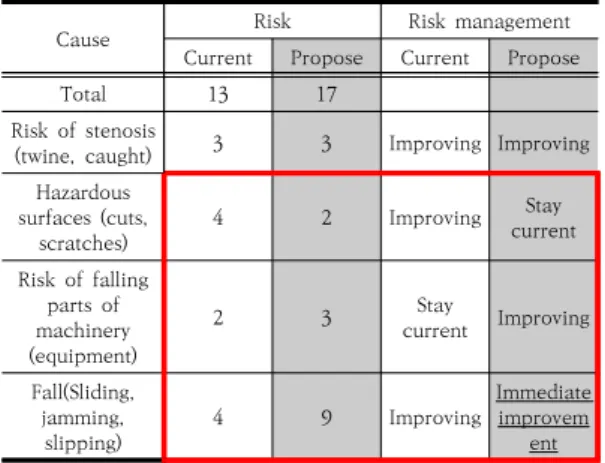
Table 10는 새로운 산정기준을 적용할 때, 알려진 위
험원에 대한 위험도 합이 현행 13에서 17으로 30.8% 높
아졌고 현상 유지 1건, 개선 필요 1건, 즉시 개선 필요
1건이 발생하였다.
3. 결론
2017년부터 고용노동부의 지침에 따라 학교급식업무
는 산업안전보건법을 전부 적용하게 되었고 산업안전보
건법 제36조에 따라 2019년부터 각급 학교는 급식업무
에 대한 위험성평가를 매년 실시하고 있다. 그러나 학교
급식업무에 대한 위험성평가는 정성적이고 주관적이어서
평가자에 따라 그 결과가 다르게 도출되어 위험성평가의
실효성에 대해 문제가 제기되었다.
본 연구는 급식종사자의 최근 몇 년간의 재해통계자료
를 토대로 정량적이고 객관적인 위험의 빈도기준과 산업
안전보건법에 따른 강도기준을 제시하여 위험성평가의
실효성을 높이고자 하였다. 본 연구에서 제안한 위험의
빈도와 강도를 적용하여 위험성평가를 실시한 결과, 기존
KRAS 적용 방식의 위험성평가에 비해 위험도가 높아져
서 시급히 개선해야 할 위험원이 발견되었고 개선방법도
작업자의 교육과 감독 이외에 설비개선, 작업방법개선,
보호구 착용 등 기술적인 방법이 추가되어야 함을 알 수
있었다. 이를 통해 급식업무 중 전처리 과정의 일부에 대
해 위험성평가가 실효성있게 실행되었고 개선방안도 보
다 구체적이며 작동성 높게 제안되었다. 매년 급식종사자
100명당 1.2명이 재해를 당하고 있으며 그 중 39.7%는
90일 이상의 큰 부상을 당하여 평균 199일을 요양하는
것은 기타의 사업에 비해 1.2배
10)[20]높으므로 정부와
학교는 급식업의 위험성을 인지하고 체계적으로 안전성
향상 대책을 마련하고 지속적으로 시행하여야 할 것이다.
10) 기타의 사업의 부상 및 질병요양자 23,532명, 요양일수
3,965,305일(고용노동부, 2018)
그간 학교 급식작업에 대한 연구는 교육학 분야 중심
으로 진행되어 왔기 때문에 본인 부주의(60.8%)
[21][22]로
귀결되어 작업자 안전교육 강조가 안전대책으로 제시될
수 밖에 없었다. 이는 본격적인 위험성평가에 대한 연구
가 부족했음을 의미하며, 안전공학 전공자 및 안전전문가
관점의 연구와 접근이 심도있게 진행되어야 할 것으로
사료된다.
또한, 본 연구가 학교 급식업무에 대한 위험성평가에
시범 적용되고 그 타당성 입증을 거쳐 전체 학교 보급 및
우수사례 공유가 이뤄짐으로써 학교급식 분야의 위험성
평가 실효성이 제고될 수 있는 단초가 되기를 기대한다.
References
[1] J. S. Kim, “A Study on the Safety-related Accidents and Operating Conditions at School meals, Master’s thesis, Korea National University of Education, p 3, 2016.
http://www.riss.kr/link?id=T14047698
[2] N. J. Kim, “A Study on Analysis of Safety Accidents according to Work Process in School Food Service : Focusing on Busan Area”, Master’s thesis, Korea National University of Education, p 17, 2019.
http://www.riss.kr/link?id=T15098676
[3] H. J. Lee, “Comparative Analysis of Status of Safety Accidents and Importance-Performance Analysis (IPA) about Precautions of Safety Accidents by School Type of School Foodservice Employees in Jeonbuk Area ”, Master’s thesis, Jeonbuk National University, p 70, 2020. http://www.riss.kr/link?id=T15680476
[4] S. J. Shin, H. J. Kim, “Study on Status of Safety Accidents and Related Factors of the Cooks for School Foodservice in Daegu”,
Korean Jounal of Food and
Nutrition,
Vol. 30, No. 6, pp. 1299-1309, 2017.http://www.riss.kr/link?id=A105309281
[5] S. H. Kim, K. S. Nam, “The state of unreported industrial accidents and its counter measures in small and medium-sized manufacturing companies”,
Journal
of the Korea Safety Management & Science,
Vol. 9, No. 3, pp. 29-40, 2007.http://www.riss.kr/link?id=T13316010
[6] S. H. Kim, “Study on the current situation and improvement of safety accident of cooking workers in school meals”, Master’s thesis, Korea National University of Education, p 2, 2016.
http://www.riss.kr/link?id=T14047701
[7] O. S. Kim, S. I. Oh, “Assessment of Accidents Occurrence and Cuisine Employees` Awareness of Workplace Safety in Contract Foodservice Management Company”,
Journal of the korean
dietetic association,
Vol. 16, No. 4, pp. 299-317, 2020.http://www.riss.kr/link?id=A82423410
[8] K. H. Shin, “Importance and implementation analysis of safety accidents status and safety management for employees of school meals in Gyeongbuk Area”, Master’s thesis, Chungnam National University, p 2, 2013.
http://www.riss.kr/link?id=T13316010
[9] Y. J. Cho, H. A. Kim, “Safety Accidents and Physical Fatigue of School Foodservice Employees”,
Journal of
the Korean Society of Food Science and Nutrition,
Vol. 42, No. 9, pp. 1482-1491, 2013.http://www.riss.kr/link?id=A99777524
[10] H. J. Chung, S. J. Rho, “A Study on the impact of cooking work and kitchen environment on the work needs of cooks”, The East Asian Society of Dietary Life, Vol. 18. No. 3, pp. 405-414, 2008.
http://www.riss.kr/link?id=A76352735
[11] H. So, “The Study on the Safety Accidents in According to the Employment Types of Cooking Staff of Industry Foodservice and Analysis of Importance and Performance about Precautions of Safety Accidents in Jeonbuk area”, Master’s thesis, Jeonbuk National University, p 12, 2017.
http://www.riss.kr/link?id=T14440574
[12] H. So, “The Study on the Safety Accidents in According to the Employment Types of Cooking Staff of Industry Foodservice and Analysis of Importance and Performance about Precautions of Safety Accidents in Jeonbuk area”, Master’s thesis, Jeonbuk National University, p 17, 2017.
http://www.riss.kr/link?id=T14440574
[13] K. H. Shin, “Importance and implementation analysis of safety accidents status and safety management for employees of school meals in Gyeongbuk Area”, Master’s thesis, Chungnam National University, p 50, 2013.
http://www.riss.kr/link?id=T13316010
[14] H. J. Lee, “Comparative Analysis of Status of Safety Accidents and Importance-Performance Analysis (IPA) about Precautions of Safety Accidents by School Type of School Foodservice Employees in Jeonbuk Area ”, Master’s thesis, Jeonbuk National University, p 70, 2020. http://www.riss.kr/link?id=T15680476
[15] S. H. Kim, “Study on the current situation and improvement of safety accident of cooking workers in school meals”, Master’s thesis, Korea National University of Education, p 65, 2016.
http://www.riss.kr/link?id=T14047701
[16] G. S. Cho, “Improvement for the Safety on the Automobile-Parts Assembly Process using Collaborative Robot through Risk Assessment : Disk snap ring assembly process mainly”,
Journal of the
Korea Academia-Industrial cooperation Society,
Vol.21, No. 8, pp. 342-347, 2020.
http://www.riss.kr/link?id=A107014334
[17] Korea Occupational Safety & Health Agency, “School lunchroom safety guide”, 2019, pp. 6-11.
https://www.kosha.or.kr/kosha/totalSearch.do
[18] H. J. Lee, “Comparative Analysis of Status of Safety Accidents and Importance-Performance Analysis (IPA) about Precautions of Safety Accidents by School Type of School Foodservice Employees in Jeonbuk Area ”, Master’s thesis, Jeonbuk National University, p 69, 2020. http://www.riss.kr/link?id=T15680476
[19] J. S. Kim, “A Study on the Safety-related Accidents and Operating Conditions at School meals, Master’s thesis, Korea National University of Education, p 100, 2016.
http://www.riss.kr/link?id=T14047698
[20] Ministry of Employment and Labor, “2017 Industrial Accident Status Analysis”, 2018, p 698.
https://www.korea.kr/common/download
[21] K. H. Shin, “Importance and implementation analysis of safety accidents status and safety management for employees of school meals in Gyeongbuk Area”, Master’s thesis, Chungnam National University, p 50, 2013.
http://www.riss.kr/link?id=T13316010
[22] J. S. Kim, “A Study on the Safety-related Accidents and Operating Conditions at School meals, Master’s thesis, Korea National University of Education, p 101, 2016.
http://www.riss.kr/link?id=T14047698