Effect of rotation bump on removal torque of orthodontic mini-implants
Odontuya Gansukh1, Jong-Wha Jeong1, Jong-Wan Kim2, Young-Kyun Kim3, Jong-Ho Lee4, Tae-Woo Kim1
1Department of Orthodontics and Dental Research Institute, School of Dentistry, Seoul National University, Seoul,
2Department of Orthodontics, Section of Dentistry, Seoul National University Bundang Hospital, Seongnam,
3Department of Oral and Maxillofacial Surgery, Section of Dentistry, Seoul National University Bundang Hospital, Seongnam,
4Department of Oral and Maxillofacial Surgery and Dental Research Institute, School of Dentistry, Seoul National University, Seoul, Korea
Abstract(J Korean Assoc Oral Maxillofac Surg 2013;39:269-273)
Objectives: This study is designed to evaluate the mechanical stability of orthodontic mini-implants with vertical grooves in rabbits.
Materials and Methods: This study was done from March 2011 to February 2012 in Dental Research Institute of Seoul National University. Thirty- two mini-implants in the control group and 32 in the rotation bump (RB) group were inserted in the tibias of 16 rabbits and were removed after two weeks and four weeks, respectively. The maximum insertion torque (MIT), maximum removal torque (MRT), torque ratio (TR) of MRT to MIT and removal angular momentum (RAM) were all measured at the time of removal.
Results: There were no significant differences between the two groups in MIT and MRT at two weeks or four weeks. However, TR and RAM at four weeks in the RB group were significantly higher than in the control group (P<0.05). TR of the RB group was significantly increased at four weeks (P<0.05). In both groups, RAM at four weeks was significantly higher than at two weeks (P<0.05).
Conclusion: These results suggest that RB of the mini-implant could provide resistance to the removal rotation, although it did not increase the MRT.
Key words: Mini-implant, Rotation bump, Torque, Torque ratio, Angular momentum
[paper submitted 2013. 10. 7 / revised 2013. 10. 11 / accepted 2013. 10. 21]
such as the modification of the shape of mini-implants, have been suggested to increase mechanical stability. Sullivan et al.8 showed that the removal torque of a screw-shaped im- plant with a 3.74 mm diameter T-chamber was greater than 10 Ncm, despite a lack of osseointegration. A vertical bump on a mini-implant provides vertical space for bone growth and could improve stability when rotational movement is ap- plied9. The stability of implants with an anti-rotational verti- cal bump may be increased through bone remodeling and bone proliferation.
Stability in the form of resistance to rotational movement can be analyzed by measuring the removal torque. The mo- bility test, resonance frequency analysis and torque analysis are techniques to evaluate the stability of implants10. Al- though insertion torque analysis was developed as a method to measure the stability and supportive capacity of implants11, insertion torque may have a weak relationship with stabil- ity, and removal torque may be more useful to test the me- chanical stability of implants5. Torque ratio (TR) can show the increase in stability from the insertion stage to the final stage2. Angular momentum, which is defined as the torque in-
I. Introduction
An implant with a small diameter and a short length may be useful in orthodontic treatment1. However, the stability of a mini-implant is uncertain because mini-implants with a small diameter can be easily loosened by low removal torque2,3. A previous study reported that the failure rate of orthodontic mini-implants ranges from 10% to 30%4. Therefore, further efforts to improve the clinical survival rate of mini-implants are needed. A number of studies on the shape2,5, soft tissue contact surface6, and insertion method7 of mini-implants have been conducted to enhance success rates. Various methods,
Jong-Wan Kim
Department of Orthodontics, Section of Dentistry, Seoul National University Bundang Hospital, 82, Gumi-ro 173 beon-gil, Bundang-gu, Seongnam 463-707, Korea TEL: +82-31-787-7549 FAX: +82-31-787-4068
E-mail: [email protected]
This is an open-access article distributed under the terms of the Creative Commons Attribution Non-Commercial License (http://creativecommons.org/licenses/by-nc/3.0/), which permits unrestricted non-commercial use, distribution, and reproduction in any medium, provided the original work is properly cited.
CC
Copyright Ⓒ 2013 The Korean Association of Oral and Maxillofacial Surgeons. All rights reserved.
This study was supported by grant no 05-2011-0005 from the SNUDH Research Fund.
mm, diameter 1.6 mm, Dual-Top; Jeil Medical Corporation, Seoul, Korea) were included in the present study: 32 in the control group and 32 in the rotation bump (RB) group.(Fig.
1) This study was approved by the Ethics Committee for Re- search on Animals (Seoul National University Ethical Board, SNU 120308-2). Sixteen three-month-old New Zealand white rabbits (mean weight was 3.5 to 4.0 kg, Dooyeol Bio- tech, Seoul, Korea) were used in this study. This study was done from March 2011 to February 2012 in Dental Research Institute of Seoul National University (Seoul, Korea).
2. Surgical procedures
The rabbits were anesthetized with an intravenous injec- tion of Zoletil 50 (7.5 mg/kg; Virbac Korea, Seoul, Korea) and Rompun 2% (0.15 mL/kg; Bayer Korea, Seoul, Korea).
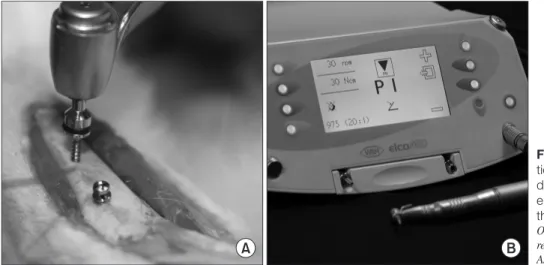
The internal surface of the tibia was further blocked with 0.5 mL of 2% lidocaine. The metaphyses of both end sides of the tibia were surgically exposed by scalpel incision to the peri- osteum and blunt dissection. The mini-implant was inserted into the metaphysis of the tibia with a surgical implant engine (Elcomed SA200C; W&H Dentalwerk, Bürmoos, Austria) after pre-drilling (Ø 1.0 mm) under saline irrigation.(Fig. 2.
A)
3. Mechanical analysis
The mini-implants were removed at two weeks and four weeks after implantation, with the torque recorded by the sur- gical engine (Fig. 2. B), which had a rotational speed of 20 rpm. Impdat software (Kea Software GmbH, Poecking, Ger- many) was used for the readout of the removal torque value.
The torque was recorded eight times per second. MIT, MRT tegrated during a certain period, represents the stability of the
implant12, and removal angular momentum (RAM) describes the resistance to removal rotational movement13.
This study was performed to evaluate the stability of orth- odontic mini-implants with an anti-rotational vertical bump in rabbits through the mechanical analysis of maximum in- sertion torque (MIT), maximum removal torque (MRT), TR and RAM at two and four weeks after insertion.
II. Materials and Methods
1. Implants and subjects
A total of 64 titanium orthodontic mini-implants (length 6.0
Fig. 2. Insertion procedure of orthodon- tic mini-implant and equipment. A. Pre- drilling with saline irrigation. B. Surgical engine which can measure and record the torque.
Odontuya Gansukh et al: Effect of rotation bump on removal torque of orthodontic mini-implants. J Korean Assoc Oral Maxillofac Surg 2013
Fig. 1. Tested groups of orthodontic mini-implants. A. Control group. B. Rotation bump group.
Odontuya Gansukh et al: Effect of rotation bump on removal torque of orthodontic mini- implants. J Korean Assoc Oral Maxillofac Surg 2013
There were no significant differences between the two groups with regard to MIT and MRT at two or four 4 weeks.
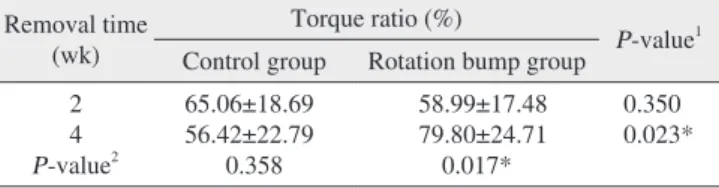
(Tables 1, 2) However, the TR of the RB group (79.80%) was significantly higher than that of the control group (56.42%) at four weeks (P<0.05).(Table 3) The RAM of the RB group (14.94 Ncms) was significantly higher (P<0.05) than that of the control group (11.20 Ncms).(Table 4)
TR and RAM at four weeks in the RB group were signifi- cantly higher than in the control group (P<0.05). The TR of the RB group significantly increased from 58.99% at two weeks to 79.80% at four weeks (P<0.05). In both groups, RAM at four weeks was significantly higher than at two weeks (P<0.05). RAM increased from 7.57 to 11.20 in the control group and from 6.78 to 14.94 in the RB group.
IV. Discussion
Mini-implants have low stability in bone because their surface area is small. The removal torque of an implant is and TR of MRT to MIT were measured to analyze mechani-
cal stability.(Fig. 3) To analyze the energy exerted to remove the mini-implant from the bone, the RAM (Ncms) was calcu- lated by integrating the torque during a half turn, which took 1.5 seconds under 20 rpm after MRT.
4. Statistical methods
All measurements were statistically evaluated using the in- dependent t-test to determine any differences in MIT, MRT, TR and RAM between the control and RB groups and at two and four weeks in each group. A P<0.05 was considered to be statistically significant.
III. Results
No failures of mini-implants occurred at two weeks. How- ever, two mini-implants in each group failed at four weeks, resulting in identical failure rates.
Fig. 3. Schematic graph to explain the mechanical characteristics of mini-implants. (A: maximum insertion torque [MIT], B: time of MIT, C:
maximum removal torque [MRT], D: time of MRT, E: 1.5 seconds after MRT, which is a time needed for a half turn, F: removal angular mo- mentum which is the torque integrated from the time of MRT to 1.5 seconds after MRT)
Odontuya Gansukh et al: Effect of rotation bump on removal torque of orthodontic mini-implants. J Korean Assoc Oral Maxillofac Surg 2013
Table 1. Maximum insertion torque at two and four weeks after insertion of a mini-implant
Removal time (wk)
Maximum insertion torque (Ncm)
P-value1 Control group Rotation bump group
2 4 P-value2
10.28±1.61 10.57±2.37
0.805
10.25±1.84 10.06±2.37
0.932
0.968 0.868
1P-value was calculated by independent t-test between control group and rotation bump group. 2P-value was calculated by independent t-test between two and four weeks in each group.
Values are presented as mean±standard deviation.
Odontuya Gansukh et al: Effect of rotation bump on removal torque of orthodontic mini- implants. J Korean Assoc Oral Maxillofac Surg 2013
Table 2. Maximum removal torque at two and four weeks after insertion of a mini-implant
Removal time (wk)
Maximum removal torque (Ncm)
P-value1 Control group Rotation bump group
2 4 P-value2
6.61±1.88 6.07±2.99
0.584
5.90±1.59 7.07±2.44 0.077
0.261 0.230
1P-value was calculated by independent t-test between control group and rotation bump group. 2P-value was calculated by independent t-test between two and four weeks in each group.
Values are presented as mean±standard deviation.
Odontuya Gansukh et al: Effect of rotation bump on removal torque of orthodontic mini- implants. J Korean Assoc Oral Maxillofac Surg 2013
MRT15. When rotational moments were applied to the mini- implant, high RAM might have made the mini-implant more resistant to the loosening moment. In both groups, RAM at four weeks was significantly higher than at two weeks. This might indicate that the osseointegration at four weeks was better than at two weeks. The higher RAM of the RB group at four weeks compared to the control group might mean that the bone growth and the osseointegration in the vertical rota- tion bump space improve resistance to removal torque16.
TR was significantly increased at four weeks in the RB group and was significantly higher than that of the control group.(Table 3) Increased TR may indicate an increase in final stability compared to initial stability2. The MRT of the RB group was increased at four weeks, although it did not show a statistically significant difference.
Although the stabilities of both groups did not differ, there was an increase in the resistance to the removal rotational movement in the RB group. This might suggest that the verti- cal rotation bump did not enhance the stability of the mini- implant at the initial stage. If the mini-implant remains stable during initial bone remodeling, the vertical rotation bump could improve the resistance of a small mini-implant to ro- tational movement, which could occur under clinical orth- odontic loading. Although conventional orthodontic force is not a rotational movement, food irritation and practices in the orthodontic environment could cause rotation force around the mini-implants during a long treatment period. A rotation bump could support resistance to some unexpected rotational movements.
A previous study suggested that immediate or early orth- odontic loading did not affect mini-implant stability because similar histomorphometric results were observed for imme- diate loading, early loading and delayed loading groups17. However, the histological results did not analyze the intensity or change in stability over time. The results of the present study suggest that RAM changes with time, and that a verti- cal rotation bump can reinforce the stability of mini-implants.
When orthodontic loading is applied to the mini-implant immediately after insertion, a vertical rotation bump does not enhance mini-implant stability. However, a mini-implant with a rotation bump may have greater stability than a mini- implant without such a bump, as long as the implant is kept stable at the initial stage.
Further studies of histological changes and clinical obser- vations are needed to improve stability and to decrease tissue stress.
proportional to its surface area, and the osseointegrated area is proportional to the square of the implant radius7 under the same osseointegration ratio condition. This indicates that mini-implants with a small radius have low removal torque requirements and can be easily removed without an addition- al operation. A previous study reported that mini-implants could be loosened with application of orthodontic loading, which can induce a rotational moment14.
A vertical rotation bump can provide vertical space for bone proliferation. The bone growth into the rotation bump space can resist the rotational movement of mini-implants.
In the present study, there were no significant differences be- tween the control group and RB group at two or four weeks.
(Tables 1, 2) However, RAM at four weeks in the RB group was significantly higher than that of the control group.(Table 4) These results imply that the mini-implants in the RB group are more resistant to removal rotation. Because RAM was defined as the integrated torque value during a half turn, high RAM might indicate high resistance to removal rotation. The removal torque suddenly decreased after MRT. High RAM might indicate that a high torque value was maintained after
Table 4. Removal angular momentum (integrated torque during a half turn after maximum removal torque) at two and four weeks after insertion of a mini-implant
Removal time (wk)
Removal angular momentum (Ncms)
P-value1 Control group Rotation bump group
2 4 P-value2
7.57±2.02 11.20±4.21 0.005**
6.78±1.72 14.94±3.12 0.000***
0.246 0.013*
1P-value was calculated by independent t-test between control group and rotation bump group. 2P-value was calculated by independent t-test between two and four weeks in each group.
*P<0.05, **P<0.01, ***P<0.001.
Values are presented as mean±stan dard deviation.
Odontuya Gansukh et al: Effect of rotation bump on removal torque of orthodontic mini- implants. J Korean Assoc Oral Maxillofac Surg 2013
Table 3. Torque ratio at two and four weeks after insertion of a mini-implant
Removal time (wk)
Torque ratio (%)
P-value1 Control group Rotation bump group
2 4 P-value2
65.06±18.69 56.42±22.79
0.358
58.99±17.48 79.80±24.71
0.017*
0.350 0.023*
1P-value was calculated by independent t-test between control group and rotation bump group. 2P-value was calculated by independent t-test between two and four weeks in each group.
*P<0.05.
Values are presented as mean±standard deviation.
Odontuya Gansukh et al: Effect of rotation bump on removal torque of orthodontic mini- implants. J Korean Assoc Oral Maxillofac Surg 2013
crews. Angle Orthod 2008;78:1057-64.
7. Kim JW, Ahn SJ, Chang YI. Histomorphometric and mechanical analyses of the drill-free screw as orthodontic anchorage. Am J Orthod Dentofacial Orthop 2005;128:190-4.
8. Sullivan DY, Sherwood RL, Collins TA, Krogh PH. The reverse- torque test: a clinical report. Int J Oral Maxillofac Implants 1996;11:179-85.
9. Linkow LI. The press-fit/tap-in, anti-rotational vent-plant cylinder implant. J Oral Implantol 1995;21:40-5.
10. Ueda M, Matsuki M, Jacobsson M, Tjellström A. Relationship between insertion torque and removal torque analyzed in fresh temporal bone. Int J Oral Maxillofac Implants 1991;6:442-7.
11. Consolo U, Travaglini D, Todisco M, Trisi P, Galli S. Histo- logic and biomechanical evaluation of the effects of implant insertion torque on peri-implant bone healing. J Craniofac Surg 2013;24:860-5.
12. Lee SY, Piao C, Heo SJ, Koak JY, Lee JH, Kim TH, et al. A com- parison of bone bed preparation with laser and conventional drill on the relationship between implant stability quotient (ISQ) values and implant insertion variables. J Adv Prosthodont 2010;2:148-53.
13. Kim SH, Lee SJ, Cho IS, Kim SK, Kim TW. Rotational resistance of surface-treated mini-implants. Angle Orthod 2009;79:899-907.
14. Costa A, Raffainl M, Melsen B. Miniscrews as orthodontic anchor- age: a preliminary report. Int J Adult Orthodon Orthognath Surg 1998;13:201-9.
15. Kwon TK, Lee HJ, Min SK, Yeo IS. Evaluation of early bone response to fluoride-modified and anodically oxidized titanium im- plants through continuous removal torque analysis. Implant Dent 2012;21:427-32.
16. Ahn SJ, Leesungbok R, Lee SW. Histomorphometric analysis and removal torque of small diameter implants with alternative surface treatments and different designs. J Oral Implantol 2010;36:263-72.
17. Oltramari-Navarro PV, Navarro RL, Henriques JF, Cestari TM, Francischone CE, Taga R, et al. The impact of healing time before loading on orthodontic mini-implant stability: a histomorphometric study in minipigs. Arch Oral Biol 2013;58:806-12.
V. Conclusion
The rotation bump group did not show significant differ- ences compared to the control group in MIT and MRT at two or four weeks after insertion of mini-implants. However, the TR and RAM of the rotation bump group were significantly higher than the control group at four weeks. RAM was sig- nificantly increased at four weeks in both groups. This sug- gests that the mini-implants were securely osseointegrated at four weeks, and bone growth at the rotation bump space may increase resistance to removal rotation movements.
References
1. Chen Y, Kyung HM, Gao L, Yu WJ, Bae EJ, Kim SM. Mechanical properties of self-drilling orthodontic micro-implants with different diameters. Angle Orthod 2010;80:821-7.
2. Kim YK, Kim YJ, Yun PY, Kim JW. Effects of the taper shape, dual-thread, and length on the mechanical properties of mini- implants. Angle Orthod 2009;79:908-14.
3. Herrmann I, Lekholm U, Holm S, Kultje C. Evaluation of patient and implant characteristics as potential prognostic factors for oral implant failures. Int J Oral Maxillofac Implants 2005;20:220-30.
4. Reynders R, Ronchi L, Bipat S. Mini-implants in orthodontics: a systematic review of the literature. Am J Orthod Dentofacial Or- thop 2009;135:564.e1-19.
5. Kim JW, Baek SH, Kim TW, Chang YI. Comparison of stability between cylindrical and conical type mini-implants. Mechanical and histological properties. Angle Orthod 2008;78:692-8.
6. Kim TW, Baek SH, Kim JW, Chang YI. Effects of microgrooves on the success rate and soft tissue adaptation of orthodontic minis-
![Fig. 3. Schematic graph to explain the mechanical characteristics of mini-implants. (A: maximum insertion torque [MIT], B: time of MIT, C:](https://thumb-ap.123doks.com/thumbv2/123dokinfo/5321765.168374/3.918.88.831.111.360/schematic-explain-mechanical-characteristics-implants-maximum-insertion-torque.webp)