• 검색 결과가 없습니다.

Grain Size Effect on Mechanical Properties of Polycrystalline Graphene

N/A
N/A
Protected

Academic year: 2021

Share "Grain Size Effect on Mechanical Properties of Polycrystalline Graphene"

Copied!
4
0
0

로드 중.... (전체 텍스트 보기)

전체 글

(1)

Vol. 29, No. 5, 375-378 (2016)

DOI: http://dx.doi.org/10.7234/composres.2016.29.5.375 ISSN 2288-2103(Print), ISSN 2288-2111(Online) Special Issue Paper

Grain Size Effect on Mechanical Properties of Polycrystalline Graphene

Youngho Park *, Sangil Hyun*

, Myoungpyo Chun *

ABSTRACT: Characteristics of nanocrystalline materials are known substantially dependent on the microstructure such as grain size, crystal orientation, and grain boundary. Thus it is desired to have systematic characterization methods on the various nanomaterials with complex geometries, especially in low dimensional nature. One of the interested nanomaterials would be a pure two-dimensional material, graphene, with superior mechanical, thermal, and electrical properties. In this study, mechanical properties of “polycrystalline” graphene were numerically investigated by molecular dynamics simulations. Subdomains with various sizes would be generated in the polycrystalline graphene during the fabrication such as chemical vapor deposition process. The atomic models of polycrystalline graphene were generated using Voronoi tessellation method. Stress strain curves for tensile deformation were obtained for various grain sizes (5~40 nm) and their mechanical properties were determined. It was found that, as the grain size increases, Young’s modulus increases showing the reverse Hall-Petch effect. However, the fracture strain decreases in the same region, while the ultimate tensile strength (UTS) rather shows slight increasing behavior. We found that the polycrystalline graphene shows the reverse Hall-Petch effect over the simulated domain of grain size (< 40 nm).

Key Words: Polycrystalline graphene, Molecular dynamics, Mechanical properties, Fracture strain, Hall-Petch effect

1. INTRODUCTION

Carbon based materials such as fullerene, CNT and graphite are well known for their superior electrical, thermal and mechanical properties than many other materials [1]. Among these, graphene has been intensively investigated recently and utilized as a functional material because of its unique two- dimensional nature [2]. Since some fabrication method such as the chemical vapor deposition (CVD) unavoidably pro- duces polycrystalline microstructure, many properties of the polycrystalline graphene are of great interest related with its grain size. And it is known various properties of composite materials are closely related to the microstructures, and they are interconnected via ‘cross-property relation’ [3].

Graphene has been known to possess the highest mechan- ical strength among the existing materials. However, due to its polycrystalline nature in realistic products, it has been highly required to predict the relation between the mechanical prop- erty and its microstructure such as grain size. Mechanical properties have been studied for single crystalline graphene via

experimental measurement [4] and computer simulations such as ab initio method [5] and molecular dynamics [6] as well. Here, while other quantities such as yield strain and ten- sile strength are rather dependent on the measurement method and the calculation conditions such as strain rate, the Young’s modulus is nearly independent on such determination conditions. In most studies, Young’s modulus turned out con- sistently to be ~1 TPa.

On the other hand, mechanical properties of “polycrystal- line” graphene have been studied mainly using molecular dynamics calculation [7,8]. To treat computationally the poly- crystalline models is still beyond the computational limit for the ab initio calculation. Grain size effects were addressed for the mechanical properties of Young’s modulus, fracture strain and ultimate tensile strength (UTS). It was shown the Young’s modulus and UTS increase and the fracture strain decreases as the grain size increases up to about 10 nm [9]. This behavior corresponds to reverse Hall-Petch effect observable in the small grain limit.

Toward the other limit of infinite grain size, which is single

Received 30 November 2016, received in revised form 22 December 2016, accepted 22 December 2016

*

*

Korea Institute of Ceramic Engineering and Technology, Jinju 52851, Korea

Korea Institute of Ceramic Engineering and Technology, Jinju 52851, Korea, Corresponding author (E-mail: [email protected])

(2)

376 Youngho Park, Sangil Hyun, Myoungpyo Chun

crystal, it is interested to determine the mechanical properties.

In many nanomaterials, it has been shown the Hall-Petch effect observable by decreasing some mechanical properties in this limit. For example, the Hall-Petch effect exists by showing certain crossover of grain size for optimal mechanical prop- erties of polycrystalline copper [10]. However, some of pre- vious studies on polycrystalline graphene did not sufficiently address it, thus we computationally determined in the large grain size limit.

In this study, we investigated mechanical properties for rather larger grain size for polycrystalline graphene. Molecular dynamics calculation was employed for the large polycrystal- line models with large grain size. In this method, we obtained stress strain curves of the polycrystalline models under tensile deformation and calculated mechanical properties such as Young’s modulus, fracture strain, and UTS.

2. SIMULATION MODELS AND METHOD

2.1 Modeling

For the atomic modeling of polycrystalline graphene, we used the Voronoi tessellation method. Each seed randomly generated in the two dimensional domain is regarded as the center of each grain, and then each grain has a shape of poly- gon. The shape of realistic grains created by CVD process may have curved grain boundaries, however, the straight grain boundaries in the simulation models would not give substan- tial effect on the mechanical properties of the polycrystalline models [7]. The size of the grains was determined by the diameter of an imaginary circle having same area with the cor- responding polygon. Fig. 1 shows an atomic model of poly- crystalline graphene. Note that each grain has different shape and crystal orientation.

2.2 Calculation Method

In this study on large atomic systems, we used a molecular dynamics simulator, which is large-scale atomic/molecular massively parallel simulator (LAMMPS) [11]. To examine the

mechanical properties, we applied tensile deformations on the models subject to constant pressure (P = 0 Pa) and tempera- ture (T = 300 K) ensemble (NPT). For the interatomic inter- action, we used the AIREBO potential [12] known to describe carbon interactions more accurately than the Tersoff potential used in other previous studies. Grain size in the models was in the range of 5 to 40 nm. To achieve better statistics, we made five different configurations for each grain size and averaged the result.

3. RESULTS AND DISCUSSIONS

3.1 Tensile Deformations

Fig. 2 shows the atomic models near the fracture or right after fracture under the tensile deformation of polycrystalline graphene with grain size 5 nm (a) and 20 nm (b) at the tensile strain of 0.08. It can be seen that the carbon atoms near the grain boundaries become unstable because of bond breaking and high energy is induced. As the Hall-Petch effect, it is seen that the crack propagation occurred in different sites depend- ing on the grain size. For example, for the small grain size (a), cracks are generated usually at the grain boundaries. However, for larger grain size (b), the crack can be initiated inside the grains. That is, for small grain size, inter-granular failure is dominant but, for large grain size, intra-granular failure is

Fig. 1. An atomic model of polycrystalline graphene generated by Voronoi Tessellation

Fig. 2. Failure patterns under the tensile deformations of poly-

crystalline graphene tensile strain of 0.08 for the grain

size of (a) 5 nm and (b) 20 nm. (color denotes energy of

each atom: red for high energy and blue for low energy)

(3)

Grain Size Effect on Mechanical Properties of Polycrystalline Graphene 377

more dominant just as in the case of polycrystalline copper [10].

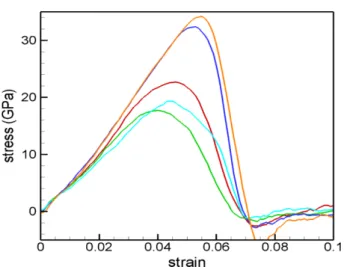
Fig. 3 presents typical stress strain curves obtained for ten- sile deformations on the grain size of 20 nm. The initial slopes are nearly same for all five configurations and the slopes begin to slightly diverge as the strain increases. It is seen that the slope becomes stiffer after the strain of 0.02. The reason might be that the initial polycrystalline models have atomic rear- rangements from sp2 to sp3 conversions caused by bond breaking at the grain boundaries. And the reconversion from sp3 to sp2 occurred under tensile deformation may show the initial small slope in the stress strain curves partially con- tributed by angular forces at the grain boundaries. It is also noted that the fracture strain and UTS vary with relatively large deviations, may be due to the deviation of geometric variations of the polycrystalline models.

3.2 Young’s Modulus, Fracture Strain and UTS

Young’s modulus is supposed to be approaching to that of single crystalline graphene as the grain size becomes large as.

In Fig. 4, Young’s modulus of the 5 nm grain model is about 200 GPa and increases to over 600 GPa for the grain size of 40 nm, which is somewhat lower than the value of single crys- tal (~ 1 TPa). This lower value may be due to the way of deter- mination strain region for the modulus. As pointed out before, the polycrystalline model might have some sp3 carbons instead of sp2 carbons near the grain boundary, which later deformed only under angular force. Thus the modulus deter- mined at the small strain region may be low estimated. Oth- erwise, the Young’s modulus beyond the 40 nm grain size would approach to 1 TPa. The Young’s modulus for the vary- ing grain size monotonically increases and thus no apparent optimum grain size is observed.

Fig. 5 shows fracture strains vs the grain size of polycrys- talline graphene. Initially, the fracture strain is obtained about Fig. 3. Stress strain curves of polycrystalline graphene with grain

size of 20 nm. Five different geometric configurations were determined in this plot

Fig. 4. Young’s modulus vs grain size

Fig. 5. Fracture strain vs grain size

Fig. 6. UTS vs grain size

(4)

378 Youngho Park, Sangil Hyun, Myoungpyo Chun

0.08 and decreases as the grain size increases. After the grain size is about 15 nm, the fracture strains are saturated around 0.05. The ultimate tensile strength (UTS) shown in Fig. 6 slowly increases as the grain size increases. It is obtained between 20~30 GPa and the deviation is shown rather large.

This large deviation is suspected to come from geometric vari- ations of the randomly generated models. That is, for each grain size of a given model is not well uniform but have mixed grain sizes and even smaller grains can exist for certain con- figurations. For example, some configuration including smaller grains than the averaged grain size may increase the fracture strain as shown in the figure.

4. CONCLUSIONS

In this study, we have investigated mechanical properties of polycrystalline graphene under tensile deformations. As the grain size of the atomic models increases, it is shown that Young’s modulus and UTS increase monotonically and on the other hand fracture strain decreases. This grain size effect (reverse H-P effect) observed in previous studies (< 10 nm) remains the same up to the larger grain size of 40 nm. We con- jecture that this result may hold up to the limit of infinite grain size corresponding to the single crystalline graphene. Similarly, the other limit of small grain size corresponding to the amor- phous materials [13,14] can be addressed as well. Some other mechanical properties such as fracture energy and the inter- facial characteristics between the grains will be investigated for deeper understanding of fracture mechanism and optimal design of polycrystalline graphene.

ACKNOWLEDGEMENT

The authors acknowledge the financial support from the International Cooperative R&D program of Ministry of Trade, Industry and Energy (MOTIE) of Korea (grant number:

N0001711).

REFERENCES

1. Dinadayalane, T.C., and Leszczynski, J., “Remarkable Diversity

of Carbon-carbon Bonds: Structures and Properties of Fullerenes, Carbon Nanotubes, and Graphene,” Structural Chemistry, Vol. 21, Iss. 6, 2010, pp. 1155-1169.

2. Stankovich, S., Dikin, D.A., Dommett, G.H.B., Kohlhaas, K.M., Zimney, E.J., Stach, E.A., Piner, R.D., Nguyen, S.B.T., and Ruoff, R.S., “Graphene-based Composite Materials,” Nature, Vol. 442, No. 7100, 2006, pp. 282-286.

3. Bergmann, D.J., “The Dielectric Constant of a Composite Material – a Problem in Classical Physics”, Phys. Rep. Vol. 43, No. 9, 1978, pp. 377-407.

4. Wei, C., Wei, X., Kysar, J.W., and Hone, J., “Measurement of the Elastic Properties and Intrinsic Strength of Monolayer Graphene,” Science, Vol. 321, Iss. 5887, 2008, pp. 385-388.

5. Liu, F., Ming, P., and Li, J., “Ab Initio Calculation of Ideal Strength and Phonon Instability of Graphene under Tension”, Phys. Rev. B, Vol. 76, Iss. 6, 2007, 064120.

6. Jiang, J.W., Wang, J.S., and Li, B., “Young’s Modulus of Graphene: A Molecular Dynamics Study,” Phys. Rev. B, Vol. 80, Iss. 11, 2009, 113405.

7. Kotakoski, J., and Meyer, J.C., “Mechanical Properties of Poly- crystalline Graphene Based on a Realistic Atomistic Model,”

Phys. Rev. B, Vol. 85 Iss. 19, 2012, 195447.

8. Mortazavi, B., and Cuniberti, G., “Atomistic Modeling of Mechanical Properties of Polycrystalline Graphene,” Nanotech- nology, Vol. 25, No. 21, 2014, 215704.

9. Sha, Z.D., Quek, S.S., Pei, Q.X., Liu, Z.S., Wang, T.J., Shenoy, V.B., and Zhang, Y.W., “Inverse Pseudo Hall-Petch Relation in Polycrystalline Graphene,” Scientific Reports, Vol. 4, 2014, 5991.

10. Choi, Y., Park, Y., and Hyun, S., “Mechanical Properties of Nanocrystalline Copper under Thermal Load,” Phys. Lett. A, Vol. 376, 2012, pp. 758-762.

11. Plimpton, S., Crozier, P., and Thompson, A., “LAMMPS-large- scale Atomic/molecular Massively Parallel Simulator,” Sandia National Laboratories, 2007 (http://lamps.sandia.gov/).

12. Stuart, S.J., Tutein, A.B., and Harrison, J.A., “A Reactive Poten- tial for Hydrocarbons with Intermolecular Interactions,” J.

Chem. Phys., Vol. 112, No. 14, 2000, pp. 6472-6486.

13. Tuan, D.V., Kumar, A., Roche, S., Ortmann., F., and Thorpe, M.F., “Insulating behavior of an Amorphous Graphene Mem- brane,” Phys. Rev. B, Vol. 86, Iss. 12, 2012, 121408.

14. Park, Y., and Hyun, S., “Characterizations of Network Struc-

tures Using Eigenmode Analysis,” Symmetry, Vol. 7, No. 2,

2015, pp. 962-975.

수치

Fig.  2  shows  the  atomic  models  near  the  fracture  or  right after fracture under the tensile deformation of polycrystalline graphene with grain size 5 nm (a) and 20 nm (b) at the tensile strain  of  0.08
Fig. 4. Young’s modulus vs grain size

참조

관련 문서

Therefore depending on the size of the fracture in the veneering porcelain, intraoral repair methods using surface treatment and composite resins may

3.7 Fracture interface after tensile shear test with plunge depth 43 Table.. 3.13 Fracture interface after tensile shear test with dwell time

Purpose: Calcaneal fracture is a rare fracture, which accounts for about 2% of all fractures, but is one of the most common fractures in the ankle bone.. There is

7 Effect of annealing temperature on the tensile properties of high manganese austenitic stainless steel with two phases of reversed austenite and

This study investigated the loading rate effect on the fracture resistance under cyclic loading conditions to clearly understand the fracture behavior of

Elastic modulus Tensile properties Residual stress Fracture toughness Indentation

No.. ramus insufficiency fracture, B) Thorax and abdomen CT showing multiple spine compression fracture.. ramus insufficiency fracture, B) After 4 months of

(a) Low-Angle and High-Angle Boundaries (b) Special High-Angle Grain Boundaries (c) Equilibrium in