서 론
천식은 전 세계적으로 2억 명 이상의 환자(성인: 4.3%–8.6%, 소 아: 2.8%–37%)가 이환된 매우 흔한 호흡기질환이다.1-3 한국에서 천 식은 성인에서는 5.7%,4 소아에서는 9.1%5인 것으로 알려져 있다.
최근 수 십 년간 천식의 유병률이 증가하였다.6 일반적으로 천식은 도움T세포의 과다활동에 의한 도움T세포 염증반응에 의해 발생한 다고 생각한다.7 또한 천식과 연관된 면역세포의 기능장애에 의해 서 호흡기감염을 포함한 감염질환의 발생이 증가한다.8-12 하지만 천 식 환자에서 폐구균, 홍역, 볼거리, 풍진, 파상풍 같은 예방접종 후 혈액에서 항체를 측정하여 천식이 항체생성반응에 미치는 영향을 규명한 연구들은 비교적 적다. 천식 환자에게 예방접종 후 접종한 균에 대한 항체생성반응에 미치는 영향을 연구하는 것은 천식의 병태생리를 연구하는 관점에서 중요하다. 이번 종설에서는 만성호 흡기질환인 천식 환자에서 예방접종 후 항체생성반응에 미치는 영 향을 규명한 연구 결과와 기전에 대해서 정리하였다.
본 론
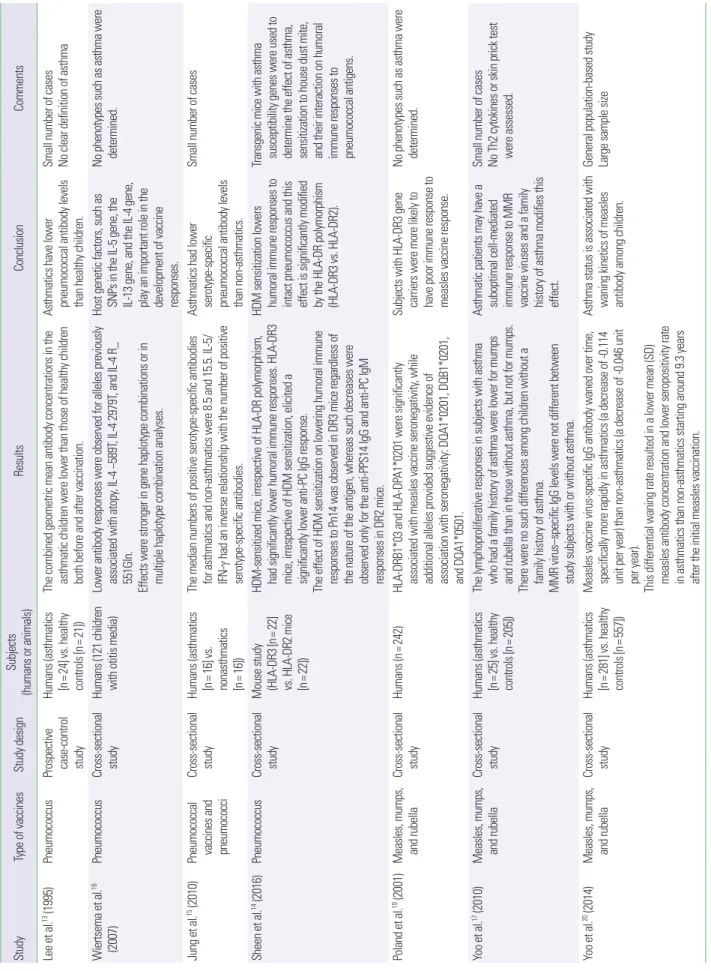
천식 환자, 천식관련유전자, 천식마우스모델에서 항체생성반응 을 측정한 연구들은 폐구균폐렴접종,13-16 홍역, 볼거리, 풍진접종,17-20 파상풍접종,21 B형간염접종22에 대해서 보고가 되었다(Table 1).
1. 천식이 폐구균접종 후 항체생성에 미치는 영향
24명 소아천식 환자, 21명 정상소아를 대상으로 23가 폐구균접 종 전후 혈청형-특이 다당류항체(6B, 9V, 14, 18C, 19F, 23F)를 측정 한 우리나라 연구가 있다.13 정상소아와 비교해서 접종 전에 천식 환 자에서 측정한 6개 항체수치가 모두 낮았고(유의한 수치: 9V, 18C, 19F) 합친 기하평균(combined geometric mean) 항체수치도 낮았 다고 보고하였다.13 23가 폐구균접종 후에도 천식 환자에서 6개 항 체수치가 모두 낮았고(유의한 수치: 9V, 14, 18C) 합친 기하평균 항 체수치도 낮았다.13 미국에서 시행한 다른 연구에서는 16명 천식 환 자 중 7명(44%), 14명 정상인 중 12명(86%)에서 23개 혈청형-특이 다당류항체 중 12개 이상 혈청형-특이 다당류항체(양성기준: ≥1.3 μg/mL)가 양성으로 측정되었다.15 혈청형-특이 항체 양성 숫자는 Allergy Asthma Respir Dis 6(6):279-283, November 2018 https://doi.org/10.4168/aard.2018.6.6.279 REVIEW
Correspondence to: Youn Ho Sheen https://orcid.org/0000-0003-3227-5511
Department of Pediatrics, CHA Gangnam Medical Center, CHA University School of Medicine, 566 Nonhyeon-ro, Gangnam-gu, Seoul 06135, Korea
Tel: +82-2-3468-3032, Fax: +82-2-3468-3697, E-mail: [email protected] Received: July 15, 2018 Revised: August 31, 2018 Accepted: September 1, 2018
© 2018 The Korean Academy of Pediatric Allergy and Respiratory Disease The Korean Academy of Asthma, Allergy and Clinical Immunology This is an Open Access article distributed under the terms of the Creative Commons Attribution Non-Commercial License
천식이 예방접종 후 항체 형성에 미치는 영향
신윤호
차의과학대학교 강남차병원 소아청소년과
Asthma has an adverse effect on the production of antibody to vaccines
Youn Ho Sheen
Department of Pediatrics, CHA Gangnam Medical Center, CHA University School of Medicine, Seoul, Korea
Asthma is considered a chronic inflammatory airway disease. Mounting evidence reports that patients with asthma are at signifi- cantly higher risk of developing communicable diseases such as invasive pneumococcal disease, Haemophilus influenza, varicella, measles, pertussis and tetanus. While impaired innate immunity may play a role in increased risk of developing these infections, suboptimal adaptive immune responses have also been reported to play a role in asthmatic subjects with regard to increased risk of infections. This review discusses the currently underrecognized immunological effect of asthma on antibody to vaccines and rec- ommends that clinicians be aware of less optimal antibody production in response to vaccines in subjects with asthma. (Allergy Asthma Respir Dis 2018;6:279-283)
Key words: Asthma, Antibody response, Vaccines
Table 1. A list of studies showing associations between asthma and the production of antibody responses to various vaccines StudyType of vaccinesStudy designSubjects (humans or animals)ResultsConclusionComments Lee et al.13 (1995)PneumococcusProspective case-control study
Humans (asthmatics [n=24] vs. healthy controls [n=21])
The combined geometric mean antibody concentrations in the asthmatic children were lower than those of healthy children both before and after vaccination.
Asthmatics have lower pneumococcal antibody levels than healthy children.
Small number of cases No clear definition of asthma
Wiertsema et al.16 (2007)PneumococcusCross-sectional studyHumans (121 children with otitis media)Lower antibody responses were observed for alleles previously associated with atopy, IL-4 −589T, IL-4 2979T, and IL-4 R_ 551Gln. Effects were stronger in gene haplotype combinations or in multiple haplotype combination analyses.
Host genetic factors, such as SNPs in the IL-5 gene, the IL-13 gene, and the IL-4 gene, play an important role in the development of vaccine responses.
No phenotypes such as asthma were determined. Jung et al.15 (2010)Pneumococcal vaccines and pneumococci
Cross-sectional studyHumans (asthmatics [n=16] vs.
nonasthmatics [n=16])
The median numbers of positive serotype-specific antibodies for asthmatics and non-asthmatics were 8.5 and 15.5. IL-5/ IFN-
γ had an inverse relationship with the number of positive serotype-specific antibodies.
Asthmatics had lower serotype-specific pneumococcal antibody levels than non-asthmatics.
Small number of cases Sheen et al.14 (2016)PneumococcusCross-sectional studyMouse study (HLA-DR3 [n=22]
vs. HLA-DR2 mice [n=22])
HDM-sensitized mice, irrespective of HLA-DR polymorphism, had significantly lower humoral immune responses. HLA-DR3 mice, irrespective of HDM sensitization, elicited a significantly lower anti-PC IgG response. The effect of HDM sensitization on lowering humoral immune responses to Pn14 was observed in DR3 mice regardless of the nature of the antigen, whereas such decreases were observed only for the anti-PPS14 IgG and anti-PC IgM responses in DR2 mice.
HDM sensitization lowers humoral immune responses to intact pneumococcus and this effect is significantly modified by the HLA-DR polymorphism (HLA-DR3 vs. HLA-DR2).
Transgenic mice with asthma susceptibility genes were used to determine the effect of asthma, sensitization to house dust mite, and their interaction on humoral immune responses to pneumococcal antigens. Poland et al.19 (2001)Measles, mumps, and rubellaCross-sectional studyHumans (n=242)HLA-DRB1*03 and HLA-DPA1*0201 were significantly associated with measles vaccine seronegativity, while additional alleles provided suggestive evidence of association with seronegativity: DQA1*0201, DQB1*0201, and DQA1*0501.
Subjects with HLA-DR3 gene carriers were more likely to have poor immune response to measles vaccine response.
No phenotypes such as asthma were determined. Yoo et al.17 (2010)Measles, mumps, and rubellaCross-sectional studyHumans (asthmatics [n=25] vs. healthy controls [n=205])
The lymphoproliferative responses in subjects with asthma who had a family history of asthma were lower for mumps and rubella than in those without asthma, but not for mumps. There were no such differences among children without a family history of asthma. MMR virus–specific IgG levels were not different between study subjects with or without asthma.
Asthmatic patients may have a suboptimal cell-mediated immune response to MMR vaccine viruses and a family history of asthma modifies this effect.
Small number of cases No Th2 cytokines or skin prick test were assessed. 20Yoo et al. (2014)Measles, mumps, Cross-sectional Humans (asthmatics and rubellastudy[n=281] vs. healthy controls [n=557])
Measles vaccine virus-specific IgG antibody waned over time, specifically more rapidly in asthmatics (a decrease of -0.114 unit per year) than non-asthmatics (a decrease of -0.046 unit per year). This differential waning rate resulted in a lower mean (SD) measles antibody concentration and lower seropositivity rate in asthmatics than non-asthmatics starting around 9.3 years after the initial measles vaccination.
Asthma status is associated with waning kinetics of measles antibody among children.
General population-based study Large sample size
(Continued to the next page)
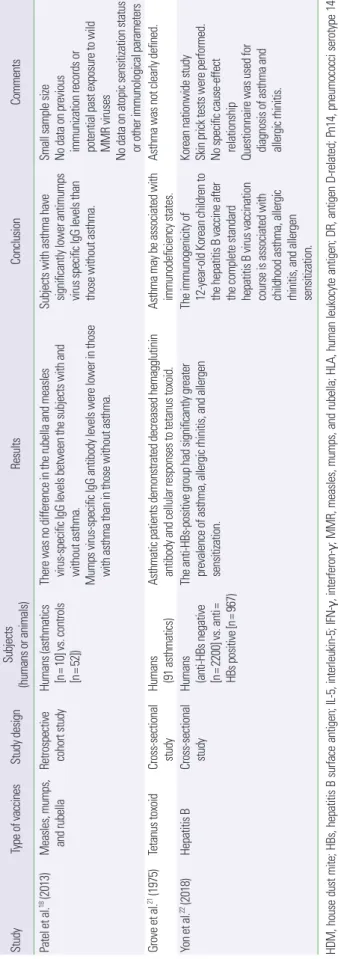
StudyType of vaccinesStudy designSubjects (humans or animals)ResultsConclusionComments Patel et al.18 (2013)Measles, mumps, and rubellaRetrospective cohort studyHumans (asthmatics [n=10] vs. controls [n=52])
There was no difference in the rubella and measles virus-specific IgG levels between the subjects with and without asthma. Mumps virus-specific IgG antibody levels were lower in those with asthma than in those without asthma.
Subjects with asthma have significantly lower antimumps virus specific IgG levels than those without asthma.
Small sample size No data on previous immunization records or potential past exposure to wild MMR viruses
No data on atopic sensitization status or other immunological parameters Grove et al.21 (1975)Tetanus toxoidCross-sectional studyHumans (91 asthmatics)Asthmatic patients demonstrated decreased hemagglutinin antibody and cellular responses to tetanus toxoid.Asthma may be associated with immunodeficiency states.Asthma was not clearly defined. Yon et al.22 (2018)Hepatitis BCross-sectional studyHumans (anti-HBs negative [n=2200] vs. anti= HBs positive [n=967)
The anti-HBs-positive group had significantly greater prevalence of asthma, allergic rhinitis, and allergen sensitization.
The immunogenicity of 12-year-old Korean children to
the hepatitis B vaccine after the complete standard hepatitis B virus vaccination course is associated with childhood asthma, allergic rhinitis, and allergen sensitization.
Korean nationwide study Skin prick tests were performed. No specific cause-effect relationship Questionnaire was used for diagnosis of asthma and allergic rhinitis. DR, antig human leukocyte antigen;lated; Pn14en D-rend rubella, pneumococci serotype 14;; HLA,γ; MMR, measles,ps, a mumron-γ, interfekin-5; IFN-L-5, interleun; Iurface antigepatitis B s, he HBst mite;HDM, house dus PPS14, antipneumococcal polysaccharide, capsular type 14; PC, phosphorylcholine; SD, standard deviation.
Table 1. Continued
정상인과 비교하였을 때 천식 환자에서 유의하게 낮았다(중위수, 15.5; 사분위수범위, 13–20 vs. 중위수, 8.5; 사분위수범위, 5.5–15.5, P= 0.034).15 또한 혈청형-특이 항체 양성 숫자와 interleukin (IL)-5/
interferon-γ 수치가 음의 상관관계에 있는 것을 확인하였다(rho=
-0.36, P= 0.052).15 이와 같이 천식 환자에서 폐구균접종 후 항체생 성이 감소되어 있다는 것은 천식감수성유전자(예: IL-4 gene, IL-13 gene, IL-4 RA gene)를 가진 사람에서 폐구균항체(pneumococcal serotype-specific IgG)가 감소되어 있다는 연구 결과에서도 확인되 었다.16 이들 연구 결과는 폐구균접종 후에 정상인과 비교해서 천식 환자가 낮은 혈청형-특이 폐구균항체를 생성한다는 것을 보고하 였다.
2. 천식이 홍역, 볼거리, 풍진 접종 후 항체생성에 미치는 영향 천식 환자에서 홍역, 볼거리, 풍진 접종 후 항체수치를 측정한 연 구가 보고되어 있다.17-20 소말리아에서 미국으로 이주한 소아(48명, 77%), 성인(14명, 23%)을 대상으로 천식이 홍역, 볼거리, 풍진 접종 항체 형성에 미치는 영향을 규명한 연구가 있다.18 이 연구에서는 정 상군과 비교하였을 때 천식 환자에서 볼거리바이러스-특이 IgG 항 체수치가 낮고(중위수, 2.3; 사분위수범위, 1.2–2.25 vs. 중위수, 3.2;
사분위수범위, 2.5–3.86, P= 0.006) 홍역, 풍진 특이 IgG 수치에서 는 두 군 간에 차이가 없는 것을 보고하였다.18 홍역, 볼거리, 풍진 접 종 후 항-홍역접종바이러스에 대한 항체 생성을 연구한 다른 단면 연구(838명: 천식, 281명[34%]; 정상인, 557명[66.5%])에서는 시간 이 경과함에 따라 항-홍역항체수치(measles vaccine virus-specific IgG)가 감소하였고 이는 천식 환자에서 유의하게 더 많이 감소하였 다고 보고하였다(천식 환자: rho=-0.30, P<0.001, -0.114 unit 감소/
년 vs. 정상인: rho=-0.13, P= 0.002, -0.046 unit 감소/년).20
3. 천식과 파상풍접종, B형 접종 항체생성과 연관성
천식 환자를 대상으로 파상풍 접종 후 항체 형성을 측정한 연구 가 있다.21 파상풍접종 후 정상인과 비교해서 천식 환자에서 항 IgG 파상풍항체, 세포매개 면역반응(phytohemagglutinin에 대한 림프 구 반응)이 감소되어 있는 것을 확인하였다.21 B형간염접종 관련해 서 보고된 국내 연구가 있다. 우리나라 일반 소아 4,112명을 대상으 로 한 연구는 3회 B형 접종 후 12세에 측정한 B형 항체 형성 유무와 천식과 연관성을 분석하였다.22 12세 B형간염항체 양성군과 음성 군을 비교하였을 때 B형간염항체 양성군에서 천식(9.7% vs. 7.0%, P= 0.009), 알레르기비염(33.3% vs. 28.8%, P= 0.013), 알레르기항 원 감작(59.2% vs. 54.5%, P= 0.014) 발생이 유의하게 증가되어 있는 것을 확인하였다.22 하지만 이 연구는 B형간염접종에 의해서 천식 발생이 영향을 받았는지 아니면 천식에 의해서 B형간염접종항체 생성이 영향을 받았는지 인과관계를 설명하기는 어렵다는 제한점 이 있다.22
생성 과정에서 적절한 T세포-B세포 상호작용이 발생하지 못해서 항체 형성이 감소될 것으로 생각한다. 그 이외에 폐구균항원펩티드 를 항원 전달하는 과정에서 수지상세포 같은 항원제시세포의 HLA-DR3 Class II의 부적절한 기능 때문에 예방접종 후 항체생성 이 저하될 가능성이 있다. 이 기전이 발생하면 항체성숙과정에서 필요한 CD4+ T세포의 활성화가 적절하게 되지 못하고 B세포에게 필요한 도움을 주지 못하게 된다. 결국 외부항원에 대해서 비효율 적이고 비생산적인 항체생성반응이 발생하게 된다.31 또한 HLA- DR3 트랜스제닉마우스에서 관찰되는 변화된 CD4+ T세포 환경은 가슴샘선택(thymic selection)과정에서 항원전달에 해로운 영향을 미칠 것이다.14 정상인과 비교해서 천식 환자가 낮은 혈청형-특이 홍 역, 볼거리, 풍진 항체가를 생성하는 기전에 대해서는 잘 알려져 있 지 않다. 이전에 보고된 연구들을 바탕으로 유추 가능한 기전은 천 식 환자에서 기억T세포(memory T cell)가 빨리 쇠퇴하기 때문에 예방접종 후 항체수치가 빨리 감소할 수 있다는 것이다.17 정상인 (557명, 66.5%)과 천식 환자(281명, 33.5%)에서 홍역접종 후 항-홍역 접종바이러스에 대한 항체생성을 연구한 단면연구에서는 항-홍역 항체수치(measles vaccine virus-specific IgG)가 시간이 경과함에 따라 감소하였고 이는 천식 환자에서 유의하게 많이 감소하였다고 보고하였다(천식 환자: rho=-0.30, P<0.001, -0.114 unit 감소/년 vs. 정상인: rho=-0.13, P= 0.002, -0.046 unit 감소/년).20 이는 정상 인과 비교하였을 때 천식 환자에서 홍역, 볼거리, 풍진 접종 후 이들 바이러스에 대해 저하되어 있는 세포매개면역반응 때문에17,21,32 기 억T세포가 빨리 쇠퇴하는 기전에 의한 것으로 생각한다.17 B형간염 항체 양성군에서 천식 발생이 높은 이유에 대해서는 기전이 확실하 지 않지만 IL-10 같은 항염증사이토카인을 통해서 조절 T세포가 Th1, Th2세포를 하향 조정해서 발생할 수 있다.33,34 천식이 B형간염 항체 생성에 미치는 영향에 대해서는 인과관계 등에 대한 연구가 더 필요할 것으로 생각한다.
결 론
천식이 있는 사람은 예방접종 후 접종균에 대한 항체생성반응이 저하되어서 예방접종을 했음에도 불구하고 이들 감염질환의 유병 률이 증가될 수 있다. 이는 부적절한 T세포-B세포 상호작용, 항원 제시세포의 HLA-DR3 Class II의 기능장애, 가슴샘선택과정에서 CD4+ T세포의 환경 변화(altered CD4+ T-cell repertoire in HLA- DR3 transgenic mice), 기억T세포의 빠른 쇠퇴화 같은 기전에 의해 서 발생할 수 있다. 천식 환자에서 예방접종 후 항체생성반응에 대 한 체계적인 연구가 필요하고 이러한 연구 결과를 바탕으로 천식 환자에 대한 새로운 보건정책이 필요할 것으로 생각한다.
4. 천식이 접종 후 항체생성 저하에 미치는 영향에 대한 기전 정상인과 비교해서 천식 환자가 비교적 낮은 혈청형-특이 폐구 균항체가를 생성하는 기전에 대해서는 잘 알려져 있지 않다. 이전 에 발표된 연구들을 바탕으로 가능한 첫 번째 기전은 다음과 같다.
폐구균다당류는 T세포-독립형 항원(T cell-independent type II, TI-2 antigen)이다.23 가장자리구역 림프구난포(marginal zone lym- phoid follicles)에 위치한 호중구는 marginal zone B세포의 동형 면 역글로불린클래스전환을 유도하는 사이토카인을 생성해서 T세포 의 도움 없이 다당류에 대한 IgG항체를 생성시키도록 한다.23 이와 같이 폐구균다당류항원 같은 T세포-독립형 항원(TI–2 antigen)은 T세포와는 다른 독립적인 기전에 의해 항체가 생성된다. 하지만 폐 구균다당류항원에 대한 적절한 면역반응이 생성되기 위해서는 T 세포-B세포 상호작용이 필요하다.24,25 천식은 Th2-지배적 면역환경 (Th2-predominant immune environment)을 유발하고 이 면역환 경은 폐구균에 대한 체액면역반응을 억제한다.14,15,26 최근 HLA- DR 다형태(HLA-DRB1*0301) 트랜스제닉-마우스에 집먼지진드기 를 감작시켜서 유전자(HLA-DR3 [HLA-DRB1*03] vs. HLA-DR2 [HLA-DRB1*1502]), 집먼지진드기 감작(집먼지진드기 감작 vs. 무 감작), 또는 이들의 상호작용이 폐구균(pneumococci serotype 14, Pn14)에 대한 체액면역반응(항-포스포릴콜린[anti-phosphoryl- choline, anti-PC] IgM/IgG, 항-폐구균다당류[antipneumococcal polysaccharide, capsular type 14, PPS14] IgM/IgG, 항-폐구균표면 단백질 A [pneumococcal surface protein A] IgG)에 미치는 영향을 규명한 연구가 보고되었다.14 이 연구에서는 유전자 형태와 상관없 이(HLA-DR3 vs. HLA-DR2) 집먼지진드기 감작을 시킨 마우스에 서 폐구균에 대한 항체생성이 감소되었다는 것을 확인하였다.14 또 한 HLA-DR2 트랜스제닉마우스와 비교하였을 때 집먼지진드기 감작 여부와 상관없이 HLA-DR3 트랜스제닉마우스가 낮은 항-포 스포릴콜린 IgG, 높은 항-폐구균표면단백질 A (PspA) IgG 항체를 생성하였다.14 집먼지진드기 감작된 HLA-DR3 트랜스제닉마우스 에서 전체적으로 폐구균에 대한 항체생성을 감소시켰다.14 하지만 집먼지진드기 감작된 HLA-DR2 트랜스제닉마우스에서는 폐구균 에 대한 항체생성 감소가 항-폐구균다당류 IgG (anti-PPS14 IgG), 항-포스포릴콜린 IgM (anti-PC IgM)에서만 관찰되었다.14 이와 같 은 마우스모델을 통해서 집먼지진드기 감작이 폐구균에 대한 체액 면역반응을 감소시키고 이런 면역반응은 HLA-DR 다형태(HLA- DR3 vs. HLA-DR2)에 의해서 영향을 받는다고 결론지었다.14 이 마 우스모델은 천식유전자(예: HLA-DR3)가 폐구균에 대한 항체생성 을 감소시키는 데 영향을 미칠 것이라고 규명하였다.14 이는 천식 환 자가 폐구균 감염 위험에 있다는 역학연구,9,12,27 단면연구,15,28 다른 마우스연구26와도 일치한다. 따라서 천식유전자가 있고 알레르기 항원에 감작된 환자는 T세포 후천성면역시스템 결함에 의해 Th2 세포 활성도 증가29,30되어 있기 때문에 폐구균다당류에 대한 항체
REFERENCES
1. To T, Stanojevic S, Moores G, Gershon AS, Bateman ED, Cruz AA, et al.
Global asthma prevalence in adults: findings from the cross-sectional world health survey. BMC Public Health 2012;12:204.
2. Asher MI, Montefort S, Björkstén B, Lai CK, Strachan DP, Weiland SK, et al. Worldwide time trends in the prevalence of symptoms of asthma, al- lergic rhinoconjunctivitis, and eczema in childhood: ISAAC Phases One and Three repeat multicountry cross-sectional surveys. Lancet 2006;368:
733-43.
3. World Health Organization. Fact sheet for asthma [Internet]. Geneva (Switzerland): World Health Organization; c2018 [cited 2018 Aug 10].
Available from: http://www.who.int/en/news-room/fact-sheets/detail/
asthma.
4. Kim S, Kim J, Kim K, Kim Y, Park Y, Baek S, et al. Healthcare use and prescription patterns associated with adult asthma in Korea: analysis of the NHI claims database. Allergy 2013;68:1435-42.
5. Lee SI. Prevalence of childhood asthma in Korea: international study of asthma and allergies in childhood. Allergy Asthma Immunol Res 2010;
2:61-4.
6. Braman SS. The global burden of asthma. Chest 2006;130(1 Suppl):4S- 7. Wills-Karp M. Immunologic basis of antigen-induced airway hyperre-12S.
sponsiveness. Annu Rev Immunol 1999;17:255-81.
8. Juhn YJ. Risks for infection in patients with asthma (or other atopic con- ditions): is asthma more than a chronic airway disease? J Allergy Clin Immunol 2014;134:247-57.
9. Juhn YJ, Kita H, Yawn BP, Boyce TG, Yoo KH, McGree ME, et al. In- creased risk of serious pneumococcal disease in patients with asthma. J Allergy Clin Immunol 2008;122:719-23.
10. Kim BS, Mehra S, Yawn B, Grose C, Tarrell R, Lahr B, et al. Increased risk of herpes zoster in children with asthma: a population-based case-con- trol study. J Pediatr 2013;163:816-21.
11. Wi CI, Kim BS, Mehra S, Yawn BP, Park MA, Juhn YJ. Risk of herpes zoster in children with asthma. Allergy Asthma Proc 2015;36:372-8.
12. Talbot TR, Hartert TV, Mitchel E, Halasa NB, Arbogast PG, Poehling KA, et al. Asthma as a risk factor for invasive pneumococcal disease. N Engl J Med 2005;352:2082-90.
13. Lee HJ, Kang JH, Henrichsen J, Konradsen HB, Jang SH, Shin HY, et al.
Immunogenicity and safety of a 23-valent pneumococcal polysaccharide vaccine in healthy children and in children at increased risk of pneumo- coccal infection. Vaccine 1995;13:1533-8.
14. Sheen YH, Rajagopalan G, Snapper CM, Kita H, Wi CI, Umaretiya PJ, et al. Influence of HLA-DR polymorphism and allergic sensitization on hu- moral immune responses to intact pneumococcus in a transgenic mouse model. HLA 2016;88:25-34.
15. Jung JA, Kita H, Dhillon R, Jacobson RM, Nahm MH, Park M, et al. In- fluence of asthma status on serotype-specific pneumococcal antibody levels. Postgrad Med 2010;122:116-24.
16. Wiertsema SP, Baynam G, Khoo SK, Veenhoven RH, van Heerbeek N, Zhang G, et al. Impact of genetic variants in IL-4, IL-4 RA and IL-13 on the anti-pneumococcal antibody response. Vaccine 2007;25:306-13.
17. Yoo KH, Agarwal K, Butterfield M, Jacobson RM, Poland GA, Juhn YJ.
Assessment of humoral and cell-mediated immune response to measles- mumps-rubella vaccine viruses among patients with asthma. Allergy Asthma Proc 2010;31:499-506.
18. Patel AR, Zietlow J, Jacobson RM, Poland GA, Juhn YJ. Asthma and the immune response to MMR vaccine viruses in Somali immigrant chil- dren: a cross-sectional retrospective cohort study. Prim Care Respir J 2013;
22:278-83.
19. Poland GA, Ovsyannikova IG, Jacobson RM, Vierkant RA, Jacobsen SJ, Pankratz VS, et al. Identification of an association between HLA class II alleles and low antibody levels after measles immunization. Vaccine 2001;
20:430-8.
20. Yoo KH, Jacobson RM, Poland GA, Weaver A, Lee L, Chang T, et al. Asth- ma status and waning of measles antibody concentrations after measles immunization. Pediatr Infect Dis J 2014;33:1016-22.
21. Grove DI, Burston TO, Wellby ML, Ford RM, Forbes IJ. Humoral and cellular immunity in asthma. J Allergy Clin Immunol 1975;55:152-63.
22. Yon DK, Ha EK, Lee SY, Kim WK, Park YM, Kim J, et al. Hepatitis B im- munogenicity after a primary vaccination course associated with child- hood asthma, allergic rhinitis, and allergen sensitization. Pediatr Allergy Immunol 2018;29:221-4.
23. Puga I, Cols M, Barra CM, He B, Cassis L, Gentile M, et al. B cell-helper neutrophils stimulate the diversification and production of immunoglob- ulin in the marginal zone of the spleen. Nat Immunol 2011;13:170-80.
24. Griffioen AW, Toebes EA, Rijkers GT, Claas FH, Datema G, Zegers BJ.
The amplifier role of T cells in the human in vitro B cell response to type 4 pneumococcal polysaccharide. Immunol Lett 1992;32:265-72.
25. Khan AQ, Lees A, Snapper CM. Differential regulation of IgG anti-cap- sular polysaccharide and antiprotein responses to intact Streptococcus neumoniae in the presence of cognate CD4+ T cell help. J Immunol 2004;
172:532-9.
26. Khan AQ, Shen Y, Wu ZQ, Wynn TA, Snapper CM. Endogenous pro- and anti-inflammatory cytokines differentially regulate an in vivo hu- moral response to Streptococcus pneumoniae. Infect Immun 2002;70:
749-61.
27. Inghammar M, Engström G, Kahlmeter G, Ljungberg B, Löfdahl CG, Egesten A. Invasive pneumococcal disease in patients with an underlying pulmonary disorder. Clin Microbiol Infect 2013;19:1148-54.
28. Podjasek JC, Jung JA, Kita H, Park MA, Juhn YJ. The FACT score in pre- dicting pneumococcal antibody levels in asthmatics. J Asthma 2015;52:
370-5.
29. Robinson KA, Baughman W, Rothrock G, Barrett NL, Pass M, Lexau C, et al. Epidemiology of invasive Streptococcus pneumoniae infections in the United States, 1995-1998: opportunities for prevention in the conju- gate vaccine era. JAMA 2001;285:1729-35.
30. James KM, Peebles RS Jr, Hartert TV. Response to infections in patients with asthma and atopic disease: an epiphenomenon or reflection of host susceptibility? J Allergy Clin Immunol 2012;130:343-51.
31. Crotty S. A brief history of T cell help to B cells. Nat Rev Immunol 2015;
15:185-9.
32. Atkinson TP, Duffy LB, Pendley D, Dai Y, Cassell GH. Deficient immune response to Mycoplasma pneumoniae in childhood asthma. Allergy Asth- ma Proc 2009;30:158-65.
33. Figueiredo CA, Amorim LD, Alcantara-Neves NM, Matos SM, Cooper PJ, Rodrigues LC, et al. Environmental conditions, immunologic pheno- types, atopy, and asthma: new evidence of how the hygiene hypothesis operates in Latin America. J Allergy Clin Immunol 2013;131:1064-8.
34. Palomares O, Akdis M, Martín-Fontecha M, Akdis CA. Mechanisms of immune regulation in allergic diseases: the role of regulatory T and B cells.
Immunol Rev 2017;278:219-36.