Received on September 17, 2014. Revised on October 5, 2014. Accepted on October 14, 2014.
CC This is an open access article distributed under the terms of the Creative Commons Attribution Non-Commercial License (http://creativecommons.org/licenses/by-nc/3.0) which permits unrestricted non-commercial use, distribu- tion, and reproduction in any medium, provided the original work is properly cited.
*Corresponding Author. Mi-Yeon Kim, Department of Bioinformatics and Life Science, Soongsil University, 369 Sangdo-ro, Dongjak-gu, Seoul, Korea. Tel: 82-2-820-0458; Fax: 82-2-824-4383; E-mail: [email protected]
Abbreviations: LPS, lipopolysaccharide; NF-κB, nuclear factor κB; MFI, mean fluorescence intensity
Immunomodulatory Effects of ZYM-201 on LPS-stimulated B Cells
Ye Eun Lee, Soochan Kim, Woong-Jae Jung, Hyung Soo Lee and Mi-Yeon Kim*
Department of Bioinformatics and Life Science, Soongsil University, Seoul 156-743, Korea
ZYM-201 is a methyl ester of triterpenoid glycoside from Sanguisorba officinalis which has been used for treatment of inflammatory and metabolic diseases. In this study, im- munomodulatory effects of ZYM-201 on B cells were exam- ined in vitro and in vivo. When splenocytes were activated with lipopolysaccharide (LPS), the major population which had shown an increase in cell numbers was B cells. However, when the B cells were treated with ZYM-201 after LPS acti- vation, their cell numbers and the expression of major cos- timulatory molecules, CD80 and CD86, were decreased.
Furthermore, the effect of LPS, which induces activation of NF-κB, was abolished by ZYM-201: LPS-stimulated B cells showed decrease of phosphorylation after treatment of ZYM-201. The same results were shown in vivo experiments.
These results suggest that ZYM-201 may play a role in the modulation of inflammatory responses through inhibiting NF-κB activation and downregulating the expression of cos- timulatory molecules on B cells.
[Immune Network 2014;14(5):260-264]
Keywords: ZYM-201, B cell, Inflammation, LPS
INTRODUCTION
Sanguisorba officinalis L. (Rosaceae), a well known traditional medicinal plant in East Asia, is used for treatment of in- flammatory and metabolic disease (1). Recent studies have been reported that various extracts of S. officinalis have me- dicinal effects such as anti-allergic, anti-cancer, anti-thrombin,
anti-wrinkle, and neuroprotective properties (1-7). The root of S. officinalis includes various saponin components includ- ing triterpenoids and their glycosides, gallic acid, and dis- accharide (8,9). ZYM-201 is a modified compound of ziyu- glycoside, one of triterpene glycoside originated from the root of S. officinalis, through deglycosidation and esterification (10).
Previous studies have shown that ZYM-201 plays a role in in- hibiting tissue factor activity, tumor necrosis factor (TNF)-α production and modulating hyperlipidemic conditions (10-12).
LPS is the major component of the outer membrane of Gram-negative bacteria and commonly used to study in- flammation because it initiates acute inflammatory responses in animals (13,14). The binding of LPS to Toll-like receptor 4 triggers signal transduction pathways and finally induces phos- phorylation and translocation of nuclear factor (NF)-κB (15) leading to regulating the expression of a large number of genes which have important functions in immune responses (16).
The stimulation of B cells by LPS induces proliferation and upregulates the expression of CD80 and CD86, which results in enhancing their antigen-presenting capacity (15,17-19).
Increased expression of these costimulatory molecules is as- sociated with activation of NF-κB (20,21).
Since ZYM-201 has been reported to inhibit the production of TNF-α, we investigated the effects of ZYM-201 on the acti- vation of lymphocytes in LPS-induced inflammation. We found that the activation of LPS-stimulated B cells was abol- ished by ZYM-201 through inhibiting NF-κB activation and downregulating costimulatory molecules.
MATERIALS AND METHODS Preparation of cells
All experiments were performed in accordance with the ap- proval of Soongsil University Institutional Animal Care and Use Committee. 6-week-old C57BL/6 mice were purchased from Young Bio (Seongnam, Korea). To make cell suspen- sions, extracted spleens from mice were cut into small frag- ments and crushed between gauze. After depletion of red blood cells with Gey’s solution, the cell suspensions were cultured in RPMI1640 (GIBCO, Grand Island, NY, USA) sup- plemented with 10% fetal bovine serum, 100 U/ml of pen- icillin and 100 μg/ml of streptomycin (GIBCO).
Chemicals
ZYM-201 is a methyl ester of triterpenoid glycoside and modi- fied compound through deglycosidation and esterification from ziyu-glycoside, which is an originated component from the root of S. officinalis (10). Extraction, modification and purification of ZYM-201 were performed as previously described (10).
Flow cytometry
Splenocytes were cultured with 1 μg/ml LPS for 24 hours and/or ZYM-201 (50 or 100 μM) was added 6 hours after LPS treatment. mAbs for CD80 (clone 16-10A1), CD86 (clone GL1), and B220 (clone RA3-6B2) were purchased from eBioscience (San Diego, CA).
Western blot
Splenocytes were positively enriched by using FITC-con- jugated B220 mAbs and anti-FITC microbeads according to the manufacturer’s instructions (Miltenyi Biotec Ltd., Bergisch Gladbach, Germany). B220+ cells were cultured with 1 μg/ml LPS and/or 100 or 200 μM ZYM-201 for 30 minutes, and lysed in RIPA buffer (Sigma-Aldrich, St.Louis, MO, USA) sup- plemented with protease inhibitor cocktail tablets and PhosSTOP (Roche, Mannheim, Germany). Cell lysates were separated using SDS-PAGE and transferred on to polyvinyli- dene difluoride membrane (Millipore, Darmstadt, Germany).
mAbs for HSP90 (clone C45G5), NF-κB p65 (clone L8F6), and phospho-NF-κB p65 (Ser536) (clone 93H1) were purchased from Cell Signaling Technology (Danvers, MA, USA). As the second step reagents, HRP-linked anti-rabbit IgG and an- ti-mouse IgG Abs were used (Cell Signaling Technology).
Proteins were visualized by enhanced chemiluminescence (Bio-Rad, Hercules, CA, USA) and x-ray films (AGFA, Dussel-
dorf, Germany) were used for detection.
in vivo experiment
7-week-old C57BL/6 mice, weighing 22±2 g were used.
Three groups were analyzed and there were four mice in each group. Mice in the control group were intraperitoneally injected with sterile PBS and mice in the other groups were intraperitoneally injected with 1 mg/kg LPS (Sigma-Aldrich) and then orally administrated with 20 mg/kg ZYM-201 dis- solved in 0.5% carboxymethylcellulose (CMC) solution (Sigma- Aldrich) or with 0.5% CMC solution twice (1 and 7 hours after LPS injection). 24 hours after LPS injection, spleens were tak- en for analysis.
RESULTS AND DISCUSSION
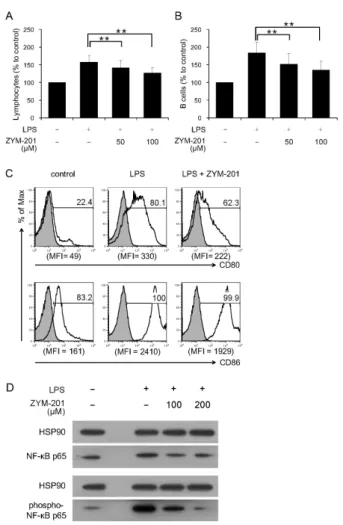
To investigate the effects of ZYM-201 on the cell number and activation of LPS-stimulated lymphocytes, cells from mouse spleens were cultured with 50, or 100 μM ZYM-201 after LPS treatment (Fig. 1A and 1B). The number of lymphocytes was increased from 100% (control) to 157% by LPS treatment, but decreased in the presence of ZYM-201 in a dose dependent manner: 142% with 50 μM ZYM-201 and 127% with 100 μM ZYM-201 (Fig. 1A). In particular, the number of B cells com- pared to other cell populations showed a big increase from 100% (control) to 185% by LPS treatment. However, this ef- fect was abolished in the presence of ZYM-201; B cell num- bers were decreased to 152% with 50 μM ZYM-201 and 132% with 100 μM ZYM-201 (Fig. 1B). In addition, the ex- pression of CD80 and CD86 on LPS-stimulated B cells was downregulated in the presence of ZYM-201; mean fluorescent intensity (MFI) of CD80 expression on LPS-stimulated B cells was downregulated from 330 to 222 followed by incubation with ZYM-201, and MFI of CD86 expression was also down- regulated from 2410 to 1929 with ZYM-201 (Fig. 1C). These data indicate that ZYM-201 downregulates the activation of LPS-stimulated B cells. Because the upregulation of CD80 and CD86 costimulatory molecules is related with activation of NF- κB, we examined levels of NF-κB p65 phosphorylation on serine 536 (22) in B cells by western blot (Fig. 1D). Levels of NF-κB p65 phosphorylation in B cells were markedly in- creased by LPS stimulation, but dramatically decreased in the presence of ZYM-201 indicating that ZYM-201 has an in- hibitory effect on LPS-stimulated B cell activation through in- hibiting NF-κB phosphorylation and downregulating cos- timulatory molecules on B cells.
Figure 2. in vivo analysis of ZYM-201 effects on B cells of LPS-injected mice. Mice were intraperitoneally injected with LPS (1 mg/kg) and/or orally administrated with ZYM-201 (20 mg/kg). Twenty four hours after LPS injection, spleens were taken. (A) and (B) Relative percentages of lymphocytes and B cells. The numbers of lymphocytes and B220+ B cells were calculated by using SPHEROTM AccuCount Blank Particles and the percentage of the cells was determined by comparison to control (100%). Error bars show standard deviation of four independent experiments. **p<0.01; ***p<0.005. (C) CD80 and CD86 expression on B cells. Filled histograms show isotype- matched control Abs and numbers above bracketed line shows the percentage of positive cells for each Ab staining. Histograms are representative and mean fluorescence intensity (MFI) shown below each histogram is the average of four independent experiments.
Figure 1. Effect of ZYM-201 on the activation of LPS-stimulated B cells in vitro. (A) and (B) Relative percentages of lymphocytes and B cells.
Splenocytes were assessed after treatment with/without LPS (1 μg/ml) for 24 hours. In the case of ZYM-201 treatment, 50 and 100 μM ZYM-201 was added 6 hours after LPS treatment. Lymphocyte numbers were calculated by using SPHEROTM AccuCount Blank Particles (Spherotech, Lake Forest, IL) according to manufacturer’s recommendations. Percentage of lymphocyte numbers was determined by comparison to control (100%). Percentage of B cells was decided using B220 mAbs and compared to control (100%). Error bars show standard deviation of six independent experiments. The statistical evaluation of the data was performed with Student’s t-test and one-way analysis of variance. **p<0.01. (C) Flow cytometric analysis of CD80 and CD86 expression on B cells cultured with LPS and/or ZYM-201 (50 μM). Filled histograms show isotype-matched control Abs and numbers above bracketed line shows the percentage of positive cells for each Ab staining. Histograms are representative and mean fluorescence intensity (MFI) shown below each histogram is the average of six independent experiments. (D) Western blot analysis of levels of NF-κB p65 phosphorylation in B cells. Enriched B cells were cultured with LPS (1 μg/ml) and ZYM-201 (0 to 200 μM) for 30 minutes. Data shows total and phosporylated NF-κB p65 at serine536. HSP90 was used as loading control. Results are represen- tative of six independent experiments.
To confirm whether ZYM-201 has an inhibitory effect on LPS-stimulated B cell activation in vivo, cells from mice that had been injected with LPS and subsequently fed ZYM-201 twice were compared with those from mice that had not (Fig.
2). The numbers of lymphocytes and B cells were increased from 100% (control) to 138% and 143%, respectively, by LPS injection. Consistent with in vitro experiments, this effect was abolished after feeding ZYM-201; the numbers of lympho- cytes and B cells were decreased to 92% and 90%, re- spectively, by ZYM-201 (Fig. 2A and 2B). Furthermore, the expression of constimulatory molecules on B cells in vivo showed the same pattern to that in vitro ; the expression of CD80 and CD86 on LPS-stimulated B cells was downregulated after feeding ZYM-201 (Fig. 2C).
Taken together, these data indicate that ZYM-201, which has been known to have inhibiting tissue factor activity, TNF-α production and modulating hyperlipidemic conditions (10-12), has another function of anti-inflammatory activities via in- hibition of NF-κB activation and downregulation of cos- timulatory molecules in B cells. In agreement with this, pre- vious studies showed that inhibition of NF-κB activation sup- press inflammatory responses (23) and have anti-inflam- mation and anticancer effects (24), and suggested that it could be used to treat immune diseases (25). Since ZYM-201 showed anti-inflammatory activities after LPS infection, we suggest that oral administration of ZYM-201 may be helpful to inflammatory diseases.
ACKNOWLEDGEMENTS
This research was supported by Basic Science Research Program through the National Research Foundation of Korea (NRF) funded by the Ministry of Education, Science and Technology (NRF-2013R1A1A2007282).
CONFLICTS OF INTEREST
The authors have no financial conflict of interest.
REFERENCES
1. East, J. 1955. The effect of certain plant preparations on the fertility of laboratory mammals. 4. Sanguisorba officinalis L.
J. Endocrinol. 12: 273-276.
2. Park, K. H., D. Koh, K. Kim, J. Park, and Y. Lim. 2004.
Antiallergic activity of a disaccharide isolated from Sanguisorba officinalis. Phytother. Res. 18: 658-662.
3. Goun, E. A., V. M. Petrichenko, S. U. Solodnikov, T. V.
Suhinina, M. A. Kline, G. Cunningham, C. Nguyen, and H.
Miles. 2002. Anticancer and antithrombin activity of Russian plants. J. Ethnopharmacol. 81: 337-342.
4. Kim, Y. H., C. B. Chung, J. G. Kim, K. I. Ko, S. H. Park, J. H. Kim, S. Y. Eom, Y. S. Kim, Y. I. Hwang, and K. H.
Kim. 2008. Anti-wrinkle activity of ziyuglycoside I isolated from a Sanguisorba officinalis root extract and its application as a cosmeceutical ingredient. Biosci. Biotechnol. Biochem.
72: 303-311.
5. Ban, J. Y., H. T. Nguyen, H. J. Lee, S. O. Cho, H. S. Ju, J. Y. Kim, K. Bae, K. S. Song, and Y. H. Seong. 2008.
Neuroprotective properties of gallic acid from Sanguisorbae radix on amyloid beta protein (25--35)-induced toxicity in cul- tured rat cortical neurons. Biol. Pharm. Bull. 31: 149-153.
6. Wang, Z., W. T. Loo, N. Wang, L. W. Chow, D. Wang, F.
Han, X. Zheng, and J. P. Chen. 2012. Effect of Sanguisorba officinalis L on breast cancer growth and angiogenesis. Expert
Opin. Ther. Targets 16 Suppl 1: S79-89.
7. Tsukahara, K., S. Moriwaki, T. Fujimura, and Y. Takema.
2001. Inhibitory effect of an extract of Sanguisorba officinalis L. on ultraviolet-B-induced photodamage of rat skin. Biol.
Pharm. Bull. 24: 998-1003.
8. Liu, X., Y. Cui, Q. Yu, and B. Yu. 2005. Triterpenoids from Sanguisorba officinalis. Phytochemistry 66: 1671-1679.
9. Mimaki, Y., M. Fukushima, A. Yokosuka, Y. Sashida, S.
Furuya, and H. Sakagami. 2001. Triterpene glycosides from the roots of Sanguisorba officinalis. Phytochemistry 57: 773-779.
10. Cho, J. Y., E. S. Yoo, B. C. Cha, H. J. Park, M. H. Rhee, and Y. N. Han. 2006. The inhibitory effect of triterpenoid glycosides originating from Sanguisorba officinalis on tissue factor activity and the production of TNF-alpha. Planta Med.
72: 1279-1284.
11. Choi, J., M. Y. Kim, B. C. Cha, E. S. Yoo, K. Yoon, J. Lee, H. S. Rho, S. Y. Kim, and J. Y. Cho. 2012. ZYM-201 sodium succinate ameliorates streptozotocin-induced hyperlipidemic conditions. Planta Med. 78: 12-17.
12. Choi, J., T. Yu, B. C. Cha, M. H. Rhee, E. S. Yoo, M. Y.
Kim, J. Lee, and J. Y. Cho. 2011. Modulatory effects of ZYM-201 sodium succinate on dietary-induced hyperlipidemic conditions. Pharmazie 66: 791-797.
13. Lu, Y. C., W. C. Yeh, and P. S. Ohashi. 2008. LPS/TLR4 sig- nal transduction pathway. Cytokine 42: 145-151.
14. Alexander, C., and E. T. Rietschel. 2001. Bacterial lipopoly- saccharides and innate immunity. J. Endotoxin Res. 7: 167-202.
15. Akira, S., and S. Sato. 2003. Toll-like receptors and their sig- naling mechanisms. Scand. J. Infect. Dis. 35: 555-562.
16. Buss, H., A. Dorrie, M. L. Schmitz, E. Hoffmann, K. Resch, and M. Kracht. 2004. Constitutive and interleukin-1-inducible phosphorylation of p65 NF-{kappa}B at serine 536 is mediated by multiple protein kinases including I{kappa}B kinase (IKK)-{alpha}, IKK{beta}, IKK{epsilon}, TRAF family mem- ber-associated (TANK)-binding kinase 1 (TBK1), and an un- known kinase and couples p65 to TATA-binding protein-asso- ciated factor II31-mediated interleukin-8 transcription. J. Biol.
Chem. 279: 55633-55643.
17. Suvas, S., V. Singh, S. Sahdev, H. Vohra, and J. N. Agrewala.
2002. Distinct role of CD80 and CD86 in the regulation of the activation of B cell and B cell lymphoma. J. Biol. Chem.
277: 7766-7775.
18. Ogata, H., I. Su, K. Miyake, Y. Nagai, S. Akashi, I. Mecklen- brauker, K. Rajewsky, M. Kimoto, and A. Tarakhovsky. 2000.
The toll-like receptor protein RP105 regulates lipopolysac- charide signaling in B cells. J. Exp. Med. 192: 23-29.
19. Collins, A. V., D. W. Brodie, R. J. Gilbert, A. Iaboni, R.
Manso-Sancho, B. Walse, D. I. Stuart, P. A. van der Merwe, and S. J. Davis. 2002. The interaction properties of cos- timulatory molecules revisited. Immunity 17: 201-210.
20. Giannoukakis, N., C. A. Bonham, S. Qian, Z. Chen, L. Peng, J. Harnaha, W. Li, A. W. Thomson, J. J. Fung, P. D. Robbins, and L. Lu. 2000. Prolongation of cardiac allograft survival us- ing dendritic cells treated with NF-kB decoy oligodeoxyr- ibonucleotides. Mol. Ther. 1: 430-437.
21. Zhang, G., and S. Ghosh. 2001. Toll-like receptor-mediated NF-kappaB activation: a phylogenetically conserved paradigm in innate immunity. J. Clin. Invest. 107: 13-19.
22. Viatour, P., M. P. Merville, V. Bours, and A. Chariot. 2005.
Phosphorylation of NF-kappaB and IkappaB proteins: im- plications in cancer and inflammation. Trends Biochem. Sci.
30: 43-52.
23. Pierce, J. W., M. A. Read, H. Ding, F. W. Luscinskas, and T. Collins. 1996. Salicylates inhibit I kappa B-alpha phosphor- ylation, endothelial-leukocyte adhesion molecule expression,
and neutrophil transmigration. J. Immunol. 156: 3961-3969.
24. Yin, M. J., Y. Yamamoto, and R. B. Gaynor. 1998. The an- ti-inflammatory agents aspirin and salicylate inhibit the activ- ity of I(kappa)B kinase-beta. Nature 396: 77-80.
25. Yamamoto, Y., and R. B. Gaynor. 2001. Therapeutic poten- tial of inhibition of the NF-kappaB pathway in the treatment of inflammation and cancer. J. Clin. Invest. 107: 135-142.