Factors Influencing Skin Tolerability to the Rivastigmine Patch in Patients with Alzheimer’s Disease
Hae Ri Na,1 Moon Ho Park,2 SangYun Kim,3 Dong Won Yang,4 Seong-Hye Choi,5 Hyun Duk Yang,6 YoungSoon Yang,7 Hyun Jeong Han,8 Jung Seok Lee,9 Young-Chul Yoon,10 Seong-Ho Koh,11 Jung Eun Kim,12 Bon D. Ku,8 Hee-Jin Kim,13 Kyung Won Park,14 Eun-Joo Kim,15 Bora Yoon,16 Key Jung Park17
1Department of Neurology, Bobath Memorial Hospital, Seongnam, Korea
2Department of Neurology, Korea University College of Medicine, Korea University Ansan Hospital, Ansan, Korea
3Department of Neurology, Seoul National University College of Medicine, Seoul National University Bundang Hospital, Seongnam, Korea
4Department of Neurology, The Catholic University of Korea College of Medicine, Seoul St. Mary’s Hospital, Seoul, Korea
5Department of Neurology, Inha University College of Medicine, Inha University Hospital, Incheon, Korea
6Department of Neurology, Wonkwang University College of Medicine, Wonkwang University Sanbon Medical Center, Gunpo, Korea
7Department of Neurology, VHS Medical Center, Seoul, Korea
8Department of Neurology, Seonam University College of Medicine, Myongji Hospital, Goyang, Korea
9Department of Neurology, Jeju National University College of Medicine, Jeju National University Hospital, Jeju, Korea
10Department of Neurology, Chung-Ang University College of Medicine, Chung-Ang University Hospital, Seoul, Korea
11Department of Neurology, Hanyang University College of Medicine, Hanyang University Guri Hospital, Guri, Korea
12Department of Neurology, Ewha Womans University School of Medicine, Ewha Womans University Mokdong Hospital, Seoul, Korea
13Department of Neurology, Hanyang University College of Medicine, Hanyang University Seoul Hospital, Seoul, Korea
14Department of Neurology, Dong-A University College of Medicine, Dong-A University Medical Center, Busan, Korea
15Department of Neurology, Pusan National University School of Medicine, Pusan National University Hospital, Busan, Korea
16Department of Neurology, Konyang University School of Medicine, Konyang University Hospital, Daejeon, Korea
17Department of Neurology, Kyung Hee University College of Medicine, Kyung Hee University Medical Center, Seoul, Korea
Background and Purpose The one-day rivastigmine patch is reportedly well tolerated and has minimal side effects. However, Asian pa- tients show more side effects than those in Western countries. We evaluated tolerability of the rivastigmine patch in South Korean patients with Alzheimer’s disease (AD) and the specific factors affecting adverse events of the skin.
Methods A 6-month, open labeled, multi-centered, observational study was carried out in 440 patients with probable AD from July 2009 to September 2010 (NCT01312363).
Results A total of 25.9% of the patients experienced adverse skin events at the rivastigmine patch application site and 17.0% discontinued treatment due to adverse events at the skin application site. The most common adverse events were itching and erythema. Patients with an al- lergic history and users of electric heating appliances reported skin discomfort. Older age was associated with discontinuing treatment.
Conclusions These results suggest that the rivastigmine patch induced some adverse skin events and may contribute to understanding and improving skin tolerability to the rivastigmine patch.
Key Words rivastigmine transdermal patch, Alzheimer’s disease, tolerability.
Received: February 16, 2015 Revised: March 9, 2015 Accepted: March 9, 2015
Correspondence: SangYun Kim, MD, PhD, Department of Neurology, Clinical Neuroscience Center, Seoul National University Bundang Hospital, 82 Gumi- ro 173beon-gil, Bundang-gu, Seongnam 463-707, Korea
Tel: +82-31-787-7462, Fax: +82-31-787-6815, E-mail: [email protected]
cc This is an Open Access article distributed under the terms of the Creative Commons Attribution Non-Commercial License (http://creativecommons.org/
licenses/by-nc/3.0) which permits unrestricted non-commercial use, distribution, and reproduction in any medium, provided the ori-ginal work is properly cited.
DND
ORIGINAL ARTICLE
Hae Ri Na et al.
Factors Influencing Skin Tolerability to the Rivastigmine
INTRODUCTION
Rivastigmine has recently been approved in patch formula- tion for treating mild-to-moderate Alzheimer’s disease (AD).
The rivastigmine transdermal patch has the potential or in- duce to minimize blood drug level fluctuations, reduce side ef- fects, and optimize efficacy to provide smooth and continuous drug delivery through the skin.1,2 The 10 cm2 (9.5 mg/day) riv- astigmine patch carries similar efficacy to the highest dose of rivastigmine capsule (12 mg/day) but with a superior tolerabil- ity profile, caregiver preference, and improved tolerability.3-5
Transdermal patches are in constant contact with the skin;
thus, they can cause adverse skin reactions.6 The expected side effects of the rivastigmine patch are associated with skin irrita- tions, which is common with other medical patches.7 Howev- er, only a few data have been reported on side effects of the riv- astigmine patch, such as skin irritation, from Western countries compared with Asian countries.
Many differences exist between Western and Asian coun- tries, such as habits, skin types, and behaviors, which could influence patch tolerability.
The objective of this study was to investigate tolerability of the rivastigmine patch in South Korean patients with AD un- der actual practical conditions. The incidence of adverse events (AEs) of the skin and factors affecting skin AEs were evaluated.
METHODS
Participants
The inclusion criteria for this study were those established for probable AD by the National Institute of Neurological and Communicative Disorders and Stroke-Alzheimer’s Disease and Related Disorders Association,8 age 51–90 years, Mini-Mental State Examination (MMSE) score of 10–26, brain magnetic resonance imaging or computed tomography scan within 12 months that was consistent with a diagnosis of probable AD and showing no clinical evidence of other diseases capable of producing a dementia syndrome, and a reliable caregiver who met the patient at least once weekly and was sufficiently fa- miliar with the patient to provide the investigator with accu- rate information. The exclusion criteria included any primary neurodegenerative disorder or psychiatric disorder other than AD; clinically significant laboratory abnormalities, such as an abnormal thyroid function test, abnormally low level of vita- min B12 or folate or a positive Venereal Disease Research Lab- oratory test; history of drug or alcohol addiction in the past 10 years; any severe or unstable medical disease that could prevent completing all study requirements; hearing or visual
impairment that could disturb the patient evaluation; and in- volvement in another clinical trial or treated by any experi- mental drug within 4 weeks. Medical history was based on family history of dementia, hypertension, diabetes mellitus (DM), hypercholesterolemia, heart disease, and depression and was evaluated at the first visit.
The study was conducted at 22 institutions throughout South Korea in accordance with the Declaration of Helsinki and good clinical reporting practices. The study protocol and informed consent form were reviewed and approved by the Institutional Review Board at each center before the study be- gan. The patients and their legal guardians or a representative gave written informed consent to participate in this study.
Study design
This was a 24-week, open labeled, multi-center, observa- tional study. All eligible patients were treated with a 5 cm2 (4.6 mg/day) rivastigmine patch for the first 4 weeks of the run-in period and then the dosage was increased to the target rivastigmine patch size of 10 cm2 (9.5 mg/day), with adjust- ments as necessary for safety and tolerability. If a patient report- ed too much discomfort using the high dose patch, an inves- tigator assessed the severity of the side effects and adjusted the dose or considered discontinuation of the study. After patients found their highest, well-tolerated patch size, it was main- tained for the remaining 20 weeks of the study. The caregiver applied the patches on the patient’s upper or lower back, either upper arm, or on the chest in clean, dry locations. The patches were exchanged every 24 hours and placed in a different loca- tion.
The safety and tolerability data were derived from partici- pants who had received at least one dose of the study medica- tion and had undergone at least one safety evaluation. The ef- ficacy assessment was performed at baseline (week 0) and the end of the study (week 24), and safety was monitored at every visit on weeks 0, 4, 8, 12, and 24.
Tolerability and safety assessments
All AEs and serious AEs were recorded at each study visit.
Investigators were asked to evaluate severity, relationship with the study drug, and seriousness of the AEs. Skin condi- tion at the application site was monitored by an investigator at every visit. The symptoms monitored by the investigators were erythema, itching, blister, urticaria, pain, and burning;
severity (very slight, mild, or moderate); and location (limited or extended).
Environmental monitoring factors, such as residence type, bed type, heating or cooling system type, and bathing fre- quency per week were evaluated. In addition, history of aller-
DND
gy, humidifier use, and the patient’s skin type were compared with the first visit using an evaluation form. Patients and their caregivers were asked at every visit about concerns or prob- lems associated with using the patch. Finally, patients who discontinued the study prematurely were evaluated through regular visits for the primary endpoint.
Other measures
Neurocognitive measures were collected at baseline and at the end of the study, including the Korean version of the MMSE,9 the Clinical Dementia Rating (CDR),10,11 the CDR- sum of boxes scores (CDR-SB), the Geriatric Depression Scale (GDpS)12 and instrumental activities of daily living (IADL).13 Sample size
The patch discontinuation rate in previous studies5,14 was 10.7%. The additional drop-out caused by ethnic and envi- ronmental factors was assumed to be about 10% in this study.
We set α=0.05, and a power of 80% with two-sided 1-β=0.80 to calculate the two proportion comparisons for superiority.
According to the calculation, 209 patients were needed. Addi- tionally, assuming a loss of up to 50% of patients, which was reported in a previous Korean study in patients with AD,15 the final sample size was more than 309 patients.
Statistical analysis
Continuous variables are presented as means±standard de- viation, and categorical variables are presented as frequencies and percentages. Demographics and clinical characteristics were compared according to skin AEs, using Student’s t-test for continuous variables and the chi-square test for categorical variables. Potential factors affecting skin AEs were entered into a multivariate logistic analysis regression and the odds ratios with 95% confidence intervals were reported. A p-value
<0.05 were considered significant. Statistical analyses were performed using SPSS 20.0 (SPSS Inc., Chicago, IL, USA).
RESULTS
Study population
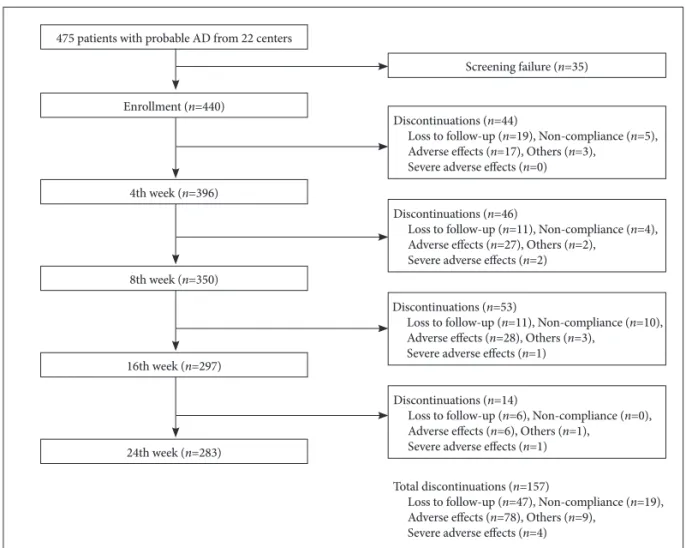
The study was conducted from July 2009 to September 2010, and 440 patients were enrolled. Mean age was 75.9±7.2 years, the majority of patients (68.8%) were female, and the mean education level was 6.0±4.9 years. A total of 157 pa- tients (35.7%) discontinued the study during the 24 weeks.
Finally, 283 patients completed the rivastigmine patch therapy (Fig. 1).
Adverse events
The number of patients reporting at least one AE over the 24-week study period was 126 (28.6%). A total of 114 patients (25.9%) reported skin AEs during the run-in period. The most frequently reported skin AE was itching (23.2%), followed by erythema (18.9%). Eighteen patients (4.2%) reported another AE. The most frequently reported other AE was nausea (0.9%), followed by dizziness (0.7%) and headache (0.7%) (Fig. 2).
Skin adverse events
The clinical characteristics according to skin AEs are shown in Table 1. No significant differences were observed for age, sex, education, or medical history (family history of demen- tia, hypertension, DM, hypercholesterolemia, heart disease, and depression). More patients with skin AEs had a history allergy than those without skin AEs (χ2=6.32, df=1, p=0.02).
More patients with skin AEs used a cooling fan (χ2=4.50, df=1, p=0.04) and an electric heating appliance (χ2=11.71, df=1, p<0.01). Patients with skin AEs had a lower CDR score (t=2.51, p=0.01) and a lower CDR-SB score (t=2.44, p=0.02).
Additionally, patients with skin AEs had a lower rate of DM compared with that of patients with no skin AEs (12.9% vs.
15.8%, p=0.04). No significant differences were observed in the other clinical characteristics, such as skin disease, dry skin type, air conditioner use, bathing frequency, humidifier use, systolic and diastolic blood pressures, body mass index, MMSE score, IADL, or GDpS score.
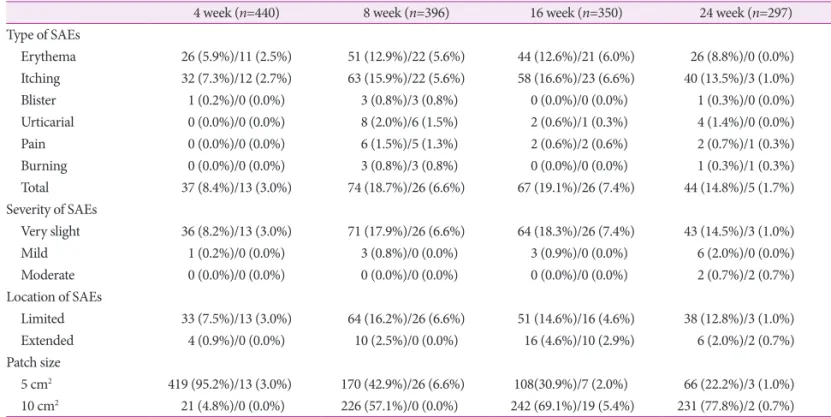
The types of skin AEs, severity of the skin AEs, and patch size are shown in Table 2. The frequencies of any skin AE were 8.4% at week 4, 18.7% at week 8, 19.1% at week 16, and 14.8%
at week 24. The frequencies of discontinuation due to any skin AE were 3.0% at week 4, 6.6% at week 8, 7.4% at week 16, and 1.7% at week 24. Sixty-six patients (22.2%) were using the 5 cm2 patch at 24 weeks.
Discontinuation
Among all patients who discontinued the study (n=157), 78 (49.7%) had an AE, and 75 (47.8%) had a skin AE. The type of skin AEs that most frequently led to discontinuation was itching, followed by erythema, pain, urticaria, burning, and blistering. The other AEs that most frequently led to discon- tinuation were nausea, followed by dizziness. Most patients experienced very slight or mild skin AEs.
Skin lesion analysis
Among 114 patients with skin lesions, 85 (19.3%) had a limited skin lesion and 29 (6.6%) had an extended skin lesion at the application site (Fig. 3). Among patients with limited skin lesions, 35 (41.2%) completed the study, and 50 (58.8%)
Hae Ri Na et al.
Factors Influencing Skin Tolerability to the Rivastigmine
did not (drop-out). Among patients with extended skin le- sions, 4 (13.8%) completed and 25 (86.2%) did not complete the study.
Exploratory assessments
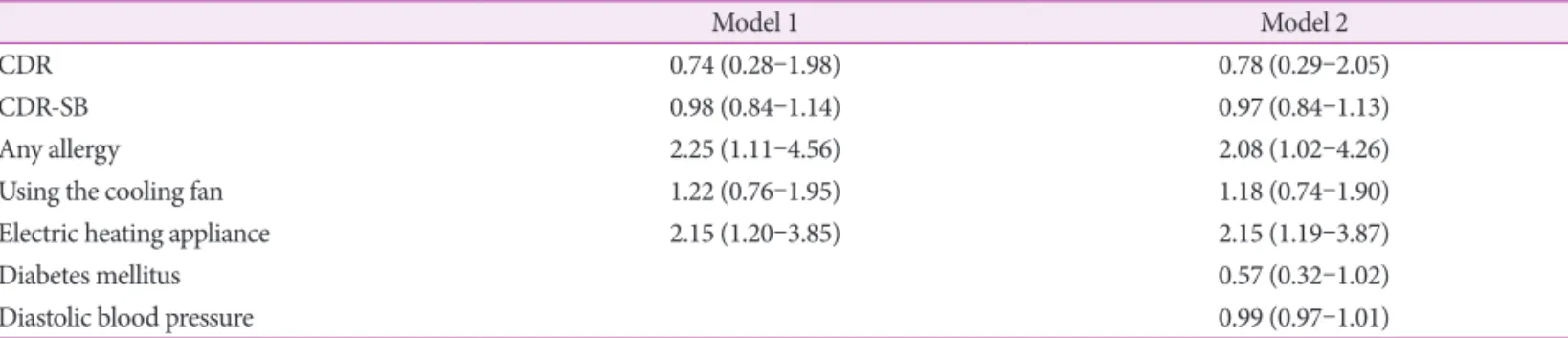
A multivariate logistic regression analysis was performed with variables associated (p<0.05 or <0.10) with skin AEs in
the initial univariate analysis to identify predictors of skin AEs. Both analyses showed that an allergy history and using an electric heating appliance were associated with skin AEs (Table 3).
The predictors of study discontinuation due to skin AEs in the multivariate logistic regression analysis were older age, erythema skin lesions, more severe skin AEs, and skin AEs in a broad area (Table 4).
DISCUSSION
We evaluated skin tolerability to the rivastigmine patch in patients with AD under actual conditions. We also evaluated the incidence and reasons for dropping out of the study, the incidence and types of skin AEs, and factors affecting skin AEs. Our results may contribute to understand and improve tolerability to the rivastigmine patch.
Skin tolerability profiles of the rivastigmine patch have been reported previously.2,5,6,16-22 Some patients treated with the rivastigmine transdermal patch may develop a skin AE, as with other kinds of medical patches. No, slight, or mild skin irritations in the Investigation of transDermal Exelon in
475 patients with probable AD from 22 centers
Screening failure (n=35)
Discontinuations (n=44)
Loss to follow-up (n=19), Non-compliance (n=5), Adverse effects (n=17), Others (n=3),
Severe adverse effects (n=0)
Discontinuations (n=46)
Loss to follow-up (n=11), Non-compliance (n=4), Adverse effects (n=27), Others (n=2),
Severe adverse effects (n=2)
Discontinuations (n=53)
Loss to follow-up (n=11), Non-compliance (n=10), Adverse effects (n=28), Others (n=3),
Severe adverse effects (n=1)
Discontinuations (n=14)
Loss to follow-up (n=6), Non-compliance (n=0), Adverse effects (n=6), Others (n=1),
Severe adverse effects (n=1)
Total discontinuations (n=157)
Loss to follow-up (n=47), Non-compliance (n=19), Adverse effects (n=78), Others (n=9),
Severe adverse effects (n=4) Enrollment (n=440)
4th week (n=396)
8th week (n=350)
16th week (n=297)
24th week (n=283)
Fig. 1. Flow of participants through the study. AD: Alzheimer’s disease.
126 (28.6%)AEs
Any skin AEs
114 (25.9%) Any other AEs
18 (4.2%) Erythema 83 (18.9%)
Itching 102 (23.2%) Blister 4 (0.9%) Urticaria 11 (2.5%) Pain 9 (2.0%) Burning 4 (0.9%)
Nausea 4 (0.9%) Vomiting 1 (0.2%) Anorexia 2 (0.5%) Dizziness 3 (0.7%) Headache 3 (0.7%) Insomnia 2 (0.5%) Others 6 (1.3%) Fig. 2. Summary of adverse events (AEs).
DND
ALzheimer’s disease (IDEAL) study5 ranged from 90% to 98% across four patch sizes (5, 10, 15, and 20 cm2). The per- centage of patients who discontinued the study as a result of a skin irritation from the rivastigmine patch was 1–2%. Skin tolerability of the rivastigmine patch during the open-label extension phase of the IDEAL was generally similar to that observed in the double-blind phase of the IDEAL.6 In a Japa- nese study,17 85.1% of participants using the 5 cm2 rivastigmine patch and 83.2% of participants using the 10 cm2 patch had no, slight, or mild skin irritations. The most common severe skin irritation was erythema from the 5 cm2 patch and pruritus from
the 10 cm2 patch. Skin irritations were observed in 42.0% of pa- tients using the rivastigmine patch plus memantine and 34.9%
of patients using the rivastigmine patch only in the Korean Ex- elon Patch and Combination With Memantine Comparative Trial (EXPECT) study.2 In a German study,18 8.7% of patients developed erythema and 8.2% of patients developed pruritus.
The most common AE leading to study discontinuation was a skin and subcutaneous tissue disorder (7.2% of patients). In the Slovenian EXTRA NEW study,19 14.09% of patients had skin reactions. In a Thai study,20 14.2–15.8% of patients developed an itching AE. In a Belgium study,22 26.9% of patients experi- Table 1. Clinical characteristics of the study participants
No skin adverse events (n=326) Skin adverse events (n=114) p Demographics
Age, years 76.22±7.91 75.05±7.27 0.14
Female 222 (68.1%) 83 (72.8%) 0.41
Education, years 6.06±4.97 5.97±5.10 0.87
Drinking 63 (19.3%) 16 (14.0%) 0.26
Smoking 26 (8.0%) 9 (7.9%) 1.00
Medical history
Family history of dementia 42 (12.9%) 13 (11.4%) 0.75
Hypertension 154 (47.2%) 56 (49.1%) 0.75
Diabetes mellitus 78 (23.9%) 18 (15.8%) 0.04
Hypercholesterolemia 32 (9.8%) 12 (10.5%) 0.86
Heart disease 27 (8.3%) 14 (12.3%) 0.26
Depression 20 (6.1%) 11 (9.6%) 0.21
Skin
Any skin disease 16 (4.9%) 10 (8.8%) 0.16
Any allergy 21 (6.4%) 16 (14.0%) 0.02
Skin type, dry 60 (18.4%) 22 (19.3%) 0.89
Life style
Using the cooling fan 115 (35.3%) 53 (46.5%) 0.04
Air conditioner 50 (15.3%) 22 (19.3%) 0.38
Electric heating appliance 37 (11.3%) 28 (24.6%) <0.01
Bath frequency, ≥3 times per week 81 (24.8%) 21 (18.4%) 0.20
Humectant 50 (15.3%) 14 (12.3%) 0.54
Clinical data
Systolic blood pressure, mm Hg 128.42±18.44 126.24±17.34 0.27
Diastolic blood pressure, mm Hg 75.24±11.51 73.01±11.79 0.08
BMI, kg/m2 22.88±3.22 22.70±3.43 0.60
Neuropsychological data
MMSE 17.38±4.91 17.61±4.63 0.66
IADL 22.30±11.69 20.61±12.67 0.19
GDpS 7.03±4.03 7.09±4.30 0.89
CDR 1.11±0.55 0.97±0.51 0.01
CDR-SB 6.25±3.57 5.39±3.11 0.02
BMI: body mass index, CDR: Clinical Dementia Rating, CDR-SB: CDR-sum of boxes scores, GDpS: Geriatric Depression Scale, IADL: instrumental activities of daily living, MMSE: Mini-Mental State Examination.
Hae Ri Na et al.
Factors Influencing Skin Tolerability to the Rivastigmine
enced skin adverse reactions. The most commonly reported AE leading to treatment discontinuation in the Canadian EM- BRACE study21 was a skin and subcutaneous tissue disorder (9.4%). Our results show that 25.9% of patients had skin AEs and 17.0% of patients with skin AEs in discontinued treatment.
Taken together, these results suggest some differences between the prevalence of skin irritation across study groups and that skin AEs led to treatment discontinuation in 7.2–17.0% of cas- es. These data also suggest that skin tolerability to rivastigmine was generally favorable if care was taken.
The most common skin AEs in our study were itching and erythema. Previous studies showed similar results and2,5,6,16-22
these skin reactions were localized, usually appearing after 1–4 months of treatment and decreased in intensity after re- moving the patch. These skin reactions were typically mild erythema (redness) and itching (pruritus), caused by contact irritation, and were not followed by any serious medical prob- lem. Allergic dermatitis with use of the rivastigmine patch is rare, and typically manifests as localized redness with swell- ing but may spread beyond the patch border.
The main factors associated with a risk of developing skin AEs are patch-related factors and clinical characteristics. Patch- related factors include the patch substance in contact with skin, substance concentration, size of the contact area, and contact Fig. 3. Locations of skin adverse events. A: Limited erythema. B: Extended erythema.
A B
Table 2. Characteristics of the skin adverse events (SAEs) and patch sizes from baseline to 24 weeks
4 week (n=440) 8 week (n=396) 16 week (n=350) 24 week (n=297)
Type of SAEs
Erythema 26 (5.9%)/11 (2.5%) 51 (12.9%)/22 (5.6%) 44 (12.6%)/21 (6.0%) 26 (8.8%)/0 (0.0%) Itching 32 (7.3%)/12 (2.7%) 63 (15.9%)/22 (5.6%) 58 (16.6%)/23 (6.6%) 40 (13.5%)/3 (1.0%)
Blister 1 (0.2%)/0 (0.0%) 3 (0.8%)/3 (0.8%) 0 (0.0%)/0 (0.0%) 1 (0.3%)/0 (0.0%)
Urticarial 0 (0.0%)/0 (0.0%) 8 (2.0%)/6 (1.5%) 2 (0.6%)/1 (0.3%) 4 (1.4%)/0 (0.0%)
Pain 0 (0.0%)/0 (0.0%) 6 (1.5%)/5 (1.3%) 2 (0.6%)/2 (0.6%) 2 (0.7%)/1 (0.3%)
Burning 0 (0.0%)/0 (0.0%) 3 (0.8%)/3 (0.8%) 0 (0.0%)/0 (0.0%) 1 (0.3%)/1 (0.3%)
Total 37 (8.4%)/13 (3.0%) 74 (18.7%)/26 (6.6%) 67 (19.1%)/26 (7.4%) 44 (14.8%)/5 (1.7%)
Severity of SAEs
Very slight 36 (8.2%)/13 (3.0%) 71 (17.9%)/26 (6.6%) 64 (18.3%)/26 (7.4%) 43 (14.5%)/3 (1.0%)
Mild 1 (0.2%)/0 (0.0%) 3 (0.8%)/0 (0.0%) 3 (0.9%)/0 (0.0%) 6 (2.0%)/0 (0.0%)
Moderate 0 (0.0%)/0 (0.0%) 0 (0.0%)/0 (0.0%) 0 (0.0%)/0 (0.0%) 2 (0.7%)/2 (0.7%)
Location of SAEs
Limited 33 (7.5%)/13 (3.0%) 64 (16.2%)/26 (6.6%) 51 (14.6%)/16 (4.6%) 38 (12.8%)/3 (1.0%)
Extended 4 (0.9%)/0 (0.0%) 10 (2.5%)/0 (0.0%) 16 (4.6%)/10 (2.9%) 6 (2.0%)/2 (0.7%)
Patch size
5 cm2 419 (95.2%)/13 (3.0%) 170 (42.9%)/26 (6.6%) 108(30.9%)/7 (2.0%) 66 (22.2%)/3 (1.0%) 10 cm2 21 (4.8%)/0 (0.0%) 226 (57.1%)/0 (0.0%) 242 (69.1%)/19 (5.4%) 231 (77.8%)/2 (0.7%) Values were indicated as ‘total frequency/frequency of discontinuation with number (percentage)’.
DND
duration.6,23,24 It was reported that the rivastigmine patch causes more skin irritations than that in comparably sized pla- cebo patches, suggesting that rivastigmine itself could be an additional irritant or allergen.6 Second, the clinical character- istics of skin AEs are sex, age, and medical factors.25 Women have a higher tendency towards developing allergic dermati- tis, whereas the evidence is more controversial for sex associ- ations with the development of irritant dermatitis. However, we found no relationship between clinical characteristics and skin AEs. Skin tends to become less elastic, undergoes epider- mal thinning, become less resistant to shearing, more likely to be torn after trauma, and has less ability to heal with age.6,26,27 Therefore, elderly subjects are more prone to develop irritant dermatitis but they may be at a decreased risk for allergic der- matitis. Because of these factors, elderly patients, such as those with AD, tend to have fragile skin that requires a more cau- tious approach, particularly with respect to avoiding mild-to- moderate erythema caused by removing a patch.28 Medical factors include pre-existing skin conditions, sensitivity to any patch component, and a medical history of allergy. Excess sweating increases the risk for a skin AE.29 However, the IDE- AL study included a number of countries that experience high temperatures where heavy perspiration is expected, and no noticeable difference were reported.14
In this study, we identified predictable skin AEs and the factors predicting treatment discontinuation due to a skin AE.
The predictive factors we found were an allergy history and use of an electric heating appliance. The association between allergy history and skin irritation is easily assumed; however, the association with electric heating appliances is less obvious.
Patients with AD stay indoors most of the day because of mo- bility limitations may more frequently use these appliances.
Use of an electric heating appliance will dry the skin and af- fects the immune system and the etiology of allergy.30,31 We also showed that the patch treatment was discontinued due to skin AEs in older aged subjects, those with erythema skin le- sions, more severe and extended lesion locations.
In conclusion, our results show that the rivastigmine patch is generally tolerable in patients with AD in an actual envi- ronment. Our results could contribute to improve tolerability to treating patients with AD. Further study with the rivastig- mine patch is needed to confirm our results, which that could have practical implications in the daily management of pa- tients with AD.
Conflicts of Interest
The authors have no financial conflicts of interest.
Acknowledgements
This study was supported by Novartis.
REFERENCES
1. Oertel W, Ross JS, Eggert K, Adler G. Rationale for transdermal drug administration in Alzheimer disease. Neurology 2007;69(4 Sup- pl 1):S4-S9.
2. Choi SH, Park KW, Na DL, Han HJ, Kim EJ, Shim YS, et al. Tolera- bility and efficacy of memantine add-on therapy to rivastigmine trans- dermal patches in mild to moderate Alzheimer’s disease: a multicenter, randomized, open-label, parallel-group study. Curr Med Res Opin 2011;27:1375-1383.
3. Winblad B, Kawata AK, Beusterien KM, Thomas SK, Wimo A, Lane R, et al. Caregiver preference for rivastigmine patch relative to cap- sules for treatment of probable Alzheimer’s disease. Int J Geriatr Psy- Table 4. Predictors of treatment discontinuation due to SAEs
Parameters Odds ratios (95% confidence interval) Age
Skin type, dry Erythema Severity of SAEs Extended location of SAEs Patch size, 10 cm2
1.09 (1.01–1.17) 4.08 (0.87–19.08) 5.09 (1.59–16.25) 11.04 (2.42–50.46) 4.19 (1.15–15.30) 0.53 (0.17–1.61)
Data are odds ratios (95% confidence interval) in a multivariate logis- tic regression analysis with two models.
SAE: skin adverse event.
Table 3. Predictors of skin adverse events
Model 1 Model 2
CDR CDR-SB Any allergy Using the cooling fan Electric heating appliance Diabetes mellitus Diastolic blood pressure
0.74 (0.28–1.98) 0.98 (0.84–1.14) 2.25 (1.11–4.56) 1.22 (0.76–1.95) 2.15 (1.20–3.85)
0.78 (0.29–2.05) 0.97 (0.84–1.13) 2.08 (1.02–4.26) 1.18 (0.74–1.90) 2.15 (1.19–3.87) 0.57 (0.32–1.02) 0.99 (0.97–1.01)
Data are presented as odds ratios (95% confidence intervals) from a multivariate logistic regression analysis with two models. Model 1 was performed with variables associated (p<0.05) with skin adverse events in the initial univariate analysis. Model 2 was performed with variables associated (p<0.10) with skin adverse events in the initial univariate analysis.
CDR: Clinical Dementia Rating, CDR-SB: CDR-sum of boxes scores.
Hae Ri Na et al.
Factors Influencing Skin Tolerability to the Rivastigmine
chiatry 2007;22:485-491.
4. Lee JH, Sevigny J. Effects of body weight on tolerability of rivastig- mine transdermal patch: a post-hoc analysis of a double-blind trial in patients with Alzheimer disease. Alzheimer Dis Assoc Disord 2011;
25:58-62.
5. Winblad B, Cummings J, Andreasen N, Grossberg G, Onofrj M, Sa- dowsky C, et al. A six-month double-blind, randomized, placebo- controlled study of a transdermal patch in Alzheimer’s disease--riv- astigmine patch versus capsule. Int J Geriatr Psychiatry 2007;22:
456-467.
6. Cummings JL, Farlow MR, Meng X, Tekin S, Olin JT. Rivastigmine transdermal patch skin tolerability: results of a 1-year clinical trial in patients with mild-to-moderate Alzheimer’s disease. Clin Drug In- vestig 2010;30:41-49.
7. Widman TJ, Oostman H, Storrs FJ. Allergic contact dermatitis from medical adhesive bandages in patients who report having a reaction to medical bandages. Dermatitis 2008;19:32-37.
8. McKhann G, Drachman D, Folstein M, Katzman R, Price D, Stadlan EM. Clinical diagnosis of Alzheimer’s disease: report of the NINCDS- ADRDA Work Group under the auspices of Department of Health and Human Services Task Force on Alzheimer’s Disease. Neurology 1984;34:939-944.
9. Kang Y, Na DL, Hahn S. A validity study on the Korean Mini-Mental State Examination (K-MMSE) in dementia patients. J Korean Neurol Assoc 1997;15:300-308.
10. Morris JC. The Clinical Dementia Rating (CDR): current version and scoring rules. Neurology 1993;43:2412-2414.
11. Choi SH, Na DL, Lee BH, Hahm DS, Jeong JH, Yoon SJ, et al. Esti- mating the Validity of the Korean Version of Expanded Clinical De- mentia Rating (CDR) Scale. J Korean Neurol Assoc 2001;19:585-591.
12. Bae JN, Cho MJ. Development of the Korean version of the Geriatric Depression Scale and its short form among elderly psychiatric pa- tients. J Psychosom Res 2004;57:297-305.
13. Ku HM, Kim JH, Kwon EJ, Kim SH, Lee HS, Ko HJ, et al. A study on the reliability and validity of Seoul-instrumental activities of daily livings (S-IADL). J Korean Neuropsychiatr Assoc 2004;43:189-199.
14. Winblad B, Grossberg G, Frölich L, Farlow M, Zechner S, Nagel J, et al. IDEAL: a 6-month, double-blind, placebo-controlled study of the first skin patch for Alzheimer disease. Neurology 2007;69(4 Sup- pl 1):S14-S22.
15. Choi SH, Kim SY, Na HR, Kim BK, Yang DW, Kwon JC, et al. Ef- fect of ApoE genotype on response to donepezil in patients with Al- zheimer’s disease. Dement Geriatr Cogn Disord 2008;25:445-450.
16. Darreh-Shori T, Jelic V. Safety and tolerability of transdermal and oral rivastigmine in Alzheimer’s disease and Parkinson’s disease dementia.
Expert Opin Drug Saf 2010;9:167-176.
17. Nakamura Y, Imai Y, Shigeta M, Graf A, Shirahase T, Kim H, et al. A 24-week, randomized, double-blind, placebo-controlled study to eval-
uate the efficacy, safety and tolerability of the rivastigmine patch in Japanese patients with Alzheimer’s disease. Dement Geriatr Cogn Dis Extra 2011;1:163-179.
18. Articus K, Baier M, Tracik F, Kühn F, Preuss UW, Kurz A. A 24- week, multicentre, open evaluation of the clinical effectiveness of the rivastigmine patch in patients with probable Alzheimer’s disease. Int J Clin Pract 2011;65:790-796.
19. Pregelj P. Safety and tolerability of rivastigmine transdermal patch formulation in newly diagnosed patients with Alzheimer’s dementia in naturalistic conditions. Psychogeriatrics 2012;12:165-171.
20. Kulkantrakorn K, Tanyakitpisal P, Towanabut S, Dejthevaporn C, Rangseekajee P, Pongpakdee S, et al. Rivastigmine patch for treat- ment of Alzheimer’s disease in clinical practice in Thailand. Psycho- geriatrics 2013;13:1-8.
21. Gauthier S, Robillard A, Cohen S, Black S, Sampalis J, Colizza D, et al. Real-life effectiveness and tolerability of the rivastigmine trans- dermal patch in patients with mild-to-moderate Alzheimer’s disease:
the EMBRACE study. Curr Med Res Opin 2013;29:989-1000.
22. Segers K, Cytryn E, Surquin M. Do local meteorological conditions influence skin irritation caused by transdermal rivastigmine? A retro- prospective, pilot study. J Clin Psychopharmacol 2012;32:412-415.
23. Upadhye MR, Maibach HI. Influence of area of application of aller- gen on sensitization in contact dermatitis. Contact Dermatitis 1992;27:
281-286.
24. Hurkmans JF, Boddé HE, Van Driel LM, Van Doorne H, Junginger HE. Skin irritation caused by transdermal drug delivery systems dur- ing long-term (5 days) application. Br J Dermatol 1985;112:461-467.
25. Ale I, Lachapelle JM, Maibach HI. Skin tolerability associated with transdermal drug delivery systems: an overview. Adv Ther 2009;26:
920-935.
26. Waller JM, Maibach HI. Age and skin structure and function, a quan- titative approach (I): blood flow, pH, thickness, and ultrasound echo- genicity. Skin Res Technol 2005;11:221-235.
27. Waller JM, Maibach HI. Age and skin structure and function, a quan- titative approach (II): protein, glycosaminoglycan, water, and lipid content and structure. Skin Res Technol 2006;12:145-154.
28. Fisher AA. Dermatitis due to transdermal therapeutic systems. Cutis 1984;34:526-527, 530-531.
29. Beltrani VS, Beltrani VP. Contact dermatitis. Ann Allergy Asthma Im- munol 1997;78:160-173; quiz 174-176.
30. Di Giampaolo L, Di Donato A, Antonucci A, Paiardini G, Travaglini P, Spagnoli G, et al. Follow up study on the immune response to low frequency electromagnetic fields in men and women working in a museum. Int J Immunopathol Pharmacol 2006;19(4 Suppl):37-42.
31. Gangi S, Johansson O. A theoretical model based upon mast cells and histamine to explain the recently proclaimed sensitivity to electric and/or magnetic fields in humans. Med Hypotheses 2000;54:663-671.