Korean J Thorac Cardiovasc Surg 2014;47:427-430 □ Case Report □ http://dx.doi.org/10.5090/kjtcs.2014.47.4.427 ISSN: 2233-601X (Print) ISSN: 2093-6516 (Online)
− 427 − Department of Cardiothoracic and Vascular Surgery, Sawai Man Singh Hospital
Received: December 5, 2013, Revised: March 17, 2014, Accepted: March 18, 2014, Published online: August 5, 2014
Corresponding author: Viju Joseph Abraham, Department of Cardiothoracic and Vascular Surgery, Sawai Man Singh Hospital, Jaipur 302004, Rajasthan, India
(Tel) 91-9983784248 (Fax) 91-1412600182 (E-mail) [email protected]
C The Korean Society for Thoracic and Cardiovascular Surgery. 2014. All right reserved.
CC This is an open access article distributed under the terms of the Creative Commons Attribution Non-Commercial License (http://creative- commons.org/licenses/by-nc/3.0) which permits unrestricted non-commercial use, distribution, and reproduction in any medium, provided the original work is properly cited.
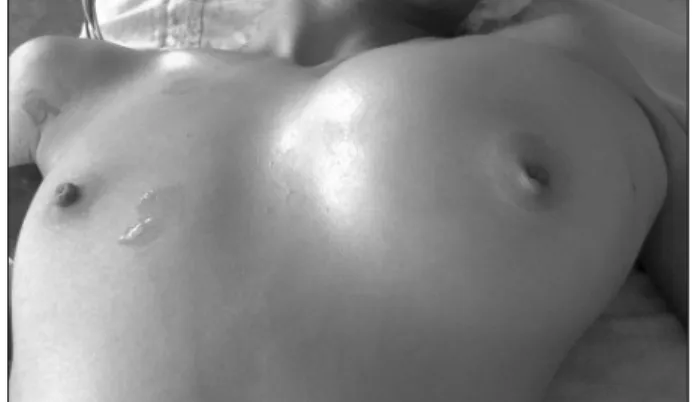
Fig. 1. Preoperative image showing the extent of the chest wall mass.
Dedifferentiated Chondrosarcoma of the Rib Masquerading as a Giant Chest Wall Tumor in a Teenage Girl:
An Unusual Presentation
Viju Joseph Abraham, M.S., Sanjeev Devgarha, M.Ch., Rajendra Mohan Mathur, M.Ch., Anula Sisodia, M.Ch., Amita Yadav, M.S.
Chondrosarcoma of the chest wall is a rare primary neoplasm found to occur in elderly men. Patients present with an enlarging, painful, anterior chest wall mass arising from either the vicinity of the costochondral junction or the sternum. Treatment includes wide resection with appropriate chest wall reconstruction. We report an unusual pre- sentation of this uncommon tumor occurring as a huge chest wall mass in a young teenage girl.
Key words: 1. Dedifferentiated chondrosarcoma 2. Ribs
3. Chest wall
CASE REPORT
A 17-year-old girl presented with complaints of a pro- gressively increasing swelling over the front of her left chest over the previous 5 months. The swelling was not painful, situated just adjacent to her left breast, with no associated shortness of breath. There was no history of trauma to the chest wall. She did not complain of an engorgement of the left breast, nipple discharge, or retraction. There was no fam- ily history of similar complaints. On examination, her vital signs were stable. There was a large, hard, non-tender mass, 25×30 cm in size, extending from just below the left clavicle to the 6th intercostal space and from the lateral border of the sternum to the mid-axillary line (Fig. 1). The mass itself was adherent to the chest wall although the overlying skin was not. The left breast had been lifted up by the mass and was not adherent to it. There was no palpable breast nodule, ul-
ceration, nipple discharge, or retraction. There were no pal- pable lymph nodes. Breath sounds were equal and normal bilaterally. The systemic examination was unremarkable.
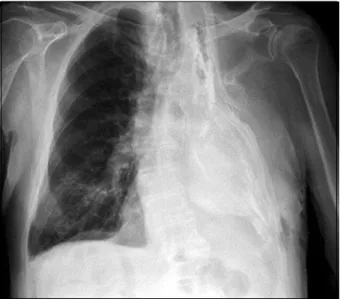
Chest X-ray showed a diffuse opacification over the mid-lung
Viju Joseph Abraham, et al
− 428 − Fig. 2. Computed tomography image showing the extent of the large destructive tumor.
Fig. 3. Intraoperative image showing the tumor (forceps) accessed via a median sternotomy and the completely dissected tumor (inset).
Fig. 4. Post-thoracoplasty chest X-ray.
field extending over to the lateral chest wall. Bronchovascular markings in the periphery were normal. A blood investigation revealed a raised lactate dehydrogenase and alkaline phospha- tase, positive C-reactive protein, and normal total counts.
Contrast-enhanced computed tomography (CT) of the thorax showed evidence of irregular destruction and periosteal re- action involving the left 3rd rib (Fig. 2). There was a large soft tissue component extending through the skin and the subcutaneous region, anterior mediastinum, and in the left up- per lobe. This was causing compression of the left upper and
lower lobe bronchus with a partial collapse of the underlying lung field. The lesion was also abutting the arch of the aorta and its branches and was found to be displacing the left bra- chiocephalic vein laterally. Magnetic resonance imaging (MRI) findings were similar with the lesion appearing hyper- intense in the T2-weighted images and hypointense in the T1-weighted images. Multiple necrotic areas were seen in the lesion. Fine-needle aspiration cytology from the mass was in- conclusive, and a core-needle biopsy was taken, which was suggestive of chondrosarcoma. The patient was subsequently taken up for the exploration and excision of the mass. The chest was opened via a median sternotomy and the tumor freed from its anterior mediastinal attachment (Fig. 3). The superior, inferior, and lateral extents of the tumor were ac- cessed via a left thoracotomy, dissecting under the sub- mammary plane, and the required resection of the 2nd to the 5th ribs. Sternal involvement required the resection of the left half of the sternum. Extensive involvement of the left lung parenchyma warranted a left pneumonectomy and a com- pletion thoracoplasty to obliterate the potential space (Fig. 4).
Major vascular structures and the left main bronchus were uninvolved. The biopsy report revealed features of a dediffer- entiated chondrosarcoma with a highly pleomorphic sarcoma- tous component. Large foci of necrosis were present, and the tumor was found to infiltrate the lung parenchyma. All mar- gins were found free of tumor involvement, thus signifying a
Dedifferentiated Chondrosarcoma of the Chest Wall
− 429 − complete resection. The patient had an uneventful post- operative course and was discharged on the 6th postoperative day.
DISCUSSION
A wide variety of benign and malignant conditions are classified under tumors of the chest wall. The most common entities are rib metastases via a hematogenous spread and di- rect chest wall invasion from contiguous lung and breast carcinoma. Primary chest wall tumors, which are quite rare, may arise from any of the soft-tissue, bony, or cartilaginous constituents of the chest wall, the latter comprising only one-third of the total number of cases. Chondrosarcoma is the most common malignant primary tumor of both the bony thorax and, in fact, the entire chest wall [1]. It accounts for nearly one-third of all primary chest wall tumors. Ten percent of chondrosarcomas are radiation-induced. Chest wall chon- drosarcoma occurs more frequently in men and in an older age group. The occurrence of a large chondrosarcoma in a teenage girl is extremely rare.
Chondrosarcomas are malignant tumors that produce a chondroid matrix. Primary chondrosarcomas arise de novo.
Secondary chondrosarcomas occur in pre-existing benign car- tilaginous neoplasms, such as the complication of a pre-exist- ing enchondroma or osteochondroma. Chondrosarcoma most commonly arises de novo within the medullary cavity of the bone (primary or central) but can result from a malignant transformation of the cartilage cap of a pre-existing benign cartilaginous tumor such as enchondroma or osteochondroma [2,3].
A majority of the patients with thoracic chondrosarcoma present with an enlarging, painful, anterior chest wall mass arising from either the vicinity of the costochondral junction or the sternum. Asymptomatic tumors detected incidentally by thoracic imaging are more likely to be benign. In a retro- spective series of patients seen at the Mayo Clinic over 73 years, only 6.5% of the 96 patients were without physical findings or symptoms [1]. A history of trauma associated with the tumor location has been implicated although its di- rect causation has not been established [3].
A basic posteroanterior and lateral chest radiograph consists
of the initial imaging work-up of these patients. A classic ra- diographic appearance of chondrosarcoma is a lobulated, mixed lytic and sclerotic lesion. The sclerotic regions on the radiographs correspond to the chondroid matrix mineraliza- tion. CT is optimal for the detection and characterization of the chondroid matrix, which classically has well-formed rings and arcs of mineralization. The characteristic flocculent or
‘popcorn’ pattern of calcification has been described for chondrosarcoma. MRI is particularly useful for defining the vascular or neural involvement and, therefore, provides com- plementary information to the CT scan. Positron emission to- mography with fluorine-18 fluorodeoxyglucose is performed to rule out extrapulmonary metastases [4].
Percutaneous image-guided core-needle biopsy and sophisti- cated cytopathology techniques should yield a diagnosis in a majority of the cases. Permeation of bone, size, and periosteal invasion are specific findings of chondrosarcoma. Cellularity, nuclear atypia (including multinucleated cells), and increased proliferation (>10%) are all indicators of an increasing grade and aggressive behavior. The less-differentiated component of dedifferentiated chondrosarcoma usually shows the multi-line- age histological features of malignant fibrous histiocytoma and fibrosarcoma.
There is no indication of neoadjuvant radiation or chemo- therapy in a suitable surgical candidate with a resectable thoracic chondrosarcoma. A wide resection of all thoracic dis- eases with appropriate margins, reconstruction of the bony chest wall to ensure preservation of respiratory mechanics, and soft-tissue coverage of reconstructive prostheses with healthy, vascularized tissue is the treatment of choice. The chondrosarcoma of the sternum should also be resected with at least a 4-cm margin. This typically requires the resection of the entire body of the sternum. The ipsilateral lung should be carefully palpated for occult metastases, which should be resected prior to the commencement of reconstruction [5,6].
In this patient, due to the extensive involvement of the chest wall and the lung parenchyma, pneumonectomy with thor- acoplasty had to be done. Thoracoplasty is the surgical re- moval of the skeletal support of a portion of the chest. This is accomplished by the subperiosteal removal of a varying number of rib segments to approximate the chest wall to the underlying lung or mediastinum to effect lung collapse or
Viju Joseph Abraham, et al
− 430 − pleural space obliteration. In spite of mutilating surgery, thor- acoplasty is justified in developing nations where issues such as poor patient compliance, post pneumonectomy empyema, drug resistance, poor healthcare delivery systems, and a cer- tain amount of mismanagement at the primary and secondary levels of healthcare need to be addressed.
Chondrosarcoma is relatively radioresistant, and conven- tional radiation therapy has demonstrated some efficacy and should be administered at the sites of positive pathologic margins (if a wider surgical margin cannot be achieved) or in cases of unresectability. Although considered a rare entity, chondrosarcoma of the chest wall is the most common malig- nant primary neoplasm. Its occurrence in a young female and with such a dimension as that described above is extremely rare. A careful work-up as well as histological correlation is vital for the adequate management of these patients, who re- quire a wide resection of the tumor supplemented with chest wall reconstruction, if possible. Lung parenchymal infiltration by the tumor is an indication for resection. Overall survival is good if the tumor has been adequately resected, respiratory mechanics preserved, and the margins are found to be free of involvement during a histopathological examination [7,8].
CONFLICT OF INTEREST
No potential conflict of interest relevant to this article was
reported.
REFERENCES
1. Ishida T, Kuwada Y, Motoi N, Oka T, Machinami R.
Dedifferentiated chondrosarcoma of the rib with a malignant mesenchymomatous component: an autopsy case report.
Pathol Int 1997;47:397-403.
2. Rascoe PA, Reznik SI, Smythe WR. Chondrosarcoma of the thorax. Sarcoma 2011;2011:342879.
3. Capps E, Shiller SM, Cheek S, Oza U, Konduri K. Chest wall chondrosarcoma. Proc (Bayl Univ Med Cent) 2009;22:
362-5.
4. McAfee MK, Pairolero PC, Bergstralh EJ, et al. Chondrosar- coma of the chest wall: factors affecting survival. Ann Thorac Surg 1985;40:535-41.
5. Somers J, Faber LP. Chondroma and chondrosarcoma.
Semin Thorac Cardiovasc Surg 1999;11:270-7.
6. O’Sullivan P, O’Dwyer H, Flint J, Munk PL, Muller NL.
Malignant chest wall neoplasms of bone and cartilage: a pictorial review of CT and MR findings. Br J Radiol 2007;80:678-84.
7. Walsh GL, Davis BM, Swisher SG, et al. A single-institu- tional, multidisciplinary approach to primary sarcomas in- volving the chest wall requiring full-thickness resections. J Thorac Cardiovasc Surg 2001;121:48-60.
8. Graeber GM, Snyder RJ, Fleming AW, et al. Initial and long-term results in the management of primary chest wall neoplasms. Ann Thorac Surg 1982;34:664-73.