• 검색 결과가 없습니다.

The Effect of Virtual Reality Training on Lower Extremity Muscle Activation in Elderly

N/A
N/A
Protected

Academic year: 2021

Share "The Effect of Virtual Reality Training on Lower Extremity Muscle Activation in Elderly"

Copied!
8
0
0

로드 중.... (전체 텍스트 보기)

전체 글

(1)

Research Article Open Access

가상현실 훈련이 노인의 하지 근활성도에 미치는 영향

조경희⋅신형수 1

대구대학교 대학원 재활과학과, 1 경운대학교 물리치료학과

The Effect of Virtual Reality Training on Lower Extremity Muscle Activation in Elderly

Gyeong-Hee Cho, PT, MS, Hyung-Soo Shin, PT, PhD 1†

Department of Rehabilitation Science, Daegu University Graduate School

1 Department of Physical Therapy, Kyungwoon University

Received: November 29, 2013 / Revised: January 14, 2014 / Accepted: January 21, 2014

ⓒ 2014 J Korean Soc Phys Med

| Abstract |

PURPOSE: The objective of this study was to determine the effects of virtual reality training on muscle activation in the elderly.

METHODS: The subjects were 32 healthy elderly people aged between 65 and 80, who were divided into the VR(virtual reality) training group(n=17) and the control group(n=15).

The Virtual reality training group engaged in a 30-minute exercise session using Wii Fit three times a week for eight weeks. Virtual reality training group used the Ski Slalom, Table tile, Balance bubble programs. low-extremity muscle activation of the two groups were measured before and after the intervention.

RESULTS: To investigate the effects of the training on lower-extremity muscle activation, biceps femoris, gastrocnemius, tibialis anterior, vastus lateralis were measured. The results revealed that the activation of gastrocnemius and tibialis anterior significantly increased(p<.05), which indicates virtual reality training is effective in improving the activation of the muscles involved in the movement of the ankle joint.

†Corresponding Author : [email protected]

CONCLUSION: Virtual reality training is effective in improving the healthy elderly’s activation of the muscles involved in the movement of the ankle joint. Thus, virtual reality training can be proposed as a form of fall prevention exercise for the elderly.

Key Words: Virtual reality training, muscle activation, elderly

Ⅰ. 서 론

한국인의 평균수명은 의료 기술의 발달, 의식주 등

의 기본욕구 충족에 힘입어 빠른 속도로 연장되어 왔

다. 통계청(2008)은 1990년에 65세 이상 노인 인구가

5.1%였던 것이 2000년에는 노인 인구가 전체 인구의

7.2%인 약 3,395천 명으로 고령화 사회로 진입하였으며

2008년에는 노인 인구가 전체 인구의 10.3%(5,016천

명 )를 차지하였다고 하며 우리나라 노인 인구의 빠른

증가를 보고하였다 . 이런 추세라면 2018년에는 노인인

구 14.3%(7,075천 명)로 고령사회에 진입하게 될 것으

로 전망된다. 통계청(2007)에서 노인들이 겪는 가장 어

려운 문제에 관하여 조사한 결과 ‘건강 문제’가 40.7%

(2)

로 가장 높게 나왔고, ‘경제적 어려움’이 40.1%로 뒤를 이어 빠르게 증가하는 노인 인구는 국가가 부담해야 할 의료비용의 증가뿐만 아니라 가족들의 재정적 , 심리 적 부담을 가중시키기 때문에 긴급한 대책을 필요로 하는 심각한 사회적 문제로 대두되고 있다.

나이가 들수록 건강에 대한 관심이 증가하고 노화로 인한 신체 능력의 약화와 질병으로 인한 건강상태의 악화는 연령이 증가할수록 더 심해진다. 노화에 따른 근골격계 퇴화로 근위축, 근력 약화, 근기능 저하가 나 타나(Schlicht 등, 2001) 균형 유지를 어렵게 한다(Judge 등 , 1993). 노인은 연령이 증가함에 따라 노화와 관련된 생리적인 변화로 건과 인대의 석회화 현상이 발생하고, 근의 면적이나 크기의 감소로 근력이 약화되며 (Spirduso 등, 2005), 자세 동요의 증가로 인해 균형 유지 가 어려워지게 된다. 하지 근력은 계단을 오르거나 의 자에서 일어설 때 도움을 주는 요인이다(Bean 등, 2002;

Lord 등, 2002). 체지방이 증가하고 근육량은 감소하는 노인들에게(Broadwin 둥, 2001; Frontera 등, 2000;

Gallagher 등, 2000; Hughes 등, 2004; Visser 등, 2002) 근복(muscle mass)의 소실을 지연시키고 남아있는 근육 의 질(muscle quality)의 감소를 늦추기 위해 노년기 근 력의 중요성이 강조되고 있다(Metter 등, 1999).

선행연구에서 노인들의 낙상을 예방하기 위해 타이 치(tai chi) 운동(Faber 등, 2006; Lin 등, 2006; Wong 등, 2001), 춤에 기반을 둔 치료 (Krampe 등, 2010), 음악을 기초로 한 다양한 과제 훈련(Trombetti 등, 2011), 균형 훈련(Faber 등, 2006), 근력 훈련(Boshuizen 등, 2005), 스트레칭 , 근력 운동, 유산소 운동을 혼합한 점프 훈련 (Cakar 등, 2010)을 적용하였고 그 결과 운동을 시행한 그룹에서 균형과 보행의 향상을 나타냈을 뿐만 아니라 낙상의 두려움이 감소하는 효과가 나타나 규칙적인 운 동이 낙상의 예방에 효과적임을 알 수 있다.

최근 과학기술의 발달로 기존의 현실적 운동 방법과 는 다른 가상현실 속에서 다양한 과제를 수행하는 새로 운 운동방법이 소개되었고 (Bryanton 등, 2006; Sveistrup, 2004) Flynn 등(2007)과 Weiss 등(2004)은 실제로 가상현 실이 흥미와 재미를 유발하여 사용자 스스로 동기부여 가 되는 효과가 있다고 하였다 . 뿐만 아니라 그 신뢰성

도 입증되어(Clark 등, 2010; Yamada 등, 2011) 가상현실 에 관련된 연구가 활발하게 진행 중이다. 사용자와 컴 퓨터 사이의 상호작용 수단으로 정의되는 쌍방향성 가 상현실은 실제 상황보다 다양한 움직임을 만들어 내기 위해 훨씬 더 넓은 활동 범위를 제공한다 . 즉, 사용자는 다양한 감각 채널을 통해 짜여진 각본(scenarios)이나 환경(environment)과 상호작용을 할 수 있는 것이다 (Burdea, 2003). 가상현실은 개개인에 맞는 운동 훈련 프로그램을 제공하기 위해 가상의 환경에서 체계적으 로 감각 피드백(청각, 시각, 고유수용감각)을 제공할 수 있고 훈련 적응 정도에 따라 운동의 난이도를 바꿔가 며 사용자에 맞는 환경을 창조할 수 있다(Wilson 등, 1997). 그러므로 선행연구에서는 가상현실 기술의 빠 른 발전이 재활 분야에서 새로운 운동 전략의 발전 가능 성을 가지고 있다고 제안한다(Adamovich 등, 2009).

따라서 본 연구에서는 신체 기능이 쇠약해진 노인들 의 건강한 노후를 위한 운동 방법의 하나로 개개인의 신체적 능력에 따라 훈련 강도를 조절하여 적용할 수 있는 가상현실 훈련을 시행하여 훈련 전⋅후 노인들의 하지 근활성도를 알아보고자 한다.

Ⅱ. 연구 방법

1. 연구 대상 및 연구 기간

본 연구는 OO시에 거주하는 65세 이상 80세 이하의

노인 32명을 가상현실 운동군 17명, 일상생활동작군

15명으로 무작위 배치하였다. 참여하는 모든 대상자는

실험 내용을 이해할 수 있도록 본 연구의 목적과 방법에

대해 충분히 설명한 후 자발적인 동의를 얻어 실시하였

고 참가자 중 한국형 간이정신상태 판별검사 (MMSE-K)

점수가 23점 이하 인 자, 최근 6개월 이내에 골절 등

정형외과적 질환으로 진단 받은 자, 시각과 청각에 이

상이 있는 자, 검사를 시행하기 전에 균형에 영향을

주는 아편계열, 알코올, 스트렙토 항생제 등의 약물을

복용한 자, 진행성 장애나 신경학적 장애(파킨슨 질환,

알츠하이머 질환 , 다발성 경화증, 간질, 뇌졸중)가 있는

자는 대상자에서 제외하였다.

(3)

2. 실험방법

1) 가상현실 훈련

본 연구에서 실시한 가상현실 훈련은 닌텐도 사 (Nintendo Inc., Japan)에서 제공하는 Wii-Fit의 Wii balance board(WBB) 게임 프로그램을 이용하였다.

Wii-Fit은 밸런스보드(balance board)와 프로그램 실행 CD로 구성되어있고 압력센서가 있는 밸런스보드 위에 대상자가 올라서면 화면에 아바타 (Mii)가 나타나 대상 자의 움직임을 따라하고 이는 대상자에게 시각적 , 청각 적 피드백을 제공할 뿐 아니라 위 리모트(wii-remote)를 통해 다양한 움직임에 대한 진동반응을 촉각 피드백으 로 제공한다. 본 연구에 사용된 밸런스 게임은 Ski slalom, Table tile, Balance bubble로 각 프로그램 당 10분 씩 시행하였다. 본 연구에 참여한 대조군은 어떠한 중 재도 하지 않았다.

2) 측정 방법

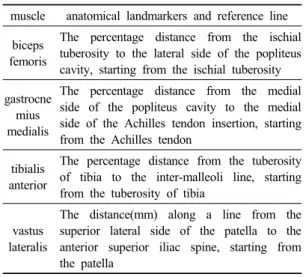
근활성도를 측정하기 위해 MP150(BIOPAC System Inc., CA. USA)을 사용하였고 넙다리두갈래근(biceps femoris), 장딴지근(gastrocnemius), 앞정강근(tibialis anterior), 가쪽넓은근(vastus lateralis)(Rainoldi 등, 2004) 을 선택하여 하지 근활성도를 측정하였다. 전극은 Ag- Ag/Cl(Biopac, diameter 2cm)를 사용하였고 전극의 부착 부위는 피부 저항을 최소화하기 위해 알코올 거즈로 닦은 후 전극을 부착하였으며 접지 전극 (ground electrode) 은 C7 가시돌기(spinous process)에 부착하였다. 표 1에 나타나 있는 각각 근육에서 근복(muscle belly)의 위치 를 찾아 전극을 부착하였다.

측정 시, 전극과 근전도계를 연결하는 전선이 엉키 지 않도록 깔끔하게 정리하여 움직임 잡음(motion artifact)이 생기지 않도록 하였고 화면에 나타난 근전도 신호를 관찰하여 근전도 잡음이 발생되고 있는지 여부 를 조사하여 잡음이 발생되는 경우에는 원인을 제거시 킨 후 전극을 부착하였다. 전극을 부착하기 전에 부착 부위의 피부에 있는 털을 제거한 후 알코올 소독하여 피부 저항을 최대한으로 줄였다. 모든 준비 작업이 끝 난 후 해당 근육에 대한 근전도를 측정하였다.

muscle anatomical landmarkers and reference line biceps

femoris

The percentage distance from the ischial tuberosity to the lateral side of the popliteus cavity, starting from the ischial tuberosity gastrocne

mius medialis

The percentage distance from the medial side of the popliteus cavity to the medial side of the Achilles tendon insertion, starting from the Achilles tendon

tibialis anterior

The percentage distance from the tuberosity of tibia to the inter-malleoli line, starting from the tuberosity of tibia

vastus lateralis

The distance(mm) along a line from the superior lateral side of the patella to the anterior superior iliac spine, starting from the patella

Table 1. Anatomical landmarkers

3) 자료 수집

두 발로 바로 선 자세를 기준으로 하고 한 쪽 다리를 들게 한 후 지지하는 다리의 근활성도를 측정하였다.

중재 전⋅후 동일한 측정자가 3회 반복한 측정치의 평균 값을 얻어 각 근육의 활성도를 비교 분석하였으며 측정 된 값을 표준화하기 위하여 원자료를 실효치 (Root Mean Square: RMS)로 변환하였다. 표면 근전도의 경우 표준 화 과정을 거쳐 일반화 시키기 위해 MVIC(Maximum Voluntary Isometric Contraction)나 RVC(Reference Voluntary Contraction)의 값을 기준으로 하는데 본 연구 에서는 RVC로 표준화하였다.

3. 자료 분석

실험 결과는 SPSS 12.0 for windows를 이용하여 측정

된 모든 변인에 대하여 평균과 표준오차를 산출하고,

그룹 간 측정 시기(가상현실 훈련 전⋅가상현실 훈련

후 )의 변화통계량을 알아보기 위해 독립 t-test를 실시하

였다. 또한 시간 경과에 따른 그룹 내 가상현실 훈련

전⋅후 검증을 위하여 대응표본 t-test를 실시하였고 유

의수준은 .05로 하였다.

(4)

Ⅲ. 결 과

1. 연구 대상자의 일반적인 특성

대상자의 일반적인 특성은 표 2에 나타내었다. 가상 현실 훈련군의 평균 연령은 73세, 신장은 164.21cm, 체 중은 63.66kg이고 대조군의 평균연령은 71세, 신장은 162.25cm, 체중은 64.43kg으로 두 그룹 간 동질성 검정 에서 유의한 차이가 나타나지 않았다.

VR (n=17) Control(n=15) t p Age(year) 73.11±1.08 71.66±1.16 .912 .369 Height(cm) 164.21±2.51 162.25±2.82 .520 .607 Weight(kg) 63.66±2.97 64.43±3.03 -.384 .704 VR: Virtual reality training group

Control: Control group Mean±SE: Mean±Standard Error

Table 2. General characteristic of subjects

(Mean±SE)

2. 가상현실 훈련군과 대조군의 근활성도 변화 비교

1) 가상현실 훈련군과 대조군의 넙다리두갈래근 (biceps femoris) 활성도 비교

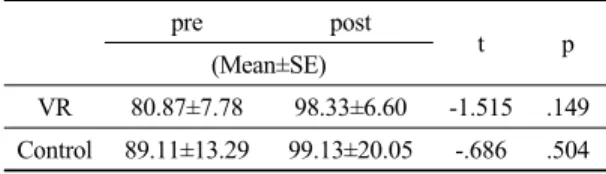
가상현실 훈련군의 넙다리두갈래근 활성도는 훈련 전 80.87±7.78 에서 훈련 후 98.33±6.60 로 유의한 차이 가 없었고(p>.05), 대조군은 훈련 전 89.11±13.29, 훈련 후 99.13±20.05 로 유의한 차이가 없었다(p>.05). 훈련 전⋅후 그룹 간 넙다리두갈래근 활성도에서도 유의한 차이를 보이지 않았다(p>.05).

Table 3. The comparison of muscle activation of biceps femoris within-subjects at pre-post intervention (unit: %RVC)

pre post

t p

(Mean±SE)

VR 80.87±7.78 98.33±6.60 -1.515 .149 Control 89.11±13.29 99.13±20.05 -.686 .504 Mean±SE: Mean±Standard Error

*p<.05

VR Control

t p

(Mean±SE)

pre-post 17.46±11.52 10.02±14.60 .404 .689 Mean±SE: Mean±Standard Error

*p<.05

Table 4. VR and control comparison of the biceps femoris muscle activity at pre-post intervention

(unit: %RVC)

2) 가상현실 훈련군과 대조군의 장딴지근 (gastrocnemius) 활성도 비교

가상현실 훈련군의 장딴지근 활성도는 훈련 전 92.47±9.80 에서 훈련 후 138.16±17.93 로 통계학적으로 유의한 차이가 있었고(p<.05), 대조군의 경우 훈련 전 122.96±19.57 에서 훈련 후 125.87±20.28 로 통계학적으 로 유의한 차이가 나타나지 않았다 (p>.05). 훈련 전⋅후 그룹 간 장딴지근 활성도 비교에서 유의한 차이가 나타 나지 않았다(p<.05).

pre post

t p

(Mean±SE)

VR 92.47±9.80 138.16±17.93 -2.951 .009*

Control 122.96±19.57 125.87±20.28 -.183 .857 Mean±SE: Mean±Standard Error

*p<.05

Table 5. The comparison of muscle activation of gastrocnemius within-subjects at pre-post intervention

(%RVC)

VR Control

t p

(Mean±SE)

pre-post 45.68±15.48 2.91±15.91 1.922 .064 Mean±SE: Mean±Standard Error

*p<.05

Table 6. VR and control comparison of the gstrocnemius muscle activity at pre-post intervention

(unit: %RVC)

(5)

3) 가상현실 훈련군과 대조군의 앞정강근(tibialis anterior) 활성도 비교

가상현실 훈련군의 앞정강근 활성도는 훈련 전 84.32±13.66 에서 훈련 후 150.19±29.21 로 유의한 차이 가 나타났고(p<.05), 대조군의 경우 훈련 전 94.37±9.84 에서 훈련 후 85.70±17.92 로 유의한 차이를 나타내지 않았다(p>.05). 훈련 전⋅후 그룹 간 앞정강근 활성도 비교에서 유의한 차이가 나타났다(p<.05).

pre post

t p

(Mean±SE)

VR 84.32±13.66 150.19±29.21 -2.504 .023*

Control 94.37±9.84 85.70±17.92 .424 .678 Mean±SE: Mean±Standard Error

*p<.05

Table 7. The comparison of muscle activation of tibialis anterior within-subjects at pre-post intervention (unit: %RVC)

VR Control

t p

(Mean±SE)

pre-post 65.87±26.31 -8.67±20.46 2.193 .036*

Mean±SE: Mean±Standard Error

*p<.05

Table 8. VR and control comparison of the tibialis anterior muscle activity at pre-post intervention

(unit: %RVC)

4) 가상현실 훈련군과 대조군의 가쪽넓은근(vastus lateralis) 활성도 비교

가상현실 훈련군의 가쪽넓은근 활성도는 훈련 전 83.23±8.60 에서 훈련 후 145.83±31.02 로 유의한 차이가 나타났고(p<.05), 대조군은 훈련 전 95.01±10.49 에서 훈련 후 116.61±21.51 로 유의한 차이가 없었다(p>.05).

훈련 전⋅후 그룹 간 가쪽넓은근 활성도에서는 유의한 차이를 보이지 않았다(p>.05).

pre post

t p

(Mean±SE)

VR 83.23±8.60 145.83±31.02 -2.123 .050 Control 95.01±10.49 116.61±21.51 -.847 .411 Mean±SE: Mean±Standard Error

*p<.05

Table 9. The comparison of muscle activation of vastus lateralis within-subjects at pre-post intervention

(unit: %RVC)

VR Control

t p

(Mean±SE)

pre-post 62.59±29.49 21.60±25.51 1.038 .308 Mean±SE: Mean±Standard Error

*p<.05

Table 10. VR and control comparison of the vastua lateralis muscle activity at pre-post intervention at pre-post intervention

(unit: %RVC)

Ⅳ. 고 찰

낙상은 부정적인 결과뿐만 아니라 높은 발생율과 유병율을 야기하는 중요한 공적 건강 문제이기 때문에 (Cesari 등, 2002; Leclerc 등, 2009) 낙상의 위험 요소에 노출된 노인들의 조기 발견을 위해서는 효율적인 낙상 예방 중재와 비용 대비 효과적인 (cost-effectiveness) 중 재방법이 필요하다(American Geriatrics Society, 2001).

초기에 낙상의 위험에 처한 노인들을 확인할 때, 환경

과 관련된 외적요인, 활동과 관련된 행동에 관한 요인

뿐만 아니라 노인 스스로와 관련된 내적 요인들도 함께

고려해야 하기 때문에 낙상의 위험을 확인하는 것은

많은 시간이 걸리고 매일의 일상생활에서 쉽게 실현

가능하지가 않다(Bongue 등, 2011). 골절이나 부상, 장

애 , 낙상에 대한 두려움과 같은 낙상의 부정적인 결과

때문에 낙상의 예방은 의무적으로 시행되어야 하며 균

형 , 근력, 신체적 활동과 같은 잠재적으로 개선 가능한

위험 요인들은 되풀이되는 낙상과 가장 관련이 깊기

때문에 이들의 개선이 함께 이루어 져야 할 것이다(Stel

(6)

등, 2003).

균형을 유지하려고 할 때 발목전략(ankle strategy)과 골반 전략(hip strategy)을 사용하게 되는데 골반 전략 보다는 발목 전략이 COP, COG이동과 상관관계가 크기 때문에 발목의 안정성이 중요하다(Gatev 등, 1999). 발 목의 발바닥 굽힘근(plantarflexor) 근력(즉, maximum isokinetic ankle torque)과 토크(torque) 발생율은 자세 동요 후 발목 전략을 사용하여 균형을 회복하기 위해 대단히 중요한데(Bento 등, 2010; Simoneau 와 Corbeil, 2005; Whipple 등, 1987) Robinovitch 등(2002)은 발목 전략을 사용하는 균형 회복에 대한 발바닥 굽힘근 (platarflexor) 토크와 토크 발생율의 효과를 조사하였다.

그들은 정적 (static) 전방 기울임으로부터 이완 된 후 균 형을 회복하기 위한 능력은 발목의 높은 토크를 유지하 고 빠르게 발생시키기 위한 능력에 의존한다고 하였다 . 본 연구에서 가상현실 훈련 중재 전, 후에 따른 노인 의 하지 근활성도를 살펴 본 결과 장딴지근과 앞정강근 에서 유의한 차이가 나타났는데 이는 발목 전략에 주로 사용되는 근육들로 가상현실 훈련이 발목관절의 안정 성 향상에 기여함을 나타낸다.

노인들은 고유수용성 정보에 대한 민감도가 체간에서 발목으로 이동되는데 이러한 결과로 젊은 사람보다 발목 근력의 높은 민감도가 요구된다 (Kalisch 등, 2011). Braun Ferreira 등 (2011)은 고유수용성 보드(proprioceptive board) 위에서 발을 떼고 눈을 감고 서 있는 동안 장딴지 근의 높은 근활성도가 요구되고 불안정한 면과 안정적 인 면에서는 앞정강근의 큰 활성도가 요구된다고 하며 종아리 근육의 중요성을 주장하였다. 두 근육 모두 균 형을 바로 잡기 위해 쓰이는 1차적인 근육으로써 필자 의 연구에서도 가상현실을 통한 균형 훈련이 다양한 전, 후, 좌, 우의 움직임을 이용해 COP의 변화를 주는 운동이였기에 먼저 발목 전략을 이용하기 위해 실험군 에서 장딴지근과 앞정상근이 활성화된 것으로 보인다 . 노화과정에서 노인들이 균형을 잡기위한 고유수용성 감각 입력 의존도가 발목으로 이동(Gouglidis 등, 2011) 하기 때문에 실험군과 대조군에서 가쪽넓은근과 넙다 리 두갈래근의 경우 유의한 근활성도를 보이지 않았다.

근활성도의 범위가 최적의 상태로 나타날 때 최상의

자세 안정성을 유지할 수 있고 근육이 너무 활성화되거 나 혹은 활성화 되지 않는다면 자세의 불안정성을 초래 할 수 있다 (Laughton 등, 2003). 노화로 인해 근력이 약해 진 노인들은 근육 약화로 인해 자세의 불안정성을 초래 할 수 있으므로 이에 따른 관리가 필요하다.

나이가 들어감에 따라 모든 신체적 기능이 저하되는 노인들이 꾸준한 운동을 한다면 효과적인 낙상 예방 방법이 될 수 있다. 특히, 비용면에서도 부담없이 가정 에서 쉽게 접하고 재미있게 시행할 수 있는 닌텐도 위 핏 프로그램을 정상 노인들이 꾸준히 시행한다면 낙상 의 예방에 효과적일 것으로 제안할 수 있겠다.

Ⅴ. 결 론

본 연구는 가상현실 훈련이 정상 노인의 하지 근활성 도에 미치는 영향을 알아보기 위해 시행되었다.

하지 근활성도 비교 결과 가상현실 훈련군에서 발목 의 움직임에 관여하는 앞정강근과 장딴지근의 활성도 가 향상됨을 볼 수 있었다.

시간과 장소에 구애를 받지 않으면서 가정에서 자유 롭게 할 수 있으며 경제적으로도 부담없이 운동할 수 있는 가상현실 훈련은 다가오는 고령 사회에서 노인들 의 발목관절의 움직임에 관여하는 근육의 활성도를 향 상시켜 낙상의 위험에 노출된 노인들의 낙상 예방에 효과적이다.

References

National Statistical Office. Report on Social 2007 Natioanl Statistical Office. Population Projections 2008 Adamovich SV, Fluet GG, Tunik E, et al. Sensorimotor training

in virtual reality: a review. NeuroRehabilitation 2009;25(1):29-44.

American Geriatrics Society. Guideline for the prevention of falls in older persons 2001.

Bean JF, Kiely DK, Herman S, et al. The relationship between

(7)

leg power and physical performance in mobility- limited older people. J Am Geriatr Soc 2002;50 (3):461-7.

Bento PC, Pereira G, Ugrinowitsch C, et al. Peak torque and rate of torque development in elderly with and without fall history. Clin Biomech 2010;25(5):450-4.

Bongue B, Dupre C, Beauchet O, et al. A screening tool with five risk factors was developed for fall-risk prediction in community-dwelling elderly. J Clin Epidemiol 2011;64(10):1152-60.

Boshuizen HC, Stemmerik L, Westhoff MH, et al. The effects of physical therapists’ guidance on improvement in a strength-training program for the frail elderly. J Aging Phys Act 2005;13(1):5-22.

Braun Ferreira LA, Pereira WM, Rossi LP, et al. Analysis of electromyographic activity of ankle muscles on stable and unstable surfaces with eyes open and closed.

J Bodyw Mov Ther 2011;15(4):496-501.

Broadwin J, Goodman-Gruen D, Slymen D. Ability of fat and fat-free mass percentages to predict functional disability in older men and women. J Am Geriatr Soc 2001;49(12):1641-5.

Bryanton C, Bosse J, Brien M, et al. Feasibility, motivation, and selective motor control: virtual reality compared to conventional home exercise in children with cerebral palsy. Cyberpsychol Behav 2006;9(2):123-8.

Burdea GC. Virtual rehabilitation--benefits and challenges.

Methods Inf Med 2003;42(5):519-23.

Cakar E, Dincer U, Kiralp MZ, et al. Jumping combined exercise programs reduce fall risk and improve balance and life quality of elderly people who live in a long-term care facility. Eur J Phys Rehabil Med 2010;46(1):

59-67.

Cesari M, Landi F, Torre S, et al. Prevalence and risk factors for falls in an older community-dwelling population.

J Gerontol A Biol Sci Med Sci 2002;57(11):M722-6.

Clark RA, Bryant AL, Pua Y, et al. Validity and reliability of the Nintendo Wii Balance Board for assessment

of standing balance. Gait posture 2010;31(3):307-10.

Faber MJ, Bosscher RJ, Chin APMJ, et al. Effects of exercise programs on falls and mobility in frail and pre-frail older adults: A multicenter randomized controlled trial. Arch Phys Med Rehabil 2006;87(7):885-96.

Flynn S, Palma P, Bender A. Feasibility of using the Sony PlayStation 2 gaming platform for an individual poststroke: a case report. J Neurol Phys Ther 2007;

31(4):180-9.

Frontera WR, Hughes VA, Fielding RA, et al. Aging of skeletal muscle: a 12-yr longitudinal study. J Appl Physiol 2000;88(4):1321-6.

Gallagher D, Ruts E, Visser M, et al. Weight stability masks sarcopenia in elderly men and women. Am J Physiol Endocrinol Metab 2000;279(2):E366-75.

Gatev P, Thomas S, Kepple T, Hallett M. Feedforward ankle strategy of balance during quiet stance in adults. J Physiol 1999;514 (Pt 3):915-28.

Gouglidis V, Nikodelis T, Hatzitaki V, et al. Changes in the limits of stability induced by weight-shifting training in elderly women. Exp Aging Res 2011;37(1):46-62.

Hughes VA, Roubenoff R, Wood M, et al. Anthropometric assessment of 10-y changes in body composition in the elderly. Am J Clin Nutr 2004;80(2):475-82.

Judge JO, Lindsey C, Underwood M, et al. Balance improvements in older women: effects of exercise training. Phys Ther 1993;73(4):254-62; discussion 63-5.

Kalisch T, Kattenstroth JC, Noth S, et al. Rapid assessment of age-related differences in standing balance. J Aging Res 2011;160490.

Krampe J, Rantz MJ, Dowell L, et al. Dance-based therapy in a program of all-inclusive care for the elderly:

an integrative approach to decrease fall risk. Nurs Adm Q 2010;34(2):156-61.

Laughton CA, Slavin M, Katdare K, et al. Aging, muscle

activity, and balance control: physiologic changes

associated with balance impairment. Gait posture

(8)

2003;18(2):101-8.

Leclerc BS, Begin C, Cadieux E, et al. A classification and regression tree for predicting recurrent falling among community-dwelling seniors using home-care services. Can J Public Health 2009;100(4):263-7.

Lin MR, Hwang HF, Wang YW, et al. Community-based tai chi and its effect on injurious falls, balance, gait, and fear of falling in older people. Phys Ther 2006;86(9):1189-201.

Lord SR, Murray SM, Chapman K, et al. Sit-to-stand performance depends on sensation, speed, balance, and psychological status in addition to strength in older people. J Gerontol A Biol Sci Med Sci 2002;57(8):M539-43.

Metter EJ, Lynch N, Conwit R, et al. Muscle quality and age: cross-sectional and longitudinal comparisons.

J Gerontol A Biol Sci Med Sci 1999;54(5):B207-18.

Rainoldi A, Melchiorri G, Caruso I. A method for positioning electrodes during surface EMG recordings in lower limb muscles. J Neurosci Methods 2004;134(1):37-43.

Robinovitch SN, Heller B, Lui A, et al. Effect of strength and speed of torque development on balance recovery with the ankle strategy. J Neurophysiol 2002;88 (2):613-20.

Schlicht J, Camaione DN, Owen SV. Effect of intense strength training on standing balance, walking speed, and sit-to-stand performance in older adults. J Gerontol A Biol Sci Med Sci 2001;56(5):M281-6.

Simoneau M, Corbeil P. The effect of time to peak ankle torque on balance stability boundary: experimental validation of a biomechanical model. Exp Brain Res 2005;165(2):217-28.

Spirduso WW, Francis K, Eakin T, et al. Quantification of manual force control and tremor. J Mot Behav

2005;37(3):197-210.

Stel VS, Smit JH, Pluijm SM, Lips P. Balance and mobility performance as treatable risk factors for recurrent falling in older persons. J Clin Epidemiol 2003;

56(7):659-68.

Sveistrup H. Motor rehabilitation using virtual reality. J Neuroeng Rehabil 2004;1(1):10.

Trombetti A, Hars M, Herrmann FR, et al. Effect of music-based multitask training on gait, balance, and fall risk in elderly people: a randomized controlled trial. Arch Intern Med 2011;171(6):525-33.

Visser M, Kritchevsky SB, Goodpaster BH, et al. Leg muscle mass and composition in relation to lower extremity performance in men and women aged 70 to 79: the health, aging and body composition study. J Am Geriatr Soc 2002;50(5):897-904.

Weiss PL, Rand D, Katz N, et al. Video capture virtual reality as a flexible and effective rehabilitation tool. J Neuroeng Rehabil 2004;1(1):12.

Whipple RH, Wolfson LI, Amerman PM. The relationship of knee and ankle weakness to falls in nursing home residents: an isokinetic study. J Am Geriatr Soc 1987;35(1):13-20.

Wilson PN, Foreman N, Stanton D. Virtual reality, disability and rehabilitation. Disabil Rehabil 1997;19(6):213-20.

Wong AM, Lin YC, Chou SW, et al. Coordination exercise and postural stability in elderly people: Effect of Tai Chi Chuan. Arch Phys Med Rehabil 2001;82 (5):608-12.

Yamada M, Aoyama T, Nakamura M, et al. The reliability and preliminary validity of game-based fall risk assessment in community-dwelling older adults.

Geriatr Nurs 2011;32(3):188-94.

수치

Table 1. Anatomical landmarkers
Table 6. VR and control comparison of the gstrocnemius muscle activity at pre-post intervention
Table 7. The comparison of muscle activation of tibialis anterior within-subjects at pre-post intervention (unit: %RVC)

참조

관련 문서

The Reliability of Balance, Gait, and Muscle Strength Test for the Elderly with Dementia: A Systematic Review.. Han-Suk Lee, PT, PhD⋅Sun-Wook Park, PT,

Key words : Virtual Reality, Closed Kinetic Chain Exercise, Muscle Activity, Stroke 논문접수일 : 2013년 5월 16일 수정접수일 : 2013년 5월 27일 게재승인일 : 2013년

The Effect of a Virtual Reality-based Exercise Program Using a Video Game on the Muscle Strength, Balance and Gait Abilities in the Elderly. Effectiveness of

A Convergence Study on Immediate Effects of kinesio taping on upper extremity pain and muscle activation of lateral

Both groups showed higher levels of muscle activation and co-activation in the medial muscles than the lateral ones while descending stairs while wearing high-heels, and the

Hwang, Effects of Virtual Reality-based Upper Limb Rehabilitation Training using a Smart Glove on Upper Extremity Function, Activities of Daily Living and Quality of

Purpose: The aim of this study was to examine the activation of the contralateral upper and lower extremities and trunk muscle during ipsilateral upper extremity

Conclusion: The biceps femoris, gastrocnemius, and tibialis anterior muscles showed greater muscle activation in the closed kinematic chain position when compared to the