• 검색 결과가 없습니다.

The Effect of PNF Arm Flexion Pattern on the Muscle Activation of Lower Extremity by Kinematic Chain Positions

N/A
N/A
Protected

Academic year: 2021

Share "The Effect of PNF Arm Flexion Pattern on the Muscle Activation of Lower Extremity by Kinematic Chain Positions"

Copied!
8
0
0

로드 중.... (전체 텍스트 보기)

전체 글

(1)

| Abstract |

Purpose: The purpose of this study was to analyze the effect of arm flexion patterns of proprioceptive neuromuscular facilitation on muscle activation in the contralateral lower extremity. Open kinematic chain and closed kinematic chain positions were used.

Methods: This study used an electromyogram (MP150, Biopac Systems, USA) to measure muscle activation in 20 healthy male students. Comparative analysis was completed on muscle activation of the vastus lateralis, biceps femoris, tibialis anterior, and gastrocnemius of the contralateral lower extremity. Open kinematic chain and closed kinematic chain positions were used with a unilateral arm flexion-abduction-external rotation pattern. Paired t-tests using the SPSS 12.0 for Windows analyzed the data produced by the electromyogram.

Results: There was a statistically significant difference in muscle activation in the biceps femoris, gastrocnemius, and tibialis anterior when the open kinematic chain and closed kinematic chain positions were compared (p < 0.05).

Conclusion: The biceps femoris, gastrocnemius, and tibialis anterior muscles showed greater muscle activation in the closed kinematic chain position when compared to the open kinematic chain position.

Key Words: Open kinematic chain position, Closed kinematic chain position, Irradiation, Muscle activation

†Coressponding Author : Hee-Gwon Kim ([email protected])

Journal of Korea Proprioceptive Neuromuscular Facilitation Association, 2015; 13(2): 95-102 Print ISSN: 1598-933X

Original Article Open Access

사슬운동 자세에 따른 고유수용성신경근촉진법 팔 패턴이 다리의 근활성도에 미치는 효과
김희권

5)

⋅서연순 목포과학대학교 물리치료과

The Effect of PNF Arm Flexion Pattern on the Muscle Activation of Lower Extremity by Kinematic Chain Positions

Hee-Gwon Kim ⋅Yeon-Soon Seo

Department of Physical Therapy, Mokpo Science University

Received: May 20, 2015 / Revised: June 16, 2015 / Accepted: June 17, 2015

ⓒ 2015 Journal of Korea Proprioceptive Neuromuscular Facilitation Association

This is an Open Access article distributed under the terms of the Creative Commons Attribution Non-Commercial License

(http://creativecommons.org/licenses/by-nc/3.0) which permits unrestricted non-commercial use, distribution, and reproduction

in any medium, provided the original work is properly cited.

(2)

ՁԾ ք ࿾㉚৞␞἖⎧ḯ῞঻ૺ⨇⛂ᦓ㉗㎊⚾Ԩ┚ԹԻઊԨ┚Ժ㌶

Ⅰ. 서 론

현대인들은 산업분야의 혁신적 변화에 의한 경제 적 성장과 생명과학 분야의 변화로 의식주 수준은 향 상되었으나 반면에 삶의 현장에서는 취업의 어려움, 직장에서의 위기감, 가족관계의 문제 등으로 많은 스 트레스를 받고 있고 개인의 사고방식 , 시간, 경제적요 인 등으로 건강관리에 소흘 함으로써 이러한 요인들 은 건강문제를 야기 할 수 있다 . 보건복지 통계연보에 의하면 사망자 266,257명의 주요 사망원인별 사망률 을 보면 악성 신생물 (암)이 인구 10만명 당 111.8명으 로 가장 높고 다음으로 뇌혈관질환(뇌졸중)이 52.8명, 심장질환 50.4명 순으로 나타났다(Statistics Korea, 2014). 의학 분야의 발달로 뇌졸중 환자의 사망률은 감소하고 있으나 사망률 감소는 재활치료가 필요한 환자 수가 증가함을 의미한다(Choi, 2013). 재활서비스 의 한 분야에 종사하는 물리치료사들은 심혈관계, 근 뼈대계 병변 환자뿐만 아니라 신경근계 병변에 의한 근육 약화로 기능적 장애 (Canning et al, 2004; Newham

& Hsiao, 2001; Pattern et al, 2004)를 받고 있는 환자들 의 문제점을 개선하기 위한 정확한 평가와 효과적인 중재의 하나의 방법으로 고유수용성신경근촉진법을 이용하여 환자의 기능회복 및 향상에 도움을 주기 위 해서 많은 시간의 노력을 하고 있다.

기능적 동작을 수행할 때 대단위 근육 군들이 결합 한 운동형태가 나타나므로 근 약증으로 인해 기능제 한이나 다른 근육으로 보상하는 경우 교정하여 올바 른 움직임이 일어나도록 관련된 근육들의 동원을 강 화시킬 수 있는 대단위 운동이 필요하다(Ma, 2008).

이러한 대단위 운동에 적절한 치료중재법으로 고유수 용성신경근촉진법이 있다 (Feber et al, 2002). 고유수용 성신경근촉진법(proprioceptive neuromuscular facilitation, PNF)은 고유수용기와 외부수용기를 자극함으로써 신 경근이 활성화되어 기능적 활동을 더 쉽게 일어나도 록 한다(Docherty et al, 2004). PNF는 인체의 한 분절이 나 특정부분의 문제만이 아닌 통합적인 치료방법으로 환자가 가장 높은 기능적 수준을 얻도록 하기 위해

신체구조와 기능뿐만 아니라 활동, 참여(participation) 수준의 치료를 포함하여 운동조절과 운동학습의 원리 를 통합함으로써 잠재력을 이끌어 낼 수 있다 . 따라서 PNF는 촉진을 위한 기본절차(basic procedures), 치료 기법(techniques), 촉진패턴(pattern) 등을 이용하여 통 증 , 관절가동범위, 근력, 협응력과 운동조절, 안정성과 균형, 지구력 등을 개선하는 치료방법이다. 이러한 PNF의 치료방안에는 직접적인 치료와 간접적인 치료 방법이 있는데 직접적인 치료는 환자의 문제점이 있 는 부위에 치료중재를 적용하는 것이고 간접적인 치 료는 방산(irradiation), 혹은 과흐름(overflow)을 이용하 는 방법이다(Alder et al, 2008).

PNF에서 방산의 개념은 저항이라는 자극에 대해 반응이 확산되는 것을 의미하는 용어로 근육의 연결 된 협응구조 상에서 일어난다(Ko et al, 2013). 강한 신체 분절에 저항을 제공하면 약한 신체분절이나 약 한 근육에서 방산을 유발할 수 있다고 하였다(Munn et al, 2004). 신체 한쪽 부위에서 적용된 근력강화가 다른 신체부위의 근력에도 영향을 미치는 현상을 교 차교육(cross education) 또는 교차훈련(cross training) 이라 한다 (Carroll et al, 2006). 교차훈련은 근력과 관련 된 중요한 생리학적 요인이기 때문에 최근 이와 관련 된 연구들이 많이 진행되고 있다 이러한 교차훈련은 손상 받지 않는 측에서의 훈련이 손상 받은 측의 기능 에 영향을 미친다는 연구 결과들이 발표되면서 지지 받기 시작하였으며(Hortobagyi et al, 1999), 이러한 교 차훈련에 대한 이론적 배경은 Sherrington의 과흐름 개념이다.

열린 사슬운동은 팔다리의 먼 쪽 부위에서 자유롭 게 움직이고 몸 쪽 부위에서는 고정된 상태에서 운동 을 시행하는 방법으로 관절가동범위가 제한된 환자의 근력강화를 위해 중요한 역할을 하며(Kim, 2007; jang, 2003) 닫힌 사슬운동은 사지의 먼 쪽 부위는 고정되어 있는 상태에서 몸 쪽 부위와 먼 쪽 부위에서 저항을 동시에 적용할 때 일어나는 운동으로 관절에 압박력 을 가해 관절의 안정성을 증가시킨다(Iwasaki, 2006).

PNF 방산을 이용하여 열린 사슬운동이나 닫힌 사

(3)

ᶪᾪ⎲თԨ⒎Ḷ⋎ԨሮᙶԨ৞␞἖⎧ḯ῞঻ૺ⨇⛂ᦓԨ〒Ԩ〦⸲⑲Ԩ࿢ᚪ⑖Ԩૺ㍚ḯჂ⋎Ԩ᣶⭖ྒԨ㎦৺ ք ՁԿ

슬운동에 의한 반대 측의 근활성도에 미치는 영향에 관한 연구문헌은 많이 있으나 사슬운동 자세에 따른 반대편 근육의 근활성도의 변화에 대한 연구문헌들은 많지 않는 실정이다 . 이에 본 연구는 PNF 팔 굽힘-벌림- 가쪽돌림(D2 팔 굽힘) 패턴을 발바닥이 벽에 닿지 않 는 열린 사슬운동 자세(Open Kinematic Chain Position, OCKP)와 발바닥이 바닥에 닿는 닫힌 사슬운동 자세 (Closed Kinematic Chain Position, CKCP)에서 적용하였 을 때 반대편 다리의 근활성도 변화를 분석하여 근뼈 대계 (musculoskeietal system) 환자나 신경근계(neuromusculat system) 환자에게 촉각자극과 방산을 이용하여 근육강 화 및 관절의 안정성을 증진시키기 위한 물리치료 중 재를 할 때 기초자료로 제공하고자 한다.

Ⅱ. 연구 방법

1. 연구 대상

본 연구의 대상은 연구의 목적을 설명하고 참여한 MSU에 재학 중인 건강한 남학생 중에서 20명을 무작 위로 선정하여 연구절차에 대해 설명을 하였고 연구 동의를 얻었다. 연구 대상자의 선정 기준은 최근에 근뼈대계와 신경근계, 심혈관계에 병력이 없으며, 관 절 운동범위가 정상이며, 등척성 저항검사에서 제 4등 급 (Good) 이상인 학생을 대상으로 연구를 실시하였다.

2. 연구 도구 및 절차

1) 연구 도구

연구 대상자의 일반적 특성에서 체지방률은 체성 분 분석기(Inbody J05, Biospace, USA)를 이용하여 측 정하였으며, 다리 근육의 근전도 신호의 수집과 신호 처리를 위해 표면근전도(MP150, Biopac system, USA) 를 사용하였다 (Fig. 1). 근전도 신호 수집을 위한 표본 추출률(sampling rate)은 1,000㎐로 하였고, 주파수 대 역필터(band-pass)는 20-500㎐로 하였다.

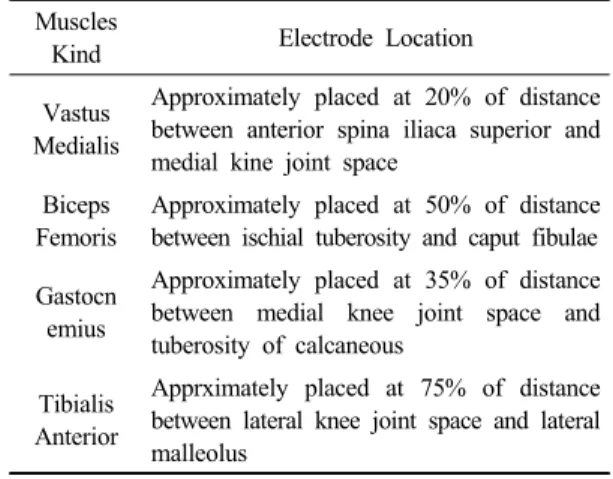
각 근육의 기록전극 부착 부위는 Table 1과 같고

접지전극은 정강뼈 거친면에 부착하였다. 기록전극으 로 표면전극(3M, USA)은 지름이 11.4mm인 Ag/AgCL 을 사용하였으며, 전극을 부착하기 전에 피부표면의 저항을 감소시키기 위하여 부착부위의 털을 제거하 고 , 알콜 솜으로 닦고 건조시킨 후 부착하여 측정하였 다. 근전도 신호의 분석은 Acqknowledge 4.1 software program (Biopac, USA)을 이용하였으며, 이를 통해 실 효치 진폭 (root meam square, RMS)을 분석하였다.

Fig. 1. MP150, Biopac system(USA)

Muscles

Kind Electrode Location Vastus

Medialis

Approximately placed at 20% of distance between anterior spina iliaca superior and medial kine joint space

Biceps Femoris

Approximately placed at 50% of distance between ischial tuberosity and caput fibulae Gastocn

emius

Approximately placed at 35% of distance between medial knee joint space and tuberosity of calcaneous

Tibialis Anterior

Apprximately placed at 75% of distance between lateral knee joint space and lateral malleolus

Table 1. Electrode location of the lower extremity muscles

2) 연구 절차

연구 절차에서 저항은 연구 대상자에게 대각선 , 나

선형(폄, 모음, 안쪽돌림) 방향으로 제공하면서 발바

닥이 벽에 접촉하지 않는 열린 사슬운동 자세(OKCP,

(4)

ՁՀ ք ࿾㉚৞␞἖⎧ḯ῞঻ૺ⨇⛂ᦓ㉗㎊⚾Ԩ┚ԹԻઊԨ┚Ժ㌶

Fig 2)와 발바닥을 벽에 접촉한 닫힌 사슬운동 자세 (CKCP, Fig 3)에서 PNF 팔 굽힘-벌림-가쪽돌림 패턴을 적용하였다. 안쪽넓은근, 넙다리두갈래근, 장딴지근, 앞정강근의 측정된 근활성도를 표준화하기 위해 최대 수의적 등척성 수축을 3회 실시하여 측정한 평균값을 구하였다. 그리고 연구 대상자에게 열린-닫힌 사슬운 동 자세에서 근 수축 시간은 5초를 유지하도록 하고 3번 반복 측정하였으며, 각각의 측정 사이에 근 피로 방지를 위해 휴식시간은 1분으로 하였다. 또한 열린 사슬운동 자세에서 연구 대상자의 측정을 모두 끝낸 뒤 닫힌 사슬운동 자세에서 측정하였다.

3) 연구 자료 처리 및 분석

근전도의 자료값은 근수축시 초기 1초와 마지막 1초 값을 제외한 중간 3초의 평균값을 이용하였으며, 실효치 진폭으로 기록하였다. 각각의 실험에서 측정 된 근활성도 자료를 정량화하기 위하여 %MVIC(%

maximal voluntary isometric contraction)로 표준화 하였 으며 , 수집된 자료는 Windows SPSS version 12.0 통계 프로그램을 이용하여 분석하였다. PNF 팔 굽힘 패턴 을 적용할 때 각각의 사슬운동 자세에 따른 반대편 다리근육의 근활성도(%MVIC)를 비교 분석하기 위해 대응표본 T 검정(Paired T-test)을 실시하였고 통계적 유의수준은 P<0.05로 하였다.

Ⅲ. 연구 결과

1. 연구 대상자의 일반적 특성

본 연구에 참여한 남학생 20명의 일반적 특성을 알아보기 위해 InBody J05 system(Biospace Co.,USA)을 이용하여 측정한 결과에서 연령은 22.95±1.73세, 신장 은 172.99±6.16cm, 체중은 73.33±14.74kg, BMI는 24.49±

4.89kg/㎡로 나타났다(Table 2).

Classification Value(Mean±SD)

Gender(male) 20

Age(Year) 22.95±1.73

Hight(cm) 172.99±6.16

Weight(kg) 73.33±14.74

BMI(kg/㎡) 24.49±4.89

* BMI; Body Mass Index

Table 2. General Characteristics of the Subjects(n=20)

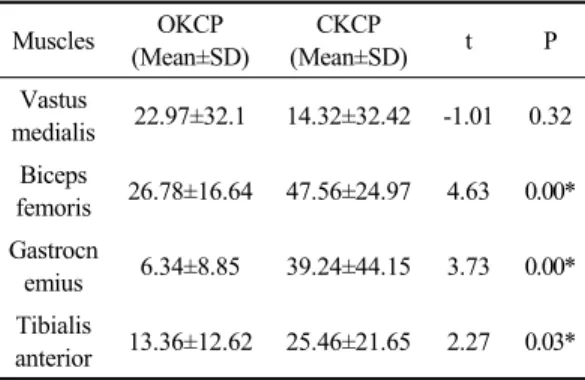
2. 팔 굽힘 패턴 때 열린 사슬운동 자세와 닫힌 사슬운동 자세에서 다리의 근활성도(%MVI) 비교 PNF 팔 굽힘-벌림-가쪽돌림 패턴을 열린 사슬운동 자세와 닫힌 사슬운동 자세에서 적용한 결과 다리의 근활성도 변화는 Table 3과 같이 나타났다. 안쪽넓은 근은 열린 사슬운동 자세에서는 22.97±32.1, 닫힌 사슬 운동 자세에서는 14.32±32.42로 나타났으나 통계학적 Fig. 2. PNF D2 Arm Flexion Pattern

(Open kinematic chain position)

Fig. 3. PNF D2 Arm Flexion Pattern

(Closed kinematic chain position)

(5)

ᶪᾪ⎲თԨ⒎Ḷ⋎ԨሮᙶԨ৞␞἖⎧ḯ῞঻ૺ⨇⛂ᦓԨ〒Ԩ〦⸲⑲Ԩ࿢ᚪ⑖Ԩૺ㍚ḯჂ⋎Ԩ᣶⭖ྒԨ㎦৺ ք ՁՁ

으로 유의한 차이가 없었다. 넙다리두갈래근은 열린 사슬운동 자세에서는 26.78±16.64, 닫힌 사슬운동 자 세에서는 47.56±24.97로 통계적으로 유의한 차이가 나 타났으며(P<0.05), 장딴지근은 열린 사슬운동 자세에 서는 6.34±8.85, 닫힌 사슬운동 자세에서는 39.24±

44.15로 통계학적으로 유의한 차이가 나타났다(P<

0.05). 앞정강근은 열린 사슬운동 자세에서는 13.36±

12.62, 닫힌 사슬운동 자세에서는 25.46±21.65로 통계 학적으로 유의한 차이가 나타났다 (P<0.05). PNF 팔 굽 힘-벌림-가쪽돌림 패턴 때 넙다리두갈래근, 장딴지근, 앞정강근은 닫힌 사슬운동 자세가 열린 사슬운동 자 세에서 보다 근활성도가 높게 나타나고 유의한 차이 를 보였다.

Muscles OKCP (Mean±SD)

CKCP

(Mean±SD) t P

Vastus

medialis 22.97±32.1 14.32±32.42 -1.01 0.32 Biceps

femoris 26.78±16.64 47.56±24.97 4.63 0.00*

Gastrocn

emius 6.34±8.85 39.24±44.15 3.73 0.00*

Tibialis

anterior 13.36±12.62 25.46±21.65 2.27 0.03*

* p<0.05

OKCP: Open Kinematic Chain Position CKCP: Closed Kinematic Chain Position

Table 3. Comparison of muscle activations according to the application of the patterns(%MVIC)

Ⅳ. 고 찰

정상 성인을 대상으로 PNF 팔 패턴을 열린 사슬운 동과 닫힌 사슬운동에 결합하여 실시하였더니 열린 사슬운동보다 닫힌 사슬운동에서 안쪽넓은근과 앞 정 강이근에서 근 활성도가 증가하는 것으로 나타났다 (Park, 2011). 건강한 대학생 22명을 대상으로 앉은 자 세에서 열린 운동형상학적사슬 (kinematic chain)과 닫 힌 운동형상학적사슬에서 한쪽 팔에 PNF 패턴 중 4가

지 팔 패턴을 적용했을 때 발생되는 방산현상이 반대 쪽 다리의 안쪽넓은근 , 넙다리두갈래근, 앞정강근, 장 딴지근의 근활성도에 미치는 영향을 측정한 결과 운 동형상학적사슬 모두에서 D2 굽힘 패턴을 적용할 때 넙다리두갈래근의 근활성도가 증가 되었고 열린 운동 형상학적사슬운동보다 닫힌 운동형상학적사슬운동 에서 안쪽넓은근과 앞정강근에서 근활성도가 유의하 게 증가하였다고 하였다 (Park, 2010).

남⋅여학생 10명을 대상으로 닫힌 사슬운동 자세 와 열린 사슬운동 자세에서 편측 팔에 PNF 패턴을 적용하였을 때 양쪽 다리의 안쪽넓은근, 넙다리두갈 래근, 장딴지근, 앞정강근의 근활성도 크기 차이를 비 교한 결과 오른쪽 다리와 왼쪽 다리에서 유의한 차이 를 나타내었으며, 오른쪽 다리보다 왼쪽 다리에서 근 활성도의 크기가 증가한 것은 PNF 방법의 방산효과 때문이라고 생각한다고 하였다(Han, 2009).

뇌졸중 환자 18명을 대상자로 비마비측에 PNF 4가 지 다리패턴 적용했을 때 마비측과 비마비측 위팔두 갈래근과 위팔세갈래근의 근활성도가 안정시보다 유 의하게 증가하였으므로 비마비측에 적용한 패턴은 관 절 운동학적 구성요소에 관계없이 방산효과를 유발하 여 마비측의 위팔두갈래근과 위팔세갈래근의 근활성 도를 간접적으로 증가시키는데 이용될 수 있다고 하 였다(Lee et al, 2009).

뇌졸중 환자 7명을 대상으로 바로누운 자세에서 비마비쪽 팔에 PNF D2 폄 패턴을 적용한 후 마비 쪽 위팔두갈래근, 위팔세갈래근, 엉덩허리근에서 방사 형태에 의해 발생되는 근활성도의 변화를 알아보았 다 . 그 결과 안정시에 비해 D2 폄 패턴을 적용한 경우 에 마비 쪽의 위팔두갈래근과 위팔세갈래근이 활성화 되어 유의하게 나타났으나 엉덩허리근은 유의하게 활 성화 되지 않았다고 보고하였다(Kim, 2009).

정상 성인 41명을 대상으로 열린 사슬운동은 공압

식 knee extensor(HUR, Filand)에서, 닫힌 사슬운동은

shuttle 2000-1(Contemporary Design Company, USA)에

서 실시하여 운동기간별 근활성도 변화를 살펴본 결

과 운동기간에 따른 안쪽넓은근과 가쪽넓은근의 근활

(6)

ԹԸԸ ք ࿾㉚৞␞἖⎧ḯ῞঻ૺ⨇⛂ᦓ㉗㎊⚾Ԩ┚ԹԻઊԨ┚Ժ㌶

성도가 운동 4주 후부터 두 사슬운동 군에서 모두 유의 하게 증가하였고 가쪽 넙다리뒤근과 안쪽 넙다리뒤근 도 두 사슬운동군 모두에서 운동 2주 후부터 유의하게 증가하였는데 닫힌 사슬운동군에서 더 증가하는 것으 로 나타났다고 하였다(Kwon, 2009).

닫힌 사슬운동과 열린 사슬운동이 엉덩관절 벌림 근인 중간볼기근 , 넙다리근막긴장근의 활성도에 미치 는 영향을 알아보기 위해 옆으로 누운자세, 선자세에 서 운동방법에 따라 벌림근의 근활성도 차이를 비교 한 결과에서 닫힌 사슬운동과 열린 사슬운동 모두에 서 활성도의 평균값이 넙다리근막긴장근보다 중간볼 기근이 더 높은 것으로 나타났으며 , 운동 유형과 근육 유형의 상호작용에 대한 사후검증 결과 닫힌 사슬운 동에서 중간볼기근의 활성도가 넙다리근막장근의 활 성도보다 높고 유의한 차이를 나타냈으나 열린 사슬 운동에서는 두 근육의 활성도에 유의한 차이가 나타 나지 않았다고 하였다(Kim, 2006).

성인 남자 23명을 대상으로 한 연구에서 한쪽 다리 에 PNF 적용한 그룹과 적용하지 않는 통제그룹에 대 해 무릎 폄근과 굽힘근에 도수저항을 8주 동안 1주일 에 3번 적용한 결과, PNF 적용한 그룹에서 저항운동을 적용하지 않는 다리의 무릎 폄근에서 교차훈련의 효 과로 근력과 지구력이 유의하게 증가를 나타냈다고 하였다(Kofotolis & Kellis, 2007).

위의 선행연구들에서 나타난 결과처럼 본 연구에 서도 PNF 팔 굽힘-벌림-가쪽돌림 패턴을 닫힌 사슬운 동 자세와 열린 사슬운동 자세에서 적용했을 때 닫힌 사슬운동 자세에서 넙다리두갈래근, 장딴지근, 앞정 강근의 근활성도가 더 높게 나타났다.

Ⅴ. 결 론

본 연구에서는 심혈관계, 근뼈대계와 신경근계에 병력이 없고 관절 운동범위가 정상이며, 등척성 저항 검사에서 제 4등급(Good) 이상인 건강한 남학생 20명 을 연구 대상자로 선정하여 PNF D2 팔 굼힘 패턴을

발바닥을 벽에 닿지 않는 열린 사슬운동 자세와 발바 닥이 벽에 닿은 닫힌 사슬운동자세에서 적용한 결과 넙다리두갈래근, 장딴지근, 앞정강근에서 근활성도 에 더 높게 나타났고 유의한 차이를 보였다(p<0.05).

따라서 임상현장에서 근뼈대계 환자와 중추신경계 환자에게 적용할 때 발바닥을 벽에 접촉하고 시행한 닫힌 사슬운동 자세가 열린 사슬운동 자세보다 근활 성화를 더 촉진시킬 수 있으므로 치료사는 환자에게 물리치료 중재를 할 때 고려해야 할 요소의 하나로 인식해야 할 것으로 사료된다 . 그러나 본 연구는 건강 한 남학생을 대상자로 선정하였고 대상자 숫자가 많 지 않으므로 일반화하기에는 한계점이 있으므로 본 연구의 뒷받침을 위해 임상에서 근뼈대계⋅중추신경 계 손상 환자를 대상으로 PNF 패턴을 닫힌 사슬운동 자세와 열린 사슬운동 자세에서 적용한 많은 연구들 을 실행하여 근거를 제시함으로써 효과적인 물리치료 중재로 이용되리라 생각한다.

References

Alder SS, Beckers D, Buck M. PNF in Practice: An illustrated guide. 3rd ed. Berlin. Springer-Verlag. 2008.

Canning CG, Ada L, Adams R, et al. Loss of strength contributes more to physical disability after stroke than loss of dexterity. Journal of Clinical Rehabilitation, 2004;18 (3):300-308.

Carroll TJ, Herbert RD, Munn J, et al. Contralateral effects of unilateral strength training: evidence and possible mechanisms. Journal of Applied Physiology Published, 2006;101(5):1514-1522.

Choi JW. The effects of task-oriented Training program on balance, activities of daily living performance and self-efficacy in stroke patients: a pilot study. Journal of the Korean Society of Integrative Medicine, 2013;1(4):15-24.

Docherty CL, Arnold BL, Zinder SM, et al. Relationship between

(7)

ᶪᾪ⎲თԨ⒎Ḷ⋎ԨሮᙶԨ৞␞἖⎧ḯ῞঻ૺ⨇⛂ᦓԨ〒Ԩ〦⸲⑲Ԩ࿢ᚪ⑖Ԩૺ㍚ḯჂ⋎Ԩ᣶⭖ྒԨ㎦৺ ք ԹԸԹ

two proprioceptive measures and stiffness at the ankle.

Journal of Electromyography and Kinesiology, 2004;14(3):317-324.

Duncan PW, Horner RD, Reker DM, et al. Adherence to postacute rehabilitation guidelines is associated with functional recovery in stroke. journal of Stroke, 2002;33(1):167-177.

Feber R, Ostering LR, Gravelle DC. Effect of PNF stretch techniques on knee flexor muscle EMG activity in older adults. Journal of Electromyography and Kinesiology, 2002;12(5):391-397.

Han HW. Effect of close kinematic chain and open kinematic chain position on proprioceptive neuromuscular facilitation applied to the unilateral upper extremity on the muscle activation of lower extremity. Korea University. Dissertation of Master’s Degree. 2009.

Hortobagyi T, Scott k, Lambert J et al. Cross-education of muscle strength is greater with stimulated than voluntary contractions. Journal of Motor Control, 1999;3:205-219.

Iwasaki T, Shiba N, Masuse H, et al. Improvement in knee extension strength through training by means of combined electrical stimulation and voluntary muscle contraction. The Tohoku Journal of Experimental Medicine, 2006;209(1):33-40.

Jang JW. The change of muscle activation in quadriceps femoris muscle during taking open kinetic chain exercise and closed kinetic chain exercise. Korea University.

Dissertation of Master’s Degree. 2003.

Kim WH. Effect of proprioceptive neuromuscular facilitation on muscle irradiation patterns of the affected side of in stroke patient: A preliminary study. Journal of Physical therapy Korea, 2009;16(2):59-66.

Kim ER. The effect of closed and open kinetic chain exercises on the activation of hip abductors. Inje University.

Dissertation of Master’s Degree. 2006.

Kim YJ. The effects of closed kinetic chain exercises on the

stability of the knee joints of patients with anterior cruciate ligament reconstruction. Daegu University.

Dissertation of Master’s Degree. 2007.

Kofotolis ND, Kellis E. Cross-training effects of a proprioceptive neuromuscular facilitation exercise programme on knee musculature. Journal of Physical Therapy in Sport, 2007;8(3):109-116.

Ko HE, Lim JH, Lee MK, et al. The combination of PNF patterns for coordinative locomotor training. Journal of the korean Association of Proprioceptive Neuromuscular Facilitation. 2013;11(1):17-25.

Kwon YJ. The effect of dynamic balance recovery and muscle activation by exercises on normal adults. Daegu University. Dissertation of Master’s Degree. 2009.

Lee MK, Kim JM, Kim WH. The effects of PNF leg patterns on activation of biceps and triceps in stroke patients.

journal of Korean Society of Physical Therapy.

2009;21(1):1-7.

Ma SY. The effects of FES and PNF on improvement of gait of stoke patients. Daegu University. Dissertation of Doctorate Degree. 2008.

Munn J, Herbert RD, Gandevia SC. Contralateral effects of unilateral resistance training: a meta analysis. Journal Applied Physiology. 2004;96(5):1861-1866.

Newham DJ, Hsiao SF. Knee muscle isometric strength, voluntary activation and antagonist co-contraction in the first six months after stroke. Journal of Disability and Rehabilitation, 2001;23(9):379-386.

Park TJ. The effects of proprioceptive neuromuscular facilitation in upper extremity patterns on activation of leg muscles according to kinematic chain. Seonam University.

Dissertation of Master’s Degree. 2010.

Park TJ, Park HK, Kim JM. The effects of PNF aem patterns on activation of leg muscles according to open and closed kinematic chains. Journal of the Korean Society of Physiacl Medicine, 2011;6(2):215-223.

Patten C. Lexell J. Brown HE. Weakness and strength training

(8)

ԹԸԺ ք ࿾㉚৞␞἖⎧ḯ῞঻ૺ⨇⛂ᦓ㉗㎊⚾Ԩ┚ԹԻઊԨ┚Ժ㌶

in persons with post stroke hemiplegia:rationale, method and efficacy. Journal of Rehabilitation

Research & Development, 2004;41(3A):293-312.

Statistics Korea. Annual report on the causes of death. 2014.

수치

Table 1. Electrode location of the lower extremity muscles
Fig. 3. PNF D2 Arm Flexion Pattern (Closed kinematic chain position)
Table 3. Comparison of muscle activations according to the application of the patterns(%MVIC)

참조

관련 문서

The index is calculated with the latest 5-year auction data of 400 selected Classic, Modern, and Contemporary Chinese painting artists from major auction houses..

The “Asset Allocation” portfolio assumes the following weights: 25% in the S&amp;P 500, 10% in the Russell 2000, 15% in the MSCI EAFE, 5% in the MSCI EME, 25% in the

1 John Owen, Justification by Faith Alone, in The Works of John Owen, ed. John Bolt, trans. Scott Clark, &#34;Do This and Live: Christ's Active Obedience as the

Depending on Tennis Forehand Stroke with elbow pain and without elbow pain Kinematic Analysis of

Changes in functional physical fitness, after the experiment compared to before the experiment in the group of exercise, showed a significant difference in

In the change of physical strength, The exercise group showed statistically significant differences in muscle strength(right), muscle strength(left),

This study was to do a comparative analysis on kinematic differences and differences in muscle activity between the skilled and the unskilled in windsurfing

Greco-Roman wrestlers of high school, college, and the professionals players showed significant differences depending on their performance when measuring the maximum muscle