• 검색 결과가 없습니다.

The Effect of Arm·Leg Flexion Patterns of PNF on Muscle Activation of Contralateral Lower Extremity

N/A
N/A
Protected

Academic year: 2021

Share "The Effect of Arm·Leg Flexion Patterns of PNF on Muscle Activation of Contralateral Lower Extremity"

Copied!
7
0
0

로드 중.... (전체 텍스트 보기)

전체 글

(1)

Original Article Open Access

고유수용성신경근촉진법 팔⋅다리 굽힘패턴이 반대측 다리의 근활성도에 미치는 영향

김희권

⋅김건 목포과학대학교 물리치료과

The Effect of Arm⋅Leg Flexion Patterns of PNF on Muscle Activation of Contralateral Lower Extremity

Hee-Gwon Kim , Gyeon Kim

Department of Physical Therapy, Mokpo Science University

Received: August 20, 2014 / Revised: September 2, 2014 / Accepted: September 12, 2014

ⓒ 2014 Journal of Korea Proprioceptive Neuromuscular Facilitation Association

This is an Open Access article distributed under the terms of the Creative Commons Attribution Non-Commercial License (http://creativecommons.org/licenses/by-nc/3.0) which permits unrestricted non-commercial use, distribution, and reproduction in any medium, provided the original work is properly cited.

| Abstract |

Purpose: The purpose of this study is to analyze the effect of arm⋅leg flexion patterns of proprioceptive neuromuscular facilitation on the muscle activation of the contralateral lower extremity.

Methods: In this study, Electromyogram MP150(Biopac system, USA) was applied to 20 healthy male subjects. Unilateral arm flexion- abduction- external rotation pattern and Unilateral leg flexion- adduction- external rotation with knee flexion pattern were applied within mid range of the supine position for measurement. The muscle activation of vastus lateralis, biceps femoris, tibialis anterior and gastrocnemius(medialis) muscle of the contralateral lower extremity were compared and analyzed during the applications.

Results: The results of this study were summarized as follows:

There was a statistically significant difference in the muscle activation of vastus lateralis and biceps femoris between the arm and leg patterns(P<0.05). There was a statistically significant difference in the muscle activation of gastrocnemius and tibialis anterior between the arm and leg patterns(P<0.05).

Conclusion: contralateral vastus lateralis, biceps femoris, gastrocnemius and tibialis anterior muscles show the higher muscle activation in the leg pattern than one in the arm pattern.

Key Words: PNF, Unilateral arm⋅leg pattern, Muscle activation

†Corresponding Author : Hee-Gwon Kim ([email protected])

(2)

Ⅰ. 서 론

인체는 내⋅외적 변화에 적응하고 신체적 균형을 유지하려는 항상성(homeostasis)을 가지고 있는데 이 러한 항상성이 상실되면 여러 가지 질병으로 인하여 해부학적, 생리학적, 심리학적 손상(impairment)으로 기능적 활동에 제약이나 장애가 발생된다. 따라서 질 병이나 손상에 의한 급성, 아급성, 만성의 증상으로 인하여 기본적인 인간의 수행력과 개인의 능력에 제 한을 가져온다고 하였다(Verbrugge와 Jetle, 1994).

물리치료사는 고객 /환자의 기능적 활동을 회복시키고 향상시키기 위한 여러 가지 치료적 운동을 모색하게 되는 데 그 중에서도 특히 신경계 손상 환자를 위한 중재전략 으로 신경 촉진법들이 사용되고 있다 . 신경 촉진법으로는 Kabat와 Knott의 고유수용성신경근촉진법(proprioceptive neuromuscular stimulation; PNF), Rood 접근법, Brunnstrom 접근법 , Bobath 접근법 등을 예로 들 수 있다.

PNF에서 고유수용성이란 신체의 움직임 및 체위와 관련된 정보를 제공하는 감각수용기와 관련 있으며, 신경근은 신경과 근육을 의미하며 촉진은 운동을 더 쉽게 하도록 하는 것이다(Docherty 등, 2004). 이러한 PNF는 근육과 힘줄 내의 고유수용기를 자극함으로써 기능을 향상시키고 근력, 유연성, 평형 능력을 증가시 킨다고 하였다(Lee 등, 2000). 또한 PNF는 기능적인 동작수행을 위한 대단위 근육 군을 강화시키는 운동 방법으로 협응력을 증가시키며 운동단위가 최대로 반 응하는데 효과적이라 하였다(Ferber 등, 2002). 그리고 PNF는 통합적인 치료법으로 인체의 한 분절 혹은 특 정부분의 문제만을 다루는 것이 아니라 인간의 전반 적인 면에서 접근을 해야 된다고 하였다(Kim 등, 2010). PNF 중재 방법은 재활에서 손상을 방지와 기능 증진을 위한 목적으로 점진적 저항운동의 대안으로 자주 이용되고 있다고 하였다 Andersion 등, 2006).

따라서 물리치료사의 역할은 고객/환자의 기능 적 움직임을 회복하거나 증진시키기 위해서는 일상 생활동작이나 스포츠 활동에서 보듯이 한 관절, 한 근육군의 작용보다는 여러 관절과 근육 군이 함께

작용하는 것이 효과적이라 할 수 있다 . 즉 인체의 기능 적 움직임은 운동사슬 (kinematic chain)과 연관되어 있 기 때문이다.

각 신체분절에서 일어나는 운동을 고려한 PNF 패 턴은 대각선, 나선형의 운동으로 이루어진 기능적인 움직임으로 신체의 근력 및 관절가동범위 그리고 지 구력 등을 증진시켜 일상생활동작 능력을 증진시킨다 고 하였다 (Kofotolis와 Kellis, 2007a) 또한 PNF 패턴은 나선형 패턴을 사용하여 근육과 건 내의 고유수용기 를 자극함으로 기능을 향상시킨다 . 그리고 근력, 유연 성, 평형성을 증가시킨다고 하였다(Klein 등, 2002).

저항을 한 쪽 팔다리에 적용하면 반대쪽 팔다리 근육에서 강화가 일어나는 방산효과를 유발할 수 있 다고 하였다(Voss 등,1985). 따라서 저항 운동을 통한 방산효과는 근수축이 감소된 마비측의 근 수축을 일 으킬 수 있는 치료적 전략으로 기능적인 움직임을 향 상을 시키는데 도움을 준다고 하였다(Jette 등, 2005).

그리고 저항은 신체의 일부분 중 강한 신체 분절 (혹은 근육)에 적용할 때 운동 과흐름(motor overflow) 현상 으로 인하여 약한 신체 분절이나 약한 근육 군에서 방산(irradiation) 및 강화(reinforcement)를 유발한다고 하였다(Carroll et al, 2006; Munn et al, 2004).

PNF는 기능장애의 문제점을 개선하기 위해 교차훈 련의 한 방법인 방산을 치료의 한 기법으로 이용하고 있으며 , 저항의 양을 증가시키는 것 또한 근육 반응의 양과 범위를 증가시키는 것으로 저항을 준 동작의 변 화나 환자의 자세 또한 결과를 변화시킨다고 하였다 (Adler et al, 2000a). 이와 같이 방산은 신체의 한 부분의 근육활동이 연결된 근육을 따라 다른 신체 부위의 근 육활동을 유발하는 것이라고 정의하고 있으며(Marcel, 2007), 또한 방산은 저항에 대항하기 위하여 반응이 협동근(synergist) 등에 까지 확산되어 운동패턴과 협 동근에 수축반응을 촉진하거나 혹은 이완시키는 것을 말한다(Min 등, 2012).

따라서 본 연구는 PNF의 한쪽 팔 굽힘-벌림-가쪽돌

림 패턴(unilateral arm flexion-abduction-external roration

pattern; 한쪽 팔 D2 굽힘), 한 쪽 다리 굽힘-모음-가쪽돌림

(3)

Fig. 1. Inbody J05, Biospace, USA 과 함께 무릎 굽힘 패턴 (unilateral leg flexion-adduction-

external rotation with knee flexion pattern; 한쪽 다리 D1 굽힘과 함께 무릎굽힘)을 적용하여 반대편 다리의 바깥쪽넓은근(vastus lateralis; VL), 넙다리두갈래근 (biceps femoris; BF), 앞정강근(tibialis anterior; TA), 장 딴지안쪽근(gastrocnemius-medialis, G-M)의 근활성도 에 미치는 영향을 비교 분석하여 신경계 및 근뼈대계 손상 환자의 기능향상을 위한 치료적 중재를 적용할 때 참고자료로 제공하고자 한다.

Ⅱ. 연구 방법

1. 실험연구 대상

본 연구의 실험 대상은 현재 전남지역에 위치한 00대학교 물리치료과 재학생 중에서 팔⋅다리의 근뼈 대계와 신경계에 과거 병력이 없으며, 신체적 결격 사유가 없는 남학생을 대상으로 20명을 무작위 표본 추출하여 실험연구 대상자로 선정하였다. 본 실험연 구에 앞서 실험연구 대상자들에게 실험의 목적과 방 법에 대해서 상세히 설명하고 실험에 대한 제반 사항 에 대해 실험연구 동의서를 받았다.

2. 실험연구 측정도구

실험연구 대상자의 일반적 특성을 분석하기 위해 체성분석기(Inbody J05, Biospace, USA)를 이용하였으 며(Fig 1), 실험연구 대상자에게 PNF의 한쪽 팔 D2 굽힘 패턴 , 한쪽 다리 D1 굽힘과 함께 무릎 굽힘 패턴을 적용하여 방산에 의한 반대편 다리 근육들의 활성도를 비교 측정하기 위해서 4개의 채널이 있는 표면 근전도 장비(MP150, Biopac system, USA)를 사용하였다.

근전도 신호 수집을 위해서 표본 수집율(sampling rate)은 1,000Hz로, 주파수 대역통과(band-pass) 필터는 20-50Hz로 설정하였다.

표면전극 (3M, USA)은 Ag/AgCL 재질의 일회용 전 극을 사용하였으며, 전극을 부착하기 전에 부착부위 피부표면의 체모를 제거하고 소독용 알코올 솜으로

닦은 뒤 전극을 배치하였다. 근활성도 측정을 위한 표면전극 배치부위는 VL 근육은 위앞엉덩뼈가시와 바깥 무릎관절 사이의 약 25% 지점, BF 근육은 정강뼈 의 가쪽관절융기와 궁둥뼈 결절사이의 약 50% 지점, TA 근육은 정강뼈 가쪽관절융기의 앞가쪽면에서 가 쪽 복숭아뼈 사이의 약 75% 지점, G-M 근육은 안쪽 무릎관절 넙다리 가쪽위관절융기에서 발꿈치뼈융기 의 약 35%지점 등 각각 근섬유 방향의 근배(muscle belly)에 부착하였다.

3. 실험연구 절차 및 방법

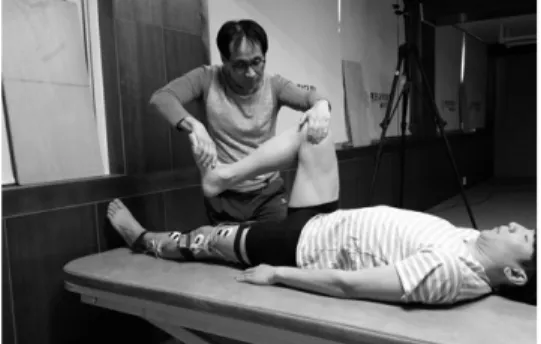
실험연구 방법은 PNF의 한쪽 팔 D2 굽힘 패턴, 한쪽 다리 D1 굽힘과 함께 무릎 굽힘 패턴을 적용하였으며, 방산에 의한 반대편 다리의 VL, BF, TA, G-M 근육들 의 측정된 근활성도를 표준화하기 위해 최대 수의적 등척성 수축시 도수근력검사 자세에서 3회 측정하여 평균값을 구하였고 퍼센트 최대 수의적 등척성 수축 (maximal voluntary isometric contraction; % MVIC)으로 정량화 하였다. 그리고 한쪽 팔 D2 굽힘 패턴(Fig 2), 한쪽 다리 D1 굽힘과 함께 무릎 굽힘 패턴을 3번 반복 하였으며, 반복하는 동안 실험 대상자의 근 피로를 방지하기 위해 휴식시간을 주었다.

4. 실험연구 자료 분석

본 실험에서 근전도 신호 분석은 Acqknowledge 4.1

software program(Biopac, 미국)을 이용하였으며, 근전

도 자료 값은 5초 근 수축 값에서 처음과 마지막 값을

(4)

Item Value(Mean±SD)

Gender(male) 20

Age(Year) 22.95±1.73

Weight(kg) 172.99±6.16

Hight(cm) 73.33±14.74

BMI(kg/㎡) 24.49±4.89

* BMI; Body Mass Index

Table 1. General Characteristics of the Subjects

Muscles Arm pattern (Mean±SD)

Leg pattern

(Mean±SD) t P

VL 22.08±32.10 37.72±35.12 -3.435 .000

BF 26.78±16.64 59.78±27.77 -6.068 .027 *

TA 13.36±12.62 23.87±24.52 -3.284 .000 *

G-M 6.34±8.85 23.66±32.22 -2.639 .049 *

* p<0.05

VL; vastus lateralis, BF; biceps femoris, TA; tibialis anterior, G-M; gastrocnemius-medialis Arm pattern: unilateral arm flexion-abduction-external rotation

Leg pattern: unilateral leg flexion-adduction-external rotation with knee flexion

Table 2. Comparison of muscle activations according to the application of the patterns (%MVIC) Fig. 2. Arm flexion-abduction-external rotation

pattern (middle range)

Fig. 3. Leg flexion-adduction-external rotation with knee flexion pattern (middle range)

제외한 중간 3초 값을 평균값으로 사용하였으며, 측정 된 근 활성도의 자료를 정량화하기 위하여 % 최대 수의적 등척성 수축으로 표준화하였다.

자료 처리를 위해 Windows SPSS version 12.0 통계프 로그램을 사용하였다 . 실험연구 대상자들의 일반적 특 성은 기술통계를 사용하여 평균±표준편차를 산출하였

으며 , PNF의 한쪽 팔 D2 굽힘 패턴, 한쪽 다리 D1 굽힘 과 함께 무릎굽힘 패턴을 적용하여 반대편 다리의 근활 성도(%MVIC) 변화를 비교하기 위하여 대응표본 T 검 정 (Paired T-test)을 이용하여 분석하였다. 그리고 모든 통계학적 유의수준은 P<0.05로 설정하였다.

Ⅲ. 연구 결과

1. 실험연구 대상자의 일반적 특성

실험연구 대상자의 일반적 특성은 다음과 같다 (Table 1).

2. 팔⋅다리 굽힘 패턴 적용에 따른 반대편 다리의 근활성도(%MVI) 비교

PNF의 한쪽 팔 D2 굽힘 패턴, 한쪽 다리 D1 굽힘과 함께 무릎굽힘 패턴을 적용한 결과 반대편 다리의 근 활성도 변화는 다음과 같이 나타났다(Table 2).

VL 근육은 한쪽 팔 D2 굽힘 패턴 적용시는

(5)

22.08±32.10로 나타났고 한쪽 다리 D1 굽힘과 함께 무릎굽힘 패턴을 적용할 때는 37.72±35.12로 나타나 통계적으로 유의한 차이를 보였다(P<0.05). 또한 BF 근육은 한쪽 팔 D2 굽힘 패턴 적용시는 26.78±16.64로 나타났고 한쪽 다리 D1 굽힘과 함께 무릎굽힘 패턴을 적용할 때는 59.78±27.77로 나타나 통계적으로 유의한 차이를 보였다(P<.05). TA 근육은 한쪽 팔 D2 굽힘 패턴 적용시는 13.36±12.62로 나타났고 한쪽 다리 D1 굽힘과 함께 무릎굽힘 패턴을 적용할 때는 23.87±24.52로 나타나 통계적으로 유의한 차이를 보였 다 (P<.05). G-M 근육은 한쪽 팔 D2 굽힘 패턴 적용시는 6.34±8.85로 나타났고, 한쪽 다리 D1 굽힘과 함께 무릎 굽힘 패턴을 적용할 때는 23.66±32.22로 나타나 통계 적으로 유의한 차이를 보였다(P<.05).

본 실험연구의 결과로 미루어 볼 때 PNF의 한쪽 팔 D2 굽힘 패턴, 한쪽 다리 D1 굽힘과 함께 무릎굽힘 패턴을 적용할 때 반대편 다리의 근 활성도에 영향을 미치는 것으로 나타났으며 , 한쪽 팔 D2 굽힘 패턴보다 는 한쪽 다리 D1 굽힘과 함께 무릎굽힘 패턴을 적용하 였을 때 근 활성도가 높게 나타났다.

Ⅳ. 고 찰

PNF에서 촉진을 위한 기본절차 중에서 방산은 신 체 지절 중에서 강한부위에 저항을 적용하여 자극에 대한 반응의 확산으로 약한 부위를 촉진시키는 방법 중 하나이다 (Alder et al, 2000b). 이같은 방산은 자극빈 도와 자극강도가 증가되었을 때 발생된다. 반대 측에 적용된 저항운동에 의해 생성된 최대 근력 증가는 정 적 운동이나 등척성 운동보다 동적 운동을 이용한 훈 련에서 더 크게 나타났고 이러한 근력의 교차 전이 현상 또는 방산은 다리에서도 일어난다고 하였다 (Shima et al, 2002; Zhou, 2000).

정상인을 대상으로 한 연구에서 한쪽 다리에 PNF 다리 패턴을 적용하고 운동을 하지 않는 쪽 다리의 근력을 측정한 결과 운동을 하지 않는 쪽 다리의 근력

과 지구력이 유의하게 증가하였다고 보고하였다 (Kofotolis와 Kellis, 2007b). 20대 성인 남녀를 대상으로 하는 PNF 연구에서도 팔 패턴과 몸통 들어올리기 패 턴을 편측에 적용하였더니 반대 측 다리의 근활성도 에 영향을 미치는 것으로 나타났다(Kim, 2005). 또한 여성에게 단기간의 한쪽 저항 운동프로그램이 훈련을 받지 않은 팔다리에도 근력 증가를 가져왔으므로 교 차훈련을 편마비 환자, 엉덩관절이나 무릎관절 관절 성형술 (arthroplasty)을 시행한 경우, 한쪽 팔다리에 석 고 고정을 시행한 경우 근력의 회복과 기능의 회복에 도움을 줄 수 있는 방법으로 제안하였다(Bemben과 Murphy, 2001).

뇌졸중 환자를 대상으로 한 사례에서 비마비 측 팔과 다리에 PNF 패턴을 적용하고 편마비 측의 근긴 장도의 변화를 분석한 결과 근 긴장도에서 유의하게 감소했다. 이에 연구자들은 그에 대한 근거로 저항에 의해 발생한 방산현상 때문이라고 결론지었다(Woo 등 , 2002). 다른 실험연구에서도 뇌졸중으로 진단받은 환자를 대상으로 실험군과 대조군으로 나누어 실험군 에 6주 PNF 패턴의 결합인 스프린터 패턴 훈련을 실시 한 후 마비 측 다리의 근 활성도를 알아본 결과 안쪽⋅

가쪽 넓은근, 안쪽⋅가쪽 넙다리뒤근 모두에서 측정 시기 간 유의한 차이가 나타났다(Jung, 2010). 그리고 뇌졸중으로 인한 편마비 환자를 대상으로 한 또 다른 연구에서도 비마비측 다리에 PNF의 다리 굽힘-신전 패턴을 적용하여 마비 측과 비마비측의 위팔두갈래근 과 위팔세갈래근의 근활성도를 측정하였더니 마비측 과 비마비측 측정 근육에서 근활성도가 유의하게 증 가시키는 것으로 나타났다(Lee, 2008).

본 실험 연구에서도 선행연구들의 결과처럼 PNF의

한쪽 팔 D2 굽힘 패턴, 한쪽 다리 D1 굽힘과 함께

무릎 굽힘 패턴을 적용했을 때 반대측 다리에 방산이

나타나므로 손상 측에 치료중재가 어려운 환자에게

중재할 때 비손상측을 이용하는 중재방법들을 고려해

야 될 것으로 생각된다. 본 실험연구의 결과는 건강한

남학생을 대상자로 선정하였고 대상자 숫자가 많지

않으므로 일반화하기에는 한계점이 있다.

(6)

Ⅴ. 결 론

본 실험연구에서는 근뼈대계와 신경계에 병력이 없는 건강한 남학생 20명을 연구 대상자로 선정하여 PNF의 한쪽 팔 D2 굽힘 패턴, 한쪽 다리 D1 굽힘과 함께 무릎굽힘 패턴을 적용한 결과에서 반대편 다리 의 근활성도는 다음과 같이 나타났다.

VL, BF, TA, G-M 근육들은 PNF의 한쪽 팔 D2 굽힘 패턴, 한쪽 다리 D1 굽힘과 함께 무릎굽힘 패턴에서 근활성도에 유의한 차이가 있었다(p<0.05).

따라서 VL, BF, TA, G-M 근육에서 한쪽 팔 D2 굽힘 패턴보다는 한쪽 다리 D1 굽힘과 함께 무릎굽힘 패턴 에서 근활성도가 높은 것으로 나타났다 . 이 같은 결과 는 한쪽 팔 D2 굽힘 패턴을 적용할 때 보다 최대 수의 적 등척성 수축시 저항의 양을 더 제공할 수 있기 때문 에 근활성도가 높게 나타났다고 사료된다.

결론적으로 임상에서 근뼈대계 (musculoskeletal system) 와 중추신경계(central nervous system)의 손상에 의한 기능장애 환자에게 PNF를 직접적으로 적용할 수도 있지만 자극에 의한 방산의 효과를 이용하여 다른 부 위에 문제점을 개선할 수 있으므로 물리치료사는 간 접적 중재방법으로 고려할 수 있다 . 따라서 본 실험연 구의 결과가 고객/환자 중재를 모색할 때 기초자료가 되리라 생각되며, 뇌졸중 환자를 대상으로 하는 많은 실험연구가 필요하다고 사료된다.

참고문헌

Alder SS, Beckers D, Buck M. PNF in practice: an illustrated guide. 2nd ed. Springer-Verlag Berlin Heidelberg.

2000.

Andersen LL, Magnusson SP, M. et al. Neuromuscular activation in conventional therapeutic exercise and heavy resistance exercise: implication for rehabilitation.

Physical Therapy. 2006;86(2):683-697.

Bemben MG, Murphy RE. Age related neural adaptation

following short term resistance training in Women.

Journal of Sports Medicine and Physical Fitness.

2001;41(3):291-299.

Carroll TJ, Herbert RD, Munn J, et al. Contralateral effects of unilateral strength training: evidence and possible mechanisms. Journal Applied Physiology. 2006;101(5):

1514-1522.

Docherty CL, Arnold BL, Zinder SM, et al. Relationship between two proprioceptive measures and stiffness at the ankle.

Journal of Electromyography and Kinesiology.

2004;14(3):317-324.

Feber R, Osterning LR, Gravells DC. Effect of PNF stretch technique on knee flexor muscle EMG activity in older adults. Journal of Electromyography and Kinesiology. 2002;12(3):91-97.

Jette DU, Latham HK, Smout RJ. Physical therapy interventions for patients with stroke in inpatient rehabilitation facilities. Physical Therapy. 2005;85(3):238-248.

Jung WS. The effect of lower limb muscle activity on balancing through sprinter patterns of PNF. Dongshin University.

Dissertation of Master’s Degree. 2010.

Kim KH. Effect of proprioceptive neuromuscular facilitation applied to the unilateral upper extremity on the muscle activation of contralateral lower extremity. Eulji University. Dissertation of Master’s Degree. 2005.

Kim SS, Kim HG, Lee HO et al. PNF in practice an illustrated guide, 3rd ed. Seoul. Yeongmunsa. 2010.

Klein DA, Stone WJ, Phillips WT, et al. PNF training and physical function in assisted living older adults.

Journal of Aging and Physical Activity. 2002;10(4):

476-488.

Kofotolis N, Kellis, E. Cross-training effects of a proprioceptive neuromuscular facilitation exercise programme on knee musculature. Physical Therapy in Sport. 2007;

8(3):109-116.

Lee KS, Kim MH, Yoo JS, The effects of proprioceptive

neuromuscular facilitation and shoulder wheel on the

(7)

range of motion and pain score in frozen shoulder.

Journal korean of Research Institute of Physical Education & Sports Science. 2000;19(1):103-111.

Lee Mk. The effect of proprioceptive neuromuscular facilitation leg patterns on activation of arm muscles in stroke patients. Seonam University. Dissertation of Master’s Degree. 2008.

Marcel G. Indirect treatment approach of proprioceptive neuromuscular facilitation in the recovery of function.

PNF Seoul Seminar. 2007.

Min KO, Kang KY, Kwon MJ et al. Therapeutic exercise for nervous system. Seongnam. Hanulbook company.

2012.

Munn J, Herbert RD, Gandevia SC. Contralateral effects of unilateral resistance training: a meta analysis. Journal Applied Physiology. 2004;96(5):1861-1866.

Shima N, Ishida K, Katayama K. Cross education of muscular strength during unilateral resistance training and

detraining. European Journal Applied Physiology.

2002;86(4):287-294.

Verbrugge L, Jetle A. The disablement process. Social Science

& Medicine. 1994;38(1):1.

Voss ED, Ionta MK, Myers BJ. Proprioceptive neuromuscular facilitation. patterns and techniques. 3rd ed. New York. Harper & Row. 1985.

W YK, Cho GH, Yoo EY. Effect of PNF applied to the unaffected side on muscle tone of affected side in patients with hemiplegia Journal of the Korean Academy of University Trained Physical Therapists. 2002;9(2):

157-168.

Zhou S. Chronic neural adaptations to unilateral exercise:

mechanism of cross education the characteristics and

potential mechanisms for the effects of unilateral

strength training on homologous muscles in the

contralateral limb are analyzed. Exercise and Sport

Sciences Reviews. 2000; 28(4):177-184.

수치

Fig. 1. Inbody J05, Biospace, USA과 함께 무릎 굽힘 패턴(unilateral leg flexion-adduction-
Table 2. Comparison of muscle activations according to the application of the patterns (%MVIC)Fig

참조

관련 문서

전완의 굴근(flexors of the forearm) 종류 심층에 존재하는 근들... 심지굴근(깊은손가락굽힘근, flexor digitorum profundus m.) 척골의

The index is calculated with the latest 5-year auction data of 400 selected Classic, Modern, and Contemporary Chinese painting artists from major auction houses..

1 John Owen, Justification by Faith Alone, in The Works of John Owen, ed. John Bolt, trans. Scott Clark, &#34;Do This and Live: Christ's Active Obedience as the

core exercise program showed not only increasing peak torque of the right leg, left leg in Hip Extension of exercise group but also increasing peak torque of the right leg, left

contralateral extremity except 3 patients who had comminuted fracture at the last follow-up. These three cases showed an angular deformity of less than 5 degrees and

Effect of Soru Lower-leg Massage Therapy on Heart Rate Variability and Reactive Oxygen Species Concentration in

In the change of physical strength, The exercise group showed statistically significant differences in muscle strength(right), muscle strength(left),

In conclusion, Pilates chair exercise is a positive factor in improving skeletal muscle mass among menopausal women's body composition and lower muscles EMG