• 검색 결과가 없습니다.

JSUJournal of Surgical Ultrasound

N/A
N/A
Protected

Academic year: 2021

Share "JSUJournal of Surgical Ultrasound"

Copied!
7
0
0

로드 중.... (전체 텍스트 보기)

전체 글

(1)

JSU

Journal of Surgical Ultrasound J Surg Ultrasound 2019;6:20-26

https://doi.org/10.46268/jsu.2019.6.1.20

Safety and Technical Efficacy of Tumescent Anesthesia in Radiofrequency Ablation for Thyroid Nodules Close to the Surrounding Structure

Tae Ik Eom, Byung Seup Kim

Department of Surgery, HiU Clinic, Suwon, Korea`

Received December 27, 2018 Revised January 25, 2019 Accepted February 11, 2019

Purpose: This study estimated the changes in distance between a thyroid nodule and the sur- rounding structures after tumescent anesthesia in radiofrequency ablation (RFA) for a be- nign thyroid nodule.

Methods: Between January 2015 and December 2017, the sonogram images in patients treated with thyroid RFA were reviewed retrospectively. Patients without images immedi- ately after tumescent anesthesia or treated with RFA for carcinoma were excluded. The 0.2% saline mixed lidocaine as a tumescent solution was injected into the anterior, posterior, and lateral capsules of the thyroid and thyroid-trachea junction. In a sonogram image, the distances between the posterior margin of the nodule and above the longus colli muscle, be- tween the medial margin of the nodule and trachea, and between the lateral margin of the nodule and common carotid artery (CCA) were measured before and after tumescent anesthesia.

Results: Tumescent anesthesia was technically successful in all 133 patients (100%) and the analgesic effect was also obtained successfully. No complications related to tumescent anes- thesia were observed. The average distance between the posterior margin of the nodule and the longus colli muscle increased by 4.2 ± 2.4 mm. The average distance between the medial margin of the nodule and trachea increased by 2.2 ± 1.9 mm. The average distance between the lateral margin of the nodule and CCA increased by 4.6 ± 3.0 mm.

Conclusion: Tumescent anesthesia is a safe and useful method for secure a safe distance (over 2 mm) in RFA for thyroid nodules close to the surrounding structure.

Keywords: Radiofrequency ablation, Thyroid, Anesthesia, Injection

Correspondence to:

Byung Seup Kim

Department of Surgery, HiU Clinic, 170 Gwongwang-ro, Paldal-gu, Suwon 16488, Korea Tel: +82-31-221-1205 Fax: +82-31-225-1207 E-mail: [email protected]

INTRODUCTION

Radiofrequency ablation (RFA) has been widely used to treat benign thyroid nodules.(1-3) The large thyroid nodule is located closely to critical structures such as the esophagus, trachea, recurrent laryngeal nerve (RLN), common carotid artery (CCA), and the vagus nerve. Several studies have reported the com-

plications related to thyroid RFA such as nerve or trachea injury.(4-6) In RFA, the ablated lesion spreads out to an oval shape around the tip.(7) If the RFA needle tip is not located on the periphery of the nodule for the fear of an injury of the surrounding structure, the nodule can re-grow from the viable cell.(8)

Tumescent injection has been known as a useful

(2)

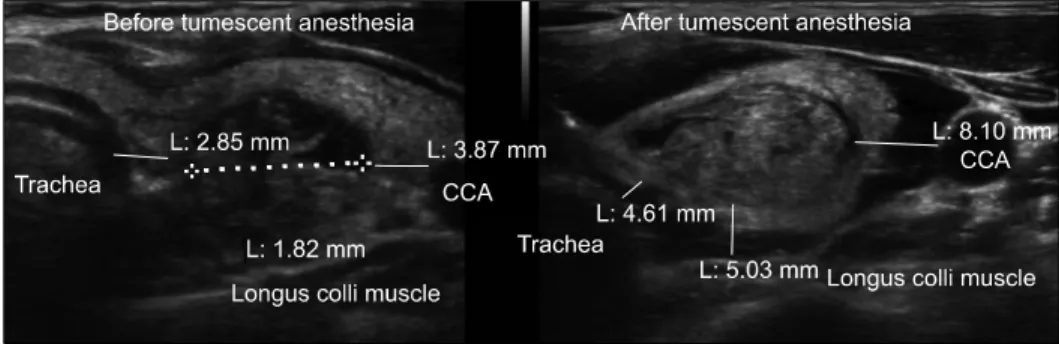
Fig. 1. The distances between no- dule and major structures were measured on PACS image before and after tumescent anesthesia using same method. CCA = common carotid artery.

method in separating the tumor from the adjacent critical structures in RFA for the hepatic tumor.(9) A tumescent solution was injected to a narrow space between the structures, thereby increasing the dis- tances between the structures. With the assistance of a tumescent solution, the safe distance for RFA was sufficiently secured. In tumescent anesthesia, the tumescent effect is combined with the local an- algesic effect using a diluted solution of local analgesics.(10) However, previous studies did not estimate the extent to which the distance between nodule and adjacent structure can increase by tu- mescent anesthesia. In the present study, we esti- mated the changes of distance between structures after tumescent anesthesia and evaluated the safety and technical efficacy in RFA for a benign thyroid nodule.

METHODS

1. Patient and sonogram image review

The Public Institutional Review Board Designated by Ministry of Health and Welfare approval to con- duct the present study (P01-201812-21-004). Between January 2015 and December 2017, a total of 171 pa- tients with thyroid nodules were consecutively treat- ed with ultrasound guided percutaneous RFA at our institution. The indication of RFA for thyroid nodule included a growing, palpable or symptomatic benign thyroid nodule with discomfort or a cosmetic problem. Although the benign thyroid nodule was not

too large in size, the RFA was performed in the cases of the patient`s anxiety. Prior to RFA, all thyroid nodules were confirmed by fine needle aspiration cy- tology or core needle biopsy. The RFA for mi- cro-papillary thyroid carcinoma was performed, af- ter consent was obtained, in the elder patients with a high operation risk. The patients treated with RFA for thyroid cancer and metastatic lymph node were excluded from the sample. The sonogram images were retrospectively reviewed using the Picture Archiving and Communication System (PACS). The patients without sonogram images before and after tumescent anesthesia were also excluded.

In a sonogram image, the distances between pos- terior margin of the nodule and above the longus colli muscle, between medial margin of the nodule and trachea, and between lateral margin of the nodule and CCA were measured before and after tumescent anesthesia using the PACS tool (Fig. 1). The dis- tances before and after tumescent anesthesia were then compared.

The nodule contents were divided into the cystic mass group and the solid mass group. Pure cyst and mainly cystic mass with below 50% solid portion were classified into the cystic mass group. The solid mass, spongiform mass, and complex echoic mass with above 50% solid portion were classified into the solid mass group.

The nodule lengths were measured for transverse

diameter (TD) and vertical diameter (VD) in the

transverse section image, and for longitudinal length

(3)

(LD) in the longitudinal section image. The volume of nodule was approximated using the following for- mula: Volume = π × (TD × VD × LD) / 6.

The RFA time was measured by checking the stored record of time on the sonogram image. The RFA time was considered as only ablation time after completing tumescent anesthesia. We checked the stored record of time immediately after the tumescent injection and immediately after RFA. The time differences were considered as the RFA time.

The records for pain and complications related RFA were checked based on the chart review.

2. Tumescent anesthesia

The first procedure of thyroid RFA was the in- jection of local anesthesia to the skin at the puncture site with 2% lidocaine. In the next step, 0.2% saline mixed lidocaine was prepared as the tumescent sol- ution (2% lidocaine and normal saline, at the ratio 1:9). After skin anesthesia, a 24-gauge 60 mm long needle was advanced into the interface between the strap muscle and the thyroid anterior capsule under ultrasound guidance using the trans-isthmic approach. Then, over 20 ml of tumescent solution were injected until the anechoic tumescent layer be- tween the strap muscle and the thyroid anterior cap- sule was seen on the real-time sonogram. Next, the needle was advanced into the interface between the thyroid posterior capsule and the longus colli muscle.

The about 40 ml of tumescent solution were injected until the thyroid was shifted upward and medially.

Thirdly, the needle was advanced into the interface between CCA and the thyroid lateral capsule. This space already widened to some degree because of the second injected tumescent solution to the posterior capsule. In order to reinforce the safe distance from CCA, an additional tumescent solution was injected between CCA and the lateral thyroid capsule until a more tumescent layer was obtained. Fourthly, the needle was advanced into the interface between thy-

roid and trachea and the tumescent solution were slowly injected. Finally, the needle was again ad- vanced into the interface between posterior capsule and the longus colli muscle and the tumescent sol- ution was injected to reinforce the safe distance from RLN. The tumescent solution was injected suffi- ciently until the tumescent layer was formed, and the thyroid shifted upwards.

3. RFA procedure

The procedure was performed using a radio- frequency generator (VIVA RF generator, STARmed, Goyang, Korea) and a peristaltic pump (VIVA pump, STARmed, Goyang, Korea) to lower the tip temperature.

We used an 18-gause, monopolar, modified, in- ternally cooled electrode (VIVA, STARmed, Goyang, Korea) with a 1 cm active tip and a 7 cm shaft length.

The RFA started from the posterior portion of the nodule, because the air bubble near needle masked the tip location under ultrasound. The RFA was ter- minated when the tumor changed to a transient hy- perechoic zone. Conscious sedation was not applied, because the patients’ state had to be monitored though verbal questions whether they experienced pain.

4. Statistical analysis

The independent t-test was used for continuous variables in order to identify statistically significant associations before and after tumescent anesthesia.

A P-value of <0.05 was considered to be statistically significant. The analyses were performed using the SPSS version 12.0 (SPSS Inc., Chicago, IL, USA).

RESULTS

1. Enrolled patients

Among 171 patients treated with RFA for the thy-

roid nodule, 11 patients with micro-papillary thyroid

carcinoma and 2 patients with lymph node metastasis

(4)

Table 1. The Distance between Nodule and Structures before and after Tumescent Anesthesia

  Before After P-value Increased distance

Nodule - Longus colli m. (post.) 2.1 ± 2.1 mm 6.3 ± 2.7 mm < 0.001 4.2 ± 2.4 mm

Nodule - Trachea (med.) 1.9 ± 2.1 mm 4.2 ± 2.5 mm < 0.001 2.2 ± 1.9 mm

Nodule - CCA (lat.) 2.1 ± 2.4 mm 6.7 ± 3.5 mm < 0.001 4.6 ± 3.0 mm

m = muscle; CCA = common carotid artery; post. = posterior; med. = medial; lat. = lateral.

Table 2. The Distance between Nodule and Structures in the Nodules with less than 2 mm Distance from the Major Structures

  n Before After P-value Increased distance

Nodule - Longus colli m. (post.) 90 0.9 ± 0.5 mm 5.7 ± 2.3 mm < 0.001 4.8 ± 2.4 mm

Nodule - Trachea (med.) 97 0.9 ± 0.6 mm 3.3 ± 1.8 mm < 0.001 2.4 ± 1.7 mm

Nodule - CCA (lat.) 94 0.8 ± 0.5 mm 5.6 ± 2.9 mm < 0.001 4.8 ± 2.9 mm

m = muscle; CCA = common carotid artery; post. = posterior; med. = medial; lat. = lateral.

Table 3. The Change of Distance between Nodule and Structures in Cystic and Solid Nodule after Tumescent Anesthesia Increased distance after tumescent anesthesia

P-value

Cyst (n = 37) Solid (n = 96)

Nodule - Longus colli m. (post.) 4.0 ± 2.4 mm 4.3 ± 2.5 mm 0.54

Nodule - Trachea (med.) 1.8 ± 1.7 mm 2.4 ± 1.9 mm 0.11

Nodule - CCA (lat.) 4.5 ± 3.0 mm 4.7 ± 3.0 mm 0.74

m = muscle; CCA = common carotid artery; post. = posterior; med. = medial; lat. = lateral.

were excluded in this study. The 25 patients without image immediately after the tumescent injection were also excluded, as we were unable to identify the distance change on the PACS images. Therefore, we reviewed the sonogram images of a total of 133 patients.

2. Technical feasibility and safety of tumescent anesthesia

The tumescent injection of 0.2% diluted lidocaine with normal saline was technically successful in all patients (100%). All thyroids were shifted after the tumescent injection and the analgesic effect was also successfully obtained. There was no pain during the RFA procedure. However, 12 patients (9.0%) com- plained about neck pain after RFA, escaping from anesthesia. They took oral analgesics and improved in 2-3 day. No complications related to tumescent

anesthesia were observed. No complications such as skin burn or permanent voice change related to RFA were observed after RFA and 1 year later.

The average distance between posterior margin of the nodule and the longus colli muscle increased by 4.2 ± 2.4 mm (from 2.1 ± 2.1 mm before to 6.3 ± 2.7 mm after the tumescent injection) (P < 0.001). The average distance between medial margin of the nod- ule and trachea increased by 2.2 ± 1.9 mm (from 1.9

± 2.1 mm to 4.2 ± 2.5 mm) (P < 0.001). The average

distance between lateral margin of the nodule and

CCA increased by 4.6 ± 3.0 mm (from 2.1 ± 2.4 mm

to 6.7 ± 3.5 mm) (P < 0.001) (Table 1). In the nodules

with less than 2 mm distance from the longus colli

muscle, trachea or CCA, the posterior distance in-

creased by 4.8 ± 2.4 mm from the longus colli muscle

(n = 90), the medial distance increased by 2.4 ± 1.7

mm from trachea (n = 97), and the lateral distance

(5)

Table 4. The Change of Distance between Nodule and Structures in Small and Large Volume of Nodule after Tumescent Anesthesia Increased distance after tumescent anesthesia

P-value Volume <300 mm

3

(n = 23) Volume ≥300 mm

3

(n = 110)

Nodule - Longus colli m. (post.) 3.8 ± 2.8 mm 4.3 ± 2.3 mm 0.36

Nodule - Trachea (med.) 2.2 ± 2.1 mm 2.6 ± 1.8 mm 0.91

Nodule - CCA (lat.) 3.8 ± 2.4 mm 4.8 ± 3.1 mm 0.15

m = muscle; CCA = common carotid artery; post. = posterior; med. = medial; lat. = lateral.

increased by 4.8 ± 2.9 mm from CCA (n = 94), re- spectively (Table 2). The nodule content (cyst vs. sol- id) and nodule volume (<300 vs. ≥300 mm

3

) were not statistically different in terms of the distance from the adjacent structures (Table 3, 4). The RFA time after tumescent anesthesia was 6.2 ± 3.5 minute (from 2 to 18 minutes).

The volume reduction rate 1 year post-RFA ranged from 20.1% to 100% (mean ± SD, 86.5 ± 17.1%) ex- cept for the follow-up loss of 38 patients. We consid- ered less than 5 mm hypoechoic lesion looking like a scar tissue after RFA 1 year as complete remission.

The complete remission rate was 29.5% except for the follow-up loss of 38 patients.

DISCUSSION

While the RFA treatment for the benign thyroid nodule was effective, inadvertent complications, such as a thermal injury of the structures adjacent to the nodule, could have occurred. In the situation when the RFA needle tip was not seen under sonogram, the flowing of radiofrequency was very dangerous.

Although the needle tip was carefully located in the inside of nodule, an inadvertent thermal injury over the nodule could have occurred due to the extension of ablation to the surrounding area of the needle.

Park et al .(11) mentioned that ablation was safe when the tip of the electrode was well positioned within a 1-2 mm distance from the target nodule margin.

Likewise, Cosman et al .(7) mentioned that the needle tip gauge, tip length, generator temperature, and

time substantially can affect RFA size and the RFA lesion exceeds the tip length by 1-5 mm. In our expe- rience, the safe distances of over 2 mm were obtained by tumescent anesthesia in the cases where the tu- mor was located to the surrounding structure closer than at 2 mm.

The normal saline and local analgesics were used to get the tumescent anesthesia. Lim et al . (12) in- jected the solution of 5% dextrose to get the effect of hydrodissection in the treatment for locoregional re- currence from papillary thyroid cancer. Laeseke et al .(13) reported that the normal saline or 5% dextrose injection had a statistically significant protective ef- fect as compared with the non-pretreated group in terms of protection against unintended thermal in- juries from RFA in the treatment of hepatic tumor.

When the 5% dextrose was compared with normal saline, the 5% dextrose was found to be more effec- tive than saline. The authors mentioned that the normal saline was an ionic fluid, so it could cause frictional heating damage to the adjacent structure due to conduction of electricity. However, the 5%

dextrose does not conduct electricity, so can provide

a thermal barrier. Although the protective effect of

the saline injection was weaker than that of 5% dex-

trose, the saline injection still demonstrated the

protective effect. Raman et al .(14) reported that in-

traperitoneal injection of saline before radio-

frequency ablation decreased the frequency and se-

verity of associated diaphragm injury in an animal

model. In the present study, we used the normal sal-

ine with local analgesics as the tumescent solution,

(6)

as local analgesics were stable in an ionic fluid. To get both the anesthesia and the tumescent effects, using normal saline was required. The issue of the weaker barrier effect of normal saline as compared to that of the 5% dextrose was overcome, as a larger tu- mescent solution was injected to obtain the sufficient tumescent layer.

Lim et al .(12) insisted that the tumescent fluid should be injected continuously with the injection needle remaining in the place, as the injected fluid may rapidly spread along the longitudinally arranged neck muscle plane. In the present study, we did not inject tumescent continuously. Immediately after tumescent anesthesia, the injection needle was withdrawn, the ablation needle was rapidly inserted to posterior margin of the nodule, and ablation of posterior margin was started. In our experience, the safe distance was maintained during the ablation for peripheral margin. When the safe distance de- creased, an additional tumescent was intermittently injected. Liu et al .(15) injected the 5% dextrose or saline solution in RFA for hepatic malignancy not continuously, but every 2 minutes. In the present study, we reasoned that an intermittent injection would be tolerable, as the time of ablation for pe- ripheral margin was not long.

The RLN was not identified on sonogram. In the surgical topographic anatomy, the course of RLN is different in the left and the right sides. The location of the left RLN was assumed based on the tra- chea-esophageal groove, since the left RLN is lo- cated in the trachea-esophageal groove.(16) The lo- cation of the right RLN was assumed to be not paral- lel, but obliquely below the thyroid, forming an angle to the trachea.(17) The distance between the nodule and RLN could not be checked, since RLN was not identified in sonogram. The aim of the present study was to identify the increased safe distance. There are thin layers of enclosed thyroid between the thyroid and the recurrent laryngeal nerve. Capsular dis-

section along the layers is a useful method to pre- serve RLN in surgery.(18) We assumed that the tu- mescent solution was injected into these layers and it would ensure a safe dissection, as in capsular dis- section in surgery. We also assumed that the dis- tance between RLN and posterior thyroid margin would followed the same pattern as the increased distance between posterior thyroid margin and the longus colli muscle due to spreading of tumescent solution within the capsular layer.

The present study has several limitations related to its retrospective design. First, we were unable to de- termine volume of the injected tumescent solution, because the injected volume was not recorded anywhere. In our experience, most RFA were finished with less than 200 ml diluted tumescent of 0.2% lido- caine (2 mg/ml). The maximum safe dosages of tu- mescent lidocaine are 28 mg/kg, so 0.2% diluted li- docaine less than 200 ml was safe.(19) Second, we could not evaluate the true benefit of tumescent an- esthesia with regard to thermal damage, as we could not confirm tissue change by RFA in vivo and could not perform a randomized controlled study. Third, we did not consider the decreasing effect for tumor vol- ume, as our primary goals was to evaluate safety and technical efficacy of tumescent anesthesia.

CONCLUSION

Our results suggest that tumescent anesthesia is a safe and useful method to secure a safe distance (over 2 mm) in RFA for the thyroid nodule very close to the surrounding structure regardless of tumor content and volume.

REFERENCES

1. Spiezia S, Garberoglio R, Milone F, Ramundo V,

Caiazzo C, Assanti AP, et al. Thyroid nodules and re-

lated symptoms are stably controlled two years after

radiofrequency thermal ablation. Thyroid 2009;19:

(7)

219-25.

2. Cesareo R, Pasqualini V, Simeoni C, Sacchi M, Saralli E, Campagna G, et al. Prospective study of effective- ness of ultrasound-guided radiofrequency ablation versus control group in patients affected by benign thyroid nodules. J Clin Endocrinol Metab 2015;100:

460-6.

3. Jeong WK, Baek JH, Rhim H, Kim YS, Kwak MS, Jeong HJ, et al. Radiofrequency ablation of benign thyroid nodules: safety and imaging follow-up in 236 patients. Eur Radiol 2008;18:1244-50.

4. Ha EJ, Baek JH, Lee JH, Kim JK, Shong YK. Clinical significance of vagus nerve variation in radio- frequency ablation of thyroid nodules. Eur Radiol 2011;21:2151-7.

5. Baek JH, Lee JH, Sung JY, Bae JI, Kim KT, Sim J, et al.; Korean Society of Thyroid Radiology. Complicati- ons encountered in the treatment of benign thyroid nodules with US-guided radiofrequency ablation: a multicenter study. Radiology 2012;262:335-42.

6. Wang JF, Wu T, Hu KP, Xu W, Zheng BW, Tong G, et al. Complications following radiofrequency ablation of benign thyroid nodules: a systematic review. Chin Med J (Engl) 2017;130:1361-70.

7. Cosman ER Jr, Dolensky JR, Hoffman RA. Factors that affect radiofrequency heat lesion size. Pain Med 2014;15:2020-36.

8. Kim JH, Baek JH, Lim HK, Ahn HS, Baek SM, Choi YJ, et al. 2017 thyroid radiofrequency ablation guide- line: Korean Society of Thyroid Radiology. Korean J Radiol 2018;19:632-55.

9. Levit E, Bruners P, Günther RW, Mahnken AH. Bile aspiration and hydrodissection to prevent complica- tions in hepatic RFA close to the gallbladder. Acta Radiol 2012;53:1045-8.

10. Conroy PH, O'Rourke J. Tumescent anaesthesia.

Surgeon 2013;11:210-21.

11. Park HS, Baek JH, Park AW, Chung SR, Choi YJ, Lee JH. Thyroid radiofrequency ablation: updates on in- novative devices and techniques. Korean J Radiol 2017;18:615-23.

12. Lim HK, Baek JH, Lee JH, Kim WB, Kim TY, Shong YK, et al. Efficacy and safety of radiofrequency abla- tion for treating locoregional recurrence from papil- lary thyroid cancer. Eur Radiol 2015;25:163-70.

13. Laeseke PF, Sampson LA, Brace CL, Winter TC 3rd, Fine JP, Lee FT Jr. Unintended thermal injuries from radiofrequency ablation: protection with 5% dextrose in water. AJR Am J Roentgenol 2006;186(5 Suppl):

S249-54.

14. Raman SS, Lu DS, Vodopich DJ, Sayre J, Lassman C.

Minimizing diaphragmatic injury during radio-fre- quency ablation: efficacy of subphrenic peritoneal saline injection in a porcine model. Radiology 2002;

222:819-23.

15. Liu CH, Yu CY, Chang WC, Dai MS, Hsiao CW, Chou YC, et al. Computed tomographic-guided percuta- neous radiofrequency ablation with hydrodissection of hepatic malignancies in the subcapsular location:

evaluation of safety and technical efficacy. J Chin Med Assoc 2016;79:93-100.

16. Hisham AN, Lukman MR. Recurrent laryngeal nerve in thyroid surgery: a critical appraisal. ANZ J Surg 2002;72:887-9.

17. Shindo ML, Wu JC, Park EE. Surgical anatomy of the recurrent laryngeal nerve revisited. Otolaryngol Head Neck Surg 2005;133:514-9.

18. Bliss RD, Gauger PG, Delbridge LW. Surgeon's ap- proach to the thyroid gland: surgical anatomy and the importance of technique. World J Surg 2000;24:891-7.

19. Klein JA, Jeske DR. Estimated maximal safe dosages

of tumescent lidocaine. Anesth Analg 2016;122:1350-9.

수치

Fig. 1. The distances between no- no-dule and major structures were  measured on PACS image before and  after tumescent anesthesia using same  method
Table 2. The Distance between Nodule and Structures in the Nodules with less than 2 mm Distance from the Major Structures
Table 4. The Change of Distance between Nodule and Structures in Small and Large Volume of Nodule after Tumescent Anesthesia Increased distance after tumescent anesthesia

참조

관련 문서

• 이명의 치료에 대한 매커니즘과 디지털 음향 기술에 대한 상업적으로의 급속한 발전으로 인해 치료 옵션은 증가했 지만, 선택 가이드 라인은 거의 없음.. •

 The Dutch physicist Pieter Zeeman showed the spectral lines emitted by atoms in a magnetic field split into multiple energy levels...  With no magnetic field to align them,

Nonlinear Optics Lab...

Modern Physics for Scientists and Engineers International Edition,

If both these adjustments are considered, the resulting approach is called a bootstrap-BC a -method (bias- corrected-accelerated). A description of this approach

③ A student who attended Korean course at KNU Korean Language Program and holds TOPIK Level 3 or a student who completed Korean course Level 4 at the KNU Korean Language

Five days later, on 15 January 1975, the Portuguese government signed an agreement with the MPLA, FNLA and UNITA providing for Angola to receive its independence on 11

· 50% exemption from tuition fee Ⅱ for the student with a TOPIK score of level 3 or higher or completion of level 4 or higher class of the Korean language program at the