123
동종조혈모세포이식에서 거대세포바이러스 감염에 미치는 전처치요법 강도의 영향과 관련위험인자 분석
이혜민
a·허윤정
a·임현정
a·정선영
a·인용원
a·정철원
b·이영미
a·손기호
ca삼성서울병원 약제부, b성균관대학교 의과대학 삼성서울병원 내과학교실 혈액종양내과, c경성대학교 약학대학 (2012년 3월 23일 접수·2012년 5월 25일 수정·2012년 5월 30일 승인)
Effect of Conditioning Regimen Intensity on Cytomegalovirus Infection and Related Risk Factors Analysis in Allogeneic
Hematopoietic Stem Cell Transplantation
Hye-Min Lee
a, Yoon-Jeong Heo
a, Hyun-Jeong Im
a, Seon-Young Chung
a, Yong-Won In
a, Chul-Won Jung
b, Young-Mee Lee
a, and Kie-Ho Sohn
caDepartment of Pharmacy, Samsung Medical Center, Seoul;
bDivision of Hematology-Oncology, Department of Medicine, Samsung Medical Center, Sungkyunkwan University School of Medicine, Seoul, 135-710
cCollege of Pharmacy, Kyungsung University, Busan, 608-736, Korea (Received March 23, 2012·Revised May 25, 2012·Accepted March 30, 2012)
거대세포바이러스(Cytomegalovirus; CMV) 감염은 동종조혈모세포이식 환자의 주요 사망원인 중 하나이다. 용량감소 전처치(Reduced-intensity conditioning; RIC)를 이용한 조혈모세포이식은 골수억제전처치(Myeloablative conditioning;
MAC) 에 비해 골수억제 및 면역억제가 적으므로 CMV 감염 발생율을 감소시킬 것이라 예상되었으나 예방적 면역억 제요법, T세포 제거 약제의 사용 등으로 서로 상이한 결과가 보고되고 있다. 2007년 1월부터 2009년 12월까지 총 141 명의 환자(MAC 113명, RIC 28명)가 동종조혈모세포이식을 받았으며, CMV 감염은 MAC 62.8%, RIC 57.1%
(p = 0.310), CMV 질환은 각각 12.4%, 14.3% (p = 0.785)에서 발생하였다. CMV 감염/질환 발생빈도와 CMV 항원 혈증검사 지속기간, 초기/최고치, 생존율은 두 군간 유의한 차이가 없었다. CMV 감염 위험인자에 대한 다변량분석 결과, 환자가 고령일수록(HR 1.024, 95% CI 1.002-1.045; p = 0.031) 또는 grade 2 이상의 급성 이식편대숙주병이 발생한 경우에(HR 1.849, 95% CI 1.031-3.315; p=0.039) CMV 감염 발생 위험율이 유의하게 높았다. 결론적으로, 전처치요법 강도에 따른 CMV 감염의 발생빈도와 발현양상의 차이는 없었으나, 고령이거나 grade 2 이상의 급성 이 식편대숙주병이 발생한 환자의 경우 CMV 감염 발생과 유의한 연관성을 보였다. 이상과 같은 결과에 비춰 봐서 CMV 질환이 대부분 이식 100일 이후에 발생한 점을 고려할 때, 이식 후 CMV 감염 발생 시 ganciclovir 선제요 법과 함께 이들 환자들에게 지속적인 모니터링을 실시하는 것이 필요할 것으로 사료된다.
□ Key words - Cytomegalovirus, Allogeneic hematopoietic stem cell transplantation, Reduced-intensity conditioning, Myeloablative conditioning
Allogeneic hematopoietic stem cell transplantation (HSCT) using conventional myeloablative conditioning (MAC) produces a period of severe myelosuppression and immunodeficiency that are significantly responsible for serious infectious complications such as cytomega- lovirus (CMV). 1-3) CMV infection, which often is
asymptomatic in immunocompetent people, is a fre- quent complication after allogeneic HSCT which causes significant morbidity and mortality during the first 100 days after transplantation. 3-6)
Reduced-intensity conditioning (RIC) has been suggested for patients who are not eligible for myeloablative HSCT because of advanced age or comorbidities. 1-2) The concept of RIC is having tumor eradication performed by the SCT donor’s immune cells, relying on T-cell mediated graft versus tumor (GVT) effects, rather than physically eradicating tumors through cytotoxic chemoradiation. 1-2)
Correspondence to : Kie-Ho Sohn
College of Pharmacy, Kyungsung University 314-79, Daeyeon-dong, Nam-gu
Busan, 608-736, Korea
Tel: +82-51-663-4887, Fax: +82-51-663-4809 E-mail: [email protected]
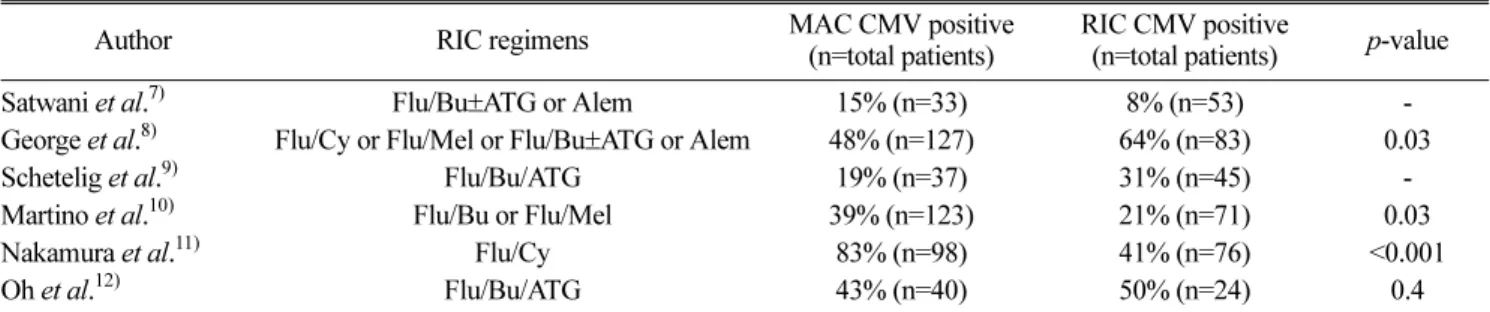
RIC was expected to carry a lower risk of infection, including CMV, due to a shorter duration of neutrope- nia. 7) However, precedent studies show contradictory data for the incidence of CMV infection (Table 1). 7-12) These results, in part, may be associated with differ- ences in the type of conditioning, patients chosen in the analysis and the use of T-cell depleting agents such as alemtuzumab and antithymocyte globulin (ATG). 7-12)
Therefore, we studied the incidence of CMV infec- tion and disease after allogeneic HSCT following MAC or RIC in our institution and the risk factors for CMV infection were identified.
MATERIALS AND METHODS
Patient Characteristics
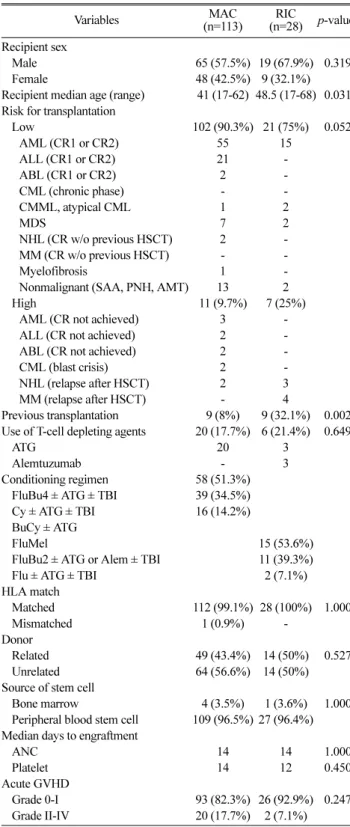
We compared outcomes of 141 adult patients who underwent allogeneic HSCT using either a RIC or a MAC at the Samsung Medical Center between January 2007 and December 2009. The data were collected from the transplant database and individual medical records retrospectively. One hundred and thirteen patients (80.1%) underwent MAC-HSCT whereas 28 (19.9%) underwent RIC-HSCT during the study period and their characteristics were not significantly different except for patient's age and previous transplant history.
The median age of RIC group (48.5 years) was signifi- cantly higher compared with MAC group (41 years;
p=0.031) and a higher proportion of patients in RIC were previously transplanted (32.1% vs 8%; p=0.002).
Transplantation risk was classified into two groups. The
low-risk transplantation group contained: acute myelog- enous leukemia (AML) or acute lymphocytic leukemia (ALL) in first or second complete remission (CR1 or CR2), chronic myelogenous leukemia (CML) in chronic phase, myelodysplastic syndrome (MDS), lymphoma or multiple myeloma (MM) in CR without previous autol- ogous transplantation, and nonmalignant diseases. The high-risk group was defined as the remaining patients not classified in the low-risk group. CMV serologic sta- tus of recipient and donor is considered to be the most important factor for CMV infection following transplan- tation, however, we did not analyze CMV serostatus in two groups as most Korean adults are seropositive. 13-14) Patient characteristics are summarized in Table 2.
Conditioning Regimens
Conditioning regimens were categorized by criteria used by the Center for International Blood and Marrow Research (CIBMTR) and the National Marrow Donor Program. 15-16) MAC regimens included fludarabine (180 mg/m 2 ), busulfan (12.8 mg/kg) ± ATG (4.5 mg/
kg) ± total body irradiation (TBI; 400 cGy) or busulfan (12.8 mg/kg), cyclophosphamide (120 mg/kg) ± ATG (7.5 mg/kg) or cyclophosphamide (120-200 mg/kg) ± ATG (4.5-10 mg/kg) ± TBI (500-999 cGy). RIC regi- mens consisted of fludarabine (125 mg/m 2 ), melphalan (140 mg/m 2 ) or fludarabine (180 mg/m 2 ), busulfan (6.4 mg/kg) ± ATG (4.5 mg/kg) / alemtuzumab (60 mg) ± TBI (400 cGy) or fludarabine (180 mg/m 2 ) ± ATG (7.5 mg/kg) ± TBI (400 cGy).
Table 1. Comparative Data of CMV Infection in MAC and RIC Transplants.
Author RIC regimens MAC CMV positive
(n=total patients)
RIC CMV positive
(n=total patients) p-value
Satwani et al.
7)Flu/Bu±ATG or Alem 15% (n=33) 8% (n=53) -
George et al.
8)Flu/Cy or Flu/Mel or Flu/Bu ±ATG or Alem 48% (n=127) 64% (n=83) 0.03
Schetelig et al.
9)Flu/Bu/ATG 19% (n=37) 31% (n=45) -
Martino et al.
10)Flu/Bu or Flu/Mel 39% (n=123) 21% (n=71) 0.03
Nakamura et al.
11)Flu/Cy 83% (n=98) 41% (n=76) <0.001
Oh et al.
12)Flu/Bu/ATG 43% (n=40) 50% (n=24) 0.4
Abbreviations: CMV=cytomegalovirus; MAC=myeloablative conditioning; RIC=reduced-intensity conditioning Flu=fludarabine; Bu=busulfan;
ATG=antithymocyte globulin; Alem=alemtuzumab; Cy=cyclophosphamide; Mel=melphalan.
Prophylaxis and Treatment of Graft-versus-Host Disease (GVHD)
Intravenous cyclosporine or tacrolimus combined with methotrexate (15 mg/m 2 i.v. on day 1, 10 mg/m 2 on D3, 6, and 11) was commonly used as GVHD pro- phylaxis. In cases of severe mucositis or elevated liver enzymes, methotrexate was discontinued and mycophe- nolate mofetil or methylprednisolone were used. If acute GVHD was diagnosed on tissue biopsy, methylpred- nisolone was given first. In patients who were steroid refractory, second line drugs such as mycophenolate mofetil, azathioprine, etanercept, rituximab, infliximab or ATG were used. These drugs, mainly steroids or cal- cineurin inhibitors, were also used in the treatment of chronic GVHD.
Supportive Care
All patients received immunoglobulin at a dose of 0.5 g/kg on day 0. It was given biweekly for 3 months after HSCT and then monthly for the next 6 months.
Acyclovir 5 mg/kg i.v. every 8 hours was given for her- pes simplex virus (HSV) prophylaxis from day 1 until engraftment or mucositis resolved.
Definitions of CMV Infection and CMV Disease CMV infection was defined as isolation of the CMV virus or detection of viral proteins or nucleic acid in any body fluid or tissue specimen. 6) CMV antigenemia was diagnosed by blood pp65 antigen testing, CMV DNAemia by polymerase chain reaction (PCR), CMV viremia by shell vial culture and CMV disease by cul- ture or immunohistochemistry. Recurrent CMV infec- tion was defined as new detection of CMV infection in a patient who had a previously documented infection and who has not had virus detected for an interval of at least 4 weeks during active surveillance. 6) CMV disease was defined as the isolation of the CMV virus in involved tissue specimens along with evidence of end- organ disease. 6) CMV disease occurring after 100 days post HSCT was defined as late CMV disease. 17) CMV disease, especially gastrointestinal disease, could develop in the absence of CMV in blood. 18)
Table 2. Demographics and Clinical Characteristics.
Variables MAC
(n=113)
RIC
(n=28)
p-value
a Recipient sexMale 65 (57.5%) 19 (67.9%) 0.319
Female 48 (42.5%) 9 (32.1%)
Recipient median age (range) 41 (17-62) 48.5 (17-68) 0.031 Risk for transplantation
Low 102 (90.3%) 21 (75%) 0.052
AML (CR1 or CR2) 55 15
ALL (CR1 or CR2) 21 -
ABL (CR1 or CR2) 2 -
CML (chronic phase) - -
CMML, atypical CML 1 2
MDS 7 2
NHL (CR w/o previous HSCT) 2 -
MM (CR w/o previous HSCT) - -
Myelofibrosis 1 -
Nonmalignant (SAA, PNH, AMT) 13 2
High 11 (9.7%) 7 (25%)
AML (CR not achieved) 3 -
ALL (CR not achieved) 2 -
ABL (CR not achieved) 2 -
CML (blast crisis) 2 -
NHL (relapse after HSCT) 2 3
MM (relapse after HSCT) - 4
Previous transplantation 9 (8%) 9 (32.1%) 0.002 Use of T-cell depleting agents 20 (17.7%) 6 (21.4%) 0.649
ATG 20 3
Alemtuzumab - 3
Conditioning regimen 58 (51.3%) FluBu4 ± ATG ± TBI 39 (34.5%)
Cy ± ATG ± TBI 16 (14.2%)
BuCy ± ATG
FluMel 15 (53.6%)
FluBu2 ± ATG or Alem ± TBI 11 (39.3%)
Flu ± ATG ± TBI 2 (7.1%)
HLA match
Matched 112 (99.1%) 28 (100%) 1.000
Mismatched 1 (0.9%) -
Donor
Related 49 (43.4%) 14 (50%) 0.527
Unrelated 64 (56.6%) 14 (50%)
Source of stem cell
Bone marrow 4 (3.5%) 1 (3.6%) 1.000
Peripheral blood stem cell 109 (96.5%) 27 (96.4%) Median days to engraftment
ANC 14 14 1.000
Platelet 14 12 0.450
Acute GVHD
Grade 0-I 93 (82.3%) 26 (92.9%) 0.247
Grade II-IV 20 (17.7%) 2 (7.1%)
Abbreviations: AML=acute myelogenous leukemia; ALL=acute lymphocytic leukemia; ABL=acute biphenotypic leukemia; CML=chronic myelogenous leukemia;
CMML=chronic myelomonocytic leukemia; MDS= myelodysplastic syndrome;
NHL=non hodgkin's lymphoma; MM=multiple myeloma; SAA=severe aplastic anemia; PNH=paroxysmal nocturnal hemoglobinuria; AMT=amegakaryocytic thrombocytopenia; CR=complete remission; HSCT=hematopoietic stem cell transplantation; ATG= antithymocyte globulin; Alem=alemtuzumab; TBI=total body irradiation; Flu=fludarabine; Bu=busulfan; Cy=cyclophosphamide; Mel=melphalan;
GVHD= graft-versus-host disease.
a
Chi-square test or Fisher’s exact test was used for categorical variables; Mann-
Whitney test or Z-test was used for continuous variables.
CMV Preemptive Therapy
Ganciclovir was started when CMV virus was detected. Patients received ganciclovir at a dose of 5 mg/kg every 12 hours until surveillance tests were neg- ative, followed by 5 mg/kg every 24 hours for 1 to 2 weeks. For patients who failed to respond or developed cytopenia, foscarnet was given.
Outcomes and Statistical Analysis
The primary outcome that was analyzed in our study was probability of CMV infection. Chi-square test or Fisher's exact test for the analysis of categorical vari- ables and Mann-whitney test or Z-test for continuous variables were used to compare the characteristics of the 2 groups. A p-value <0.05 was considered statisti- cally significant. Probability of CMV infection was analyzed by Cox proportional hazard model. To deter- mine risk factors for CMV infection, univariate and multivariate Cox proportional hazard models were used to estimate hazard ratios and 95% confidence intervals (95% CI). Other outcomes analyzed and statistical anal- yses used in parentheses were as follows: median days to CMV infection and duration of CMV antigenemia (Su and Wei's test); recurrent CMV infection, CMV dis- ease, patient's overall survival (Cox proportional hazard model); late CMV disease (Z-test); initial and peak antigenemia level (Mann-Whitney test). We evaluated our data based on survival analysis where patients were censored at death, follow-up loss, subsequent transplan- tation and relapse. For patients who received more than 1 conditioning regimen during the study period, only the first transplantation was evaluated. GVHD was con- sidered a potential risk factor only if it occurred before CMV infection was diagnosed.
RESULTS
CMV Infection and CMV Disease
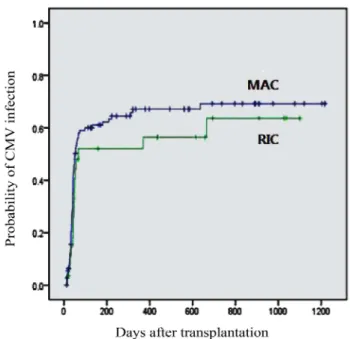
In 71 of 113 MAC transplants (62.8%) and in 16 of 28 RIC transplants (57.1%), CMV infection was detected ( p=0.310; Figure 1) at a median of 52 days (range: 14- 636) and 68 days (range: 12-666) post transplant, respec-
tively ( p=0.825). Among them, 23 in MAC (32.4%) and 5 in RIC (31.3%) had recurrent CMV infection ( p=0.982).
CMV antigenemia continued for 21 days (median, range:
0-217) in MAC and 16 days (median, range: 2-188) in RIC ( p=0.798). The median initial and peak level of CMV antigenemia in MAC was 3 (range: 1-600) and 14 (range: 1-620) compared to 7 (range: 1-720) and 7 (range: 1-720) in RIC ( p=0.164 and 0.746), respectively.
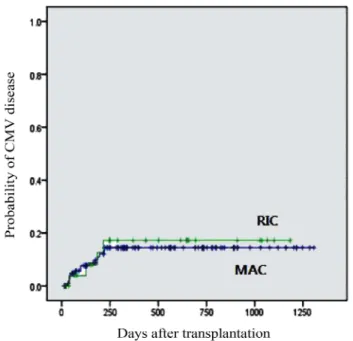
The probability of developing CMV disease was also not different between the two groups (12.4% in MAC and 14.3% in RIC transplants, p=0.785; Figure 2). Five patients with CMV colitis and 2 patients with CMV pneumonia were diagnosed as having CMV disease by confirming CMV in the tissue specimen but not in the blood. CMV colitis was the most common type in both groups (MAC, 7 and RIC, 3). Other types of CMV dis- ease were pneumonia (MAC, 5), retinitis (MAC, 2 and RIC, 1), enteritis (MAC, 1 and RIC, 1) and proctitis (MAC, 2). Two types of CMV disease were present at the same time in 3 MAC and 1 RIC transplants. Among patients who developed CMV disease, late CMV dis- ease occurred in 92.3% of MAC and in 96.2% of RIC ( p=0.397). Overall, there was no significant difference between the two groups (Table 3).
Fig. 1. Probability of CMV Infection in MAC and RIC.
Survival
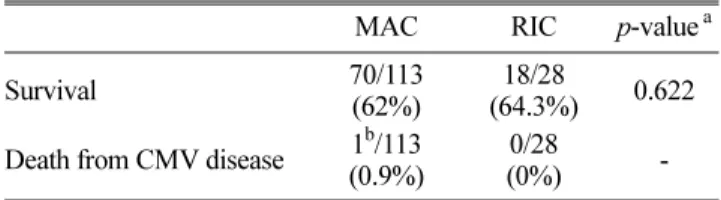
At the last follow up, 70 MAC (62%) and 18 RIC transplant recipients (64.3%) were alive ( p=0.622; Fig- ure 3). One patient in MAC died of CMV pneumonia despite antiviral therapy (Table 4). This patient was treated with ganciclovir and then switched to foscarnet because of cytopenia, however, ganciclovir was eventu- ally reinitiated due to foscarnet resistance.
Risk factors for CMV Infection
Univariate analysis identified grade II-IV acute GVHD was associated with the incidence of CMV infection (HR 1.944, 95% CI 1.136-3.326; p=0.015) (Table 5). In order to control disbalanced variables in both groups, multi- variate Cox proportional hazard analysis was performed (Table 5). Age (HR 1.024, 95% CI 1.002-1.045; p=0.031) and grade II-IV acute GVHD (HR 1.849, 95% CI 1.031- 3.315; p=0.039) were confirmed as independent risk fac- tors for CMV infection. The intensity of conditioning regimen (HR 0.650, 95% CI 0.352-1.199; p=0.168), risk of transplantation (HR 0.684, 95% CI 0.284-1.645;
p=0.396) and use of T-cell depleting agents (HR 1.111, 95% CI 0.606-2.034; p=0.734) did not have a significant impact on CMV infection.
DISCUSSION
Reduced-intensity conditioning (RIC) has been exten- sively investigated for patients who are not eligible for Fig. 2. Probability of CMV Disease in MAC and RIC.
Table 3. CMV Infection and Disease in MAC and RIC Transplants.
MAC RIC p-value
aCMV infection 71/113
(62.8%)
16/28
(57.1%) 0.310 Median days to infection
(range)
52 (14-636)
68
(12-666) 0.825 Recurrent CMV infection 23/71 (32.4%) 5/16 (31.3%) 0.982
CMV antigenemia 0.310
Duration (range) 21 (0-217) 16 (2-188) 0.798 Initial level (range) 3 (1-600) 7 (1-720) 0.164 Peak level (range) 14 (1-620) 7 (1-720) 0.746 CMV disease 14
a/113 (12.4%) 4
b/28 (14.3%) 0.785
Colitis 7 3
Pneumonia 5 -
Retinitis 2 1
Enteritis 1 1
Proctitis 2 -
Late CMV disease 92.3% 96.2% 0.397
a Statistical analyses: CMV infection, recurrent CMV infection, CMV disease (Cox proportional hazard model); Median days to infection, duration of CMV antigenemia (Su and Wei’s test); initial and peak antigenemia level (Mann-Whitney test); Late CMV disease (Z-test)
b Two patients developed CMV colitis/proctitis and one patient developed CMV colitis/enteritis at the same time.
c One patient developed CMV colitis/enteritis at the same time.
Fig. 3. Probability of Overall Survival in MAC and RIC.
conventional myeloablative conditioning (MAC). Since RIC regimen theoretically could shorten the period of pancytopenia and cause less damage to the mucocuta- neous barriers, reduced incidence of severe infections such as CMV post-HSCT was expected. Nonetheless, there are conflicting data on the incidence of CMV infection in RIC transplant patients. George et al. 8) in their study of 210 patients reported significantly higher incidence of CMV reactivation in CMV seropositive recipients who were given fludarabine-based RIC com- pared with MAC. This difference was independent of the presence of GVHD and additional use of T-cell depleting agents. Fludarabine, a potent T-cell immuno- suppressant, may be related to inadequate recovery of specific cellular immunity to CMV. Schetelig et al. 9) in their study of 45 RIC transplants showed a higher inci- dence of CMV reactivation when RIC consisted of flu- darabine, busulfan and ATG. However, the difference between these groups was not statistically significant.
On the other hand, Martino et al. 10) in their study of 194 patients showed a significantly lower incidence of CMV infection in patients following RIC with fludara- bine plus busulfan or melphalan. ATG was not included
in their RIC regimen protocols and this may partly explain the lower incidence of CMV infection. The use of T-cell depleting agents such as ATG or alemtuzumab are known to delay CMV-specific immune reconstitu- tion. 19-20) Nakamura et al. 11) in their study of 174 patients reported a significantly lower incidence of CMV infection after RIC using fludarabine and cyclo- phosphamide compared with MAC. In this study, how- ever, all patients in MAC group had T-cell depleted grafts that may partly explain this result.
In our study, there was no significant difference in the incidence of CMV infection and disease between the MAC and RIC groups. Median days to CMV infection, duration of CMV antigenemia, overall survival, and ini- tial/peak level of antigenemia, which is considered a strong determinant of time to develop CMV-related complications and the severity of CMV disease 21) , were not different between groups. As expected from prece- dent studies, univariate analysis of our data indicated that grade II–IV acute GVHD could be a significant risk factor for CMV infection and this finding was con- firmed by multivariate analysis where older age was found to be another risk factor. RIC may have reduced the duration of pancytopenia compared with MAC, but the use of immunosuppressive agents or reconstitution of CMV-specific cellular immunity is considered to be more associated with CMV infection. Several studies presented that not only T-cell depletion of the graft and the addition of T-cell depleting agents reduced the risk of acute GVHD, but also impaired immune reconstitu- tion; this has been shown to be associated with a higher Table 4. Survival in MAC and RIC Transplants.
MAC RIC p-value
aSurvival 70/113
(62%)
18/28
(64.3%) 0.622 Death from CMV disease 1
b/113
(0.9%)
0/28
(0%) -
aProbability was estimated with Cox proportional hazard model.
bCMV pneumonia
Table 5. Univariate and Multivariate Analysis of Risk Factors for CMV Infection.
Variables Univariate HR (95% CI) p-value Adjusted HR (95% CI) p-value
aRecipient Sex (Female) 0.904 (0.589-1.389) 0.646 0.948 (0.602-1.493) 0.818
Recipient Age 1.016 (0.998-1.034) 0.074 1.024 (1.002-1.045) 0.031
Unrelated donor 0.779 (0.551-1.189) 0.247 0.811 (0.518-1.269) 0.360
Stem cell source (PBSC) 0.769 (0.243-2.437) 0.656 0.671 (0.196-2.304) 0.526
Risk of transplantation (High) 0.669 (0.323-1.385) 0.279 0.684 (0.284-1.645) 0.396
Previous transplantation 0.974 (0.529-1.792) 0.932 1.519 (0.695-3.321) 0.294
Conditioning regimen (RIC) 0.755 (0.438-1.299) 0.310 0.650 (0.352-1.199) 0.168
T-cell depleting agents 0.918 (0.526-1.601) 0.763 1.111 (0.606-2.034) 0.734
Acute GVHD (grade II-IV) 1.944 (1.136-3.326) 0.015 1.849 (1.031-3.315) 0.039
a Cox proportional hazard model was used to detemine risk factors.