서 론
생기능의학은 心身을 여러 기능 중심으로 한의학 적 관점에서 평가하고 관리함으로써 未病 관리 및 건 강증진을 목적으로 하는 임상의학이다.
1)인체 기능 평가지표중 하나인 맥파는 대동맥판이 폐쇄됨과 동 시에 대동맥으로부터 말초동맥을 따라 형성되는 일
종의 파동으로서, 검출방법에 따라 압맥파 (pressure wave)와 광용적맥파 (PPG; photoplethysmograph)로 분류된다. 맥파는 동맥경화가 진행될 경우 파형이 변 화하므로, 심혈관계 질환의 중요한 선행지표중 하나 로 인식되고 있다.
2)특히, 광용적맥파의 원래 파형을 이차 미분함으로써 얻어지는 가속도맥파 (SDPTG : second derivative of photoplethysmograph)는 맥파
광용적맥파와 SF-36을 이용한 여성의 삶의 질 관계 연구
장영훈1, 박영재1,2*
1경희대학교 대학원 한방 인체정보의학과, 2경희대학교 한의과대학 진단 ․ 생기능의학과 Original Article
⋅Received:25 October 2019 ⋅Revised:22 May 2020 ⋅Accepted:25 May 2020
⋅Correspondence to:박영재
경희대학교 한의과대학 진단 생기능의학과
Tel:+82-2-440-7229, E-mail:[email protected]
A Study on the Correlation between the Second Derivative of Photoplethysmogram and Quality of Life using SF-36 Questionnaire in Women
Young-Hun Jang1, Young-Jae Park1,2*
1Department of Human Informatics of Korean Medicine, Graduate School, Kyung Hee University,
2Department of Biofunctional Medicine and Diagnostics, College of Korean Medicine, Kyung Hee University Background and Objectives: The purpose of this study was to examine the relationship between between one’s quality of life (QoL) level and the arterial stiffness estimated by the second derivative of photoplethysmogram (SDPTG) for women patients.
Methods: A retrospective chart review was performed on charts of 407 women patients (38.38±11.82 years) who visited Gangdong Kyung Hee Hospital between April 1st and September 30th, 2011. Vascular aging index (VAI, (b-c-d)/a), b/a, c/a, and d/a were considered as the arterial stiffness indexes, and the Korean version of the Short-Form 36 (SF-36) were completed to estimate one’s physical and mental QoL.
Results: Physical and mental components of the SF-36 in older group (50, 60, and 70 years-group) were lower than those in younger group (20 and 30 years-group). Large arterial stiffness-related b/a in older group was higher that in younger group, while small arterial stiffness-related d/a in older group was lower that in younger group. Physical and mental component scores of the SF-36 had the negative correlations with VAI and b/a (r; -0.153~-0.195), while had the positive correlations with c/a and d/a (r; 0.147~0.228).
Conclusions: In conclusion, this study suggests that convenient and cost-effective SDPTG test may serve as an auxiliary tool to estimate one’s physical and mental QoL.
Key Words : second derivative of photoplethysmogram, SF-36, quality of life
파형 분석에 용이하므로 임상에서 널리 사용되고 있다.
PPG는 광센서를 통해서 피부 근처에 분포하는 모 세혈관들의 시간에 따른 혈액 용적변화를 기록한다.
비침습적이고 생체신호 검출의 용이성이 있어서 연 관된 다양한 연구가 진행되고 있다. 공중보건분야에 서는 운동요법 이후의 심혈관 기능을 비교하는 용도 로 사용된 바 있으며
3), 광용적맥파 신호를 이용하여 수면중 호흡 모니터링의 가능성을 찾는 연구가 진행 되었다.
4)PPG의 파형지표로부터 새로운 통증평가 지표를 도출하여 수술 후 및 마취상태에서의 통증 평가도구로 제안되었다.
5)전통의학 분야에서도 다양 하게 응용연구가 진행되었는데, Kampo 의학에서는 한약이 생리전증후군에 미치는 효과를 알기 위한 평 가지표로 사용되었으며
6), 한약이 중풍환자의 동맥경 직도 및 맥압에 미치는 영향을 측정하는 기준으로 사용되었고
7), 중풍 표준화변증과 상관성에 대한 연 구도 진행되었다.
8)또한 광용적맥파센서의 크기가 소형이라는 점, 피부 근처에서 비침습적으로 측정할 수 있다는 검출방법의 용이성과 건강에 대한 관심으 로 귀걸이 반지 모양 등 기존의 형태와 다른 다양한 형태의 웨어러블 디바이스로 개발하는 시도가 진행 되었다.
9,10)현대사회에서 행복과 복지에 대한 관심이 늘어나 면서 삶의 질은 중요한 주제가 되고 있다. 세계보건 기구에서는 삶의 질(quality of life: QoL) 이란 “한 개인이 살고 있는 문화권과 가치체계의 맥락 안에서 자신의 목표, 기대, 규범, 관심과 연관되어 자신이 차 지하는 위치에 대한 개인적인 견해”로 정의한다.
11)건강관련 삶의 질은 건강, 질병, 재해, 이로 인한 증 상, 증후, 치료부작용 사회적 기능 등에 의해 직접적, 간접적으로 영향을 받는 삶의 전반적인 구성을 포괄 하며, 보건의료의 결과로서의 건강상태를 측정하는 데 사용된다.
12)삶의 질을 측정하는 도구중 Short Form-36 (SF-36) 설문지가 널리 활용되고 있는데, SF-36은 삶의 질을 측정하는 36개의 문항으로 구성
되어 있으며 신체적기능, 사회적기능, 신체적 역할 제한, 감정적 역할 제한, 정신 건강, 활력, 통증, 일반 건강의 8개 범주로 분류된다.
13)우리나라에서도 한국 판SF-36의 신뢰도와 타당도가 검정되었으며
14), 노인, 청소년, 여성 등 다양한 계층에 대한 삶의 질에 대한 연구에 활용되었고, 산업재해 및 우울증 뇌졸중과 삶 의 질간 관계 연구도 보고되었다.
15-17)한의학에 있어 서는, 삶의 질과 어혈과의 연구 및 전침치료 후 환자 의 만족도 변화 등의 연구가 보고되었다.
18,19)García-Ortiz 등은 동맥경화지표의 일종인 cardio -ankle vascular index(CAVI)의 증가와 삶의 질 저하 간 연관성을 보고하였다.
20)그런데 아직까지 SDPTG 지표와 삶의 질간의 연구는 보고되지 않았다. 이에 본 연구에서는 여성에 있어서 SDPTG 지표와 삶의 질간 연관성을 분석, 일정한 의의를 도출하였기에 이 를 보고하는 바이다.
연구대상 및 방법 1. 연구대상
본 연구는 2011년 4월 1일부터부터 2011년 9월 30일까지 강동 경희대학교 한방병원 여성건강클리닉 을 방문한 여성 환자 407명(38.38±11.82 years)을 대 상으로 하였다. 본 연구에 관한 모든 사항은 강동경 희대학교 의료기기 임상시험 심사위원회에서 심의, 승인을 받은 후 시행하였다 (KHNMC MD IRB 2011-008). SDPTG지표에 영향을 줄 수 있는 질환, 즉 부정맥 등의 심조율 이상, 자율신경계 질환의 병 력, 자율신경계에 영향을 줄 수 있는 약물을 복용하 고 있는 경우는 chart review에서 배제하였다.
2. 연구방법
1) 삶의 질 설문(SF-36)
여성 환자들은 SDPTG 검사 당일 SF-36 설문지를
함께 작성하였다. SF-36는 36문항으로 된 환자보고
식 설문지로서, 8개 하위 그룹(subgroup)으로 구성되
어 있다. 각 하위그룹 문항은 증상 발현의 빈도와 정 도에 따라 Likert 척도로 답변한다. 8개 하위그룹은 신체기능(physical function; PF), 신체적 역할제한 (role limitation due to physical health problems RP), 신체적 통증(bodily pain; BP), 종합건강(general health; GH), 활력(vitality; VT), 사회적 기능(social function; SF), 정신적 역할 제한(role limitation due to physical emotional problems RE), 정신건강 (mental health: MH)의 8개로 구성되어 있으며, 그룹 에 따라 문항수가 다르게 책정되어 있다. 문항별로 점수를 합산하며, 수치가 높을수록 각 하위범주의 삶 의 질이 양호한 것으로 해석한다. 8개의 하위그룹중 PF, RP, BP, GH 합산점수는 육체적 삶의 질 (physical QoL) 평가항목이며, VT, SF, RE, MH 합 산점수는 육체적 삶의 질(mental QoL) 평가항목이다.
2) 생기능 검사
피검자는 SDPTG 검사 전 24시간 이내 담배, 아스 피린, 커피, 녹차, 알코올 섭취와 혈관운동성에 영향 을 미치는 약물의 복용을 피하고, 48시간 이내에는 자율신경에 영향을 주는 약물의 복용을 금하였다. 검 사 전 22-24°C의 조용한 방안에서 피검자는 안정되 고 편안한 상태에서, 10분 이상 휴식하여 안정을 취 한 후 각각의 생체신호를 측정하였다.
SDPTG 측정은 SA-3000P (Medicore Co., Seoul, Korea)을 이용해 90초간 좌측 식지에서 PPG 신호를 취득했다. PPG 신호는 장비를 통해 이차미분이 수행 되며, SDPTG 지표가 자동으로 산출된다. SDPTG 맥파 파형은 총 5개의 peak, 즉 a, b, c, d, e peak를 도출하며, 이중 a, c, e는 positive peak이며 b, d는 negative peak이다. 그런데 SA-3000P의 경우 e peak 를 산출하지 않으며, 본 연구에서는 b/a, c/a, d/a를 분석에 활용하였다. 혈관노화지표(vascular aging index; VAI) 역시 e값을 제외한 (b-c-d)/a를 활용하였 다. SDPG 지표중 b/a는 혈관상태가 양호할수록 절 대값이 크며 대동맥 혈관의 경화도를 반영하는데 비
해, d/a는 혈관상태가 양호할수록 절대값이 작으며 말초동맥 혈관의 경화도를 반영한다. c/a지표는 동맥 경화가 진행될수록 d/a처럼 절대값이 커지는 양상을 나타낸다.
3) 통계
통계분석용 프로그램은 SPSS 21 (SPSS Inc., Chicago, IL, USA)를 이용하였다. 삶의 질 설문점수와 생기능검사 지표의 상관관계는 Pearson’s Correlation 을 사용하여 분석하였다. 연령분포에 따른 SF-36 지 표들과 SDPTG 지표들의 차이가 있는지 one-way ANOVA를 통해 살펴보았으며, 만일 차이가 있다면 Duncan 사후 분석법을 실시하였다. 모든 분석에서 p<0.05인 경우를 통계적으로 유의한 것으로 판정하 였다.
연구결과
전체 여성 연령의 평균 및 표준편차는 38.38±11.82 세였다. 10-19세는 14명, 20-29세는 78명, 30-39세는 150명, 40-49세는 86명, 50-59세는 60명, 60-69세는 15명 70-79세는 4명이었다. 연구 대상자의 연령에 따른 SF-36의 physical component와mental component 관련 기술통계량 및 연령분포에 따른 각 지표 차이 는 Table 1과 Table 2에 각각 제시하였다. Physical component의 경우 연령분포에 따라 모든 지표들의 차이가 나타났으며, 나이의 증가에 따라 육체적 측면 에서의 삶의 질은 감소하였다. Mental component의 경우 RE와 mental component 총점수가 연령에 따른 차이를 나타냈으며, VT, SF, MH는 연령별 차이를 나타내지 않았다.
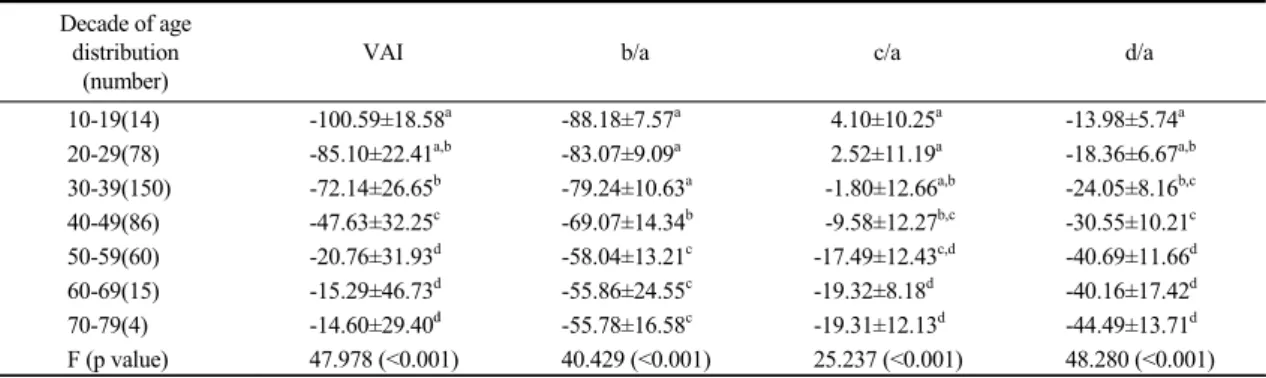
연구 대상자의 연령에 따른 SDPTG 지표 기술 통
계량 및 각 지표내 ANOVA분석결과를 Table 3에
제시하였다. VAI, b/a, c/a 및 d/a는 연령구간별 유의
미한 차이를 나타냈다 (P value <0.001). Duncan 사
Table 1. Descriptive statistics of the physical components of the SF-36 and differences in the physical components by decade of age distribution
Decade of age
distribution (number) PF RP BP GH Total scores of the
physical subscales 10-19 (14) 88.57±11.67a 76.78±20.72a 67.43±17.87a 50.71±14.7a 283.50± 47.17a 20-29 (78) 83.33±17.22a,b 74.36±44.86a,b 66.41±28.64a 49.04±16.9a 273.14±82.77a,b 30-39 (150) 76.17±19.78a,b,c 56.83±38.09a,b,c 55.3±28.24a,b 44.00±17.4a 232.34±84.77a,b,c 40-49 (86) 73.49±21.78b,c 50.29±40.67a,b,c 51.93±27.17a,b 41.34±16.2a 217.05±83.52b,c 50-59 (60) 66.17±20.26c,d 38.75±39.44c 48.17±25.26a,b 39.33±17.77a 192.42±77.77c,d 60-69 (15) 72.00±22.35b,c 45.00±41.40b,c 44.60±25.62b 45.67±17.30a 207.27±82.21c,d 70-79 (4) 53.75±17.97d 18.75±23.94d 37.25±27.49b 38.75±25.29a 148.50±66.26d F (p value) 6.392 (<0.001) 6.350 (<0.001) 4.188 (<0.001) 2.661 (0.015) 7.924 (<0.001) PF; physical function), RP; role limitation due to physical health problems, BP; bodily pain, GH; general health. . a, b, c,; age decade group where a specific score was determined to be homogeneous, through Duncan posthoc test. For example, RP scores of “10-19”, “20-29”, “30-39”, and “40-49” age groups are homogeneous, while RE values of “20-29”, “30-39”, “40-49”, and “60-69” age groups are homogeneous.
Table 2. Descriptive statistics of the mental components of the SF-36 and differences in the mental components by decade of age distribution
Decade of age
distribution (number) VT SF RE MH Total scores of the
mental subscales
10-19(14) 54.29± 11.91 83.29±18.60 81.00± 25.24a 38.57± 13.00 257.15±28.83a
20-29(78) 56.60±17.63 68.35± 24.89 72.68±36.00a,b 41.95±18.11 239.58±41.39a,b
30-39(150) 62.17±19.16 67.02±24.79 64.03±39.89a,b 46.21±19.66 239.43±44.95a,b
40-49(86) 57.97±17.68 64.88±23.32 53.48±46.12a,b,c 41.12±18.78 217.44±46.75b,c
50-59(60) 58.17±20.67 65.25±20.79 53.88±43.47b,c 38.93±17.86 216.23±46.67b,c
60-69(15) 62.33±21.78 71.07±26.92 44.40±44.87b,c 41.07±22.75 218.87±53.77b,c
70-79(4) 55.00±12.91 75.25±10.21 24.75±16.50c 41.00±10.52 196.00±39.18c
F (p value) 1.241 (0.197) 1.444 (0.197) 3.485 (0.002) 1.533 (0.166) 5.143 (<0.001) VT; vitality, SF; social function, RE; role limitation due to physical emotional problems, MH; mental health. a, b, c,; age decade group where a specific score was determined to be homogeneous, through Duncan posthoc test. For example, RE scores of “10-19”, “20-29”, “30-39”, and “40-49” age groups are homogeneous, while RE values of “20-29”, “30-39”, “40-49”, “50-59”, and “60-69” age groups are homogeneous.
Table 3. Descriptive statistics of the SDPTG parameters and differences in the SDPTG parameters by decade of age distribution
Decade of age distribution
(number)
VAI b/a c/a d/a
10-19(14) -100.59±18.58a -88.18±7.57a 4.10±10.25a -13.98±5.74a
20-29(78) -85.10±22.41a,b -83.07±9.09a 2.52±11.19a -18.36±6.67a,b
30-39(150) -72.14±26.65b -79.24±10.63a -1.80±12.66a,b -24.05±8.16b,c
40-49(86) -47.63±32.25c -69.07±14.34b -9.58±12.27b,c -30.55±10.21c
50-59(60) -20.76±31.93d -58.04±13.21c -17.49±12.43c,d -40.69±11.66d
60-69(15) -15.29±46.73d -55.86±24.55c -19.32±8.18d -40.16±17.42d
70-79(4) -14.60±29.40d -55.78±16.58c -19.31±12.13d -44.49±13.71d
F (p value) 47.978 (<0.001) 40.429 (<0.001) 25.237 (<0.001) 48.280 (<0.001) VT; vitality, SF; social function, RE; role limitation due to physical emotional problems, MH; mental health. a, b, c,; age decade group where a specific score was determined to be homogeneous, through Duncan posthoc test. For example, RE scores of “10-19”, “20-29”, “30-39”, and “40-49” age groups are homogeneous, while RE values of “20-29”, “30-39”, “40-49”, “50-59”, and “60-69” age groups are homogeneous.
후분석시 대략적으로10대, 20대, 30대가 하나의 군 을 형성하고, 50대, 60대, 70대가 하나의 군을 형성 했다.
연구 대상자의 SF-36의 최소값 최대값 평균 표준 편차 기술 통계량은 Table 4에 제시하였다.
연구 대상자의 SDPTG 지표 최소값, 최대값, 평균, 표준편차의 기술 통계량은 Table 5에 제시하였다.
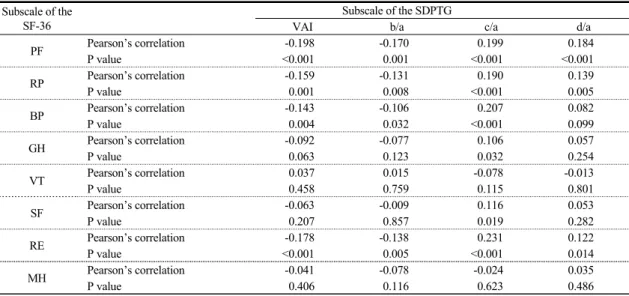
SF-36의 physical, mental component 점수와 SDPTG 지표간 상관관계를 분석한 결과, 두 가지 component 점수가 높을수록 VAI와 b/a는 낮았으며, c/a와 d/a는 높게 나타났다 (Table 6). SF-36 8개 하위그룹 점수 와 SDPTG 지표간 상관관계 분석시, PF와 RP는
physical component 점수처럼 VAI와 b/a간 음의 상 관관계를, c/a와 d/a간 양의 상관관계를 나타냈다.
BP는 VAI와 b/a간 음의 상관관계를, c/a와 양의 상 관관계를 나타냈다. GH는 c/a와 양의 상관관계를 나 타냈다. Mental component중 RE는 VAI, b/a와 음의 상관관계를, c/a와 d/a간 양의 상관관계를 나타냈다.
SF는 c/a와 양의 상관관계를 나타냈다. 그런데 VT와 MH는 SDPTG 지표와 상관성을 나타내지 않았다.
고 찰
현대 사회에서 삶의 질은 다양한 분야에서 연구되 고 있다. 행복한 삶을 위해 삶의 상태를 개선 증진시
Table 4. Descriptive statistics of the SF-36 subscales
SF-36 Subscale Minimum Maximum Mean ± SD
PF 5 145.00 75.56± 20.48
RP 0 300.00 56.02 ± 41.38
BP 0 123.00 55.53 ± 27.93
GH 0 90.00 43.96 ± 17.33
VT 5 100.000 59.29 ± 18.70
SF 0 100.00 67.35 ± 23.85
RE 0 167.00 61.44 ± 41.56
MH 0 100.00 42.74 ± 18.89
PF; physical function), RP; role limitation due to physical health problems, BP; bodily pain, GH; general health, VT; vitality, SF; social function, RE; role limitation due to physical emotional problems, MH; mental health.
Table 5. Descriptive statistics of the SDPTG parameters
SDPTG Parameter Minimum Maximum Mean ± SD
VAI -145.34 125.82 -60.19± 37.43
b/a -109.23 22.10 -73.92± 15.53
c/a -48.42 39.90 -5.54± 14.06
d/a -91.44 -3.88 -27.23± 12.27
VAI; vascular age index.
Table 6. Correlations between SDPTG parameters and physical and mental subscales of the SF-36 (n=407)
SF-36 Subscale of the SDPTG
VAI b/a c/a d/a
Physical component Pearson’s correlation -0.188 -0.153 0.228 0.148
P value <0.001 0.002 <0.001 0.003
Mental component Pearson’s correlation -0.195 -0.155 0.226 0.147
P value <0.001 0.002 <0.001 0.003
VAI; vascular age index. Bold numbers indicate significant Pearson’s correlation.
키고자 하는 인간의 노력은 삶의 질에 대한 관심으 로 이어진다. 삶의 질은 특히 생명 과학 분야에서 많 은 관심을 가지고 연구되었다. 환자는 자신이 받고 있는 치료의 질적 측면을 평가하고 개선하고자 하며 이에 대한 검증을 원한다. 제약회사는 환자 상태를 개선하는데 어떤 약물이 가장 유효한지 결정하고자 하며, 의사도 환자의 삶의 질을 더욱 개선시키려 한 다. 한 국가에 있어서 삶의 질에 대한 자료는 건강 자 원을 효율적으로 배치하는데 중요한 의미가 있다.
21)의학에서는 건강과 관련된 삶의 질 개념이 생겼다.
전체 인구의 평균 수명이 증가하면서 오랜 치료 기 간이 필요한 만성 질환의 치료에 많은 관심이 집중 되었다. 환자들은 단순하게 생존을 원하는 게 아니라 생생하게 살아가기를 원하게 되었으며, 만성적인 질 환이 가족, 보건 체계와 사회에 부담이 되어가는 배 경에서 이런 질환의 영향을 평가하기 위해 건강관련 삶의 질은 발전되어 왔다.
22)건강관련 삶의 질은 기저에 건강의 정의를 가정으 로 하고 있다. 건강은 단순히 질병이 없거나 병약하
지 않은 상태가 아니라 완전한 신체적, 정신적, 사회 적 안녕 상태를 말한다.
1)최근에는 건강과 질병은 명 확히 구분될 수 있는 이질적 개념이라기 보다는, 일 직선상에 위치한 연속적 개념이라는 인식이 주목받 고 있다. 이런 인식을 바탕으로 건강저하 상태이지만 아직 특정 질환은 아닌 상태, 즉 미병 단계에서의 건 강증진방안이 주목받고 있다. 건강증진을 위해 삶의 질을 평가하고 관리하는 것이 중요시된다. 건강관련 삶의 질을 측정하기 위해서 제작된 설문지가 SF-36 이며 PF, RP, BP, GH, VT, SF, RE, MH의 총 8개 하위 범주로 구성되어있다.
여성 환자를 대상으로 살펴본 본 연구 결과, SF-36 으로 평가한 삶의 질 척도는 연령분포별 유의미한 차이를 나타냈으며, 연령이 증가함에 따라 삶의 질은 저하하는 양상을 나타냈다. 특히 육체적 삶의 질이 정신적 삶의 질에 비해 연령에 따른 저하 양상이 두 드러졌다. 그런데 육체적, 정신적 삶의 질 총 점수는 모두 유의미한 연령별 차이를 나타냈으므로 임상에 서는 육체적 삶의 질과 더불어 정신적 삶의 질 역시
Table 7. Correlations between SDPTG parameters and the SF-36 subscales (n=407) Subscale of the
SF-36
Subscale of the SDPTG
VAI b/a c/a d/a
PF Pearson’s correlation -0.198 -0.170 0.199 0.184
P value <0.001 0.001 <0.001 <0.001
RP Pearson’s correlation -0.159 -0.131 0.190 0.139
P value 0.001 0.008 <0.001 0.005
BP Pearson’s correlation -0.143 -0.106 0.207 0.082
P value 0.004 0.032 <0.001 0.099
GH Pearson’s correlation -0.092 -0.077 0.106 0.057
P value 0.063 0.123 0.032 0.254
VT Pearson’s correlation 0.037 0.015 -0.078 -0.013
P value 0.458 0.759 0.115 0.801
SF Pearson’s correlation -0.063 -0.009 0.116 0.053
P value 0.207 0.857 0.019 0.282
RE Pearson’s correlation -0.178 -0.138 0.231 0.122
P value <0.001 0.005 <0.001 0.014
MH Pearson’s correlation -0.041 -0.078 -0.024 0.035
P value 0.406 0.116 0.623 0.486
VAI; vascular age index, PF; physical function), RP; role limitation due to physical health problems, BP; bodily pain, GH; general health, VT;
vitality, SF; social function, RE; role limitation due to physical emotional problems, MH; mental health. Bold numbers indicate significant Pearson’s correlation.