Agric. Chem. Biotechnol. 49(3), 114-116 (2006)
Short Communication Production of 5,7-dihydroxy, 3',4',5'-
trimethoxyflavone from 5,7,3',4',5'- Pentahydroxyflavone Using two O - methyltransferases Expressed in
Escherichia coli
Jeong Ho Kim, Bong Gyu Kim, Younghee Park, Jin Hee Han, Yoongho Lim and Joong-Hoon Ahn*
Division of Bioscience and Biotechnology, Bio/Molecular Informatics Center, Konkuk University, Seoul 143-701, Korea
Received June 27, 2006; Accepted August 18, 2006 Key words: Flavonoids, O-methyltransferases
Flavonoids are derivatives of 1,3-diphenylpropan-1-one which derives from malonyl-CoA and p-courmaroyl-CoA.1) In plants, biosynthetic enzymes of flavonoids have been characterized well and corresponding genes were cloned from various plants.2) Based on their roles in the flavonoid biosynthesis, they could be classified into two groups; the first group is involved in the backbone of flavonoid such as chalcone synthetase, chalcone isomerase and flavone synthase and the second group contains genes involved in modification reactions such as hydroxylation, O-methylation, and glycosylation.3) The genes in the second group are diverse, which reflects on the structural diversity of flavonoids. Naringenin, one of the starting flavonoids in the flavonoid pathway serves as a starting material in the synthesis of diverse of flavonoids. In addition, the genes in the second group could be utilized for in vitro modification of basic flavonoids.
Biological effects of flavonoids on human health are as diverse as their structures. They serve as antioxidants, radical scavengers, antimutagens, anti-inflammatory and anticarcinogenic agents.4,5) Lists of their biological activities will be extended if large amounts of flavonoids could be provided to study their activities. Some of flavonoids that have significant impacts on human health have been extracted from plants or synthesized chemically. However, extraction from plant sometimes does not provide the amount of materials we needed. On the other hand, chemical synthesis of specific flavonoid could be hindered by regioselectivity or enantioselectivity. In contrast, enzymatic modification of flavonids from simple starting materials such as naringenin and quercetin or from less expensive flavonoid(s) could be an alternative to circumvent these problems.6,7)
Tricetin (5,7,3',4',5'-pentahydroxylflavone) is one of the rare flavonoids found in the Myrtaceae pollen and Eucalyptus
honey;8.9) also, its 3',4',5'-trimethyl ether of tricetin is rarely found in nature. Two O-methyltransferases, SOMT-2 (soybean
O-methyltransferase 2)10) and ROMT-9(rice O-methyltransferase 9)11) were used to produce 5,7-dihydroxy-3',4',5'-tirmethoxyflavone from tricetin. Transgenic E.coli expressing SOMT-2 transferred a methyl group to 4'-hydroxyl group of flavonoids. ROMT-9 transferred a methyl group to 3'-hydroxyl group of flavonoids if only 3'-hydroxyl group is available, and transferred methyl groups into both 3'- and 5'-hydroxyl groups if both are available.
We tested whether the E. coli expressing both SOMT-2 and ROMT-9 could regioselectively produce 5,7-dihydroxy-3',4',5'- trimethoxyflavone from tricetin. Whole cells expressing ROMT-9 and SOMT-2 were used. This approach, called biotransformation, does not need the purification of the expressed enzyme; also it could save some cofactors, which could be supplied from the host itself. The E. coli
transformant containing both ROMT-9 and SOMT-2 was grown in LB containing 50µg ampicillin/ml and ROMT-9 and SOMT-2 were induced as described in Kim et al.
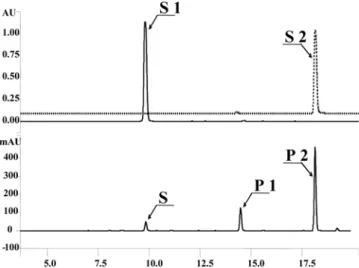
(2005).10) After adding tricetin at 100µM, the mixture was shaken at 28oC for 8 hrs. The culture filtrate was extracted twice with ethylacetate and the organic layer was evaporated to dryness. The resulting reaction products were analyzed by high performance liquid chromatography. As shown in Figure 1, culture filtrate revealed three peaks (S1, P1, and P2). S1 had the same retention time as those of substrate, tricetin. P2 had the same retention with that of authentic 5,7-dihydroxy- 3',4',5'-trimethoxyflavone. P1 showed the same retention time with that of reaction product from ROMT9 and was suspected
*Corresponding author
Phone: 82-2-450-3764; Fax: 82-2-3437-6106 E-mail: [email protected]
Fig. 1. HPLC analysis of tricetin reaction product. S1, authentic tricetin; S2, authentic 5,7-dihydroxy, 3',4',5'-trimethox- yflavone; S, substrate tricetin; P1, product 2 (5,7,4'-trihydroxy, 3',5'-dimethoxyflavone); P2, reaction product (5,7-dihydroxy, 3',4',5'-trimethoxyflavone)
Regioselective O-methylation of tricetin using two O-methyltransferases 115
as the reaction intermediate, 5,7,4'-trihydroxy-3',5'-dimethoxy- flavone. In order to identify the structure of P1 and P2, nuclear magnetic resonance (NMR) spectroscopy was carried out; P1 and P2 were purified using HPLC and its experimental procedures were reported previously by Kim et al.11) Before assigning the NMR data of P1, the 1H NMR data of P2 were interpreted. Its 1H NMR data are as follows: 1H-NMR (400 MHz, DMSO-d6): δ 7.05 (1H, s, H-3), 6.21 (1H, d, J= 2.1 Hz H-6), 6.57 (1H, d, J= 2.1 Hz, H-8), 7.33 (2H, s, H-2'/H-6'), 3.90 (6H, s, 3'-OCH3/5'-OCH3), 3.75 (3H, s, 4'-OCH3). 1H- NMR data of the P2 matched with those of authentic 5,7- dihydroxy-3',4',5'-trimethoxyflavone. Based on the comparison of the 1H NMR data of P2 with those of P1, the NMR data of P1 can be assigned as follows: 1H-NMR (400 MHz, DMSO- d6): δ 6.98 (1H, s, H-3), 6.20 (1H, d, J= 1.6 Hz H-6), 6.56 (1H, d, J= 1.6 Hz, H-8), 7.33 (2H, s, H-2'/H-6'), 3.89 (6H, s, 3'-OCH3/5'-OCH3). Unlike P2, P1 did not show the 1H peak for 4'-OCH3. In the heteronuclear multiple bonded connectivities (HMBC) experiment, H-2'/H-6' at 7.33 ppm gave a long- ranged coupling to the 13C peak at 139.9 ppm which was assigned C-4'. The complete assignments of the 1H and 13C NMR data of P1 are listed in Table 1. As a result, P1 was determined to be 5,7,4'-trihydroxy-3',5'-dimethoxyflavone and P2 was 5,7-dihydroxy-3',5'-trimethoxyflavone.
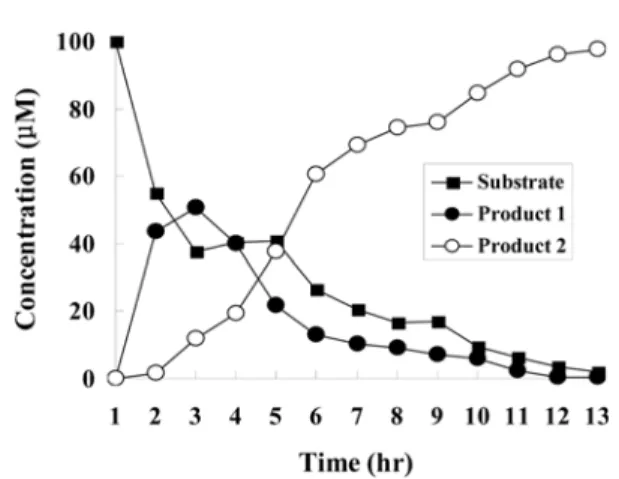
Conversion kinetics of tricetin into 5,7-dihydroxy, 3',4',5'- trimethoxyflavone were examined. After induction of ROMT- 9 and SOMT-2, the cells were resuspended with LB containing ampicillin to OD600 = 0.8 and tricentin was added to the final concentration of 100µM. The reaction mixture was incubated at 28oC with shaking and samples were collected periodically and the amounts of reactant and product were quantified using HPLC. As a control, E. coli transformant containing an empty vector was used and concentration of tricetin in a control was not changed during incubation. The 5,7,4'-trihydroxy, 3',5'-
dimethoxyflavone was produced initially and continue to increase until 2 hrs. The production of 5,7-dihydroxy, 3',4',5'- trimethoxyflavone was observed after 2 hrs and its production increased until 12 hrs. In contrast, the amount of tricentin decreased continuously and it was converted almost completely into 5,7-dihydroxy, 3',4',5'-trimethoxyflavone after 12 hrs. The amount of tricetin in E. coli containing an empty vector did not changed during incubation. 97 % of tricetin was converted into the final product. Thus, this method is useful for regioselective modification of tricetin.
Acknowledgments
This work is supported by a grant from Konkuk University in 2006.
References
1. Havsteen, B. (2003) Flavonoids, a class of natural products of high pharmacological potency. Biochem. Pharmacol. 32, 1141-1148.
2. Winkel-Shirley, B. (2001) Flavonoid biosynthesis. A color- ful model for genetics, biochemistry, cell biology, and bio- technology. Plant Physiol.126, 485-493.
3. Winkel-Shirley, B. (2001) It takes a garden. How work on diverse plant species has contributed to an understanding of Fig. 2. Time course conversion of tricetin into 5,7-dihy-
droxy, 3',4',5'-trimethoxyflavone using E. coli expressing two
O-methyltransferases. Substrate indicates the change of trice- tin in E. coli expressing two O-methyltransferases. Product 1 and product 2 indicate the change of concentration of 5,7,4'-tri- hydroxy, 3',5'-dimethoxyflavone, and 5,7-dihydroxy, 3',4',5'-tri- methoxyflavone, respectively in E. coli expression two O- methyltransferases.
Table 1. The complete assignments of the 1H and 13C NMR data of P1, one of the reaction products, shown in Fig. 1
position δ of 1H δ of 13C
2 - 161.4
3 6.98 (s) 103.6
4 - 181.7
5 - 161.4
6 6.20 (d; 1.6) 98.8
7 - 164.2
8 6.56 (d; 1.6) 94.2
9 - 157.5
10 - 116.3
1' - 120.4
2'/6' 7.33 (s) 104.4
3'/5' - 148.2
4' - 139.9
3'/5'-OCH3 3.89 (s) 56.4
116 Jeong Ho Kim et al.
flavonoid metabolism. Plant Physiol.127, 1399-1404.
4. Stangl, V., Lorenz, M. and Stangl, K. (2006) The role of tea and tea flavonoids in cardiovascular health. Molecular Nutrition and Food Research.50, 218-228.
5. Cornwell, T., Cohick, W. and Raskin, I. (2004) Dietary phy- toestrogens and health. Phytochemistry65, 995-1016.
6. Kim, B. G., Shin, K. H., Lee, Y., Hur, H.-G., Lim, Y. and Ahn, J.-H. (2005) Multiple regiospecific methylations of a flavonoid by plant O-methyltransferases expressed in E.
coli. Biotech. Letters 27, 1861-1864.
7. Kim, B. G., Kim, H., Kim, J. H., Lim, Y. and Ahn, J.-H.
(2006) Synthesis of ermanin, 5,7-Dihydroxy-3,4'-dimethoxy- flavone from kaempferol, 3,5,7,4'-tetrahydroxyflavone with two O-methyltransferase expressed in E.coli. Bull. Korean Chem. Soc. 27, 357-358.
8. Campos, M. G., Webby, R. F. and Markham, K. R. (2002) The unique occurrence of the flavone aglycone tricetin in myrtaceae pollen. Z. Naturforsch. 57c, 944-946.
9. Martos, I., Ferreres, F. and Tomas-Barberan, F. A (2000) Identification of flavonoid markers for the botanical origin of Eucalyptus honey. Argic. Food. Chem.48, 1498-1502.
10. Kim, D. H., Kim, B. G., Lee, Y., Ryu, J. Y., Lim, Y., Hur H.-G. and Ahn, J.-H. (2005) Regiospecific methylation of naringenin to ponciretin by soybean O-methyltransferase expressed in Escherichia coli. J. Biotech.119, 155-162.
11. Kim, B. G., Lee, Y., Hur, H.-G., Lim, Y. and Ahn, J.-H.
(2006) Flavonoid 3'-O-methyltransferase from rice: cDNA cloning, characterization and functional expression. Phy- tochemistry 67, 387-394.