J. Appl. Biol. Chem. 50(1), 13-16 (2007) Article
Three Terpenes and One Phenolic Compound from
Sasa borealisJun Lee1, Yeon Hee Jeong1, Dae Sik Jang2 and Eun-Kyoung Seo1,*
1College of Pharmacy and Center for Cell Signaling & Drug Discovery Research, Ewha Womans University, Seoul 120-750, Korea
2Department of Herbal Pharmaceutical Development, Korea Institute of Oriental Medicine, Daejeon 350-811, Korea
Received December 8, 2006; Accepted February 23, 2007
Four compounds of previously known structures, friedeline (1), 3-hydroxyglutinol (2), p-hydroxy- benzealdehyde (3), and squalene (4) were obtained from the n-hexane- and EtOAc-soluble fractions of the dried whole plants of Sasa borealis. The structures of 1-4 were identified by the interpretation of their spectroscopic data including 1D and 2D NMR as well as by comparison with previously reported values. This is the first report on the isolation of compounds 1-4 from S.
borealis.
Key words: friedeline, Gramineae, 3-hydroxyglutinol, p-hydroxybenzealdehyde, Sasa borealis, squalene
The family Gramineae is composed of 550 genera with 10,000 species and has been known to contain lower terpenes, indolyalkylamines, alkaloids, flavonoids, and some glycosides [Frahn & Illman, 1973; Koh & Jeon, 2003; Ohmoto et al., 1970; Ohmoto et al., 1974; Wassel et al., 1987; Yoon et al., 2000]. Sasa species (Gramineae) are mostly small, fast spreading species, often with relatively large, broad, ribbed leaves and arching culms [Koh & Jeon, 2003]. Major components of the genus Sasa including triterpenoids, flavonoids, and flavonolignans [Nakajima et al., 2003; Yoon et al., 2000] have generated intense interest due to their pharmacological effectiveness to retard spontaneous mammary tumorigenesis and to suppress apoptosis induced by oxidative stress (Akao et al., 2004; Ren et al., 2004]. Sasa borealis (Hack.) Makino has been used in traditional medicines for the treatment of burns, hemoptysis, and uremia in Asia [Namba & Ki, 1982]. Previous phytochemical investigations have reported that this plant contains several secondary metabolites such as flavonoids, flavone glucosides, triterpenoids, flavonolignans, and lignans [Jeong et al., 2006; Jeong et
al., 2005; Yoon et al., 2000]. In contrast, both chemical and biological studies on this plant remain minimal.
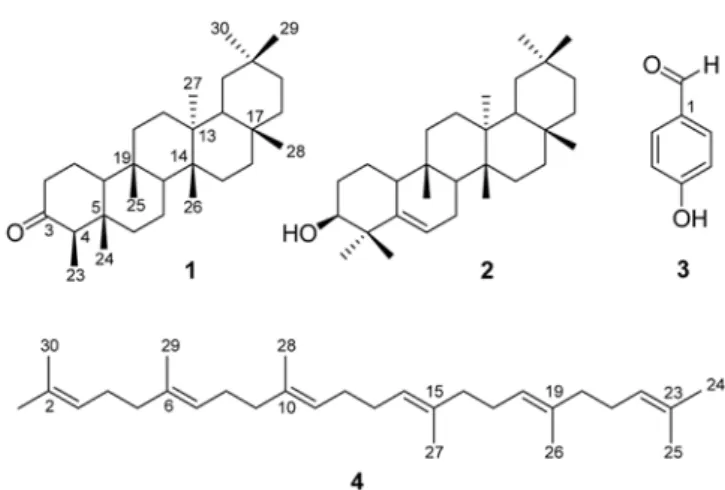
Here, a study of chemical constituents of S. borealis was undertaken as a part of our research program to search for bioactive compounds from native medicinal plants in Korea. Chromatographic separations of the n- hexane- and EtOAc-soluble fractions of the dried whole plants of S. borealis led to the isolation of four compounds of previously known structures, friedeline (1), 3-hydroxyglutinol (2), p-hydroxybenzealdehyde (3), and squalene (4) (Fig. 1). All the isolates (1-4) were identified by spectroscopic methods including 1D and 2D NMR techniques as well as by comparison with literature data. To the best of our knowledge, compounds (1-4) were obtained from S. borealis for the first time. We report herein the isolation and identification of these compounds.
Materials and Methods
Plant materials.Sasa borealis (Hack.) Makino purchased from Kyungdong Oriental Herbal Market, Korea, in February 2003, and was identified by Emeritus Professor, Chang Soo Yook at Kyung Hee University, Korea. A voucher specimen (No. EA226) was deposited at Natural Product Chemistry Laboratory, College of Pharmacy, Ewha Womans University, Korea.
General experimental procedures. Optical rotations were measured with a P-1010 polarimeter (Jasco, Japan) at 25°C. UV and IR spectra were recorded on a U-3000
*Corresponding author
Tel: +82-2-3277-3047; Fax: +82-2-3277-3051 E-mail: [email protected]
Abbreviations: EIMS, electron impact mass spectrometry;
HMBC, heteronuclear multiple bond correlation; HRMS, high resolution mass spectrometry; LRESIMS, low resolution electro- spray ionization mass spectrometry; TLC, thin-layer chromatog- raphy; TMS, tetramethylsilane
14 Jun Lee et al.
spectrophotometer (Hitachi, Japan) and a FTS 135 FT-IR spectrometer (Bio-Rad, CA), respectively. 1D and 2D NMR experiments were performed on a UNITY INOVA 400 MHz FT-NMR instrument (Varian, CA) with TMS as internal standard. EIMS was obtained on a JMS 700 Mstation HRMS spectrometer (JEOL, Japan). LRESIMS were recorded on VG Biotech platform mass spectrometer (VG Biotech, UK). TLC analysis was performed on Kieselgel 60 F254 (Merck, Germany) plates (silica gel, 0.25 mm layer thickness), with compounds visualized by dipping plates into 10% (v/v) H2SO4 reagent (Aldrich) followed by charring at 110oC for 5-10 min. Silica gel (230-400 mesh, Merck, Germany), RP-18 (YMC · GEL ODS-A, 12 nm, S-150 ìm), and Sephadex LH-20 (Amersham Biosciences, Sweden) were used for column chromatography. All solvents used for chromatographic separations were distilled before use.
Extraction and isolation. The dried whole plants (4 kg) were extracted with MeOH (20 L×3) overnight at room temperature. The combined MeOH extracts was evaporated in vacuo to give a dark residue (96 g). The MeOH extract was suspended in water, and then partitioned successively with n-hexane, EtOAc, and n-BuOH to afford the residues of n-hexane (23 g), EtOAc (17.7 g), and n-BuOH (22.7 g), respectively. The n-hexane-soluble extract (23 g) was mixed with Celite (38 g) and subjected to silica gel column chromatography (230-400 mesh, 7× 30 cm) using n-hexane-EtOAc gradient (from 19 : 1 to 0 : 1 v/v) as an elution system to provide thirteen fractions (FI-FXIII). The EtOAc soluble-extract (17.7 g) was chromatographed over silica gel column (230-400 mesh, 6.5 × 30 cm) using a CH2Cl2-MeOH gradient (from 1 : 0 to 0 : 1 v/v) as mobile phase to give eleven fractions (F01-F11). Compounds 1 (163.6 mg, 0.00409%) and 2 (45 mg, 0.00113%) were obtained from FIII (1.2 g) and FVI (1.1 g), respectively, by recrystallization in MeOH.
F03 (40 mg) was further fractionated over a sephadex LH-20 column chromatography (2×80 cm) and eluted with CHCl3-MeOH (1 : 2), to yield compound 3 (8.9 mg, 0.00022 %, Rf = 0.7; n-hexane-EtOAc = 1 : 1). Compound
4 (67.8 mg, 0.00170 %, Rf = 0.8; n-hexane-CH2Cl2= 1 : 1) was purified from a fraction (FI and FII, 2.5 g) through a silica gel column chromatography (3.5×30 cm) using n- hexane-CH2Cl2 (9 : 1) as solvent system.
Friedeline (1): Colorless needles; −75.8o (c 0.1, CHCl3); UV (MeOH) λmax (log ε) 338 nm (2.13); IR (film) νmax 2932, 2862, 1714, 1454, 1389, 1223, 1180, 1040 cm−1; EIMS m/z (% rel. int.) 426 [M]+ (15), 411 (10), 341 (13), 302 (27), 273 (100). 1H NMR (400 MHz, CDCl3) d 2.39 (1H, ddd, J= 14.0, 5.3, 2.0 Hz, H-2a), 2.30 (1H, m, H-2b), 2.25 (1H, m, H-4), 1.97 (1H, m, H-1a), 1.75 (1H, m, H-6), 1.68 (1H, dd, J= 12.0, 5.2 Hz, H-1b),
1.22 (1H, m, H-19), 1.18 (3H, s, CH3-28), 1.05 (3H, s, CH3-27), 1.01 (3H, s, CH3-26), 1.00 (3H, s, CH3-30), 0.95 (3H, s, CH3-29), 0.89 (3H, d, J= 6.8Hz, CH3-23), 0.87 (3H, s, CH3-25), 0.73 (3H, s, CH3-24); 13C NMR (100 MHz, CDCl3) d 213.0 (C-3), 59.7 (C-10), 58.4 (C-4), 53.3 (C-8), 43.0 (C-18), 42.4 (C-5), 41.8 (C-2), 41.5 (C-6), 39.9 (C-13), 39.5 (C-22), 38.5 (C-14), 37.7 (C-9), 36.3 (C-16), 35.9 (C-11), 35.6 (C-19), 35.3 (C-29), 33.0 (C- 21), 32.7 (C-15), 32.4 (C-28), 32.1 (C-30), 30.8 (C-12), 30.2 (C-17), 28.4 (C-20), 22.5 (C-1), 20.5 (C-26), 18.9 (C-27), 18.5 (C-7), 18.2 (C-25), 14.9 (C-24), 7.1 (C-23).
3-Hydroxyglutinol (2): Colorless needles; +46.7o (c 0.12, CHCl3); UV (MeOH) λmax (log ε) 365 nm (2.51);
IR (film) νmax 3561, 1448, 1373 cm−1; EIMS m/z (% rel.
int.) 426 [M]+ (10), 274 (100), 259 (75), 205 (30), 134 (20), 95 (23). 1H NMR (400 MHz, CDCl3) d 5.63 (1H, br d, J= 6.0 Hz, H-6), 3.46 (1H, br s, H-3), 1.16 (3H, s, CH3-28), 1.14 (3H, s, CH3-24), 1.09 (3H, s, CH3-26), 1.04 (3H, s, CH3-23), 1.01 (3H, s, CH3-27), 0.99 (3H, s, CH3- 30), 0.95 (3H, s, CH3-29), 0.85 (3H, s, CH3-25); 13C NMR (100 MHz, CDCl3) d 141.8 (C-5), 122.2 (C-6), 76.5 (C- 3), 49.9 (C-10), 47.6 (C-8), 43.3 (C-18), 41.0 (C-4), 39.5 (C-14), 39.2 (C-22), 38.0 (C-13), 36.2 (C-16), 35.3 (C- 19), 35.1 (C-9), 34.8 (C-15), 34.7 (C-29), 33.3 (C-21), 32.6 (C-30), 32.3 (C-11), 32.3 (C-28), 30.6 (C-12), 30.3 (C-17), 29.2 (C-23), 28.5 (C-20), 28.0 (C-2), 25.7 (C-24), 23.9 (C-7), 19.8 (C-26), 18.6 (C-27), 18.4 (C-1), 16.4 (C- 25).p-Hydroxybenzaldehyde (3): Pale yellow solids; UV (MeOH) λmax (log ε) 238 nm (3.21); IR (film) νmax 3207, 1675, 1607, 1458 cm−1; EIMS m/z (%) 122 [M]+ (42), 121 (53), 83 (68), 71 (85).
1H NMR (400 MHz, acetone-d6) δ 9.85 (1H, s, CHO), 7.80 (2H, dd, J= 8.8, 2.6 Hz, H-2 and H-6), 7.01 (2H, dd, J= 8.4, 1.8 Hz, H-3 and H-5);
13C NMR (100 MHz, acetone-d6) δ 191.1 (CHO), 164.1
α [ ]D25
α [ ]D25
Fig. 1. Structures of compounds 1-4 from S. borealis.
Chemical constituents of Sasa borealis 15 (C-4), 132.9 (C-2 and C-6), 130.5 (s, C-1), 116.8 (C-3 and
C-5).
Squalene (4): Oil: UV (MeOH) λmax (log ε) 344 nm (2.06); IR (film) νmax 2927, 1707, 1448, 1379 cm−1; EIMS m/z (% rel. int.) 410 [M]+ (5), 341 (8), 137 (17), 81 (40), 69 (100). 1H NMR (400 MHz, CDCl3) δ 5.12 (6H, m, H- 3, H-7, H-11, H-14, H-18, and H-22), 2.03 (20H, m, H-4, H-5, H-8, H-9, H-12, H-13, H-16, H-17, H-20, and H- 21), 1.68 (6H, s, CH3-25 and CH3-30), 1.60 (18H, s, CH3- 1, CH3-24, CH3-26, CH3-27, CH3-28, and CH3-29); 13C NMR (100 MHz, CDCl3) d 135.2 (C-6 and C-19), 135.0 (C-10 and C-15), 131.3 (C-2 and C-23), 124.6 (C-3 and C-22), 124.5 (C-7 and C-18), 124.4 (C-11 and C-14), 40.0 (C-5 and C-20), 40.0 (C-9 and C-16), 28.6 (C-12 and C-13), 27.1 (C-4 and C-21), 27.0 (C-8 and C-17), 26.0 (C-1 and C-24), 18.0 (C-25 and C-30), 16.3 (C-26 and C- 29), 16.3 (C-27 and C-28).
Results and Discussion
Four known compounds, friedeline (1), 3-hydroxyglutinol (2), p-hydroxybenzealdehyde (3), and squalene (4), were isolated from the n-hexane- and EtOAc-soluble fractions of the dried whole plants of S. borealis using repeated chromatographic fractionation procedure. The structural identifications of the isolates (1-4) were carried out by spectroscopic analysis including 1D and 2D NMR techniques as well as by comparison of spectral and physical data with those reported in literature (Fig. 1).
Compound 1 was obtained as colorless needles and had a molecular formula of C30H50O, which was deduced from its EIMS (m/z 426, [M]+) and confirmed by 13C- NMR and DEPT analysis. The 1D NMR data (1H- and
13C-NMR) of 1 and those of published analogous compounds supported that compound 1 was a friedelane- type of triterpene [Akihisa et al., 1992; Chang et al., 1999; Leong & Harrison, 1999; Lin et al., 1989]. In particular, the 1H-NMR spectrum of 1 indicated the presence of eight methyl groups (δH 1.18, 1.05, 1.01, 1.00, 0.95, 0.89, 0.87, and 0.73) and 13C-NMR spectrum showed the 30 carbons including a conjugated ketone (C- 3) at δC 213.0. The positions of quaternary carbons and methyl groups were assigned by HMBC correlations and comparison with NMR data reported previously [Akihisa et al., 1992; Chang et al., 1999]. Therefore, compound 1 was identified as friedeline. Compound 2 was obtained as colorless needles. The EIMS showed [M]+ at m/z 426, consistent with the molecular formula C30H50O. The eight methyl signals at δH 1.16, 1.14, 1.09, 1.04, 1.01, 0.99, 0.95, and 0.85 were also observed from its 1H-NMR spectrum. Compound 2 showed similar 1H- and 13C-NMR spectral data to those of 1 except for the presence of a
double bond signals at δH 5.63 (1H, br d, J= 6.0 Hz, H-6),
δC 122.2 (C-6), and 141.8 (C-5). Compound 2 had a hydroxyl group at C-3 instead of the carbonyl group in 1. In addition, the methyl group was attached at C-4 in 2. These spectral data revealed that 2 was identical to 3- hydroxyglutinol. Its structure was established based on comparison of 1H- and 13C-NMR spectral data with those of reference values [Akihisa et al., 1992; Leong &
Harrison, 1999; Lin et al., 1989]. The EIMS spectrum of compound 3 showed [M]+ ion peak at m/z 122, consistent with the molecular formula C7H6O2. The 1H-NMR spectrum of 3 displayed characteristic signals for an aldehyde proton at δH 9.85 (1H, s, CHO) and a pair of double of doublets (AB pattern) at δH 7.80 (2H, dd, J= 8.8, 2.6 Hz, H-2 and H-6), 7.01 (2H, dd, J= 8.4, 1.8 Hz, H-3 and H-5) and indicated the existence of aromatic system composed of ortho- and meta-coupled protons.
The 13C-NMR spectrum showed a carbonyl group signal of aldehyde moiety at d 191.1 and two symmetrical aromatic carbon signals at d 132.9 (C-2 and C-6) and 116.8 (C-3 and C-5). Hence, the structure of 3 was identified as p-hydroxybenzealdehyde and further verification of this structure was conducted by comparison with previously reported NMR data [Jang et al., 2004].
Compound 4 was obtained as red oil, and its molecular formula was deduced as C30H50 on the basis of EIMS (m/z 410, [M]+) and 13C-NMR analysis. The 1H-NMR spectrum of 4 indicated the presence of eight methyl groups [δ 1.60 (18H, s, CH3-1, CH3-24, CH3-26, CH3-27, CH3-28, and CH3-29) and δ 1.68 (6H, s, CH3-25 and CH3-30)], ten methylenes [δ 2.03 (20H, m, H-4, H-5, H-8, H-9, H-12, H-13, H-16, H-17, H-20, and H-21)], and six vinylic proton signals [δ 5.12 (6H, m, H-3, H-7, H-11, H-14, H- 18, and H-22)]. These spectral data revealed that compound 4 was identified as squalene, which was established by comparison of its physical and spectral data with those of literature values [He et al., 2002;
Jautelat et al., 1970]. To the best of our knowledge, compounds 1-4 were never reported from S. borealis previously.
Acknowledgments. This work was supported in part by a grant from the Brain Korea 21 program and in part by the NCRC program of MOST/KOSEF (Grant # R15- 2006-020-00000-0) through the Center for Cell Signaling
& Drug Discovery Research at Ewha Womans University.
References
Akao Y, Seki N, Nakagawa Y, Yi H, Matsumoto K, Ito Y, Ito K, Funaoka M, Maruyama W, Naoi M, and Nozawa Y (2004) A highly bioactive lignophenol derivative from
16 Jun Lee et al.
bamboo lignin exhibits a potent activity to suppress apo- ptosis induced by oxidative stress in human neuroblas- toma SH-SY5Y cells. Bioorg Med Chem 12, 4791-4801.
Akihisa T, Yamamoto K, Tamura T, Kimura Y, Iida T, Nambara T, and Chang FC (1992) Triterpenoid ketones from Lingnania chungii McClure: arborinone, friedelin and glutinone. Chem Pharm Bull40, 789-791.
Chang CW, Wu TS, Hsieh YS, Kuo SC, and Chao PDL (1999) Terpenoids of Syzygium formosanum. J Nat Prod
62, 327-328.
Frahn JL and Illman RJ (1973) Separation of some indolyla- lkylamines from their metho cation derivatives using neutral polystyrene resin. Application to the alkaloids of Phalaris tuberosa (gramineae). J Chromatogr 87, 187- He HP, Cai Y, Sun M, and Corke H (2002) Extraction and191.
purification of squalene from Amaranthus Grain. J Agric Food Chem50, 368-372.
Jang DS, Han AR, Park G, Jhon GJ, and Seo EK (2004) Flavonoids and aromatic compounds from the rhizomes of Zingiber zerumbet. Arch Pharm Res27, 386-389.
Jautelat M, Grutzner JB, and Roberts JD (1970) Natural- abundance carbon-13 nuclear magnetic resonance spec- tra of terpenes and carotenes. Proc Natl Acad Sci USA
65, 288-292.
Jeong YH, Lee J, Kwon Y, and Seo EK (2006) Reverse- phase HPLC method for identification of diastereomeric constituents from Sasa borealis. Yakhak Hoechi 50, 21- Jeong YH, Nam JW, Lee NY, Seo EK, and Kwon Y (2005)25.
Isolation and structural identification of minor constitu- ents from Sasa borealis. Nat Prod Sci11, 170-173.
Koh K and Jeon ES (2003) Ferns, Fern-Allies and seed- bearing plants of Korea. pp. 736-740, Iljinsa, Seoul.
Leong YW and Harrison LJ (1999) (20R,23E)-eupha-8,23- diene-3b,25-diol from Tripetalum cymosum. Phytochem
50, 849-857.
Lin YL, Kuo YH, and Chen YL (1989) Two new cle- rodane-type diterpenoids, clerodinins A and B, from Cle- rodendron brachyanthum Schauer. Chem Pharm Bull37, 2191-2193.
Nakajima Y, Yun YS, and Kunugi A (2003) Six new fla- vonolignans from Sasa veitchii (Carr.) Rehder. Tetrahe- dron59, 8011-8015.
Namba T and Ki HB (1982) Pharmacognogical studies on the crude drug “Zhu’-ye” and Nambusaceous plants (VII). On the botanical origins of the folk medicine
“Kuma-zasa” on the Japanese markets and the compara- tive anatomical studies of the leaves of the Genus Sasa. Shoyakugaku Zasshi36, 43-54.
Ohmoto T, Ikuse M, and Natori S (1970) Triterpenoids of the Gramineae. Phytochem9, 2137-2148.
Ohmoto T, Uzawa S, and Tanaka R (1974) Triterpenoids and the related compounds from gramineae plants. Shoy- akugaku Zasshi28, 1-6.
Ren M, Reilly RT, and Sacchi N (2004) Sasa health exerts a protective effect on Her2/NeuN mammary tumorigene- sis. Anticancer Res.24, 2879-2884.
Wassel G, El-Menshawi B, Saeed A, Mahran G, and Reisch J (1987) New sources of pyrrolizidine alkaloids: genus Cordia (Ehretiaceae) and Schismus (Gramineae). Sci Pharm55, 163-166.
Yoon KD, Kim CY, and Huh H (2000) The flavone glyco- sides of Sasa borealis. Saengyak Hakhoechi31, 224-227.